The Life Cycle Concept
&
the Evolution of
Villages
Noga Collins-Kreiner*
Department of Geography and Environmental Studies, University of Haifa, Israel
Abstract
This paper tries to provide a theoretical framework for systematizing our understanding of how the rural settlements change. The work presents a structured description of the evolving phenomenon of Counter- Urbanization in the Moshavim (villages) in Israel using the 'product life cycle' model. The paper uses the model in order to explain the changes, which have taken place in the “Moshavim”- rural villages in Israel. It is claimed that as part of an ongoing process of change the Moshav is gradually going through the stages of a “product life cycle”- starting at birth, then development, stagnation, decline, death and a possible eventual rejuvenation. Today, it is assumed that many Moshavim in the central part of Israel are to be in the stage of ‘rejuvenation’ - which means that they are losing some of their unique features, those which formed the basis for their identities as a special type of rural community and are developing a new identity as a distinct type of rural community, or as a suburban or urban community. The research’s main contribution is provision of
an elaborate framework for systematizing our
understanding of how rural settlements change during time. This usage of a framework of the “Product life cycle” model was found to be suitable for interpreting the process that villages are experiencing today.
Keywords
Life Cycle Model; Villages; Counter- Urbanization; Israel
Introduction
The objective of the paper is to develop a systematic framework for analyzing the changes taking place in the Israeli rural settlements.
This paper tries to provide a framework for systematizing our understanding of how the rural
settlements change by presenting a structured description of the evolving phenomenon of Counter- Urbanization in the Moshavim using the 'product life cycle' model. It deals with a specific aspect of change in the Moshav, i.e. its changing attractiveness to population (counter-urbanization) and to non-farming businesses, with other aspects (economic, physical etc.). The contribution which this paper attempts to make, is in providing a more elaborate framework for systematizing our understanding of how rural settlements change during time.
The empirical context of the paper is the Moshav
(village) of Burgata. But the emphasis in this research is rather theoretical and methodological then empirical. The “life cycle” model which will be presented emphasizes the temporal and social effects of migration implications on the landscape.
The article begins by exploring the academic literature relating to counter-urbanization in the world as a whole and in Israel particularly. Then it turns to illustrate the relevance of the “life cycle” model using material collected by the author from observations and interviews with migrants to the rural Moshavim and with the local population.
RURAL ENVIRONMENT AND ‘COUNTER URBANIZATION'
the basis of the process of ‘Counter-Urbanization' which means mobility of population from the city to the village. This has been one of the most influential processes affecting the rural environment over the last century in the Western world. In the literature the term used is 'Turnaround' and 'Counter-urbanization' [2, [9 and [10].
Any study of migration to rural areas is undertaken against the backdrop of an abundant academic literature [2], [3] and [4]. This work will try to look at the process of counter urbanization as a whole whereas most studies of migration to rural areas, like migration studies more generally [11] have legitimized their analysis through reference to categories of migrants and migrant motivations derived from some form of numerical or statistical analysis of census or survey data. Categorization of migration in this way is not a neutral act and one of the consequences of this categorization procedure is that inevitably it separates the migration act from its wider context as explanations are sought for population movements in terms of predefined "causal" categories such as "quality of life or "rural employment". The outcome of conventional quantitative survey methods has been to establish a bewildering list of "explanations of counter urbanization” [2] that might lead one to conclude that "counter-urbanization" as a label is no more than a chaotic conception [12].
This invasion of other than agriculturist employed creates problems for two different reasons: a growth in the population and the different and contrasting nature of the two populations: the newcomers and the local residents. A discrepancy often develops between community growth and development of public services. In most cases the expectations of the local residents do not fit in with the reality. The expansion of population also creates problems of social integration [9].
In Britain and in other countries community polarization was effected as a consequence of the entry of non agricultural population to the rural landscape. This social phenomenon is called 'Encapsulation', which means a community inside another community. The social problems are emphasized especially in places where a rural tradition is rooted, which tradition is different from the modern social systems in the urban landscape [13]. Encapsulation is just one
possible result of the immigration and it is not necessarily universal.
One result of the counter-urbanization process is the transformation in the socio-demographic characteristics of the population. Areas closer to urban centres are encountering a growing in-migration of urban dwellers seeking a better life in the countryside. This trend has been facilitated by improvements in the physical and economic infrastructure and in the quality of life in rural areas such as education, culture etc. [14]. The majority of newcomers are upper middle-class educated young people with families, and there is an element of retirees. The incoming population has an immediate positive effect on the rural communities in terms of both population growth and demographic rejuvenation. It often also contributes to the improvement of local services and to the creation of new employment opportunities for local residents. At the same time, competition may develop between new residents and old-timers in the housing market and in the political arena, and conflicts may arise between the two groups, especially with regard to the future development of the community. The newcomers’ impact may therefore reach beyond the immediate changes, by reshaping the rural space according to their conception of the rural image [14], [5] and [6].
The Rural Environment and ‘Counter-Urbanization in Israel
The birth of the moshav was at 1921 as an agriculture settlement, but 70 years later from economic, social and cultural reasons the moshav found itself at the beginning of a new way. The moshav was at that time at the end of an earlier cycle, and at a crossroad between stagnation and rejuvenation [15].
In Israel, in the last 20 years there has been a major change in the nature of the Rural environment as a whole and in the nature of the Moshav in particular
outcome of this process. For example the population change is one of the subjects where the Moshav is going through a change: Rural communities are turning into middle-class suburbs, inhabited by urban migrants who come in search of real or imagined rural lifestyles and new land-use patterns and structures, designed for industrial, commercial and leisure activities proliferate in the rural landscape [16] and [18].
The pace of counter-urbanization in Israel has been considerably accelerated since the mid 1980s due to a dramatic change in government policy which removed some of the institutional restrictions on the allocation of farmland for residential use by non-farmers [16]. It is important to mention that long time limitations on entry into the moshav existed and that entry was never free. Even today it is regulated to some extent by selective procedures, although market forces seem to be more important. This move - accelerated migration into rural areas, and the population of many rural communities doubled within less than a decade. The immigration of town people has changed the villages physically, economically and socially [19].
The reasons for the Israeli counter urbanization process are a bit different from these in other countries. The economic and social crises appeared at the moshavim in the 80th and in 1986 a communal
neighborhood near Kfar Mymon in the western Negev was approved, even though that only since 1989 the planning authority permitted the expansion of moshavim. The decision permits the expansion of these settlements by building a non-cooperative neighborhood, whose size will not exceed 115 per cent of the number of planned household in the cooperative settlement.
Few researchers [20], [13], [21], [22], [23], [16] and many others have examined this expansion procedure through 1991 to 2005 which brought into the Moshavim
nearly 10,000 new households, an increase of about 35% in a decade.
Among the first works on the subject looked at the beginning of the process and covered the institutional context and program policy guidelines. It also examined the expansion program in the moshav sector as a whole in 1991 by sampling 24 moshavim. It is important to note that a major change was made in public policy concerning the moshav sector: for the first time in their history the moshavim were allowed to
re-allocate part of their land to be residential only and for use by a non-farming population [20] and [21]. Many
moshavim responded quickly to this new and radical ruling and expended.
Based on an analysis of the differences between the moshavim that do engage and those that do not engage in a process of expansion, it is evident that demographics and economics play a central role in the decision. The weaker moshavim view the expansion as a means to self improvement. Well established and secure moshavim are less likely to engage in expansion. Other factors were found to be insignificant [19]. Finally it is important to note that there is a public debate concerning the expansion decision. It is not clear whether it will remain intact in the future, or whether it will be changed. Economic considerations constitute the main objectives for undertaking expansion, while demographic trends and social consideration are of secondary importance. Today- only a few moshavim are not expanding because such expansion stands in direct conflict to their ideal philosophy of a moshav. The moshav has experienced major changes. Economic crises that erupted twenty years ago have transferred into major social and cultural changes.
agriculture. About 25% of the farm holdings produced 70% of the total family farming production, indicating the tendency for the concentration of production in a small number of relatively large-scale farms [16].
The Life Cycle Concept
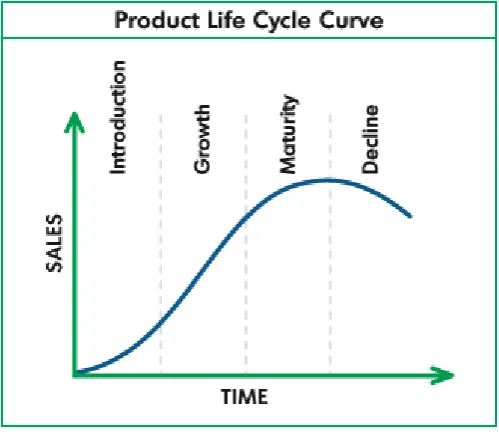
The Product Life Cycle refers to the succession of stages a product goes through. It is a model of a process whereby sales of a product proceed slowly at first, experience a rapid rate of growth, stabilize, and subsequently decline. In other words, a basic asymptotic curve is followed. The term was used by the first time by Levitt in 1965 [28] in his famous article: Exploit the Product Life Cycle )Harvard Business Review(. The model analyzes the profitability of a product at different stages of its life cycle and present and future profit from a product can be maximized by deciding where it stands in its Life Cycle [26].
FIG. 1: A HYPOTHETICAL EVOLUTION OF A LIFE CYCLE
The four stages are:
Introduction: The need for immediate profit is not a pressure. The product is promoted to create awareness. If the product has no or few competitors, a skimming price strategy is employed. Limited numbers of product are available in few channels of distribution.
Growth: Competitors are attracted into the market
with very similar offerings. Products become more
profitable and companies form alliances, joint ventures and take each other over. Advertising spend is high and focuses upon building brand. Market share tends to stabilize.
Maturity: Those products that survive the earlier
stages tend to spend longest in this phase. Sales grow at a decreasing rate and then stabilize. Producers attempt to differentiate products and brands are key to this. Price wars and intense competition occur. At this point the market reaches saturation. Producers begin to leave the market due to poor margins. Promotions become more widespread and use a greater variety of media.
Decline: At this point there is a downturn in the
market. For example more innovative products are introduced or consumer tastes have changed. There is intense price-cutting and many more products are withdrawn from the market. Profits can be improved by reducing marketing spend and cost cutting.
The general model is presented below even though that the reality is of course much more complex than the following presentation. In reality very few products follow such a prescriptive cycle. The length of each stage varies enormously. The decisions of marketers can change the stage, for example from maturity to decline by price-cutting. Not all products go through each stage. Some go from introduction to decline. It is not easy to tell which stage the product is in. Remember that PLC is like all other tools. Use it to inform your gut feeling.
The model refers usually to “products” – but there are also works that have been written on other aspects such as tourist sites [9]. In this work, I will try to show that it could be adjusted to villages.
Methodology
The study employs a mixed methodological approach. It is based on an ethnographic work done in a village in the center of Israel- the Sharon area for 11 years between 1995 and 2013. Data was gathered mainly by field observations and by in-depth open-ended interviews with the local population and with decisions makers. The researcher engaged in participant observation and had short-informal and unstructured discussions with the local population. As participant observers, the author has - at different and numerous times since 1995—participated in formal and informal meetings and experienced living in the village.
As the author was a participant observer, the paper includes empirical observations concerning the observed practices of the local population. Additionally, the author has accessed archival materials from a variety of resources. To supplement archival materials, the author report data obtained from discussions or e-mail communications with the locals. In 2005, 10 semi-structured interviews were performed to provide additional data and information. Finally, the author has left the village in 2005 and for the purposes of establishing positionality he is able to provide both an “insider” and “outsider” perspective. As both an insider and outsider, the author is able to draw his understanding of local dynamics associated with the case study and have experienced the landscape from a variety of disparate perspectives— resident, visitor, researcher, and passerby.
It is hypothesized that as facilities are provided and awareness grows, the local population's numbers will increase rapidly. Eventually, however, the rate of increase in residents' numbers will decline as saturation levels of carrying capacity are reached. The concept of a recognizable cycle in the evolution of
Moshavim is presented using a basic curve to illustrate their varying popularity. Specific stages in the evolutionary sequence are described along with a range of possible future trends. The implications of using this model in the planning and management of villages is discussed in the light of a continuing decline in the environmental quality.
There can be little doubt that rural areas are dynamic, that they evolve and change over time. This evolution is brought about by a variety of factors including changes in the preferences and needs of the local population, the gradual deterioration and possible replacement of physical plant and the change or even disappearance of the original natural and cultural – social characteristics which were responsible for the initial image and popularity of the area. In some cases, while these characteristics remain, they may come to be regarded as less significant in comparison with the new features of the Moshav.
Findings: The Life Cycle stages of the Moshav
Burgata is a Moshav in central Israel. It is located east of the city of Natanya and about 30 km from the metropolis of Tel Aviv in the heart of the rural area of Hasharon. The moshav was founded in 1949 by immigrants from Turkey. Burgata was established as an agriculture village and most of its residents were occupied by agriculture at the first 30 years. Since its establishment there were 100 households in the
Moshav.
new house, of those, about 70% are owned by “returning sons” (Second generation) and about 30% are owned by new comers (Ofra, Personal interview). The stages through which BURGATA has gone through were analyzed and categorized according to the life cycle model as follows:
The 'Exploration Stage'
This stage has started in BURGATA in 1992 when the expansion project in the Moshav was authorized and in 1994, the stage of house occupation commenced. This stage was characterized by small numbers of new residents, making individual arrangements. They have been attracted to the area "by its unique or considerably different natural and cultural features and cheap land" (Suzan, Personal interview) or by family ties. At this time there would be few facilities provided for local population. The village and social milieu of the area would be unchanged by newcomers. As numbers of newcomers increase and assume some stability, some local residents enter the 'service stage' and begin to provide facilities other then agriculture. It seems is if there is interaction between the entry of newcomers and the array of facilities other than agriculture in the Moshav. For example, there was development of private services such as a hairdresser that opened a small business in her house. A shop for machinery was opened, a small shop of kids cloth, carpentry and other small entrepreneurs.
At this stage, initially, pressures were put upon government and the local authority to provide or improve transport and other facilities such as health, leisure, and education.For example a strong pressure was on the local municipality, the office of education to open a school for the four Moshavim including BURGATA which will sent their children to this nearby school instead to the school- almost half an hour drive on rush hours.
The 'Development Stage'
This stage reflects a well-developed moshav and was apparent in BURGATA between the years 1994-1996. As this stage progresses, local involvement, and control of development declined rapidly. Some locally provided facilities will have disappeared, being superseded by larger, more elaborate and more up to date facilities provided by external organizations such as storerooms, sheds and warehouses. For example, the old and tiny grocery store changed into a
supermarket owned by non local residents. Diverse attractions and facilities have been developed such as a shop that sells wood for art work and artifacts. Two kinds of services appear: community services and the businesses which belong to the economic service sector but do not serve the population. Changes in physical appearance of the Moshav are noticeable, and not all of them are welcomed or approved by the local population.
This stage has been happening in the mid and latter 1990s’ in all of the developed areas of the central Israel. Regional and national involvement in the planning and provision of facilities is becoming necessary and again is not completely in keeping with local preferences. The number of newcomers is becoming equal or exceed the permanent "veteran" population. The “type” of newcomers also have changed as a wider market is drawn upon and it will not be seekers or naturalists but middle class town dwellers, representing the mid centric.
The 'Consolidation Stage'
As this stage is entered, the rate of increase in numbers of newcomers declined, although total numbers still increase and total numbers of the "new" population exceed the number of veterans. A major part of the area's economy as a whole and the Moshav specifically is tied to services rather then agriculture. From a survey held by the author, only ten families were fully involved (2005) in agriculture and another five are partly occupied by it (Shuky, Personal interview). It is important to note that these changes took place not only in BURGATA but in many other villages in the area. At this stage there were more than 200 families at the Moshav and the numbers were growing as more and more houses were built on the land around the main house (“Nahala A”).
Such trends are also evident in areas near the metropolis today especially in the Sharon region in the Moshavim of Kefer Hess, Michmoret, Herut and Kefar Vitkin.
The 'stagnation stage'
Since 2005 the Moshav enters the 'stagnation stage'- as the peak numbers of residents have been attained. Capacity levels for many variables have been attained or exceeded, with attendant environmental, social and economic problems that will be described. The former agricultural residents need employment and are willing to use their land for (almost) any possible purpose. In contrast, the newcomers moved to the village because of its very rural nature and high quality of life. These residents are then not willing to accept changes which would revert them to their former urban surroundings. As a result conflicts arise and become a sensitive issue. In the moshvim around BURGATA one wedding garden was opened, a two coffee place, a shop to sell cheese products, a shop for selling wood artifacts, a B & B and a club that was opened only at late night time. The Moshav has by now a well established image though the social problems infect the local relathionships.
The 'decline stage' or 'rejuvenation'?
Currently one may defnetlly say that the 'decline stage' has not (yet?) reached the Moshav. In this stage – the Moshav will not be able to compete as it used too with other moshvim and so will face a declining market, both spatially and numerically. It will no longer appeal to residents, but will be utilized for industry and services.
Property turnover will be high and some facilities often will be replaced by others, as its character changes. This latter process of course is cumulative. More facilities disappear as the area becomes less attractive to residents and the viability of other facilities becomes more questionable. Local involvement in the industry and in small businesses is likely to increase at this stage. The conversion of many facilities to related activities is likely to happen. For example, store rooms may become 'bed and breakfast' in the first stage and then may become a center for health treatments. Ultimately, the area may turn into a semi industrial area, or lose its residential function completely. It seems as if Moshavim in older areas near the Metropolis are getting close to this phase.
On the other hand 'rejuvenation' is more likely to occur, although it is almost certain that this stage will never be fully reached without a complete change at the decision makers' level, or without predication, concerning the development of rural areas in Israel. The main features of rejuvenation are population growth, improvement of community services and to some extent also visual renewal. Usually, suburbanization is the outcome of this process
Today, many Moshavim in the central part of Israel are in this stage of rejuvenation - which means that they are losing some of their unique features, those which formed the basis for their identities as a special type of rural community such as an agricultural base, small houses, a feeling of community etc. They are developing a new identity as a distinct type of rural community, or as a suburban or urban community.
Discussion, Implication and Limitations
The life cycle process as seen in the Moshav is an outcome of a combination of "natural demand" i.e. a wish to live outside of the city and of national policy decisions. Although a consistent evolution of
Moshavim can be conceptualized, it must be emphasized again that not all areas experience the stages of the cycle as clearly as others. Public and private agencies alike, rarely if ever, refer to the anticipated life span. Rather, because counter urbanization has shown as yet, an unlimited potential for growth, despite the urbanization phenomena, it is taken for granted that numbers of settlers will continue to increase.
The application of the model to the Moshavim is simplified as it comes to suggest a theoretical framework rather to an empirical research. My hope that other researchers will benefit from this theoretical frame and will carry an empirical work on different villages at different place of the world.
The process illustrated in Fig. 1 has two axes representing numbers of new residents and time. An increase in either direction implies a general reduction in overall quality and attractiveness after capacity levels are reached. In the case of first comers, those who came in the exploration era, the Moshav would become unattractive long before capacity levels would be reached, and they will move on to other undeveloped areas or settlements. A few families in Burgata, for example have left or are planning to leave the village for these reasons (Tami, Personal Interview).
It can also be anticipated that reaction to the newcomers by the local population will undergo change thought this period: from apathy to antagonism as their numbers grow and their demands increase. More recent research [19] has shown that residents' reaction to the newcomers is not necessarily explained by increasing contact with visitors or increasing numbers of newcomers alone. It is a more complex function related to the characteristics of both populations and the specific arrangement of the area involved.
The direction of the curve after the period of stabilization illustrated in Fig. 1 is open to several interpretations. We could say they most of the
Moshavim today in Israel's central areas are at this stagnation stage (2005). Successful redevelopment could result in renewed growth and expansion as shown by curve a. Minor modification and adjustment to capacity levels and continued protection of resources could allow continued growth at a much reduced rate (curve b). A readjustment to meet all capacity levels would enable a more stable level visitation to be maintained after an initial readjustment downwards (curve c). Continued overuse of resources, emerging conflicts and decreasing competitiveness with other areas would result in decline (curve d).
To date, the arguments put forward in this paper are general and are only now being substantiated in terms of quantifiable data. A major problem in testing the basic hypothesis and modeling the curve for specific
Moshavim is that of obtaining data on newcomers to areas over long periods. These are rarely available and it is particularly unlikely that they will date back to the onset of newcomer's arrivals. However, those data which are available for a few Moshavim for periods in
excess of thirty or forty years substantiate the general arguments put forward in this paper.
At the same time the shape of the curve must be expected to vary for different areas and different
Moshavim, reflecting variations in such factors as rate of development, numbers of newcomers, location, accessibility, government policies and numbers of similar competing villages. It has been shown for example that each improvement in accessibility to an area results in significantly increased counter-urbanization. The developments of Moshavim near the new highway (number 6) bears witness to this process. If development of facilities and accessibility is delayed for whatever reason, be it local opposition, lack of interest, lack of capital, the exploration period may be much longer then anticipated.
These observations also suggest that a change of attitude is required on the part of those who are responsible for planning, developing and managing rural areas. Counter-urbanization to Moshavim is not infinite and timeless but should be viewed and treated as finite and possibly non renewable resources. They could then be more carefully protected and managed. The development of the village could and should be kept within predetermined capacity limits and its potential competitiveness as a residence area maintained over a longer period. In a few localities already, limits to the growth of the village have been adopted, including the number of residents and services, chiefly because of severe environmental damage to the area.
This theoretical method does seems as a possible base for future analysis as to the development of Moshavim
and villages in the future, but it also seems that it is more complicated in real life then in the model, especially because of governmental influence.
and developed. People who were interested in the Moshav because of its natural and undeveloped nature would subsequently lose interest in them as they develop. Another reason for the loss of appeal is the establishment of business to the village, and its metamorphosis as a commercial area.
Though there is no clear cut connection between the expansions of the Moshavim and the establishment of businesses in the Moshav - there is definitely an overlapping of the two phenomena. The establishment of business is usually made by the original residents of the Moshav. This can cause a decline or in the attractively of a house in the village but not necessarily. For example, Moshav Rishpon located on the northern edge of Tel Aviv sells plots in one of the highest cost in Israel, tough it is going through a commercial and industrial process. Therefore, the model has limitations in its ability to predict future trends.
Conclusion
This paper aims to explain the changes which have taken place in the villages by using the life cycle model. Its main contribution is provision of an elaborate framework for systematizing our understanding of how rural settlements change during time. This usage of a framework of the “Product life cycle” model seems to be suitable for interpreting the process that the villages are experiencing today and raises a major question regarding the future of rural settlements.
REFERENCES
[1]E. Boyarsky, "Residents' perception of environmental
and socio-economic impacts of non-farming enterprises
in the Moshav", Horizons in Geography 59 2004: 78-94.
[2]A. C. Champion, Counterurbanization: The Changing
Pace and Nature ofPopulation Deconcentration. London:
Edward Arnold, 1989.
[3]A. Champion, Studying counterurbanisation and the
population turnaround . In: Boyle, P., Halfacree, K. (Eds.), Migration into Rural Areas. Theories and Issues .Wiley, Chichester, 1998: 21-40.
[4]T. Champion, “Testing the return migration element of
the ‘escalator region’ model: an analysis of migration into
and out of South East England, 1966-2001”. Cambridge
Journal of Regions, Economy and Society 5 2012: 255-269.
[5] O. Furuseth, Service provision and social deprivation”,
In: The geography of RuralChange, Ilbery, B. (ed.), pp.
233-256. Harlow, Essex: Longman, 1998.
[6] A. Stockdale, A. Findlay & D. Short, “The Repopulation of rural Scotland: opportunity and threat”. Journal of
Rural Studies 16(2) 2000: 243-257.
[7] A. Stockdale & G. Catney, “A lifecourse perspective on urban-rural migration: the importance of the local
context”. Population, Space & Place.DOI: 10.1002/psp.
1758, 2013.
[8] A. Stockdale, M. MacLeod & L. Philip, “Connected Life
Courses: Influences on and experiences of 'Mid life'
in-migration to rural areas”. Population, Space and Place, 2012.
(Published online in Wiley Online Library
(wileyonlinelibrary.com) DOI: 10.1002/psp.1709).
[9] M. Arbel & D. Czamanski, Residential Neighborhoods Next to Kibbutz. Ramat Efal: Yad Tabenkin, 2001.
[10] A. J. Fielding, “Counter urbanization' in Western
Europe”, Progress in Planning 17 1982: 1-52.
[11] A. Findlay & A. Stockdale, “The Temporal and Social
Embeddedness of Migration: A Methodological
Exploration Using Biographical Analysis”. Geography Research Forum 23 2003: 4-29.
[12] A. Sayer, Method in Social Science: A Realist Approach.
Second edition. New York: Routledge, 1992.
[13] G. Grosman, Rural Process-Pattern Relationships. Praeger, New York, 1993.
[14] G. M. Robinson, Conflict and Change in the Countryside.
London: Belhaven Press, 1990.
[15] M. Schwartz, "From agricultural cooperative to rural
residential settlement? The story of the Moshav:
freezing and transformation in a changing
environment", Horizons in Geography 59 2004: 11-35.
[16] L. Applebaum & M Sofer, “The Moshav – current
changes and future trends”, Horizons in Geography 59 2004: 36-60.
[17] M. Palgi, “Human and socio cultural capital and the
commitment of youth to live in Yezreel Valley”,
Horizons in Geography 59 2004: 106-117.
[18] A. Gonen, “Between City and Suburb: Jewish
Residential Patterns and Processes in Israel”.
[19] T. Uzan, “Integration of New Residents into the
Moshavim as Part of their Community Expansion
Program”. M.A. Thesis, 2002.
[20] L. Applebaum & F. Keidar, The Expansion Program of Moshav Communities - A Follow-Up Study. Rehovot:
Development Study Center (Research Report),
(Hebrew), 1992.
[21] L. Applebaum & F. Keidar, The Expansion Program of
Moshav Communities - A Follow-up Study (Phase 2 -
1992). Rehovot: Development Study Center, (Hebrew), 1993.
[22] L. Applebaum & A. Rimalt, Integration of Suburban
Neighborhoods into Cooperative Communities Under Conditions of Uncertainty. Rehovot: Developent Study
Center, (Hebrew), 1995.
[23] G. Ben Dror, “The influence of geographical factors on changes in the Moshav”, Horizons in Geography 59 2004:
61-77.
[24] E. Feitelson, “Social Norms, Rationals and Policies: Reframing Farmland Protection in Israel”, Journal of
Rural Studies 15 1999: 431-446.
[25] T. Levitt, “Exploit the product life cycle”, Harvard Business Review, vol 43, November-December
1965:81-94.
[26] L. Anderson & C. P. Zeithaml, “Stage of the Product
Life Cycle", C.R. Academy of Management Journal, 1984.
[27] R. W. Butler, “The Concept of a Tourist Area Cycle of
Evolution: Implications for Management of Resources”,
The Canadian Geographer, xxiv, 1, 1980.
[28] M. Sofer & L. Applebaum, “The Rural Space in Israel in