163
Copyright © 2016. Vandana Publications. All Rights Reserved.
Volume-7, Issue-1, January-February 2017
International Journal of Engineering and Management Research
Page Number: 163-168
Properties of Jatropha Curcas Oil and Diesel Blends as a Fuel for C.I.
Engines
Deshmukh S. B.1, Patil D. V.2
1,2Department of Mechanical Engineering, Sanjeevan Engineering & Technology Institute, Panhala, INDIA .
ABSTRACT
Biomass derived vegetable oils can be used an alternative fuels for CI engines. In this view the properties measurement of biodiesel and its blends were carried. Also the efforts were made, to study the preparation method and its probable effect on CI engine is discussed. The blends of the biodiesel (Jatropha oil) are formed in volume proportions of 10, 20, 30, 40, 50 and 100 % with high speed diesel. The various physical and the chemical properties of these biodiesel blends and crude oil were measured. From the measured data of these properties trend lines were plotted and the correlations are found. Also comparative studies of these properties of the blends are discussed in terms of its suitability as fuel in the CI engine with emission characteristics. The main objective of this study is to find the suitability of biodiesel as alternative fuel for CI Engine.
Keywords-- Jatropha Curcas oil; Biodiesel; C.I.
Engine; Transesterification; Properties; Blends
I.
INTRODUCTION
Among the various possible options available, fuel derived from triglycerides (vegetable oils/animal fats) is presenting a promising “greener” substitute to the conventional petroleum resources. Also from the point of view of protecting global environment and concerns for long term energy security, it is becoming necessary to develop an alternative fuel with properties comparable to petroleum based fuels. One possible alternative to fossil fuel is the use of oils of plant origin like vegetable, tree borne and seeds. Biofuels contains 90% of the heat energy of diesel which makes them better alternative to the diesel fuel termed as biodiesel. It is biodegradable,
non-toxic and possesses low emission profiles. Usage of biodiesel will allow a balance to be sought between agriculture, economic development and the environment. Chemically, biodiesel is referred to as the mono-alkyl esters of long chain fatty-acids derived from renewable liquid sources. Biodiesel is the name for a variety of ester based oxygenated fuel from renewable biological sources. It can be used directly in CI engines with little or no modifications. Vegetable oils are produced from numerous oil seed crops. While all vegetable oils have high energy content, most of them require some processing to assure safe use in internal combustion engines. Jatropha oil is one of the biodiesel which obtain from the seeds of this plant. In this view some of the researchers have tested Jatropha oil and its blends with diesel as fuel in CI engines.
Forson et al. [1] showed that Jatropha oil could be conveniently used as a diesel substitute in CI engine. But high viscosity of vegetable oil causes inadequate atomization and incomplete combustion. Jatropha oil can be used as an ignition-accelerator additive for diesel fuel. Pramanik [2] suggested the high viscosity of Jatropha Curcas oil can be used as a potential alternative fuel for CI engine by blending with diesel. The effect of temperature on viscosity of biodiesel also evaluated. Mahanta et al. [3] prepared and tested various blends of non-edible vegetable oils, known as honge. These blends showed that blends of pongamia up to 10% have viscosity comparable to pure diesel. Even 30% blend shows
almost 50% reductions in viscosity. Reddy and
164
Copyright © 2016. Vandana Publications. All Rights Reserved.
slower combustion. Sundarapandian and Devaradjane [5] studied and improved the physical & chemical properties of biodiesel by transesterification because of more cetane number than diesel. It enhances the combustion process and generates lower nitric oxide formation in the exhaust. Deshmukh [6] have tested different biodiesel jatropha blends on VCR engine in order to find the optimum compression ratio. He concluded that the biodiesel performance better at the high compression ratio. Pandey et al. [7] carried out transesterification reaction of refined coconut oil with methanol using potassium hydroxide as a catalyst to produce methyl ester of biodiesel. The products were evaluated by comparing the characteristics like specific gravity, density, viscosity, pour point, fire point and heating value of biodiesel with diesel. From above survey, as biodiesel occupy a prominent position in the development of alternative fuels although, there are many problems associated with using it directly in CI engine. These include, choking and trumpet formation on the injectors to such an extent that fuel atomization does not occur properly or even prevented as a result of plugged orifices, carbon deposits, oil ring sticking, thickening or gelling of the lubricating oil as a result of contamination by vegetable oils and lubricating problems [1]. Other disadvantages to the use of vegetable oils are the high viscosity, about 11-17 times higher than diesel fuel and lower volatilities that causes the formation of deposits in engines due to incomplete combustion and incorrect vaporization characteristics. Also most of the works were carried out to use vegetable oil both in its pure form and modified form. These studies show that the usage of vegetable oils in pure form is possible but not preferable. Also it can possible to use of biodiesel in its blended form. Also less research was directed towards overall study properties of biodiesel and its blends as fuel for C.I. engine. Alternative fuel must be technically feasible, economically competitive, environmentally acceptable, and readily available. In search of it Jatropha oil blends with diesel are selected for this study.
So the main objective of proposed work is to study the properties Jatropha oil blends and its suitability as fuel for CI engines. In this view the process of preparation of Jatropha biodiesel and its physical and chemical properties of its blends with diesel were studied. The Jatropha oil which is used for the preparation of blends with commercially
available diesel oil was supplied by Indian Biodiesel Corporation; Baramati, Maharashtra (India).
II.
PREPARATION OF JATROPHA
OIL
Most of the researchers have claimed that a dry seed of Jatropha Curcas contain about 55% of oil [6]. The maximum amount of oil that can be extracted from a given sample of the seed depends on the method of extraction and perhaps the quality of the feedstock.
2.1. Extraction:
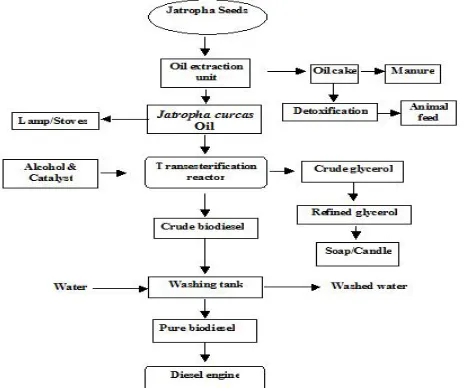
Fig. 1 shows the process flow for biodiesel pilot plant of IBDC, Baramati. The Jatropha plant can grow in hilly area with less rainfall. Jatropha Curcas seeds are collected from nearby area of Baramati. These seeds of Jatropha are fed to oil extraction unit. Generally two methods of extracting the oil from seed have been used. One is chemical extraction method using solvent extraction with n-hexane and another is mechanical extraction method using manual ram-press or engine driven expeller extraction, later is used at Indian Biodiesel Corporation, Baramati. The chemical extraction process has advantages over mechanical ram-press method due to high yield of oil. The crude oil obtained after extraction may be used as a fuel for lamp/ stove or a furnace oil and the oil cake obtained, is used as a fertilizer or animal feed after detoxification. Crude Jatropha oil is blended with alcohol (20 % methanol) and Potassium hydroxide is used as catalyst in Transesterification reactor.
165
Copyright © 2016. Vandana Publications. All Rights Reserved.
The reactor is maintained at reaction temperature (70 0C) for specific duration (36 hrs.) with vigorous agitation. Then mixture of biodiesel and glycerol is sent to the glycerol settling tank where crude glycerol is separated from the crude biodiesel. The byproduct glycerol gets refined and it is used for preparing candles and soaps. The crude biodiesel is washed by water to get pure biodiesel and then heated up to 100 0C, so that water present in the tank gets evaporated.
2.2. Transesterification Process:
Transesterification is most commonly used method to reduce the viscosity of crude vegetable oils. After transesterification the properties of crude vegetable oil like density, viscosity, cetane number, calorific value, vaporization rate, and molecular weight are improved [2,5]. The transesterification reaction is shown as. The triglycerides called as Jatropha oil (vegetable oil) and R1, R2 and R3 represents the fatty acid. One part vegetable oil reacting with three parts methanol gives three parts methyl esters (biodiesel) and one part glycerol. In practical terms, the volume of biodiesel obtained will be equal to the crude oil.
2.3. Properties of Jatropha Crude Oil & Biodiesel:
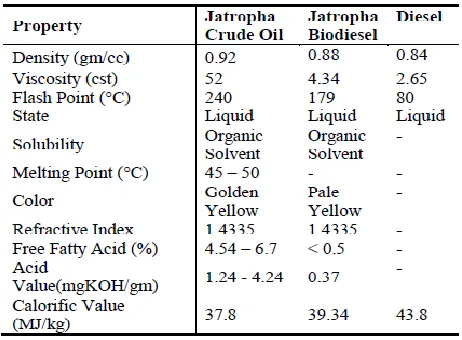
The properties of Jatropha crude oil and biodiesel after and before transesterification were measured by IBDC Baramati, India and tabulated in Table 1. These properties were measured by using standard methods and supplied along with biodiesel fuel.
Table 1: Properties of Crude Jatropha Oil & Jatropha Biodiesel
After the transesterification process the properties of biodiesel are changed drastically. That is significant reduction in density, viscosity and flash
point occurred. The density is reduced up to 0.88 gm/cc which is still higher than diesel, this indicated that the higher molecular weights of the triglyceride molecules are present in biodiesel. Kinematic viscosity of crude Jatropha oil was reduced from 52 to 4.34 cst which is nearer to the diesel. That indicated that less power is required to atomize the fuel. Calorific value of biodiesel improved up to 7 % by esterification. This value is still lesser than diesel this may be due to the presence of oxygen molecules in the biodiesel. Also the flash point is reduced by esterification process but it is still higher than diesel which indicates that its handling is safe. The Golden yellow color of the crude Jatropha oil becomes pale yellow after transesterification. Also the contents of the fatty acid and acid value were drastically reduced.
III.
PREPARATION OF JATROPHA
DIESEL OIL BLENDS
The properties of the biodiesel are
approaching towards the diesel fuel; therefore it becomes strong contender to replace the diesel fuels. Still small deviation of these properties like density, viscosity and calorific values are playing important role in the operation of the CI engine. So instead of it use in pure form it can be used in the blends with diesel. Percentage of biodiesel in blends play vital role in the performance and emission characteristics of CI engine [5]. So to use the biodiesel blends in commercial scale their physical and chemical properties are need to be studied. The preparation of the Jatropha oil blends with diesel were made by adding it in commercially available diesel oil (HSD) by volume of 10%, 20%, 30%, 40% and 50%, these are named as B10, B20, B30, B40 and B50 respectively. The pure Jatropha oil is named as B100.
3.1 Properties of Jatropha Biodiesel Blends:
The various properties of prepared blend samples were measured using standard methods at room temperature. These properties are tabulated in the Table 2. The measured properties like density, flash and fire point, viscosity, Cetane number, carbon residue, calorific value, sulphur and ash content these are related with the performance and the emission characteristics of the engine.
166
Copyright © 2016. Vandana Publications. All Rights Reserved.
Table 2: Properties of biodiesel BlendsAlso the trends of these properties were plotted with the percentage of biodiesel and it discussed in terms of their suitability and possible causes if it is used as fuel in CI engine. Figures (2-9) show the various physical and chemical properties with respect to the percentage of Jatropha biodiesel in the blends. From these curves equation were fitted so as to one can find the properties of the any percentage of biodiesel. Dilution effect of biodiesel on the properties is discussed as follows.
3.1.1 Density:
The density of diesel is 0.84 gm/cc whereas it is 0.88 for jatropha biodiesel. Fig.2 shows the effect of addition of biodiesel in diesel on density. With the addition of biodiesel in diesel, the density goes on increasing. The equation of curve is,
ρ = -4E-6x2
+ 0.837………(1) where, ρ and x are the density and percentage of biodiesel blend. The increased density of Jatropha blended fuels reflects its unsuitability as diesel fuel in cold climatic conditions. In general,the injection pressure required will be more and its penetration is also deeper. It may cause problems in fuel atomization.
Fig. 2. Variation of Density with Biodiesel addition
3.1.2 Flash Point:
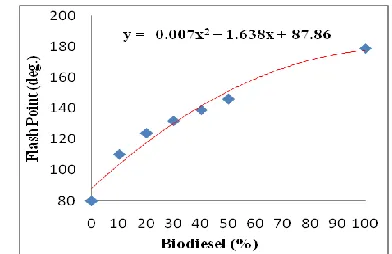
Figure 3 shows the effect of dilution of biodiesel on flash point. As the biodiesel addition in diesel goes on increasing the flash of blends increased. The trend curve for flash point is,
Tflash = 0.007x 2
+ 1.63x + 87.86………… (2) This indicates that the biodiesel is extremely safe to handle. As the flash point of blended fuels increases, engine is required to operate at higher compression ratio. Increased compression ratio increases the air temperature inside the cylinder consequently reducing ignition lag causing better and more complete burning of blended fuel.
Fig. 3. Variation of Flash Point with Biodiesel addition
3.1.3 Fire Point:
The effect of addition of biodiesel in diesel on fire point is shown in Fig 4. As the biodiesel addition in diesel goes on increasing the fire point of blends increases.
TFire = -0.005x 2
+ 1.379x + 107.8…. (3) This indicates that the biodiesel is extremely safe to handle. As the flash point of blended fuels increases, engine would be operated at higher compression ratio. Increased compression ratio increases the air temperature inside the cylinder consequently reducing ignition lag causing better and more complete burning of blended fuel.
167
Copyright © 2016. Vandana Publications. All Rights Reserved.
3.1.4 Viscosity:
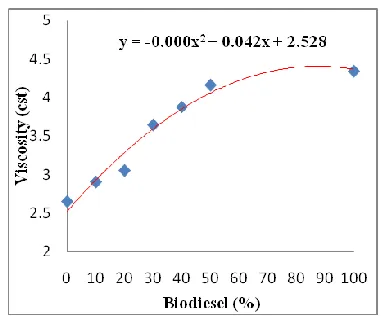
The effect of addition of biodiesel in diesel the viscosity is goes on incresing which shown in Fig. 5. It is highest for pure biodiesel and increases with increased amount of biodiesel in pure diesel. The equation which fit the data for viscosity is,
υ = -0.000x2
+ 0.042x + 2.528…………(4) υ is called as kinematic viscosity.
Fig. 5. Variation of Viscosity with Biodiesel addition
High viscosity of biodiesel limits the use of pure biodiesel in the C.I. engine. Higher viscosity is a major problem in using Jatropha biodiesel as fuel for C.I. engines which produce undesirable high pressure on fuel injection system that can cause undue wear of pump and increased maintenance. Significant reduction in viscosity was achieved by heating the oil and dilution of Jatropha oil with diesel. Since the viscosity of Jatropha oil is higher than diesel it can lead to poor atomization and mixture formation with air. This will lead to slower combustion, lower thermal efficiency and higher exhaust emissions.
3.1.5 Cetane Number:
Cetane rating of fuel is a measure of its ability to auto-ignite quickly when it is injected into the compressed and heated air in the engine. The cetane number of diesel and biodiesel is 50 and 58.4 respectively. Percentage increment of biodiesel in diesel causes 1 to 2 percent increment in Cetane number as shown in Fig. 6.
CN = 0.045x + 49.86………. (5) Where, CN is a cetane number. Straight chain compounds chemical structure of biodiesel has
higher cetane number than branched chain
compounds structure of diesel. In general lower the cetane number higher is the hydrocarbon emissions and noise levels due to increased rate of pressure rise.
Fig. 6. Variation of Cetane Number with Biodiesel addition
3.1.6 Calorific Value:
Figure 2f shows the effect of addition of biodiesel in diesel on calorific value.
CV = - 0.058x + 43.58……… (6)
Fig. 7. Variation of Calorific Value with Biodiesel addition
Lower calorific of value causes the percentage increase in specific fuel consumption with increased amount of biodiesel fuel in the blend. This also leads to lower brake thermal efficiency of the engine
3.1.7 Carbon Residue:
168
Copyright © 2016. Vandana Publications. All Rights Reserved.
Fig. 8. Variation of Carbon Residue with Biodieseladdition
3.1.8 Sulphur Content:
Sulphur content for biodiesel is very less than the diesel. Fig. 9 shows that sulphur content decreases with addition of biodiesel in diesel.
S = 2E-5x2 – 0.002x + 0.115………(8)
Fig. 9. Variation of Sulphor Content with Biodiesel addition
IV.
CONCLUSION
From the results of this study the following major conclusions are drawn.
1. The density, cloud point and pour point of Jatropha oil was found higher than diesel. Higher cloud and pour points reflect unsuitability of Jatropha oil as diesel fuel in cold climatic conditions.
2. Higher viscosity is a major problem in using vegetable oil as fuel for diesel engines. Significant reduction in viscosity was achieved by heating the oil and dilution of vegetable oil (Jatropha) with diesel in varying proportions.
3. The flash and fire points of Jatropha oil was quite high compared to diesel. Hence, Jatropha oil is extremely safe to handle.
4. Higher carbon residue from Jatropha oil may possibly lead to higher carbon deposits in combustion chambers of the engine. It can also lead to choking and trumpet formation on the injectors to such an extent that fuel atomization will not occur properly. 5. Presence of oxygen in fuel improves combustion properties and emissions but reduces the calorific value of the fuel. Jatropha oil has approximately 90% calorific value compared to diesel.
REFERENCES
[1] F.K. Forson, E.K.Oduro, E. Hammond-Donkoh, “Performance of jatropha oil blends in a diesel engine”, Renewable Energy 29, 2004, p. 1135-1145. [2] K. Pramanik, “Properties and use of jatropha curcas oil and diesel fuel blends in compression ignition engine”, Renewable Energy 28, 2003, p.239-248.
[3] P.Mahanta, S.C.Mishra, “An experimental study of pongamia pinnata L. oil as a diesel substitute”
Agricultural Engineering International CIGRE
Journal Manuscript EE, Vol. XI, 2006.
[4] J. N. Reddy, A. Ramesh, “Parametric studies for improving the performance of a Jatropha oil-fuelled compression ignition engine”, Renewable Energy 31, 2006, p. 1994-2016.
[5] S.Sundarapandian, G.Devaradjane, “Performance and Emission Analysis of Bio Diesel Operated CI Engine”, Journal of Engineering, Computing and Architecture. ISSN, Volume 1, Issue 2, 2007, p. 1934-7197.
[6] S.B. Deshmukh “Optimizing the Compression Ratio for C.I. Engine Fuelled with Jatropha Oil and its Blends” ME dissertation, Shivaji University Kolhapur, 2010.
[7] R. K. Pandey, A. Rehman, R. M. Sarviya and S.Dixit, “Development of clean burning fuel for compression ignition engines”, Asian Journal. Of Exp. Sci. Vol 23, No.1, 223-234, (2009).