EDUCATIONAL ASSESSMENT & EVALUATION | RESEARCH ARTICLE
Qualitative evaluation of individual experiences of
a school-based educational programme on crime
Michelle C. Mack1*and Gill Allen1Abstract:
Project Chameleon is a school-based educational programme relating to
crime, UK law and social moral positioning. Qualitative data were collated from three
focus groups with child participants and two focus groups with university psychology
student volunteers. The data related directly to the individual experiences of child
participants and student volunteers supporting the facilitation of the programme.
Three overarching themes emerged from the data: Personal Experiences, relating to
individual learning, attitude and behavioural changes and how individuals used the
information provided by the programme; Programme Delivery, which examined all
aspects of how the programme was taught to child participants; and Session Content
and Issues, discussing the topics and any relevant problems occurring whilst
participating. Recommendations for future school-based interventions are discussed,
including delivery style, interactivity, dosage and tailored content.
Subjects: Social Sciences; Education - Social Sciences; Criminology and Criminal Justice; Behavioural Sciences; Education; Primary; Elementary Education; School Psychology; Secondary Education; Classroom Practice; Curriculum Studies
Michelle C. Mack
ABOUT THE AUTHORS
Michelle Mack is the Restorative Justice Administrator at the University of Bolton, having graduated with first class honours in
Criminological and Forensic Psychology. She has coordinated the university’s Community Resolution Panel since 2016, and is an active researcher. Michelle has a keen interest in beha-vioural change, and has worked with children with Autistic Spectrum Condition, delivering early behavioural interventions to using the principles of Applied Behaviour Analysis.
Gill Allen is a chartered Psychologist and an Associate Teaching Professor at the University of Bolton, and is programme lead for BSc (Hons) Criminological and Forensic Psychology. She worked within the prison service, and held the position of treatment manager of an offending behaviour treatment programme. Gill also has experience working within youth offending ser-vices and alongside forensic community mental health teams. Gill has research interests which span disparities in mental health service needs and forensic contexts and has a deep enthusiasm for working on interventions which may support people in desisting from crime.
PUBLIC INTEREST STATEMENT
This research explores personal experiences of Project Chameleon, a school-based programme delivered to children aged 9 and 10. The project ran for 10 weeks, focusing on educating children about crime and UK law and helping the children to understand their own moral position. The school children were selected from the eight schools taking part, and university student volunteers assisted with the programme and took part in focus groups. Data suggest that the children have limited understanding of crime and the law, and that they are motivated to engage with in-school programmes delivered by external providers. Child participants and student volun-teers agreed that Project Chameleon should be integrated into the curriculum, and provided insight into how the programme could be tai-lored and improved for maximum educational impact.
© 2018 The Author(s). This open access article is distributed under a Creative Commons Attribution (CC-BY) 4.0 license.
Received: 2 February 2018 Accepted: 22 May 2018 First Published: 04 June 2018
*Corresponding author: Michelle C. Mack, School of Education and Psychology, University of Bolton, Deane road, Bolton, BL3 5AB, United Kingdom.
E-mail:[email protected]
Reviewing editor:
Sammy King Fai Hui, The Education University of Hong Kong, Hong Kong
Keywords: Qualitative; school; children; educational programme; personal experience; intervention; crime and law; evaluation
1. Background
School-based interventions and educational programmes have become increasingly popular throughout the last decade (Dariotis, Mirabel-Beltran, Cluxton-Keller, Gould, Greenberg, & Mendelson,2016; Public Health England,2016). Whilst there is a robust argument for interven-tions to be implemented before a child reaches the age of five (Field,2010; Natale et al.,2013), targeting older, school-age children may enable them to adjust or develop positive attitudes and patterns of behaviour (Beelmann & Raabe, 2009; Durlak, Weissberg, Dymnicki, Taylor, & Schellinger, 2011); which may continue into adolescence and adulthood (Beelmann, Saur, Ziegler, Diener, & Noack, 2010). Such programmes and interventions aimed specifically at reducing antisocial behaviour and criminal activity available to UK children are few. There is little research known to the authors conducted on the impact of proactive educational mea-sures to prevent youth offending, and the personal experiences of those participating. The Social Development Model (SDM) (Hawkins & Weis, 1985) suggests preventative interventions relating to issues such as delinquency (Hawkins & Weis,1985; Loeber, Farrington, & Petechuk, 2003; Kim, Gilman, & Hawkins, 2015) and mental health (National Research Council, 2009), should target important units of socialisation; including family, school, peers and community (Hawkins & Weis, 1985). Programmes have been developed for children identified as being at risk of developing conduct disorder (Webster-Stratton, Reid, & Stoolmiller, 2008) and for those at risk of engaging in criminality (Prior & Paris,2005).
Categorising children into risk groups for targeted interventions could be counterproductive to desired outcomes (Berndt,1979; Erickson, Crosnoe, & Dornbusch,2000; Sim & Koh,2003; Steinberg & Monahan,2007). Brown (2004) suggested that inclusive programme delivery to all pupils may provide positive dialogue and the opportunity for children to observe and learn from desired behaviours being reinforced (Bandura, 1962, 1977, 1978). Behavioural responses may subse-quently be shaped by the perceived social norms of their peers (Turner, 1991), inferring that including all children in a programme provides a greater variety of learning opportunities. Providing a tailored, comprehensive and inclusive educational package for young children may increase thinking skills (Wallace & Bentley,2014) and an understanding of consequences, whilst simultaneously dispelling “urban myths” learnt from their social network. Providing such pro-gramme packages would help educational providers to equip children with the necessary tools to make pro-social choices and have ownership of the events and consequences in their lives (Department for Education and Skills,2017). The insight into personal responsibility gained through crime oriented programmes may also help reduce the number of young people entering the Criminal Justice System (Huey & McNulty,2005).
Furthermore, exploration of the experiences of volunteers assisting in the delivery of school-based programmes has found that individuals perceive their roles as a career-enhancing stepping stone leading to further education or employment (Ford-Jones & Daly,2017). Additional benefits of volunteering include feeling appreciated (Herrera, Sipe, & McClanahan, 2000), the ability to enhance their own knowledge and educate family and friends (Ford-Jones & Daly,2017; Herrera et al.,2000). Whilst utilising a diverse range of facilitators and volunteers may offer variety and differing perspectives, adherence to the crucial elements of a programme should be balanced with flexibility to maintain programme effectiveness (Dane, 1999). Additionally, programmes which adhere to established frameworks (see Durlak et al., 2011; Noble & McGrath, 2015) can signifi-cantly increase the ability to build positive skills and self-control and reduce risky behaviours and violence.
Given the positive impact of programmes aimed at raising health awareness, SEL and building social respect in an educational setting (Conduct Problems Prevention Research Group, 2004; Domitrovich et al.,2007; Durlak et al.,2011; Greenberg et al.,1995; Ttofi & Farrington,2011), it could be argued that in-school hours are an optimum period for proactive teaching relating to contemporary social issues. Exploration of patterns of offending (Farrington et al., 2006; Frick,
2016; Hawkins et al.,2000; Loeber & Farrington,2011; Mclean & Beak,2012) and statistics relating to the criminality and incarceration of young people (Allen & Watson,2017; Flatley,2017; Ministry of Justice,2017) are indicative of the need for early, proactive, educational interventions. Whilst some programmes attempt proactivity by targeting children thought to be at risk of criminality (Prior & Paris, 2005; Webster-Stratton, 2008) and others deliver reactive interventions (Darker, Ward, & Caulfield,2008; Squires & Stephen,2013), there are no proactive educational programmes known to the authors directly relating to crime, UK law and social moral positioning. Furthermore, few studies investigating the effectiveness of school-based educational interventions explore the lived experience of those participating and delivering the material.
2. The programme
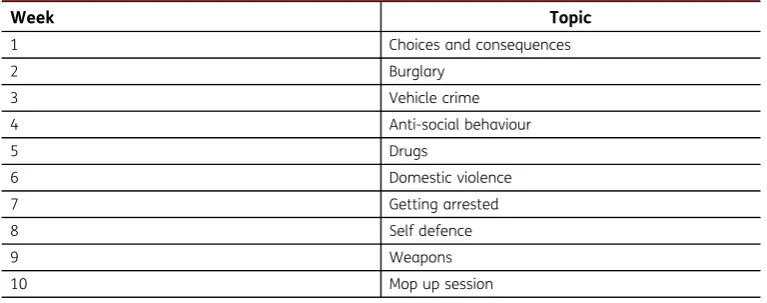
Project Chameleon is a school-based programme delivered to Year 5 (KS2) children within the educational setting. The programme lasts for 10 weeks and is delivered in sessions of two to two and a half hours, 1 day per week. All children in the Year 5 cohort are included in the programme. The programme curriculum covers topics relating to crime and UK law, including antisocial behaviour, drugs, domestic violence and vehicle crime (see Table1for full curriculum). Sessions are facilitated by former police officers, assisted by volunteer psychology students from the University of Bolton, which may increase the programme impact compared to if the sessions were delivered by the regular teacher (Stallard et al.,2014). The overarching aim of the project is to promote positive decision making and enhance the children’s ability to consider their choices and the consequences of their actions, facilitating autonomy, relatedness and competence (Deci &
Table 1. Overview of Project Chameleon curriculum
Week Topic
1 Choices and consequences
2 Burglary
3 Vehicle crime
4 Anti-social behaviour
5 Drugs
6 Domestic violence
7 Getting arrested
8 Self defence
9 Weapons
Ryan,1985; Niemiec & Ryan,2009; Ryan & Deci2000a,2000b), and the development of an internal LOC (Rotter,1954). Throughout the interactive sessions the children have the opportunity to reflect on and discuss their individual experiences, and participate in group activities. Additionally, ses-sions enable the children to challenge the beliefs and attitudes held by themselves and their communities, promoting the development of positive values and pro-social norms (Eisenberg, Fabes, & Spinrad,1998; Eisenberg, Spinrad, & Knafo-Noam,2015).
The current article is a qualitative enquiry conducted to explore the experiences of Project Chameleon from the perspective of the participants and student volunteers assisting with facilita-tion. A previous systematic review and meta-analysis has examined quantitative evaluations of school-based programmes (Ttofi & Farrington, 2011). However, few studies explore the deeper meaning for individual participants through qualitative enquiry. This study aims to bridge the gap, adding the current knowledge through exploratory investigative evaluation of the subjective experiences of both child participants and university student volunteers. The research addresses two primary research questions: (1) What are the individual personal experiences of children and university student volunteers who have participated in the programme? (2) How may session facilitation, interactivity, and delivery style, impact on participants’perceptions of the programme and their motivation to engage?
3. Methodology
3.1. Design
The study uses a qualitative exploratory evaluation design to explore the lived experience data from three small focus groups comprised of child participants and two small focus groups com-prised of student volunteers, after a 10-week educational crime programme. Exploratory evalua-tion through qualitative enquiry provides detailed and in-depth informaevalua-tion relating to programme effectiveness, and can inform future research measures and designs (Fixsen, Naoom, Blase, & Friedman,2005). Furthermore, documenting implementation techniques and the impact of con-textual factors may assist with future adaptations of the programme for use with different populations or in other contexts (Fixsen et al.,2005; Framework Workgroup,2014).
3.2. Participants
3.2.1. The schools
All schools in a cluster of nine Bolton primary schools were invited to participate in Project Chameleon, and one school declined to take part. Of the eight participating schools, one school was considered outstanding by Ofsted, five schools were considered good, and Ofsted reported two school required improvement. Four of the schools were of Church of England denomination, and four were of no denomination. The eight schools which agreed to parti-cipate in the programme were invited to attend focus groups. Three schools responded to the invite and participated voluntarily for the focus groups (37.5% response rate). One of the schools which volunteered was of Church of England denomination and had an outstanding Ofsted report. Two of the schools which volunteered were of no denomination and had a good Ofsted report.
3.2.2. Child participants
3.2.3. University student volunteers
All of the ten student volunteers who had assisted facilitation of Project Chameleon across the eight schools were invited to attend two small focus groups. A self-selecting sample of eight student volunteers confirmed their participation (80% response rate). Two groups of four student volunteers were set up. Group 1 comprised of three females and one male. Group 2 comprised of two females, with two non-attendees. Student volunteers were aged from 19–35. No incentives were offered to secure student volunteers. Participation was voluntary and consent was gained prior to the commencement of the focus group.
All participants were informed that the answers they provided would be kept confidential and handled in accordance with the Data Protection Act 1998. Participants were informed that any data used in the publication of the research would be anonymised and all identifying content would be removed. Safeguarding was observed throughout the research, in line with the individual school’s safeguarding policy. Ethical approval was granted in October 2016 by the University of Bolton’s Ethics Committee. 3.3. Materials
Two focus group scripts were used, designed by the researcher (MM) in accordance with guidelines set out by Krueger (2002) and Williamson and Miller (2013). The children’s script was an amended version of the adult script, containing the same questions reworded for ease of understanding. Both scripts used semi-structured and open-ended interview questions focusing on four main themes; taking part in the project, likes and dislikes, project content and delivery style. Three general primary questions were formulated designed to explore thoughts, experiences and opi-nions relating to the project, with each primary question having several suggested secondary questions designed to prompt the participant and encourage debate in order to gather richer in-depth data (Table2). A Dictaphone was used to digitally record proceedings.
3.4. Procedure
Focus groups with child participants who had completed Project Chameleon were conducted on 5 April 2017, 2 weeks after completion of Project Chameleon. Focus groups with KS2 children were conducted in meeting rooms within the schools, away from other students where confidentiality could be maintained. These focus group lasted 40 min, 33 min and 23 min. Focus groups with student volunteers were conducted on 10th April in a group work room within the University of Bolton campus, away from staff and other students where confidentiality could be maintained. These focus groups lasted 56 min and 55 min. The primary researcher conducting the focus groups has been trained in the use of Restorative Approaches and has extensive experience in conducting restorative meetings where heavy emphasis is placed on ensuring that every parti-cipant has the opportunity to speak and be heard. A script was used comprising of an introduc-tion explaining the focus group procedure, guidance notes for the researcher and the research questions (Table2). During the focus groups, participants were free to respond to each other’s question responses and discuss the topic further. Short silences were permitted to allow parti-cipants to consider and formulate their responses, and the researcher interjected or moved to the next question only when it was evident all views and opinions had been heard. The researcher digitally recorded proceedings from all focus groups on a Dictaphone and made handwritten notes throughout. Recordings were transcribed verbatim by the researcher, con-verted to Pdf format, and input into QSR NVivo V20 for thematic analysis.
Table 2. Primary and secondary questions for focus groups with children and volunteers Primary question Secondary questions (children) Secondary questions (volunteers) What did you think about Project Chameleon? What did you like best about the project? How were you feeling at the start of the project? What was the most interesting thing for you? What could have made the project better? What other activities would you have liked to have on the project? What did you like best about the project? How were you feeling at the start of the project? What do you think worked well? What could have made the project better? What was the best thing for you during the project? What was your overall experience of the project? Think back to the days you had Project Chameleon; was there anything that we could have done better? Think back to your time in the classroom, was there anything that could have been improved? On a scale of 1 to 10, how well did you think the children engaged with the activities? How do you think you did at relating to the children? Think back to a time when you were challenged; can you tell us about that? If you were in charge and could change one thing to make the project better, what would you do? What were your feelings about the content covered in the project? On a scale of 1 to 10, can you tell us how much you think the project was worth doing? What did you think about being taught by other people instead of your
teachers Ifa
4. Results
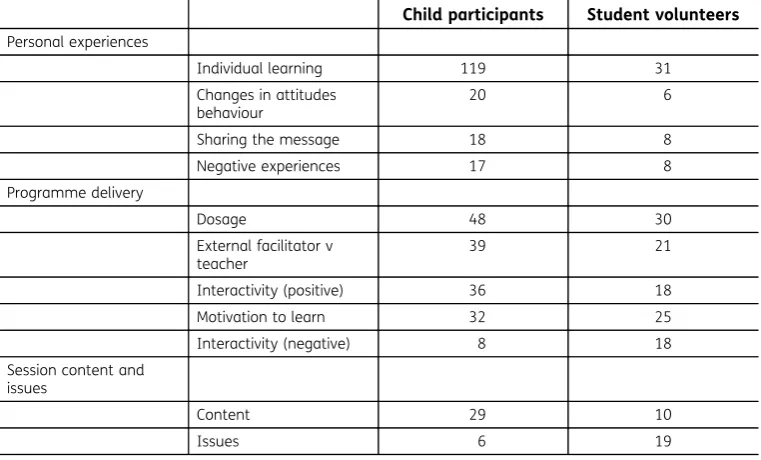
Three main themes emerged relating to the personal experiences of student volunteers and child participants who completed Project Chameleon; individual personal experiences, pro-gramme delivery, and session content and issues. Eleven further overlapping sub-themes emerged as the analysis progressed (see Table3).
5. Analysis and discussion
The results of the thematic analysis have addressed both primary research questions: (1) What are the individual personal experiences of children and student volunteers who have partici-pated in the programme? (2) How may session facilitation, interactivity and delivery style impact on participants’ perceptions of the programme and their motivation to engage? The Project Chameleon educational programme met SAFE (Durlak et al.,2011) criteria, in that it was sequenced, active, focused and explicit. Programme material was disseminated to all children in the year 5 group, providing the opportunity for social learning amongst peers (Bandura, 1962,
1977, 1978; Brown, 2004; Turner, 1991), and promoting positive dialogue (Brown, 2004). Children identified as“at risk”of offending were not targeted and grouped together, therefore avoiding the negative effects of peer influence (Berndt,1979; Erickson et al.,2000; Sim & Koh,
2003). Three overarching themes emerged from the data – personal experiences, programme delivery, and session content and issues–with several overlapping sub-themes.
5.1. Personal experiences
5.1.1. Individual learning
There were four sub-themes which emerged relating to the personal experiences of child partici-pants and student volunteers; individual learning, changes in attitudes and behaviour, sharing the message, and negative experiences. Individual learning was shown to be an important part of the personal experiences of participating in Project Chameleon. The programme has been a positive learning experience for child participants in relation to crime and the law, and their understanding of specific crimes:“I loved it and I thought it was amazing and we learnt a lot about crime and ages of things like what age you have to be”(Sophie). When asked, all child participants stated Table 3. Table showing the number of references to each theme and sub-theme from focus group transcripts
Child participants Student volunteers
Personal experiences
Individual learning 119 31
Changes in attitudes behaviour
20 6
Sharing the message 18 8
Negative experiences 17 8
Programme delivery
Dosage 48 30
External facilitator v teacher
39 21
Interactivity (positive) 36 18
Motivation to learn 32 25
Interactivity (negative) 8 18
Session content and issues
Content 29 10
that there were some types of criminal activity that they did not know existed prior to participation in the project:“I really like doing this and I think we should learn more about different crimes in school! I learnt a lot about crimes I never even knew about like you could get arrested for hitting people back (self-defence)” (Eva). This understanding is necessary for the child to be able to choose an appropriate course of action (Hamedani & Darling-Hammond,2015; Howe & Covell,
2005). Additionally, helping to deliver Project Chameleon was described as a learning experience by university student volunteers, one of which revealed:
I would like listening to some of the things, just like having that knowledge, why should I be learning at 23, things that we should know already? And my friends, they didn’t know half the stuff that I was saying that we’re teaching to 10 year olds. I’ve got a young nephew now, I’d rather him be involved in something like that so he can then go out into the world and make the right life choices. (Sarah)
The learning experiences of child participants have raised awareness and altered perceptions relating to types of crime and this is particularly important when considering crime typology and prevalence (Allen & Watson,2017; Flatley,2017). Providing young people with the facts in relation to these types of crime through educational programmes allows them to make a more informed choice if faced with a dilemma. The theme of aggression was revisited during several sessions, and the domestic violence content challenged some children’s prior understanding of what is consid-ered acceptable behaviour towards another: “Domestic violence like, I know what it is now but obviously, I didn’t know what it was before, I thought it were just where a boy and a girl that hit each other, but actually it happens in a house”(Sophie).
When discussing violence and aggression, one strategy used to help the children visualise the difference between self-defence and becoming the aggressor was the“ladder of aggression.”This concept was described by several child participants as having helped their learning experience:
“The ladder of aggression part, because if you don’t start it and you go over the ladder of aggression, you’re the attacker, not them”(Lucy).
As young people, especially females, have also been found to have a high level of engagement in drug offences (Allen & Watson,2017), the increased awareness of different types of drug crimes and changing perceptions relating to drugs, highlights the appropriateness of the project for the child participants. Having some knowledge of the effects and consequences of taking drugs could potentially counter any sensation-seeking behaviour (Steinberg, et al., 2009). The drug session was talked about among several of the children: “My favourite thing in project chameleon was the drugs because I didn’t know what drugs can do to you know I do”(Liam), and some were able to consider how they would generalise the information to hypothetical real-life scenarios:
So if we’re walking down the street and say our friend got some, catched up to us and said do you want one of these, we’d know what they looked like. We’d know they were drugs and we’d know not to take them. (Sophie)
The main objectives of the programme were promoting choices and highlighting consequences. As a result of the positive learning experience provided by Project Chameleon, child participants verbalised a developed respect for the rights of peers, family and strangers. Furthermore, they may feel empowered and more able to“do the right thing”in the future (DfES, 2017; Howe & Covell,2005).
5.1.2. Changes in attitudes and behaviour
I thought it was really good. I mean all the children really engaged and they really did actually learn a lot and, a lot of the negative attitudes that were displayed at the beginning had pretty much changed towards the end. So they had a better attitude towards police, towards the law, I didn’t expect it. (Paula)
Also:“Watching attitudes change. Seeing how they grow in their understanding and their knowl-edge and stuff. I thought that was really rewarding”(Paula). Positive changes in behaviour of the child participants were described by one student volunteer:
The first week he was really badly behaved, he was with the certain group of boys that were always misbehaving, but however when it came to second week, he quieted down a little bit, and from then onwards he was so engaged with the material, always had these really deep questions to ask and really wanted to know about the law and really wanted to get our opinions on stuff. And he really engaged with the material. (Faye)
Further to the changes noted in the child participants’attitudes and behaviour, a student volunteer also reflected on changes in their own attitudes and behaviour brought about by the experience of participating in Project Chameleon:
For me it was really interesting to see my attitude change. I had few stereotypes, like I had for example this student who I thought she was a bully, to be honest. Whereas in the moment she started speaking more about her experience and everything, it built up on the psychological theories and I saw behind that so I’m thinking now obviously I don’t see her the way I saw her at the beginning. (Kate)
For one child participant, sharing the message with a younger sibling was important. The experi-ences gained from engaging with the programme helped to shape positive behaviours outside of the programme, within the family (Hawkins & Weis, 1985): “I taught my sister some with the booklets. And she was dead interested in it, I said we’ve not got all the videos but it’ll still be fun”
(Emma).
5.1.3. Sharing the message
In addition to sharing what they had learnt with siblings and family, all child participants offered positive comments when asked how they would encourage others to participate in the programme:
I would probably say to him or her please can we do this because it’s like it’s helping the world to stop doing what they’re doing, stop the behaviour and stuff. . .it’d be better for everyone else because obviously other people would stop doing it and calm it down a bit, like antisocial behaviour and stuff, and if they learn about it then obviously they’ll stop doing it. (Sophie)
Furthermore, one student volunteer disclosed how the experiences gained from participating in highly interactive sessions of Project Chameleon had solidified her own learning and given her tools with which to share her knowledge outside of the classroom into her local community (Ford-Jones & Daly,2017; Herrera et al.,2000) :“Really I learned from him as well. . . and in my local church, I teach in Sunday school, and because of that roleplay I’ve been bringing it to Sunday school as well. The roleplay that [facilitator] has been doing”(Mary). The learning achieved by student volunteers was also expanded into the workplace, as is shown by this comment from another student volunteer:
5.1.4. Negative experiences
The negative experiences revealed by child participants relating to their experiences during Project Chameleon sessions were directly relating to the behaviour of their peers:“I was like shut up I’m trying to listen here”(Emma), which many described as disrespectful:“I was quite upset but I know the reasons because everyone was talking over him and they was a bit disrespect, well they was disrespectful, so I was quite annoyed with everyone else”(Dan).
Negative experiences described by student volunteers were almost all in relation to classroom dynamics in their school setting. Strategies employed to motivate children by facilitators were sometimes incongruent with those the class teacher implemented:
The teacher in ours, did class points. When they were really misbehaving we, we took some off and we nearly caused a mini-riot by doing that, in our class. Once we did that, we had no control over that class. We had to call it a day. (Faye)
Another area where facilitators and class teachers could improve communication is class disci-pline. Classroom ground rules and boundaries should be clearly defined to external facilitators to ensure that existing strategies are utilised. Facilitators may then deliver the intervention in line with these, providing consistency and predictability, particularly in relation to discipline and sanc-tions. Student volunteers across the participating schools reported vast differences in the level of involvement from school staff in relation to classroom management. Some school staff were disengaged: “I think whenever it came to discipline within the classroom she was very, she didn’t really get involved, it was really left to us and (facilitator) to do it”(Faye), and“He was a bit, wasn’t much of an authoritarian so he wasn’t like, assertive with the class, wasn’t good with discipline and that”(John),
whilst others actively engaged with the programme and the behavioural management of the child participants:
The substitute teacher was always kind of getting involved. . .they knew not to mess with that teacher, they knew that if did, they were gonna be told, they were not gonna have playtime, they were gonna be sent to the head, she really did work with them. (Faye)
Liaising with school staff and establishing protocol for classroom management and beha-vioural sanctions prior to commencing the programme would be advantageous. Awareness of the strategies in place and who is responsible for implementing them may allow for seam-less management of unwanted behaviour and limit disruption when delivering Project Chameleon.
5.2. Programme delivery
Several sub-themes emerged relating to different aspects of programme delivery which impacted on the participants’ and student volunteers’ experiences of Project Chameleon. Various pro-gramme delivery factors impacted on the personal experiences of Project Chameleon.
5.2.1. Dosage
You’d be getting like two lots of it. . .what you learn the first year like will be refreshed in year 6. When you go into, after year 6 you’d be going into high school so then it’d be like fresh in your memory for high school and what choices you need to make and what you don’t. (Ethan)
This perspective was further reiterated by the student volunteers, who suggested that the whole programme should be longer:“But even if they’d been able to run it, I don’t know whether you’d say for a full year or half a year or whatever, because I think it like, repetition with the kids”
(Sarah), and that the sessions themselves were too short:“When it was coming to the end of the session, we hadn’t quite finished what we needed to do every time”(John).
One student volunteer suggested that Project Chameleon should be embedded into the curri-culum as a regular taught subject:“I think it should be part of the school curriculum”(Mary), with agreement from the other volunteers participating in the focus group. Another student volunteer proposed that tailoring the programme with age appropriate material could offer the potential to continue delivering Project Chameleon throughout secondary education and further:
Once you get into high school you could possibly start thinking like, more adult topics that would kind of happen at the end of high school, say more when it comes to kind of like, sexual abuse and stuff done through your phones and stuff like that, that would be kind of really appropriate to do cause the kids just don’t know about it. (Faye)
Whilst schools are engaging in delivering education relating to personal and social health, and SEL, the potential benefits of proactively implementing the Project Chameleon programme are high-lighted in this comment from a student volunteer:
I think if things like the Chameleon Project cannot get there, then the wrong crowd is going to teach the kids. Because the internet is there, it’s got so much information, their peer group is there, they’ll teach them the wrong thing. . . something else will get there before Chameleon Project. (Mary)
With evidence from prior research (Conduct Problems Prevention Research Group,2004; Dariotis et al.,2016; Domitrovich et al.,2007; Durlak et al.,2011) and qualitative experiential evidence from this study, it may be concluded that for the Project Chameleon programme to maximise its educational potential, both the session dosage and programme length require adjustment.
5.2.2. External facilitator vs class teacher
This sub-theme explores the perceived differences between having the Project Chameleon pro-gramme delivered by external facilitators and the regular teaching staff. In addition, discussion of the differences between how the external facilitators delivered the programme in their respective schools also occurred. When asked, child participants were unanimous in their opinion that the programme should be delivered by“expert”external staff (see Stallard et al.,2014), with one child participant suggesting that the Project Chameleon programme was also educational for teaching staff:“The teachers also need to learn”(Sophie).
All child participants were able to define specific benefits of having ex-police officers delivering the programme and disadvantages of having the programme delivered by their class teacher:“If the teacher were doing it it’d be really different but I’d prefer the facilitator doing it because he was an ex-policeman and he’d know a lot more”(Eva), and“He’s had more experience in policing cause he’s been, he’s an ex police officer. . .if we had an ordinary teacher they wouldn’t have had all the experience”(Sophie).
maintain control of the classroom. Subsequently, higher levels of interaction had a direct effect on the child participants’ motivation to learn: “I get bored with having the same teacher all the time. . .it is good to have someone else, more fun”(Isaac), and appeared to increase the level of enjoyment children had whilst participating in the programme: “Loved it. amazing. never done anything better. I know a lot more about crime. I want to learn about this every day. I wish this wasn’t the end. I wish project chameleon could stay”(Zoey).
Student volunteers’experiences of assisting in the programme delivery were also impacted by the delivery style of the facilitator in their school. Several volunteers noted that increased inter-activity had a motivating effect on the children in their class:“I found on weeks where we had the drugs case week, kids were a lot more interested all the way through rather than when they were just sat there looking at the board or something like that”(Sarah).
5.2.3. Interactivity
The inclusion of role-play and other interactive tools, such as videos and props, had a considerable effect on the children’s motivation to learn and were engaging and enjoyable for child participants. Interactivity in the form of role-play appears to have had the largest impact on the individual experiences of both children and student volunteers. One child from a class that had role-played every week commented:“I like that there is a lot of physical modeling not just all verbal”(Liam), which was further reiterated by a student volunteer:
We had it every single session. Like we had like three four roleplays in a session and it actually brought the message home. Because, if say for example something like citizen’s arrest and you get the kids to act it they actually understood what it is. (Mary)
And in addition:
It was better when he made one of his stories a real case scenario, where children would act out, and this happened, he would go to the real stuff like that, so when they go into the character, it made it fun for everyone. (Kate)
Another student volunteer had this to say regarding the impact of facilitator led role-play on a child that was severely disengaged at the start of the programme:
I’ve seen a totally uninterested student at the beginning, like they couldn’t care less, it was just a session when they can just have their pen and daydream, and they became so engaged, it was enough for [facilitator] to say I need three actors and you would see everyone, including me and [student volunteer], with our hand up. Everyone wanted to be chosen, everyone wanted to be part of that thing, and I think it’s a really really really good thing. (Kate)
5.2.4. Motivation to learn
In addition to high levels of interactivity provided through role-plays and video material, some facilitators also utilised a token economy to motivate the child participants, such as points systems and certificates, with some success:“By the time we got to the third session they were actually participating, so they had a certificate for most improved”(Mary). Comments from child partici-pants highlighted a desire to participate in the programme again, suggesting an elevated level of motivation to learn more information on the topics embedded in Project Chameleon:“I found project chameleon amazing. I want them to come back in year 6”(Seth).
5.2.5. Negative experiences
interactive drug case showcasing several types of substances:“I didn’t like the drug session. . .I dunno I just didn’t want to look at them. People should have a choice whether to see them”(Isaac).
These comments were incongruent with the other children’s feedback and facilitators liaised with school staff where necessary. The differing personal experiences of child participants and student volunteers regarding the delivery of Project Chameleon support the notion that incon-sistency between facilitators results in significantly different experiences for children. The potential to limit these differences so that all children have a similar experience may lie with guidance from previously established frameworks for programme delivery (Durlak et al.,2011; Noble & McGrath,
2015), whilst maintaining some flexibility (Dane,1999).
5.3. Session content and specific issues
5.3.1. Content
Two sub-themes emerged when exploring the child participants’and student volunteers’ experi-ences of the sessions, which related to the session content and specific issues which had occurred. Student volunteers agreed that the sessions covered a lot of topics pertinent to contemporary society:
The sub teacher that we had in was like we need this in our school. . . we’ve got 10 year olds who are smoking, they’re carrying knives, and they are thinking about drugs. . .I think depending on the school’s area and the problem that that school has could probably be where the focus could be put possibly? (Faye)
Child participants also commented on the possibility of tailoring the content to the specific issues facing individual schools and communities, such as drugs, weapons crime and anti-social behaviour. However, this was aimed more at differing age groups:“If it was in year 2 or something and they were learning about that I don’t think he’d tell them everything about drugs and stuff. Um cause obviously they wouldn’t understand what it is and stuff”
(Sophie).
5.3.2. Specific issues
Student volunteers and child participants disclosing issues with the programme reported both personal issues and issues relating to the programme delivery. Child participants spoke more of issues with content being upsetting or hard to view, whilst student volunteers discussed technical delivery issues. The Project Chameleon programme utilises a web-based package designed using Prezi. Student volunteers suggested that this format was not always compatible with the school system and could result in delays or problems with video playback:“I know some of the videos embedded in Prezi had to be opened on Internet Explorer which was quite time consuming because it must not have been opened up in the first place”(Paula). Suggestions were made how this problem could be avoided in future:
The only major issue that I had at my school was that the internet sometimes didn’t work. . . So, maybe if they had a backup plan for if the internet doesn’t work. (John)
If they had like a hard copy, on a USB or something. (Sarah)
6. Conclusion
Whilst reactive strategies may be appropriate for those already identified as being“at risk,”it is clear from this study and others like it that early access to educational programmes and intervention is imperative to teaching children so that they may make their own, informed choices. The project has targeted many aspects of crime-related learning and has covered morality and aspects of citizenship suitable for KS2 children. Both the child participants and student volunteers recommended that the opportunity for rehearsal should be provided in the form of follow-up or refresher sessions, to ensure that the lessons learnt throughout Project Chameleon are not lost. All the children and student volunteers, when asked, stated that Project Chameleon should be an integrated aspect of the curriculum, with content designed to be appropriate for differing ages from KS1 through to second-ary school. Exploration of individual experiences has provided subjective perspectives of Project Chameleon; results highlight what is considered important to the child participants and student volunteers and provide guidance for the enhancement of the programme for future delivery.
Limitations arise from inconsistency in the manner the sessions were delivered. Of the four facilitators, only one consistently and reliably integrated role-play into the sessions. Considering the volume of positive comments relating to how role-play has helped to solidify concepts and aid learning, recommendations for establishing this as standard should be considered. This inconsis-tency resulted in differing school experiences due to variables not accounted for in this evaluation, such as differences in delivery style between facilitators. Another limitation is the small sample size used, and further research building on the current evidence could recruit a larger sample of focus group participants in order to enhance validity and generalisability of the results. Furthermore, allocating more participants to each individual focus group may increase the level of debate leading to a greater depth of understanding for the researchers. Lastly, voluntary participation may induce the self-selection bias (Costigan & Cox,2001), where consenting partici-pants may be different to non-volunteer within the sample. This may lead to gender biases (Dindia & Allen,1992), and participants who are generally proactive and more confident (Abrams,2010), and may impact on the generalisability of the research findings.
This study provides implications for programme delivery, in particular regarding who should deliver the programme. Results suggest that external“expert”facilitators should be employed to deliver the programme in place of the regular class teacher to achieve maximum engagement. The study also highlights the need for effective communication between facilitators and school staff to ensure classroom strategies and boundaries are maintained. Comparison of qualitative data on a school by school basis could be conducted; results may highlight specific areas which require work in each class, enabling the content to be tailored to maximise learning. Further exploration regarding gender differences and differences in data from differing socioeconomic backgrounds may also be carried out to explore whether these factors impact on the programme effectiveness. Finally, all further studies and evaluations should investigate whether the programme adheres fully to a robust frame-work such as SAFE (Durlak et al.,2011) or PROSPER (Noble & McGrath,2015) and findings utilised to establish a“gold standard”of content and delivery which, by presenting robust evidence to those responsible for the UK education syllabus, could be embedded into the national curriculum.
Acknowledgements
The authors would like to acknowledge the contributions of Hunter Jennings for assistance with conducting the focus groups and transcription of the focus group recordings.
Funding
This work was supported by the University of Bolton Jenkinson Award.
Author details Michelle C. Mack1
E-mail:[email protected]
ORCID ID:http://orcid.org/0000-0003-0743-7339 Gill Allen1
E-mail:[email protected]
ORCID ID:http://orcid.org/0000-0002-0226-9818
1Department of Education & Psychology, University of
Bolton, Greater Manchester, United Kingdom.
Citation information
Cite this article as: Qualitative evaluation of individual experiences of a school-based educational programme on crime, Michelle C. Mack & Gill Allen, Cogent Education (2018), 5: 1483545.
References
Abrams, L. S. (2010). Sampling“hard to reach”
youth.Qualitative Social Work,9, 536–550. doi:10.1177/1473325010367821
Allen, G., & Watson, C. (2017).UK prison population
sta-tistics. London: House of Commons.
Bandura, A. (1962). Social learning through imitation. In
M. R. Jones (Ed.),Nebraska symposium on motivation
(pp. 211–274). Oxford, England: University of
Nebraska Press.
Bandura, A. (1977). Social learning theory. Retrieved
September 30, 2014, fromhttp://www.esludwig.com/
uploads/2/6/1/0/26105457/bandura_sociallear ningtheory.pdf
Bandura, A. (1978). Social learning theory of aggression.
Journal of Communication,28(3), 12–29. doi:10.1111/ j.1460-2466.1978.tb01621.x
Banerjee, R., McLaughlin, C., Cotney, J., Roberts, L., &
Peereboom, C. (2016).Promoting emotional health,
wellbeing and resilience in primary schools. london: The National Archives.
Beelmann, A., & Raabe, T. (2009). The effects of
prevent-ing antisocial behavior and crime in childhood and adolescence: Results and implications of research
reviews and meta-analyses.International Journal of
Developmental Science,3(3), 260–281.
Beelmann, A., Saur, M., Ziegler, P., Diener, K., & Noack, P. (2010).The PARTS-project: The evaluation of a multi-modal intervention programme to prevent prejudice and promote. Paper presented at the 18th annual meeting of the Society on Prevention Research. Denver, CO, USA.
Berkowitz, S. (1997). Analyzing qualitative data. In J.
Frechtling & L. Sharp (Eds.),User-friendly handbook
for mixed method evaluations. Arlington, VA: Division of Research, Evaluation and Communication, National Science Foundation.
Berndt, T. (1979). Developmental changes in conformity
to peers and parents.Developmental Psychology,15,
608–616. doi:10.1037/0012-1649.15.6.608
Boyatzis, R. E. (1998).Transforming qualitative
informa-tion: Thematic analysis and code development. Sage. London: Sage.
Brown, B. (2004). Adolescents’relationships with peers. In
R. Lerner & L. Steinberg (Eds.),Handbook of adolescent
psychology(2nd ed., pp. 363–394). New York: Wiley.
Conduct Problems Prevention Research Group. (2004).
The effects of the fast track programme on serious problem outcomes at the end of elementary school.
Journal of Clinical Child and Adolescent Psychology,
33, 650–661. doi:10.1207/s15374424jccp3304_1
Costigan, C. L., & Cox, M. J. (2001). Fathers’participation
in family research: Is there a self-selection bias?
Journal of Family Psychology,15f, 706–720. doi:10.1037/0893-3200.15.4.706
Dane, A. V. (1999). Program integrity in primary and early
secondary prevention, preserving what works across diverse settings. (Doctoral dissertation), National Library of Canada= Bibliothèque nationale du Canada.
Dariotis, J. K., Mirabal-Beltran, R., Cluxton-Keller, F., Gould,
L. F., Greenberg, M. T., & Mendelson, T. (2016). A
qualitative evaluation of student learning and skills use in a school-based mindfulness and yoga
pro-gramme.Mindfulness,7(1), 76–89. doi:10.1007/
s12671-015-0463-y
Darker, I., Ward, H., & Caulfield, L. (2008). An analysis of
offending by young people looked after by local
authorities.Youth Justice,8(2), 134–148. doi:10.1177/
1473225408091374
Deci, E. L., & Ryan, R. M. (1985). The general causality
orientations scale: Self-determination in personality.
Journal of Research in Personality,19(2), 109–134. doi:10.1016/0092-6566(85)90023-6
Department for Education and Skills. (2017, August). The
effective involvement of children and young people.
Retrieved from Gov.co.uk:https://www.nwleics.gov.
uk/files/documents/guide_to_involving_children_ and_young_people/Guide%20to%20Involving% 20Children%20and%20Young%20People.pdf
Dindia, K., & Allen, M. (1992). Sex differences in
self-dis-closure: A meta-analysis.Psychological Bulletin,112,
106–124. doi:10.1037/0033-2909.112.1.106
Domitrovich, C. E., Cortes, R. C., & Greenberg, M. T. (2007).
Improving young children’s social and emotional
competence: A randomized trial of the preschool
“PATHS”curriculum.The Journal of Primary
Prevention,28(2), 67–91. doi: 10.1007/s10935-007-0081-0
Durlak, J. A., Weissberg, R. P., Dymnicki, A. B., Taylor, R. D.,
& Schellinger, K. B. (2011). The impact of enhancing
students’social and emotional learning: A
meta-analysis of school-based universal interventions.
Child Development,82(1), 405–432. doi:10.1111/ j.1467-8624.2010.01564.x
Eisenberg, N., Fabes, R. A., & Spinrad, T. L. (1998).
Prosocial development. In W. Damon & N. Eisenberg
(Eds.),Handbook of child psychology: Vol. 3. Social,
emotional, and personality development(5th ed., pp.
701–778). New York: John Wiley & Sons, Inc.
Eisenberg, N., Spinrad, T. L., & Knafo-Noam, A. (2015).
Prosocial development. In R. M. Lerner (Ed.),
Handbook of child psychology and developmental science. New York: John Wiley & Sons, Inc.
Erickson, K., Crosnoe, R., & Dornbusch, S. M. (2000). A
social process model of adolescent deviance: Combining social control and differential association
perspectives.Journal of Youth and Adolescence,29,
395–425. doi:10.1023/A:1005163724952
Farrington, D. P., Coid, J. W., Harnett, L. M., Jolliffe, D.,
Soteriou, N., Turner, R. E., & West, D. J. (2006).
Criminal careers up to age 50 and life success up to age 48: New findings from the Cambridge study in
delinquent development (p. 19).London: Home Office
Research Study,299.
Field, F. (2010).The Foundation Years: Preventing poor
children becoming poor adults, The report of the Independent Review on Poverty and Life Chances. The Stationery Office. London: The National Archives. Fixsen, D. L., Naoom, S. F., Blase, K. A., & Friedman, R. M.
(2005). Implementation research: A synthesis of the
literature. Tampa, Florida, USA. Retrieved fromhttp://
nirn.fpg.unc.edu/sites/nirn.fpg.unc.edu/files/ resources/NIRN-MonographFull-01-2005.pdf
Flatley, J. (2017).Crime in England and Wales: Year ending
June 2017. London: Office for National Statistics.
Ford-Jones, P., & Daly, T. (2017). Volunteers’experiences
delivering a community-university chronic disease health awareness program for South Asian older
adults.Journal of Community Health,42(6), 1148–
1155. doi:10.1007/s10900-017-0364-1
Framework Workgroup. (2014).A framework to design,
test, spread, and sustain effective practice in child welfare. Washington, DC: Children’s Bureau, Administration for Children and Families, U.S. Department of Health and Human Services.
Frick, P. J. (2016). Early identification and treatment of
antisocial behavior.Pediatric Clinics of North America,
63(5), 861–871. doi:10.1016/j.pcl.2016.06.008
Greenberg, M. T., Kusche, C. A., Cook, E. T., & Quamma, J.
P. (1995). Promoting emotional competence in
curriculum.Development and Psychopathology,7(1),
117–136. doi:10.1017/S0954579400006374
Hamedani, M. G., & Darling-Hammond, L. (2015).Social
emotional learning in high school: How three urban high schools engage, educate, and empower youth. Stanford, CA: Stanford Center for Opportunity Policy in Education.
Hawkins, J. D., Herrenkohl, T. I., Farrington, D. P., Brewer,
D., Catalano, R. F., Harachi, T. W., & Cothern, L. (2000).
Predictors of youth violence. Washington DC: US Department of Justice.
Hawkins, J. D., & Weis, J. G. (1985). The social
develop-ment model: An integrated approach to delinquency
prevention.The Journal of Prevention,6(2), 73–97.
doi:10.1007/BF01325432
Herrera, C., Sipe, C. L., & McClanahan, W. S. (2000).
Mentoring school-age children: Relationship develop-ment in community-based and school-based programs. Philadelphia, PA: National Mentoring Partnerships.
Howe, R. B., & Covell, K. (2005).Empowering children:
Children’s rights education as a pathway to
citizen-ship. Toronto: University of Toronto Press.
Huey, M. P., & McNulty, T. L. (2005). Institutional
condi-tions and prison suicide: Conditional effects of
deprivation and overcrowding.The Prison Journal,85
(4), 490–514. doi:10.1177/0032885505282258
Kim, B. E., Gilman, A. B., & Hawkins, J. D. (2015). 28
School-and community-based preventive interven-tions during adolescence: Preventing delinquency through science-guided collective action. In J.
Morizot & L. Kazemian (Eds.),The development of
criminal and antisocial behavior(pp. 447–460). Switzerland: Springer International Publishing.
Krueger, R. A. (2002, October).Designing and conducting
focus group interviews. St Paul, Minnesota, USA.
Retrieved October 06, 2016 fromhttp://www.eiu.edu/
ihec/Krueger-FocusGroupInterviews.pdf
Loeber, R., Farrington, D. P. & Petechuk, D. (2011).Young
homicide offenders and victims: Risk factors, predic-tion, and prevention from childhood. New York: Springer.
Mclean, F., & Beak, K. (2012).Factors associated with
serious or persistent violent offending: Findings from a rapid evidence assessment. London: National Policing Improvement Agency.
Ministry of Justice. (2017).Youth justice statistics 2015/
16. London: Author.
Natale, R., Scott, S. H., Messiah, S. E., Schrack, M. M., Uhlhorn,
S. B., & Delamater, A. (2013). Design and methods for
evaluating an early childhood obesity prevention
pro-gramme in the childcare center setting.BMC Public
Health,13(1), 78. doi:10.1186/1471-2458-13-78
National Research Council. (2009).Preventing mental,
emotional, and behavioral disorders among young people: Progress and possibilities. Washington DC: National Academies Press.
Niemiec, C. P., & Ryan, R. M. (2009). Autonomy,
compe-tence, and relatedness in the classroom: Applying self-determination theory to educational practice.
School Field,7(2), 133–144. doi:10.1177/ 1477878509104318
Noble, T., & McGrath, H. (2015). Prosper: A new framework
for positive education.Psychology of Well-Being,5(1),
2. doi:10.1186/s13612-015-0030-2
Patton, M. Q. (1980).Qualitative evaluation methods.
Beverly Hills, CA: Sage.
Prior, D., & Paris, A. (2005).Preventing children’s involvement
in crime and anti-social behaviour: A literature review. Birmingham: Department for Education and Skills.
Public Health England. (2016).National child and
mater-nal health intelligence network. Retrieved November
15, 2016, from Public Health England:http://www.
chimat.org.uk/default.aspx?RID=160019
Rotter, J. B. (1954).Social learning and clinical psychology.
Englewood Cliffs, NJ, US: Prentice-Hall, Inc.
Ryan, R. M., & Deci, E. L. (2000a). Intrinsic and extrinsic
motivations: Classic definitions and new directions.
Contemporary Educational Psychology,25(1), 54–67. doi:10.1006/ceps.1999.1020
Ryan, R. M., & Deci, E. L. (2000b). Self-determination
the-ory and the facilitation of intrinsic motivation, social
development, and well-being.American Psychologist,
55(1), 68–78. doi:10.1037/0003-066X.55.1.68
Sim, T., & Koh, S. (2003). A domain conceptualization of
adolescent susceptibility to peer pressure.Journal of
Research on Adolescence,13, 57–80. doi:10.1111/ 1532-7795.1301002
Squires, P., & Stephen, D. (2013).Rougher justice;
Antisocial behaviour and young people. Cullompton: Willan Publishing.
Stallard, P., Skryabina, E., Taylor, G., Phillips, R., Daniels, H.,
Anderson, R., & Simpson, N. (2014). Classroom-based
cognitive behaviour therapy (FRIENDS): A cluster randomised controlled trial to prevent anxiety in
children through education in schools (PACES).The
Lancet Psychiatry,1, 185–192. doi: 10.1016/S2215-0366(14)70244-5
Steinberg, L., Albert, D., Cauffman, E., Banich, M., Graham, S., & Woolard, J., (2009). Age differences in sensation seeking and impulsivity as indexed by behavior and self-report: Evidence for a dual systems model.
Behavioral Sciences and the Law,29: 173–190. doi:10.1037/a0012955
Steinberg, L., & Monahan, K. (2007). Age differences in
resistance to peer influence.Developmental
Psychology,43(6), 1531–1543. doi: 10.1037/0012-1649.43.6.1531
Ttofi, M. M., & Farrington, D. P. (2011). Effectiveness of
school-based programs to reduce bullying: A
sys-tematic and meta-analytic review.Journal of
Experimental Criminology,7(1), 27–56. doi:10.1007/ s11292-010-9109-1
Turner, J. C. (1991).Social Influence. Milton Keynes: Open
University press.
Wallace, B., & Bentley, R. (Eds.). (2014).Teaching thinking
skills across the middle years: A practical approach for children aged 9-14. Oxon: Routledge.
Webster-Stratton, C., Reid, M. J., & Stoolmiller, M. (2008). Preventing conduct problems and improv-ing school readiness: Evaluation of the incredible years teacher and child training programmes in
high-risk schools.Journal of Child Psychology and
Psychiatry,49(5), 471–488. doi: 10.1111/j.1469-7610.2007.01861.x
Williamson, A., & Miller, L. (2013).Focus group guide.
London, England. Retrieved October 11, 2016, from
© 2018 The Author(s). This open access article is distributed under a Creative Commons Attribution (CC-BY) 4.0 license.
You are free to:
Share—copy and redistribute the material in any medium or format.
Adapt—remix, transform, and build upon the material for any purpose, even commercially. The licensor cannot revoke these freedoms as long as you follow the license terms. Under the following terms:
Attribution—You must give appropriate credit, provide a link to the license, and indicate if changes were made. You may do so in any reasonable manner, but not in any way that suggests the licensor endorses you or your use. No additional restrictions
You may not apply legal terms or technological measures that legally restrict others from doing anything the license permits.
Cogent Education(ISSN: 2331-186X) is published by Cogent OA, part of Taylor & Francis Group. Publishing with Cogent OA ensures:
• Immediate, universal access to your article on publication
• High visibility and discoverability via the Cogent OA website as well as Taylor & Francis Online
• Download and citation statistics for your article
• Rapid online publication
• Input from, and dialog with, expert editors and editorial boards
• Retention of full copyright of your article
• Guaranteed legacy preservation of your article
• Discounts and waivers for authors in developing regions