The Thirty-Third AAAI Conference on Artificial Intelligence (AAAI-19)
Robust Estimation of Similarity Transformation for Visual Object Tracking
Yang Li,
1Jianke Zhu,
*1,3Steven C.H. Hoi,
2Wenjie Song,
1Zhefeng Wang,
1Hantang Liu
11Colleage of Computer Science and Technology, Zhejiang University, Hangzhou, China
2School of Information Systems, Singapore Management University, Singapore 3Alibaba-Zhejiang University Joint Research Institute of Frontier Technologies
{liyang89,jkzhu,seeyou,wangzhefeng,liuhantang}@zju.edu.cn, [email protected]
Abstract
Most of existing correlation filter-based tracking approaches only estimate simple axis-aligned bounding boxes, and very few of them is capable of recovering the underlying similar-ity transformation. To tackle this challenging problem, in this paper, we propose a new correlation filter-based tracker with a novel robust estimation of similarity transformation on the large displacements. In order to efficiently search in such a large 4-DoF space in real-time, we formulate the problem into two 2-DoF sub-problems and apply an efficient Block Coordinates Descent solver to optimize the estimation result. Specifically, we employ an efficient phase correlation scheme to deal with both scale and rotation changes simultaneously in log-polar coordinates. Moreover, a variant of correlation filter is used to predict the translational motion individually. Our experimental results demonstrate that the proposed tracker achieves very promising prediction performance compared with the state-of-the-art visual object tracking methods while still retaining the advantages of high efficiency and simplicity in conventional correlation filter-based tracking methods.
Introduction
Visual object tracking is one of the fundamental problems in computer vision with a variety of real-world applications, such as video surveillance and robotics. Although having achieved substantial progress during past decade, it is still difficult to deal with the challenging unconstraint environ-mental variations, such as illumination changes, partial oc-clusions, motion blur, fast motion and scale variations.
Recently, correlation filter-based methods have attracted continuous research attention (Mueller, Smith, and Ghanem 2017; Ma et al. 2015a; 2015b; Zhang et al. 2017; Li, Xu, and Zhu 2017) due to its superior performance and robustness in contrast to traditional tracking approaches. However, with correlation filters, little attention has been paid on how to ef-ficiently and precisely estimate scale and rotation changes, which are typically represented in a 4-Degree of Freedom (DoF) similarity transformation. To deal with scale changes of the conventional correlation filter-based trackers, (Danell-jan et al. 2017b) and (Li and Zhu 2014) extended the 2-DoF representation of original correlation filter-based meth-ods to 3-DoF space, which handles scale changes in object
*Corresponding author.
Copyright © 2019, Association for the Advancement of Artificial Intelligence (www.aaai.org). All rights reserved.
176 431
42 197
OURS DSST SAMF Staple
Figure 1: The similarity geometric transformation represen-tation achieves more accurate and robust tracking results.
appearance by introducing a pyramid-like scale sampling ensemble. Unfortunately, all these methods have to inten-sively resample the image in order to estimate the geomet-ric transformation, which incurs huge amounts of compu-tational costs. In addition, their accuracy is limited to the pre-defined dense sampling of the scale pool. This makes them unable to handle the large displacement that is out of the pre-defined range in the status space. Thus, none of these methods is guaranteed to the optimum of the scale estima-tion. On the other hand, rotation estimation for the corre-lation filter-based methods has not been fully exploited yet, since it is very easy to drift away from the inaccurate rotation predictions. This greatly limits their scope of applications in various wide situations. Table 1 summarizes the properties of several typical trackers.
Table 1: Comparison with different kinds of trackers.
Type Trackers Sample Num. Scale Rot. Pretrain Performance GPU FPS
Traditional Methods
Lucas-Kanade based (Baker and Matthews 2004) Depends √ √ × Fair × Depends
Keypoint based (Nebehay and Pflugfelder. 2014) Depends √ √ × Fair × 1~20
Particle filter-based (Ross et al. 2008; Ji 2012) 300~600 √ √ × Fair × 1~20
Deep Learning
MDNet (Nam and Han 2016) 250 √ × √ Excellent √ ~1
SiamFC (Bertinetto et al. 2016) 5 √ × √ Excellent √ 15~25
Correlation Filter
original CF (Henriques et al. 2015; Bolme et al. 2010) 1 × × × Fair × 300+
DSST (Danelljan et al. 2017b),SAMF (Li and Zhu 2014) 7~33 √ × × Good × 20~80
Ours 2~8 √ √ × Excellent × 20~30
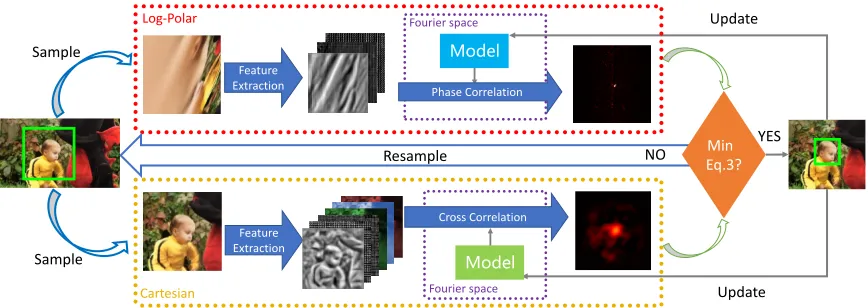
performance in the 4-DoF space, we propose to tackle the optimization task of estimating the similarity transformation by applying an efficient Block Coordinates Descent (BCD) solver. Specifically, we employ an efficient phase correlation scheme to deal with both scale and rotation changes simul-taneously in log-polar coordinates and utilize a fast variant of correlation filter to predict the translational motion. This scheme sets our approach free from intensive sampling, and greatly boosts the performance in the 4-DoF space. More importantly, as BCD searches the entire similarity trans-formation space, the proposed tracker achieves very accu-rate prediction performance in large displacement motion while still retaining advantages of the efficiency and sim-plicity in conventional correlation filter. Experimental re-sults demonstrate that our approach is robust and accurate for both generic object and planar object tracking.
The main contributions of our work are summarized as follows: 1) a novel framework of similarity transformation estimation which only samples once for correlation filter-based trackers; 2) a joint optimization to ensure the stabil-ity in translation and scale-rotation estimation; 3) a new ap-proach for scale and rotation estimation with efficient im-plementation which can improve a family of existing corre-lation filter-based trackers (our implementation is available at https://github.com/ihpdep/LDES).
Related Work
Traditionally, there are three genres to handle scale and rota-tion changes. The most widely used approach is to iteratively search in an affine status space with gradient descent-based method (Baker and Matthews 2004; Song et al. 2016). How-ever, they are easy to get stuck at local optima, which are not robust for large displacements. Trackers based on particle filter (Ross et al. 2008; Ji 2012; Zhang, Xu, and Yang 2017; Li, Zhu, and Hoi 2015) search the status space stochastically by observing the samples, which are employed to estimate the global optima in the status space. Their results are highly related to the motion model that controls the distribution of the 6-DoF transformation. This makes the tracker per-form inconsistently in different situations. Another choice is to take advantage of keypoint matching to predict the geometric transformation (Nebehay and Pflugfelder. 2014; Zuysal et al. 2010). These keypoint-based trackers first de-tect feature points, and then find the matched points in the following frames. Naturally, they can handle any kind of transformations with the matched feature points. Due to the lack of global information on the whole target, these
track-ers cannot effectively handle the general objects (Kristan et al. 2015).
Our proposed method is highly related to correlation filter-based trackers (Henriques et al. 2015; Bolme et al. 2010). (Danelljan et al. 2017b) and (Li and Zhu 2014) ex-tend the original correlation filter to adapt the scale changes in the sequences. (Bertinetto et al. 2015) combines color information with correlation filter method in order to build a robust and efficient tracker. Later, (Danelljan et al. 2015) and (Galoogahi, Fagg, and Lucey 2017) decouple the rela-tionship between the size of filter and searching range. These approaches enable the correlation filter-based methods to have larger searching range while maintaining a relative compact presentation of the learned filters. (Mueller, Smith, and Ghanem 2017) learns the filter with the additional neg-ative samples to enhance the robustness. Note that all these approaches emphasize on the efficacy issue, which employs either DSST or SAMF to deal with the scale changes. How-ever,these methods cannot deal with rotation changes.
Fourier Mellin image registration and its variants (Ravichandran and Casasent 1994; Zokai and Wolberg 2005) are also highly related to our proposed approach. These methods usually convert both the test image and template into log-polar coordinates, in which the relative scale and rotation changes turn into the translational displacement. (Ravichandran and Casasent 1994) propose a rotation-invariant correlation filter to detect the same object from a god view. (Zokai and Wolberg 2005) propose an image registration method to recover large-scale similarity in spatial domain. Recently, (Li and Liu 2016) and (Zhang et al. 2015) introduce the log-polar coordinates into correlation filter-based method to estimate the rotation and scale. Compared with their approaches, we directly employ phase correlation operation in log-polar coordinates. Moreover, an efficient Block Coordinates Descent optimization scheme is proposed to deal with large motions with real-time performance.
Our Approach
pro-YES NO
Cartesian Update
Update
Feature Extraction
Feature Extraction
Phase Correlation
Resample Eq.3?Min
Fourier space
Log-Polar
Cross Correlation
Model
Fourier space
Model
Sample
Sample
Figure 2: Overview of our proposed approach in estimation of similarity transformation.
posed LDES approach. In the following, we first formally formulate the problem as an optimization task, and then di-vide it into two sub-problems, translation estimation and scale-rotation prediction. We solve the two sub-problems it-eratively to achieve a global optimal.
Problem Formulation
Given an image patchxisampled from thei-th frameIiin a
video sequence, the key idea of our proposed approach is to estimate the similarity transformationSim(2)in 2D image space of the tracked traget. To this end, we need to predict a 4-DoF transformation status vectorτi ∈ R4based on the
output of the previous frame. Generally,τi is obtained by
optimizing the following score function:
τi= arg max τ∈Sim(2)
f(W(Ii, τ);hi−1), (1)
wheref(·)is a score function with the modelhi−1learned
from the previous frames I1:i−1. W is an image warping
function that samples the imageIi with respect to the
simi-larity transformation status vectorτ.
The 2D similarity transformation Sim(2) deals with 4-DoF {tx, ty, θ, s} motion, where {tx, ty} denotes the 2D
translation.θdenotes the in-plane rotation angle, ands rep-resents the scale change with respect to the template. Obvi-ously, Sim(2)has a quite large searching space, which is especially challenging for real-time applications. A typical remedy is to make use of effective sampling techniques to greatly reduce the searching space (Doucet, de Freitas, and Gordon 2001).
Since the tracking modelhi−1is learned from the
previ-ous frame, which is kept constant during the prediction. The score functionf is only related to the status vectorτ. We abuse the notation for simplicity:
fi(τ) =f(W(Ii, τ);hi−1). (2)
Typically, most of the conventional correlation filter-based methods only take into account of in-plane translation with 2-DoF, where the score functionfi can be calculated
completely and efficiently by taking advantage of Convolu-tion Theorem. To search the 4-DoF similarity space, the total number of candidate status exponentially increases.
Although Eq. 1 is usually non-convex, the optimal trans-lation is near to the one in the previous frame in object track-ing scenarios. Thus, we assume that the function is convex and smooth in the nearby region, and split the similarity transformation Sim(2)into two blocks, t = {tx, ty}and ρ={θ, s}, respectively. We propose a score functionfi(τ),
which is the linear combination of three separate parts:
fi(τ;hi−1) =ηft(t;ht) + (1−η)fρ(ρ;hρ) +g(t, ρ), (3)
whereηis an interpolation coefficient.ftis the translational
score function, andfρdenotes the scale and rotation score
function.g(t, ρ) =exp(|τ−τi−1|2)−1is the motion model
which prefers the location nearby the last status. Please note that we omit the subscripti−1ofhtandhρfor simplicity.
Eq. 3 is a canonical form which can be solved by the Block Coordinate Descent Methods (Richt´arik and Tak´aˇc 2014; Nesterov 2010). We optimize the following two sub-problems alternatively to achieve the global solution:
arg max
t g(t, ρ
∗) +ηf
t(t), (4)
arg max
ρ g(t
∗, ρ) + (1−η)f
ρ(ρ), (5)
ρ∗ and t∗ denote the local optimal estimation result from previous iteration, which is fixed for the current subproblem. Sincegcan be calculated easily, the key to solving Eq. 1 in real-time is to find the efficient solvers for the above two subproblems,fρandft.
Translation Estimation by Correlation Filter
Translation vectortcan be effectively estimated by Discrim-inative Correlation Filters (DCF) (Henriques et al. 2015; Mueller, Smith, and Ghanem 2017). A large part of its success is mainly due to the Fourier trick and translation-equivariance within a certain range, which calculates theft
in the spatial space exactly. According to the property of DCF, the following equation can be obtained:
ft(W(I,t);ht) =W(ft(I;ht),t). (6)
Since the calculation of arg maxtW(ft(I;ht),t)is
tfrom the response map. Thus, the overall process is highly efficient. The score functionftcan be obtained by
ft(z) =F−1
X
k
ˆ ht
(k)
Φˆ(k)(z), (7)
where z indicates a large testing patch. F−1 denotes the inverse Discrete Fourier Transformation operator,is the element-wise multiplication and ˆ· indicates the Fourier space.ht(k)andΦ(k)represent thek-th channel of the linear
model weights and the feature map, respectively. The whole computational cost isO(KNlogN), whereKis the chan-nel number andNis the dimension of the patchz.
To this end, we need to learn a modelht in the process.
Note that any quick learning method can be used. Without loss of generality, we briefly review a simple correlation fil-ter learning approach (Bolme et al. 2010) as follows:
X
k
Φ(k)(x)?ht(k)−y
2
2
+λ1khtk22, (8)
where?indicates the correlation operator andλ1is the
reg-ularization filters.yis the desired output, which is typically a Gaussian-like map with maximum value of one. Accord-ing to Parseval’s theorem, the formulation can be calculated without correlation operation. By stalling each channel and vectorizing the matrix, Eq. 8 can be reformulated as a nor-mal ridge regression without correlation operation. Thus, the solution to Eq. 8 can expressed as follows:
ˆ
ht= (XˆTXˆ +λ1I)−1XˆTˆy, (9)
where Xˆ = [diag( ˆΦ(1)(x))T, ...,diag( ˆΦ(K)(x))T] and
ˆ ht = [ˆh
(1)T t , ...,ˆh
(K)T t ]
T. In this form, we need to solve
aKD×KDlinear system, whereD is the dimension of testing patchx.
To solve our sub-problem efficiently, we assume that ev-ery channel is independent. Thus, by applying Parseval’s theorem, the whole system can be simplified as element-wise operation. The final solution can be derived as below:
ˆ
h(tk)= ˆαΨˆ(k)
= (ˆy−1(X
k
V∗kVk+λ))V∗k,
(10)
whereαdenotes the parameters in dual space andΨ indi-cates the model sample in feature space.Vk is the feature
data,Φˆ(k)(x)and−1is the element-wise division. Thus,
the solution can be very efficiently obtained with a compu-tational cost of O(KD). With Eq. 10, the computational cost of Eq. 8 isO(KDlogD)which is dominated by the FFT operation. For more details, please refer to the seminal work (Henriques et al. 2015; Kiani, Sim, and Lucey 2013; Mueller, Smith, and Ghanem 2017).
Scale and Rotation in Log-polar Coordinates
We introduce an efficient method to estimate scale and rota-tion changes simultaneously in the log-polar coordinates.
Log-Polar Coordinates Suppose an imageI(x, y)in the spatial domain, the log-polar coordinates I0(s, θ) can be viewed as a non-linear and non-uniform transformation of the original Cartesian coordinates. Like polar coordinates, the log-polar coordinates needs a pivot point as the pole and a reference direction as the polar axis in order to expend the coordinates system. One of the dimension is the angle be-tween the point and the polar axis. The other is the logarithm of the distance between the point and the pole.
Given the pivot point(x0, y0)and the reference direction
rin Cartesian coordinates, the relationship between Carte-sian coordinates and Log-polar coordinates can be formally expressed as follows:
s= log(p(x−x0)2+ (y−y0)2)
θ= cos−1( <r,(x−x0, y−y0)>
||r||p(x−x0)2+ (y−y0)2
). (11)
Usually, the polar axis is chosen as thex-axis in Carte-sian coordinates, whereθcan be simplified astan−1(y−y0
x−x0).
Suppose two images are related purely by rotation θ˜and scale e˜s which can be written as I
0(escosθ, essinθ) =
I1(es+˜scos(θ+ ˜θ), es+˜ssin(θ+ ˜θ))in Cartesian coordinates.
The log-polar coordinates enjoy an appealing merit that the relationship in the above equation can be derived as the fol-lowing formula in log-polar coordinates:
I00(s, θ) =I10(s+ ˜s, θ+ ˜θ), (12)
where the pure rotation and scale changes in Log-polar coor-dinates can be viewed as the translational moving along the axis. As illustrated in Fig. 3, this property naturally can be employed to estimate the scale and rotation changes of the tracked target.
Scale and Rotation Changes By taking advantage of the log-polar coordinates, Eq. 5 can be calculated very effi-ciently. Similarly, scale-rotation invariant can be hold as in Eq. 6. The scale-rotation can be calculated as below:
fρ(W(Ii, ρ);hρ) =W(fρ(Ii;hρ), ρ0), (13)
where ρ0 = {θ0, s0} is the coordinates of ρ in log-polar space.s = es0log(W/2)/W andθ = 2πθ0/H.H andW is
the height and width of the imageIi, respectively. Similar to
estimating the translation vectortbyft, the whole space of fρcan be computed at once through the Fourier trick:
fρ(z) =F−1
X
k
ˆ
h(ρk)Φˆ(k)(L(z)), (14)
where L(x) is the log-polar transformation function, and hρis a linear model weights for scale and rotation
estima-tion. Therefore, the scale and rotation estimation can be ob-tained very efficiently without any transformation sampling
W. Note that the computational cost of Eq. 14 is unrelated to the sample numbers of scale or rotation. This is extremely efficient compared to the previous enumerate methods (Li and Zhu 2014; Danelljan et al. 2017b)
To obtain the ˆhρ efficiently, we employ the
phase-correlation to conduct the estimation, ˆ
Figure 3: The 3rd and 4th charts are corresponding Log-polar coordinates of the 1st and 2nd images. 2nd image is a30◦ rotation and 1.2 times scale version of the first image. The last two charts are the phase correlation response maps. In log-polar coordinates, the response is a peak while it is noisy in Cartesian coordinates.
whereΥ = P
jβjΦ(L(xj)) is the linear combination of
previous feature patch and| · |is the normal operation. In-tuitively, we compute the phase correlation between current frame and the average of previous frames to align the image.
Implementation Details
In this work, we alternatively optimize Eq. 4 and Eq. 5 until
f(x)does not decrease or reaches the maximal number of iterations. After the optimization, we update the correlation filter model as
ˆ
Ψi= (1−λφ) ˆΨi−1+λφΦ(xˆ i), (16)
where λφ is the update rate of the feature data model in
Eq. 10. The kernel weight in dual space is updated as be-low:
ˆ
αi=(1−λα) ˆαi−1
+λα(ˆy−1(
X
k
ˆ
Φ(k)(xi)∗Φˆ(k)(xi) +λ1)), (17)
whereλαis the update of the kernel parameter in dual space
of Eq. 10. Although there exist some theoretical sounding updating schemes (Kiani, Sim, and Lucey 2015; Danelljan et al. 2017a; 2015), the reason we use linear combination is due to its efficiency and the comparable performance.
Meanwhile, we also update the scale and rotation model as a linear combination,
Υi= (1−λw)Υi−1+λwΦ(L(xi)), (18)
whereλw can be explained as an exponentially weighted
average of the model βjΦ(L(xj)). We update the model
uponΦinstead ofxi becauseΦ(PiL(xi))is not defined.
The logarithm function in log-polar transformation intends to blur the image due to the nonuniform sampling. This will decrease the visual information in the original images. To alleviate the artificial effects casued by discretization, we interpolate theft andfρ with a centroid-based method to
obtain sub-pixel level precision. In addition, we use differ-ent size ofzin testing andxin training since a larger search range (N > D) help to improve the robustness for the so-lution to sub-problems. To match the different dimensionN
andD, we padhwith zero in spatial space.
Experiments
In this section, we conduct four different experiments to evaluate our proposed tracker LDES comprehensively.
Experimental Settings
All the methods were implemented in Matlab and the ex-periments were conducted on a PC with an Intel i7-4770 3.40GHz CPU and 16GB RAM. We employ HoG feature for both translational and scale-rotation estimation, and the extra color histogram is used to estimate translational. All patch is multiplied a Hann window as suggested in (Bolme et al. 2010).ηis 0.15 andλis set to1e−4.λφandλαare both
set to 0.01.λωis 0.015. The size of learning patchDis 2.2
larger than the original target size. Moreover, the searching window size N is about 1.5 larger than the learning patch sizeD. For scale-rotation estimation, the phase correlation sample size is about 1.8 larger than the original target size. All parameters are fixed in the following experiments.
Experiments on Proposed Scale Estimator
As one of the contributions in our work is a fast scale esti-mator, we first evaluate our proposed log-polar based scale estimator on OTB-2013 and OTB-100 dataset (Wu, Lim, and Yang 2013; 2015).Three baseline trackers are involved in the scale estimation evaluation. They are SAMF (Li and Zhu 2014), fDSST (Danelljan et al. 2017b) and ECO (Danell-jan et al. 2017a). For fair comparison, we implement three counterpart-trackers including fDSST-LP, SAMF-LP and ECO-LP, which replace the original scale algorithm with our proposed scale estimator.
In Fig. 5, these variant trackers with our scale compo-nent outperform their original implementation. This indi-cates that our proposed scale estimator has superior per-formance compared with current state-of-the-art scale es-timator. Specifically, ECO-LP achieves 69.1% and 67.3% in OTB-2013 and OTB-2015 respectively, compared with its original CPU implementation’s 67.8% and 66.8%. This proves the effectiveness of our proposed scale method since it can even improve the state-of-the-art tracker with a simple replacement of the scale component.
0 0.1 0.2 0.3 0.4 0.5 0.6 0.7 0.8 0.9 1 Overlap threshold 0 0.1 0.2 0.3 0.4 0.5 0.6 0.7 0.8 0.9 1 Success rate
Success plots of OPE
LDES [0.677] ECO-HC [0.652] SRDCF [0.629] BACF [0.624] Staple [0.600] fDSST [0.596] SAMF [0.579] KCF [0.516]
0 5 10 15 20 25 30 35 40 45 50
Location error threshold
0 0.1 0.2 0.3 0.4 0.5 0.6 0.7 0.8 0.9 1 Precision
Precision plots of OPE
LDES [0.810] ECO-HC [0.797] BACF [0.768] SRDCF [0.762] Staple [0.726] fDSST [0.726] SAMF [0.723] KCF [0.676]
(a) Overall results on OTB-2013
0 0.1 0.2 0.3 0.4 0.5 0.6 0.7 0.8 0.9 1
Overlap threshold 0 0.1 0.2 0.3 0.4 0.5 0.6 0.7 0.8 0.9 1 Success rate
Success plots of OPE
ECO-HC [0.643] LDES [0.634] BACF [0.603] SRDCF [0.598] Staple [0.582] SAMF [0.553] fDSST [0.550] KCF [0.478]
0 5 10 15 20 25 30 35 40 45 50
Location error threshold
0 0.1 0.2 0.3 0.4 0.5 0.6 0.7 0.8 0.9 1 Precision
Precision plots of OPE
ECO-HC [0.783] LDES [0.760] BACF [0.749] SRDCF [0.725] Staple [0.717] SAMF [0.692] fDSST [0.666] KCF [0.637]
(b) Overall results on OTB-100
Figure 4: The overall and scale performance in precision and success plots on OTB-2013 and OTB-100 dataset.
Comparison in OTB-2013
59.6 57.9
67.8
60.7 60.5
69.1
fDSST SAMF ECO
50 55 60 65 70 Success rate Original implementation Our scale component
Comparison in OTB-100
55.0 55.3
66.8
55.3 57.1
67.3
fDSST SAMF ECO
50 55 60 65 70 Success rate Original implementation Our scale component
Figure 5: Evaluation of tracking success rate improvements over the original implementations of different trackers en-hanced by the proposed scale estimator.
Comparison with Correlation Filter Trackers
With efficient and effective scale estimator, our proposed tracker performs very promising in different situations. We select seven state-of-the-art Correlation Filter-based trackers as reference methods, including ECO-HC (Danelljan et al. 2017a), SRDCF (Danelljan et al. 2015), Staple (Bertinetto et al. 2015), SAMF, fDSST, BACF (Galoogahi, Fagg, and Lucey 2017), and KCF (Henriques et al. 2015). We initial-ize the proposed tracker with axis-aligned bounding box and ignore the rotation parameter in the similarity transforma-tion as tracking output since the benchmarks only provide axis-aligned labels.
In Fig. 4, it can be clearly seen that our proposed method outperforms most of the state-of-the-art correlation filter-based trackers and obtains 67.7% and 81.0% in OTB-2013 success and precision plots, and 63.4% and 76.0% in OTB-100 plots respectively. ECO-HC achieves better results in OTB-100. However, we can see that our method is more ac-curate above 0.6 overlap threshold in success plot and com-parable in the precision plot. The reason is that introducing rotation improves the accuracy but also enlarges the search space and hurts the robustness when large deformation oc-curs. In general, our method is very promising in generic object tracking task.
The proposed approach maintains 20 fps with similarity estimation and is easy to implement due to its simplicity. Moreover, our no-BCD version tracker achieves 82 fps in the benchmark while stall maintains comparable performance (67.5% and 62.2% accuracy in OTB-2013 and OTB-100, re-spectively).
Please note that our proposed LDES is quite stable in
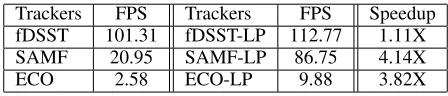
Table 2: Evaluation of speedup results on different track-ers achieved by applying the proposed Log-Polar (LP) based scale estimator.
Trackers FPS Trackers FPS Speedup fDSST 101.31 fDSST-LP 112.77 1.11X SAMF 20.95 SAMF-LP 86.75 4.14X
ECO 2.58 ECO-LP 9.88 3.82X
searching the 4-DoF status space. Introducing rotation gives the tracker more status choice in tracking process while the benchmark only provides axis-aligned labels which make the performance less robust in OTB-100. However, our pro-posed tracker still ranks 1st and 2nd in 2013 and OTB-100 respectively, and beats most of the other correlation filter-based trackers.
Comparison with State-of-the-Art trackers on POT
To better evaluate our proposed approach to rotation estima-tion, we conduct an additional experiment on POT bench-mark (Liang, Wu, and Ling 2018) which is designed to eval-uate the planar transformation tracking methods. The POT dataset contains 30 objects with 7 different categories which yield 210 videos in total. Alignment error and homography discrepancy are employed as the evaluation metrics. In ad-dition, six state-of-the-art trackers and two rotation-enabled trackers are involved. They are ECO-HC, ECO (Danelljan et al. 2017a), MDNet (Nam and Han 2016), BACF (Galoogahi, Fagg, and Lucey 2017), ADNet (Yun et al. 2017), Siame-seFC (Bertinetto et al. 2016), IVT (Ross et al. 2008) and L1APG (Ji 2012). To illustrate the POT plots appropriately, we set the maximal value of the alignment error axis from 20 to 50 pixels in precision plot and utilize the AUC as the metrics for ranking in both precision and homography dis-crepancy plots as same as OTB (Wu, Lim, and Yang 2015).
0 10 20 30 40 50 Alignment error threshold 0 0.1 0.2 0.3 0.4 0.5 0.6 0.7 0.8 Precision All sequences LDES [0.5064] ECO [0.3599] ECO-HC [0.3488] MDNet [0.3389] BACF [0.3004] SiamFC [0.2949] ADNet [0.2544] IVT [0.2083] L1APG [0.1803]
0 50 100 150 200 Homography discrepancy threshold 0 0.1 0.2 0.3 0.4 0.5 0.6 0.7 0.8 0.9 Success rate All sequences LDES [0.5131] ECO-HC [0.3791] ECO [0.3779] MDNet [0.3600] SiamFC [0.3492] BACF [0.3401] ADNet [0.3082] L1APG [0.2007] IVT [0.1838]
(a) All 210 sequences
0 10 20 30 40 50
Alignment error threshold 0 0.1 0.2 0.3 0.4 0.5 0.6 0.7 0.8 Precision Unconstrained LDES [0.4159] ECO [0.1610] MDNet [0.1576] SiamFC [0.1329] ECO-HC [0.1225] ADNet [0.1095] BACF [0.1064] IVT [0.0899] L1APG [0.0563]
0 50 100 150 200 Homography discrepancy threshold 0 0.1 0.2 0.3 0.4 0.5 0.6 0.7 0.8 Success rate Unconstrained LDES [0.4526] ECO [0.1852] SiamFC [0.1755] MDNet [0.1738] ECO-HC [0.1715] ADNet [0.1579] BACF [0.1482] IVT [0.0973] L1APG [0.0731]
(b) 30 videos with unconstrained changes
0 10 20 30 40 50
Alignment error threshold 0 0.2 0.4 0.6 0.8 1 Precision Rotation LDES [0.6986] IVT [0.4900] ECO [0.0895] MDNet [0.0893] SiamFC [0.0764] ECO-HC [0.0737] ADNet [0.0733] BACF [0.0610] L1APG [0.0367]
0 50 100 150 200
Homography discrepancy threshold 0 0.2 0.4 0.6 0.8 1 Success rate Rotation LDES [0.6778] IVT [0.4405] MDNet [0.0872] ECO [0.0863] ADNet [0.0824] ECO-HC [0.0820] SiamFC [0.0810] BACF [0.0704] L1APG [0.0400]
(c) 30 videos with pure rotation changes
0 10 20 30 40 50
Alignment error threshold 0 0.2 0.4 0.6 0.8 1 Precision Scale change LDES [0.7858] ECO [0.7756] ECO-HC [0.7728] BACF [0.7021] MDNet [0.6899] ADNet [0.6439] SiamFC [0.6274] L1APG [0.4975] IVT [0.4610]
0 50 100 150 200 Homography discrepancy threshold 0 0.1 0.2 0.3 0.4 0.5 0.6 0.7 0.8 0.9 Success rate Scale change ECO-HC [0.5390] LDES [0.5298] ECO [0.5235] BACF [0.5098] MDNet [0.4914] ADNet [0.4889] L1APG [0.4588] SiamFC [0.4531] IVT [0.2891]
(d) 30 videos with pure scale changes
Figure 6: Precision and success plots on the POT dataset.
Precision Scale Rotation Persp. Dist. Motion Blur Occlusions Out of View Unconstrained ALL
LDES 0.7858 0.6986 0.2807 0.1699 0.6277 0.5663 0.4159 0.5064
LDES-NoBCD 0.6461 0.6898 0.2528 0.1595 0.6679 0.5507 0.3759 0.4775 Success Scale Rotation Persp. Dist. Motion Blur Occlusions Out of View Unconstrained ALL
LDES 0.5298 0.6778 0.3339 0.44 0.5947 0.5629 0.4526 0.5131
LDES-NoBCD 0.4724 0.6849 0.3215 0.43 0.6392 0.5615 0.4353 0.5064
Table 3: Comparison in all 7 categories attributed videos on POT benchmark.
generalization capabilities compared with pure deep learn-ing based approaches in wide scenarios. It also shows that our proposed method is able to search the 4-DoF similarity status simultaneously, efficiently and precisely.
Moreover, our method ranks 1st in almost all other plots. It not only validates the effectiveness of our proposed rota-tion estimarota-tion but also shows the superiority of our method compared with traditional approaches. In Fig. 6d, we argue that our proposed log-polar based scale estimation is at least comparable with mainstream methods in performance.
BCD Framework Evaluation on POT
To verify the proposed framework with Block Coordinate Descent (BCD), we implement an additional variant, named LDES-NoBCD, which turns off the BCD framework and only estimates the object status once in each frame. We conduct comparison experiments on POT benchmark with LDES and LDES-NoBCD.
In Table 3, LDES performs better than its No BCD ver-sion in most of the categories. Specifically, BCD contributes more performance in scale attributed videos and uncon-strained videos. LDES achieves 0.7858 and 0.5298 in scale compared with LDES-NoBCD’s 0.6461 and 0.4724, which is about 14% improvement in precision plot and 5% in success plot, respectively. This indicates that the proposed framework ensures the stable searching in the 4-DoF space.
In rotation column,the ranks in precision and success rate metrics are inconsistent. The reason is that rotation at-tributed videos contain pure rotation changes. This gives ro-tation estimation a proper condition to achieve a promising result. The only category that LDES performs inferior is oc-clusion attributed videos. When the ococ-clusion occurs, BCD framework tries to find the best status of the templated ob-ject while the original obob-ject is being occluded and cannot be seen properly. This leads the algorithm to an inferior sta-tus. In contrast, No-BCD version algorithm does not search an optimal point in the similarity status space.
Conclusion
Acknowledgments
This work is supported by the National Key Research and Development Program of China (No. 2016YFB1001501) and also by National Natural Science Foundation of China under Grants (61831015). This research is also supported by the National Research Foundation Singapore under its AI Singapore Programme [AISG-RP-2018-001], and the Na-tional Research Foundation, Prime Minister’s Office, Singa-pore under its International Research Centres in SingaSinga-pore Funding Initiative.
References
Baker, S., and Matthews, I. 2004. Lucas-kanade 20 years on: A unifying framework.IJCV56(3):221–255.
Bertinetto, L.; Valmadre, J.; Golodetz, S.; Miksik, O.; and Torr, P. 2015. Staple: Complementary learners for real-time tracking. InCVPR.
Bertinetto, L.; Valmadre, J.; Henriques, J.; Vedaldi, A.; and Torr, P. H. 2016. Fully-convolutional siamese networks for object tracking.ECCV Workshop.
Bolme, D. S.; Beveridge, J. R.; Draper, B. A.; and Lui, Y. M. 2010. Visual object tracking using adaptive correlation fil-ters. InCVPR.
Danelljan, M.; H¨ager, G.; Khan, F.; and Felsberg, M. 2015. Learning spatially regularized correlation filters for visual tracking. InICCV.
Danelljan, M.; Bhat, G.; Khan, F.; and Felsberg, M. 2017a. Eco: Efficient convolution operators for tracking. InCVPR. Danelljan, M.; H¨ager, G.; Khan, F.; and Felsberg, M. 2017b. Discriminative scale space tracking. TPAMI.
Doucet, A.; de Freitas, N.; and Gordon, N. 2001.Sequential Monte Carlo Methods in Practice. Springer-Verlag, 2001. Galoogahi, H. K.; Fagg, A.; and Lucey, S. 2017. Learning background-aware correlation filters for visual tracking. In
ICCV.
Henriques, J.; Caseiro, R.; Martins, P.; and Batista, J. 2015. High-speed tracking with kernelized correlation filters. In
IEEE TPAMI, volume 37, 583–596.
Ji, H. 2012. Real time robust l1 tracker using accelerated proximal gradient approach. InCVPR, 1830–1837.
Kiani, H.; Sim, T.; and Lucey, S. 2013. Multi-channel cor-relation filters. InICCV.
Kiani, H.; Sim, T.; and Lucey, S. 2015. Correlation filters with limited boundaries. InCVPR.
Kristan, M.; Matas, J.; Leonardis, A.; Felsberg, M.; Ce-hovin, L.; Fernandez, G.; Vojir, T.; Hager, G.; Nebehay, G.; and Pflugfelder, R. 2015. The visual object tracking vot2015 challenge results. InICCV Workshops.
Li, Y., and Liu, G. 2016. Learning a scale-and-rotation cor-relation filters for robust visual tracking. InICIP.
Li, Y., and Zhu, J. 2014. A scale adaptive kernel correlation filter tracker with feature integration. InECCV Workshops. Li, Y.; Xu, Z.; and Zhu, J. 2017. Cfnn: Correlation filter neural network for visual object tracking. InIJCAI.
Li, Y.; Zhu, J.; and Hoi, S. C. 2015. Reliable patch track-ers: Robust visual tracking by exploiting reliable patches. In
CVPR.
Liang, P.; Wu, Y.; and Ling, H. 2018. Planar object tracking in the wild: A benchmark. InICRA.
Ma, C.; Huang, J.-B.; Yang, X.; and Yang, M.-H. 2015a. Hierarchical convolutional features for visual tracking. In
ICCV.
Ma, C.; Yang, X.; Zhang, C.; and Yang, M.-H. 2015b. Long-term correlation tracking. InCVPR.
Mueller, M.; Smith, N.; and Ghanem, B. 2017. Context-aware correlation filter tracking. InCVPR.
Nam, H., and Han, B. 2016. Learning multi-domain convo-lutional neural networks for visual tracking. InCVPR. Nebehay, G., and Pflugfelder., R. 2014. Consensus-based matching and tracking of keypoints. InWinter Conference on Applications of Computer Visio.
Nesterov, Y. 2010. Efficiency of coordinate descent meth-ods on huge-scale optimization problems.SIAM Journal on
Optimization22(2):341–362.
Ravichandran, G., and Casasent, D. 1994. Advanced in-plane rotation-invariant correlation filters. TPAMI
16(4):415–420.
Richt´arik, P., and Tak´aˇc, M. 2014. Iteration complexity of randomized block-coordinate descent methods for min-imizing a composite function. Mathematical Programming
144(1):1–38.
Ross, D. A.; Lim, J.; Lin, R.-S.; and Yang, M.-H. 2008. Incremental learning for robust visual tracking. IJCV 77(1-3):125–141.
Song, W.; Zhu, J.; Li, Y.; and Chen, C. 2016. Image align-ment by online robust pca via stochastic gradient descent.
IEEE Transactions on Circuits and Systems for Video
Tech-nology26(7):1241–1250.
Wu, Y.; Lim, J.; and Yang, M.-H. 2013. Online object track-ing: A benchmark. InCVPR.
Wu, Y.; Lim, J.; and Yang, M. 2015. Object tracking bench-mark. TPAMI37(9):1834–1848.
Yun, S.; Choi, J.; Yoo, Y.; Yun, K.; and Choi, J. Y. 2017. Action-decision networks for visual tracking with deep re-inforcement learning. InCVPR.
Zhang, M.; Xing, J.; Gao, J.; Shi, X.; Wang, Q.; and Hu, W. 2015. Joint scale-spatial correlation tracking with adaptive rotation estimation. InICCV Workshop.