Issue 2 Measuring Success in Public Education
2012
Expanding Learning Time in Schools: Considering the Challenges
Expanding Learning Time in Schools: Considering the Challenges
of Implementation and the Potential Impact
of Implementation and the Potential Impact
David Farbman
National Center on Time & Learning, [email protected]
Follow this and additional works at: https://digitalcommons.library.tmc.edu/childrenatrisk
Recommended Citation Recommended Citation
Farbman, David (2012) "Expanding Learning Time in Schools: Considering the Challenges of
Implementation and the Potential Impact," Journal of Applied Research on Children: Informing Policy for Children at Risk: Vol. 3 : Iss. 2 , Article 7.
Available at: https://digitalcommons.library.tmc.edu/childrenatrisk/vol3/iss2/7
Introduction
Why More School Time?
There are 5 basic arguments that educators and policymakers employ to explain why a school calendar that extends far beyond the conventional is necessary to prepare today’s students adequately for college and career. Before exploring these, it is important to note that, based on data collected through the 2008 Schools and Staffing Survey managed by the U.S. Department of Education, the current national average calendar is 179 days and 6.7 hours. Equally important to mention is the remarkably small range within this average. The number of days per year for U.S. public schools at the 25th percentile stands at 176 days, while the number at the 75th percentile is only 4 days more (180 days). Similarly, the number of hours at the 25th percentile is 6.41 (about 6 hours, 25 minutes) and at the 75th percentile is 7.0 hours; only 35 minutes separates the top quartile from the bottom.2
It is from this baseline that we can then define an “expanded-time school” as having a day that is at least 7 hours long (i.e., in the top quartile of all schools) and that is at least 30 minutes longer or as having a year that is at least 10 days longer than surrounding district schools. This definition—the same established by the NCTL database—is used because it captures the notion that creating a legitimate expanded-time school fundamentally entails 2 strong impulses: first, the need to build in meaningfully more time into the school day (and/or year) for the purpose of enhancing teaching and learning and, second, the need to depart in a noticeable way from the surrounding norm as a distinguishing feature of a school’s educational model.
within 30 years, most states mandated a school year ranging from 170 to 180 days.3
When a majority of children lived in homes where there was at least 1 parent who did not work outside the home, the school schedule that left children at home in the afternoons and for extended periods throughout the year was not an undue burden. Yet in the 21st century, this calendar seems no longer to reflect the social structures of today’s society. Most children now live in homes where both parents (or a single parent) work outside the home. To have schools operate on a schedule that is at odds with that of the typical workday and year is not only impractical but also raises a host of issues related to child care and children’s safety.4
The second line of reasoning for more school time also involves a comparison, not from past to present, but between the United States and other nations. The argument has been articulated by President Barack Obama, who in a March 2009 address also referred to the 19th-century roots of the school calendar:
We can no longer afford an academic calendar designed for when America was a nation of farmers who needed their children at home plowing the land at the end of each day. That calendar may have once made sense, but today it puts us at a competitive disadvantage. Our children—listen to this—our children spend over a month less in school than children in South Korea—every year. That's no way to prepare them for a 21st century economy. That's why I'm calling for us . . . to rethink the school day to incorporate more time—whether during the summer or through expanded-day programs for children who need it.5
In fact, available data confirm that the United States features one of the shortest school years among industrialized nations.6
President Obama’s argument draws a straight line between our education system—and its graduates—and our economic standing in comparison to other nations. It rests on 2 assumptions: (a) more time will yield more learning and (b) more learning will mean a stronger workforce. These assumptions are so deeply held that they need not be stated explicitly to drive home the point to the American public that an education system with a calendar that is significantly shorter than that of other nations implies a weaker workforce.
rendering of how the learning process in schools works. In due course, Carroll determined that the process ultimately revolves around time. Time acts to regulate how much students (or individuals generally) learn and can be expressed simply as a ratio of how much time a learner spends
learning to the time a learner needs to achieve mastery of a particular “piece of learning.” (See Figure 1.)
Figure 1. The Carroll Model of Learning
Degree of learning =
ƒ
(
Time Spent Learning)
Time Needed for Learning
Subsequent experiments by Maribeth Gettinger proved the veracity of Carroll’s formulation: the more time students spent learning a reading passage, the greater their comprehension, especially when that time spent most closely matched the time students estimated they needed.8-10
Other researchers have adjusted Carroll’s model to detail more explicitly how the learning process, enveloped by time, plays out in the real-world setting of schools. The most ambitious effort involved using data collected through the Beginning Teacher Evaluation Study in California in the 1970s. Through classroom observations, Fisher et al11 were able to determine not only how much time was allotted to instruction but also how much time students actually spent learning. Then they sought to test how these various time quantities correlated to student learning. On allotted class time measures, the researchers found only weak associations to student outcomes. However, the correlations between outcomes and quantities of class time in which students were actually learning—a portion they named “Academic Learning Time” and that represented just a fraction of overall allotted time—were relatively strong.11 Subsequent research, using another data set, found similar correlation levels for top-performing students but with an even greater influence of time spent learning on the lowest-performing students.12 At base, then, this research verifies the notion that the more time students engage in learning, the greater their proficiency is likely to be.
students are expected to know and to do more than they have in previous generations. (Greater amount of educational content is the result of the standards-based education approach that took hold in the 1990s and has intensified over the last decade, since the implementation of No Child Left Behind in 2003. The basic principle of the approach is that schools must teach sufficient content in reading, math, and other subjects such that graduates will be well prepared for college and career.) Practitioners then believe that, to enable all their students to become proficient in this increased content, they will need additional time to teach material and their students additional time to practice, to understand, and to apply said material. Whether teachers have a finely tuned sense of the Academic Learning Time of each student in their class is immaterial in this context. Rather, many practitioners contend that a longer day and/or year is necessary in order that their schools might build in the additional class time (and, by extension, learning time) their students require to master the greater degree of content.
How does this perceived mismatch between time needed and time spent reveal itself? A survey of teachers across 4 states found that less than half (48%) believed that they had sufficient time to cover the curriculum.13 With 46 states set to implement the Common Core Standards—the most rigorous standards in reading and math to date—the perceived differential between time needed to teach the expected curricula and time available will likely only grow. Consider that in Massachusetts, a state with current standards of equivalent rigor to that of the Common Core, only 39% of teachers believed they had sufficient time to teach the curriculum.14
In fact, in the case of Massachusetts, ever since the state introduced higher standards in the mid 1990s, not only teachers but also the designers of the more robust content recognized the implications on learning time. “If schools are to meet the enormous demands of assisting students in meeting these new standards,” the Massachusetts Department of Education wrote in 1995, “it may become necessary to increase the amount of time that students spend directly involved in education.”15 (p4) The Massachusetts Commission on Time and Learning (1995) made an even stronger case:
The fourth argument for seeking more time might be considered the practical converse to the third—not sacrificing the pursuit of a well-rounded education to meet high academic standards. According to a survey of parents released in 2008, 84% believe a “well-rounded education” should be a “critical” or “very important” goal of their children’s schools.17 As pressure rises on schools to demonstrate their capacity to enable all children to achieve proficiency in reading and math (as measured by state assessments), there is concern among parents and the general public that schools may end up dedicating too much time to only those tested subjects. They worry that academic subjects like science and social studies that are not tested, to say nothing of non-academic subjects like the arts and physical education, run the risk of being squeezed out of the day.
There is some evidence to suggest that these concerns are justified. A 2008 survey of elementary schools found that their students spend, on average, 142 more minutes per week in English classes and 88 more minutes per week in math than in the days before the 2003 No Child Left Behind Act (NCLB).18 Without more time available across the whole day, schools have instead had to reallocate time use within the temporal boundaries of the standard-time day, taking minutes from other classes to feed these increases in English and math. These “time losers” include science and social studies (now meeting about 75 fewer minutes per week), followed by art (57 minutes per week), and physical education (40 minutes).
These average losses are not necessarily spread evenly across public schools. The US Government Accountability Office indicates that these time reductions may be felt more profoundly in schools serving high-poverty populations, in schools designated as “needs improvement,” or in schools that had higher percentages of minority students, as they were much more likely to report decreased time spent in the arts than schools that are not deemed in need of improvement.19 On the flip side, evidence suggests that schools that do have more time across the whole school day are able to devote more time for the classes that are typically classified within the well-rounded-education domain, including science, social studies, physical education, and music.2(p12)
these opportunities can lead to higher-quality instruction because teachers often act to hold each other accountable to high expectations. These sets of behaviors and attitudes then coalesce into “professional learning communities,” the collaborative effort of all faculty members to improve student learning and achievement across a whole school. Research has found that, among various school conditions, having a regular time for teachers to meet together is the most powerful factor generating this mutual commitment—one that explains up to 70% of the variation in the relative strength of professional learning communities among schools.20 While having sufficient collaboration time does not necessarily depend on a schedule that is markedly longer than the traditional, more time helps to ensure its inclusion and full implementation.
For 2 key reasons, all 5 of these arguments find particular relevance for schools serving students from more disadvantaged backgrounds. First, poorer students typically have limited learning opportunities outside of formal education, such that time spent in school appears to be a powerful means to keep them from lagging even further behind their more affluent peers. Research has shown, for example, that students from lower socioeconomic status (SES) and those from higher SES make nearly identical gains during the academic year. Over the summer, however, higher SES students continue to increase knowledge and skills, while lower SES students not only lose academic ground relative to advantaged students but also absolutely. They actually do worse on tests in the fall than they did in the spring, so they slip even further behind their peers.21,22 That is, achievement gaps are caused not
by school but, rather, by low-income students’ time away from school. This
phenomenon would suggest conversely that a prime means to narrow achievement gaps would be to provide those lagging behind more time in school.
The How and What of Implementation
It is one thing to believe that students, especially poor students, should have more time in school. It is quite another to make such a major shift in the norm happen. Indeed, 3 obstacles stand foremost in the way of expanding school time. The first of these is money. Public funding of schools is very much tied to school time because the chief operational cost of schooling—personnel, especially teachers—rests on how much staff are paid for their time worked. Collective bargaining contracts usually designate the number of daily required hours for teachers to be on school premises and, in many cases, indicate the hourly rate teachers must be paid if they work beyond those required hours. Expanding school time, thus, typically translates to higher compensation for teachers.
The second complication is the infringement of school time expansion on family life and other student commitments. If the school day were to be lengthened by 2 hours, for example, students with after-school employment or activities like athletics or private lessons would be hampered from participating in them. Likewise, parents might resist the expansion of the school year into the summer months when families may travel or depend on students to obtain full-time employment.
Finally, the “inertia factor” should not be underestimated. School systems, like most large institutions, rely on some level of constancy to ensure smooth operation. At times, however, this bias toward stability can lead to a kind of institutional sclerosis, where practices are maintained, even if they work against the best interests of those who are the intended beneficiaries of the institution.24 To execute large-scale structural change, such as schedule expansion, in such a system requires, first, that leaders explain to the various constituencies served by the institution why a disruption of the status quo will be of greater value than maintaining it, followed next by a critical mass of the institution’s constituencies demonstrating support for said disruption.
Importantly, students attend these schools by choice and must register to attend as an alternative to their assigned district school. In most states, money follows the student, meaning that the per capita funding (or some portion of it) that the student’s home district would have received to educate that child is transferred instead to the charter school, where that student is now being educated. Charters then have considerable flexibility in how to apply those funds to support their particular educational model.
Given this structure, it becomes apparent why charter schools, regardless of their educational strengths and weaknesses, are best positioned from a legal and organizational perspective to be able to deviate from the conventional calendar. For one, charters are not bound by collective bargaining agreements or other district policies that set the number of hours and days schools are in session. As long as they meet state minimums, charters can set whatever schedule will serve the needs and interests of their student body. Second, freedom from collective bargaining means that teachers can be paid based on the school’s own salary schedule and one that is not necessarily linked to hours worked. Third, because students choose to attend charter schools, the obstacles associated with imposing a schedule upon an unwilling student (and parent) body are rendered moot; if the students and parents do not approve of the longer days and/or years, they need not choose to register at that school. Finally, as a “start up,” charters are not weighed down by inertial factors that resist large-scale change.
FY 2010, provided grants to over 1,200 schools nationwide in the 2010-2011 school year.25
Preliminary evidence indicates that only a minority of schools have expanded the schedule in a way that would meet the working definition of this paper. In the NCTL database, only 77 SIG schools meet the definition of an expanded-time school. Nonetheless, the SIG program is significant because, in addition to increasing the number of expanded-time schools nationally, it does prioritize more time as a pivotal lever in a school’s efforts to generate improvements in educational efficacy. In other words, the SIG framework resets the concept of expanded time as a kind of “boutique alternative” as practiced in charter schools into a meaningful strategy that should be adopted by district schools to boost student achievement.
Aside from these 2 major drivers of expanded time in public schools—charters and the SIG program—most of the other instances of schools building in significantly more time into their schedules are found in unconnected district initiatives or individual schools that, by dint of singular champions who have pushed for them, have carved out unique structural autonomies and funding streams to support a longer day and/or year, at least for some period of years. The Achievable Dream Academy in Newport News, Virginia, for example, includes a middle and high school that emerged in 1994 from a partnership among the school district, city, and local business community. It operates with a day that is 8 hours long and a 210-day school year. District initiatives to expand school time include the “Apollo 20” program in Houston, Texas, and the Plus One initiative in Volusia County (Daytona Beach), Florida.
The story of how expanded-time schools came to be in Massachusetts is fairly typical. The first instances occurred when the state legislature passed the law allowing for the approval and establishments of charter schools in 1993. Though there was nothing official in the legislation that referred to the school calendar, the law did allow (and even encouraged) these new schools to function with school structures and educational programs that were distinct from the conventional. As a result, when the first 15 charter schools were approved by the Board of Education in 1995, almost all of them featured some form of a longer school day and/or year. In the decade and a half since the first charter schools were established in Massachusetts, 52 of the now 73 charter schools feature a day longer than surrounding schools.1 In many cases, charter schools have more days in the school year as well.
“pilot schools,” beginning in 1995. Granted similar (though somewhat more limited) autonomies as Massachusetts-authorized charters, these pilot schools had some flexibility around scheduling. A handful of the now 21 pilot schools have taken advantage of this opportunity by operating with a longer day—at least 1 hour longer than typical Boston Public Schools.
Where Massachusetts is unique from other states is its state initiative (outside of mandated turnaround efforts) that funds the conversion of traditional district schools to a substantially longer schedule. In 2006, the legislature introduced a new line item in the state education budget allocating $6.5 million to the Expanded Learning Time program that would fund participating schools to add 300 hours annually. Districts would apply to the state’s Department of Elementary and Secondary Education on behalf of schools that sought to add school time for the express purpose of raising student achievement. In turn, the Department would administer grants (at a rate of $1,300 per student) to those schools that could best articulate how this additional time would not merely be tacked on but would fundamentally change the design of the educational program. A key stipulation was that the extra time had to be distributed to 3 areas: (a) more academics, (b) more enrichment, and (c) more teacher collaboration and professional development. Districts also had to demonstrate support from teachers in the respective schools and their collective bargaining units.
The first year, the state funded 10 schools across 5 districts. Over the next few years, the Expanded Learning Time Initiative added a number of schools, as the state funding for the program peaked at $17.5 million, supporting 26 schools in the 2008-09 school year. The Initiative included 19 schools across 9 districts for the 2011-2012 school year. Massachusetts remains the only state that has a program to enable expanded time that seeks to overcome the 3 major obstacles by having voluntary participation (at least at the administrator and faculty level), by establishing a program specifically designed to break from the status quo, and by designating funds to support the schedule expansion.26(p6-8)
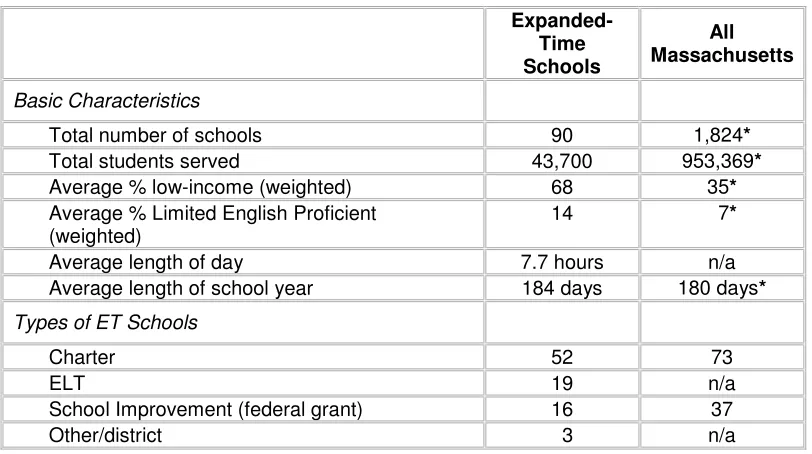
(or about 14%) feature a schedule with more time. A quick data portrait of the ET schools in Massachusetts is contained in Table 1.
Table 1. Basic facts about expanded-time (ET) schools in Massachusetts
Expanded-Time Schools
All Massachusetts
Basic Characteristics
Total number of schools 90 1,824*
Total students served 43,700 953,369*
Average % low-income (weighted) 68 35*
Average % Limited English Proficient (weighted)
14 7*
Average length of day 7.7 hours n/a
Average length of school year 184 days 180 days*
Types of ET Schools
Charter 52 73
ELT 19 n/a
School Improvement (federal grant) 16 37
Other/district 3 n/a
* Inclusive of expanded-time schools
The Effects of Expanded School Time
The fact that educators in at least 1,000 schools have made the conscious choice to add significant time to their school day and/or year indicates that they believe that this departure from the conventional schedule will benefit the teaching and learning process and, in turn, will have a positive impact on student levels of proficiency. Certainly, as the first section details, such belief is justified, in part, by considerable research, but are such convictions borne out in the real world? Do schools with substantially more time post better student outcomes and, if so, how? Research into this question divides into 3 basic camps. The first 2 tend more toward the quantitative end of the spectrum, relying primarily on statistical analysis to determine the impact of more time. Of these 2, 1 considers the role of time as a factor retrospectively, examining how expanded time may have played a role in schools that have demonstrated stronger than average performance among their students. The second considers the role of time prospectively, probing whether the introduction of more time in a school or set of schools has delivered measurable change in student performance. The final method, meanwhile, is more qualitative in nature, offering descriptions of how the reality of a longer day and/or year influences the work of education practitioners, as reported by those practitioners. Following is an attempt to synthesize or, at least, to consolidate the findings of these 3 streams of inquiry and to identify those areas that remain without sufficient answers.
The most meticulous studies within the first set of research typically center on data culled from charter schools. Research from Will Dobbie and Roland Fryer, for example, examined charter schools in New York City to identify those elements within schools that had the greatest impact on academic outcomes.27 The researchers considered traditional factors expected to have an effect on student performance, including teacher certification, class size, and per pupil expenditure, and found that these, in fact, yielded minimal correlation to outcomes. Instead they identified other often overlooked components, including the amount of instructional time and high-dosage tutoring, to be much stronger predictors of higher achievement.
students with 200 days in kindergarten made significantly more progress in mathematics from kindergarten to first grade than did students with 180 days of school.30
In the same vein as these retrospective studies, the National Center on Time & Learning conducted its own analysis of the cohort of expanded-time schools in Massachusetts to determine if student growth measures were greater in this cohort versus the general (i.e., regular-schedule) population of schools. The analysis uses the Student Growth Percentile, or SGP, which was developed by the state to measure how individual students perform each year compared to peers across the state with the same performance history. Specifically, “Each student with at least two consecutive years of MCAS scores will receive a student growth
percentile, which measures how much the student changed relative to
other students statewide with similar scores in previous years. Student growth percentiles range from 1 to 99, where higher numbers represent higher growth and lower numbers represent lower growth.”31 (p1)
The state then uses the SGP metric to determine how whole schools (and grades within schools) have performed. In particular, by identifying the median SGP within a school (or grade at a school), it is possible to discern the relative capacity of a school to change overall student performance (what might be termed its “value added”). Given the nature of the SGP metric, about two-thirds of all schools statewide post a median SGP (or MSGP) of between 40 and 60. Of the remaining one-third, they fall evenly on the lower and higher ends of the bell curve. So a school with a MSGP above 60 is considered to be a high-growth school, besting about 85% (i.e., roughly five-sixths) of all schools in the state. Likewise, a school with under 40 MSGP is considered low-growth, with about 85% of schools performing better.
Figure 3. Percentage of schools in low-, mid-, and high-growth categories among all Massachusetts schools
All schools vs. Expanded-Time (ET) schools
English Language Arts Math
Figure 4. Percentage of schools in low-, mid-, and high-growth categories among majority low-income schools only
All schools vs. Expanded-Time (ET) schools
English Language Arts Math
*N = 1,505 (all schools with SGP reported, expanded-time [ET] schools removed)
**N = 68 Massachusetts ET schools identified in NCTL database with 2011 outcomes; TechBoston Academy included as two schools (Upper and Lower Academy)
22 ET schools were either not ET schools in Spring 2011 or did not report 2011 SGP outcomes.
Even with these strong associations discovered between expanded time and better performance (or higher growth) researchers are quick to point out that these studies highlight only correlation not causation. As indicated above, there is sufficient evidence testing the more-time-equals-more-learning dynamic for individual students to confirm it as a general principle in both controlled and classroom settings. It is, however, much more complicated to determine how this dynamic might play out across whole schools and, more significantly, how it is that quantity of time relates to the hard-to-define matters of instructional quality and the holding of high expectations. The key question that these retrospective analyses leave partially unanswered is whether having more time is the source of higher student outcomes or whether the fact of a school having more time is instead associated with other educational components (e.g., strong leadership or higher-quality instruction) that might actually be the primary reason(s) why students tend to perform better. That is, we are still left to wonder whether it is the additional time that is leading to better performance or whether those schools most likely to be filled with effective educators are also those that accept an expanded-time schedule as necessary for their work. It becomes a chicken-and-egg matter, and thus, it is difficult to isolate quantity of time at the school level as a definitive factor in influencing student achievement.
From a research perspective, then, examining the effects of time prospectively might seem a more promising approach to determining the arrow of causation. Through this methodology, researchers can more systematically examine the status of student achievement before the intervention of more time and then compare it to the levels of student achievement with the presence of more school time. Indeed, results from the prospective approach do increase the degree of certainty of effects of expanding time on student performance, though vital questions still remain.
the degree to which expanded time rendered effects. (Patall et al32 do observe that the better-designed studies show more consistently positive effects.) Second, authors find that the research base is too sparse and erratic to determine optimal time amounts, the core matter of linking time to learning. Instead, as one review explains, they are left to speculate that, based on the available evidence,
. . . it seems likely that the relationship between extended school time and achievement would function as a sigmoid growth curve. That is, extending school time increases achievement slowly initially, then once some critical amount of time has been added, extending school time increases achievement rapidly. However, at some point this rapid acceleration declines such that increasing school time no longer results in commensurate gains in achievement and may even result in a negative effect on achievement.32(p429)
The final hesitation among the authors to draw definitive conclusions about the connection between expanded school time and better student performance reflects exactly the problem that the retrospective body of research spotlights—an inability to disentangle time from other educational factors. In particular, Patall et al point to instructional quality as the pivot point: “[W]e would suggest that instructional practices can be viewed as mediators of extended school time effects on students. That is, the effectiveness of instruction might determine whether extended school time has positive, negative, or no effects on student outcomes.”32(p430)
Meanwhile, in their analysis of the implementation of the ELT program, evaluators confirmed that ELT schools did allocate significantly more time to core academics, as compared to the matched cohort schools. Thus, the findings on implementation and outcomes seem somewhat contradictory. What might account for the seeming disconnect between findings on implementation (more allocated learning time) and outcomes (not significantly more learning)?
Evaluators pose 3 possible reasons. First, they suggest that the process of comparing ELT schools as a group to the matched cohort in aggregate may not yield meaningful results because the matched cohort schools did, in many cases, install “ELT-like components.” Thus, the ELT schools’ advantage over the comparison group of having roughly 300 more hours on the books may have been offset by the fact that the non-ELT schools may have found other ways to increase learning time for students in tested subjects. They may have provided extra tutoring to students during non-school hours, for example and, thus, may have effectively closed the time differentials between the 2 groups, even if these did not show up in the analysis of the official school day.26(p139)
The second reason relates to the flaw of seeking to determine effects in aggregate, rather than measuring effects in individual schools. When findings in changes in student proficiency rates from pre-intervention to the most recent year (2011) are reported for individual schools, for example, evaluators identify a number of schools (names are withheld) that did see large increases in proficiency rates, especially in middle grades, while there are also a number of schools with only small positive (or, in a few cases, small negative) changes in proficiency. Thus, when findings are aggregated across all schools, the sites that can claim greater positive effects on student proficiency are offset by those that have seen only smaller positive (or negative) effects.
Higher scores were assigned to schools that evaluators deemed to be of higher intensity of implementation in that specific criterion. The ratings of each area were then totaled to deliver an index score for each school. On a total possible score of 24 (the composite of individual ratings in 8 separate categories), evaluators report an index range of 5 to 22 among the ELT school cohort, thus indicating a wide variation in implementation fidelity.26(pp39-46)
To try to overcome the confounding effects of implementation variation, evaluators compared ELT schools to one another, based on the implementation index, to determine how these on-the-ground factors might mediate effects on outcomes. Evaluators found that those schools deemed “high implementers”—meaning the schools had a greater amount of time spent in key areas and had well-aligned goals and practices— posted achievement scores not significantly higher than “low implementers,” those schools with lower fidelity to the ELT design principles. The one exception to this finding was among the schools that had participated in the ELT initiative longest. In this case, students in high implementer schools significantly outperformed those in low implementer schools in all assessed grades and subjects. In Grade 4 reading, Grade 5 science, and Grade 8 math and science, the effect size differential between these two groups was quite strong, ranging between 0.5 to 0.7.26(p217)
The evaluators suggest that the reason for the limited findings using the implementation index methodology and internal comparisons (again, except for the most veteran participants) point to the third challenge: the fundamental difficulty of measuring the degree of educational efficacy within a classroom or school. The evaluators state: “It is important to note that these results are preliminary, as although the implementation index . . . developed for this study addresses the types of activities ELT schools engaged in and the amount of time ELT schools spent on various activities, it does not measure the quality of ELT activities.”26(p131,emphasis added)
Enter the third stream of research that seeks to provide some qualitative evidence to inform the question of how expanded time plays a role in student outcomes. The emphasis of this research is not as much on why students in schools with more time might perform better than students in traditional-schedule schools but, rather, how educational practitioners perceive the ways expanded time can enhance or accelerate their capacity to strengthen student outcomes. The National Center on Time & Learning conducted one such study in 2011 that involved an examination of expanded-time schools that had already demonstrated success (as measured by performance on state assessments). The purpose of this research was, thus, not to prove that certain school components will lead to (or may be associated with) particular outcomes but, instead, to unpack the logic and mechanisms that experienced educators employ to achieve their educational goals. This study might best be characterized as “knowledge capture” or “effective practices” research.34
The particular study explored a cohort of 30 schools that share 3 basic characteristics. The schools: (a) operate with an expanded-time schedule—that is, the schools meet the minimums described above; (b) serve a student body that is at least 50% low-income; and (c) post proficiency rates on state assessments that are at least 10 points higher than the average of the surrounding district. The cohort included a mix of elementary, middle, and high schools, with most schools located in urban areas. Researchers then conducted site visits to each school; these site visits included classroom observations, interviews with key stakeholders, and collection of extant data.
Findings from the research included the naming of 8 core practices that characterized much of the work of these schools, such as a
demonstrated focus among staff on using time efficiently, a highly
regulated system of collecting data on student performance and analyzing the results to better tailor instruction, and the deliberate cultivation of positive behaviors and attitudes among both students and teachers. Throughout the study, NCTL sought to learn how the educators' understanding of the expanded time available to them acted upon the other aspects of their school model."
The testimony from these schools, thus, lends considerable insight into the operational value of more time within the wider school structure and how particular programmatic and instructional components that appear to have an impact on educational efficacy might be included in an expanded schedule. Indeed, the practice profiles of these particular schools might help to explain why both retrospective and prospective quantitative research has uncovered an association between expanded school time and superior student performance generally: expanded time can lead not only to a greater quantity of instruction but also to more opportunities for schools to enhance such instruction through more teacher training and increased avenues for student engagement.
Yet this qualitative research, like its quantitative cousins, cannot provide all the answers we seek to the basic question of how time (and, specifically, expanded time) affects student outcomes. For one, it offers no direct comparisons to schools with more conventional instructional days (and years). It may very well be the case that traditional schools can also harness time in ways to increase educational efficacy and, thus, higher student performance may, as the quantitative research insinuates, relate more to effective use of time than to schools possessing certain larger quantities of daily minutes for instruction.
What the 3 strands of research trying to unearth the core question of how expanded-time schools affect student outcomes ultimately suggest, then, is that it may actually take a combination of methods to arrive at a fully satisfying explanation.
The Future Prospects for Expanded-Time Schools
The final question that the current movement toward increasing the number of expanded-time schools raises relates to the likelihood that such growth will continue. Signs of what is to come are, in fact, contradictory. Some signals point to the possibility that many more expanded-time schools will come into being, while others indicate that growth will slow and, in fact, that school time generally will begin to shrink.
than the norm.2(p10) Notably, the recent USED program known as “Race to the Top”—large grants to states to implement a wide range of state-level education reforms—encouraged states to make it easier to establish more charter schools. In all likelihood, then, with more charter schools will come more expanded-time schools.
The second source comes more directly from the federal government’s action. For one, the USED has indicated its continued investment in turning around low-performing schools. With additional funding in the pipeline available to support reform efforts and the bias for increased learning time in the current administration of that program, it is likely that more schools that have become federal grant recipients will be encouraged (or even required) to build in more time into their schedules for all students.
Another means for expanded time facilitated by the federal government might be through the so-called waiver system. In response to Congressional inaction on the re-authorization of the Elementary and Secondary Education Act—a delay which has left states in limbo as to how to apply accountability measures of the current law—the USED has developed a process through which states could apply to the Department for waivers from the current law. Tucked into the waiver provisions is a process enabling states to redirect funds that have been intended exclusively to support voluntary after-school programs (known as 21st Century Learning Centers) and remedial tutoring for low-performing students (through Supplemental Education Services) to now be able to fund as well expanded learning opportunities for an entire student body— essentially, an expanded-time school.36 It remains to be seen how many states and, in turn, districts and schools take advantage of the funding flexibilities built into the waiver, but with greater funding available, there is an avenue to overcome one of the chief obstacles of creating expanded-time schools.
A final source for the establishment of more expanded-time schools is found in the efforts of individual districts to modify their minimum required daily scheduled hours upwards. Districts that have adopted this approach include Elizabeth, New Jersey and Charlotte-Mecklenburg, North Carolina. Additionally, districts like Houston and Denver have designated a certain group of schools for more time but have indicated a district-wide commitment to ensuring adequate learning time for all students.
the shortest days among major districts at 5 hours, 45 minutes (for elementary schools) and a year of only 170 days. In a new agreement with the teachers’ union, the district has now reconfigured the elementary school day to be 7 hours with a school year of 180 days, thus increasing total school time in elementary schools by almost 300 hours annually. (At the secondary school level, the district has increased the standard day from 7 hours to 7-½ hours and has also extended the school year by 10 days.) With over 600 schools, this would represent, by far, the largest single effort to expand time on a mass scale.37
Against these forces pushing for school time expansion stand other fiscal realities that make implementation less likely. Not only have the revenues of individual cities declined so that their funding of the school department has tightened, but also states, which typically fund a good portion of local district budgets, face steep drops in revenues. In an era of shrinking budgets, the possibility of supporting a school reform that generally costs more appears more remote. Indeed, many districts are cutting back school time. As NCTL reported in 2011, several states, including Arizona, Nevada, and most significantly, California, have passed legislation that allows districts to cut days from the school year in order to furlough teachers and save money.38
Ultimately, school districts everywhere are confronting dual pressures, appearing to push the prospects for creating more schools with longer days and/or years in opposite directions. On the one side, fiscal constraints make the potential increasingly slim to fund a reform that usually costs some percentage more on a per pupil basis. On the other side, accountability pressures make the possibility of building in more learning time for students—a reform strategy that is becoming increasingly standard in today’s policy climate—seem all the more likely. It is difficult to know at this juncture which force will prove stronger.
Areas for Further Research
evaluation, reach this same conclusion.) That is, quantity of time is mediated by use of that time, and thus it is not possible to interpret the effects of expanded time on student outcomes without examining how schools not only allot time but also how they spend that time in individual classrooms and across the entire school year.
The contributions of qualitative research are meaningful in this regard, for this stream of investigation has demonstrated that schools with more time available are able to develop an educational program that can facilitate steps to boost teacher efficacy, suggesting a certain symbiotic relationship between the quantity of time and the quality of how it is spent. Still missing, however, is research to pinpoint 2 major areas of inquiry. The first centers on the quantities of time that might be necessary to enable those methods intended to boost quality to take full effect. How much time, for example, is needed for teacher collaboration to make a significantly positive difference in instruction? Or to what degree do enrichment activities enhance student learning throughout the school day? Or how much time might be needed to teach the Common Core Standards? Which is more effective for generating improved student outcomes—a longer day or a longer year? And picking up on the concept of a sigmoid growth curve raised by the research, how much time is enough and how much is too much?
The second area of research that deserves more attention from scholars is how the use of time might actually be used as a metric through which to assess the quality of instruction and other educational components within a school. That is, researchers tend to focus now on the matter of how quantity of time affects quality, when, in actuality, a more fitting analysis might be to examine how the uses of time in classrooms (and across schools) are strong indicators of the relative strength of teaching practice. A teacher who spends some comparatively large portion of her class time disciplining students or in ways other than direct instruction may be less effective no matter how much time she has available. Thus, it may be incumbent on researchers to engage in sophisticated observations of classrooms to begin to tease out time use correlations with accepted measures of educational efficacy (test scores and the like). Then upon this foundation of data, researchers can more productively analyze how the addition of more time might lead to greater efficacy in the classroom.
References
1. Expanded-Time Schools Database. National Center on Time & Learning Web site. http://www.timeandlearning.org/db/#. Updated May 2012. Accessed August 16, 2012.
2. Kolbe T, Partridge M, O’Reilly F. Time and Learning in Schools: A
National Profile. Boston, MA: National Center on Time and Learning and
Storrs, CT: Center for Education Policy Analysis; March 2011.
3. Rakoff J. Schooltime. Paper presented at: Annual Meeting of the American Educational Research Association; April 19, 1999; Montreal, Canada.
4. Gabrieli C, Goldstein W. Time to Learn: How a New School Schedule
Is Making Smarter Kids, Happier Parents, and Safer Neighborhoods. San
Francisco, CA: Jossey-Bass; 2008.
5. Obama B. Speech presented to: Hispanic Chamber of Commerce. March 10, 2009; Washington, DC.
6. Mullis IVS, Martin MO, Olson JF, Berger DR, Milne D, Stanco GM, eds.
TIMSS 2007 Encyclopedia: A Guide to Mathematics and Science
Education Around the World, Volumes 1 and 2. Chestnut Hill, MA: Boston
College; 2008.
7. Carroll, J. A model of school learning. Teachers Coll Rec. 1963;64:723-733.
8. Gettinger M. Individual differences in time needed for learning: a review of literature. Educ Psychol. 1984;19:15-29.
9. Gettinger M. Time allocated and spent relative to time needed for learning as determinants of achievement. J Educ Psychol. 1985;77:3-11. 10. Gettinger M. Effects of maximizing time spent and minimizing time needed for learning on pupil achievement. Amer Educ Res J. 1989;26:73-91.
11. Fisher CW, Berliner DC, Filby NN, Marliave RS, Cahen LS, Dishaw MM, et al. Teaching and Learning in the Elementary School: A Summary
of the Beginning Teacher Evaluation Study. San Francisco, CA: Far West
Lab for Educational Research and Development; 1978.
12. Rossmiller RA. Resource Utilization in Schools and Classrooms: Final
Report (Program Report 86-7). Madison, WI: Wisconsin Center for
Education Research; 1986.
13. Teaching & Learning Conditions Survey. New Teacher Center Web site. http://www.newteachercenter.org/tlcsurvey/index.php. Accessed April 2012.
14. Listening to Experts: What Massachusetts Teachers Are Saying About
Time and Learning and the Expanded Learning Time Initiative. Boston,
MA: Massachusetts 2020; 2009.
15. Education Reform: First Annual Implementation Report. Malden, MA:
16. Massachusetts Commission on Time and Learning. Unlocking the
Power of Time. Boston, MA: Massachusetts Department of Education;
November 1995.
17. Key Findings on Attitudes Toward Education and Learning.
Washington, DC: Peter D. Hart Research Associates; May 2008.
18. McMurrer J. Instructional Time in Elementary Schools: A Closer Look
at Changes for Specific Subjects. Washington, DC: Center on Education
Policy; February 2008.
19. Access to Arts Education: Inclusion of Additional Questions in
Education’s Planned Research Would Help Explain Why Instruction Time
Has Decreased for Some Students. Washington, DC: US Government
Accountability Office; 2009.
20. Louis KS, Marks HM, Kruse S. Teachers’ professional community in restructuring schools. Am Educ Res J. 1996;33:757-798.
21. Alexander KL, Entwisle DR, Olson LS. Schools, achievement, and inequality: a seasonal perspective. Educ Eval Policy Anal. 2001;23:171-191.
22. Downey DB, von Hippel PT, Broh BA. Are schools the great equalizer? cognitive inequality during the summer months and the school year. Amer
Sociol Rev. 2004;69:613-635.
23. Roth JL, Brooks-Gunn J, Linver MR. What happens during the school day? time diaries from a national sample of elementary school teachers.
Teachers Coll Rec. 2003;105:317-43.
24. Fullan M. Change Forces: Probing the Depths of Educational Reform.
New York, NY: Routledge; 1993.
25. Hurlburt S, Le Floch KC, Therriault SB, Cole S. Baseline Analyses of
SIG Applications and SIG-Eligible and SIG-Awarded Schools.
Washington, DC: National Center for Education Evaluation and Regional Assistance, US Dept of Education; May 2011.
26. Checkoway A, Gamse B, Velez M, Caven M, de la Cruz R, Donoghue N, et al; for Abt Associates. Evaluation of the Massachusetts Expanded
Learning Time (ELT) Initiative, Year Five Final Report: 2010-11.
Cambridge, MA: Abt Associates; February 2012.
27. Dobbie W, Fryer RG. Getting Beneath the Veil of Effective Schools:
Evidence From New York City. Cambridge, MA: National Bureau of
Economic Research; December 2011.
28. Hoxby CM, Murarka S, Kang J. How New York City's Charter Schools
Affect Achievement, August 2009 Report. Cambridge, MA: New York City
Charter Schools Evaluation Project; September 2009.
29. Therriault SB, Gandhi AG, Casasanto J, Carney S; for American Institutes of Research. Out of the Debate and Into the Schools; Comparing Practices and Strategies in Traditional, Pilot, and Charter Schools in the
City of Boston: Supporting Evidence for Key Findings. Boston, MA: The
Boston Foundation; May 2010.
31. MCAS Student Growth Percentiles: Interpretive Guide. Malden, MA: Massachusetts Dept of Elementary and Secondary Education; March 2011.
32. Patall EA, Cooper H, Allen AB. Extending the school day or school year: a systematic review of research (1985-2009). Rev Educ Res.
2010;80:401-436.
33. Redd Z, Boccanfuso C, Walker K, Princiotta D, Knewstub D, Moore K.
Expanding Time for Learning Both Inside and Outside the Classroom: A
Review of the Evidence Base. Washington, DC: Child Trends; 2012.
34. Kaplan C, Chan R. Time Well Spent: Eight Powerful Practices of
Successful, Expanded-Time Schools. Boston, MA: National Center on
Time & Learning; 2011.
35. Digest of Education Statistics. Table 100: Number and enrollment of public elementary and secondary schools, by school type, level, and charter and magnet status: Selected years, 1990-91 through 2008-09. US Dept of Education Web site.
http://nces.ed.gov/programs/digest/d10/tables/dt10_100.asp. 2010. Accessed May 30, 2012.
36. ESEA Flexibility: Frequently Asked Questions. US Dept of Education
Web site.
http://www.swaec.org/Documents/ESEA_Resources/esea-flexibility-faqs.pdf. Published October 3, 2011. Accessed May 24, 2012. 37. Zorn E. Chicago’s longer school day—facts, figures and a Q&A.
Chicago Tribune. August 9, 2012.
http://blogs.chicagotribune.com/news_columnists_ezorn/2012/08/ school-hours-and-staffing-q-a-.html. Accessed August 16, 2012.
38. Farbman D. Learning Time in America: Trends to Reform the American