ISSN: 2279-087X (P), 2279-0888(online) Published on 5 September 2012
www.researchmathsci.org
44
Applications of *b-open Sets and **b-open Sets in
Topological Spaces
T. Indira1and K. Rekha2
1
Department of mathematics, Seethalakshmi Ramaswami College, Tiruchirappalli-620 002, Tamilnadu, India.
Email: [email protected]
2
Department of mathematics, Bishop Heber College, Tiruchirappalli-620 017, Tamilnadu, India. Email: [email protected]
Received 18 August 2012; accepted 28 August 2012
Abstract. In this paper, we introduce D(c,*b)-set,D(c,**b)-set, **b-continuous, locally **b-closed continuous, D(c,*b)-continuous, D(c,**b)-continuous functions and discuss some properties of the above sets and continuous functions.
AMS Mathematics Subject Classification (2010):54A05, 54D05 Keywords : *b-open sets,**b-open sets, t-sets, t*-sets, B-sets, B*-sets. 1. Introduction
45
no separation assumed, unless otherwise stated. Let
A
⊆
X
,the closure ofAand the interior ofAwill be denoted byCl(A)andInt(A), respectively.2. Preliminaries
Definition 2.1. A subset A of a space X is said to be : 1. Semi-open [14] ifA⊆Cl(Int(A))
2. Pre open[15] ifA⊆Int(Cl(A)) 3.
α
-open [16] if A⊆ Int(Cl(Int(A)))4.
β
-open [1,4] if A⊆Cl(Int(Cl(A)))5. b-open [3] if A⊆Cl(Int(A))∪Int(Cl(A))
6. *b-open [10] if A⊆Cl(Int(A))∩Int(Cl(A))
7. b**-open [6] if A⊆Int(Cl(Int(A)))∪Cl(Int(Cl(A)))
8. **b-open [10] if A⊆Int(Cl(Int(A)))∩Cl(Int(Cl(A)))
Definition 2.2. A subset A of a space X is called: 1. t-set [21] ifInt(A)=Int(Cl(A))
2. t*-set [10] if Cl(A)=Cl(Int(A))
3. B-set [21] if
A
=
U
∩
V
, whereU
∈
τ
andV
is a t-set. 4. B*-set [10] ifA
=
U
∩
V
, whereU
∈
τ
andV
is a t*-set.5. locally closed [5] if
A
=
U
∩
V
, whereU
∈
τ
andV
is a closed set. 6. locally b-closed [6] ifA
=
U
∩
V
, whereU
∈
τ
andV
is a b-closed set. 7. locally *b-closed [10,13] ifA
=
U
∩
V
, whereU
∈
τ
andV
is a *b-closed set. 8. locally b**-closed [6] ifA
=
U
∩
V
, whereU
∈
τ
andV
is a b**-closed set. 9. locally **b-closed [10] ifA
=
U
∩
V
, whereU
∈
τ
andV
is a **b-closed set. 10. D(c,b) –set [21] if Int(A)=bInt(A)11. D(c,b**) –set [6] if Int(A)=b**Int(A)
Definition 2.3. A function f :X →Yis called [1,2,12,13,14,15,16,22]:
1. semi continuous if
f
−1(
V
)
is semi open in X for each open set
V
of Y. 2. pre continuous iff
−1(
V
)
is pre open in X for each open setV
of Y. 3.α
-continuous iff
−1(
V
)
isα
- open in X for each open setV
of Y . 4.β
-continuous iff
−1(
V
)
isβ
-open in X for each open setV
of Y . 5. b-continuous iff
−1(
V
)
is b-open in X for each open set
V
of Y. 6. *b-continuous iff
−1(
V
)
is *b-open in X for each open set
V
of Y . 7. b**-continuous iff
−1(
V
)
46 8. t-continuous if
f
−1(
V
)
is t-set inX for each open set
V
of Y. 9. B-continuous iff
−1(
V
)
is B-set inX for each open set
V
of Y. 10. locally closed continuous iff
−1(
V
)
is locally closed in X for each open set
V
of Y .11. locally b-closed continuous if
f
−1(
V
)
is locally b-closed in X for each open set
V
of Y.12. locally *b-closed continuous if
f
−1(
V
)
is locally *b-closed in X for each open setV
of Y.13. locally b**-closed continuous if
f
−1(
V
)
is locally b**-closed in X for each open set
V
of Y.14. completely continuous if
f
−1(
V
)
is regular open in X for each open setV
of Y.
15. D(c,b)-continuous if
f
−1(
V
)
is D(c,b)-set in X for each open set
V
of Y. 16. D(c,*b)-continuous iff
−1(
V
)
is D(c,*b)-set in X for each open set
V
of Y. 17. D(c,b**)-continuous iff
−1(
V
)
is D(c,b**)-set in X for each open set
V
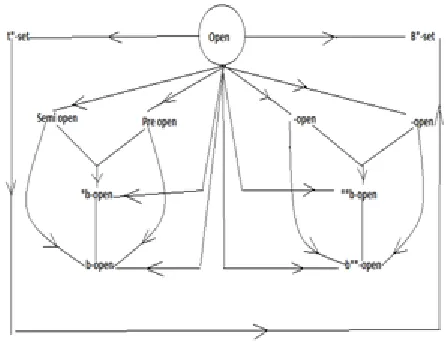
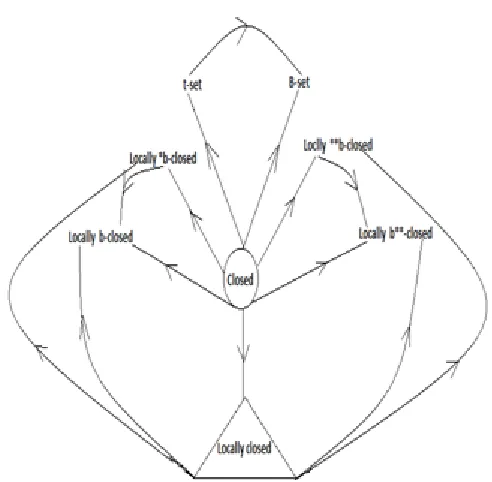
of Y. The Figure 1 and Figure 2 give the relations between the above sets.Figure 1
3. Properties of *b-open sets and **b-open sets Definition 3.1. A subset A of a space X is called: 1. D(c,*b) –set ifInt(A)=*bInt(A)
47 Result 3.2.
1.Every regular open set is a t-set. 2.Every regular closed set is a t*-set. 3.Every locally closed set is a B-set.
Theorem 3.3. Let A be a subset of (X,
τ
).Then to prove the following: 1. A is a t-set iff it is semi closed.2. A is a t*-set iff it is semi open.
Figure 2
Proof.
1. Let A be a t-set.
Then Int(A)=Int(Cl(A))
Therefore Int(Cl(A))⊆ A
⇒
A is semi closed.Conversly, Assume that A is semi closed Then Int(Cl(A))⊆ A
) ( ))) ( (
(Int Cl A Int A
Int ⊆
) ( )) (
(Cl A Int A
Int ⊆ (1)
48 From (1) and (2)
)) ( ( )
(A Int Cl A
Int =
⇒
A is a t-set.2 Let A be a t*-set. Then ClA)=Cl(Int(A))
Therefore A⊆Cl(Int(A))
⇒
A is semi open.Conversly, Assume that A is semi open Then A⊆Cl(Int(A))
))) ( ( ( )
(A Cl Cl Int A
Cl ⊆
)) ( ( )
(A Cl Int A
Cl ⊆ (1) Since Cl(Int(A))⊆Cl(A) (2)
From (1) and (2)
)) ( ( )
(A Cl Int A
Cl =
⇒
A is a t*-set.Theorem 3.4.
1. If A andBare t-sets, then A∩Bis a t-set. 2. If A andB are t*-sets, then A∪Bis a t*-set.
Proof.
1. Let AandBbe t-set.
Then we have Int(A)= Int(Cl(A)); Int(B)=Int(Cl(B))
Since Int(A∩B)⊆Int(Cl(A∩B))
⊆Int(Cl(A)∩Cl(B)) = Int(Cl(A))∩Int(Cl(B)) = Int(A)∩Int(B)
= Int(A∩B)
Int(A∩B)⊆Int(Cl(A∩B))⊆ Int(A∩B)
⇒
Int(A∩B)=Int(Cl(A∩B))
⇒
A∩Bis a t-set.2. Let AandBbe t*-set.
Then we have Cl(A)=Cl(Int(A)); Cl(B)=Cl(Int(B))
Since Cl(A∪B)=Cl(A)∪Cl(B)=Cl(Int(A))∪Cl(Int(B))
49 ⊂Cl(Int(A∪B))
Cl(A∪B)⊂Cl(Int(A∪B)) (1)
Since Int(A∪B)⊂ A∪B
Cl(Int(A∪B))⊂Cl(A∪B) (2)
From (1) and (2)
Cl(A∪B)=Cl(Int(A∪B))
⇒
A∪Bis a t*-set.Theorem 3.5. A set A is a t-set iff its complement is a t*-set. Proof.
Let A be a t-set.
Then Int(A)=Int(Cl(A))
⇔
X −Int(A)= X −Int(Cl(A))⇔
Cl(X −A)=Cl(Int(X −A))⇔
Cl
(
A
c)
=
Cl
(
Int
(
A
c))
⇔
A
cis a t*-set.
Theorem 3.6. For a subset A of a space(X,
τ
), the following are equivalent: 1. A is open.2. A is pre open and a B-set.
Proof.
To prove: (1)
⇒
(2) Let A be openThen A=Int(A)
⇒
Int(A)⊆ Int(Cl(A))⇒
A⊆Int(Cl(A))⇒
Ais pre openLet
U
=
A
∈
τ
andV
=
X
be a t-set containing AV
U
A
=
∩
⇒
⇒
A is a B-set.Hence A is pre open and a B-set.
To prove: (2)
⇒
(1)LetAbe pre open and a B-set Since Ais a B-set
50
⇒
Int(V)= Int(Cl(V))sinceAis pre open
⇒
A⊆Int(Cl(A))= Int(Cl(U ∩V)) =Int(Cl(U))∩Int(V)∴U ∩V ⊂Int(Cl(U))∩Int(V)
Consider
U ∩V =(U ∩V)∩U⊂[Int(Cl(U))∩Int(V)]∩U =U ∩Int(V)
) (V Int U V
U∩ ⊂ ∩
⇒
) (V Int
V ⊂
⇒
) (V Int V = ⇒
⇒
A=U∩V =U∩Int(V)⇒
A=Int(A)⇒
Ais open.Theorem 3.7. For a subset Aof a space (X,
τ
), the following are equivalent: 1.Ais regular open2. Ais pre open and a t-set. Proof.
To prove: (1)
⇒
(2) Let Abe regular open. Then A= Int(Cl(A))A
⇒
is pre open SinceA=Int(Cl(A))⇒
Int(A)= Int(Cl(A))⇒
Ais a t-set. To prove: (2)⇒
(1)LetAbe pre open and a t-set.
Then A⊆ Int(Cl(A)) (1)
Since Ais a t-set
Then Int(Cl(A))⊆ A (2)
From (1) and (2)
Ais regular open.
Theorem 3.8. For a subset Aof a space (X,
τ
), the following are equivalent: 1.Ais regular closed2.Ais pre closed and a t*-set. Proof.
51 Then A=Cl(Int(A))
A
⇒
is pre closed SinceA=Cl(Int(A))⇒
Cl(A)=Cl(Int(A))⇒
Ais a t*-set. To prove: (2)⇒
(1)LetAbe pre closed and a t*-set.
Then Cl(Int(A))⊆ A (1)
Since Ais a t-set
Then A⊆Cl(Int(A)) (2) From (1) and (2)
Ais regular closed.
Theorem 3.9.
1. The intersection of a b-open set and a *b-open set is a b-open set. 2. The intersection of a b**-open set and a **b-open set is a b**-open set.
Theorem 3.10.
1. The intersection of a locally b-closed set and a locally *b-closed set is a locally b-closed set.
2. The intersection of a locally b**-closed set and a locally **b-closed set is a locally b**-closed set.
Theorem 3.11. For a subset Aof an extremally disconnected space(X,
τ
),the following are equivalent:1. Ais open
2. Ais *b-open and locally closed 3. Ais b-open and locally closed Proof.
Let Abe a subset of an extremally disconnected space (X,
τ
). Then Cl(Int(A))=Int(Cl(A))To prove: (1)
⇒
(2) From theorem 2.4[13], To prove: (2)⇒
(3)LetAbe *b-open and locally closed Since Every *b-open set is b-open.
⇒
Ais b-open and locally closed To prove: (3)⇒
(1)From theorem 2.1[2],
52 1.Ais open
2. Ais *b-open and D(c,*b)-set 3. Ais b-open and D(c,b)-set Proof.
To prove: (1)
⇒
(2) From theorem 2.7[13], To prove: (2)⇒
(3)Let Abe *b-open and D(c,*b)-set
Then A=*bInt(A)andInt(A)=*bInt(A) (1)
Since Every *b-open set is b-open.
⇒
Ais b-open.⇒
A=bInt(A) (2)From (1) and (2)
) ( * )
(A bInt A
bInt
A= = (3)
From (1) and (3)
) ( )
(A bInt A
Int =
⇒
Ais a D(c,b)-set. To prove: (3)⇒
(1)Let Abe b-open and D(c,b)-set To prove: Ais open
Since A=bInt(A)andInt(A)=bInt(A)
⇒
Ais open.Theorem 3.13. For a subset Aof an extremally disconnected space(X,
τ
), the following are equivalent:1.Ais open
2.Ais **b-open and locally closed 3.Ais b**-open and locally closed Proof.
Let Abe a subset of an extremally disconnected space (X,
τ
). Then Cl(Int(A))=Int(Cl(A))To prove: (1)
⇒
(2) From theorem 2.9 [10], To prove: (2)⇒
(3)LetAbe **b-open and locally closed Since Every **b-open set is b**-open.
⇒
Ais b**-open and locally closed To prove: (3)⇒
(1)From theorem 2.1[6],
53 1.Ais open
2.Ais **b-open and D(c,**b)-set 3.Ais b**-open and D(c,b**)-set Proof.
To prove: (1)
⇒
(2). Let Abe openTo prove:Ais **b-open From theorem 2.9[10] , To prove: Ais a D(c,**b)-set
Since Ais open and Every open set is **b-open. Then A= Int(A)=**bInt(A)
⇒
Ais a D(c,**b)-set. To prove: (2)⇒
(3)Let Abe **b-open and D(c,**b)-set
Then A=**bInt(A)andInt(A)=**bInt(A)
(1)
Since Every **b-open set is b**-open.
⇒
Ais b**-open.⇒
A=b**Int(A) (2)From (1) and (2)
) ( * * ) ( *
* Int A bInt A
b
A= = (3)
From (1) and (3)
) ( * * )
(A b Int A
Int =
⇒
Ais a D(c,b**)-set. To prove: (3)⇒
(1)Let Abe b**-open and D(c,b**)-set To prove: Ais open
Since A=b**Int(A)andInt(A)=b**Int(A)
⇒
Ais open.4. Applications of *b-continuous and **b-continuous functions Definition 4.1.
A function f :X →Yis called: 1. **b-continuous if
f
−1(
V
)
is **b-open in X for each open set
V
of Y. 2. t*-continuous iff
−1(
V
)
is t*-set in X for each open setV
of Y . 3. B*- continuous iff
−1(
V
)
is B*-set inX for each open setV
of Y .4. locally **b-closed continuous if
f
−1(
V
)
is locally **b-closed in X for each open setV
of Y.5. D(c,**b)-continuous if
f
−1(
V
)
54 Example 4.2.
Let X ={a,b,c,d}
τ
={X,φ
,{c},{d},{c,d},{a,c,d},{{b,c,d}}ς
={X,φ
,{a,b,d},{a,b,c},{a,b},{b},{a}} 1.The collection of **b-open sets ={X,
φ
,{c},{d},{c,d},{a,c,d},{b,c,d}}Define a function f :X → X such that f(a)=b, f(b)=a, f(c)=d, f(d)=c
Then f is **b-continuous. 2.The collection of t*- sets = }} , , { }, , , { }, , , { }, , { }, , { }, , { }, , { }, , { }, { }, { }, { , ,
{X
φ
b c d a c a d b c b d c d a b c a b d b c dDefine a function such tha f(a)=b, f(b)=d, f(c)=a, f(d)=c
Then f is t*-continuous.
3.The collection of B*-sets = }} , , { }, , , { }, , , { }, , , { }, , { }, , { }, , { }, , { }, , { }, { }, { }, { , ,
{X
φ
b c d a c a d b c b d c d a b c a b d a c d b c dDefine a function such tha f(a)=b, f(b)=d, f(c)=a, f(d)=c
Then f is B*-continuous.
4. The collection of locally **b-closed sets =
{X,
φ
,{a},{b},{c},{d},{a,b},{a,c},{a,d},{b,c},{b,d}, {c,d},{a,b,c},{a,b,d},{a,c,d},{b,c,d}}Define a function such tha f(a)=c, f(b)=a, f(c)=b, f(d)=d
Then f is locally **b-closed continuous. 5. The collection of D(c,**b)-sets =
{X,
φ
,{a},{b},{c},{d},{a,b},{a,c},{a,d},{b,c},{b,d},{c,d},{a,b,c},{a,b,d},{a,c,d},{b,c,d}} Define a function such that f(a)=c, f(b)=a, f(c)= f(d)=d
Then f is D(c,**b)-continuous.
Theorem 4.3. Let f :X →Ybe a function and let X be an extremally disconnected space. Then the following are equivalent:
1. f is continuous
2. f is *b-continuous and locally closed continuous 3. f is b-continuous and locally closed continuous Proof.
X X
f : →
X X
f : →
X X
f : →
X X
55 It follows from theorem 3.11.
Theorem 4.4. Let f :X →Ybe a function. Then the following are equivalent: 1. f is continuous
2. f is *b-continuous and D(c,*b)-continuous 3. f is b-continuous and D(c,b)-continuous Proof.
It follows from theorem 3.12.
Theorem 4.5. Let f :X →Y be a function and let X be an extremally disconnected space. Then the following are equivalent:
1. f is continuous
2. f is **b-continuous and locally closed continuous 3. f is b**-continuous and locally closed continuous Proof. It follows from theorem 3.13 .
Theorem 4.6. Let f :X →Ybe a function. Then the following are equivalent: 1. f is continuous
2. f is **b-continuous and D(c,**b)-continuous 3. . f is b**-continuous and D(c,b**)-continuous Proof. It follows from theorem 3.14.
Theorem 4.7. Let f :X →Ybe a function. Then
1. f is continuous iff f is pre continuous and B-continuous
2. f is completely continuous iff f is pre continuous and t-continuous 3. . f is t*-continuous iff f is semi continuous
Proof.
1.It follows from theorem 3.6. 2.It follows from theorem 3.7. 3.It follows from theorem 3.3(2).
REFERENCES
1. M.E. Abd El-Monsef, S.N. El-Deep and R.A. Mahmoud,
β
-open sets andβ
-continuous mappings, Bull-Fac. Sci. Assiut. Univ.,12 (1983) 77-90.2. Ahmad Al-Omari and Mohd.Salmi Md. Noorani, Decomposition of continuity via b-open set, Bol. Soc. Paran. Mat. (3s) 26(1-2) (2008) 53-64.
56
5. N. Bourbaki, General Topology, Part 1, Addison-Wesley (Reading, Mass, 1966).
6. S. Bharathi, K. Bhuvaneshwari, N. Chandramathi, On locally b**-closed sets, International Journal of Mathematical Sciences and Applications, 1(2) (2011) 636-641.
7. M. Ganster and I.L. Reilly, A Decomposition of continuity, Acta Math. Hungar, 56(3-4) (1990) 229-301.
8. 8.T. Hatice, Decomposition of continuity, Acta Math. Hungar, 64(3) (1994) 309-313.
9. T. Hatice and T. Noiri, Decomposition of continuity and complete continuity, Acta Math. Hungar, 113 (4) (2006) 278-281.
10. T. Indira and K. Rekha, On locally **b-closed sets, Proceedings of the Heber International Conference on Applications of Mathematics and Statistics (HICAMS) (2012).
11. T. Indira and K. Rekha, *b-t-sets in topological spaces, Presented in National seminar on Applications of Mathematics, held at Jamal Mohamed College (Autonomous), Tiruchirappalli-20 during 22nd February (2012). Communicated
12. T. Indira and K. Rekha, On Almost *b-continuous functions, Antarctica Journal of Mathematics, 9 (2012) , accepted for publications.
13. T. Indira and K. Rekha, Decomposition of continuity via *b-open set, Communicated (2012).
14. N. Levine, Semi open sets and semi-continuity in topological spaces, Amer Math. Monthly, 70 (1963) 36-41. MR0166752(29#4025)
15. A.S. Mashhour, M.E. Abd El-Monsef and S.N. El-Deeb, On pre-continuous and weak pre continuous mapping, Proc Math Phys Soc Egypt, 53 (1982) 47-53.
16. A.S. Mashhour, I.A. Hasanein and S.N. El-Deep,
α
-continuity andα
-open mappings, Acta Math. Hungar, 41 (1983) 213-218.17. O. Njastad, On some classes of neary open sets, Pacific J. Math, 15 (1965) 961-970. MR0195040 (33:3245)
18. T. Noiri and R. Sayed, On decomposition of continuity, Acta Math. Hungar, 111(1-2) (2006) 1-8.
19. M. Przemski, A decomposition of continuity and
α
-continuity, Acta Math. Hungar, 61(1-2) (1993) 93-98.20. I.L. Reilly and M.K. Vamanamurthy, On
α
-continuity in Topological spaces, Acta Math. Hunger., 45 (1-2) (1985) 27-32.21. J. Tong, On decomposition of continuity in Topological spaces, Acta Math. Hungar, 54 (1-2) (1989) 51-55.