119 | P a g e M21-1-1-4-2014
1. INTRODUCTION
A mobile ad hoc network (MANET) is a network consisting of a set of mobile nodes with no centralized administration. MANET is self-configuring, self-organizing and self-maintaining. MANET may have dynamic topology. These networks do not work on any infrastructure and the mobiles communicate either directly or via other nodes of the network by establishing routes. These routes are prone to frequent ruptures because of nodes mobility. In this paper multipath routing protocols are studied which directly or indirectly helps to solve the problem of congestion. By reducing the congestion authors have shown that overall performance of the network can be increased with respect to packet delivery ratio, end to end delay and routing overhead.
2. MULTICHANNEL MOBILE AD-HOC LINKS FOR MULTIMEDIA
COMMUNICATION
In this mechanism two multichannel routing protocols are discussed. The first one is based on single-path routing and aims at suppressing the intra-path interference in a
Journal homepage: www.mjret.in
ISSN:2348 - 6953
Shitalkumar A Jain
Computer Engineering Department MIT Academy of Engineering
Alandi (D), Pune, India
A Study on Congestion Aware
Multipath Routing Protocols in
MANET
Abstract
Traditional routing schemes that route all traffic along a single path. Multipathrouting strategy takes more than one possible path between the same source and destination pair. This facility is used to control the congestion and overcome the performance degradation. Unlike single path routing, multipath routing relies on multiple paths if one route fails without halting the data transmission multipath routing strategy chooses another alternate path and continues the transmission. In this paper several fundamental multipath routing protocols are discussed in detail. Every protocol has its unique feature and it controls congestion in a different way.
120 | P a g e M21-1-1-4-2014
carrier sense multiple access/collision avoidance network. This is achieved by developing a link-partitioning scheme where nodes in the neighboring partitions operate at different non- overlapping frequency bands. The second multichannel scheme is developed for transmission of real-time traffic over multiple-path routes. Unfortunately, in mobile ad hoc network environments, particularly for real-time traffic, it can suffer greatly from co-channel interference due to the simultaneous transmission of packets via multiple routes. A dual-path routing protocol is designed, which guarantees a different frequency band for each path, thus eliminating any inter-path interference. Concepts used in single inter-path multichannel routing and partitioning are Alternate switching channel system (ASCS), Link Partitioning, Three Channel Extensions, RTC/CTS mechanism, Route Discovery / Data Transmission, Route maintenance.
Fig.2.1 Alternate Switching Channel System (ASCS)
While in Multipath channel routing concepts of Dual channel-dual path routing (DDR), Dual Description video coding are used for Performance Evaluation, to reduce interference from wireless equipment, to improve picture quality of streaming video. Root cause of interference is overlapping of frequency bands while transmitting & receiving packets. Proposed solution for it is link partition scheme which is effective for controlling inter-path interference.
By removing inter and intra path interference it helps to minimize the level of congestion. Protocol uses only two paths for transmission. Multiple paths can be used with multi channel concept.
3. EARLY CONGESTION DETECTION AND ADAPTIVE ROUTING IN MANET
121 | P a g e M21-1-1-4-2014
Fig. 3.1 Bidirectional Path Discovery
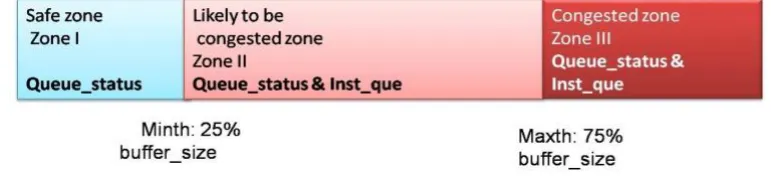
EDCSCAODV is Early Detection Congestion and Self Cure routing consists of three components Route Discovery, Early Congestion detection and Self Cure Routing.
Fig.3.2 Buffer Status
Performance Metrics used to compare with AODV and AOMDV are Packet Delivery Ratio (PDR), End-to-End Delay and Routing overhead. Protocol works with fewer packets loss and tries to prevent congestion from occurring in the first place. A key in EDAPR design is the NHN nodes selection it does not incur heavy overhead to find non-congested paths. It also monitors congestion status during data transmission. Based on congestion status it finds an alternate route through NHN set with short end-to-end delay.
Protocol works with low velocity network only. It does not consider the load of nodes and number of active paths going through the node while selecting the NHN.
4. A GREEDY-BASED STABLE MULTIPATH ROUTING PROTOCOL IN
MOBILE AD-HOC NETWORK
122 | P a g e M21-1-1-4-2014
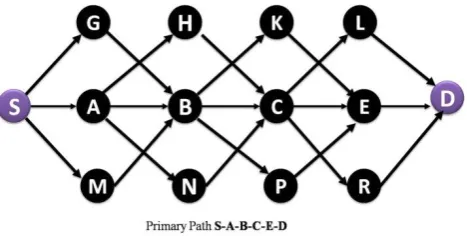
path fails and it greatly reduces the network overhead. The concept of primary path and local backup path is shown in Fig 4.1
Fig 4.1 Primary Path and Local-backup Path
Greedy based backup path routing protocol improves route stability. When a link in the primary path fails, the upstream node of the failed link in the primary path can continue the data delivery through local backup path. It has excellent performance in terms of packet delivery ratio and control overhead.
Intermediate nodes have to keep large amount control information and only single local backup path can be formed. Throughput may decrease for high velocity and heavy traffic.
5. MULTIPATH FRESNEL ZONE ROUTING WITH LOAD BALANCING
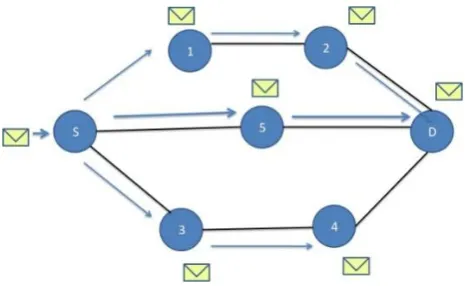
This protocol avoids congestion using multipath routing by balancing load and dispersing traffic into multiple paths. Load balancing is shown in Fig. 5.1
Fig 5.1 Load Balancing with Multipath
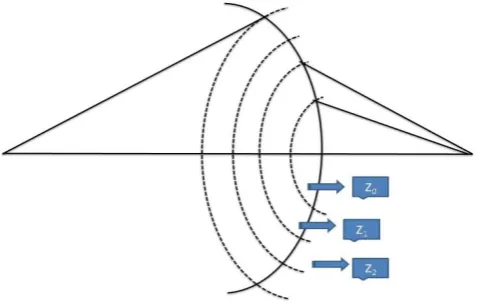
Fresnel zone routing protocol construct the Fresnel zones and disperse the traffic in multiple path along the zones shown in Fig. 5.2.
123 | P a g e M21-1-1-4-2014
FZR are avoids routing latency, provides batter resource utilization and lowers the chances of congestion.
Fig 5.2 Fresnel Zone Construction
It does not consider the effect of rapid topology changes and TCP congestion mechanism does not work well with FZR. Number of overlapping will create the problems for node and link disjointness. Very few paths can be used for data transmission.
6. CHANNEL AWARE ROUTING IN MANETS WITH ROUTE HANDOFF
It proposes a novel channel adaptive routing protocol which extends the Ad-hoc On-Demand Multipath Distance Vector routing protocol (AOMDV) to accommodate channel fading. Route discovery in CA-AOMDV is an enhanced version of route discovery in AOMDV, incorporating channel properties for choosing more reliable paths it is necessary to find efficient ways of addressing path failure. In this mechanism, using prediction and handoff to preempt fading on a link on the active path, disconnections can be minimized, reducing transmission latency and packet drop rate. During path maintenance, predicted signal strength and channel average fading duration are combined with handoff to combat channel fading and improve channel utilization. Throughput decreases with increased node mobility in AOMDV, but CA-AOMDV outperforms. It maintains a lower routing overhead compared with AOMDV and decreases of average end-to-end delay.
It increases the overall control overhead with respect to other summarized protocol.
7. SMORT : SCALABLE MULTIPATH ON-DEMAND ROUTING FOR
MANETS
124 | P a g e M21-1-1-4-2014
order to compute fail-safe paths. It minimizes the amount of routing overhead generated by single path on-demand routing overhead. Source node receives primary path after initiating the route discovery and which is shortest path. The advantage of node-disjoint path is that they are independent of each other.
Fig 7.1 Node-Disjoint Paths
In large network, total numbers of node-disjoint paths at all nodes are less, hence AODV is modified to use fail-safe path. A fail-safe path is path between source and destination if it bypasses at least one intermediate node on the primary path. Due to this more fail-safe paths are computed than node-disjoint or link-disjoint multiple paths. Fail-safe multiple paths are different from both node-disjoint and link-disjoint path. They can have both nodes and links in common. Fail-safe segment is fail-safe path that bypasses node(s) on the primary path. Each node on primary path accepts at most two secondary paths in order to limit the multipath computation.
Fig 7.2 Fail-Safe Paths
125 | P a g e M21-1-1-4-2014
Performance metrics used like throughput, routing overhead and average packet transmission delay in which improvement seems with respect to basic protocols. But it cannot work with high velocity ad hoc networks.
8. CONGESTION ADAPTIVE ROUTING IN MOBILE AD-HOC NETWORKS
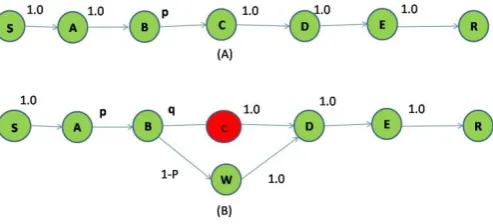
In CRP protocol Power consumption is efficient because traffic load is fairly distributed and Congestion is resolved beforehand and, consequently, CRP contains a small packet loss rate. Congestion Adaptive Routing (CRP) is a congestion adaptive single path routing protocol for MANETs. Every node appearing on a route warns its previous node when prone to be congested. It is on-demand routing protocol and consists of the six main components like Congestion monitoring, Primary route discovery, Bypass discovery, Traffic splitting and congestion adaptively, Multipath minimization, Failure recovery.
Fig 8.1 (A) Primary Path S to R (B) Bypass Route B-W-D
CRP contains fewer packet losses than routing protocols that are not adaptive to congestion. A bypass in CRP is a sub path connecting a node and the next non-congested node. CRP makes the network less non-congested as the queuing delay is less. Since recovery of a link breakage is realized by making use of the existing bypass paths, the delay due to new-route establishment is also low.
Only one bypass route is allowed whereas it is possible to discover more bypass through any node which is expected in highly dense ad hoc network.
9. SPLIT MULTIPATH ROUTING WITH MAXIMALLY DISJOINT PATHS IN AD HOC NETWORKS
126 | P a g e M21-1-1-4-2014
forwards this packet. Destination waits for some time to receive more RREQs to learn all possible routes. Destination then selects the route which is maximally disjoint to the first route. If there are more maximally disjoint routes with the first route, the one with shortest hop distance is chosen. If there are multiple routes that meet the above condition, then quick delivery of RREQ among the path is considered. Due to mobility of node route can be broken and RERR packet is propagated from upstream node to the source node along the reverse path. RERR message contains route to the source, immediate upstream node of broken link and immediate downstream node of broken link.
The performance of SMR is poor in dense networks and networks with high traffic load because of the immense control traffic generated. More than 2 paths can be used for data transmission. Not suitable for real time application.
10.RESULT AND ANALYSIS
a. Multichannel Mobile Ad-Hoc Links for Multimedia Communication
i. Throughput comparison between Split Multipath Routing (SMR) and Dual-Channel/Dual-Path (DDR) with number of packet size indicates DDR done well if packet size is increased.
ii. Throughput is compared between SMR and DDR by considering number of nodes. DDR outperform SMR in term of throughput if average number of nodes are increased.
b. Early Congestion Detection and Adaptive Routing in MANET
i. This scheme works with fewer packet losses than other techniques ii. When data packet-sending rate is low delay increases almost linearly
with increase in offered load.
iii. In heavy traffic routing overhead of EDPAR is reduced from 15%-13% than EDCSCAODV
c. A Greedy-Based Stable Multipath Routing Protocol in Mobile Ad-hoc Network
i. Node mobility does not guarantee multimedia transmission in network with dynamic topology
ii. Node transmission range (in meters) is directly proportional to packet delivery ratio.
d. Multipath Fresnel Zone Routing with Load Balancing
i. Frequent change of topology affects the zone construction process ii. As traffic load increases end-to-end delay is slightly increases than the
delay when traffic load is medium.
iii. As compared to SMR, Multipath Distance Vector Routing low end-to-end delay when traffic load is high.
iv. It is also proven that if traffic load is high then maximum number of packets delivered from one node to intermediate node.
127 | P a g e M21-1-1-4-2014
i. CA-AOMDV outperforms AOMDV when packet delivery ratio is increases with increase in packet transmission rate.
ii. It generated measurable routing control overhead. Theoretical results are of CA-AOMDV approximately matching with simulation result of AOMDV
f. SMORT : Scalable Multipath On-Demand Routing for MANETs
i. Number of nodes increases throughput decreases as compared to AODV and DMRP
ii. Routing Overhead – Low routing overhead as increase in number of nodes than AODV
iii. RERR Packets Overhead – As number of nodes increases there is slight increase in RERR overhead than AODV
iv. Network Load Vs CTRL Packets – Increase in network overhead increases CTRL overhead.
g. Congestion Adaptive Routing in Mobile Ad-Hoc Networks
i. End-to-End Delay – CRP provides average shorter delay than AODV and DSR
ii. Data Packet Delivery Ratio –CRP and AODV successfully deliver more data packets than DSR
iii. Protocol Overhead – CRP and DSR are lightweight than AODV. If network traffic is heavy CRP done exceptionally well than AODV and DSR
iv. Energy Efficiency – CRP is more energy efficient than AODV h. New Multipath Node-Disjoint Routing Based on AODV Protocol
i. It has low overhead than AODV-Multipath
i. Split Multipath Routing with Maximally Disjoint Paths in Ad hoc Networks i. Number of packet drop is low as compared to DSR
ii. Routing Load – SMR generates more control packets than DSR which degrades performance
iii. Mobility increases hop distance resulting in longer paths in SMR
11.CONCLUSION
128 | P a g e M21-1-1-4-2014
REFERENCES
[1]. Broch J, Johnson DB, Maltz DA. The dynamic source routing for mobile ad hoc networks IETF Internet-draft, draft-ietf-manet-dsr-00 txt; 1998.
[2]. Carthy PM, Grigoras D. Multipath associativity based routing In: Proceedings of the second annual conference on wireless on-demand network systems and services (WONS), 2005, p.60–9.
[3]. Cha M, Lee D K. Split-n-save multiplexing in wireless ad hoc routing In: Proceedings of the 24th annual joint conference of the IEEE computer and communications societies (INFOCOM), Miami, March2005.
[4]. Chen, Xiaoqin and Jones, Haley and Jayalath, Dhammika, Channel aware routing in MANETs with route handoff IEEE Transactions on Mobile Computing VOL. X, NO. X, 2010
[5]. Duc A. Tran, Harish Raghavendra, Member, IEEE, Congestion Adaptive Routing in Mobile Ad Hoc Networks, In: IEEE Transactions On Parallel And Distributed Systems, Vol. 17, No. 11, November 2006.
[6]. Hamid Gharavi, Fellow IEEE, Multichannel Mobile Ad Hoc Links for Multimedia Communications INVITED P A P E R, Proceedings of the IEEE, Vol. 96, No. 1, January 2008
[7]. Huang X, FangY End-to-end delay differentiation by prioritized multipath routing in wireless sensor networks In: Military communications conference, MILCOM 2005, vol.2, p.1277–83.
[8]. Jing F, Bhuvaneswaran R S, Katayama Y, Takahashi N. A multipath on-demand routing with path selection probabilities for mobile ad hoc networks In: Proceedings of the international conference on wireless communications, Networking and mobile computing, 2005, vol.2, p.1145–8
[9]. Lee S-J, Gerla M. SMR: split multipath routing with maximally disjoint paths in ad hoc networks. Technical report, Computer Science Department, University of California, LosAngeles, August2000.
[10]. Li X, Cuthbert L. Stable node-disjoint multipath routing with low overhead in mobile ad hoc networks In: Proceedings of the IEEE computer society’s 12th annual international symposium on modeling, analysis, and simulation of computer and telecommunications systems (MASCOTS2004), October4–11, 2004, p.184–91. [11]. Liang Y, Midkiff S F. Multipath Fresnel zone routing for wireless ad hoc networks. In: Proceedings of the IEEE
wireless communications and networking conference, vol.4, March2005, p.1958–63.
[12]. Liang Q, Ren Q. Energy and mobility aware geographical multipath routing for wireless sensor networks In: Proceedings of the IEEE wireless communications and networking conference, vol.3, March2005, p.1867–71. [13]. Lim H,XuK, GerlaM. TCP performance over multipath routing in mobile ad hoc networks In IEEE international
conference on communication(ICC),vol.2, 2003,p.1064–8.
[14]. Mueller S, Ghosal D. Analysis of a distributed algorithm to determine multiple routes with path diversity in ad hoc networks In: Proceedings of the third international symposium on modeling and optimization in mobile, ad hoc, and wireless networks (WIOPT), 2005, p.277–85.
[15]. Nasipuri A, Das SR. On-demand multipath routing for mobile ad hoc networks In: Proceedings of the 8th international conference on computer communications and networks, Boston, October 1999, p.64–70.
[16]. Perkins C.E Ad hoc on-demand distance vector (AODV) routing IETF Internet-draft, draft-ietf-manet-aodv-00 txt; [17]. Peter P. Pham *, Sylvie Perreau, Increasing the network performance using multi-path routing mechanism with
load balance, In: Elseveir ScienceDirect , Ad Hoc Networks, 2004, p 433–459
[18]. Reddeppa Reddy Y, Raghavan S V, SMORT: Scalable multipath on-demand routing for mobile ad hoc networks, In: Elseveir ScienceDirect Ad Hoc Networks, 2007, 162–188
[19]. Senthil Kumaran T, Sankaranarayanan V, Early congestion detection and adaptive routing in MANET, In: Elseveir ScienceDirect, Egyptian Informatics Journal, 2011, P 165–175
[20]. Valera A, Seah W K G, Rao S V. Cooperative packet caching and shortest multipath routing in mobile ad hoc networks In: IEEE Transactions On Mobile Computing, Vol. 4, No. 5, 2005
[21]. WangL, Zhang L,Shu Y.Dong multipath source routing in wireless ad hoc networks In: Canadian conference on electrical and computer engineering,vol.1,2000, p.479–83.
[22]. WeiW, Zakhor A. Robust multipath source routing protocol (RMPSR) for video communication over wireless ad hoc networks In: IEEE international conference on multimedia and expo, vol.2, ICME2004, p.1379–82.
[23]. Wenjing Yang , Xinyu Yang , Shusen Yang , Dongxu Yang A greedy-based stable multi-path routing protocol in mobile ad hoc networks In: Elseveir ScienceDirect, Ad Hoc Networks 9 (2011) 662–674
[24]. Yao Z, JiangJ, FanP, CaoZ, LiVO K. A neighbor table based multipath routing in ad hoc networks In: 57th IEEE semiannual vehicular technology conference, vol. 3, April2003, p.1739–43.
[25]. YeZ, Krishnamurthy SV, TripathiSK . A framework for reliable routing in mobile ad hoc networks In: Proceedings of the 22nd annual joint conference of the IEEE computer and communications societies (INFOCOM), vol.1, 2003, p. 270–80.
[26]. Yaun Peiyan Li Layuan, Li Chunlin , A Performance evaluation and simulations of routing protocols in ad hoc networks, Computer Communication, Elsevier 2007
[27]. Zangeneh V, Mohammadi S, New Multipath Node-Disjoint Routing Based on AODV Protocol, In: World Academy of Science, Engineering and Technology 76 2011
[28]. Zygmunt J. Haas, Prince Samar, Marc R. Pearlman Independent Zone Routing: An Adaptive Hybrid Routing Framework for Ad Hoc Wireless Networks In: IEEE/ACM Transactions On Networking, Vol. 12, No. 4, August 2004