Multidisciplinary Journal of Research in Engineering and Technology, Volume 3, Issue 2, Pg.977-981
BOOK RECOMMENDATION SYSTEM
Shubham Shah, Aslam Motala, Niket Thombre, Charudatta Ugale
Prof. P.S.Desai.
Department of computer engineering
Smt. Kashibai Navale COE Vadgaon Pune, India
.
Abstract: Recommendation systems are widely used to recommend products to the end users that are most appropriate. Online book selling websites now-a-days are competing with each other by many means. Recommendation system is one of the stronger tools to increase profit and retaining buyer. The book recommendation system must recommend books that are of buyer’s interest. This paper presents book recommendation system based on combined features of content filtering, collaborative filtering and association rule mining.
Keywords: Association rule mining, Collaborative filtering (CF), content based filtering (CBF), and Recommendation system.
1. INTRODUCTION
Recommendation Systems (RSs) are software tools and techniques providing suggestions for items to be of use by a user. The suggestions relates to various decision-making processes such as, what items to buy? What music to listen? , or what online news to read? “Item” is the general term used to denote what the system recommends to the user. A RS normally focuses on a specific type of item (e.g., CDs, Books or news) and accordingly its design, its graphical user interface(GUI), and the recommendation technique used to generate the recommendations are all customized to provide useful and effective suggestions for that specific type of item. RSs are primarily directed towards individuals who lack sufficient personal experience or gets difficulty in selecting the items. For example, recommendation system may assists users to select a book, music, news etc. to read.There are many techniques used for recommendation. These are classified on the basis of different knowledge sources. Knowledge sources include users’ features like age and gender, item/service features like keywords, genre and user-item preferences data like rating, purchase history, etc. This user-item preference data creates a user profile which plays an important role in recommendations. Existing recommendation techniques use these user and item features for recommendation but they are not sufficient to provide effective recommendations. User profiling and improving existing techniques is the main challenge
Journal homepage: www.mjret.in
Multidisciplinary Journal of Research in Engineering and Technology, Volume 3, Issue 2, Pg.977-981
today.
2. TECHNOLOGIES USED IN BRS
These are the technologies that we are using in this Recommendation System to improve the quality of recommending filtered books that might be as per the User's interest.
a) Content Based Filtering
Content-based filtering (CBF) is one of the most widely used and researched recommendation approaches. One central component of CBF is the user modeling process, in which the interests of users are inferred from the items that users interacted with (past searches). “Items” are usually textual, for instance emails or WebPages. "Interaction" is typically established through actions, such as downloading, buying, authoring, or tagging an item. Items are represented by a content model containing the items’ features. Features are typically word-based, i.e. single words, phrases, or n-grams. Some recommender systems also use non-textual features, such as writing style layout information and XML tags. Typically, only the most descriptive features are used to model an item and users and these features are commonly weighted. Once the most discriminative features are identified, they are stored, often as a vector that contains the features and their weights.
The user model typically consists of the features of a user's items. To generate recommendations, the user model and recommendation candidates are compared, for example using the vector space model and the cosine similarity coefficient. Content-based recommendation systems try to recommend items similar to those a given user has liked in the past, whereas systems designed according to the collaborative recommendation paradigm identify users whose preferences are similar to those of the given user and recommend items they have liked.
b) Collaborative filtering
The term “collaborative filtering” (CF) was coined in 1992 by Goldberg. Who proposed that “information filtering can be more effective when humans are involved in the filtering process” .Compared to CBF, CF offers three advantages.
First, CF is content independent, i.e. no error-prone item processing is required.
Second, because humans do the ratings, CF takes into account real quality assessments.
Multidisciplinary Journal of Research in Engineering and Technology, Volume 3, Issue 2, Pg.977-981
target user has rated and computes how much similar they are to the target item i and then selects k- most similar items {i1, i2….., ik} to the set of items the target user has rated, the recommendation is then computed by taking the weighted average of the target user’s rating on these similar items.
c) Association rule mining
Association rule mining, one of the most important and well researched techniques of data mining. It aims to extract interesting correlations, frequent patterns, associations or casual structures among sets of items in the transaction databases or other data representation. Association rule mining finds interesting association and correlation relationship among large data set of items .Market basket analysis in considered as a typical example of association rule mining. In market basket analysis customer buying habit is analyzed for finding association between different items customer put together in their shopping cart. Let I = {i1, i2…, in} be a set of items. An association rule can be represented by this form A B, where A ⊆ I, B ⊆ I and A ∩ B=∅. Association rule extract the pattern from the database based on the two measures minimum support and the minimum confidence. The support and confidence measures are described as stated in.
Support: The rule (A B) holds in transaction set D with support s, where s is the percentage of the transactions in D containing A ∪ B. Support (A ∪ B) =P (A ∪ B)
Confidence: The rule (A B) has confidence c in the transaction set D, where c is the percentage of transactions in D containing A that also contain B. than or equal to the user defined minimum confidence.
3. RELATED WORKS
content-Multidisciplinary Journal of Research in Engineering and Technology, Volume 3, Issue 2, Pg.977-981
based techniques match content resources to user characteristics. Content-based filtering
techniques normally base their predictions on user’s information, and they ignore
contributions from other users as with the case of collaborative techniques and. Fab relies
heavily on the ratings of different users in order to create a training set and it is an example of
content-based recommender system. The system makes use of a user interface that assists
users in browsing the Internet; it is able to track the browsing pattern of a user to predict the
pages that they may be interested in. designed an intelligent agent that attempts to predict
which web pages will interest a user by using naive Bayesian classifier. The agent allows a
user to provide training instances by rating different pages as either hot or cold.
4. ARCHITECTURE OF THE BRS
Fig.1. Architecture Design
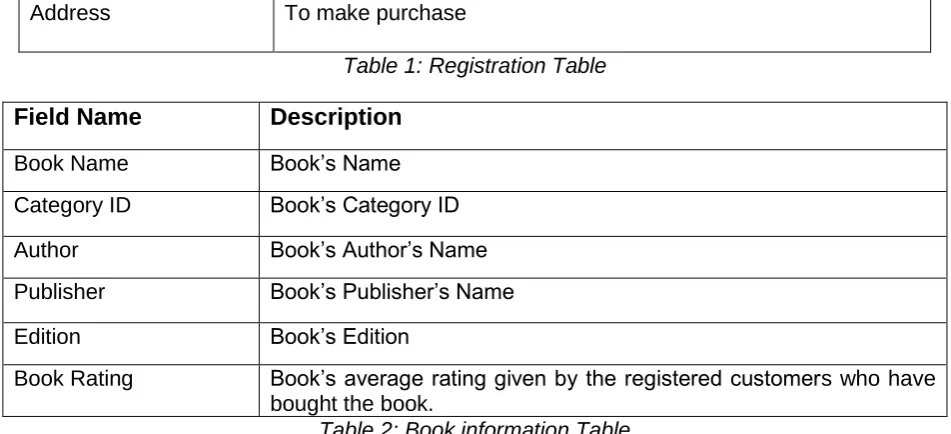
5. TABLES USED IN THE BRS
Field Name
Description
Login ID Customer login ID
Customer Name Customer Name
Password Login Password
Email To confirm User ID
Multidisciplinary Journal of Research in Engineering and Technology, Volume 3, Issue 2, Pg.977-981
Address To make purchase
Table 1: Registration Table
Field Name
Description
Book Name Book’s Name
Category ID Book’s Category ID
Author Book’s Author’s Name
Publisher Book’s Publisher’s Name
Edition Book’s Edition
Book Rating Book’s average rating given by the registered customers who have bought the book.
Table 2: Book information Table
6. CONCLUSION
We presented a systematic comparison of various technologies on a real-life purchase dataset. We showed that recommender systems can be developed on purchase rather than rating data, and that, in such cases, algorithms comparison is different from the standard rating case. In particular, on our data, the simplest algorithm based on bigram association rules obtained the best performances. We believe that such case-studies are necessary to better understand the specificities of purchase datasets and the factors that impact recommender systems for retailers.
ACKNOWLEDGEMENTS
We thank Prof.P.S.Desai for guiding us throughout and giving us this opportunity to publish the paper.
REFERENCES
[1] G. Adomavicius and A. Tuzhilin, “Towards the next generation of recommender systems: a survey of the state-of-the-art and possible extensions,” IEEE Trans. on Data and Knowledge Engineering 17:6, pp. 734– 749, 2005.
[2] Michael Hashler, Recommender Lab: A Framework for Developing and Testing Recommendation Algorithms Nov. 2011.
[3] Michael D. Ekstrand, John T. Riedl and Joseph A. Konstan’ “Collaborative Filtering Recommender Systems”.
[4] Ashish Fatarphekar, Tejas Nashikkar, Vivek Patil and Gayatri Naik “Book Recommendation System Based on Combine Features of Content Based Filtering, Collaborative Filtering and Association Rule Mining”JIAATS-JASE.
[5] Manisha Chandaka, Sheetal Giraseb, Debajyoti Mukhopadhyayc,” Introducing Hybrid Technique for Optimization of Book Recommender System”Procedia Computer Science 45 ( 2015 ) 23 – 31. [6] G. Linden, B. Smith, and J. York, “Amazon.com recommendations: item to-item collaborative filtering,”
Internet Computing 7:1, pp. 76–80, 2003.