Volume 2
Issue 1 Winter 2014 Article 7
January 2014
Pilot Interprofessional Education Program for OT Student
Pilot Interprofessional Education Program for OT Student
Pediatric Practice Readiness
Pediatric Practice Readiness
Michelle A. Suarez
Western Michigan University - USA, [email protected]
Heather K. Koole
Calvin College - USA, [email protected]
Jerrold Jackson
Dallas Independent School District - USA, [email protected]
Follow this and additional works at: https://scholarworks.wmich.edu/ojot
Part of the Occupational Therapy Commons
Recommended Citation Recommended Citation
Suarez, M. A., Koole, H. K., & Jackson, J. (2014). Pilot Interprofessional Education Program for OT Student Pediatric Practice Readiness. The Open Journal of Occupational Therapy, 2(1). https://doi.org/10.15453/ 2168-6408.1068
This document has been accepted for inclusion in The Open Journal of Occupational Therapy by the editors. Free, open access is provided by ScholarWorks at WMU. For more information, please contact
Abstract Abstract
This mixed methods pilot study investigated the impact of an interprofessional education program on OT student readiness for collaboration with SLP students in a pediatric teaching-clinic practice setting. OT students were randomly assigned to either the treatment group, which received the interprofessional education experience, or the control group, which received the typical educational experience. Students completed pre and post surveys and journaled about the experience. Results pointed to a ceiling effect in the measurement scales in both the treatment and control groups due to positive attitudes at baseline. This positivity was also reflected in journal entries for the treatment group students. Several insights were gained through data analysis about the feasibility of this type of program, the usefulness of available measuring tools for detecting change in small samples, and the developmental progression of interprofessional skills attainment.
Comments
Declaration on interest
This project was funded by a doctoral student research grant from the Blue Cross Blue Shield Foundation of Michigan.
Keywords Keywords
Occupational therapy, interprofessional education, pediatric practice
Cover Page Footnote Cover Page Footnote
Acknowledgments I would like to thank the Blue Cross Blue Shield foundation of Michigan for the doctoral student research award that supported this project. I also want to thank the students who participated in the Interprofessional Education Program and Dr. Nickola Nelson for her mentorship and support.
Credentials Display
Michelle A. Suarez, Ph.D., OTR/L; Heather K. Koole, MA, CCC-SLP; Jerrold Jackson, M.A., CCC-SLP
Copyright transfer agreements are not obtained by The Open Journal of Occupational Therapy (OJOT). Reprint permission for this Topics in Education should be obtained from the
corresponding author(s). Click here to view our open access statement regarding user rights and distribution of this Topics in Education.
DOI: 10.15453/2168-6408.1068
Interprofessional collaboration among allied
health professionals is essential in the provision of
holistic, early intervention pediatric practice for best
patient outcomes (James & Chard, 2010).
However, there is evidence that teaming skills are
not intuitive and that learning to work together does
not always occur on the job (Barnsteiner, Disch,
Hall, Mayer, & Moore, 2007). The preprofessional
period provides an opportunity to institute
interprofessional education to facilitate the
development of collaboration skills (Barnsteiner et
al., 2007). Unfortunately, most health care
education is highly segregated (Carlisle, Cooper, &
Watkins, 2004). There is a need for
interprofessional education programs that teach
allied health students who are preparing to work in
pediatric practice the skills required to collaborate
with other professions in order to meet the complex
needs of this population.
Providing high-quality treatment in the
current, complex health care environment requires
the ability to collaborate with other professionals.
A research synthesis conducted by the Institute of
Medicine (2003) has illustrated that when health
care workers understand the roles, language, and
values of other professionals, they are able to work
together more effectively to ensure high-quality
care. Interprofessional collaboration is especially
important in the provision of holistic, early
intervention pediatric practice. A lack of continuity
of care can threaten optimal service provision for
the early childhood population. For example, in a
study of the parental experience with early
intervention services, parents highlighted the
negative impact that a lack of cooperation among
professionals had on their service delivery
experience (James & Chard, 2010). The parents felt
that there was meaningful collaboration between
themselves and the individual professionals but that
this was lacking among the service providers.
Furthermore, deficient collaboration among early
intervention professions can drain the time of a
family that is already experiencing the stress of
caring for a child with special needs (Brotherson &
Goldstein, 1992).
Occupational therapists play a key role in
providing services for young children with special
needs. Teaching occupational therapy (OT)
students to work with other professionals before
they graduate will lead to their working together
effectively in a changing and challenging health
care environment (Parsell and Bligh, 1998).
However, even when OT and other allied heath
students are learning similar content, they typically
do so without any interactions that cross
professional boundaries (Carlisle et al., 2004).
Despite the fact that health care educational
programs exist in close spatial proximity and offer
services to the same population of clients,
collaboration is rare. For example, at Western
Michigan University, where this study took place,
OT and Speech Language Pathology (SLP) students
were often offering services to the same clients in
minimal to no interaction among the treatment
providers. This can lead to misunderstandings, the
devaluation of others’ contributions, and
professional protectionism. Education that involves
going beyond the confines of one’s own discipline
to develop teamwork, collaboration, and clinical
reasoning skills in the context of an
interprofessional team is an essential foundation for
practice after graduation (Barnsteiner et al., 2007).
There are several difficulties in developing
interprofessional education programs. These
challenges include organizational barriers to
implementation, such as incongruent class
schedules and curriculums among disciplines, the
lack of shared meeting space, and financial
disincentives (Price et al., 2009; Rees & Johnson,
2007). For example, Price et al. (2009) identified
“logistic enablers,” such as the physical layout of
the clinic, the electronic medical records
communication system, and the support from
leadership for increased time allotted for
collaboration, as key elements of a successful
interprofessional education program.
Organizational determinants, including specified
time and space for collaboration and fee structures
that make collaboration financially feasible, are
necessary for successful interprofessional work
(Price et al., 2009; Rees & Johnson, 2007).
In addition, two other barriers to
implementation of interprofessional education
programs exist. First, there are currently no gold
standard measuring tools to capture changes in
interprofessional skills after engagement in an
interprofessional education program (Thannhauser,
Russell-Mayhew, & Scott, 2010). Second, there is a
limited understanding of both the elements that
make an interprofessional education program
effective and the developmental progression of
interprofessional skills attainment (Barr & Ross,
2006).
There is a lack of well-developed tools for
measuring outcomes of interprofessional education.
In a systematic review of the literature of
interprofessional education outcome measures,
Thannhauser, Russell-Mayhew, and Scott (2010)
concluded that little information exists about the
psychometric properties of published instruments,
and that none have been used in existing studies
more than two times. Also, a major concern about
the available instruments is the lack of validity
information. This literature review singled out two
instruments that have promise for measuring
outcomes of interprofessional education: The
Interdisciplinary Education Perception Scale (IEPS)
and the Readiness for Interpersonal Learning Scale
(RIPLS). There is a need to further evaluate these
and other existing instruments to determine gold
standard measuring tools for interprofessional
learning outcomes.
The ability of interprofessional education
programs to increase collaboration readiness has
been assumed, but research evidence is still in
development (Barr & Ross, 2006). One
(2004) evaluated interprofessional skills and
perceptions after a large-scale overhaul of the
curriculum for 10 allied health profession programs.
This curriculum included an interprofessional
module in each year of the study. The researchers
used a quantitative questionnaire to collect baseline
data from 643 students before they began the core
curriculum. The main findings were that students
were positive about their own communication and
team-working skills, as well as about
interprofessional learning; however, most of the
students did not have favorable perceptions of
actual interprofessional interaction. Also, findings
during the interim and graduation measurements
were different from what the researchers
hypothesized. These findings indicated that student
perceptions of interprofessional collaboration
readiness decreasedinitially and then stabilized
(Pollard, Miers, Gilchrist, & Sayers, 2006; Pollard
et al., 2004).
The Pollard et al. (2004) longitudinal study
may provide some insight into a developmental
progression of interprofessional collaboration skills.
The perception of interprofessional skills and
attitudes may be positively inflated initially, before
the students have the opportunity to test their own
skills in the curriculum. Then, the students may
experience a “reality check” when actual
performance is required. Over time, confidence
may build, thus returning scores to a realistic level.
When the students in the Pollard et al. study who
had experienced the interprofessional curriculum
graduated, researchers were able to compare their
scores to the scores of students who had graduated
previously. The researchers found that the
interprofessional curriculum had an overall positive
effect on the students’ attitudes toward their own
professional relationships. The work of Pollard et
al. gives us some insight into the developmental
progression of interprofessional knowledge and
attitudes, but there is still much to be learned.
The pilot interprofessional education
program in this current study aimed to meet these
challenges by addressing three specific goals: (a) to
investigate the feasibility of the implementation of
an interprofessional educational experience in an
early OT internship for master’s level OT students
in a typically segregated, university-run teaching
clinic setting, (b) to determine whether three
published scales developed to measure
interprofessional attitudes (i.e., the IEPS, the
RIPLS, and the Role Perception Questionnaire
[RPQ]) were appropriate for detecting changes in
interprofessional attitudes and readiness with this
population of students, and (c) to explore the
developmental progression of interprofessional
skills through an examination of interprofessional
scales pre-post interprofessional experience and
through the themes developed in the students’
reflection journals. The information obtained from
this pilot study could be a catalyst for the
Method
This was a pilot, mixed method study that
examined the impact of an interprofessional
education experience on OT students’ readiness for
and perceptions of interprofessional collaboration.
Data included quantitative and qualitative elements.
The OT participants, who were entering their level I
placement at the university-run clinic, were
randomly assigned to the treatment group
(participated in the interprofessional education
experience) or the control group (participated in the
typical internship experience). The typical
internship experience took place at the
university-run, discipline-specific clinic in which there are no
opportunities for interprofessional collaboration.
The participants in both the treatment group and the
control group were asked to complete an electronic
survey designed to measure interprofessional
readiness and collaboration skills at the beginning
and end of the semester. In addition, the OT
participants in the treatment group completed
journals as part of the fieldwork experience.
Journaling included reflection after completing
interprofessional modules and after the
interprofessional evaluation experience. The
journals provided the researchers with insight into
the experience of interprofessional education from
the perspectives of the individuals who shared this
experience. The researchers obtained human
subjects review board approval before the study
began, and the participants signed an informed
consent document.
Interprofessional Education Experience
The interprofessional education experience
for this pilot study was presented within the context
of an OT level I fieldwork at the university teaching
clinic. Several interprofessional modules were
presented at the student clinic orientation sessions.
The curriculum was led by the study’s authors: One
OT professor and two SLP professors with over 30
years combined pediatric clinical experience and
over 10 years combined teaching experience.
Students in the OT program paired with students in
the SLP program to complete these modules:
• Getting to know you—student introductions
and presentation of own profession.
The interprofessional experience began with
an icebreaker activity to allow the students
to start to connect on a personal level. Then,
in small OT-SLP groups, the students
presented the overarching philosophy and
scope of practice of their respective
profession. The students were instructed to
explore the similarities and differences
between the two professions.
• Understanding the role of SLPs and OTs in
pediatric practice.
In this module, the students were instructed
to discuss their profession’s role in several
pediatric settings, including outpatient
practice. They identified common
overarching functional client goals that
how each profession would contribute to the
achievement of these goals.
• Pediatric development from two different
perspectives.
The next three modules focused on a
pediatric case study that included OT and
SLP service provision. The student OT-SLP
pairs were given a client name with an age
and diagnosis. They were asked to discuss
the developmental milestones expected for
this particular age. The OT students
described typical motor and sensory
development, the SLP students discussed the
development of communication skills, and
both students in the pairs discussed what
they would expect to see in social
interaction. Then, they were asked to
describe, from their professional
perspectives, how they would frame the
specified diagnosis (autism, in this case).
They were asked what the expected deficit
areas would be and how they would measure
whether these deficits were present in this
particular case.
• Integration of theory with practice;
exploration of what we have in common and
our unique contributions.
In this module, the student OT-SLP pairs
were given an evaluation report from the
other profession. They were instructed to
highlight terms that they did not understand,
identify an evaluation focus that was the
same as it would be for their profession, and
recognize aspects that were different. After
individual readings of these documents, the
students paired with their other profession
partners to discuss unfamiliar terms and the
focus of the assessments, as well as to
brainstorm ways that information contained
in the other profession’s report would better
inform their own treatment plan.
• Teachers as role models; interprofessional
collaboration examples in the field.
This module concluded the didactic
instruction for this pilot program. The OT
and SLP instructors described a case in
which interprofessional collaboration was
successful. The students were asked to
identify the elements that made this
collaboration a success and how this
collaboration may have impacted the client’s
care.
After the completion of the modules, the
OT-SLP teams completed a comprehensive
developmental evaluation of a pediatric client who
was referred to the clinic for this purpose. The
evaluation process included joint planning, meeting
with the family, assessing the child, and completing
documentation as an OT-SLP team. The OT
students reflected on the team experience by
Instrumentation
The Interprofessional Experience Survey included
41 questions that were designed to collect the
following information:
• Demographic information (N = 4)
• Interdisciplinary Education Perception Scale
(IEPS) (McFadyen, Webster, & Maclaren,
2006) (N = 18). This Likert scale was
designed to measure attitudinal changes pre
and post interprofessional education. It was
originally developed by Luecht, Madsen,
Taugher, and Petterson (1990), and tested on
143 administrators and graduate students.
Later, McFadyen et al. (2006) suggested a
revised version of this instrument based on
reliability data from 247 students. The
revised version was used in this study.
• Readiness for Interprofessional Learning
Scale (RIPLS) (Parsell & Bligh, 1999) (N =
19). The RIPLS measures students’
readiness for learning information and skills
related to interprofessional development
(McFadyen et al., 2005).
• Role Perception Questionnaire (RPQ)
(Mackay, 2004). The RPQ was designed to
be a generic measure of health care
professionals’ perceptions of their own roles
and those of others in different fields. In 31
bi-polar questions, participants are asked to
discriminate on a scale from 1-10, where
their opinion falls between the opposite
constructs. According to the developers of
this questionnaire, there is no “right
answer.” Therefore, a summary score was
not tabulated for the current study. Instead,
items were analyzed individually to track
changes in the participant’s attitudes
throughout the study. Also, prior to data
analysis, the interprofessional
educators/researchers each independently
marked toward which opposite pole the
students’ ratings would drift after the
interprofessional education experience on
each item (↓↑). Items that were judged to
be neutral were marked as such (↔). Then,
these determinations of direction were
compared and any differences were
discussed until consensus was reached. For
example, on the item that asks: “My
profession works effectively within a team
(1..2..3..4..5..6..7..8..9..10) My profession
works more effectively alone,” the
consensus was that after the
interprofessional learning experience the
students’ ratings would drift toward the team
(↓). The item that states: “My profession
demonstrates a sense of humor
1..2..3..4..5..6..7..8..9..10 My profession
displays a serious attitude” was marked by
the interprofessional educators as neutral
(↔).
The researchers gathered qualitative
the treatment group completed as part of their
internship experience.
Analysis
Participant survey data were entered into
SPSS, and descriptive statistics and graphic displays
were used first to explore the data. Repeated
measures ANOVA was used to look at pre-post
changes for the treatment and control groups on the
IEPS, the RIPLS, and the RPQ. Fisher’s Exact Test
(used due to cell sizes with fewer than 5) was used
to determine if scores on the RPQ moved toward
the pole in the direction the educator expected.
Qualitative data was explored using a
phenomenological approach to data analysis
recommended by Moustakas (1994).
Phenomenological analysis was chosen in order to
gain insight into the students’ perceptions of their
interprofessional experience that could be used to
explore implementation of a larger scale
interprofessional program later. In the qualitative
analysis, each journal statement was evaluated for
relevance to understanding the student’s perception
of the interprofessional experience. Statements
identified by the researchers as relevant were then
clustered into themes and the relationship among
the themes was explored. Verbatim examples were
chosen to create a deep description of the
interprofessional experience for the student
participants.
Results
Demographic Information
All of the participants were enrolled in the
OT master’s program. There were seven female
students and one male student in the treatment
group, and there were six female students and one
male student in the control group. The mean age of
the participants in the treatment group was 26.1
years (SD = 3 years) and the mean age of the
participants in the control group was 34.3 years (SD
= 13.8 years).
IEPS and RIPLS
Means and standard deviations for the IEPS
and the RIPLS are reported in Table 1. Using
mixed, repeated measures ANOVA, there were no
differences in the pre to post-test scores for the
treatment and control groups on either of these
interprofessional measures. On this survey, an
IEPS score of 1 indicated strong agreement with
items regarding positive interprofessional
perception and a score of 6 indicated strong
disagreement. On the RIPLS, a score of 1 also
indicated a strong agreement with items related to
positive interprofessional development, and a score
of 5 indicated strong disagreement.
RPQ
Items on the RPQ were evaluated
individually to determine if there were significant
differences between pre and post-test for the
treatment and control groups. Results of mixed,
repeated measures ANOVAs are reported in Table
Table 1
Means and Standard Deviations of Pre-post Test Scores for Treatment and Control Groups on Interprofessional Perception and Readiness Measures
IEPS
F(1, 13) = .22, p = .65
RIPLS
F(1, 13) = .12, p = .73
Group Pre X SD
Post X SD
Pre X SD
Post X SD Treatment 1.9 .3 1.6 .3 1.4 .2 1.5 .4 Control 1.8 .4 1.8 .4 1.4 .3 1.4 .2
Table 2
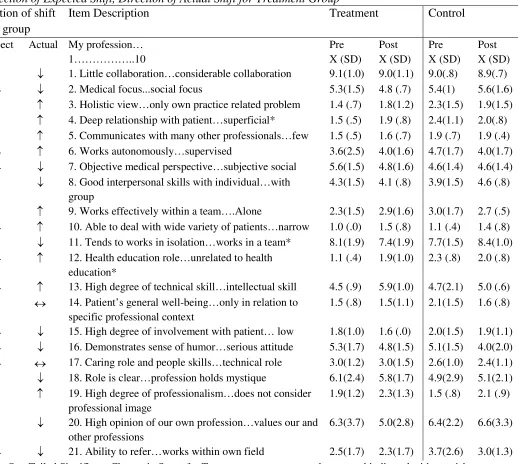
Means and Standard Deviations for Treatment and Control Groups on the Role Perceptions Questionnaire and Direction of Expected Shift, Direction of Actual Shift for Treatment Group
Direction of shift for tx group
Item Description Treatment Control
Expect Actual My profession… 1………..10
Pre X (SD)
Post X (SD)
Pre X (SD)
Post X (SD) ↑ ↓ 1. Little collaboration…considerable collaboration 9.1(1.0) 9.0(1.1) 9.0(.8) 8.9(.7) ↔ ↓ 2. Medical focus...social focus 5.3(1.5) 4.8 (.7) 5.4(1) 5.6(1.6)
↓ ↑ 3. Holistic view…only own practice related problem 1.4 (.7) 1.8(1.2) 2.3(1.5) 1.9(1.5) ↓ ↑ 4. Deep relationship with patient…superficial* 1.5 (.5) 1.9 (.8) 2.4(1.1) 2.0(.8) ↓ ↑ 5. Communicates with many other professionals…few 1.5 (.5) 1.6 (.7) 1.9 (.7) 1.9 (.4) ↔ ↑ 6. Works autonomously…supervised 3.6(2.5) 4.0(1.6) 4.7(1.7) 4.0(1.7) ↔ ↓ 7. Objective medical perspective…subjective social 5.6(1.5) 4.8(1.6) 4.6(1.4) 4.6(1.4)
↑ ↓ 8. Good interpersonal skills with individual…with group
4.3(1.5) 4.1 (.8) 3.9(1.5) 4.6 (.8)
↓ ↑ 9. Works effectively within a team….Alone 2.3(1.5) 2.9(1.6) 3.0(1.7) 2.7 (.5) ↔ ↑ 10. Able to deal with wide variety of patients…narrow 1.0 (.0) 1.5 (.8) 1.1 (.4) 1.4 (.8) ↑ ↓ 11. Tends to works in isolation…works in a team* 8.1(1.9) 7.4(1.9) 7.7(1.5) 8.4(1.0) ↔ ↑ 12. Health education role…unrelated to health
education*
1.1 (.4) 1.9(1.0) 2.3 (.8) 2.0 (.8)
↔ ↑ 13. High degree of technical skill…intellectual skill 4.5 (.9) 5.9(1.0) 4.7(2.1) 5.0 (.6) ↓ ↔ 14. Patient’s general well-being…only in relation to
specific professional context
1.5 (.8) 1.5(1.1) 2.1(1.5) 1.6 (.8)
↔ ↓ 15. High degree of involvement with patient… low 1.8(1.0) 1.6 (.0) 2.0(1.5) 1.9(1.1) ↔ ↓ 16. Demonstrates sense of humor…serious attitude 5.3(1.7) 4.8(1.5) 5.1(1.5) 4.0(2.0) ↔ ↔ 17. Caring role and people skills…technical role 3.0(1.2) 3.0(1.5) 2.6(1.0) 2.4(1.1) ↓ ↓ 18. Role is clear…profession holds mystique 6.1(2.4) 5.8(1.7) 4.9(2.9) 5.1(2.1) ↓ ↑ 19. High degree of professionalism…does not consider
professional image
1.9(1.2) 2.3(1.3) 1.5 (.8) 2.1 (.9)
↑ ↓ 20. High opinion of our own profession…values our and other professions
6.3(3.7) 5.0(2.8) 6.4(2.2) 6.6(3.3)
↔ ↓ 21. Ability to refer…works within own field 2.5(1.7) 2.3(1.7) 3.7(2.6) 3.0(1.3)
Items 4 (F = 4.13, p = .03), 11 (F = 6.97, p
= .01), and 12 (F = 76, p = .02) changed
significantly from pre to posttest for the treatment
group when compared to the control group. Also,
9/10 items that the educators/researchers expected
to drift toward one pole after participation in the
interprofessional education program actually drifted
toward the opposite pole. There was a significant
difference between the direction of change that was
expected and the actual direction of change for the
students in the treatment group (Fisher’s Exact Test:
p = .004).
Qualitative Journal
Overall, statements regarding the strengths
of the interprofessional experience and the
contrasting challenges were common in the student
journals. From these statements, themes developed.
First, the students were positive about the
interprofessional learning experience. They
consistently identified the growth of their own
professional identity as an OT as a benefit of the
interprofessional learning experience. (n = 7/8)
• “One of the most beneficial aspects of the
collaboration activity with the SLP student
was having the opportunity to ask and be
asked ‘what and why’ of each discipline.”
• “Collaborating with another professional
forced me to advocate for the OT
profession.”
• “Throughout the process, I gained great
insight into the working dynamics of a
collaborative partnership, which allowed me
to grow within my own profession and will
have a great impact on my future.”
It was somewhat surprising that there was
little mention in the journals of learning about the
SLP profession. The students did not focus on what
they learned about SLPs but instead on what they
learned about themselves and their own profession
through their interaction with the other profession.
The students also consistently identified the
need for more time with the SLP students as a
challenge of the interprofessional experience. (n =
8/8)
• “I wish we could have spent more time
focusing on this throughout the semester and
I hope to be exposed to more here in my
time at WMU.”
Discussion
One focus of this pilot study was to
determine if interprofessional education was
feasible in a university clinic setting. This included
consideration of the organizational determinants of
successful interprofessional education discovered
through educator/researcher reflection. Another
focus was to determine the appropriateness of some
existing “off the shelf” measures for detecting
meaningful change in a small group of participants.
In addition, the effect of the interprofessional
education program on the attitudes and readiness of
the OT students was measured and compared to the
controls.
Currently, there is no standardized
determinants of successful interprofessional
collaboration (San Martin-Rodriguez, Beaulieu,
D’Amour, & Ferrada-Videla, 2005). Through the
interprofessional education process and after data
collection, the educators/researchers reflected on
these factors to identify facilitators and barriers in
this study and to consider the feasibility of
interprofessional education in this typically
segregated, university teaching-clinic environment.
First, interprofessional education is a key priority
within this particular university’s strategic goals.
This allowed for administrative support to
overcome barriers to make this project work.
However, many organizational barriers existed.
First, the billing structure for this clinic setting was
not set up to accommodate interprofessional work.
Both disciplines agreed to take a reduced fee for
this project, but this may not be acceptable as a
long-term solution. Second, the students’ class
schedules were rigid, and finding time to work
together was a challenge. The interprofessional
modules and evaluations were squeezed into
available times that were less than optimal for
educators, students, and clients. Finally, due to
current assignment procedures, it was not possible
to randomly assign the SLP students to a treatment
and control group; as a result, this study considers
changes in the OT students’ interprofessional
attitudes and readiness only. In order for
interprofessional education to be a feasible and
sustainable part of clinical education, faculty and
administration must collaborate at the curriculum
development level to allow for smooth and
systematic inclusion of this type of education in
clinical internships. Issues such as billing,
assignment to clinical placements, and class
schedules must be aligned to enable successful
interprofessional collaboration between disciplines.
In future studies, systematic measurement of
organizational determinants for the success of
interprofessional education is warranted.
Consideration of the less formal information
gathered through educator reflection in this study
and future studies that provide systematic
measurement may be useful in the development of
successful interprofessional learning programs.
This study evaluated several instruments for
measuring interprofessional attitudes and readiness
to determine their appropriateness for measuring
meaningful change in a small-scale project and
actual change in participant outcomes. The results
indicated that these instruments may not be ideal for
detecting change with a small sample size. It is
possible that a ceiling effect on the IEPS and the
RIPLS made it hard to see any changes in
interprofessional attitudes and readiness. Also,
many of the RPQ items did not intuitively make
sense in the context of interprofessional outcomes
measurement (e.g., my profession has a sense of
humor…). In total, this information fits with the
literature that highlights the need for further
examination of the validity and reliability of
possible development of new, meaningful
instruments sensitive enough to measure change.
The researchers gathered qualitative
information though the identification of themes in
the student journals. Overall, the students in the OT
treatment group were positive in their perceptions
of this interprofessional experience. Consistently,
the students identified that the main benefit of the
program was their development of a greater
identification with and an understanding of their
own profession. The students also expressed the
hope that they would receive more interprofessional
interaction as they continued in the master’s
program.
Despite this positivity, the direction of
endorsement of items on the RPQ was the opposite
of what the educators hypothesized would indicate
greater interprofessional readiness. For example,
the educators expected that the students’ scores on
the RPQ would shift toward an endorsement of
health care professionals working as a team.
Instead, scores shifted significantly toward an
endorsement of health care professionals working
more in isolation. The studies by Pollard et al.
(2004, 2006) may shed some light on this
unforeseen development. In this large-scale study,
before any real world interprofessional interaction,
students were positive in their perception of their
own interprofessional skills and their
interprofessional attitudes. After some
interprofessional experience, this confidence
declined before stabilizing at graduation. The
results from the current pilot study combined with
the literature may illustrate a possible
developmental progression of interprofessional
skills. Students start out positive about their own
interprofessional readiness. However, after
experiencing the reality and challenges inherent in
actual interprofessional collaboration, they may
retreat behind their own scope of practice. Then,
after they fully establish their own professional
identity, they are able to look outside of their own
profession for an understanding of how others
integrate into the bigger health care picture. This
theory fits with the information obtained in the
qualitative journals. The students spoke of the
value of this interprofessional education program in
terms of a greater understanding of and
identification with the OT profession and less about
gaining an understanding of their interprofessional
team member.
This study has several strengths. A
considerable strength is that this interprofessional
education program was interwoven into an existing,
typically segregated clinical internship experience.
Through identification of the logistical facilitators
and barriers, other programs may take advantage of
this information for planning interprofessional
education programs. Another strength was the
random assignment of the OT students to the
treatment and control groups. This pilot program
identified some challenges with existing outcome
instruments that may provide a catalyst for future
possible theoretical course for the development of
interprofessional readiness. However, due to the
small sample size and the small shifts on the RPQ,
this interpretation should be viewed with caution.
There are also some limitations to consider.
This pilot project contained a very small sample and
this may have limited the ability to detect change on
the IEPS and the RIPLS. The feasibility of the
program was considered through informal reflection
from interprofessional educators, and there is a need
to collect this information in a more systematic
fashion. Finally, the study analyzed outcome data
for the OT students only. It is important to consider
the interprofessional attitudes and readiness of all
health care students in order to ease the transition
from course work to clinical work in teams.
In conclusion, this pilot study provided
information about the feasibility of interprofessional
work in a university clinic, some of the challenges
of measuring change in small samples of students,
and possible insight into the course of
interprofessional skill development. However, this
area of study warrants more work. Research that
looks at organizational determinants of successful
interprofessional education and how to measure
these constructs would be important for integrating
interprofessional education into allied health
curriculums. It is necessary to continue the
development of outcome measures that are valid,
reliable, and sensitive to change. Finally, learning
more about how health care students internalize
interprofessional skills would assist with the
development of more effective interprofessional
References
Barnsteiner, J. H., Disch, J. M., Hall, L., Mayer, D., & Moore, S. M. (2007). Promoting
interprofessional education. Nursing Outlook, 55(3), 144-150.
Barr, H., & Ross, F. (2006). Mainstreaming interprofessional education in the United Kingdom:
A position paper. Journal of Interprofessional care, 20(2), 96-104.
Brotherson, M. J., & Goldstein, B. L. (1992). Time as a resource and constraint for parents of
young children with disabilities: Implications for early intervention services. Topics in
Early Childhood Special Education, 12(4), 508–527.
Carlisle, C., Cooper, H., & Watkins, C. (2004). “Do none of you talk to each other?” The
challenges facing the implementation of interprofessional education. Medical Teacher,
26(6), 545-552.
Institute of Medicine. (2003). Health Professions Education: A Bridge to Quality. Washington,
DC: National Academies Press, 2003.
James, C., & Chard, G. (2010). A qualitative study of parental experiences of participation and
partnership in an early intervention service. Infants & Young Children, 23(4), 275-285.
Luecht, R. M., Madsen, M. K., Taugher, M. P., & Petterson, B. J. (1990). Assessing professional
perceptions: Design and validation of an interdisciplinary education perception scale.
Journal of Allied Health, 19(2), 181-191.
Mackay, S. (2004). The role perception questionnaire (RPQ): A tool for assessing undergraduate
students’ perceptions of the role of other professions. Journal of Interprofessional Care,
18(3), 289-302.
McFadyen, A., Webster, V., & Maclaren, W. (2006). The test-retest reliability of a revised
version of the Readiness for Interprofessional Learning Scale (RIPLS). Journal of
Interprofessional Care, 20(6), 633-639.
McFadyen, A., Webster, V., Strachan, K., Figgins, E., Brown, H., & McKechnie, J. (2005). The
readiness for interprofessional learning scale: A possible more stable sub-scale model for
the original version of RIPLS. Journal of Interprofessional Care, 19(6), 595-603.
Moustakas, C. (1994). Phenomenological research methods. Thousand Oaks, CA: Sage.
Parsell, G., & Bligh, J. (1998). Educational principles underpinning successful shared learning.
Medical Teacher, 20(6), 522-529.
health care students for interprofessional learning (RIPLS). Medical Education, 33(2),
95-100.
Pollard, K. C., Miers, M., & Gilchrist, M. (2004). Collaborative learning for collaborative
working? Initial findings from a longitudinal study of health and social care students.
Health and Social Care in the Community, 12(4), 346-358.
Pollard, K. C., Miers, M., Gilchrist, M., & Sayers, A. (2006). A comparison of interprofessional
perceptions and working relationships among health and social care students: The results
of a 3-year intervention. Health and Social Care in the Community, 14(6), 541-552.
Price, D., Howard, M., Hilts, L., Dolovich, L., McCarthy, L., Walsh, A. E., & Dykeman, L.
(2009). Interprofessional education in academic family medicine teaching units: A
functional program and culture. Canadian Family Physician, 55(9), 901-901.e5.
Rees, D., & Johnson, R. (2007). All together now? Staff views and experiences of a
pre-qualifying interprofessional curriculum. Journal of Interprofessional Care, 21(5),
543-555.
San Martin-Rodriguez, L., Beaulieu, M., D’Amour, D., & Ferrada-Videla, M. (2005). The
determinants of successful collaboration: A review of theoretical and empirical students.
Journal of Interprofessional Care, 19(1),132-147.
Thannhauser, J., Russell-Mayhew, S., & Scott, C. (2010). Measures of interpersonal education