WHAT’S KNOWN ON THIS SUBJECT: Demographic data
concerning health care providers working long-term in resource-limited areas with religious groups or other government or nongovernment organizations are limited. Health outcomes from these programs vary with the focus of the individual program.
WHAT THIS STUDY ADDS: This study describes the composition and evaluation of a long-term global health corps program. Other groups interested in long-term physician placement in resource-limited areas will be able to use these data while developing their program.
abstract
BACKGROUND:The Baylor College of Medicine International Pediatric AIDS Initiative at Texas Children’s Hospital created a global health corps named the Pediatric AIDS Corps (PAC) in June 2005. This report provides descriptive details and outputs for PAC over itsfirst 5 years. METHODS: Demographic data were gathered about PAC physicians employed from July 2006 to June 2011. A 21-question survey was used to query PAC physicians about their experiences in the program. Data concerning clinical experiences and educational programs also were reviewed.
RESULTS:A total of 128 physicians were employed with PAC. The me-dian duration served was 22.7 months. Eighty-seven percent indicated that experience affected their future career choice, with half continuing to work with children and families living in resource-limited areas after they left PAC. Patient care was identified as the most rewarding part of their work (73%), whereas deaths (27%) were the most difficult. Baylor College of Medicine International Pediatric AIDS Initiative enrollment of HIV-infected children and adolescents into care and treatment increased from 6107 to103 731 with the addition of PAC physicians. Approximately 500 local health care professionals per quarter benefited from HIV clinical attachments that were not available before PAC arrival. PAC physicians visited outreach sites providing in-depth HIV mentoring of local health care professionals, leading to 37% of the sites becoming self-sufficient.
CONCLUSIONS:The positive evaluation by the PAC and the scale-up of clinical and educational programs support the recent calls for the de-velopment of a national global health corps program. Pediatrics
2014;133:e1548–e1554
AUTHORS:Gordon E. Schutze, MD, Margaret G. Ferris, PhD, MPH, David C. Jones, BA, R. Sebastian Wanless, MBChB, Nancy R. Calles, MSN, RN, PNP, ACRN, MPH, Michael B. Mizwa, Heidi L. Schwarzwald, MD, MPH, and Mark W. Kline, MD
Department of Pediatrics, Baylor College of Medicine and Texas Children’s Hospital, Baylor International Pediatric AIDS Initiative at Texas Children’s Hospital, Houston, Texas
KEY WORDS
global health corps, global health, HIV, acquired immunodeficiency syndrome (AIDS)
ABBREVIATIONS
BCM—Baylor College of Medicine
BIPAI—Baylor International Pediatric AIDS Initiative at Texas Children’s Hospital
IR—incidence rate PAC—Pediatric AIDS Corps
Dr Schutze conceptualized, designed, and analyzed the Pediatric AIDS Corps (PAC) follow-up survey used in this manuscript, gathered the demographic data of the PAC physicians, and wrote the initial manuscript and all subsequent drafts; Drs Ferris and Schwarzwald, Mr Jones, and Mr Mizwa reviewed and interpreted the PAC survey data, and revised the initial manuscript; Dr Wanless gathered, analyzed, and interpreted the patient encounter and educational program data, and revised the initial manuscript; Ms Calles helped design and analyze the PAC follow-up survey, helped provide the demographic data of the PAC physicians, and revised the initial manuscript; Dr Kline helped design and analyze the PAC follow-up survey, helped draft the initial manuscript, and revised the initial manuscript; and all authors approved thefinal manuscript as submitted. www.pediatrics.org/cgi/doi/10.1542/peds.2013-2938
doi:10.1542/peds.2013-2938
Accepted for publication Mar 7, 2014
Address correspondence to Gordon E. Schutze, MD, Texas Children’s Hospital, 6621 Fannin, Suite A150, MC A1150, Houston, TX 77030. E-mail: [email protected]
PEDIATRICS (ISSN Numbers: Print, 0031-4005; Online, 1098-4275).
Copyright © 2014 by the American Academy of Pediatrics
FINANCIAL DISCLOSURE:The authors have indicated they have nofinancial relationships relevant to this article to disclose.
FUNDING:Support for this program was from the Bristol-Myers Squibb Foundation, Secure the Future Program, and Baylor College of Medicine.
At the conclusion of 2005,∼2.3 million children were living with HIV/AIDS. Globally, children accounted for 14% of all new HIV infections and 18% of all deaths from HIV/AIDS. The largest burden of disease in children,5 years of age was in southern Africa, where HIV/AIDS accounted for more deaths than all other causes combined.1It was during this time that the Institute of Medicine recommended that the US federal government create and fund an umbrella organization called the US Global Health Service to mobilize US health care professionals tofight HIV/ AIDS.2
In parallel with this call to action, the Baylor College of Medicine International Pediatric AIDS Initiative (BIPAI) at Texas Children’s Hospital announced the cre-ation of a global health corps named the Pediatric AIDS Corps (PAC). This pro-gram was developed to address the critical shortage of physicians trained in the care of infants and children infected and affected with HIV/AIDS in Africa and other parts of the world.3 The program was designed not only to expand existing health professional capacity for providing care and treat-ment in several hard-hit African coun-tries, but also to institute training programs to supply local providers with the skills and confidence needed to take care of HIV-infected infants and children.
The PAC recruited board-eligible/ certified pediatricians, internists, and family medicine physicians for long-term assignments ($1 year) in Africa. Physicians were employed by Baylor College of Medicine (BCM) and were linked to BIPAI’s Clinical Centers of Excellence or other nongovernment organizations in African countries hard hit by HIV/AIDS. The recruitment, placement, and training of the PAC has been described in depth in previous publications.4,5Support for thefirst 5 years of this program was provided by
the Bristol-Myers Squibb Foundation, Secure the Future Program, and BCM. The purpose of this report was to provide descriptive details and outputs for this unique program over thefirst 5 years of its existence.
METHODS
Basic demographic data were gathered from application files for all PAC physicians employed from July 2006 to June 2011. A 21-question survey was developed and used to query all PAC physicians about their experiences in the program. A link to this survey (SurveyMonkey at www.surveymonkey. com) was sent to each PAC physician on 4 occasions over a 2-month period. Data concerning clinical experiences were obtained through reviews of de-identified summary data from an electronic medical record. Local re-cords were reviewed for educational endeavors. Incidence rates (IR) for de-pression and mental health evacuation were calculated using 239.94 PAC-years. This was the number of years served by the physicians responding to the survey. Based on physicians com-ing into the program without a history of tuberculosis, 2664.5 PAC-months were used to calculate the IR of tuber-culosis, which was defined as a new positive tuberculin skin test. The study was reviewed and approved by the in-stitutional review board for human subject research for BCM and affiliated hospitals.
RESULTS
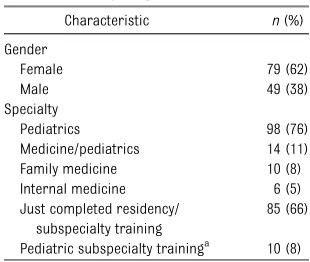
A total of 128 physicians were employed with PAC between July 2006 and June 2011 (Table 1). One physician worked in Malawi in 2006–2007, left the program and completed a pediatric hematology-oncology fellowship, and returned to Malawi for 2010–2011. The median duration of service in PAC was 22.7 months (range: 8.8–59.5 months). The
12 countries where the PAC physicians worked are listed in Table 2. There were 107 doctors who worked in 1 country each, whereas 16 worked in 2 countries, 4 worked in 3 countries, and 1 worked in 4 countries. Most PAC physicians worked at BIPAI’s Clinical Centers of Excellence and/or outreach clinics in Botswana, Burkina Faso, Le-sotho, Malawi, Swaziland, and Tanzania. These centers focused on the care and treatment of children and their fami-lies with HIV/AIDS. A small number of physicians were linked with other non-government organizations working with pediatric HIV/AIDS in Tanzania and Mozambique (Elizabeth Glaser Pe-diatric AIDS Foundation) and South Africa (Harvard University). In Ethiopia, physicians worked at the Gondar Uni-versity Hospital in the Department of Pediatrics to teach medical students and train interns in general pediatrics. This program was in conjunction with the American Joint Jewish Distribution Committee and funded by the Mary L. and William J. Osher Foundation. One PAC physician worked for BIPAI as a consultant in India for 6 months under an agreement with UNICEF to evaluate all of the pediatric HIV/AIDS clinical centers in that country.
The Bristol-Myers Squibb Foundation’s Secure the Future Program provided
TABLE 1 Characteristics of 128 Physicians Participating in PAC, 2006–2011
Characteristic n(%)
Gender
Female 79 (62)
Male 49 (38)
Specialty
Pediatrics 98 (76)
Medicine/pediatrics 14 (11)
Family medicine 10 (8)
Internal medicine 6 (5)
Just completed residency/ subspecialty training
85 (66)
Pediatric subspecialty traininga
10 (8)
Degrees of the physicians included the following: MD (121), DO (5), MBChB (1), MBBS (1).
aCardiology (2), hematology-oncology (2), infectious dis-ease (6).
$22.5 million to support the program’s administration and physicians’salary, training, living, and travel expenses. Eighty-seven (68%) of the PAC physi-cians came into the program with ed-ucational debt. The total amount of debt owed by this cohort was $10 262 426 (mean: $117 958 per person; range: $31 326–$228 007). At the conclusion of the 5-year program, BCM had provided $6 057 518 in loan repayments and 26 (30%) became debt-free through their participation in the PAC program.
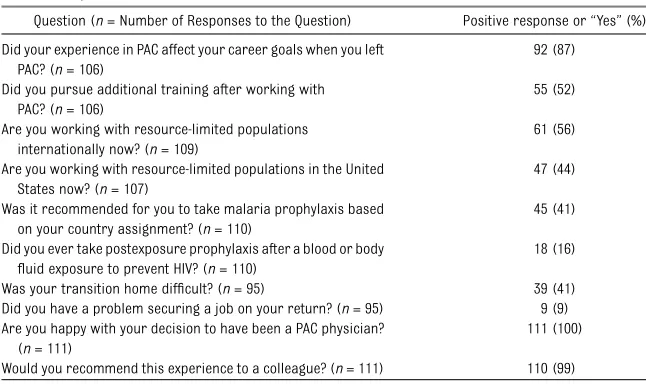
A total of 126 PAC physicians (2 were deceased) were contacted with a sur-vey link and 111 (88%) completed the survey. Sixteen percent of the physi-cians were currently working for BIPAI under a revision of the program re-ferred to as the Texas Children’s Global Health Corps, 22% had left PAC,1 year before, 37% had been out from 1 to 3 years, and 25% had been out for.3 years. The experience of the PAC physicians was noted to have affected further career choices in 87% (Table 3). Of those who had their career choice affected, 71% indicated that global health would remain a focus of their career, whereas half of those who pursued additional training included training in public health alone (eg, master’s or doctorate degrees, Epi-demic Intelligence Service) or in addi-tion to subspecialty training. Subspecialty
training pursued included infectious diseases (9), emergency medicine (4), hematology-oncology (3), cardiology (2), pulmonology (2), academic pedi-atrics (2), unspecified (2), neonatology, critical care, integrative medicine, preventive medicine, and combined hematology-oncology-infectious disease. Approximately half continue to work with children and families living in resource-limited areas domestically or abroad. Seventy-three percent of responding physicians indicated that patient care was the most rewarding part of the PAC experience; program development was identified by 15%. The most difficult experiences identified were the number of deaths (27%), diffi -culty in accepting the limitations of the local health care system (24%), and managerial decisions made at the local clinics (21%). The most important accomplishments identified by PAC physicians were in the categories of in-frastructure building (33%) and educa-tion (31%). The nonclinical endeavors the PAC physicians participated in are outlined in Table 4.
Forty-one percent of PAC physicians had problems transitioning home, and the most common areas identified were classified as personal issues (53%) and job-related difficulty (22%). The work
(62%) and the relationships that were developed (36%) were identified as the best parts of being a member of PAC. Administrative issues, either locally (35%) or in Houston (19%), were the most common items mentioned as something that needed to change. De-spite these issues, all physicians sur-veyed stated that they were happy to have been a member of PAC and 99% said that they would encourage others to participate in the program. The 1 physician who indicated that he or she would not recommend this program noted the fact that research experience was not the major focus of the program and those interested in a research ca-reer might find another venue that would be a betterfit.
The health and safety of the PAC physicians also was evaluated (Table 5). Forty-two percent indicated that they had been a victim of robbery/theft/ violent crime or sexual assault while serving abroad. Sexual assaults in-volved groping. Malaria prophylaxis was required for PAC physicians working in malaria-endemic areas (Table 3). Of the 45 PAC physicians who commented on their malaria pro-phylaxis, 7 (16%) reported that they never took it, 26 (58%) reported that they took it intermittently or stopped it Month, 2006–2011
Country No. Physiciansa
Botswana 29
Burkina Faso 5
China 2
Ethiopia 5
India 1
Lesotho 28
Malawi 30
Mozambique 1
South Africa 1
Swaziland 30
Tanzania 19
Uganda 6
aTwenty-one physicians worked in.1 country.
Question (n= Number of Responses to the Question) Positive response or“Yes”(%)
Did your experience in PAC affect your career goals when you left PAC? (n= 106)
92 (87)
Did you pursue additional training after working with PAC? (n= 106)
55 (52)
Are you working with resource-limited populations internationally now? (n= 109)
61 (56)
Are you working with resource-limited populations in the United States now? (n= 107)
47 (44)
Was it recommended for you to take malaria prophylaxis based on your country assignment? (n= 110)
45 (41)
Did you ever take postexposure prophylaxis after a blood or body
fluid exposure to prevent HIV? (n= 110)
18 (16)
Was your transition home difficult? (n= 95) 39 (41) Did you have a problem securing a job on your return? (n= 95) 9 (9) Are you happy with your decision to have been a PAC physician?
(n= 111)
111 (100)
prematurely, and only 12 (27%) stated that they took it regularly. Seven indi-viduals had been treated for malaria at least once (Table 5).
Eighteen physicians required post-exposure prophylaxis for occupational exposure to HIV (Table 3). These 18 physicians had 27 high-risk events, such as mucous membrane exposure with bodyfluids (14) or needle sticks (13). Five individuals reported 2 sepa-rate events, whereas 2 individuals reported 3 events. Completion of the prescribed course of antiretroviral prophylaxis was reported for 12 (44%) of the episodes. Gastrointestinal prob-lems (nausea, vomiting, and distress) were the most common reason for
discontinuation of prophylaxis. One physician sustained 2 different splash exposures near the eye and took pro-phylaxis with thefirst event but did not take it for the second. No PAC physician reported seroconversion to HIV after these events or after working with PAC.
Thirteen PAC physicians had a history of tuberculous disease before joining the program. All others were screened with a tuberculin test by using purified protein derivative before leaving for their assignments and yearly while abroad. Seven were subsequently di-agnosed with latent tuberculosis in-fection while abroad or within 6 months after returning home. Each of the 7 had a positive tuberculin skin test with negative chest radiographs (Table 5; IR for latent and active tuberculous dis-ease were 2.62 per 1000 PAC-months abroad and 0 per 1000 PAC-months abroad, respectively). Six were trea-ted with isoniazid alone, and 1 received a course of pyrazinamide and etham-butol because of concern for multidrug-resistant organisms.
Eleven percent of those surveyed identified depression as a problem while serving abroad (Table 5; IR: 50 per 1000 PAC-years abroad). Two physi-cians required evacuation from their assigned country to South Africa for stabilization of psychiatric illness (IR: 8.3 per 1000 PAC-years abroad) before
returning home. For the 12% who responded that there were other sig-nificant events that affected their health or safety or a family member’s, most were medical illnesses in a family member (eg, diarrheal disease, malaria).
Before the deployment of PAC in July 2006, BIPAI had enrolled 6107 patients into HIV/AIDS care. By June 2011, BIPAI had enrolled 103 731 children and adolescents into care and treatment.6 Parents of children (10 771) also were brought for care at specially created family care clinics. Approximately 42% were treated at the BIPAI Centers of Excellence, whereas the remainder were cared for at BIPAI satellite sites or in outreach locations visited by PAC doctors. At 4 of the centers (Botswana, Lesotho, Malawi, and Swaziland) where the PAC provided most of the care,
.92 000 patients were enrolled with ∼48% of HIV-infected patients receiving antiretroviral therapy (Table 6).
As a result of training activities carried out by PAC doctors by June 2011,∼500 local health care professionals per quarter were benefiting from clinical attachments of at least 1 week at the Centers of Excellence, whereas .700 health care professionals per month were attending didactic training ses-sions on HIV/AIDS, either at the centers or at outreach sites.6In addition, PAC doctors were visiting outreach sites between 1 and 4 times per month, providing in-depth mentoring of local health care professionals. Clinical progress at these outreach sites was monitored, and when a set of estab-lished criteria for standards of care were met, sites were graduated. By June 2011, 52 (37%) of 142 sites had graduated across the network. Of the 4 major sites with physician short-ages that required the use of PAC phy-sicians to scale up the clinical work in 2006 (Botswana, Lesotho, Malawi, and Swaziland), by June 2011, 2 (Botswana,
TABLE 4 Nonclinical Care Activities Carried Out by 111 PAC Physicians, 2006–2011
Activities No. Who Participated (%)
Grant writing 35 (32)
Operational research 40 (36)
Abstract presentations at scientific meetings 25 (23)
Manuscript preparation and submission 30 (27)
Fund-raising 24 (22)
Policy development 42 (38)
Guideline writing 63 (57)
Monitoring and evaluation 54 (49)
Community mobilization projects 47 (42)
Project administration 59 (53)
Human resources 28 (25)
Volunteerism 44 (40)
Training of health professionals, staff, or lay people 111 (100)
Creation of training materials 84 (76)
Other 12 (11)
TABLE 5 Health and Safety Events for 111 PAC Physicians, 2006–2011
Event n(%)
Serious motor vehicle accident 6 (5) Illness requiring medical attention 20 (18) Illness requiring hospitalization 7 (6) Diagnosed with malaria 7 (6) Diagnosed with latent tuberculosis
infection
7 (6)a
Problems with depression while abroad
12 (11)
Family member requiring medical attention for serious event
10 (9)
Victim of robbery or theft 40 (36)
Victim of assault 5 (4)
Victim of sexual assault 2 (2) Other type of significant event to the
PAC physician or family member
13 (12)
aData based on 115 physicians.
Lesotho) were able to retain local physicians in numbers to be self-sufficient. The success of these 2 pro-grams in building local capacity was in large part because of the work of the PAC physicians.
A total of 106 research studies either had been completed or were ongoing, with 34 publications at the conclusion of the 5 years. PAC physicians contributed substantially to the development of national treatment guidelines for HIV/ AIDS in a number of African countries as well as other relevant issues affect-ing maternal-child health (eg, guidelines for the prevention of mother-to-child transmission of HIV, care of the HIV-exposed infant). In addition, PAC phy-sicians worked as part of committees or writing groups at the invitation of Ministries of Health in preparing ap-plications to the Global Fund to Fight AIDS, Tuberculosis, and Malaria.
DISCUSSION
The 5-year history of PAC demonstrates that a global health corps can catalyze a rapid scale-up of clinical services and build local health professional capacity for pediatric health care in resource-limited settings. Securing of the oper-ational funds and recruitment of physicians in the later part of 2005 with a July to August 2006 training and de-ployment for thefirst PAC physicians was a logistical feat. This rapid scale-up and deployment allowed PAC physicians to become an integral part of each country’s antiretroviral therapy rollout
for children, but was also most likely a reason behind the administrative challenges noted in the survey. Besides exceeding expectations in the areas of clinical service and education, a collat-eral benefit of this program was the involvement of PAC in numerous non-clinical care activities (eg, participa-tion in guideline writing, project administration) that helped define health care delivery in each of the countries. The experience also helped shape the future career goals of the physicians as it relates to global health, as well as working with children living in resource-limited settings domesti-cally. Despite the health and safety issues encountered, 100% of partic-ipants were happy with their decision to join this program.
The PAC program was established so that children with HIV/AIDS could re-ceive quality health care and have ac-cess to antiretroviral therapy. The large number of physicians placed in coun-tries allowed for the establishment of robust educational programs that achieved the goal of building local clinical capacity for the treatment of infants and children with HIV/AIDS and other serious or life-threatening med-ical conditions. In addition to the HIV-focused programs, the placement of pediatricians in Ethiopia helped ad-dress a poor student-to-teacher ratio that was jeopardizing the quality of education provided to medical students and interns in pediatrics. PAC physi-cians collaborated with Ethiopian pediatricians in re-designing the
med-shaping a pediatrics residency pro-gram. PAC also became active in other important nonclinical activities, such as national and global policy development, teen clubs, community health pro-grams, and guideline writing that ex-tended beyond HIV/AIDS.
Safety and health issues were identified as important components of the PAC experience. Robbery/theft and other vi-olent crimes, in addition to motor vehicle accidents, are well recognized events leading to injury and death among in-ternational travelers and other hu-manitarian workers.7–11Issues relating to health and safety are addressed in the pretravel training that PAC physi-cians receive before leaving for their assignments abroad.5Despite a focus of the pretravel program on malaria pre-vention, it was concerning to note that there were physicians working in malaria-endemic regions that did not take chemoprophylaxis. Most of these physicians were concerned about the impact of long-term exposure to malaria prophylaxis on their health and chose to rely on bednetting and per-sonal protection strategies. Those who chose not to take chemoprophylaxis were encouraged to have medications for self-treatment with them at all times.
Our data demonstrate that PAC physi-cians have higher rates of tuberculin skin test conversion when compared with US Peace Corps volunteers (1.283 per 1000 volunteer-months) but lower rates of active tuberculous disease (0.057 per 1000 volunteer-months).12 When skin test conversion data for the Peace Corps is limited only to Africa (1.464 per 1000 volunteer-months) or to the same 9 countries where our physicians worked (1.36 per 1000 volunteer-months), the incidence of conversion is still higher among the PAC physicians. The reason for this is not known, but the fact that members
Date HIV Infected Without ART HIV Infected With ART HIV Exposed Total Patients
June 2006a 9492 1984 809 12 285
June 2007 16 661 3966 2745 23 372
June 2008 21 917 6494 7174 35 585
June 2009 25 791 8787 9953 44 531
June 2010 38 036 16 609 12 557 67 202
June 2011 49 594 23 787 19 306 92 687
ART, antiretroviral therapy.
of PAC are supplying direct HIV/AIDS patient care certainly may play a sig-nificant role. In a recent study of skin test conversion in travelers from the Netherlands, investigators found a skin test conversion incidence of 3.5 per 1000 person-months traveled.13If health care workers were eliminated, the incidence was still high, at 2.8 per 1000 person-months traveled. Inter-estingly, if limited only to Africa, the incidence was 4.49 per 1000 person-months traveled.
Depression was identified as a problem in 11% of PAC physicians. Issues with mental health among long-term trav-elers, Peace Corps volunteers, and missionaries have been reported.14–16A wide range of incidence rates from 41 per 1000 missionary-years to 87 per 1000 Peace Corps volunteer-years have been reported and are certainly simi-lar to the incidence reported in this cohort of PAC physicians (50 per 1000 PAC-years abroad).15,16 Our incidence rate for mental health evacuation was similar to that described for British missionaries (8.3 per 1000 PAC-years versus 8.19 per 1000
missionary-years).16Physicians who treat children in resourced countries are not exposed to the large-scale death encountered in resource-limited areas. This fact and the long work hours in a new country and unfamiliar culture no doubt con-tribute to the mental health issues encountered. The importance of men-tal health problems, including post-traumatic stress disorder, depression, and anxiety, are becoming recognized more commonly but are still un-derappreciated for individuals doing this type of work.17
Beginning in July 2011, the name of our program changed from PAC to the Texas Children’s Global Health Corps. This name change not only reflects a change in funding, but also indicates that the program is expanding the clinical focus to include treatment of common childhood cancers, sickle cell disease, malnutrition, tuberculosis, and malaria. An additional 38 physi-cians have joined the program since July 2011. One was in the second group of PAC physicians and worked for 1 year in Lesotho and returned after hematology-oncology training to work
in Botswana. Another physician was from Botswana, trained in pediatrics in the United States, and has returned to Botswana to work at the BIPAI Cen-ter of Excellence. These new global health corps physicians include not only the specialties of pediatrics, in-ternal medicine, and family medicine, but also obstetrics/gynecology and general surgery. Physicians were as-signed not only to Botswana, Ethiopia, Lesotho, Malawi, Swaziland, and Tan-zania, but also to Equatorial Guinea, Angola, Liberia, Colombia, and Papua New Guinea.
CONCLUSIONS
PAC was envisioned and developed as a measure to aid and expand capacity in areas of the world that were combating the worst epidemic in human history. The positive evaluation of the program by the physician participants, and the documented scale-up of clinical and educational programs, provides evi-dence in support of the recent calls for the development of a national global health corps program.18,19
REFERENCES
1. Joint United Nations Program on HIV/ AIDS.AIDS Epidemic Update, 2005. Geneva, Switzerland: Joint United Nations Program on HIV/AIDS and World Health Organization; 2005:1–90
2. Institute of Medicine. Healers Abroad: Responding to the Human Resource Crisis in HIV/AIDS. Washington, DC: National Academies Press; 2005
3. Kline MW. Perspectives on the pediatric HIV/AIDS pandemic: catalyzing access of children to care and treatment.Pediatrics. 2006;117(4):1388–1393
4. Kline MW, Ferris MG, Jones DC, et al. The Pediatric AIDS Corps: responding to the African HIV/AIDS health professional re-source crisis.Pediatrics. 2009;123(1):134– 136
5. Schutze GE, Ferris MG, Jones DC, et al. Education and preparation of physicians entering an international pediatric AIDS
program: the Pediatric AIDS Corps. AIDS Patient Care STDS. 2008;22(9):709–714 6. Damonti J, Doykos P, Wanless RS, Kline M.
HIV/AIDS in African children: the Bristol-Myers Squibb Foundation and Baylor re-sponse. Health Aff (Millwood). 2012;31(7): 1636–1642
7. Waner S. Health risks of travelers in South Africa.J Travel Med. 1999;6(3):199–203 8. Leggat PA, Leggat FW. Travel insurance
claims made by travelers from Australia.J Travel Med. 2002;9(2):59–65
9. Dahlgren A-L, Deroo L, Avril J, Bise G, Loutan L. Health risks and risk-taking behaviors among International Committee of the Red Cross (ICRC) expatriates returning from humanitarian missions.J Travel Med. 2009; 16(6):382–390
10. Nurthen NM, Jung P. Fatalities in the Peace Corps: a retrospective study, 1984 to 2003.
J Travel Med. 2008;15(2):95–101
11. Sheik M, Gutierrez MI, Bolton P, Spiegel P, Thieren M, Burnham G. Deaths among hu-manitarian workers. BMJ. 2000;321(7254): 166–168
12. Jung P, Banks RH. Tuberculosis risk in US Peace Corps volunteers, 1996 to 2005. J Travel Med. 2008;15(2):87–94
13. Cobelens FG, van Deutekom H, Draayer-Jansen IWE, et al. Risk of infection with
Mycobacterium tuberculosis in travellers to areas of high tuberculosis endemicity.
Lancet. 2000;356(9228):461–465
14. Chen LH, Wilson ME, Davis X, et al; Geo-Sentinel Surveillance Network. Illness in long-term travelers visiting GeoSentinel clinics.Emerg Infect Dis. 2009;15(11):1773– 1782
15. Leutscher PDC, Bagley SW. Health-related challenges in United States Peace Corps Vol-unteers serving for two years in Madagascar.
J Travel Med. 2003;10(5):263–267
1991;41(345):159–162
17. Connorton E, Perry MJ, Hemenway D, Miller M. Humanitarian relief workers and
18. Mullan F. Responding to the global HIV/AIDS crisis: a Peace Corps for health. JAMA. 2007;297(7):744–746
DOI: 10.1542/peds.2013-2938 originally published online May 26, 2014;
2014;133;e1548
Pediatrics
R. Calles, Michael B. Mizwa, Heidi L. Schwarzwald and Mark W. Kline
Gordon E. Schutze, Margaret G. Ferris, David C. Jones, R. Sebastian Wanless, Nancy
The Pediatric AIDS Corps: A 5-Year Evaluation
Services
Updated Information &
http://pediatrics.aappublications.org/content/133/6/e1548
including high resolution figures, can be found at:
References
http://pediatrics.aappublications.org/content/133/6/e1548#BIBL
This article cites 17 articles, 5 of which you can access for free at:
Subspecialty Collections
alth_sub
http://www.aappublications.org/cgi/collection/international_child_he International Child Health
http://www.aappublications.org/cgi/collection/hiv:aids_sub HIV/AIDS
following collection(s):
This article, along with others on similar topics, appears in the
Permissions & Licensing
http://www.aappublications.org/site/misc/Permissions.xhtml
in its entirety can be found online at:
Information about reproducing this article in parts (figures, tables) or
Reprints
http://www.aappublications.org/site/misc/reprints.xhtml
DOI: 10.1542/peds.2013-2938 originally published online May 26, 2014;
2014;133;e1548
Pediatrics
R. Calles, Michael B. Mizwa, Heidi L. Schwarzwald and Mark W. Kline
http://pediatrics.aappublications.org/content/133/6/e1548
located on the World Wide Web at:
The online version of this article, along with updated information and services, is
by the American Academy of Pediatrics. All rights reserved. Print ISSN: 1073-0397.