IJPAR |Vol.7 | Issue 1 | Jan - Mar -2018 Journal Home page: www.ijpar.com
Research article Open Access
RP-UPLC method development and validation for the simultaneous
estimation of montelukast and ebastine in bulk and pharmaceutical dosage
form
Amaresha S*, Rakesh K Jhat
Department of Pharmacy, JJT University, Jhunjhunu, Rajasthan, India
*Corresponding Author:Amaresha S
Email: [email protected]
ABSTRACT
A simple, accurate, precise and reliable RP-UPLC method was developed for the simultaneous estimation of the Montelukast and Ebastine in pharmaceutical dosage form. Mobile phase with 0.1% Ortho phosphoric acid: Acetonitrile in the ratio of 60:40 run through Waters C18 150 x 3 mm, 2.column at a rate of 0.3ml/min. at temperature 30°C and optimized wavelength was set at 244nm. Retention time of Montelukast and Ebastine were found to be 1.298 min and 1.636 min. The method developed was validated in accordance with ICH guidelines with respect to the stability indicating capacity of the method including system suitability, accuracy, precision, linearity, range, limit of detection, limit of quantification and robustness. This method passed all the validation parameters; hence, it can be employed for routine quality control of Montelukast and Ebastine in pharmaceutical industries and drug testing laboratories.
Keywords:
Montelukast, Ebastine, UPLCINTRODUCTION
Montelukast (Fig. 1), (R)-1-[(1-(3-(2-(7-chloro-2-quinolinyl)- ethenyl) phenyl)-3-(2-(2-hydroxy-2-propyl)phenyl) propyl) thiomethyl] cyclopropane acetic acid, is a potent and selective antagonist of the cysteinyl leukotriene receptor 1 subtype (CysLT1). Montelukast is a leukotriene receptor antagonist used for the maintenance treatment of asthma and to relieve symptoms of seasonal allergies. [1] Montelukast comes as a tablet, a chewable tablet, and granules to take by mouth. [2] Montelukast is usually taken once a day
with or without food. Montelukast is a CysLT1antagonist; it blocks the action of leukotriene D4 (and secondary ligands LTC4 and LTE4) on the cysteinyl leukotriene receptor CysLT1 in the lungs and bronchial tubes by binding
to it. This reduces
the bronchoconstriction otherwise caused by the leukotriene and results in less inflammation. Because of its mechanism of action, it is not useful in the treatment of acute asthma attacks. The Mont in Montelukast stands for Montreal, the place where Merck (MSD) developed the drug. Ebastine
(diphenylmethoxy)-1-piperidinyl]-1-butanone. It is a selective, long-acting, nonsedating, second-generation antihistamine. It has been reported to be safe and effective in the treatment of allergic rhinitis and chronic idiopathic urticaria. [3] Ebastine (Fig 2) is a second-generation H1-receptor antagonist with an oxypiperidine-based structure, whose active form is the metabolite carebastine. Ebastine is administered orally once daily and is indicated for the treatment of the symptoms of allergic rhinitis and chronic idiopathic urticaria. [4] Ebastine is a H1 antihistamine with low potential for causing drowsiness. It does not penetrate the blood–brain barrier to a significant amount and thus combines an effective block of the H1 receptor in peripheral tissue with a low incidence of central side effects, i.e. seldom causing sedation or drowsiness.
The literature survey was carried out for the simultaneous estimation of Montelukast and Ebastine, few analyical methods are methods avaliable for Montelukast and Ebastine individually and in combination with other drugs [5-10]. According to literature survey there is no official method for the estimation of Montelukast and Ebastine by ultra performance liquid chromatography (UPLC) in pharmaceutical dosage forms. Hence, an attempt has been made to develop new method for the simultaneous estimation and validation of Montelukast and Ebastine in pharmaceutical formulation in accordance with the ICH guidelines.
MATERIALS AND METHODS
Chemicals and Reagents
Montelukast and Ebastine pure drugs (API) were obtained from spectrum Pharma research solutions and eye drops containing ophthalmic solution equivalent to (Ebast M) 10 mg and 10mg of montelukast and ebastine was purchased from local Pharmacy store. All the chemicals and solvents like Distilled water, Acetonitrile, Phosphate buffer, Methanol, Potassium dihydrogen orthophosphate buffer, Ortho-phosphoric acid are from RANKEM- Mumbai.
Instruments
and
Chromatographic
Conditions
Electronics Balance-Denver, PH meter -BVK enterprises, India, Ultrasonicator-BVK enterprises, WATERS UPLC Aquity system equipped with quaternary pumps, UV detector and Auto sampler integrated with Empower 2 Software was used for LC peak integration and Data processing. UV-VIS spectrophotometer PG Instruments T60 with special bandwidth of 2mm and 10mm and matched quartz cells integrated with UV-win 6 Software was used for measuring absorbance of Montelukast and Ebastine solutions. The mobile phase used was 0.1% Ortho phosphoric: Acetonitrile in the ratio of 60:40 run through Waters C18 150 x 3 mm, 2.column at a rate of 0.3ml/min. for 3 min at Temperature 30°C and Optimized wavelength was 244nm at the injection volume of 3L.
Preparation of Solvents and Solution
Diluent
Diluent was selected Based on the solubility of the drugs, Water: Acetonitrile (50:50) were taken as diluent.
Preparation of buffer
Preparation of 0.1% Ortho phosphoric acid
Buffer
Accurately weighed 1.36gm of Potassium dihyrogen Ortho phosphate in a 1000ml of Volumetric flask add about 900ml of milli-Q water added and degas to sonicate and finally make up the volume with water then added 1ml of Triethylamine then PH adjusted to 4.8 with dil. Orthophosphoric acid solution
Preparation of Mobile Phase
Mobile phase was prepared my mixing 0.1% Ortho phosphoric: Acetonitrile in the ratio of 60:40 and sonicated using ultrasonic bath to degas and subjected to vacuum filtration with 0.45 Millipore Nylon filter.
Preparation of Standard stock solutions
Preparation of Standard working solutions
(100% solution)
Accurately about1ml of above each stock solution was pipetted out and transfered into a 10ml volumetric flask and the final volume was made up with diluent. (100 µg/ml of Montelukast and 100µg/ml of Ebastine).
Preparation of Sample stock solutions
5 tablets were weighed and calculate the average weight of each tablet then the weight equivalent to 1 tablet was transferred into a 10mL volumetric flask, 5mL of diluent added and sonicated for 25 min, further the volume made up with diluent and filtered. From the filtered solution 1ml was pipeted out into a 10 ml volumetric flask and made upto 10ml with diluents.
Method Validation
As per ICH guidelines the method was validated and the parameters like Linearity, Specificity, Accuracy, Precision, Limit of Detection (LOD) and Limit of Quantitation (LOQ) were assessed.
Specificity
It is the ability of analytical method to measure the response of the analyte and have no interference from other extraneous components and well resolved peaks are obtained.
LINEARITY
25% Standard solution
0.25ml each from two standard stock solutions was pipetted out and made up to 10ml. (25µg/ml of Montelukast and 25 µg/ml of Ebastine)
50% Standard solution
0.5ml each from two standard stock solutions was pipetted out and made up to 10ml. (50µg/ml of Montelukast and 50µg/ml of Ebastine)
75% Standard solution
0.75ml each from two standard stock solutions was pipetted out and made up to 10ml. (75 µg/ml of Montelukast and 75 µg/ml of Ebastine)
100% Standard solution
1.0ml each from two standard stock solutions was pipetted out and made up to 10ml. (100µg/ml of Montelukast and100 µg/ml of Ebastine)
125% Standard solution
1.25ml each from two standard stock solutions was pipetted out and made up to 10ml. (125µg/ml of Montelukast and 125 µg/ml of Ebastine)
150% Standard solution
1.5ml each from two standard stock solutions was pipetted out and made up to 10ml (150µg/ml of Montelukast and 150 µg/ml of Ebastine)
ACCURACY
Preparation of Standard stock solutions
Accurately Weighed and transferred 10mg of Montelukast and 10mg of Ebastine working Standards into a 10 ml&10ml clean dry volumetric flasks, add 7ml of diluent , sonicated for 5 minutes and make up to the final volume with diluents. From the above stock solution (1000µg/ml&1000µg/ml)
Prep
aration of 50% Spiked Solution
0.5ml of sample stock solution was taken into a 10ml volumetric flask, to that 1.0ml from each standard stock solution was pipetted out, and made up to the mark with diluent.
Preparation of 100% Spiked Solution
1.0ml of sample stock solution was taken into a 10ml volumetric flask, to that 1.0ml from each standard stock solution was pipetted out, and made up to the mark with diluent.
Preparation of 150% Spiked Solution
1.5ml of sample stock solution was taken into a 10ml volumetric flask, to that 1.0ml from each standard stock solution was pipetted out, and made up to the mark with diluent.
Robustness
were not much affected and all the parameters were passed. %RSD was within the limit.
LOD sample Preparation
0.25ml each from two standard stock solutions was pipetted out and transferred to two separate 10ml volumetric flasks and made up with diluents. From the above solutions 0.3ml each of Montelukast and Ebastine solutions respectively were transferred to 10ml volumetric flasks and made up with the same diluents
LOQ sample Preparation
0.25ml each from two standard stock solutions was pipetted out and transferred to two separate 10ml volumetric flask and made up with diluent. From the above solutions 0.3ml each of Montelukast and Ebastine solutions respectively were transferred to 10ml volumetric flasks and made up with the same diluent. Samples were injected in duplicates.
System Suitability
By preparing standard solutions of Montelukast (100ppm) and Ebastine (100ppm) the system suitability parameters were determined the solutions were injected six times and the parameters like peak tailing, resolution and the USP theoretical plate count were assessed to check whether the results complies with Recommended limits.
Assay of Montelukast and Ebastine
An Accurately measured weight equivalent to (Ebast M)) 10 mg and 10 mg of montelukast and ebastine respectively was used to perform assay by utilizing the method developed and under the optimized chromatographic conditions. Sample solutions were injected in to the UPLC system and scanned at 244 nm from which the % of drug was estimated.
RESULTS & DISCUSSIONS
Optimization of Chromatographic Conditions
To develop and establish a suitable RP-UPLC method for simultaneous estimation of Montelukast and Ebastine in bulk and Tablet dosage forms, different preliminary tests were performed and different chromatographic conditions were tested and optimized chromatographic conditions were
developed which were given in Table-1.The final analysis was performed by using 60% Ortho phosphoric acid:40% Acetonitrile at a flow rate of 1.0 ml/min. samples were analyzed at 244 nm detector wave length and at an injection volume of 3 μL using Waters C18 150 x 3 mm, 2m column with run time of 3 min. The proposed method was optimized to give sharp peak with good resolution and minimum tailing effect for Montelukast and Ebastine , the optimized chromatogram was obtained as shown in (Figure-3).
Chromatographic conditions
Flow rate : 0.3 ml/min
Column : Waters C18 150 x 3 mm, 2.
Detector wave length : 244nm Column temperature : 30°C Injection volume : 3L
Run time : 3min
Diluent :Water:Acetonitrile (50:50)
Validation
indicates that the method developed was precise as shown in (Table-3). The LOD and LOQ values were evaluated based on Relative standard deviation of response and slope of the calibration curve Montelukast and Ebastine. The detection limit values were obtained as 0.38 and 1.15 and Quantitation limit were fund to be 0.09 and 0.28 for Montelukast and Ebastine Respectively as given in (Table-4).
Robustness conditions like Flow minus (0.27ml/min), Flow plus (0.33ml/min), mobile phase minus (65:35) mobile phase plus (55:45) temperature minus (25°C) and temperature plus (35°C) was maintained and samples were injected in duplicate manner Table -5).. System suitability parameters were not much affected and all the parameters were passed. %RSD was within the limit (Table -6). Montelukast and Ebastine pure drugs (API) were obtained from spectrum Pharma
research solutions and eye drops containing ophthalmic solution equivalent to (Ebast M)10 mg and 10mg of montelukast and ebastine equivalent to 10 mg and 10 mg of montelukast and ebastine respectively was used to perform assay and the Average % of drug was found to be 100.93 and 101.65% for Montelukast and Ebastine respectively the results were shown in (Table-7) and the chromatograms for Montelukast and Ebastine standard drugs and pharmaceutical dosage forms were shown in (Figure-6, 7) Respectively.
Degradation Studies
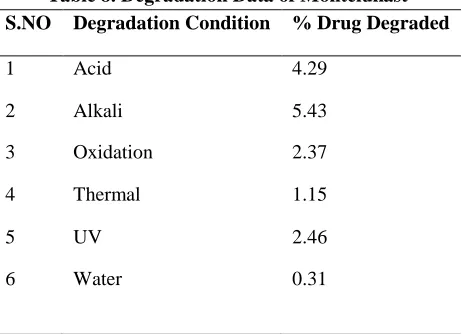
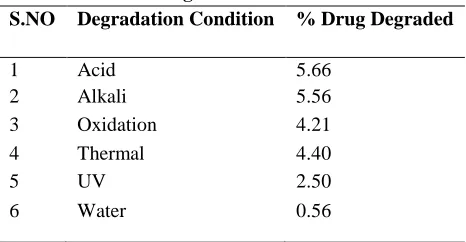
Degradation studies were performed with the formulation and the degraded samples were injected. Assay of the injected samples was calculated and all the samples passed the limits of degradation (Table 8&9).
Figure-1: Chemical Structure of Montelukast
Figure-3: Optimized Chromatogram of Montelukast and Ebastine
Figure-4: Linearity Curve of Montelukast
Figure-6: Standard Chromatogram of Montelukast and Ebastine
Figure-7: A Sample Chromatogram of Montelukast and Ebastine in Pharmaceutical Dosage Form
Table-1: Optimized Chromatographic Conditions Parameter Condition
RP-UPLC WATERS UPLC SYSTEM equipped with quaternary pumps with TUV detector Mobile phase Buffer and ACN: taken in the ratio 60:40. Flow rate 0.3ml/min
Column Waters C18 150 x 3 mm, 2. Detector wave length 244nm
Column temperature 30°C Injection volume 3L Run time 3 min
Table-2: Accuracy results of Montelukast and Ebastine
Conc.
Montelukast Ebastine Amount
added (µg/ml)
Amount recovered (µg/ml)
% Recovery Amount added (µg/ml)
Amount recovered (µg/ml)
% Recovery
50%
50 49.64 99.28 50 50.11 100.23
50 49.83 99.67 50 49.60 99.20
50 50.27 100.53 50 50.73 101.46
100%
100 99.83 99.83 100 101.21 101.21 100 101.40 101.40 100 99.03 99.03
100 99.83 99.83 100 99.72 99.72
150%
150 148.81 99.21 150 150.07 100.05 150 149.90 99.93 150 151.48 100.99 150 150.59 100.39 150 148.98 99.32 Mean % Recovery 100.01% Mean % Recovery 100.13%
Table-3: Precision Results of Montelukast and Ebastine S.No Repeatability Intermediate precision
Area of Montelukast Area of Ebastine Area of Montelukast Area of Ebastine
1. 2242085 2593353 2067472 2235855
2. 2244548 2602117 2075676 2232146
3. 2212966 2619485 2058202 2225542
4. 2234176 2614953 2075429 2232241
5. 2238071 2579639 2066073 2247538
6. 2239127 2609946 2076196 2233303
Mean 2235162 2603249 2069841 2234438
S.D 11435.4 14846.5 7224.1 7268.1
%RSD 0.5 0.6 0.3 0.3
Table-4: LOD and LOQ values of Montelukast and Ebastine Molecule LOD LOQ
Montelukast 0.38 1.15 Ebastine 0.09 0.28
Table-5 Robustness Data of Montelukast and Ebastine
S.no. Condition %RSD of Montelukast %RSD of Ebastine
1 Flow rate (-) 0.9ml/min 0.5 1.4
2 Flow rate (+) 1.0.3ml/min 0.8 1.3
3 Mobile phase (-) 35B:65A 1.8 1.9
4 Mobile phase (+) 45B:55A 1.5 1.7
5 Temperature (-) 25°C 0.9 0.5
Table-6: System Suitability Parameters Results of Montelukast and Ebastine S no Montelukast Ebastine
Inj RT(min) USP Plate Count Tailing RT(min) USP Plate Count Tailing Resolution
1 1.295 2611 1.30 1.634 4661 1.16 3.4
2 1.295 2609 1.27 1.635 4264 1.15 3.3
3 1.296 2507 1.29 1.636 4369 1.15 3.3
4 1.296 2474 1.27 1.636 4854 1.18 3.4
5 1.299 2470 1.23 1.636 4634 1.15 3.3
6 1.300 2700 1.20 1.637 4460 1.15 3.3
Figure-7: Assay Results of Montelukast and Ebastine S.No Montelukast Ebastine
Standard Area Sample area % of Drug Standard Area Sample area % of Drug
1. 2211642 2242085 101.24 2581317 2593353 101.27
2. 2229330 2244548 101.35 2534616 2602117 101.61
3. 2231862 2212966 99.93 2535195 2619485 102.29
4. 2202595 2234176 100.89 2561234 2614953 102.11
5. 2194107 2238071 101.06 2573801 2579639 100.73
6. 2204468 2239127 101.11 2563694 2609946 101.92
Mean 2212334 2235162 100.93 2558310 2603249 101.65
S.D 15229.1 11435.4 0.52 19506.6 14846.5 0.5797
%RSD 0.7 0.5 0.51 0.8 0.6 0.6
Table 8. Degradation Data of Montelukast S.NO Degradation Condition % Drug Degraded
1 Acid 4.29
2 Alkali 5.43
3 Oxidation 2.37
4 Thermal 1.15
5 UV 2.46
Table 9. Degradation Data of Ebastine S.NO Degradation Condition % Drug Degraded
1 Acid 5.66
2 Alkali 5.56
3 Oxidation 4.21
4 Thermal 4.40
5 UV 2.50
6 Water 0.56
CONCLUSION
A new Accurate, Precise, Simple and reliable method for the simultaneous estimation of the Montelukast and Ebastine in Pharmaceutical Dosage Form has been developed. The method developed was validated and was found to be sensitive, accurate, precise and reliable for the analysis of Montelukast and Ebastine in Bulk and Pharmaceutical dosage forms. The Results obtained were within the prescribed limits of ICH Guidelines
and shown accuracy and preciseness of the method developed. As the Retention times were decreased and that run time was less the method can be effectively adopted in regular quality control testing in industries which is also economical too. Finally it can be concluded from the results that the method developed was simple and accurate with robust and reliability as added values to the method.
REFERENCES
[1]. De Lepeleire I, Reiss TF, Rochette F, Botto A, Zhang J, Kundu S, Decramer M. Montelukast causes prolonged, potent leukotriene D4-receptor antagonism in the airways of patients with asthma.Clin Pharmacol Ther. 61(1), 1997, 83-92.
[2]. Jones TR, Metters K, Evans AJ. Preclinical pharmacological studies with montelukast (Singulair), a selective cysteinyl leukotriene receptor (CysLT1) antagonist. Clinical and Experimental Allergy Reviews 1, 2001, 205– 209.
[3]. Hurst M, Spencer CM. Ebastine: An update of its use in allergic disorders. Drugs. 59, 2000, 981–1006. [4]. Sastre J. Ebastine in allergic rhinitis and chronic idiopathic urticaria. Allergy. 63, 2008, 1–20.
[5]. Rana NS, Rajesh KS, Patel NN, Patel PR, Limbachiya U, Pasha TY. Development and Validation of RP-HPLC Method for the Simultaneous Estimation of Montelukast Sodium and Ebastine in Tablet Dosage Form. Indian J Pharm Sci . 75(5), 2013, 599–602.
[6]. Baokar Shrikrishna, Ranpise Nisharani.Analytical Method Development and Validation for Simultaneous Estimation of Montelukast and Ebastine by HPLC. Research Journal of Pharmacy and Technology. 5(1), 2015, 1817-1820·
[7]. R.L. Bakal Anil V Chandewar an isocratic hplc method for simultaneous determination of montelukast and ebastine in pharmaceutical formulations. Ijdfr. 4(3), 2013.
[8]. Hepcy Kalarani D, Shaanthi A, Venkatesh P, Lakshman Kumar D, Purushothaman M. Development and validation of reverse phase hplc method for the simultaneous estimation of montelukast sodium and ebastine in its tablet dosage form. World journal of pharmacy and pharmaceutical sciences. 4(9), 2015, 1004-1021. [9]. Anand Jigna, Mohan Sellappan. Development and Validation of RP HPLC Method for Simultaneous
Estimation of Ebastine and Montelukast Sodium In Combined Dosage Form. American Journal of PharmTech Research. 3(3), 2013, 770-777.