December 2019, Vol.4, No. 2 [218-228] ISSN Online 2616-7093 Functional English Courses for BS Applied Sciences Programme: Former
Students’ and Teachers’ Perceptions
Muhammad Nawaz1
1. Assistant Professor, Department. of Humanities, COMSATS University, Islamabad
Abstract
This paper aims to find out the perceptions of the teachers and the former students of BS in Applied Sciences about Functional English courses. The data were collected through semi-structured interviews, and analyzed both quantitatively and qualitatively. An eclectic model was employed using various variables. The results reflect that Functional English courses have very general aims, and books are recommended as the course material; however, it varies from class to class which show lack of uniformity in the choice of material. It also reveals that the former students’ speaking skills have not been improved during studying these courses. They recommend that the practical tasks to be added in the courses. It also shows that half of the teachers practice reading and listening skills in the classes. The former students report that practicing listening skills and reading technical articles can be much helpful for students in their practical life. Both the teachers and the former students show agreement that there is intense need to add practical activities in the existing courses.
Keywords: Functional English; Courses, Teachers, Students, Applied Sciences Introduction
This paper intends to know the perceptions of the teachers and the former students about Functional English courses for undergraduate students. The students of Bachelor of Science (BS) in Applied Sciences are taught Functional English courses for two semesters; it is supposed to help the students during their academic and occupational life. It is generally observed that these students lack effective communication skills. They have a general grasp of grammatical and syntactical knowledge. However, it remains to be seen whether or not the existing Functional English courses are useful for making students competent to meet the needs of their profession. This research finds out the perceptions of teachers and former students about Functional English contents. It uses the eclectic approach in the selection of model for the evaluation of the courses which is based on some previous models of course evaluation.
It investigates whether or not the existing Functional English courses for Bachelor of Science fulfill the needs of the students. It may review all the course components and provide useful insight regarding the courses development. It may benefit Functional English teachers, students and syllabus designers.
Literature Review
English for Specific Purposes (ESP) Course
The term ESP denotes learning and teaching of English to meet the specific demands of a profession that the students have either joined or are supposed to join.
Chen (2006) states that an ESP course design is “based on the specific needs of
learners of a particular discipline. There are different purpose-oriented ESP courses, such as EST (English for Science and Technology), EAP (English for Academic Purposes), EOP (English for Occupational Purposes), and EBP (English for Business Purposes) etc” (p.25).However, in Pakistan, as Mueen (1995) reports, the ESP
syllabus is designed in such a manner that the learners are exposed to merely the grammatical concepts which they must learn. Jiajing (2007) suggests that in ESP
course learners’ needs should be analyzed. The students’ needs consist of using
language in their practical lives.
Evaluation of Course
Evaluation plays an important role in the field of second language learning and teaching. It varies in its scope and covers dimensions like programme evaluation, evaluation of entire educational institution, classroom evaluation or course evaluation. Evaluation is an ongoing process which gives an insight into a programme
in order to make the programme more successful and updated.“Evaluation helps to
show how well the course is actually fulfilling the needs...thus evaluating an ESP course helps to establish whether it is meeting its aims...course evaluation also plays a useful social role, by showing the various parties involved (teachers, learners,
sponsors etc.)” (Hutchinson & Waters, 1987).
Characteristics of Formative and Summative Evaluation
With regard to course evaluation, Johnson (1989) has discussed two approaches of evaluation: product evaluation and process evaluation. Summative evaluation inclines to the product which aims to know the end result of the programme, i.e., whether or not the goals of the programme have been achieved while formative evaluation intends to look at process with the aim to collect the data in order to know not only whether the goals of the programmes have been met but also to study and improve those processes which were involved.
Evaluation Models
Syllabus evaluation models mean some important and relevant aspects of a course on the basis of which the syllabus needs to be evaluated. Different evaluation models of language syllabus have been proposed by the researchers, some of them are
presented in the following. Munby’s (1978)model includes communication needs processor which focuses on the variables that affect the communication needs “by organizing them as parameters in a dynamic relationship to each other” (p. 32). According to Nunan (1988), Munby’s model (1978) is “the most sophisticated application of need analysis to language design” (p.19).
Another model by Hutchinson and Waters’ (1987) comprises of the
Nunan’s model (1988) suggests that in syllabus designing the following points need to
be kept in mind. The course should comprise of analysis of the language which includes the grammatical, vocabulary items etc. Moreover, Cunnings worth (1995) proposed a material evaluation model which focuses on the language content, skills, topics and methodology of a course. Another model posited by Forsyth, Jolliffe and Stevens (1999) includes material content, overall design, interactivity, navigation, motivational components, media, assessment, look, record keeping and tone. Most of the items in this model suggest new components for the evaluation of the learning materials.
These models identify various components of the course which need to be kept in mind in evaluating a course. The researcher has followed an eclectic approach by combining the different elements described in the previous models. The main reason for using this approach is that the components which have mostly been preferred by the various models are combined together in the form of new model. These components are: a) Background to the course, b) Skills, c) Course contents, d) Teaching methodology, and e) Assessment. This new form covers all the main elements of the discussed models, and in light of these components, the existing Functional English courses are evaluated.
Evaluation Studies on English Courses
Leung (1991) undertook a study to evaluate a programme of teaching standard report writing at Hong Kong Polytechnic University. Similarly, Sysoyev (2000) designed an ESP course in Russia using the learner centered approach. Likewise, Flowerdew (2005) described a course for English for Occupational Purposes (EOP) that integrated the traditional and critical approaches to syllabus design. Kantonidou (2008) conducted a case study of ESP in the context of electrical engineering curricula, and concluded that theoretical evidence should be reconciled with hard facts through the cooperation of all the stakeholders.
Material and Methods
The data were collected from Functional English teachers and the former students of the BS Applied Science using semi-structured interviews. The data were collected from a university located in the Federal Capital Territory, Islamabad. The
university’s name is not disclosed to hide its identity. The population was all the
teachers of Functional English courses in the Faculty of Applied Sciences of the University. In addition, all the former students of BS in Applied Sciences, who had completed their degrees from the university in the last three years, are included. The sample comprises of 4 teachers who have been teaching Functional English in the Faculty, and 20 former students who have received their BS degrees in Applied Sciences from the university, and currently working in the field. The data were analyzed under various themes.
The data in this study comprise of the Functional English teachers’ interviews
on the basis of obtained data: a) Background to the course, b) Skills, c) Contents, d) Teaching methodology, d) Assessment. Each component is analyzed separately in
light of teachers’ and students’ responses.
Background to the Course
First, the data based on teachers’ interviews and then the former students’
interviews are tabulated quantitatively and qualitatively using thematic analysis.
Table 1
Arethe aims and objectives of the courses stated clearly? (Teachers’ interview) Frequency Themes
3 Functional English courses have general aims but do not provide specific details.
1 Teacher sets the aims and objectives for the courses in light of the department outlines.
Most of the teachers’ interviews (3) show that the Functional English courses
have the general aims and objectives, and, in the light of these, they set the specific aims and objectives by themselves.
Table 2
What types of aims and objectives would you recommend for the courses? (Former students’ interview)
Frequencies Themes
7 The aims and objectives of Functional English courses should be set in ways which develop writing, reading, speaking and listening skills of the students.
4 The aims and objectives of the English course must be prepared which cover all the four skills.
1 The aims and objectives of Functional English should be developed which enable students to write accurate reports and to speak confidently with others.
3 The aims and objectives should be set in the light of real-life needs of the students.
The former students say that the aims and objectives of Functional English courses should be prepared keeping in view the occupational needs of the students which enable the students to speak, write, read and listen effectively in their occupation.
Table 3
What material do you recommend for the courses? (Teachers’ interviews) Frequency Themes
3 Teachers refer the books like “Business Communication”, or
“Communication Skills” etc to students which are available in the
university’s library and in the local market of Rawalpindi/ Islamabad as
form, so that it should be not burden on the pocket of the parents of the student but also motivate the students to grasp, comprehend and obtain good position.”
1 Teacher provides the materials to the students which he gets from different
resources like libraries, internet and market. “I recommend comprehension
books, film, cassettes, play role, novel, articles, journals, and newspapers
for the class discussion.”
Majority of the teachers are of the view that they recommend books for the students, and they also provide notes as a course material.
Skills
In this section, the data collected from the respondents concerning four skills of students has been analyzed.
Table 4
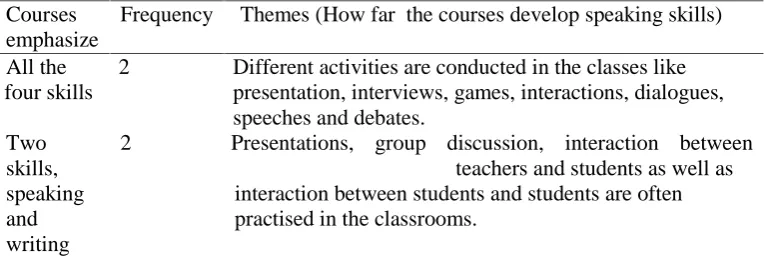
What skills do the courses emphasize? (Teachers’ interview) Courses
emphasize
Frequency Themes (How far the courses develop speaking skills)
All the four skills
2 Different activities are conducted in the classes like presentation, interviews, games, interactions, dialogues, speeches and debates.
Two skills, speaking and writing
2 Presentations, group discussion, interaction between teachers and students as well as interaction between students and students are often practised in the classrooms.
Two teachers (no 1 & 4) report that the courses emphasize reading, writing, listening and speaking, and all the skills are given equal weightage in the classrooms whereas other two teachers (no 2 & 3) say that although courses emphasize four skills, yet two skills speaking and writing are given more importance in the classroom because these two skills are practised in the practical field. The data also reveal it depends on the teachers to decide which skills are more important or less important for the students, and which of the skills should be taught to the students. Teachers teach the students according to their own will.
Table 5
How much do the speaking skills learnt during the courses help you in practical life? (Former students’ interview)
Frequency Themes
7 Students got benefit from the course and these students recorded their interviews speaking fluently in English. They propose that course should provide more opportunities for practicing speaking skills in the classrooms.
Majority of the former students complain that their speaking skills have not improved. The students suggest there is need to focus on practical tasks in the classrooms for developing speaking skills because in real-life, they are required to speak English. They propose that proper training may enable them to face the challenges of their professions.
Table 6 How far the courses develop the reading skills of the students? (Teachers’ interview)
Frequency Themes(Reading skills)
2 Different sub-skills of reading are practiced in the classes like skimming, scanning and the purpose of a text. Students are provided the notes, and the books as reading material; they read and discuss.
2 At university level, students can comprehend the given reading materials easily
because reading skills are focused since students’ primary school, and they
also get chance for reading during the other subjects taught at BS level, and they do not give much importance to reading skills.
Two of the teachers (no 1 & 4) practiced the reading skills in the classroom while other two teachers (no 2 & 3) state that students get chance of reading skills since their school life, and they feel comfortable in reading skills; hence, they do not practice it in the classrooms.
Table 7
How much do the reading skills learnt during the courses help you in practical life? (Former students’interview)
Frequency Themes(Reading Skills)
9 Students rarely face problems in reading skills.
6 Students need to read the articles for the clients and they suggest that the reading skills must be added in the course which might polish their abilities of reading technical articles at work place.
5 Reading skills must be practiced in the classrooms and the course should add the relevant tasks.
Almost half of the former students report that they feel confident in reading technical articles. Nearly half of the former students state that the course should
emphasize on reading skills keeping in view their profession’s needs like the
technical articles. They say that there is need to add such articles in the Functional English courses.
Table 8 How far the courses develop the writing skills of the students? (Teachers’ interviews)
Frequency Themes(Writing Skills)
2 Teachers teach writing skills but complain it is hard for them to train the students who are too weak in writing because these skills require that a student must have strong background since his schooling. One of the
teachers reports “I teach them essay writing, projects, letter writing, summary, paraphrasing, questions and answers, and comprehensions
2 Perfection in writing skills is not possible unless time span is increased for Functional English courses. One of them further proposes that number of the students in a class should not exceed 40.
All the teachers are of the view that the students need strong background in writing skills because it is not possible to train them in writing skills in one or two semesters. By and large, the teachers report that they teach the students, grammar, essay writing, application, formal and informal letters, projects, paraphrasing, questions/answers, and comprehensions questions etc.
Table 8
How much do the writing skills learnt during the courses help you in practical life? (Former students’ interviews)
Frequency Themes(Writing Skills)
12 Need to write reports which comprised of daily reports, weekly reports, monthly reports, analysis reports, and progress reports. They report that they rarely got chance to practice these reports during the course work. They suggest that teachers should give practical work in the classes to develop
the students’ writing skills.
6 Need to write letters, applications, documents, summary of the articles, e-mails, and explanation of the tasks assigned to them while during the courses they were taught the theory of writing skills not practical work. 2 Writing skills should be given equal weightage in the class.
Most of the former students think that they need to write different reports in the field. They propose that Functional English courses should emphasize on practical tasks in the classrooms, not theoretical work.
Table 9 How far the courses develop the listening skills?(Teachers’ interviews) Frequency Themes(Listening Skills)
1 Emphasizes on the listening skills and he selects reputable films and students get chance listening different characters in different accent which stimulate them for listening.
1 Uses cassettes/audio recording for developing listening skills of the students.
2 There should be another semester because it is hard to cover all the skills within two semesters. One of them say that listening is much important, if there are no receptive skills there would be no productive skills whereas other teacher suggests that department should take steps by providing proper outline and provide modern equipments.
Two teachers (no 1 & 2) practiced the listening skills in the classrooms whereas others two teachers (no 3 & 4) propose that time span should be increased because in two semesters it is not possible to cover all the four skills since each skill requires suitable time and proper attention of both teachers and students.
Table 10
How much do the listening skills learnt during the courses help you in practical life? (Former students’ interviews)
14 Listening skills learnt during the Functional English courses helped them in the field. They report, specifically, watching movies was a healthy practice which enabled them to become good listeners. Former students suggest that practice of listening skills should be continued in the classrooms. 4 Up to some extent listening skills have improved but it should be often
practiced in the classes.
2 Did not get chance for developing the listening skills in the classrooms.
Majority of the former students got opportunity for developing their listening skills which help them a lot in practical field and they propose that the courses should emphasize the practice of listening skills which can be helpful for students in their real life.
Contents of the courses
Table 11
Do the objectives of the courses match the contents? (Teachers’ interviews) Frequency Themes
4 The contents of the courses match with the aims and objectives.
All of the teachers claim that the contents match with the aims and objectives of the course.
Table 11
What are you views regarding suitability of the contents of the courses in terms of their relevance to your profession? (Former students’ interviews) Frequency Themes
3 The contents of the speaking and listening skills are helpful in their occupation and they propose that similar contents of other skills should be developed which help them in their vocation.They claim that watching movies and presentation conducted in the classroom help them in real-life. 6 The contents should include watching movies, reading newspapers,
discussion on different topics, writing different reports which provide the opportunities for practical tasks.
5 The contents should be developed keeping in view the needs of the students in real life like case study, software development study, discussions on technical topics in the classes.
3 The contents must be organized specifically not generally.
3 More presentations and topics should be given on the spot, group discussions, question/ answer sessions, and creative writing system, not copy and paste system, should be included in the contents.
Most of the former students are of the view that courses should develop the specific contents related to their occupation which fulfill the needs of the students in real-life and the contents of the courses must lead students towards practical tasks. Teaching Methodology
The data related to teaching methodology are analyzed in the following: Table 12
White board, projector,and multimedia
4 White board, projector, and multimedia are used in the classrooms.
All of the teachers report that they teach different skills by using visual aids like white board, projector and multimedia.
Assessment
The data related to assessment are analyzed in the following: Table 13
How do you assess different skills of the students?(Teachers’ interview) Assessme
nt methods
Frequen cy
Themes
Writing skills
4 Teachers give the tasks like essay writing in which they test the organization of the ideas, appropriate use of vocabulary, understanding of the topic, logical order in the structure, the beginning and conclusion of the topic and correct English of the students. One of the teachers also added, “In writing, I test the grammar, subject agreement, vocabulary, correct English, usages, good ideas.”
Speaking skills
4 All of the four teachers have same view that they assess the students’
confidence, correct English, logical order, grammar and correct pronunciation. Three of the teachers claimed that students are asked to give presentation before the class, speech, debate, conservation, and table talk etc and one of the teachers reports,“Students are allowedto participate in the class activities and sufficient time is given to the students to express their abilities before the class.”
Reading skills
2 In the reading skills they assess the students in the papers as to how much were students able to understand a text.
1 Teacher assesses the reading skills of the students by giving them reading comprehension and academic texts.
1 Teacher gives 10% weightage to the reading skills which consist of the tasks like reading paragraph and questions/ answers activity.
Listening skills
2 Teachers assess the students whether they are able to understand the information in the dialogue spoken by others. Do the students understand the conversation between several people? Can the students understand the message? What strategies do they employ to cope with problems in listening?
Teachers’ interviews reveal that most of them claim that they assess the
performance of the students through all the four skills.
Discussion
Teachers reported that the courses have general aims while the former students viewed that aims of the courses should be prepared according to students’ occupational
needs. Regarding the material, most of the teachers recommended books and notes for the courses. Half of the teachers emphasized on four skills whereas other teachers focused on speaking and writing skills which mean its teachers’ choice what to teach to
developed in the courses. The former students complained that their speaking skills have not been improved during studying the Functional English courses. They have suggested that practical activities to be added in the courses. Likewise, Finocchiaro and Brumfit (1983) propose that a functional course presupposes that the speakers have a real purpose for speaking.
Similarly, two teachers practiced various reading strategies like skimming and scanning etc while the other teachers reported that the students were familiar with this skills from the beginning of school; thus, not to be given much importance at tertiary level. Similarly, nearly half of the former students were satisfied with the reading activities in the classroom, whereas others recommended that it must be thoroughly practiced and technical articles to be added in the courses.
All the teachers viewed that strong background in writing skills to be required
for improving students’ writing skills. They also recommended duration of courses be
increased and strength of students be decreased for effective writing skills of students. The former students recommended that the following contents to be added in the courses like daily reports, weekly reports, monthly reports, analysis reports, progress reports, letters, applications, documents, summary of the articles, e-mails, explanation of the tasks, and all these must be practiced in the classes. Cunnings worth (1995) suggests that the courses should develop appropriate activities in the writing skills in terms of amount of guidance and degree of accuracy and proper style.
Listening skills is practiced by two teachers while the other teachers suggested increasing time span of the course for teaching all skills in the classrooms. These findings are similar to McDonough and Shaw (2003), and Cunnings worth (1995) that well recorded materials are needed in developing the listening skills of the learners. The former students reported that the practiced listening skills helped them a lot in their practical field. They proposed that it must be practiced in the classrooms to prepare them for practical life. All the teachers viewed that the contents matched with the aims and objectives of the course. On the other hand, the former students reported that the contents of the courses must be taken from real-life which lead towards practical tasks. Similarly, Hutchinson and Waters (1987) point out that there should be proper organization of the contents throughout the materials and within the units.
Regarding teaching methodology, all of the teachers report that they teach different skills by using visual aids like white board, projector and multimedia etc. Cunnings worth (1995) suggests that the skills should be taught differently for
developing the learners’ communicative competence. For assessing the students,
overall, all the teachers claim that they assessed the performance of the students through all the four skills.
From the finding, the researcher suggests that Functional English courses
should be developed after analyzing the students’ needs. The syllabus designers should
take the responsibility to find out the needs of the students in the corporate sectors.
They should design the courses for in light of students’ needs like, writing reports,
References
Chen,Y. (2006). From common core to specific. Asian ESP Journal. 1. 24-50
Cunningsworth, A. (1995). Choosing your course book. Oxford:Heinemann.
Flowerdew. (2005). Integrating traditional and critical approaches to course design:
The ‘what’, the ‘how’ and the ‘why’? Journal of English for Academic Purposes, 4, 135-147.
Finnochiaro, M. &Brumfit. C.J. (1983). The functional notional approach: From theory to practice. Oxford: Oxford University Press.
Forsyth, I., Jolliffe, A. & Stevens, D. (1999). Evaluating a course. (2nded.). London: Kogan page.
Hutchinson, T., & Waters, A. (1987). English for specific purpose. Cambridge: Cambridge University Press.
Jiajing, G. (2007). Designing an ESP course for Chinese university students of business. Asian ESP Journal. http://www.asian-esp-journal.com_EBook.pdf
Johnson, R. K. (1989). The second language learning: Cambridge:Cambridge University press.
Kantonidou, M. M. (2008). English for specific purposes in the context of electrical engineering curricula: A case study.[Electronic version]
http://ieeexplore.ieee.org/stamp/stamp.jsp?arnumber=04610157
Leung, P. (1991). An evaluation study of a programme to teach standard report writing. Hong Kong Papers in Linguistics and Language Teaching,14, 65-79.
Mueen, A. (1995). ESP for doctors. Unpublished dissertation, Allama Iqbal Open University, Islamabad.
Munby, J. (1978). Communicative course design. Cambridge: Cambridge University Press.
Nunan, D. (1988). Course design. New York: Oxford University Press.