Ames Laboratory Publications
Ames Laboratory
12-1-2011
Anisotropic magnetoelastic coupling in
single-crystalline CeFeAsO as seen via high-resolution
x-ray diffraction
H.-F. Li
Institut Laue-Langevin
J.-Q. Yan
Iowa State University
J. W. Kim
Argonne National Laboratory
R. William McCallum
Iowa State University, [email protected]
Thomas A. Lograsso
Iowa State University, [email protected]
See next page for additional authors
Follow this and additional works at:
http://lib.dr.iastate.edu/ameslab_pubs
Part of the
Condensed Matter Physics Commons
, and the
Materials Science and Engineering
Commons
The complete bibliographic information for this item can be found at
http://lib.dr.iastate.edu/
ameslab_pubs/56
. For information on how to cite this item, please visit
http://lib.dr.iastate.edu/
howtocite.html
.
Anisotropic magnetoelastic coupling in single-crystalline CeFeAsO as
seen via high-resolution x-ray diffraction
Abstract
Single-crystal synchrotron x-ray diffraction studies of CeFeAsO reveal strong anisotropy in the
charge-correlation lengths along or perpendicular to the in-plane antiferromagnetic (AFM) wave vector at low
temperatures, indicating an anisotropic two-dimensional magnetoelastic coupling. The high-resolution setup
allows to distinctly monitor each of the twin domains by virtue of a finite misfit angle between them that
follows the order parameter. In addition, we find that the in-plane correlations, above the orthorhombic
(O)-to-tetragonal (T) transition, are shorter than those in each of the domains in the AFM phase, indicating a
distribution of the in-plane lattice constants. This strongly suggests that the phase above the structural O-to-T
transition is virtually T with strong O-T fluctuations that are probably induced by spin fluctuations.
Keywords
Physics and Astronomy, Materials Science and Engineering
Disciplines
Condensed Matter Physics | Materials Science and Engineering
Comments
This article is from
Physical Review B
84 (2011): 220501(R), doi:
10.1103/PhysRevB.84.220501
.
Authors
H.-F. Li, J.-Q. Yan, J. W. Kim, R. William McCallum, Thomas A. Lograsso, and David Vaknin
RAPID COMMUNICATIONS
PHYSICAL REVIEW B84, 220501(R) (2011)
Anisotropic magnetoelastic coupling in single-crystalline CeFeAsO as seen
via high-resolution x-ray diffraction
H.-F. Li (),1,2,*J.-Q. Yan,1,3,4J. W. Kim,5R. W. McCallum,1,6T. A. Lograsso,1and D. Vaknin1,7 1Ames Laboratory, US Department of Energy, Ames, Iowa 50011, USA
2J¨ulich Centre for Neutron Science (JCNS), Forschungszentrum J¨ulich GmbH, Outstation at Institut Laue-Langevin (ILL),
Boˆıte Postale 156, F-38042 Grenoble Cedex 9, France
3Department of Materials Science and Engineering, University of Tennessee, Knoxville, Tennessee 37996, USA 4Materials Science and Technology Division, Oak Ridge National Laboratory, Oak Ridge, Tennessee 37831, USA
5Advanced Photon Source, Argonne National Laboratory, Argonne, Illinois 60439, USA 6Department of Materials Science and Engineering, Iowa State University, Ames, Iowa 50011, USA
7Department of Physics and Astronomy, Iowa State University, Ames, Iowa 50011, USA (Received 6 November 2011; published 1 December 2011)
Single-crystal synchrotron x-ray diffraction studies of CeFeAsO reveal strong anisotropy in the charge-correlation lengths along or perpendicular to the in-plane antiferromagnetic (AFM) wave vector at low temperatures, indicating an anisotropic two-dimensional magnetoelastic coupling. The high-resolution setup allows to distinctly monitor each of the twin domains by virtue of a finite misfit angle between them that follows the order parameter. In addition, we find that the in-plane correlations, above the orthorhombic (O)-to-tetragonal (T) transition, are shorter than those in each of the domains in the AFM phase, indicating a distribution of the in-plane lattice constants. This strongly suggests that the phase above the structural O-to-T transition is virtually T with strong O-T fluctuations that are probably induced by spin fluctuations.
DOI:10.1103/PhysRevB.84.220501 PACS number(s): 74.70.Xa, 74.25.Jb, 75.30.Fv, 75.50.Ee
Understanding the strong magnetoelastic coupling ob-served in parent ferropnictides is pivotal to unraveling the mechanism that makes these systems superconducting (SC) by chemical doping.1–3 This strong coupling is manifested
in the emergence of a stripe-type antiferromagnetic (AFM) phase that is stable in an orthorhombic (O) phase that results from shearing distortions of a high-temperature tetragonal (T) phase, as illustrated in Fig. 1. The magnetic and structural transitions occur simultaneously in the AFe2As2 (A=Ca,
Sr, and Ba, “122”) systems,4–6 while the magnetic ordering
transition temperature (TN) is in a range of∼6–18 K below the structural transition temperature (TS) and is strongly dependent
on the sample quality in the LnFeAsO (Ln=lanthanide element, “1111”) family.7 The spin-lattice coupling has also
been implied in the interpretation of spin dynamics as well as its influence on the structures of these systems. Inelas-tic neutron-scattering studies from single-crystal CaFe2As2
(Refs. 8 and 9) and polycrystalline LaFeAsO (Ref. 10) showed that spin fluctuations persist above TN up to at least room temperature. It was argued that such fluctuations introduce dynamic disorder of the O and T phases, so that finite orthorhombicity and tetragonality may exist above and below TS, respectively.6,7,11 Furthermore, the magnetic and
structural transitions can be simultaneously tuned by chemical substitutions, e.g., suppressing the AFM and O phases and setting in the SC state.12
The magnetic structure as schematically shown in Fig.1
and spin dynamics indicate a strong magnetic frustration due to the competition between the nearest-neighbor (NN) and the next-NN (NNN) AFM exchange couplings (referred to as the
J1-J2 model) that produces a stripe-type AFM structure for J2> J1/2 in the parent pnictides. One of the consequences of the magnetic frustration is the possible emergence of nematic degrees of freedom13that can give rise to a short-range O order
aboveTS.14–16However, directly probing nematic fluctuations
is nontrivial due to the difficulties in unequivocally decoupling their effects from that of the twin domains,17 as well as the fact that the magnetic field fluctuations associated with them average to zero. The roles of nematic fluctuations in shaping the magnetic and structural transitions and in the pairing mechanism that leads to superconductivity in the iron arsenides are under intense debate.16,18
Here we report on high-resolution synchrotron x-ray diffraction studies of a CeFeAsO single crystal that enable us to separately monitor the development of each of the twin domains in this system. In particular, we examine the in-plane charge correlations as a function of temperature to gain insight on the two-dimensional (2D) coupling between the structural and magnetic properties of this typical ferropnictide.
CeFeAsO single crystals were synthesized in NaAs flux at ambient pressure, as described previously.19 Crystal quality
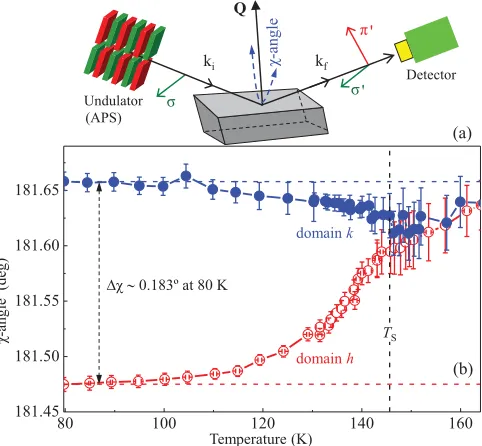
was characterized by Laue backscattering, x-ray powder-diffraction, heat capacity, magnetization, and resistivity mea-surements. A large as-grown platelike CeFeAsO single crystal (∼5 mg) with the crystallographic c axis perpendicular to its surface was selected. The x-ray diffraction studies were carried out on the six-circle diffractometer of the 6-ID-B (XOR/MU) beamline at the Advanced Photon Source (APS) at Argonne National Laboratory. The x-ray energy throughout the experiment was kept atE=7.1000(5) keV. The incident radiation was linearlyσ polarized with a spatial cross section of 1.0 mm (horizontal)×0.25 mm (vertical). The scattering geometry is shown in Fig.2(a), where theχangle represents a relative tilting of the sample with respect toQ. In this configu-ration, charge scattering does not change the polarization of the scattered photons and occurs in theσ-σ scattering channel. The mosaic of the single crystal is∼0.09◦ full width at half maximum (FWHM) as measured on the charge (205)OBragg
220501-1
LI, YAN, KIM, MCCALLUM, LOGRASSO, AND VAKNIN PHYSICAL REVIEW B84, 220501(R) (2011)
FIG. 1. (Color online) Schematic illustration of the formation of twin domains when the T structure transfers into the O phase in CeFeAsO. The O distortion in pnictides proceeds by shearing the T planar square into two rhombuses with anglesπ
2 ±δ(preserving the length of the square), creating twin domains.δis the shearing angle. Here we just show one rhombus for clarity.J1andJ2represent the NN and NNN AFM exchange interactions, respectively.aT(T symmetry), andaOandbO(O symmetry) are the in-plane lattice constants. The arrows on the Fe ions represent the spins of iron ions.
reflection at 80 K. The sample was mounted at the end of the cold finger of a displex cryogenic refrigerator with theacplane as the scattering plane, and was measured at a temperature range of∼80–170 K. We note that the (H KL)T indices for
the T symmetry correspond to the O reflection (hkl)O based
on the relations ofh=H+K,k=H−K, andl=L. Upon cooling, atTS, the T (P4/nmm) structure transfers
into the O (Cmma) one. This is accompanied by an appearance of twin domains, e.g., the Bragg (H K0)T reflection in the
T symmetry splits into twined (H+K,H−K,0)O/(H− K,H+K,0)O ones in the O symmetry. To obtain the
angle misfit between the twin domains, we monitored the (205)O/(025)Oreflections. Figure2(b)shows the temperature
dependence of theχangle [as illustrated in Fig.2(a)] of both reflections. We find that for the k domain, represented by the (025)Oreflection, theχ angle has no appreciable change
within statistics in the investigated temperature range of∼80– 164 K; whereas for thehdomain, represented by the (205)O
reflection, the χ angle gradually increases below ∼130 K upon warming, and then steeply increases until merging into that of thekdomain atTS. The measuredχ-angle difference χ =χk−χhis∼0.183◦at 80 K, as indicated in Fig.2(b).
The separation of the twin domains belowTSallows us to
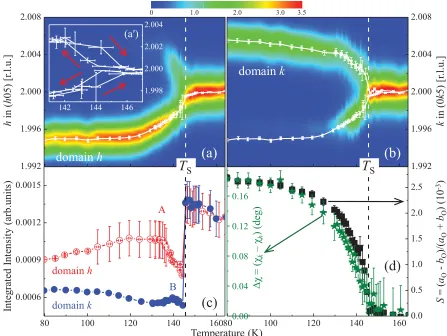
practically focus on an untwinned single crystal and follow the evolutions of the lattice constants and the correlations along thea andbaxes. Figures3(a)and3(b)show the temperature dependence of the (h05) and (0k5) reflections from the
h and k domains, respectively, indicating TS=145(1) K.
The integrated intensities of the longitudinal h andk scans from both domains shown in Fig. 3(c) exhibit two features associated withTSandTN. The dramatic jump in the intensity atTSis clear evidence that the structural transition is first order
FIG. 2. (Color online) (a) Illustration of the x-ray diffraction setup at the 6-ID-B beamline at APS at Argonne National Laboratory. The χangle indicates the directions for tilting the CeFeAsO single crystal with respect toQ. (b) Temperature evolution of theχangle of theh andk domains. The vertical dashed line implies the structural O-T transition temperatureTS. The horizontal dashed lines indicate the χ-angle difference between thehandkdomains at 80 K. The solid lines are guides to the eye.
in character. This is also manifested by a∼2 K hysteresis effect as shown in Fig.3(a), consistent with similar observations in other pnictides.5,6 The other feature in Fig.3(c), labeled by A and B, is more subtle and may result from the magnetic transition as discussed below, providing evidence for the coupling between lattice and spin orders.
Figure3(d) shows the temperature dependence of the O strainS and the misfit-angle differenceχ =χk−χh. The
value of the strain S∼2.7×10⁻³ at 80 K in CeFeAsO [S≡(aO−bO)/(aO+bO), whereaOandbOare the O lattice
constants] is almost half the corresponding values in SrFe2As2
(Ref.6) and CaFe2As2(Ref.5) compounds. This indicates that
the out-of-plane coupling in the “1111” system is much weaker than that in the “122” family. The temperature dependence of the misfit-angle difference coincides well with that of the O strain, indicating a close relationship between microscopic (S) and macroscopic (χ) parameters. This demonstrates thatχ
can serve as yet another probe to monitor the order parameter of the O-T structural transition.
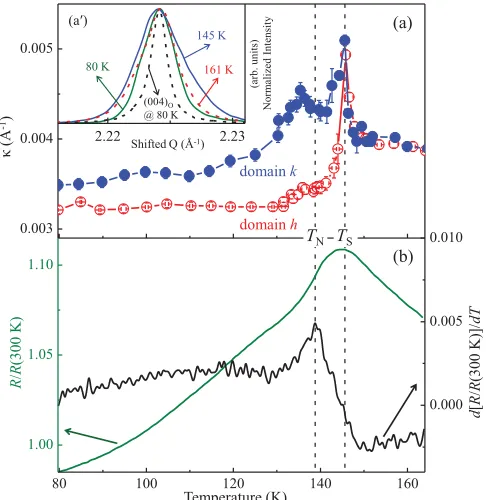
The most remarkable observation in this paper is the temperature variation in the peak linewidth (i.e., the FWHM=
κ) for both twin domains, as shown in Fig.4(a). This linewidth obtained from the longitudinalhandkscans extends beyond the instrumental resolution, as demonstrated by comparing it with that of the correspondinglscans of the (004)Oreflection
[Fig.4(a)], and is thus inversely proportional to the intrinsic in-plane charge-correlation lengths. At low temperatures (<TN), the charge-correlation length along thehdirection is significantly larger than that along thekdirection, indicating that the h domain is majority consistent with the stronger
[image:4.608.52.296.69.262.2] [image:4.608.317.558.72.295.2]RAPID COMMUNICATIONS
ANISOTROPIC MAGNETOELASTIC COUPLING IN. . . PHYSICAL REVIEW B84, 220501(R) (2011)
FIG. 3. (Color online) Temperature evolution of (a) thehdomain and (b) thekdomain. The solid line in (a) and the lower solid line in (b) indicate the Lorentzian-fit center of the longitudinalhscans atQ=(h05)O. The upper solid line in (b) indicates the Lorentzian-fit center of the longitudinalkscans atQ=(0k5)O. (c) Temperature evolutions of the integrated intensities of the longitudinalhandkscans atQ=(h05)O and (0k5)O, respectively, and (d) the O distortion (squares) (right) in the crystallineab plane, namely,S≡(aO−bO)/(aO+bO), and the domain-angle misfit (stars) (left), namely,χ=χk−χh. (a) The∼2 K temperature hysteresis effect of the Lorentzian-fit centers indicative of a first-order O-T structural transition. Points A and B in (c) indicate the kink positions probably associated with the AFM transition, as described in the test. The vertical dashed lines in (a)–(d) indicate the structural O-T transition temperatureTS. The solid lines in (a)–(c) and (a) are guides to the eye.
intensity observed for thehdomain in Fig.3(c). This agrees well with the fact that the AFM interaction (interstripe) in this system is much stronger than the effective FM one (intrastripe), which results from the competing NNN interactions (J2,
as illustrated in Fig. 1) that introduce frustration in the magnetic system. This charge-correlation-length anisotropy is also consistent with recent observations in an inelastic neutron-scattering study of SC Ba(Fe0.926Co0.074)2As2 that
show a similar anisotropy in the spin-correlation lengths.20
The much smaller FWHM of the (004)Oreflection compared
to that of thehscans of the (205)Oreflection at 80 K [Fig.4(a)]
in turn demonstrates that the spin-lattice coupling is 2D, and thus the magnetic exchange along theldirection is very weak. With the increase in temperature, the anisotropy becomes more and more pronounced, and two prominent peaklike features are observed at∼135 and∼145 K, which we associate with the stripe-type AFM and the O-T transitions, respectively. The relatively large broadening at TS is due to the genuine
increase in linewidth with temperature and the fact that the splitting may not be resolvable, and thus was treated as a
single peak. Figure4(b)shows the temperature dependence of the normalized in-plane resistivity and its first derivative, clearly showing anomalies atTSandTN, consistent with the
observations in Fig.4(a).
In the T symmetry, above TS, the linewidths are sig-nificantly larger than those at low temperatures. Similar observations have been reported in powder-diffraction studies of LaFeAsO.21,22 This indicates that what is measured is in
fact a distribution in thed spacings due to the fluctuating O/T structures, which may not be resolved on the time scale and precision of the instrument. This seems to be an averaged-T phase with O/T fluctuations that are probably induced by the strong spin fluctuations typical in these systems.8It should be noted that in general the correlation length diverges close to the O-T transition. However, the correlation lengths observed here are at their local minima close to the transition, char-acteristic of a martensiticlike transition, due to the shearing distortion in these systems.11
The behavior of the asymmetric FWHM as shown in Fig. 4(a) may imply a remnant orthorhombicity above TS,
[image:5.608.80.527.70.406.2]LI, YAN, KIM, MCCALLUM, LOGRASSO, AND VAKNIN PHYSICAL REVIEW B84, 220501(R) (2011)
FIG. 4. (Color online) Temperature evolutions of (a) the FWHM κ of the longitudinal h and k scans at Q=(h05)O and (0k5)O, respectively, and (b) the resistivity measurement (left) and its first derivative (right) indicate the temperatures of the AFM transition of iron ions (TFe
N ) as well as the O-T structural transition (TS). (a) shows the longitudinalhscans atQ=(h05)O and at temperatures of 80, 145, and 161 K. To estimate the instrumental resolution effect, we also showed the correspondinglscan of the (004)Oreflection at 80 K. TheQvalues and observed intensities were shifted and normalized, respectively, for comparison. The vertical dashed lines in (a) and (b) indicate the AFM and the O-T structural transition temperaturesTN andTS, respectively. The solid lines in (a) are guides to the eye.
while the gradual decrease of the FWHM of the k domain below ∼130 K may indicate a remnant tetragonality below
TS. It is possible that the remnant tetragonality follows the k domain because both lattice constantsbO andbT decrease
upon cooling. Therefore, we argue that both T and O phases may coexist dynamically in a certain temperature range around
TS, most likely due to the strong magnetic fluctuations, and, perhaps, due to spin nematic degrees of freedom.7,14,20 This scenario may explain the small temperature hysteresis effect [Fig.3(a)] and the gradual increase of the order parameters in the first-order structural O-T transition belowTS[Fig.3(d)].
Our discussion above assumes that the variations in the linewidths are purely from correlations. Another alternative is the domain-size effect, in which the variations indicate that in the critical fluctuation regime, magnetoelastic coupling already nucleates anisotropic domains, giving rise to elongated domains upon freezing, consistent with the observation in electron-microscopy studies.11
It is interesting to note that the structural O-T transition temperature TS=145(1) K determined in Fig. 3(d) is also
reflected in the linewidths [Fig.4(a)] and in the integrated intensities [Fig.3(c)]. This shows that the temperature vari-ation of integrated intensities could be useful in determining the O-T structural transition temperature in these systems.6 Similar observations by high-resolution x-ray diffraction were reported for TbVO4and TbAsO4,23where the T-to-O structural
transition is driven by the cooperative Jahn-Teller distortion rather than spin fluctuations.
To summarize, we demonstrate that with high-resolution synchrotron x-ray diffraction, the twin domains observed in single-crystal CeFeAsO can be distinct, allowing the practical study of an individual untwinned crystal. Most importantly, we find that the charge correlations show a significant anisotropy along and perpendicular to the stripe-type 2D AFM wave vector. This is consistent with the anisotropic 2D spin correlations, indicative of an anisotropic 2D magnetoelastic coupling, and implies that the AFM ordering is the driving force for the structural T-to-O transition in this system. In addition, we show that the misfit-angle difference of the O twin domains (a macroscopic variable) follows well the O strain (or shearing) order parameter, indicating that it can be used to monitor the order parameter of the O-T structural transition. Furthermore, based on the observed charge-correlation lengths of the O twin domains and the T domain below and aboveTS, respectively, we argue that at high temperatures the system is virtually a T phase that exhibits strong O/T structural fluctuations. This fluctuating phase is probably induced by the strong spin fluctuations, most likely by the spin-nematic phase.
Research at Ames Laboratory is supported by the US De-partment of Energy, Office of Basic Energy Sciences, Division of Materials Sciences and Engineering under Contract No. DE-AC02-07CH11358. Use of the Advanced Photon Source at Argonne National Laboratory was supported by the US Department of Energy, Office of Science, Office of Basic Energy Sciences, under Contract No. DE-AC02-06CH11357.
1Y. Kamihara, T. Watanabe, M. Hirano, and H. Hosono, J. Am.
Chem. Soc.130, 3296 (2008).
2X. H. Chen, T. Wu, G. Wu, R. H. Liu, H. Chen, and D. F. Fang,
Nature (London)453, 761 (2008).
3Z. A. Ren, W. Lu, J. Yang, W. Yi, X. L. Shen, Z. C. Li, G. C. Che,
X. L. Dong, L. L. Sun, F. Zhou, and Z. X. Zhong,Chin. Phys. Lett. 25, 2215 (2008).
4J.-Q. Yan, A. Kreyssig, S. Nandi, N. Ni, S. L. Bud’ko, A. Kracher,
R. J. McQueeney, R. W. McCallum, T. A. Lograsso, A. I. Goldman, and P. C. Canfield,Phys. Rev. B78, 024516 (2008).
5A. I. Goldman, D. N. Argyriou, B. Ouladdiaf, T. Chatterji,
A. Kreyssig, S. Nandi, N. Ni, S. L. Bud’ko, P. C. Canfield,
and R. J. McQueeney, Phys. Rev. B 78, 100506(R)
(2008).
6H.-F. Li, W. Tian, J. L. Zarestky, A. Kreyssig, N. Ni, S. L. Bud’ko,
P. C. Canfield, A. I. Goldman, R. J. McQueeney, and D. Vaknin, Phys. Rev. B80, 054407 (2009).
7A. Jesche, C. Krellner, M. de Souza, M. Lang, and C. Geibel,Phys.
Rev. B81, 134525 (2010).
8S. O. Diallo, V. P. Antropov, T. G. Perring, C. Broholm, J. J.
Pulikkotil, N. Ni, S. L. Bud’ko, P. C. Canfield, A. Kreyssig,
[image:6.608.53.296.70.320.2]RAPID COMMUNICATIONS
ANISOTROPIC MAGNETOELASTIC COUPLING IN. . . PHYSICAL REVIEW B84, 220501(R) (2011)
A. I. Goldman, and R. J. McQueeney,Phys. Rev. Lett.102, 187206 (2009).
9J. Zhao, D. T. Adroja, D.-X. Yao, R. Bewley, S. L. Li, X. F. Wang,
G. Wu, X. H. Chen, J. P. H., and P. C. Dai,Nat. Phys.5, 555 (2009). 10S. Wakimoto, K. Kodama, M. Ishikado, M. Matsuda, R. Kajimoto,
M. Arai, K. Kakurai, F. Esaka, A. Iyo, H. Kito, H. Eisaki, and S. Shamoto,J. Phys. Soc. Jpn.79, 074715 (2010).
11J. C. Loudon, C. J. Bowell, J. Gillett, S. E. Sebastian, and P. A.
Midgley,Phys. Rev. B81, 214111 (2010).
12J. Paglione and R. Greene,Nat. Phys.6, 645 (2010).
13P. Chandra, P. Coleman, and A. I. Larkin,Phys. Rev. Lett.64, 88
(1990).
14C. Fang, H. Yao, W.-F. Tsai, J. P. Hu, and S. A. Kivelson,Phys.
Rev. B77, 224509 (2008).
15C. Xu, M. M¨uller, and S. Sachdev,Phys. Rev. B78, 020501(R)
(2008).
16R. M. Fernandes, L. H. VanBebber, S. Bhattacharya, P. Chandra,
V. Keppens, D. Mandrus, M. A. McGuire, B. C. Sales, A. S. Sefat, and J. Schmalian,Phys. Rev. Lett.105, 157003 (2010).
17J. Chu, J. Analytis, K. Greve, P. McMahon, Z. Islam, Y. Yamamoto,
and I. Fisher,Science329, 824 (2010).
18T. Chuang, M. Allan, J. Lee, Y. Xie, N. Ni, S. Bud’ko, G. Boebinger,
P. Canfield, and J. Davis,Science327, 181 (2010).
19J.-Q. Yan, S. Nandi, J. L. Zarestky, W. Tian, A. Kreyssig,
B. Jensen, A. Kracher, K. W. Dennis, R. J. McQueeney, A. I. Goldman, R. W. McCallum, and T. A. Lograsso,Appl. Phys. Lett. 95, 222504 (2009).
20H.-F. Li, C. Broholm, D. Vaknin, R. M. Fernandes, D. L. Abernathy,
M. B. Stone, D. K. Pratt, W. Tian, Y. Qiu, N. Ni, S. O. Diallo, J. L. Zarestky, S. L. Bud’ko, P. C. Canfield, and R. J. McQueeney,Phys. Rev. B82, 140503(R) (2010).
21H.-F. Li, W. Tian, J.-Q. Yan, J. L. Zarestky, R. W. McCallum, T. A.
Lograsso, and D. Vaknin,Phys. Rev. B82, 064409 (2010). 22N. Qureshi, Y. Drees, J. Werner, S. Wurmehl, C. Hess, R. Klingeler,
B. Buchner, M. T. Fern´andez-D´ıaz, and M. Braden,Phys. Rev. B 82, 184521 (2010).
23K. C. Rule, M. J. Lewis, H. A. Dabkowska, D. R. Taylor, and B. D.
Gaulin,Phys. Rev. B77, 134116 (2008).