The Open Journal of Occupational Therapy
The Open Journal of Occupational Therapy
Volume 8
Issue 1 Winter 2020 Article 4
January 2020
Sensory Processing Patterns and Internalizing Behaviors in the
Sensory Processing Patterns and Internalizing Behaviors in the
Pediatric and Young Adult General Population: A Scoping Review
Pediatric and Young Adult General Population: A Scoping Review
Kasey Kotsiris
Rush University - USA, [email protected]
Jennifer Westrick
Rush University - USA, [email protected]
Lauren Little
Rush University - USA, [email protected]
Follow this and additional works at: https://scholarworks.wmich.edu/ojot Part of the Occupational Therapy Commons
Recommended Citation Recommended Citation
Kotsiris, K., Westrick, J., & Little, L. (2020). Sensory Processing Patterns and Internalizing Behaviors in the Pediatric and Young Adult General Population: A Scoping Review. The Open Journal of Occupational Therapy, 8(1), 1-13. https://doi.org/10.15453/2168-6408.1624
This document has been accepted for inclusion in The Open Journal of Occupational Therapy by the editors. Free, open access is provided by ScholarWorks at WMU. For more information, please contact
Sensory Processing Patterns and Internalizing Behaviors in the Pediatric and Sensory Processing Patterns and Internalizing Behaviors in the Pediatric and Young Adult General Population: A Scoping Review
Young Adult General Population: A Scoping Review
Abstract Abstract
Background: While research has largely focused on the relationship between sensory processing patterns and internalizing behaviors (e.g., anxiety, depression) in children with autism spectrum disorder or
attention deficit hyperactivity disorder, this relationship is not fully understood among the general population or across development.
Method: This scoping review addressed the following research question: How are sensory processing patterns associated with internalizing behaviors (e.g., anxiety, depression) among children with various conditions as well as typically developing children from birth to 22 years of age?
Results: Since 2005, n = 97 peer-reviewed articles have addressed this topic and were included in the current review. Overall, findings show a complex interplay between sensory processing patterns, internalizing behaviors, cognitive factors (intolerance of uncertainty, ritualism, cognitive rigidity), and personality characteristics.
Discussion: The results of this review showed that research primarily focused on individuals with ASD, and many articles used mediation models to examine complex relationships. Implications for future research are discussed.
Comments
The authors report that they have no conflicts of interest to disclose.
Keywords Keywords
sensory processing, anxiety, depression, scoping review
Credentials Display
Kasey Kotsiris, BA; Jennifer Westrick, MSLIS; Lauren M. Little, PhD, OTR/L
Copyright transfer agreements are not obtained by The Open Journal of Occupational Therapy (OJOT). Reprint permission for this Applied Research should be obtained from the
corresponding author(s). Click here to view our open access statement regarding user rights and distribution of this Applied Research.
DOI: 10.15453/2168-6408.1624
Literature Review
According to the Centers for Disease Control (CDC), individuals with internalizing disorders experience persistent negative thoughts and feelings that result in feelings of fear and sadness (CDC, 2019a). Anxiety disorders and depression are the two most common types of internalizing disorders in children, with anxiety disorders occurring in 7.1% and depression in 3.2% of children 3 to 17 years of age (CDC, 2019b). In addition to anxiety and depression, internalizing behaviors may also manifest as social withdrawal and somatic or physical problems (Merrell, 2008). Overall, internalizing disorders are based in thoughts and feelings that perpetuate individuals’ fears, sadness, and distress (CDC, 2019a). Studies suggest that differences in sensory processing, specifically sensory overresponsivity, are
associated with symptoms of anxiety and depression (Lane, Reynolds, & Thacker, 2010; Mazurek et al., 2013; Sullivan, Miller, Nielsen, & Schoen, 2014). Sensory processing describes how individuals detect and respond to sensory stimulation in their everyday lives, and individuals may show sensory over and/or underresponsivity (Dunn, 2014). Sensory processing differences, including sensory over and underresponsivity, are highly prevalent among children with developmental conditions, including autism spectrum disorder (ASD) and attention deficit hyperactivity disorder (ADHD); however, some children with typical development (TD) also show sensory processing differences (Dunn, Little, Dean,
Robertson, & Evans, 2016). The relationship between sensory processing differences and internalizing disorders among the general population and throughout development, however, remains unclear.
Research suggests that sensory processing differences may be early indicators of internalizing conditions, such as anxiety and depression in young children (Bitsika, Sharpley, & Mills, 2016; Green, Ben-Sasson, Soto, & Carter, 2012). For example, one recent study showed that sensory overresponsivity during preschool predicted anxiety symptoms at 6 years of age (Carpenter et al., 2019). Several studies have found an association between overresponsivity and anxiety among children with ASD (Mazurek & Petroski, 2015; Sullivan et al., 2014), ADHD (Lane et al., 2010), and in children with TD (Lane,
Reynolds, & Dumenci, 2012). In addition, various studies have found that underresponsivity is associated with depressive symptoms in children and adolescents (Pfeiffer, Daly, Nicholls, & Gullo, 2015) as well as adults (Serafini et al., 2017). A combination of sensory processing differences (being under and overresponsive) may be predictive of mental health difficulties in young children as well. For example, Engel-Yeger et al. (2018) found that low registration and sensory sensitivity were significantly correlated with elevated depression, hopelessness, and irritable and risk-taking hypomania in individuals 18 to 65 years of age.
Occupational therapists possess knowledge about how individuals’ sensory processing patterns influence their participation across contexts. Given that research suggests that sensory processing differences may precede and/or exacerbate mental health difficulties, we need a better understanding of the relationship between sensory processing and internalizing as it unfolds throughout development into adolescence and into young adulthood. While research has primarily focused on children with ASD or ADHD, it is unclear if specific sensory processing patterns may be associated with internalizing behaviors in the general population. If occupational therapists have knowledge about how sensory processing differences are related to potential mental health difficulties in all individuals, they will be better equipped to provide assessment and intervention. Therefore, in this scoping review we addressed the following research question: To what extent is sensory processing associated with internalizing behaviors among individuals from birth to 22 years of age? We specifically examined the literature to understand how particular sensory processing patterns may be related to internalizing behaviors (e.g.,
anxiety, depression) among individuals with and without conditions and across development into young adulthood.
Method
A scoping review design was chosen for the current study because the relationship between internalizing behaviors and sensory processing, particularly among those with and without conditions and across development, is not well understood.
We conducted a scoping review by following a five-step process: 1. Identify the research question.
2. Identify relevant studies. 3. Select studies.
4. Chart the data.
5. Collate, summarize, and report results (Arksey & O’Malley, 2005; Levac, Colquhoun, & O’Brien, 2010).
Identifying the Research Question
This study examined literature on the relationship between internalizing behaviors and sensory processing patterns among individuals from birth to 22 years of age with various conditions as well as TD. A scoping review explores a research question by charting out the different themes and important concepts in a given research area (Arksey & O’Malley, 2005; Peters et al., 2015). Scoping reviews include a broad overview of a topic or question in order to identify gaps and types of evidence and to further define questions in the research. One of the benefits of a scoping review is that it analyzes the broad range of evidence on a topic regardless of the specific study designs (Arksey & O’Malley,
2005). This is useful when the research question is not well defined or the area of research is newer and less understood.
Identifying Relevant Studies
We identified three concepts in our research question: internalizing, sensory processing, and age. The databases searched included PubMed (MEDLINE), CINAHL, and Scopus. We limited the search to articles published between 2005 and 2018 and conducted our search from October through November 2017. For all concepts, we searched using both keywords and controlled vocabularies (MeSH in
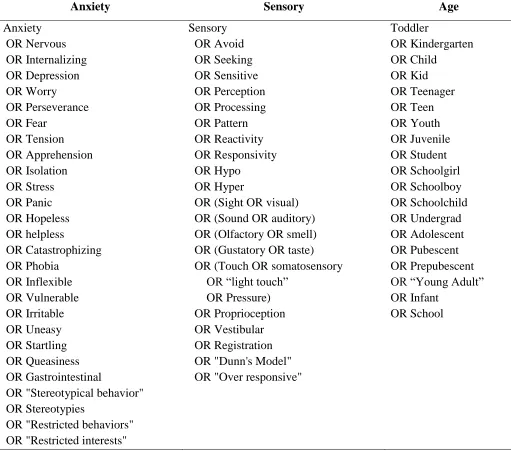
PubMed and Suggested Subject Terms in CINAHL). See Table 1 for a complete list of search terms.We included studies that investigated concepts of sensory processing and internalizing using questionnaire or structured behavioral observation data. In addition, we included only articles that studied individuals from birth to 22 years of age.We excluded studies that investigated stroke or pain, had nonhuman subjects, or were not written in English. We also excluded dissertations, theses, book chapters, and reviews. We excluded articles that solely included a physiological measure of sensory processing.
Table 1
Search Concepts and Related Terms
Anxiety Sensory Age
Anxiety OR Nervous OR Internalizing OR Depression OR Worry OR Perseverance OR Fear
OR Tension OR Apprehension OR Isolation OR Stress OR Panic OR Hopeless OR helpless
OR Catastrophizing OR Phobia
OR Inflexible OR Vulnerable OR Irritable OR Uneasy OR Startling OR Queasiness OR Gastrointestinal
OR "Stereotypical behavior" OR Stereotypies
OR "Restricted behaviors" OR "Restricted interests"
Sensory OR Avoid OR Seeking OR Sensitive OR Perception OR Processing OR Pattern OR Reactivity OR Responsivity OR Hypo
OR Hyper
OR (Sight OR visual) OR (Sound OR auditory) OR (Olfactory OR smell) OR (Gustatory OR taste) OR (Touch OR somatosensory OR “light touch”
OR Pressure) OR Proprioception OR Vestibular OR Registration OR "Dunn's Model" OR "Over responsive"
Toddler
OR Kindergarten OR Child
OR Kid OR Teenager OR Teen OR Youth OR Juvenile OR Student OR Schoolgirl OR Schoolboy OR Schoolchild OR Undergrad OR Adolescent OR Pubescent OR Prepubescent OR “Young Adult” OR Infant
OR School
Study Selection
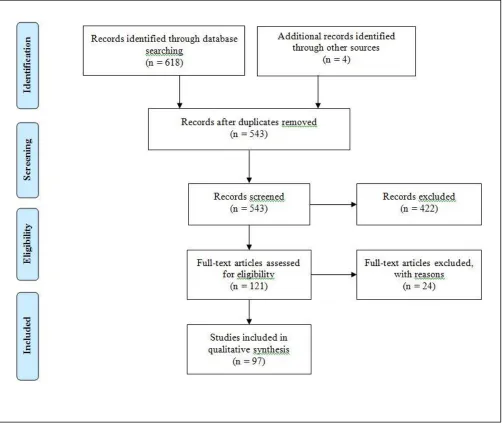
We used Covidence (www.covidence.org), which is a web-based platform to screen and extract information from articles. We used this platform to import, organize, and manage all articles. Pubmed (n = 309), Scopus (n = 115), and CINAHL (n = 198) yielded 622 articles; 79 articles were removed as duplicate, leaving 543 articles to screen. Two of the authors each screened all article abstracts to ensure 100% agreement of articles that would be included in the full text article review; 422 articles were excluded based on the screening process, leaving 121 articles included in the full text review. During full text review, we excluded 24 articles, as they did not include a measure of sensory processing, did not include individuals in our specified age range, or were not empirical studies (e.g., papers that described theories; see Figure 1).
Figure 1. PRISMA flowchart of article selection process.
Data Extraction and Charting
Using full texts imported into Covidence, we then extracted all study information and put it into an Excel file. We charted each study’s journal, research question, sample, methods, measures, and conclusions. Specific variables of interest in each article included the measure and definition of
internalizing that was used (e.g., depression, anxiety, somatization, introversion) as well as the measure and definition of sensory processing (e.g., sensory overresponsivity, sensory seeking, sensory
avoidance). We charted all findings that were about relationships between constructs related to
internalizing (e.g., anxiety, depression) and specific sensory processing patterns. We then used the Excel file to understand and organize commonalities across studies.
Results
After the selection process, n = 97 articles matched the review criteria. Articles were found across 61 journals; for example, n = 20 (20.6%) of the articles were found in ASD-specific journals (e.g., Journal of Autism and Developmental Disabilities; Autism) and n = 8 (8.26%) were found in
occupational therapy specific journals. Approximately 61% of the articles were published in the past 5 years.
Diagnoses
Studies included individuals from birth to 22 years of age with various diagnoses. Specifically, n = 36 studies included children with ASD and n = 10 of those studies tested the differences between children with ASD versus those with TD. Thirty-four studies included individuals with TD and followed the sample longitudinally. When presenting data on very early development of the general population, it is unknown if children were diagnosed with conditions later in development. Individuals with ADHD were included in n = 7 studies, many of which used a TD comparison sample and/or an ASD
comparison sample. Adolescents with major depressive disorder and/or bipolar disorder were included in n = 6 studies, and n = 2 studies included individuals with anxiety disorders. Other conditions in individual studies included opsoclonus myoclonus syndrome, Williams Syndrome, atopic dermatitis, stereotypic movement disorder, anorexia, a history of prematurity, and childhood behavioral disorders.
Ages
Studies focused on a wide range of individuals across ages and studies spanned across age categories, including infants (0 to 1 year of age; n = 3 studies), toddlers (1 to 3 years of age; n = 16 studies), preschool (3 to 6 years of age; n = 15 studies), school-aged (6 to 12 years of age; n = 44 studies), adolescents (12 to 18 years of age; n = 23 studies), and young adult (18 to 22 years of age; n = 26 studies). Some studies included more than one age group; therefore, categories are not mutually exclusive.
Sample Sizes
The range of sample sizes was 3 to 2,052 participants. Across studies, the average number of participants was 209.77; however, this number was skewed because one study included 2,052
participants (Keuler, Schmidt, Van Hulle, Lemery-Chalfant, & Goldsmith, 2011). The median number of participants was 105 and the mode was 50 participants.
Measures
We examined the behavioral measures that researchers used to quantify variables of interest. The most commonly used measure of sensory processing was the Sensory Profile (Dunn, 2014; n = 48), followed by the Highly Sensitive Person Scale(Aron & Aron, 1997; n = 14) and the Sensory Over-Responsivity Scales(Schoen, Miller, & Green, 2008; n = 12). The most commonly used measures of internalizing behavior included the Child Behavior Checklist (Achenbach, 1991; n = 9) and the Spence Children’s Anxiety Scale (Spence, 1998; n = 9), followed by the Beck Depression Inventory(Beck, Steer, & Brown, 1996; n = 8).
The question of this scoping review was focused on the relationship between internalizing and sensory processing patterns. Because of the various behaviors that are associated with internalizing, studies included in the review fell in the following categories as they related to sensory processing: (a) anxiety and depression, (b) temperament and personality characteristics, (c) caregiver strain, (d) restricted interests and repetitive behaviors, and (e) regulatory processes (i.e., sleep, eating).
Anxiety and Depression
Forty-four articles addressed the relationship between sensory processing patterns and anxiety and/or depression. Many studies investigated how individuals with increased sensory sensitivity may be more susceptible to negative environmental factors, which then may perpetuate the manifestation of anxiety or depression. For example, children with increased sensory sensitivity who experience adverse
childhood events are more likely to show adult shyness and negative affectivity (Aron, Aron, & Davies, 2005). In a study about how parenting style contributes to anxiety and depression, Liss, Timmel, Baxley, and Killingsworth (2005) found that young adults with sensory sensitivity were more highly susceptible to negative parenting practices than those without sensory sensitivity. In another study in young adults, sensory sensitivity was associated with relationship anxiety and relationship avoidance (Jerome & Liss, 2005). Sensory sensitivity was also found to be associated with anxiety and conscientiousness in young adults (Ahadi & Basharpoor, 2010). Environmental factors may also influence the presentation of
sensory features as well. For example, Ben-Sasson, Carter, and Briggs-Gowan (2009) found that sensory sensitivity in children was associated with a higher rate of social emotional difficulties, single parent households, and living in poverty.
Other studies investigated the extent to which sensory sensitivity changes throughout
development and may be particular to those with anxiety or depression. In a large sample of individuals in the general population 3 months to 18 years of age, individuals with sensory sensitivity were more likely to show anxiety or depression; however, not all individuals with sensitivity showed anxiety or depression and not all those with internalizing showed sensitivity (Schmidt et al., 2013). This finding was also supported in studies of school-aged children (Carter, Ben-Sasson, & Briggs-Gowan, 2011; Conelea, Carter, & Freeman, 2014).
Many studies have addressed the association between sensory sensitivity and anxiety or
depression in individuals with developmental conditions, such as ADHD or ASD. In children with ASD, research shows that sensitivity is positively associated with anxiety in toddlers (Ben-Sasson et al., 2008), school-aged children (Lane et al., 2012; Pfeiffer, Kinnealey, Reed, & Herzberg, 2005), and adolescents (Tseng, Fu, Cermak, Lu, & Shieh, 2011; Uljarević, Lane, Kelly, & Leekam, 2016). One longitudinal study showed that sensory sensitivity stabilizes over time in ASD, while symptoms of anxiety increase (Green et al., 2012). Among children with ADHD, those with sensory sensitivity are more likely to show anxiety than those with ADHD alone or those with TD (Reynolds & Lane, 2009). Conversely, various studies have found that underresponsivity was significantly associated with depressive symptoms in children and adolescents with high functioning autism (Bitsika et al., 2016) and children and adolescents with Asperger’s syndrome (Pfeiffer et al., 2005). As children with ASD and ADHD show higher rates of sensory sensitivity and/or anxiety and depression than the general population, it is unclear if the
association between such behaviors in these clinical groups is causal.
Temperament and Personality Characteristics
Many studies of the general population of adolescents and young adults showed a link between sensory features and personality or temperament characteristics. For example, Ahadi and Basharpoor (2010) studied various associations between sensory processing sensitivity, personality traits, and mental health among undergraduate students. The authors found a significant, positive association between sensory sensitivity and neuroticism, physical problems, anxiety, and mental health difficulties. In
addition, neuroticism and openness positively predicted sensory processing sensitivity; extraversion was negatively associated with sensory sensitivity among undergraduate students (Listou Grimen & Diseth, 2016). Similarly, Hebert (2015) found that underresponsivity was associated with increased impulsivity, whereas individuals with increased sensitivity are less impulsive. Lastly, sensory sensitivity was
associated with better performance on a visual detection task but resulted in higher perceived stress among young adults (Gerstenberg, 2012). The aforementioned studies point to ways in which
individuals with high sensory sensitivity are able to distinguish and respond to sensory elements in their
environments quickly and with precision. Conversely, individuals with registration difficulties or underresponsivity (i.e., bystanders) are more likely to respond in a more impulsive manner.
Restricted and Repetitive Behaviors
Eighteen studies investigated the relationship between sensory processing differences and the presence of restricted and repetitive behaviors (RRBs), which includes insistence on sameness,
intolerance for uncertainty, and stereotyped behaviors. RRBs were often proposed as a manifestation of anxiety-driven behaviors, as many authors pointed to the role in which overarousal played in these behaviors. Twelve of these studies included children with ASD, and the relationship between sensory features and RRBs remains across development in this group, including toddlers (Wiggins, Robins, Bakeman, & Adamson, 2009; Wolff et al., 2017), school aged children (Black et al., 2017; Boyd et al., 2010; Matsushima et al., 2016; Neil, Olsson, & Pellicano, 2016), and adolescents (Green, Chandler, Charman, Simonoff, & Baird, 2016). Researchers have attempted to unravel the complexities between specific RRBs, anxiety, and sensory sensitivity. For example, Neil, Olsson, and Pellicano (2016) found that among children 6 to 14 years of age, intolerance of uncertainty accounted for 50% of children’s sensory sensitivities in an ASD group, but only 20% in a TD group. In addition, authors found that intolerance to uncertainty accounted for a high percentage of children with ASD’s sensitivity, even when accounting for anxiety (Neil et al., 2016).
The complex associations between elements of cognitive rigidity, sensory sensitivity, and anxiety are also found in studies of children with TD and other conditions. Children with Williams Syndrome show a high rate of RRBs, which are positively associated with sensory sensitivity (Janes, Riby, & Rodgers, 2014). With regard to ritualistic behaviors associated with obsessive compulsive disorder (OCD), school-aged children with increased sensory features show high rates of ritualistic behaviors (Dar, Kahn, & Carmeli, 2012), and anxiety was found to mediate the relationship between sensory processing and ritualistic behaviors (Bart, Bar-Shalita, Mansour, & Dar, 2017). In children, sensory sensitivity may drive the need for ritualism, which is suggested to contribute to OCD symptoms (Ben-Sasson & Podoly, 2017).
Caregiver Strain
Research investigated how children’s sensory processing is related to caregiver stress and disruptions in family routine. For example, in a sample of preschool children with developmental and behavioral conditions, those with sensory differences showed increased internalizing behaviors, which was related to increased parent stress (Gourley, Wind, Henninger, & Chinitz, 2013). One study of infants with TD showed that higher parent conflict was associated with sensory sensitivity, which was also related to infants’ higher physiological arousal and less physiological regulation (Mammen,
Busuito, Moore, Quigley, & Doheny, 2017). In studies of ASD, research has used measures of caregiver internalizing to relate to children’s sensory patterns. For example, Kirby, White, and Baranek (2015) found that among parents of children with ASD, children’s sensory sensitivity significantly predicted caregiver internalizing strain. In another study, Ben-Sasson, Soto, Martínez-Pedraza, and Carter (2013) found higher life impairment and parenting stress for families of children with ASD who showed higher sensory sensitivity than those without sensitivity. In addition, qualitative findings show that parents of children with ASD make changes to daily routines based on a child’s individual sensory sensitivity (Schaaf, Toth-Cohen, Johnson, Outten, & Benevides, 2011). Overall, the research about caregivers suggests that children’s sensitivities are stressful for parents, who must consistently be vigilant about how to navigate daily routines.
Regulatory Processes
Individuals with sensory sensitivity have difficulties with regulatory processes, as evidenced by eating and sleeping differences. In a large sample of TD children, Boterberg and Warreyn (2016) found that children with high sensory processing sensitivity were more likely to have cried excessively as a baby, have medically unexplained physical symptoms, and sleeping and eating difficulties. Sensory sensitivity has been associated with poor sleep quality among children with ASD (Mazurek & Petroski, 2015; Reynolds, Lane, & Thacker, 2012), atopic dermatitis (Shani‐Adir, Rozenman, Kessel, & Engel‐ Yeger, 2009), fetal alcohol spectrum disorder (Wengel, Hanlon-Dearman, & Fjeldsted, 2011), and TD (Mazurek & Petroski, 2015). With regard to selective eating, Farrow and Coulthard (2012) found that sensory sensitivity fully mediated the relationship between anxiety and selective eating among typically developing children 5 to 10 years of age. In addition, Kauer, Pelchat, Rozin, and Zickgraf (2015) found that picky eaters had significantly higher OCD symptoms, disgust sensitivity, food neophobia, and were more likely to score within the clinical range of depression symptoms than non-picky eaters. It is clear that sensory sensitivity is associated with sleeping and eating difficulties and may be because of the heightened oro-gustatory perception and arousal in which children with sensory sensitivity demonstrate.
Mediation Models
Many studies included in this scoping review used mediation models to test the extent to which one variable explains the relationship between two other variables (Baron & Kenny, 1986). In mediation models, we are able to identify the process, or third variable, that underlies the observed relationship between two other variables. In this section, we examine studies that used mediation models to
understand the complex relationships between sensory processing patterns and internalizing behaviors among children and young adults.
Studies examined the contribution of sensory processing in children to various behaviors, such as picky eating, ritualistic behaviors, and anxiety. For example, Farrow and Coulthard (2012) found that sensory sensitivity fully mediated the relationship between anxiety and selective eating among children with TD 5 to 10 years of age. Bart, Bar-Shalita, Mansour, and Dar (2017) found that anxiety mediated the relationship between sensory processing and ritual behaviors among children 5 to 9 years of age. In children with ASD, Lane, Reynolds, and Dumenci (2012) found that children’s physiological reactivity to sensory stimulation mediated the relationship between arousal/attention and anxiety. In addition, Neil et al. (2016) found that anxiety partially mediated the relationship between intolerance of uncertainty and sensory processing in school-aged children with ASD. In children with ASD 8 to 16 years of age, intolerance for uncertainty and anxiety mediated the relationship between sensory over and
underresponsivity and repetitive behaviors (Wigham, Rodgers, South, McConachie, & Freeston, 2015). In mothers of children with ASD, intolerance for uncertainty mediated the association between anxiety and sensory sensitivity (Uljarević et al., 2016). Black et al. (2017) found that sensory hyperresponsivity mediated the relationship between specific phobia and insistence on sameness in children with ASD 7 to 17 years of age.
In young adults with TD, as well as those with conditions, sensory characteristics impact personality features and symptoms. For example, Aron, Aron, and Davies (2005) found that in TD young adults, sensory sensitivity predicted shyness; however, the relationship between sensitivity and shyness is mediated by negative affectivity (i.e., fearfulness, anxiety, depression). In TD young adults, coping style of focusing on and venting emotions mediated the relationship between sensory sensitivity and relationship anxiety (Jerome & Liss, 2005). In addition, low registration was associated with
relationship anxiety, which was partially mediated by a coping style of denial and disengagement. Engel-Yeger et al. (2018) found that sensory processing mediated the relationship between hypomanic symptoms (i.e., irritability, risk taking) and depressive symptoms among young adults with major
depressive disorder (MDD). In another study of adults with MDD and Bipolar Disorder, sensory features were negatively associated with Quality of Life (QoL) in participants with MDD; however, coping strategies did not mediate the association between sensory processing patterns and QoL (Engel-Yeger et al., 2018). It is clear that there are complex relationships between sensory processing patterns, specific internalizing behaviors (e.g., anxiety, depression), personality characteristics, and other behaviors. Studies have used sensory features as both predictors and mediators, which makes it difficult to unravel the extent to which sensory processing may directly contribute to or underlie relationships among other behaviors. However, the significant findings of mediation across studies point to the potential ways in which sensory processing plays a vital role in the presentation of internalizing behaviors across populations and development.
Discussion
The current review investigated the relationship between sensory processing patterns and internalizing behaviors among individuals from birth to 22 years of age with TD as well as various developmental and mental health conditions. The findings suggest that sensory processing patterns mapped onto behaviors associated with internalizing disorders, such as anxiety and depression. Results across articles, however, also showed that behaviors characterized as temperament, restricted and
repetitive behaviors, caregiver strain, and regulatory processes (i.e., eating, sleep) were also indicative of internalizing, which were then linked with differences in sensory processing.
The research showed that sensory sensitivity was related to internalizing behaviors; however, the strength of the association between sensitivity and internalizing behaviors across conditions was variable and sensory sensitivity may be present in those with TD. For example, studies of young adults without conditions show that sensory sensitivity is a person characteristic that is related to shyness (Aron et al., 2005), anxiety (Ahadi & Basharpoor, 2010), neuroticism, physical health problems, and
conscientiousness and is negatively associated with extroversion (Listou Grimen & Diseth, 2016). Difficulties with sensory registration (i.e., underresponsiveness) are related to increased impulsivity (Hebert, 2015). In addition, studies suggest that individuals with increased sensory sensitivity are more vulnerable to negative environmental factors, which contributes to and perpetuates behaviors related to anxiety or depression (Aron et al., 2005). Studies of the general population (Schmidt et al., 2013) as well as at-risk samples (Carter et al., 2011; Conelea et al., 2014) show that internalizing behaviors and
sensory sensitivity are not always directly related; that is, not all individuals with sensory sensitivity show internalizing and vice versa.
The majority of the research was focused on how sensory patterns relate to internalizing behaviors among individuals with ASD, and this is likely because of the relatively high prevalence of sensory features and internalizing behaviors in this specific population. It is interesting that some studies showed that both hyper and hyporesponsiveness were associated with anxiety in ASD (Wigham et al., 2015), while others pointed to the prominent contribution of sensory sensitivity only (Black et al., 2017; Futoo et al., 2014; Green et al., 2012; Lane et al., 2012; Mazurek & Petroski, 2015; Sullivan et al., 2014; Uljarević et al., 2016).
Lastly, studies used various models to understand how either cognitive rigidity (e.g., insistence on sameness), anxiety, or sensory sensitivity mediated associations between other variables. While the
findings across those studies clearly point to the relationships among such constructs, it remains difficult to parse out which behavior may truly serve as the mediator. This is important because mediation
models help researchers attempt to understand complex relationships; thus, often targeting the mediator in treatment approaches. If intervention studies target sensory sensitivity, for example, the underlying theoretical approach is that an individual’s sensory processing can be changed, which will then change an outcome, such as anxiety. Conversely, if an intervention study targets changing an individual’s use of coping strategies, the underlying assumption is that if coping strategies are learned, the target outcome will change.
Limitations
Limitations of this research include the lack of inclusion of a wider variety of databases, such as PsycINFO, PsycARTICLES, and ERIC. In addition, our search terms may not have fully captured every dimension of internalizing behavior, and future reviews should include more terms, such as introversion, negative emotions, and poor self-concept.
Conclusion
Overall, this research suggests that sensory sensitivity interacts with environmental factors that may result in anxiety or depression; however, not all individuals with sensory sensitivity show
internalizing difficulties. Extensive literature on gene-environment interactions has shown that some individuals are more susceptible to both negative and positive environmental influences (Belsky & Pluess, 2009; Burmeister, McInnis, & Zöllner, 2008). If sensory processing is viewed as a person-centered construct only, occupational therapists may miss how environmental and social influences shape mental health over time. While the literature showed that sensory sensitivity is a risk factor for developing an internalizing disorder, occupational therapists must work to understand how
environmental and social factors may be used in intervention to ameliorate the effect of internalizing behaviors on participation in everyday activities.
References
Achenbach, T. (1991). Manual for the child behavior checklist/4-18 and 1991 profile.
Burlington, VT: University of Vermont Department of Psychiatry.
Ahadi, B., & Basharpoor, S. (2010). Relationship between sensory processing sensitivity, personality dimensions and mental health. Journal of Applied Sciences, 10(7), 570-574. https://doi.org/10.3923/jas.2010.570.574 Arksey, H., & O’Malley, L. (2005). Scoping studies:
Towards a methodological framework. International Journal of Social Research Methodology, 8(1), 19-32.
https://doi.org/10.1080/1364557032000119616 Aron, E. N., & Aron, A. (1997). Sensory-processing
sensitivity and its relation to introversion and emotionality. Journal of Personality and Social Psychology, 73(2), 345-368.
https://doi.org/10.1037//0022-3514.73.2.345 Aron, E. N., Aron, A., & Davies, K. M. (2005). Adult
shyness: The interaction of temperamental sensitivity and an adverse childhood
environment. Personality and Social Psychology
Bulletin, 31(2), 181-197.
https://doi.org/10.1177/0146167204271419 Baron, R. M., & Kenny, D. A. (1986). The
moderator-mediator variable distinction in social psychological research: Conceptual, strategic, and statistical considerations. Journal of Personality and Social Psychology, 51(6), 1173-1182.
https://doi.org/10.1037//0022-3514.51.6.1173
Bart, O., Bar-Shalita, T., Mansour, H., & Dar, R. (2017). Relationships among sensory responsiveness, anxiety, and ritual behaviors in children with and without atypical sensory responsiveness.
Physical & Occupational Therapy in Pediatrics, 37(3), 322-331.
https://doi.org/10.1080/01942638.2016.1185504 Beck, A. T., Steer, R. A., & Brown, G. (1996). Manual
for the beck depression inventory-II.San Antonio, TX: Psychological Corporation. Belsky, J., & Pluess, M. (2009). Beyond diathesis stress:
Differential susceptibility to environmental influences. Psychological Bulletin, 135(6), 885-908. https://doi.org/10.1037/a0017376
Ben-Sasson, A., Carter, A. S., & Briggs-Gowan, M. J. (2009). Sensory over-responsivity in elementary school: Prevalence and social-emotional correlates. Journal of Abnormal Child Psychology, 37(5), 705-716.
https://doi.org/10.1007/s10802-008-9295-8 Ben-Sasson, A., Cermak, S. A., Orsmond, G. I.,
Tager-Flusberg, H., Kadlec, M. B., & Carter, A. S. (2008). Sensory clusters of toddlers with autism spectrum disorders: Differences in affective
symptoms. Journal of Child Psychology and
Psychiatry, 49(8), 817-825. https://doi.org/10.1111/j.1469-7610.2008.01899.x
Ben-Sasson, A., & Podoly, T. Y. (2017). Sensory over responsivity and obsessive compulsive
symptoms: A cluster analysis. Comprehensive
Psychiatry, 73, 151-159.
https://doi.org/10.1016/j.comppsych.2016.10.013 Ben-Sasson, A., Soto, T. W., Martínez-Pedraza, F., &
Carter, A. S. (2013). Early sensory over-responsivity in toddlers with autism spectrum disorders as a predictor of family impairment and parenting stress. Journal of Child Psychology and Psychiatry, 54(8), 846-853.
https://doi.org/10.1111/jcpp.12035
Bitsika, V., Sharpley, C. F., & Mills, R. (2016). Are sensory processing features associated with depressive symptoms in boys with an ASD? Journal of Autism and Developmental Disorders, 46(1), 242-252. https://doi.org/10.1007/s10803-015-2569-4
Black, K. R., Stevenson, R. A., Segers, M., Ncube, B. L., Sun, S. Z., Philipp-Muller, A., . . . Ferber, S. (2017). Linking anxiety and insistence on sameness in autistic children: The role of sensory hypersensitivity. Journal of Autism and
Developmental Disorders, 47(8), 2459-2470. https://doi.org/10.1007/s10803-017-3161-x Boterberg, S., & Warreyn, P. (2016). Making sense of it
all: The impact of sensory processing sensitivity on daily functioning of children. Personality and Individual Differences, 92, 80-86.
https://doi.org/10.1016/j.paid.2015.12.022 Boyd, B. A., Baranek, G. T., Sideris, J., Poe, M. D.,
Watson, L. R., Patten, E., & Miller, H. (2010). Sensory features and repetitive behaviors in children with autism and developmental delays. Autism Research, 3(2), 78-87.
https://doi.org/10.1002/aur.124
Burmeister, M., McInnis, M. G., & Zöllner, S. (2008). Psychiatric genetics: Progress amid
controversy. Nature Reviews Genetics, 9(7), 527-540. https://doi.org/10.1038/nrg2381
Carpenter, K. L. H., Baranek, G. T., Copeland, W. E., Compton, S., Zucker, N., Dawson, G., & Egger, H. L. (2019). Sensory over-responsivity: An early risk factor for anxiety and behavioral challenges in young children. Journal of
Abnormal Child Psychology, 47(6), 1075-1088. https://doi.org/10.1007/s10802-018-0502-y Carter, A. S., Ben-Sasson, A., & Briggs-Gowan, M. J.
(2011). Sensory over-responsivity,
psychopathology, and family impairment in school-aged children. Journal of the American Academy of Child & Adolescent Psychiatry, 50(12), 1210-1219.
https://doi.org/10.1016/j.jaac.2011.09.010 Centers for Disease Control and Prevention. (2019a).
Anxiety and depression in children. Retrieved from
https://www.cdc.gov/childrensmentalhealth/depr ession.html.
Centers for Disease Control and Prevention. (2019b). Data and statistics on children’s mental health. Retrieved from
https://www.cdc.gov/childrensmentalhealth/data. html.
Conelea, C. A., Carter, A. C., & Freeman, J. B. (2014). Sensory over-responsivity in a sample of children seeking treatment for anxiety. Journal of Developmental & Behavioral Pediatrics, 35(8), 510-521.
https://doi.org/10.1097/dbp.0000000000000092 Dar, R., Kahn, D. T., & Carmeli, R. (2012). The
relationship between sensory processing, childhood rituals and obsessive–compulsive
symptoms. Journal of Behavior Therapy and
Experimental Psychiatry, 43(1), 679-684. https://doi.org/10.1016/j.jbtep.2011.09.008 Dunn, W. (2014). Sensory profile-2. San Antonio, TX:
Pearson Publishing.
Dunn, W., Little, L., Dean, E., Robertson, S., & Evans, B. (2016). The state of the science on sensory factors and their impact on daily life for children:
A scoping review. OTJR: Occupation,
Participation and Health, 36(Suppl. 2), 3S-26S. https://doi.org/10.1177/1539449215617923 Engel-Yeger, B., Gonda, X., Canepa, G., Pompili, M.,
Rihmer, Z., Amore, M., & Serafini, G. (2018). Sensory profiles as potential mediators of the association between hypomania and
hopelessness in 488 major affective outpatients. Journal of Affective Disorders, 225, 466-473. https://doi.org/10.1016/j.jad.2017.08.036 Farrow, C. V., & Coulthard, H. (2012). Relationships
between sensory sensitivity, anxiety and selective eating in children. Appetite, 58(3), 842-846. https://doi.org/10.1016/j.appet.2012.01.017 Futoo, E., Miyawaki, D., Goto, A., Okada, Y., Asada, N.,
Iwakura, Y., . . . Inoue, K. (2014). Sensory hypersensitivity in children with
high-functioning pervasive developmental disorder. Osaka City Medical Journal, 60(2), 63-71. Gerstenberg, F. X. R. (2012). Sensory-processing
sensitivity predicts performance on a visual search task followed by an increase in perceived stress. Personality and Individual Differences,
53(4), 496-500.
https://doi.org/10.1016/j.paid.2012.04.019 Gourley, L., Wind, C., Henninger, E. M., & Chinitz, S.
(2013). Sensory processing difficulties, behavioral problems, and parental stress in a clinical population of young children. Journal of Child and Family Studies, 22(7), 912-921. https://doi.org/10.1007/s10826-012-9650-9 Green, S. A., Ben-Sasson, A., Soto, T. W., & Carter, A. S.
(2012). Anxiety and sensory over-responsivity in toddlers with autism spectrum disorders: Bidirectional effects across time. Journal of Autism and Developmental Disorders, 42(6), 1112-1119. https://doi.org/10.1007/s10803-011-1361-3
Green, D., Chandler, S., Charman, T., Simonoff, E., & Baird, G. (2016). Brief report: DSM-5 sensory behaviours in children with and without an autism spectrum disorder. Journal of Autism and Developmental Disorders, 46(11), 3597-3606. https://doi.org/10.1007/s10803-016-2881-7 Hebert, K. (2015). The association between impulsivity
and sensory processing patterns in healthy adults. British Journal of Occupational Therapy, 78(4), 232-240.
https://doi.org/10.1177/0308022615575670 Janes, E., Riby, D. M., & Rodgers, J. (2014). Exploring
the prevalence and phenomenology of repetitive behaviours and abnormal sensory processing in children with Williams Syndrome. Journal of Intellectual Disability Research, 58(8), 746-757. https://doi.org/10.1111/jir.12086
Jerome, E. M., & Liss, M. (2005). Relationships between sensory processing style, adult attachment, and coping. Personality and Individual Differences, 38(6), 1341-1352.
https://doi.org/10.1016/j.paid.2004.08.016 Kauer, J., Pelchat, M. L., Rozin, P., & Zickgraf, H. F.
(2015). Adult picky eating. Phenomenology, taste sensitivity, and psychological correlates. Appetite, 90, 219-228.
https://doi.org/10.1016/j.appet.2015.03.001 Keuler, M. M., Schmidt, N. L., Van Hulle, C. A.,
Lemery-Chalfant, K., & Goldsmith, H. H. (2011). Sensory overresponsivity: Prenatal risk factors and temperamental contributions. Journal of Developmental & Behavioral Pediatrics, 32(7), 533-541.
https://doi.org/10.1097/dbp.0b013e3182245c05 Kirby, A. V., White, T. J., & Baranek, G. T. (2015).
Caregiver strain and sensory features in children with autism spectrum disorder and other
developmental disabilities. American Journal on Intellectual and Developmental Disabilities, 120(1), 32-45. https://doi.org/10.1352/1944-7558-120.1.32
Lane, S. J., Reynolds, S., & Dumenci, L. (2012). Sensory overresponsivity and anxiety in typically developing children and children with autism
and attention deficit hyperactivity disorder: Cause or coexistence? American Journal of Occupational Therapy, 66(5), 595-603. https://doi.org/10.5014/ajot.2012.004523 Lane, S. J., Reynolds, S., & Thacker, L. (2010). Sensory
over-responsivity and ADHD: Differentiating using electrodermal responses, cortisol, and anxiety. Frontiers in Integrative Neuroscience, 4. https://doi.org/10.3389/fnint.2010.00008 Levac, D., Colquhoun, H., & O’Brien, K. K. (2010).
Scoping studies: Advancing the methodology. Implementation Science, 5(1), 69.
https://doi.org/10.1186/1748-5908-5-69 Liss, M., Timmel, L., Baxley, K., & Killingsworth, P.
(2005). Sensory processing sensitivity and its relation to parental bonding, anxiety, and depression. Personality and Individual Differences, 39(8), 1429-1439.
https://doi.org/10.1016/j.paid.2005.05.007 Listou Grimen, H., & Diseth, Å. (2016). Sensory
processing sensitivity: Factors of the highly sensitive person scale and their relationships to personality and subjective health complaints. Perceptual and Motor Skills, 123(3), 637-653. https://doi.org/10.1177/0031512516666114 Mammen, M. A., Busuito, A., Moore, G. A., Quigley, K.
M., & Doheny, K. K. (2017). Physiological functioning moderates infants’ sensory sensitivity in higher conflict families.
Developmental Psychobiology, 59(5), 628-638. https://doi.org/10.1002/dev.21528
Matsushima, K., Matsubayashi, J., Toichi, M., Funabiki, Y., Kato, T., Awaya, T., & Kato, T. (2016). Unusual sensory features are related to resting-state cardiac vagus nerve activity in autism spectrum disorders. Research in Autism Spectrum Disorders, 25, 37-46.
https://doi.org/10.1016/j.rasd.2015.12.006 Mazurek, M. O., & Petroski, G. F. (2015). Sleep problems
in children with autism spectrum disorder: Examining the contributions of sensory over-responsivity and anxiety. Sleep Medicine, 16(2), 270-279.
https://doi.org/10.1016/j.sleep.2014.11.006 Mazurek, M. O., Vasa, R. A., Kalb, L. G., Kanne, S. M.,
Rosenberg, D., Keefer, A., . . . Lowery, L. A. (2013). Anxiety, sensory over-responsivity, and gastrointestinal problems in children with autism spectrum disorders. Journal of Abnormal Child Psychology, 41(1), 165-176.
https://doi.org/10.1007/s10802-012-9668-x Merrell, K. W. (2008). Helping students overcome
depression and anxiety: A practical guide (2nd ed.). New York, NY: Guilford Press.
Neil, L., Olsson, N. C., & Pellicano, E. (2016). The relationship between intolerance of uncertainty, sensory sensitivities, and anxiety in autistic and typically developing children. Journal of Autism and Developmental Disorders, 46(6),
1973. https://doi.org/10.1007/s10803-016-2721-9
Peters, M. D. J., Godfrey, C. M., Khalil, H., McInerney, P., Parker, D., & Soares, C. B. (2015). Guidance for conducting systematic scoping reviews. International Journal of Evidence-Based Healthcare, 13(3), 141-146.
https://doi.org/10.1097/xeb.0000000000000050 Pfeiffer, B., Daly, B. P., Nicholls, E. G., & Gullo, D. F.
(2015). Assessing sensory processing problems in children with and without attention deficit hyperactivity disorder. Physical & Occupational Therapy in Pediatrics, 35(1), 1-12.
Pfeiffer, B., Kinnealey, M., Reed, C., & Herzberg, G. (2005). Sensory modulation and affective disorders in children and adolescents with Asperger’s disorder. American Journal of Occupational Therapy, 59(3), 335-345. https://doi.org/10.5014/ajot.59.3.335 Reynolds, S., & Lane, S. J. (2009). Sensory
overresponsivity and anxiety in children with
ADHD. American Journal of Occupational
Therapy, 63(4), 433-440.
https://doi.org/10.5014/ajot.63.4.433
Reynolds, S., Lane, S. J., & Thacker, L. (2012). Sensory processing, physiological stress, and sleep behaviors in children with and without autism spectrum disorders. OTJR: Occupation, Participation and Health, 32(1), 246-257. https://doi.org/10.3928/15394492-20110513-02 Schaaf, R. C., Toth-Cohen, S., Johnson, S. L., Outten, G.,
& Benevides, T. W. (2011). The everyday routines of families of children with autism: Examining the impact of sensory processing difficulties on the family. Autism, 15(3),
373-389. https://doi.org/10.1177/1362361310386505
Schmidt, N. L., Van Hulle, C. A., Brooker, R. J., Meyer, L. R., Lemery-Chalfant, K., & Goldsmith, H. H. (2013). Wisconsin twin research: Early
development, childhood psychopathology, autism, and sensory over-responsivity. Twin Research and Human Genetics, 16(1), 376-384. https://doi.org/10.1017/thg.2012.105
Schoen, S. A., Miller, L. J., & Green, K. E. (2008). Pilot study of the sensory over-responsivity scales:
Assessment and inventory. American Journal of
Occupational Therapy, 62(4), 393-406. https://doi.org/10.5014/ajot.62.4.393
Serafini, G., Gonda, X., Canepa, G., Pompili, M., Rihmer, Z., Amore, M., & Engel-Yeger, B. (2017). Extreme sensory processing patterns show a complex association with depression, and impulsivity, alexithymia, and hopelessness. Journal of Affective Disorders, 210, 249-257. https://doi.org/10.1016/j.jad.2016.12.019
Shani‐Adir, A., Rozenman, D., Kessel, A., & Engel‐ Yeger, B. (2009). The relationship between sensory hypersensitivity and sleep quality of children with atopic dermatitis. Pediatric Dermatology, 26(2), 143-149.
https://doi.org/10.1111/j.1525-1470.2009.00904.x
Spence, S. H. (1998). A measure of anxiety symptoms
among children. Behaviour Research and
Therapy, 36(5), 545-566.
https://doi.org/10.1016/s0005-7967(98)00034-5 Sullivan, J. C., Miller, L. J., Nielsen, D. M., & Schoen, S.
A. (2014). The presence of migraines and its association with sensory hyperreactivity and anxiety symptomatology in children with autism spectrum disorder. Autism, 18(6), 743-747. https://doi.org/10.1177/1362361313489377 Tseng, M.-H., Fu, C.-P., Cermak, S. A., Lu, L., & Shieh,
J.-Y. (2011). Emotional and behavioral problems in preschool children with autism: Relationship with sensory processing dysfunction. Research in Autism Spectrum Disorders, 5(4), 1441-1450. https://doi.org/10.1016/j.rasd.2011.02.004 Uljarević, M., Lane, A., Kelly, A., & Leekam, S. (2016).
Sensory subtypes and anxiety in older children and adolescents with autism spectrum disorder. Autism Research, 9(10), 1073-1078.
https://doi.org/10.1002/aur.1602
Wengel, T., Hanlon-Dearman, A. C., & Fjeldsted, B. (2011). Sleep and sensory characteristics in young children with fetal alcohol spectrum disorder. Journal of Developmental & Behavioral Pediatrics, 32(5), 384-392. https://doi.org/10.1097/dbp.0b013e3182199694 Wiggins, L. D., Robins, D. L., Bakeman, R., & Adamson,
L. B. (2009). Brief report: Sensory abnormalities as distinguishing symptoms of autism spectrum disorders in young children. Journal of Autism and Developmental Disorders, 39(7), 1087-1091. https://doi.org/10.1007/s10803-009-0711-x
Wigham, S., Rodgers, J., South, M., McConachie, H., & Freeston, M. (2015). The interplay between sensory processing abnormalities, intolerance of uncertainty, anxiety and restricted and repetitive behaviours in autism spectrum disorder. Journal of Autism and Developmental Disorders, 45(4), 943-952. https://doi.org/10.1007/s10803-014-2248-x
Wolff, J. J., Swanson, M. R., Elison, J. T., Gerig, G., Pruett, J. R., Styner, M. A., . . . Piven, J. (2017). Neural circuitry at age 6 months associated with later repetitive behavior and sensory
responsiveness in autism. Molecular Autism, 8(1). https://doi.org/10.1186/s13229-017-0126-z