Dimensionality Reduction for Supervised Learning with
Reproducing Kernel Hilbert Spaces
Kenji Fukumizu [email protected]
Institute of Statistical Mathematics
4-6-7 Minami-Azabu, Minato-ku, Tokyo 106-8569, Japan
Francis R. Bach [email protected]
Computer Science Division University of California Berkeley, CA 94720, USA
Michael I. Jordan [email protected]
Computer Science Division and Department of Statistics University of California
Berkeley, CA 94720, USA
Editor:Chris Williams
Abstract
We propose a novel method of dimensionality reduction for supervised learning problems. Given a regression or classification problem in which we wish to predict a response variable
Y from an explanatory variable X, we treat the problem of dimensionality reduction as that of finding a low-dimensional “effective subspace” for X which retains the statistical relationship between X and Y. We show that this problem can be formulated in terms of conditional independence. To turn this formulation into an optimization problem we establish a general nonparametric characterization of conditional independence using co-variance operators on reproducing kernel Hilbert spaces. This characterization allows us to derive a contrast function for estimation of the effective subspace. Unlike many conven-tional methods for dimensionality reduction in supervised learning, the proposed method requires neither assumptions on the marginal distribution ofX, nor a parametric model of the conditional distribution ofY. We present experiments that compare the performance of the method with conventional methods.
Keywords: regression, dimensionality reduction, variable selection, feature selection, kernel methods, conditional independence.
1. Introduction
another. There are additional motivations for dimensionality reduction that it is also helpful to specify, including: providing a simplified explanation of a phenomenon for a human (possibly as part of a visualization algorithm), suppressing noise so as to make a better prediction or decision, or reducing the computational burden. These various motivations are often complementary.
In this paper we study dimensionality reduction in the setting of supervised learning. Thus, we consider problems in which our data consist of observations of (X, Y) pairs, where Xis anm-dimensional explanatory variable and whereY is an`-dimensional response. The variableY may be either continuous or discrete. We refer to these problems generically as “regression” problems, which indicates our focus on the conditional probability density function pY|X(y | x). In particular, our framework includes discriminative approaches to classification problems, whereY is a discrete label.
We wish to solve a problem of feature selection in which the features are linear combi-nations of the components of X. In particular, our modeling framework posits that there is anr-dimensional subspace S⊂Rm such that
pY|X(y |x) =pY|ΠSX(y|ΠSx),
for all x and y, where ΠS is the orthogonal projection of Rm onto S. The subspace S is
called theeffective subspace for regression. Based on a set of observations of (X, Y) pairs, we wish to recover a matrix whose columns span the effective subspace. The effective subspace can help to provide explanation of the statistical relation between X and Y, by isolating the feature vectors that capture that relation. Also, finding such a space can suppress noise, to the extent that the orthogonal direction to the effective subspace is noisy vis-a-vis the prediction of Y.
We approach the problem as asemiparametricstatistical problem; in particular, we make no assumptions regarding the conditional distribution pY|ΠSX(y | ΠSx), nor do we make
any assumptions regarding the marginal distributionpX(x). That is, we wish to estimate a
finite-dimensional parameter (a matrix whose columns span the effective subspace), while treating the distributions pY|ΠSX(y|ΠSx) andpX(x) nonparametrically.
Having found an effective subspace, we may then proceed to build a parametric or nonparametric regression model on that subspace. Thus our approach is an explicit dimen-sionality reduction method for supervised learning that does not require any particular form of regression model, and can be used as a preprocessor for any supervised learner. This can be compared to the use of methods such as principal components analysis (PCA) in regression, which also make no assumption regarding the subsequent regression model, but fail to make use of the response variable Y.
There are a variety of related approaches in the literature, but most of them involve making specific assumptions regarding the conditional distribution pY|ΠSX(y | ΠSx), the
marginal distribution pX(x), or both. For example, classical two-layer neural networks
involve a linear transformation in the first “layer,” followed by a specific nonlinear function and a second layer (Bishop, 1995). Thus, neural networks can be seen as attempting to estimate an effective subspace based on specific assumptions about the regressorpY|ΠSX(y|
ΠSx). Similar comments apply to projection pursuit regression (Friedman and Stuetzle,
1986), all of which provide a methodology for dimensionality reduction in which an additive model E[Y |X] =g1(β1TX) +· · ·+gK(βKTX) is assumed for the regressor.
Bayesian approaches to variable selection include the Automatic Relevance Determina-tion (ARD) method proposed by Neal (1996) for neural networks. Vivarelli and Williams (1999) have adapted this approach to feature selection in the setting of Gaussian process regression. These methods also depend on a specific parametric model, on which a Bayesian prior distribution is assumed.
Canonical correlation analysis (CCA) and partial least squares (PLS, H¨oskuldsson, 1988, Helland, 1988) are classical multivariate statistical methods that can be used for dimension-ality reduction in regression (Fung et al., 2002, Nguyen and Rocke, 2002). These methods are based on a linearity assumption for the regressor, however, and thus are quite strongly parametric.
The line of research that is closest to our work has its origin in a technique known as sliced inverse regression (SIR, Li, 1991). SIR is a semiparametric method for finding effective subspaces in regression. The basic idea is that the range of the response variable Y is partitioned into a set of “slices,” and the sample means of the observations X are computed within each slice. This can be viewed as a rough approximation to the inverse regression ofXonY. For univariateY the method is particularly easy to implement. Noting that the inverse regression must lie in the effective subspace if the forward regression lies in such a subspace, principal component analysis is then used on the sample means to find the effective subspace. Li (1991) has shown that this approach can find effective subspaces, but only under strong assumptions on the marginal distribution pX(x)—in particular, the
marginal distribution must be elliptically symmetric.
Further developments in the wake of SIR include principal Hessian directions (pHd, Li, 1992), and sliced average variance estimation (SAVE, Cook and Weisberg, 1991, Cook and Yin, 2001). These are all semiparametric methods in that they make no assumptions about the regressor (see also Cook, 1998). However, they again place strong restrictions on the probability distribution of the explanatory variables. If these assumptions do not hold, there is no guarantee of finding the effective subspace.
There are also related nonparametric approaches that estimate the derivative of the regressor to achieve dimensionality reduction, based on the fact that the derivative of the conditional expectation E[y | BTx] with respect to x belongs to the effective sub-space (Samarov, 1993, Hristache et al., 2001). However, nonparametric estimation of deriva-tives is quite challenging in high-dimensional spaces.
There are also dimensionality reduction methods with a semiparametric flavor in the area of classification, notably the work of Torkkola (2003), who has proposed using nonparametric estimation of the mutual information between X and Y, and subsequent maximization of this estimate of mutual information with respect to a matrix representing the effective subspace.
op-erations in function spaces to be performed in a computationally-efficient manner, our work differs in that it cannot be viewed as a “kernelization” of an underlying linear algorithm. Rather, we use reproducing kernel Hilbert spaces to provide characterizations of general notions of independence, and we use these characterizations to design objective functions to be optimized. We build on earlier work by Bach and Jordan (2002), who showed how to use reproducing kernel Hilbert spaces to characterize marginal independence between pairs of variables, and thereby design an objective function for independent component analysis. In the current paper, we extend this line of work, showing how to characterize
conditional independence using reproducing kernel Hilbert spaces. We achieve this by ex-pressing conditional independence in terms of covariance operators on reproducing kernel Hilbert spaces.
How does conditional independence relate to our dimensionality reduction problem? Recall that our problem is to find a projection ΠS of X onto a subspace S such that the
conditional probability ofY givenXis equal to the conditional probability ofY given ΠSX.
This is equivalent to finding a projection ΠS which makes Y and (I−ΠS)X conditionally
independent given ΠSX. Thus we can turn the dimensionality reduction problem into an
optimization problem by expressing it in terms of covariance operators.
In a presence of a finite sample, we need to estimate the covariance operator so as to obtain a sample-based objective function that we can optimize. We derive a natural plug-in estimate of the covariance operator, and fplug-ind that the resultplug-ing estimate is identical to thekernel generalized variance that has been described earlier by Bach and Jordan (2002) in the setting of independent component analysis. In that setting, the goal is to measure departures from independence, and the minimization of the kernel generalized variance can be viewed as a surrogate for minimizing a certain mutual information. In the dimensionality reduction setting, on the other hand, the goal is to measureconditional independence, and minimizing the kernel generalized variance can be viewed as a surrogate for maximizing
a certain mutual information. Not surprisingly, the derivation that leads to the kernel generalized variance that we present here is quite different from the one presented in the earlier work on kernel ICA. Moreover, the argument that we present here can be viewed as providing a rigorous foundation for other, more heuristic, ways in which the kernel generalized variance has been used, including the model selection algorithms for graphical models presented by Bach and Jordan (2003b).
2. Dimensionality Reduction for Regression
We consider a regression problem, in whichY is an `-dimensional random vector, andX is an m-dimensional explanatory variable. (Note again that we use “regression” in a generic sense that includes both continuous and discreteY). The probability density function ofY givenXis denoted bypY|X(y|x). Assume that there is anr-dimensional subspaceS ⊂Rm
such that
pY|X(y |x) =pY|ΠSX(y|ΠSx), (1)
for all x and y, where ΠS is the orthogonal projection of Rm onto S. The subspace S is
called theeffective subspace for regression.
The problem that we treat here is that of finding the subspace S given an i.i.d.sample
{(X1, Y1), . . . ,(Xn, Yn)}frompX andpY|X. The crux of the problem is that we assume noa
priori knowledge of the regressor, and place no assumptions on the conditional probability pY|X.
As in the simpler setting of principal component analysis, we make the (generally un-realistic) assumption that the dimensionality r is known and fixed. While choosing the dimensionality is a very important problem, we separate it from the task of finding the best subspace of a fixed dimensionality, and mainly focus on the latter problem. In Section 6, we briefly discuss various approaches to the estimation of the dimensionality.
The notion of effective subspace can be formulated in terms of conditional independence. Let (B, C) be them-dimensional orthogonal matrix such that the column vectors ofB span the subspace S, and define U = BTX and V = CTX. Because (B, C) is an orthogonal matrix, we have
pX(x) =pU,V(u, v), pX,Y(x, y) =pU,V,Y(u, v, y), (2)
for the probability density functions. From Equation (2), Equation (1) is equivalent to
pY|U,V(y|u, v) =pY|U(y|u).
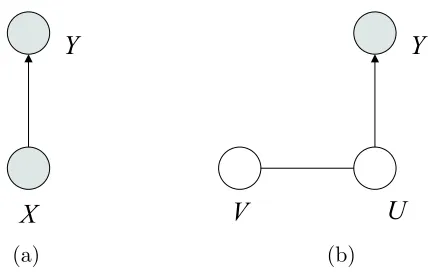
This shows that the effective subspace S is the one which makes Y and V conditionally independent givenU (see Figure 1).
Mutual information provides another point of view on the equivalence between condi-tional independence and the existence of the effective subspace. From Equation (2), it is straightforward to see that
I(Y, X) =I(Y, U) +EU£I(Y|U, V|U)¤, (3)
whereI(Z, W) denotes the mutual information defined by
I(Z, W) :=
Z Z
pZ,W(z, w) log
pZ,W(z, w)
pZ(z)pW(w)
dz dw.
U
V
Y
X
Y
(a) (b)
Figure 1: Graphical representation of dimensionality reduction for regression. The variables Y and V are conditionally independent givenU, whereX= (U, V).
The expression in Equation (3) can be understood in terms of the decomposition of the mutual information according to a tree-structured graphical model—a quantity that has been termed theT-mutual information by Bach and Jordan (2003a). Considering the tree Y −U −V in Figure 1(b), we have that the T-mutual informationIT is given by
IT =I(Y, U, V)−I(Y, U)−I(U, V).
This is equal to the KL-divergence between a probability distribution on (Y, U, V) and its projection onto the family of distributions that factor according to the tree; that is, the set of distributions that verify Y⊥⊥V | U. Using Equation (2), we can easily see that I(Y, U, V) =I(Y, X) +I(U, V), and thus we obtain
IT =I(Y, X)−I(Y, U) =EU[I(Y|U, V|U)]. (4)
Then, dimensionality reduction for regression can be viewed as the problem of minimizing the T-mutual information for the fixed tree structure in Figure 1(b).
Our approach to dimensionality reduction also makes use of the kernel generalized vari-ance. However, we do not take the mutual information as our point of departure, because we expect to be far from the setting of mutual independence in which Bach and Jordan (2002) showed that the mutual information and kernel generalized variance are closely re-lated. Instead, we take an entirely different path, presenting a rigorous characterization of conditional independence using reproducing kernels, and showing that this characterization leads once again to the kernel generalized variance.
3. Kernel Method for Dimensionality Reduction in Regression
In this section we present our kernel-based method for dimensionality reduction. We dis-cuss the basic definition and properties of cross-covariance operators on reproducing kernel Hilbert spaces, derive an objective function for characterizing conditional independence us-ing cross-covariance operators, and finally present a sample-based objective function based on this characterization.
3.1 Cross-Covariance Operators on Reproducing Kernel Hilbert Spaces
We use cross-covariance operators on reproducing kernel Hilbert spaces to derive an objec-tive function for dimensionality reduction. While cross-covariance operators are generally defined for random variables in Banach spaces (Vakhania et al., 1987, Baker, 1973), the theory is much simpler for reproducing kernel Hilbert spaces. We summarize only basic mathematical facts in this subsection, and defer the details to the Appendix. Let (H, k) be a reproducing kernel Hilbert space of functions on a set Ω with a positive definite kernel k: Ω×Ω→R. The inner product ofH is denoted byh·,·iH. We consider only real Hilbert spaces for simplicity. The most important aspect of reproducing kernel Hilbert spaces is the reproducing property:
hf, k(·, x)iH=f(x) for all x∈Ω andf ∈ H.
Throughout this paper we use the Gaussian kernel
k(x1, x2) = exp¡−kx1−x2k2/σ2¢,
which corresponds to a Hilbert space of smooth functions.
Let (H1, k1) and (H2, k2) be reproducing kernel Hilbert spaces over measurable spaces
(Ω1,B1) and (Ω2,B2), respectively, withk1 andk2 measurable. For a random vector (X, Y)
on Ω1×Ω2, the cross-covariance operator fromH1 toH2 is defined by the relation
hg,ΣY XfiH2 =EXY[f(X)g(Y)]−EX[f(X)]EY[g(Y)] (5)
for all f ∈ H1 and g ∈ H2. Equation (5) implies that the covariance of f(X) andg(Y) is given by the action of the linear operator ΣY X and the inner product. (See the Appendix
for a basic exposition of cross-covariance operators.)
relation holds between the conditional expectation and the cross-covariance operator, given that ΣXX is invertible:1
EY|X[g(Y)|X] = ΣXX−1 ΣXYg for all g∈ H2, (6)
Equation (6) can be understood by analogy to the conditional expectation of Gaussian random variables. If X and Y are Gaussian random variables, it is well known that the conditional expectation is given by
EY|X[aTY |X=x] =xTΣ−XX1 ΣXYa, (7)
for an arbitrary vector a, where ΣXX and ΣXY are the variance-covariance matrices in the
ordinary sense.
3.2 Conditional Covariance Operators and Conditional Independence
We derive an objective function for characterizing conditional independence using cross-covariance operators. Suppose we have random variables X and Y on Rm and R`,
respec-tively. The variable X is decomposed into U ∈ Rr and V ∈ Rm−r so that X = (U, V).
For the function spaces corresponding to Y,U and V, we consider the reproducing kernel Hilbert spaces (H1, k1), (H2, k2), and (H3, k3) on R`, Rr, and Rm−r, respectively, each
en-dowed with Gaussian kernels. We define the conditional covariance operator ΣY Y|U on H1
by
ΣY Y|U := ΣY Y −ΣY UΣ−U U1ΣU Y, (8)
where ΣY Y, ΣU U, ΣY U are the corresponding covariance operators. As shown by
Proposi-tion 5 in the Appendix, the operator ΣY Y|U captures the conditional variance of a random variable in the following way:
hg,ΣY Y|UgiH1 =EU £
VarY|U[g(Y)|U]¤
, (9)
where g is an arbitrary function in H1. As in the case of Equation (7), we can make an analogy to Gaussian variables. In particular, Equations (8) and (9) can be viewed as the analogs of the following well-known equality for the conditional variance of Gaussian variables:
Var[aTY |U] =aT(ΣY Y −ΣY UΣ−U U1ΣU Y)a.
It is natural to use minimization of ΣY Y|U as the basis of a method for finding the most informative direction U. This intuition is justified theoretically by Theorem 7 in the Appendix. That theorem shows that
ΣY Y|U ≥ΣY Y|X for any U, (10)
and
ΣY Y|U−ΣY Y|X = 0 ⇐⇒ Y⊥⊥V|U,
where, in Equation (10), the inequality should be understood as the partial order of self-adjoint operators. From these relations, the effective subspace S can be characterized in terms of the solution to the following minimization problem:
min
S ΣY Y|U, subject to U = ΠSX. (11)
In the following section we show how to turn this population-based criterion into a sample-based criterion that can be optimized in the presence of a finite sample.
3.3 Kernel Generalized Variance for Dimensionality Reduction
To derive a sample-based objective function from Equation (11), we have to estimate the conditional covariance operator from data, and choose a specific way to evaluate the size of self-adjoint operators. While there are many possibilities for approaching these two problems, we make a specific choice, adopting an approach which has been used successfully for independent component analysis (Bach and Jordan, 2002).
We describe a regularized empirical estimate of the cross-covariance operator. Define ˜
k1(i) ∈ H1by ˜k1(i)=k1(·, Yi)−n1Pnj=1k1(·, Yj), and ˜k(2i)∈ H2similarly usingUi. By replacing
the expectation with the empirical average, the covariance is estimated by
f,ΣY Ug®H
1 ≈ 1 n n X i=1 ˜
k1(i), f®˜
k(2i), g®
.
Let ˆKY be the centralized Gram matrix (Bach and Jordan, 2002, Sch¨olkopf et al., 1998),
defined by
ˆ
KY =¡In−n11n1Tn ¢
GY¡In−n11n1Tn ¢
, (12)
where (GY)ij = k1(Yi, Yj) is the Gram matrix and 1n = (1, . . . ,1)T is the vector with all
elements equal to 1. The matrix ˆKU is defined similarly using {Ui}ni=1. Then, it is easy
to see that ˜
k(1i),k˜(1j)®
= ¡ˆ
KY ¢
ij and h˜k
(i) 2 ,˜k
(j) 2
®
= ¡ˆ
KU ¢
ij. If we decompose f and g as
f =Pn
`=1aik˜1(`)+f⊥ and g=
Pn
m=1bmk˜(2m)+g⊥, wheref⊥ and g⊥ are orthogonal to the
linear hull of{˜k1(i)}ni=1and{˜k2(i)}ni=1, respectively, we see that the covariance is approximated by
f,ΣY Ug ®
H1 ≈ n X `=1 n X m=1
a`bm
¡ˆ
KYKˆU)lm.
Thus, by restricting the covariance operator ΣY U to the n-dimensional subspaces spanned
by {k1(i)}ni=1 and {k2(i)}ni=1, we can estimate the operator by ˆ
ΣY U = ˆKYKˆU.
In estimating ΣY Y and ΣU U, we use the same regularization technique as Bach and Jordan
(2002). The empirical conditional covariance matrix ˆΣY Y|U is then defined by
ˆ
ΣY Y|U := ˆΣY Y −ΣˆY UΣˆ−U U1ΣˆU Y = ( ˆKY +εIn)2−KˆYKˆU( ˆKU+εIn)−2KˆUKˆY, (13)
The size of ˆΣY Y|U in the ordered set of positive definite matrices can be evaluated by its determinant. Although there are other choices for measuring the size of ˆΣY Y|U, such
as the trace and the largest eigenvalue, we focus on the determinant in this paper. Using the Schur decomposition det(A−BC−1BT) = det³BA BT C
´
/detC, the determinant of ˆΣY Y|U
can be written as follows:
det ˆΣY Y|U =
det ˆΣ[Y U][Y U] det ˆΣU U
,
where ˆΣ[Y U][Y U] is defined by
ˆ
Σ[Y U][Y U]=
µˆ
ΣY Y ΣˆY U
ˆ
ΣU Y ΣˆU U 
=
µ
( ˆKY +εIn)2 KˆYKˆU
ˆ
KUKˆY ( ˆKU+εIn)2 
.
We symmetrize the objective function by dividing by the constant det ˆΣY Y, which yields
the objective function
det ˆΣ[Y U][Y U] det ˆΣY Ydet ˆΣU U
. (14)
We refer to the problem of minimizing this function with respect to the choice of subspace S asKernel Dimensionality Reduction (KDR).
Equation (14) has been termed the “kernel generalized variance” by Bach and Jordan (2002), who used it as a contrast function for independent component analysis. In that setting, the goal is to minimize a mutual information (among a set of recovered “source” variables), in the attempt to obtain independent components. Bach and Jordan (2002) showed that the kernel generalized variance is in fact an approximation of the mutual information of the recovered sources, when this mutual information is expanded around the manifold of factorized distributions. In the current setting, on the other hand, our goal is to maximize the mutual informationI(Y, U), and we certainly do not expect to be near a manifold in which Y and U are independent. Thus the argument for the kernel generalized variance as an objective function in the ICA setting does not apply here. What we have provided in the previous section is an entirely distinct argument that shows that the kernel generalized variance is in fact an appropriate objective function for the dimensionality reduction problem, and that minimizing the kernel generalized variance in Equation (14) can be viewed as a surrogate for maximizing the mutual informationI(Y, U), while the value of I(Y, U) may not be explicitly related to the value of the kernel generalized variance.
For the optimization of Equation (14), we use gradient descent with line search in our experiments. In a straightforward implementation, the matrix B is updated iteratively according to
B(t+ 1) =B(t)−η∂log det ˆΣY Y|U ∂B
=B(t)−ηTrhΣˆY Y−1|U∂ΣˆY Y|U ∂B
i
, (15)
where η is optimized through golden section search. The trace term in Equation (15) is rewritten by
TrhΣˆ−Y Y1|U∂ ˆ ΣY Y|U
∂B
i
= 2εTrhΣˆ−Y Y1|UKˆY
¡ˆ
KU+εIn
¢−1∂KˆU
∂B
¡ˆ
KU+εIn
¢−2 ˆ
KUKˆY i
All of these matrices are calculated directly from the definitions in Equations (12) and (13). Given that the numerical task that must be solved in KDR is the same as the numerical task that must be solved in kernel ICA, we can import all of the computational techniques developed by Bach and Jordan (2002) for minimizing kernel generalized variance in the KDR setting. In particular, we can exploit incomplete Cholesky decomposition, which approximates an n×n positive semidefinite matrix K by K ≈AAT, where A is an n×` matrix for` < n. Application of this decomposition reduces then×nmatrices ˆKY and ˆKU
required in Equation (15) to low-rank approximations. This diminishes the computational cost associated with multiplying and inverting large matrices, especially for a largen. For an exposition of incomplete Cholesky decomposition, see Bach and Jordan (2002). Another computational issue, which may arise in minimizing Equation (14), is the problem of local minima, because the objective function is not a convex function. To cope with this problem, we make use of an annealing technique, in which the scale parameter σ for the Gaussian kernel is decreased gradually during the iterations of optimization. For a larger σ, the contrast function is smoother with fewer local optima, which makes optimization easier. The search becomes more accurate as σ is decreased.
4. Experimental Results
We study the effectiveness of the new method through experiments, comparing it with several conventional methods: SIR, pHd, CCA, and PLS. For the experiments with SIR and pHd, we use an implementation in R due to Weisberg (2002).
In all of our experiments, we use a fixed value 0.1 for the regularization coefficient ε; empirically, the performance of the algorithm is robust to small variations in this coefficient. This coefficient could also be chosen using cross-validation.
4.1 Synthetic Data
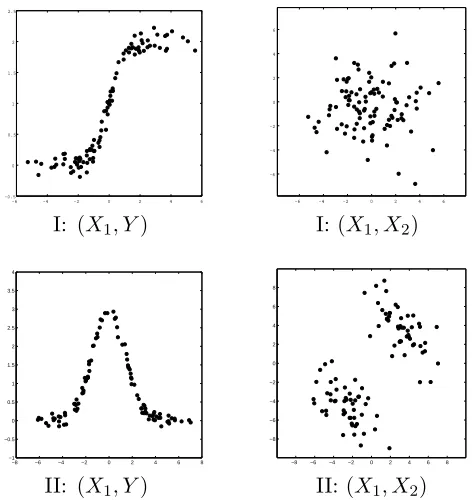
The data sets Data I and Data II comprise one-dimensional Y and two-dimensional X = (X1, X2). One hundred i.i.d. data points are generated by
I : Y ∼1/(1 + exp(−X1)) +Z,
II : Y ∼2 exp(−X12) +Z,
where Z ∼ N(0,0.12), and X = (X1, X2) follows a normal distribution and a normal
mixture with two components for Data I and Data II, respectively. The effective subspace is spanned by B0 = (1,0)T in both cases. The data sets are depicted in Figure 2.
Table 1 shows the angles between B0 and the estimated direction. For Data I, all the
methods except PLS yield a good estimate of B0. Data II is surprisingly difficult for the
conventional methods, presumably because the distribution of X is not spherical and the regressor has a strong nonlinearity. This indicates the weakness of model-based methods; if data do not fit the model, the obtained result may not be meaningful. The KDR method succeeds in finding the correct direction for both data sets.
Data III has 300 samples of 17 dimensionalX and one dimensionalY, which are gener-ated by
III : Y ∼0.9X1+ 0.2
1 1 +X17
-6 -4 -2 0 2 4 6 -0.5
0 0.5 1 1.5 2 2.5
-6 -4 -2 0 2 4 6
-6 -4 -2 0 2 4 6
I: (X1, Y) I: (X1, X2)
−8 −6 −4 −2 0 2 4 6 8
−1 −0.5 0 0.5 1 1.5 2 2.5 3 3.5 4
−8 −6 −4 −2 0 2 4 6 8 −8
−6 −4 −2 0 2 4 6 8
II: (X1, Y) II: (X1, X2)
Figure 2: Data I and II. One-dimensionalY depends only on X1 inX= (X1, X2).
SIR pHd CCA PLS Kernel
I: angle (rad.) 0.0087 -0.1971 0.0099 0.2736 -0.0014 II: angle (rad.) -1.5101 -0.9951 -0.1818 0.4554 0.0052
Table 1: Angles between the true and the estimated subspaces for Data I and II.
where Z ∼ N(0,0.012) and X follows a uniform distribution on [0,1]17. The effective
subspace is given byb1 = (1,0, . . . ,0) andb2= (0, . . . ,0,1). We compare the KDR method
with SIR and pHd only—CCA and PLS cannot find a two-dimensional subspace, becauseY is one-dimensional. To evaluate the accuracy of the results, we use the multiple correlation coefficient
R(b) = max
β∈B
βTΣXXb p
βTΣXXβ·bTΣXXb
, (b∈B0),
which is used in Li (1991). As shown in Table 2, the KDR method outperforms the others in finding the weak contribution of the second direction.
SIR(10) SIR(15) SIR(20) SIR(25) pHd Kernel
R(b1) 0.987 0.993 0.988 0.990 0.110 0.999
R(b2) 0.421 0.705 0.480 0.526 0.859 0.984
Data set dim. of X training sample test sample
Heart-disease 13 149 148
Ionosphere 34 151 200
Breast-cancer-Wisconsin 30 200 369
Table 3: Data description for the binary classification problem.
4.2 Real Data: Classification
In this section we apply the KDR method to classification problems. Many conventional methods of dimensionality reduction for regression are not suitable for classification. In particular, in the case of SIR, the dimensionality of the effective subspace must be less than the number of classes, because SIR uses the average of X in slices along the variable Y. Thus, in binary classification, only a one-dimensional subspace can be found, because at most two slices are available. The methods CCA and PLS have a similar limitation on the dimensionality of the effective subspace; they cannot find a subspace of larger dimension-ality than that of Y. Thus our focus is the comparison between KDR and pHd, which is applicable to general binary classification problems. Note that Cook and Lee (1999) dis-cuss dimensionality reduction methods for binary classification, and propose the difference of covariance (DOC) method. They compare pHd and DOC theoretically, and show that these methods are the same in binary classification if the population ratio of the classes is 1/2, which is almost the case in our experiments.
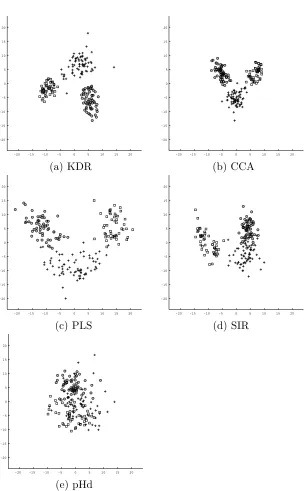
In the first experiment, we demonstrate the visualization capability of the dimensionality reduction methods. We use theWinedata set in the UCI machine learning repository (Mur-phy and Aha, 1994) to see how the projection onto a low-dimensional space realizes an effective description of data. The wine data consist of 178 samples with 13 variables and a label of three classes. We apply the KDR method, CCA, PLS, SIR, and pHd to these data. Figure 3 shows the projection onto the two-dimensional subspace estimated by each method. The KDR method separates the data into three classes most completely, while CCA also shows perfect separation. We can see that the data are nonlinearly separable in the two-dimensional space. The other methods do not separate the classes completely.
Next we investigate how much information onY is preserved in the estimated subspace. After reducing the dimensionality, we use the support vector machine (SVM) method to build a classifier in the reduced space, and compare its accuracy with an SVM trained using the full dimensional vectorX.2 Although we should theoretically use the (unknown)
optimum classifier to evaluate the extent of the information preserved in the subspace, we use an SVM classifier whose parameters were chosen by exhaustive grid search. We use the
Heart-diseasedata set,3 Ionosphere, and Wisconsin-breast-cancerfrom the UCI repository.
A description of these data is presented in Table 3.
2. In our experiments with the SVM, we used the Matlab Support Vector Toolbox by S. Gunn; see http://www.isis.ecs.soton.ac.uk/resources/svminfo.
3. We use theClevelanddata set, created by Dr. Robert Detrano of V.A. Medical Center, Long Beach and
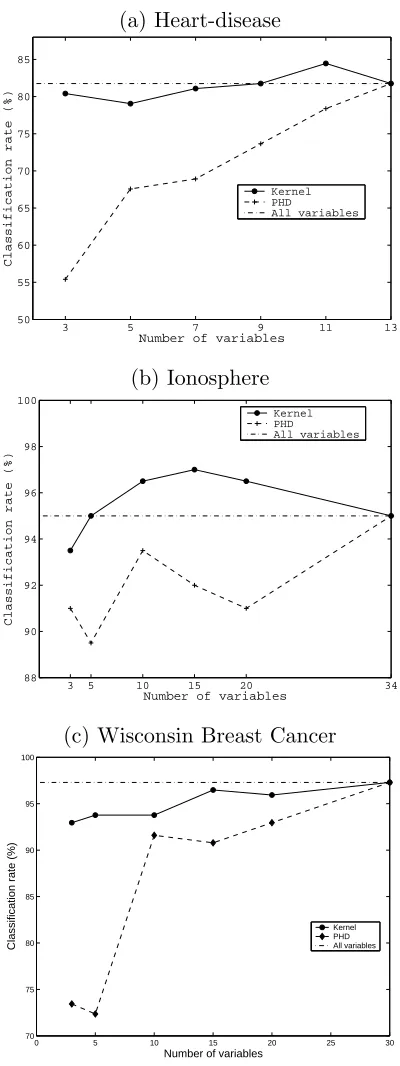
Figure 4 shows the classification rates for the test set in subspaces of various dimen-sionality. We can see that KDR yields good separation even in low-dimensional subspaces, while pHd is much worse in low dimensions. It is noteworthy that in the Ionosphere data set the classifier in dimensions 5, 10, and 20 outperforms the classifier in the full dimensional space. This is presumably due to the suppression of noise irrelevant to the prediction of Y. These results show that the kernel method successfully finds a subspace which preserves the class information even when the dimensionality is reduced significantly.
5. Extension to Variable Selection
In this section, we describe an extension of the KDR method to the problem of variable selection. Variable selection is different from dimensionality reduction; the former involves selecting a subset of the explanatory variables{X1, . . . , Xm} in order to obtain a simplified
prediction ofY fromX, while the latter involves finding linear combinations of the variables. However, the objective function that we have presented for dimensionality reduction can be extended straightforwardly to variable selection. In particular, given a fixed number of variables to be selected, we can compare the KGV for subspaces spanned by combinations of this number of selected variables. This gives a reasonable way to select variables, because for a subset W = {Xj1, . . . , Xjr} ⊂ {X1, . . . , Xm}, the variables Y and WC are conditionally
independent givenW if and only ifY and ΠWcXare conditionally independent given ΠWX,
where ΠW and ΠWC are the orthogonal projections onto the subspaces spanned byW and
WC, respectively. If we try to select r variables from among m explanatory variables, the
total number of evaluations is ¡m r ¢
. When ¡m
r ¢
is large, we must address the computational cost that arises in comparing large numbers of subsets. As in most other approaches to variable selection (see, e.g., Guyon and Elisseeff, 2003), we propose the use of a greedy algorithm and random search for this combinatorial aspect of the problem. (In the experiments presented in the current paper, however, we confine ourselves to small problems in which all combinations are tractably evaluated).
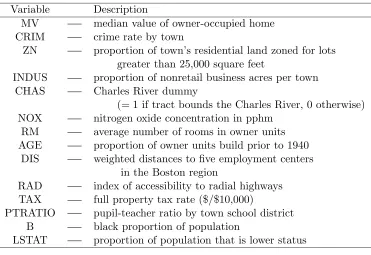
We apply this kernel-based method of variable selection to the Boston Housing data (Harrison and Rubinfeld, 1978) and theOzone data (Breiman and Friedman, 1985), which have been often used as testbed examples for variable selection. Tables 4 and 5 give the detailed description of the data sets. There are 506 samples in the Boston Housing data, for which the variable MV, the median value of house prices in a tract, is estimated by using the 13 other variables. We use the corrected version of the data set given by Gilley and Pace (1996). In the Ozone data in which there are 330 samples, the variable UPO3 (the ozone concentration) is to be predicted by 9 other variables.
rel--20 -15 -10 -5 0 5 10 15 20 -20
-15 -10 -5 0 5 10 15 20
-20 -15 -10 -5 0 5 10 15 20 -20
-15 -10 -5 0 5 10 15 20
(a) KDR (b) CCA
-20 -15 -10 -5 0 5 10 15 20 -20
-15 -10 -5 0 5 10 15 20
-20 -15 -10 -5 0 5 10 15 20 -20
-15 -10 -5 0 5 10 15 20
(c) PLS (d) SIR
-20 -15 -10 -5 0 5 10 15 20 -20
-15 -10 -5 0 5 10 15 20
(e) pHd
(a) Heart-disease
3 5 7 9 11 13
50 55 60 65 70 75 80 85
Number of variables
Classification rate (%)
Kernel PHD
All variables
(b) Ionosphere
3 5 10 15 20 34
88 90 92 94 96 98 100
Number of variables
Classification rate (%)
Kernel PHD All variables
(c) Wisconsin Breast Cancer
0 5 10 15 20 25 30 70
75 80 85 90 95 100
Number of variables
Classification rate (%)
Kernel PHD All variables
Variable Description
MV median value of owner-occupied home
CRIM crime rate by town
ZN proportion of town’s residential land zoned for lots greater than 25,000 square feet
INDUS proportion of nonretail business acres per town
CHAS Charles River dummy
(= 1 if tract bounds the Charles River, 0 otherwise) NOX nitrogen oxide concentration in pphm
RM average number of rooms in owner units AGE proportion of owner units build prior to 1940
DIS weighted distances to five employment centers in the Boston region
RAD index of accessibility to radial highways TAX full property tax rate ($/$10,000)
PTRATIO pupil-teacher ratio by town school district
B black proportion of population
LSTAT proportion of population that is lower status
Table 4: Boston Housing Data
Variable Description
UPO3 upland ozone concentration (ppm) VDHT Vandenburg 500 millibar height (m)
HMDT himidity (percent)
IBHT inversion base height (ft.)
DGPG Daggett pressure gradient (mmhg)
IBTP inversion base temperature (◦F)
SBTP Sandburg Air Force Base temperature (◦C) VSTY visibility (miles)
WDSP wind speed (mph)
DAY day of the year
Table 5: Ozone data
atively small contribution of NOX. For the Ozone data, all three of the result sets in the variable selection method include HMDT, SBTP, and IBHT. The variables IBTP, DGPG, and VDHT are chosen in one of the sets. This shows a fair accordance with earlier results by Breiman and Friedman (1985) and Li et al. (2000); the former concludes by ACE that SBTP, IBHT, DGPG, and VSTY are the most influential, and the latter selects HMDT, IBHT, and DGPG using a pHd-based method.
6. Conclusion
Boston 1st 2nd 3rd
CRIM X
ZN INDUS
CHAS NOX
RM X X X
AGE
DIS X
RAD
TAX X X
PTRATIO X X
B
LSTAT X X X
KGV .1768 .1770 .1815
Ozone 1st 2nd 3rd
VDHT X
HMDT X X X
IBHT X X X
DGPG X
IBTP X
SBTP X X X
VSTY WDSP DAY
KGV .2727 .2736 .2758
Table 6: Variable selection using the proposed kernel method.
we do not impose any strong assumptions on either the conditional or the marginal distri-bution. This allows the method to be applicable to a wide range of problems, and gives it a significant practical advantage over existing methods such as CCA, PPR, SIR, and pHd. These methods all impose significant restrictions on the conditional probability, the marginal distribution, or the dimensionality of the effective subspaces.
Our experiments have shown that the KDR method can provide many of the desired effects of dimensionality reduction: it provides data visualization capabilities, it can suc-cessfully select important explanatory variables in regression, and it can yield classification performance that is better than the performance achieved with the full-dimensional covari-ate space. We have also discussed the extension of the KDR method to variable selection. Experiments with classical data sets has shown an accordance with the previous results on these data sets and suggest that further study of this application of KDR is warranted.
The theoretical basis of KDR lies in the nonparametric characterization of conditional independence that we have presented in this paper. Extending earlier work on the kernel-based characterization of independence in ICA (Bach and Jordan, 2002), we have shown that conditional independence can be characterized in terms of covariance operators on a reproducing kernel Hilbert space. While our focus has been on the problem of dimensionality reduction, it is also worth noting that there are many other possible applications of this characterization. In particular, conditional independence plays an important role in the structural definition of probabilistic graphical models, and our results may have applications to model selection and inference in graphical models.
of the effective subspace. If the goal is that of achieving high predictive performance after dimensionality reduction, we can use one of many existing methods (e.g., cross-validation, penalty-based methods) to assess the expected generalization as a function of dimensionality. Note in particular that by using KDR as a method to select an estimator given a fixed dimensionality, we have substantially reduced the number of hypotheses being considered, and expect to find ourselves in a regime in which methods such as cross-validation are likely to be effective. It is also worth noting, however, that the goals of dimensionality reduction are not always simply that of prediction; in particular, the search for small sets of explanatory variables will need to be guided by other principles. Finally, asymptotic analysis may provide useful guidance for selecting the dimensionality; an example of such an analysis that we believe can be adopted for KDR has been presented by Li (1991) for the SIR method.
Acknowledgments
This work was done while the first author was visiting the University of California, Berkeley. We thank the action editor and reviewers for their valuable comments. In particular, the proof of Theorem 6 was suggested by one of the reviewers. We also thank Dr. Noboru Murata of Waseda University and Dr. Motoaki Kawanabe of Fraunhofer, FIRST for their helpful comments on the early version of this work. We wish to acknowledge support from JSPS KAKENHI 15700241, ONR MURI N00014-00-1-0637, NSF grant IIS-9988642, and a grant from Intel Corporation.
Appendix A. Cross-Covariance Operators on Reproducing Kernel Hilbert Spaces and Independence of Random Variables
In this appendix, we present additional background and detailed proofs for results relat-ing cross-covariance operators to marginal and conditional independence between random variables.
A.1 Cross-Covariance Operators
While cross-covariance operators are generally defined for random variables on Banach spaces Vakhania et al. (1987), Baker (1973), they are more easily defined on reproducing kernel Hilbert spaces (RKHS). In this subsection, we summarize some of the basic math-ematical facts used in Sections 3.1 and 3.3. While we discuss only real Hilbert spaces, extension to the complex case is straightforward.
Theorem 1 Let (Ω1,B1) and (Ω2,B2) be measurable spaces, and let (H1, k1) and(H2, k2) be reproducing kernel Hilbert spaces on Ω1 and Ω2, respectively, with k1 and k2 measur-able. Suppose we have a random vector (X, Y) on Ω1 ×Ω2 such that EX[k1(X, X)] and EY[k2(Y, Y)] are finite. Then, there exists a unique operatorΣY X fromH1 toH2 such that hg,ΣY XfiH2 =EXY[f(X)g(Y)]−EX[f(X)]EY[g(Y)] (16)
Proof Obviously, the operator is unique, if it exists. From Riesz’s representation theo-rem (see Reed and Simon, 1980, Theotheo-rem II.4, for example), the existence of ΣY Xf ∈ H2for
a fixedf can be proved by showing that the right hand side of Equation (16) is a bounded linear functional on H2. The linearity is obvious, and the boundedness is shown by
¯
¯EXY[f(X)g(Y)]−EX[f(X)]EY[g(Y)] ¯ ¯
≤EXY ¯
¯hk1(·, X), fiH1hk2(·, Y), giH2 ¯
¯+EX
¯
¯hk1(·, X), fiH1 ¯
¯·EY
¯
¯hk2(·, Y), giH2 ¯ ¯
≤EXY£kk1(·, X)kH1kfkH1kk2(·, Y)kH2kgkH2 ¤
+EX£kk1(·, X)kH1kfkH1 ¤
EY£kk2(·, Y)kH2kgkH2 ¤
≤©
EX[k1(X, X)]1/2EY[k2(Y, Y)]1/2+EX[k1(X, X)1/2]EY[k2(Y, Y)1/2]ªkfkH1kgkH2
≤2EX£k1(X, X)¤1/2EY£k2(Y, Y)¤1/2kfkH1kgkH2. (17)
For the second last inequality, kk(·, x)k2H =k(x, x) is used. The linearity of the map ΣY X
is given by the uniqueness part of Riesz’s representation theorem.
From Equation (17), ΣY X is bounded, and by definition, we see Σ∗Y X = ΣXY, where A∗
denotes the adjoint of A. If the two RKHS are the same, the operator ΣXX is called the
covariance operator. A covariance operator ΣXX is bounded, self-adjoint, and trace-class.
In an RKHS, conditional expectations can be expressed by cross-covariance operators, in a manner analogous to finite-dimensional Gaussian random variables.
Theorem 2 Let (H1, k1) and (H2, k2) be RKHS on measurable spaces Ω1 and Ω2, respec-tively, withk1 andk2 measurable, and(X, Y) be a random vector onΩ1×Ω2. Assume that EX[k1(X, X)] and EY[k2(Y, Y)] are finite, and for all g ∈ H2 the conditional expectation EY|X[g(Y)|X =·] is an element of H1. Then, we have for allg∈ H2
ΣXXEY|X[g(Y)|X =·] = ΣXYg,
where ΣXX and ΣXY are the covariance and cross-covariance operator.
Proof For any f ∈ H1, we have
hf,ΣXXEY|X[g(Y)|X =·]iH1
=EX £
f(X)EY|X[g(Y)|X]¤
−EX[f(X)]EX £
EY|X[g(Y)|X]¤
=EXY[f(X)g(Y)]−EX[f(X)]EY[g(Y)] = hf,ΣXYgiH1.
This completes the proof.
Corollary 3 Let Σ˜−XX1 be the right inverse of ΣXX on (KerΣXX)⊥. Under the same
as-sumptions as Theorem 2, we have
hf,Σ˜−XX1 ΣXYgi=hf, EY|X[g(Y)|X=·]i
for allf ∈(KerΣXX)⊥ and g∈ H2. In particular, if KerΣXX = 0, we have
Proof Note that the product ˜Σ−XX1 ΣXY is well-defined, because RangeΣXY ⊂RangeΣXX =
(KerΣXX)⊥. The first inclusion is shown from the expression ΣXY = Σ1XX/2VΣ
1/2
Y Y with a
bounded operator V (Baker, 1973, Theorem 1), and the second equation holds for any self-adjoint operator. Take f = ΣXXh∈RangeΣXX. Then, Theorem 2 yields
hf,Σ˜−XX1 ΣXYgi=hh,ΣXXΣ˜XX−1 ΣXXEY|X[g(Y)|X=·]i
=hh,ΣXXEY|X[g(Y)|X=·]i=hf, EY|X[g(Y)|X=·]i.
This completes the proof.
The assumption EY|X[g(Y)|X =·]∈ H1 in Theorem 2 can be simplified so that it can
be checked without reference to a specificg.
Proposition 4 Under the condition of Theorem 2, if there exists C >0 such that
EY|X[k2(y1, Y)|X=x1]EY|X[k2(y2, Y)|X =x2]≤Ck1(x1, x2)k2(y1, y2)
for all x1, x2 ∈ Ω1 and y1, y2 ∈ Ω2, then for all g ∈ H2 the conditional expectation EY|X[g(Y)|X =·] is an element of H1.
Proof See Theorem 2.3.13 in Alpay (2001).
From this proposition, it is obvious that EY|X[g(Y) |X =·]∈ H1 holds, if the range ofX
and Y are bounded.
For a function f in an RKHS, the expectation off(X) can be formulated as the inner product off and a fixed element. Let (Ω,B) be a measurable space, and (H, k) be an RKHS on Ω with k measurable. Note that for a random variable X on Ω, the linear functional f 7→EX[f(X)] is bounded ifEX[k(X, X)] exists. By Riesz’s theorem, there is u∈ Hsuch
thathu, fiH =EX[f(X)] for allf ∈ H. If we defineEX[k(·, X)]∈ Hby this element u, we
formally obtain the equality
hEX[k(·, X)], fiH=EX[hk(·, X), fiH],
which looks like the interchangeability of the expectation by X and the inner product. While the expectationEX[k(·, X)] can be defined, in general, as an integral with respect to
the distribution on H induced byk(·, X), the element EX[k(·, X)] is formally obtained as
above in a reproducing kernel Hilbert space.
A.2 Conditional Covariance Operator and Conditional Independence
We define the conditional (cross-)covariance operator, and derive its relation with the con-ditional covariance of random variables. Let (H1, k1), (H2, k2), let (H3, k3) be RKHS on
measurable spaces Ω1, Ω2, and Ω3, respectively, and let (X, Y, Z) be a random vector on
Ω1×Ω2×Ω3. Theconditional cross-covariance operator of (X, Y) given Z is defined by
ΣY X|Z := ΣY X−ΣY ZΣ˜−ZZ1ΣZX.
Because KerΣZZ ⊂KerΣY Z from the fact ΣY Z = Σ1Y Y/2VΣ
1/2
ZZ for some bounded operator
Σ−ZZ1 is not unique. By abuse of notation, we write ΣY ZΣ−ZZ1ΣZX, when cross-covariance
operators are discussed.
The conditional cross-covariance operator is related to the conditional covariance of the random variables.
Proposition 5 Let (H1, k1), (H2, k2), and (H3, k3) be reproducing kernel Hilbert spaces on measurable spaces Ω1, Ω2, and Ω3, respectively, with ki measurable, and let (X, Y, Z) be
a measurable random vector on Ω1×Ω2×Ω3 such that EX[k1(X, X)], EY[k2(Y, Y)], and EZ[k3(Z, Z)] are finite. It is assumed that EX|Z[f(X) |Z =·] and EY|Z[g(Y) |Z =·] are
elements ofH3 for all f ∈ H1 and g∈ H2. Then, for allf ∈ H1 and g∈ H2, we have hg,ΣY X|ZfiH2 =EXY[f(X)g(Y)]−EZ
£
EX|Z[f(X)|Z]EY|Z[g(Y)|Z]¤
=EZ £
CovXY|Z¡
f(X), g(Y)|Z¢¤
. (18)
Proof From the decomposition ΣY Z = Σ1Y Y/2VΣZZ1/2, we have ΣZYg ∈ (KerΣZZ)⊥. Then,
by Corollary 3, we obtain
hg,ΣY ZΣ˜−ZZ1ΣZXfi=hΣZYg,Σ˜ZZ−1ΣZXfi=hΣZYg, EX|Z[f(X)|Z]i
=EY Z £
g(Y)EX|Z[f(X)|Z]¤
−EX[f(X)]EY[g(Y)].
From this equation, the theorem is proved by
hg,ΣY X|Zfi=EXY[f(X)g(Y)]−EX[f(X)]EY[g(Y)]
−EY Z £
g(Y)EX|Z[f(X)|Z] ¤
+EX[f(X)]EY[g(Y)]
=EXY[f(X)g(Y)]−EZ£EX|Z[f(X)|Z]EY|Z[g(Y)|Z] ¤
. (19)
The following definition is needed to state our main theorem. Let (Ω,B) be a measurable space, let (H, k) be a RKHS over Ω with kmeasurable and bounded, and let S be the set of all the probability measures on (Ω,B). The RKHSHis calledprobability-determining, if the map
S 3P 7→ (f 7→EX∼P[f(X)])∈ H∗
is one-to-one, where H∗ is the dual space of H. From Riesz’s theorem, H is probability-determining if and only if the map
S 3P 7→ EX∼P[k(·, X)]∈ H
is one-to-one. For Gaussian kernels, the following theorem can be proved by an argument similar to that used in the proof of Theorem 2 in Bach and Jordan (2002) and the uniqueness of the characteristic function. For completeness, we present another simple proof here.
Proof Suppose P and Q are different probabilities on Rm such that E
Z∼P[f(Z)] =
EZ∼Q[f(Z)] for all f ∈ H. Let y1 and y2 be two different vectors in Rm, and Y be a
random variable with probability 1/2 for each of Y = y1 and Y = y2. Define a random
variableXso that the probability ofXgivenY =y1 andY =y2 areP andQ, respectively.
Noting that the marginal distribution of X is (P +Q)/2, we have for allf, g ∈ H,
EX,Y[f(X)g(Y)]−EX[f(X)]EY[g(Y)] =EY £
EX|Y[f(X)|Y]g(Y)¤
−EX[f(X)]EY[g(Y)]
= 1
2g(y1)EX|Y[f(X)|Y =y1] + 1
2g(y2)EX|Y[f(X)|Y =y2]
− 1
2
¡
EZ∼P[f(Z)] +EZ∼Q[f(Z)]¢
g(y1) +g(y2)
2 = 0.
From Theorem 2 in Bach and Jordan (2002), X and Y must be independent, which con-tradicts the construction of X and Y.
Recall that for two RKHS H1 and H2 on Ω1 and Ω2, respectively, the direct product H1⊗ H2 is the RKHS on Ω1×Ω2 with the positive definite kernel k1k2 (see Aronszajn,
1950). Note that if the two RKHS have Gaussian kernels, their direct product is also a RKHS with Gaussian kernel, and thus probability-determining. The relation between conditional independence and the conditional covariance operator is given by the following theorem:
Theorem 7 Let (H11, k11), (H12, k12), and (H2, k2) be reproducing kernel Hilbert spaces on measurable spaces Ω11, Ω12, and Ω2, respectively, with continuous and bounded kernels. Let (X, Y) = (U, V, Y) be a random vector on Ω11×Ω12×Ω2, where X = (U, V), and let H1 = H11⊗ H12 be the direct product. It is assumed that EY|U[g(Y) |U = ·]∈ H11 and EY|X[g(Y)|X =·]∈ H1 for allg∈ H2. Then, we have
ΣY Y|U ≥ΣY Y|X, (20)
where the inequality refers to the order of self-adjoint operators, and if further H2 is probability-determining, the following equivalence holds
ΣY Y|X = ΣY Y|U ⇐⇒ Y⊥⊥V |U. (21)
Proof The right hand side of Equation (21) is equivalent to PY|X = PY|U, where PY|X
and PY|U are the conditional probability of Y given X and givenU, respectively. Taking the expectation of the well-known equality
VarY|U[g(Y)|U] =EV|U £
VarY|U,V[g(Y)|U, V] ¤
+ VarV|U £
EY|U,V[g(Y)|U, V] ¤
with respect toU, we derive
EU£VarY|U[g(Y)|U] ¤
=EX£VarY|X[g(Y)|X] ¤
+EU£VarV|U[EY|X[g(Y)|X]] ¤
. (22)
Equality holds if and only if VarV|U[EY|X[g(Y) | X]] = 0 for almost every U, which meansEY|X[g(Y)|X] does not depend on V almost surely. This is equivalent to
EY|X[g(Y)|X] =EY|U[g(Y)|U]
for almost everyV andU. BecauseH2is probability-determining, this meansPY|X =PY|U.
A.3 Conditional Cross-Covariance Operator and Conditional Independence
Theorem 7 characterizes conditional independence using the conditional covariance opera-tor. Another formulation is possible with a conditional cross-covariance operaopera-tor.
Let (Ω1,B1), (Ω2,B2), and (Ω3,B3) be measurable spaces, and let (X, Y, Z) be a random
vector on Ω1×Ω2×Ω3 with lawPXY Z. We define a probability measureEZ[PX|Z⊗PY|Z]
on Ω1×Ω2 by
EZ[PX|Z⊗PY|Z](A×B) =EZ£EX|Z[χA|Z]EY|Z[χB |Z]¤,
whereχA is the characteristic function of a measurable setA. It is canonically extended to
any product-measurable sets in Ω1×Ω2.
Theorem 8 Let (Ωi,Bi) (i= 1,2,3) be a measurable space, let (Hi, ki) be a RKHS on Ωi
with kernel measurable and bounded, and let(X, Y, Z) be a random vector onΩ1×Ω2×Ω3. It is assumed that EX|Z[f(X)|Z =·]and EY|Z[g(Y)|Z =·] belong to H3 for all f ∈ H1 and g∈ H2, and that H1⊗ H2 is probability-determining. Then, we have
ΣY X|Z=O ⇐⇒ PXY =EZ[PX|Z⊗PY|Z]. (23)
Proof The right-to-left direction is trivial from Theorem 5 and the definition ofEZ[PX|Z⊗
PY|Z]. The left-hand side yields EZ[EX|Z[f(X) |Z]EY|Z[g(Y)|Z]] =EXY[f(X)g(Y)] for
all f ∈ H1 and g ∈ H2. Because H1 ⊗ H2 is defined as the completion of all the
lin-ear combinations of fi(x)gi(y) for fi ∈ H1 and gi ∈ H2, we have E(X0,Y0)∼Q[h(X0, Y0)] =
EXY[h(X, Y)] for every such linear combination, and thus every h ∈ H1⊗ H2 as a limit,
where Q = EZ[PX|Z ⊗ PY|Z]. This implies the right-hand side, because H1 ⊗ H2 is
probability-determining.
The right-hand side of Equation (23) is weaker than the conditional independence of X and Y given Z. However, if Z is a part of X, we obtain conditional independence.
Corollary 9 Let (H11, k11), (H12, k12), and (H2, k2) be reproducing kernel Hilbert spaces on measurable spaces Ω11, Ω12, andΩ2, respectively, with kernels measurable and bounded. Let (X, Y) = (U, V, Y) be a random vector on Ω11 ×Ω12×Ω2, where X = (U, V), and let H1 = H11 ⊗ H12 be the direct product. It is assumed that EX|U[f(X) | U = ·] and
EY|U[g(Y) |U =·]belong to H11 for all f ∈ H1 and g∈ H2, and H1⊗ H2 is probability-determining. Then, we have
Proof For any measurable sets A⊂Ω11,B⊂Ω12, and C⊂Ω2, we have, in general, EU
£
EX|U[χA×B(U, V)|U]EY|U[χC(Y)|U] ¤
−EXY[χA×B(U, V)χC(Y)]
=EU£EV|U[χB(V)|U]χA(U)EY|U[χC(Y)|U]¤−EU£EV Y|U[χB(V)χC(Y)|U]χA(U)¤
=
Z
A ©
PV|U(B |u)PY|U(C |u)−PV Y|U(B×C |u)ª
dPU(u). (25)
From Theorem 8, the left-hand side of Equation (24) is equivalent to EU[PX|U ⊗PY|U] =
PXY, which implies that the last integral in Equation (25) is zero for all A. This means
PV|U(B |u)PY|U(C|u)−PV Y|U(B×C |u) = 0 for almost everyu-PU. Thus,Y andV are
conditional independent given U. The converse is trivial.
Note that the left-hand side of Equation (24) is not ΣY V|U but ΣY X|U, which is defined on the direct product H11⊗ H12.
References
Daniel Alpay. The Schur Algorithm, Reproducing Kernel Spaces and System Theory. Amer-ican Mathematical Society, 2001.
Nachman Aronszajn. Theory of reproducing kernels. Transactions of the American Math-ematical Society, 69(3):337–404, 1950.
Francis R. Bach and Michael I. Jordan. Kernel independent component analysis. Journal of Machine Learning Research, 3:1–48, 2002.
Francis R. Bach and Michael I. Jordan. Beyond independent components: trees and clusters.
Journal of Machine Learning Research, 2003a. In press.
Francis R. Bach and Michael I. Jordan. Learning graphical models with Mercer kernels. In S. Becker, S. Thrun, and K. Obermayer, editors, Advances in Neural Information Processing Systems 15. MIT Press, 2003b.
Charles R. Baker. Joint measures and cross-covariance operators. Transactions of the American Mathematical Society, 186:273–289, 1973.
Christopher M. Bishop. Neural Networks for Pattern Recognition. Oxford University Press, 1995.
Bernhard E. Boser, Isabelle M. Guyon, and Vladimir N. Vapnik. A training algorithm for optimal margin classifiers. In D. Haussler, editor, Fifth Annual ACM Workshop on Computational Learning Theory, pages 144–152. ACM Press, 1992.
Leo Breiman and Jerome H. Friedman. Estimating optimal transformations for multiple regression and correlation. Journal of the American Statistical Association, 80:580–598, 1985.
R. Dennis Cook and Hakbae Lee. Dimension reduction in regression with a binary response.
Journal of the American Statistical Association, 94:1187–1200, 1999.
R. Dennis Cook and S. Weisberg. Discussion of Li (1991).Journal of the American Statistical Association, 86:328–332, 1991.
R. Dennis Cook and Xiangrong Yin. Dimension reduction and visualization in discriminant analysis (with discussion).Australian & New Zealand Journal of Statistics, 43(2):147–199, 2001.
Jerome H. Friedman and Werner Stuetzle. Projection pursuit regression. Journal of the American Statistical Association, 76:817–823, 1981.
Wing Kam Fung, Xuming He, Li Liu, and Peide Shi. Dimension reduction based on canon-ical correlation. Statistica Sinica, 12(4):1093–1114, 2002.
Otis W. Gilley and R. Kelly Pace. On the Harrison and Rubingeld data. Journal of Environmental Economics Management, 31:403–405, 1996.
Isabelle Guyon and Andr´e Elisseeff. An introduction to variable and feature selection.
Journal of Machine Learning Research, 3:1157–1182, 2003.
David Harrison and Daniel L. Rubinfeld. Hedonic housing prices and the demand for clean air. Journal of Environmental Economics Management, 5:81–102, 1978.
Trevor Hastie and Robert Tibshirani. Generalized additive models. Statistical Science, 1: 297–318, 1986.
Inge S. Helland. On the structure of partial least squares. Communications in Statistics -Simulations and Computation, 17(2):581–607, 1988.
Agnar H¨oskuldsson. PLS regression methods. Journal of Chemometrics, 2:211–228, 1988.
Marian Hristache, Anatoli Juditsky, J¨org Polzehl, and Vladimir Spokoiny. Structure adap-tive approach for dimension reduction. The Annals of Statistics, 29(6):1537–1566, 2001.
Ker-Chau Li. Sliced inverse regression for dimension reduction (with discussion). Journal of the American Statistical Association, 86:316–342, 1991.
Ker-Chau Li. On principal Hessian directions for data visualization and dimension reduc-tion: Another application of Stein’s lemma. Journal of the American Statistical Associ-ation, 87:1025–1039, 1992.
Ker-Chau Li, Heng-Hui Lue, and Chun-Houh Chen. Interactive tree-structured regression via principal Hessian directions. Journal of the American Statistical Association, 95(450): 547–560, 2000.
Radford M. Neal. Bayesian Learning for Neural Networks. Springer Verlag, 1996.
Danh V. Nguyen and David M. Rocke. Tumor classification by partial least squares using microarray gene expression data. Bioinformatics, 18(1):39–50, 2002.
Michael Reed and Barry Simon. Functional Analysis. Academic Press, 1980.
Alexander M. Samarov. Exploring regression structure using nonparametric functional estimation. Journal of the American Statistical Association, 88(423):836–847, 1993.
Bernhard Sch¨olkopf, Alexander Smola, and Klaus-Robert M¨uller. Nonlinear component analysis as a kernel eigenvalue problem. Neural Computation, 10:1299–1319, 1998.
Kari Torkkola. Feature extraction by non-parametric mutual information maximization.
Journal of Machine Learning Research, 3:1415–1438, 2003.
Nikolai N. Vakhania, Vazha I. Tarieladze, and Sergei A. Chobanyan. Probability Distribu-tions on Banach Spaces. D. Reidel Publishing Company, 1987.
Vladimir N. Vapnik, Steven E. Golowich, and Alexander J. Smola. Support vector method for function approximation, regression estimation, and signal processing. In M. Mozer, M. Jordan, and T. Petsche, editors, Advances in Neural Information Processing Systems 9, pages 281–287. MIT Press, 1997.
Francesco Vivarelli and Christopher K.I. Williams. Discovering hidden features with Gaus-sian process regression. In Michael Kearns, Sara Solla, and David Cohn, editors,Advances in Neural Processing Systems, volume 11, pages 613–619. MIT Press, 1999.