The Journal of Public Space 2017 | Vol. 2 n. 4
https://www.journalpublicspace.org
EDITORIAL TEAM
Founding Editors
Luisa Bravo, City Space Architecture, Italy
Mirko Guaralda, Queensland University of Technology, Australia
Scientific Board
Davisi Boontharm, Meiji University, Japan
Simone Brott, Queensland University of Technology, Australia Julie-Anne Carroll, Queensland University of Technology, Australia
Margaret Crawford, University of California Berkeley, United States of America Philip Crowther, Queensland University of Technology, Australia
Simone Garagnani, University of Bologna, Italy
Pietro Garau, University of Rome “La Sapienza”, Italy
Carl Grodach, Queensland University of Technology, Australia Chye Kiang Heng, National University of Singapore, Singapore Miquel Marti, Universitat Politècnica de Catalunya, Spain Darko Radovic, Keio University, Japan
Estanislau Roca, Universitat Politècnica de Catalunya, Spain Joaquin Sabate, Universitat Politècnica de Catalunya, Spain Robert Saliba, American University of Beirut, Lebanon Claudio Sgarbi, Carleton University, Canada
Hendrik Tieben, The Chinese University of Hong Kong, Hong Kong
Editorial Board
Glenda Caldwell, Queensland University of Technology, Australia Linda Carroli, Queensland University of Technology, Australia Debra Cushing, Queensland University of Technology, Australia Severine Mayere, Queensland University of Technology, Australia
Editorial Support
Susan Carson, Queensland University of Technology, Australia Rajjan Chitrakar, Queensland University of Technology, Australia Ron Frey, Queensland University of Technology, Australia
Paul Donehue, Queensland University of Technology, Australia Michael Marriott, Queensland University of Technology, Australia Marisha McAuliffe, Queensland University of Technology, Australia Galyna McLellan Queensland University of Technology, Australia Michelle Newcomb, Queensland University of Technology, Australia
Journal Manager
Luisa Bravo, City Space Architecture, Italy
THE JOURNA
The Journal of Public Space | 2017, Vol. 2 n. 4 | Editorial Team and Policies
Correspondents
Michael Barke, University of Northumbria at Newcastle, United Kingdom Gem Barton, Brighton University, United Kingdom
Simon Bell, Estonian University of Life Sciences, Estonia Chris Brisbin, University of South Australia, Australia
Liz Brodgen, Queensland University of Technology, Australia Martin Bryant, Victoria University of Wellington, New Zealand Phillippa Carnemolla, University of Technology Sydney, Australia Dave Colangelo, Portland State University, United States
Raul Dias De Carvalho, Queensland University of Technology, Australia Rinchumphu Damrongsak, Thammasat University, Thailand
Thomas Fowler, California Polytechnic State University, United States of America Emilio Garcia, The University of Auckland, New Zealand
Pedro Ressano Garcia, Universidade Lusófona, Portugal
Morten Gjerde, Victoria University of Wellington, New Zealand Maria Goula, Cornell University, United States of America
Adrian Gras-Velazquez, Swarthmore College, United States of America Kai Gu, The University of Auckland, New Zealand
Danny O’Hare, Bond University, Australia
Phil Heywood, Queensland University of Technology, Australia Konstantinos Ioannidis, Aristotle University of Thessaloniki, Greece Marjut Kirjakka, Aalto University, Finland
Anoma Kumarasuriyar, Queensland University of Technology, Australia
Matthew D. Lamb, The Pennsylvania State University, United States of America Yoav Lerman, Tel Aviv University, Israel
Marieta Maciel, Universitade Federal de Minas Gerais, Brazil Nicola Marzot, TU Delft, The Netherlands
The Journal of Public Space | 2017, Vol. 2 n. 4 | Editorial Team and Policies
Milica Muminović, University of Canberra, Australia
Nga Nguyen, Vietnam National University Ho Chi Minh City, Vietnam Vitor Oliveira, University of Porto, Portugal
Kaan Ozgun, University of Queensland, Australia Leonardo Parra, Universidad de Los Andes, Colombia
Mark Pennings, Queensland University of Technology, Australia Gavin Perin, University of Technology Sydney, Australia
Helena Piha, Queensland University of Technology, Australia Dorina Pojani, University of Queensland, Australia
Lakshmi Priya Rajendran, Anglia Ruskin University, United Kingdom Renato Rego, Universidade Estadual de Maringá - UEM, Brazil Yodan Rofe, Ben-Gurion University of the Negev, Israel Paul Sanders, Queensland University of Technology, Australia Massimo Santanicchia, Iceland Academy of the Arts, Iceland Leigh Shutter, Griffith University, Australia
Thomas Sigler, The University of Queensland, Australia
Claudia Justino Taborda, Queensland University of Technology, Australia Mark Taylor, The University of Newcastle, Australia
Goran Vodicka, University of Sheffield, United Kingdom
Bing Wang, Beijing University of Civil Engineering and Architecture, China Margaret Ward, Griffith University, Australia
Katharine Willis, Plymouth University, United Kingdom Zhen Xu, Nanjing Forestry University, China
Yannis Zavoleas, The University of Newcastle, Australia Parisa Ziaesaeidi, Erfan Institute of Higher Education, Iran
The Journal of Public Space | 2017, Vol. 2 n. 4 | Editorial Team and Policies
FOCUS AND SCOPE
The Journal of Public Space is the first, international, interdisciplinary, academic, open access journal entirely dedicated to public space.
Established on a well-consolidated global network of scholars and professionals, The Journal of Public Space is committed to expand current scholarship by offering a global perspective and providing the opportunity for unheard countries to speak up and to discuss neglected as well as emerging topics that are usually sidelined in mainstream knowledge.
The Journal of Public Space is addressing social sciences and humanities as a major field, and is interested also in attracting scholars from several disciplines. It will perform as a scholarly journal but also as an interdisciplinary platform of discussion and exchange by scholars, professionals, organizations, artists, activists and citizens, whose activities are related to public space.
The Journal of Public Space will be enriched by hosting papers on design projects, art performances and social practices, fostering civic engagement and non-expert knowledge.
TOPICS
Authors are welcome to submit original research articles dealing with themes relating to the vision of the journal, which may include, but are not confined to:
SPACE SOCIETY SYSTEMS
Architecture Urban Planning Urban Design Urban Morphology Urban Resilience Landscape architecture Interior design
Interactive and visual design Art City transformation Infrastructure Environment Ecology Climate change Gender Human scale People Everyday life Social engagement Health and safety Perception and senses Human rights Social justice Education Heritage History Culture Geography Anthropology Ethnography Community empowerment Migrations Conflicts Inclusion/Exclusion Informality
Sub and fringe cultures
Economy Political power Governance
The Journal of Public Space | 2017, Vol. 2 n. 4 | Editorial Team and Policies
POLICIES
Peer Review Process
A double blind peer review process, based on a distinguished board of editors and
editorial advisors, ensures the quality and high standards of research papers. Each paper is assessed by two reviewers and any identifying information in relation to the author is removed during the review process. Reviewers follow an evaluation framework and recommendation guidelines to ensure objectivity and fairness.
Submitted articles should not have been previously published. If publication or
dissemination through presentation has occurred, then the article should acknowledge this and pay due credit to the original source.
Publication Ethics Statement
The Journal of Public Space aligns itself with the Committee on Publication Ethics (COPE) best practice guidelines for dealing with ethical issues in journal publishing.
http://publicationethics.org/
Open Access Policy
The Journal of Public Space is licensed under a Creative Commons Attribution- NonCommercial 4.0 International License. It provides immediate open access to its content on the principle that making research freely available to the public supports a greater global exchange of knowledge.
https://creativecommons.org/licenses/by-nc/4.0/
CONTACT
PublisherQueensland University of Technology Brisbane, AUSTRALIA
www.qut.edu.au
Partners
City Space Architecture non-profit cultural association Bologna, ITALY
www.cityspacearchitecture.org
UN Habitat - United Nations Human Settlements Program Nairobi, KENYA
www.unhabitat.org
Editorial offices
Queensland University of Technology 2 George Street, Brisbane
QLD 4000, AUSTRALIA [email protected]
City Space Architecture
Via Paolo Giovanni Martini 26/d 40134 Bologna, ITALY
The Journal of Public Space | 2017, Vol. 2 n. 4 | Editorial Team and Policies
Call for papers | 2018 issues
The Journal of Public Space welcomes full papers for 2018 issues, to be published in April, August and December.
Deadline for April issue: January 10, 2018 Deadline for August issue: May 10, 2018
Deadline for December issue: September 10, 2018
Submissions will be ongoing throughout the year. Submission can be made:
- using the OJS platform by registering online. If you are already a registered author you can log in using your username and password;
- by sending an email to Founding Editors Luisa Bravo and Mirko Guaralda at this email address: [email protected].
Before submitting, please read: - the Focus and Scope of the journal - the Author Guide Lines
Full papers should be between 5.000 and 8.000 words.
The Journal of Public Space 2017 | Vol. 2 n. 4
https://www.journalpublicspace.org
TABLE OF CONTENTS
EDITORIAL
The Inclusion Imperative. Forging an Inclusive New Urban Agenda
Victor Santiago Pineda, Stephen Meyers, John Paul Cruz 1-20
OVERVIEW
Participation, Co-Creation, and Public Space Marcus Foth
21-36
SPACE
The Nineteenth Century American promenade: precedent and form Wendy R. Jacobson
37-62
SOCIETY
Placemaking, livability and public spaces. Achieving sustainability through happy places
Marichela Sepe
63-76
SYSTEMS
A critical definition of the concept of ‘public space’
Sarah Isabella Chiodi 77-90
Context, contribution and characteristics of public spaces for place making in contemporary knowledge and innovation spaces: Observations from Brisbane, Australia
Surabhi Pancholi, Mirko Guaralda, Tan Yigitcanlar
91-102
THE JOURNA
The Journal of Public Space | 2017, Vol. 2 n. 4 | Table of Contents
VIEWPOINT About Public Place.
A joint work of Behnam Zakeri and Morteza Niknahad Behnam Zakeri
In protest of apathy: the case of Panjim, Goa
103-106
Namita Kambli 107-110
PORTFOLIO
Creative Community Development: from urban design studio to international collaborative workshop
Jarunee Pimonsathean
111-130
The Journal of Public Space 2017 | Vol. 2 n. 4
https://www.journalpublicspace.org
EDITORIAL
The Inclusion Imperative.
Forging an Inclusive New Urban Agenda
1Victor Santiago Pineda
University of California Berkeley, United States of America [email protected]
Stephen Meyers
University of Washington, United States of America [email protected]
John Paul Cruz
World Enabled, United States of America [email protected]
Overview of the Inclusion Imperative. Inclusion in the Urban Century Over the next 32 years, cities will shape virtually every aspect of global development, including the manner in which rights to housing, health, and education are won or wasted, implemented or ignored (Marcuse and Van Kempen, 2011; Sassen, 2011). The urban century can transform the productive capacity and outcomes of the estimated 400-600 million urban citizens who live with disabilities. This number is set to increase dramatically by 2050 when 66% of the global population will be living in cities (Acuto, 2013; Alger, 2013). Of the projected increase of 2.5 billion urban dwellers,2 15-20% are expected to
be persons with disabilities.3 Well-planned cities have dramatically improved the social
and economic outcomes for individuals with a range of disabilities, their families, and the larger communities they participate in. Well-planned cities take into consideration the widest range of needs and incorporate design standards that assume that a significant portion of the population may have difficulty seeing, hearing, or moving around without assistance.
A growing body of research now shows that the most pressing issue faced by millions of persons with disabilities worldwide is not their disability but rather social exclusion
1 Portions of this paper were published by CBM and World Enabled in “The Inclusion Imperative: Towards Disability-inclusive and Accessible Urban Development Key Recommendations for an Inclusive Urban Agenda” at http://www.cbm.org/article/downloads/54741/The_Inclusion_Imperative__Towards_Disability-Inclusive_Development_and_Accessible_Urban_Development.pdf
2 The proportion of the world’s urban population is expected to increase to approximately 57% by 2050. African Development Bank, http://www.afdb.org/en/blogs/afdb-championing-inclusive-growth-across-africa/post/urbanization-in-africa-10143/.
3 Approximately 90% of this increase will be concentrated in African and Asian cities like Shenzhen, Karachi, Lagos, Guangzhou, Dhaka, Jakarta, and many others that have urbanized at a rate of 40-60% between
THE JOURNA
The Inclusion Imperative
(Abendroth et al., 2015; Ahmmad et al., 2014; Al Qadi et al., 2012; Amedeo and Speicher, 1995; Anguelovski, 2013; Bezmez, 2013). Poor planning, and unregulated urban
development can have devastating consequences for persons with disabilities. According to the United Nations CRPD Committee, “Without access to the physical environment, to transportation… and to other facilities and services open or provided to the public, persons with disabilities would not have equal opportunities for participation in their respective societies.”4 The committee also states that “Accessibility is a precondition for
persons with disabilities to live independently and participate fully and equally in society.”5
Gender, ethnicity, and poverty, compound existing exclusions for persons with disabilities, limiting their access to opportunities. According to Nobel prize winning economist Amartya Sen, the lack of access too often deprives persons with disabilities of their right to mobility, education, and healthcare.6 Cities are under immense pressure to
ensure that urban development is inclusive and responds to the needs of marginalized groups (Barber, 2013; Bell and De-Shalit, 2013). These pressures include responding to the needs of older persons and persons with disabilities (Beard and Petitot, 2010; Honglin 2013; Clarke et al., 2008; Dumbaugh, 2008; Plouffe and Kalache, 2010; Murray, 1996). What steps can urban planners, development practitioners, and scholars take to promote a better understanding of access and inclusion for people with disabilities in cities?
The main goal of this chapter is to review the global status of disability rights in urban
development and offer a set of recommendations to ensure that local city initiatives respond to the needs of persons with disabilities. The paper starts with a baseline review of the progress made in recent years and highlights good practices alongside the voices of persons with disabilities. The report also offers technical and policy recommendations derived from extensive research on disability inclusive urban policy. The recommendations provide practical steps and guide immediate and bold measures to (1) account for and report progress on the rights of persons with disabilities in urban planning, policy and development, and (2) ensure that key issues in the New Urban Agenda, such as accessibility and equality, truly address the needs of everybody, including persons with disabilities.
Disability in Global Development
Globally, more than half of all people with disabilities now live in towns and cities and by 2030 this number is estimated to swell to between 750,000 - 1 billion.7 Persons with
disabilities face technical and environmental barriers such as steps at the entrances of
4 CRPD/C/GC/2
5 The International Convention on the Elimination of All Forms of Racial Discrimination guarantees everyone the right of access to any place or service intended for use by the general public, such as
transport, hotels, restaurants, cafes, theatres and parks (art. 5 (f)). Thus, a precedent has been established in the international human rights legal framework for viewing the right to access as a right per se.
6 Sen. Disability and Justice. 2004 retrieved August 5, 2015:
http://siteresources.worldbank.org/DISABILITY/214576-1092421729901/20291152/Amartya_Sen_Speech.doc
Victor Santiago Pineda, Stephen Meyers, John Paul Cruz
buildings, the absence of lifts in multi-floor buildings and a lack of information in accessible formats. The built environment always relates to social and cultural development as well as customs; therefore the built environment is under the full control of society (Robin, 2014).8 The Convention on the Rights of Persons with Disabilities (CRPD) includes
accessibility as one of its key underlying principles — a vital precondition for the effective and equal enjoyment of civil, political, economic, social and cultural rights of persons with disabilities. Accessibility should be viewed not only in the context of equality and non-discrimination, but also as an integral part of the sustainable development agenda.9
The international community, in the Outcome Document of the UN High Level Meeting on Disability and Development, reaffirmed its commitment to advancing a disability-inclusive development agenda, emphasizing among other issues, the importance of accessibility and inclusion for persons with disabilities in urban development contexts.10
As the international community embarks on implementing the Sustainable Development Goals (SDGs), it is important to make cities and human settlements inclusive, safe and sustainable. This means actions and measures must ensure universal access to safe, inclusive and accessible green and public spaces, adequate and affordable housing, urban and peri-urban transport and basic services for all urban dwellers, whether or not they live with a disability.11 It also means that persons with disabilities are included as full and
equal participants in the social, political, and economic life of cities and urban dwellings, including representation in civil society and political decision making and access to employment and income-generating activities on an equal basis with others.
The processes leading to the formulation of the 2016-2030 Sustainable Development Goals recognize the critical need to include people with disabilities more broadly in development.12 Forms
of inclusion are explicitly mentioned in Sustainable Development Goal No.11, stating that cities should be ‘inclusive, safe, resilient and sustainable’. This goal should explicitly engage universal design principles and encourage cities to develop
regulations and building codes that comply with the principle of universal design.13 Social inclusion thus
is understood to be a central aspect of a global, and increasingly urbanized, form of development.
8 CRPD/C/GC/2
9 CRPD/C/GC/2
10 General Assembly Resolution 68/3.
11 Report of the Open Working Group of the General Assembly on Sustainable Development Goals , see
http://www.un.org/ga/search/view_doc.asp?symbol=A/68/970&Lang= E
12 Rio+20 promised to strive for a world that is just, equitable and inclusive, and committed to work together to promote sustained and inclusive economic growth, social development and environmental protection and thereby to benefit all, in particular the children of the world, youth and future generations of the world without distinction of any kind such as age, sex, disability, culture, race, ethnicity, origin,
migratory status, religion, economic or other status.
13 See targets 11.2 ‘By 2030, provide access to safe, affordable, accessible and sustainable transport systems for all, improving road safety, notably by expanding public transport, with special attention to the needs of those in vulnerable situations, women, children, persons with disabilities and older persons’ and 11.7, ‘By 2030, provide universal access to safe, inclusive and accessible, green and public spaces, in particular for
The Inclusion Imperative
Although disability inclusive development has influenced the Sustainable Development process, its coordination and administration on the local level requires additional specifications and guidelines. Like other urban issues, tackling accessibility will require assessing and responding to shortcomings in infrastructure management, municipal codes, land use, transportation planning, housing and community development, mobility, social services, and broader monitoring of human rights on a local level.
Calls for an ambitious New Urban Agenda have gained momentum on a global stage. A disability inclusive New Urban Agenda has the potential to transform geographies of exclusion, dependence, isolation, and despair14 into thriving active communities that
according to Nobel Laureate Amartya Sen, afford disabled citizens the “capabilities to live the type of lives they have reason to value.”15 More inclusive communities are forming at
global, regional, national and local levels. By creating a barrier-removal plan or a plan for accessibility cities, town, and villages can implement the CRPD and other internationally adopted agreements concerning the human rights of people with disabilities.16
Forging an Inclusive New Urban Agenda Cities are at the epicenter of the global sustainable development agenda; how that agenda is shaped will determine the character of our future cities and towns (Artuso, 2013). The Third United Nations Conference on Housing and Sustainable Development (Habitat III) and the meetings leading up to the conference provide a critical opportunity for the disability
community to help shape a more accessible and inclusive urban future. Habitat III aims to help cities fulfill their role as drivers of sustainable development, and hence shape the implementation of new global development and climate change goals. Habitat III will be one of the first United Nations global summits after the adoption of the Sustainable Development Goals. It provides an opportunity to include accessibility and universal design as a key principle guiding how cities, towns and villages are planned, built and managed.17
The international community has an opportunity to change the current status quo. More than 100 countries are currently drafting their National Reports, the key documents that identify challenges, emerging trends and a prospective vision for urban development. Unfortunately, of the 65 national or regional statements submitted to the second preparatory meeting, none mention disability nor disability related accessibility as a
14 Likewise, in developed countries, rapid urbanization can result segregation ordinances, privatized spaces, and exclusions of undesirable or destabilizing social groups. Cities will increasingly be looking for ways to turn the tide on increasing concentrations of poverty, inequality, and social marginalization.
15 Amartya Sen. 1999.
16 The United Nations, and other organizations such as the World Bank, UNICEF, UNDP, WHO, UNDESA have undertaken important work in the area of disability inclusive development.
17 The Conference welcomes the participation and contributions of all Member States and relevant stakeholders, including parliamentarians, civil society organizations, regional and local government and
VOICES: Ambrose Murangira
Kampala, Uganda
Victor Santiago Pineda, Stephen Meyers, John Paul Cruz
specific area of concern.18 These reports and statements have the potential to help cities
share ideas on how universal designed accessible cities can be built. 19 States have a key
opportunity to include a disability perspective in the planning and preparatory efforts that lead to the New Urban Agenda.
Likewise, National Urban Forums have the potential to enrich national reports and share perspectives on disability inclusive development.20 These Forums contribute to building a
knowledge base and provide a forum for policy debate and advocacy activities that support the National preparations, but as of yet have not explicitly shown how to make the New Urban Agenda more disability inclusive. This is particularly important as the next host of the World Urban Forum (WUF), Kuala Lumpur, Malaysia, is preparing for WUF9 in close connection with the Habitat III process.
At all levels there continues to be a lack of reliable data on disability. This hinders the ability of development actors to assess progress and take action.21 For example, urban indicators
measuring accessibility of the built environment, mobility barriers, or budget allocations for local community based programs that support the implementation of Article 19 of the CRPD
“Community and Independent Living” are rarely measured.22
Diversity, inclusion, cooperation, and innovations in local practice characterized the Sustainable Development Goals (SDG) and are also guiding the preparatory process to Habitat III. But many questions remain to be answered: Will these processes be made more inclusive of the broad needs of persons with disabilities? What criteria should be used when assessing the administrative and coordinating capacity of governments, civil society, the private sector and other stakeholders to effectively identify and eliminate physical barriers? What actions can be taken now to ensure a more inclusive urban future?Before we answer these questions, it’s important to review the landscape of research on disability and urban studies.
Assessing specific challenges.
Multidimensional and cross sectional analysis is needed.
The World Report on Disability Summary, published in 2011 by the World Health Organization and the World Bank within the framework of the largest consultation on
18 We reviewed 65 national or regional reports hosted on the website for Habitat III available at
http://unhabitat.org/prepcom2/. (accessed on May 5, 2015)
19 The second session of the Preparatory Committee of the United Nations Conference on Housing and Sustainable Urban Development (Habitat III) was held in Nairobi, Kenya, from Tuesday, 14 April to Thursday, 16 April 2015. Documents we reviewed included governmental, and regional reports submitted/presented during the second preparatory meeting in Nairobi, Kenya April 17, 2015.
20At the sixth session of the World Urban Forum (Naples, September 2012), WUC partners endorsed and launched the ‘Manifesto for Cities – The Urban Future We Want’ a statement about the urgency to address urbanization challenges and calling for an inclusive partners process for the Habitat III Conference. This statement failed to mention disability as a specific area of focus.
21 The World Development Reports and the World Development Indicators have only begun to consider disability.
22 Sweden, Norway, Denmark, and Finland support municipal programs that allow people with significant
VOICES: Mohammed Loutfy
The Inclusion Imperative
disability to date and with the active involvement of hundreds of professionals in the field of disability, stresses that the built environment, transport systems and information and communication are often inaccessible to persons with disabilities (p. 10). Persons with disabilities are prevented from enjoying some of their basic rights, such as the right to seek employment or the right to health care, owing to a lack of accessible transport and inaccessible buildings and infrastructure. The level of implementation of accessibility laws remains low in many countries and persons with disabilities are often denied their right to freedom of expression and full political participation in their communities owing to the inaccessibility of information and communication.23
Poorly planned cities create a series of interconnected barriers that limit mobility options, increase environmental hazards, and ultimately prevent persons with disabilities from enjoying their right to accessible housing. Such barriers put persons with disabilities in a precarious, often challenging position, whereby the rights to education, employment and security of tenure are denied due to a lack of adequate housing. Urban Centers in all developing nations struggle to control the expansion of informal and inaccessible housing. Informal housing and unplanned growth often results in housing that has limited access to latrines, water and sanitation, electricity and other energy sources, and affordable
transportation. Many informal developments increase the marginalization of their resident populations by crowding them together and restricting their mobility. These very urban issues are also the main factors that deprive persons with disabilities wellbeing, dignity and the benefits of social and economic development on an equal basis with others.
A limited number of publications have recently focused on disability in urban planning specifically or or the built environment more generally. While these books, chapters, and articles represent a significant contribution towards understanding the social, political, and economic participation of persons with disabilities living in cities around the world, they also demonstrate the challenges that lie ahead for researchers who want to develop comprehensive and comparable research regarding disability inclusion in urban environments globally.
Growing a base for empirical evidence
There has been relatively little empirical work done on either disability inclusion by urban studies scholars or urban environments by disability studies scholars.24 For example, in a
keyword search of Disability & Society, a leading disability studies journal, not a single article was coded for either “city” or “urban” from the last 30 years of publications. The same can be said for an index search of the Disability Studies Quarterly, the oldest academic journal dedicated to disability studies. The journal Urban Studies contains no articles from the past fifty years of publication indexed under “disability.” When journals such as these do publish articles that address disability in urban environments, the research is almost exclusively focused on inclusive design25. Mainstream fields of inquiry, such as economics,
sociology, anthropology, public health, public policy, architecture, and law have produced
23 CRPD/C/GC/2
Capability enhancing
communities are increasingly offering innovative
Victor Santiago Pineda, Stephen Meyers, John Paul Cruz
even less substantive research on disability inclusion in urban spaces. That being said, in the available literature, the following insights have emerged:
1. Cities can promote innovation and/or fragmentation of disability policy.
2. Urban centers can potentially create opportunities for persons with disabilities or additional barriers for them.
3. The experience of persons with disabilities in urban environments varies widely not only with respect to local conditions, but also in terms of the intersecting identities of people with disabilities within the borders of the same municipality.
Cities promote innovation for, but also the fragmentation of national disability policy
Disability inclusion policies vary greatly across countries, within countries, and between cities. For example, municipal policy innovations have allowed persons with disabilities to enjoy a greater degree of autonomy and individual choice. Such innovations can occur in states undergoing administrative decentralization, where greater responsibility in
implementing policies are given to local governments who are, in turn, empowered to test innovative ideas and formulate policies in close collaboration with local groups.26 In
Yerevan, for example, the city architect formed a partnership with disability rights groups, whereby they worked together to identify, prioritize, and monitor the construction of hundreds of sloped curb cuts in the historic city center. This initiative was successful, with the end result that it is now being replicated to address bus stops and the provision of other municipal services. Developing such partnerships can help address human resource constraints and provide added momentum as cities begin to address the needs of persons with disabilities. Such responsive and collaborative approaches to broader social issues are needed.27 But, decentralized policies can also lead to inequalities and exclusions on
the basis of residence, where opportunities available in one city or human settlement are not available in others within the same national context.
China’s disability employment policy, for example, provides an example of where
decentralization can have varied results where access to rights and benefits are ensured in one municipality, but not in another (Shang 2000). In China, the history of work units, which were organized locally following the Revolution, means that employment and rights and benefits associated with labor for persons with disabilities are overseen by
municipalities and administered by the individuals’ work unit.28 In the past, local work
units were responsible for ensuring that persons with disabilities who were able to work were assigned jobs. If their work unit was unable to provide job placements, then persons with disabilities received benefits which were nationally determined and far lower than what could be gained through employment. While work units no longer play the same role they played before economic reforms, their legacy has meant that ensuring employment for persons with disabilities has remained a local responsibility. In recent
26 Although support for decentralization has grown so has the proliferation of short-term policies. As such urban interventions promoting inclusion fall short with technical or financial support to effectively
implement comprehensive transformations on the local level.
27 Pineda, Victor Santiago (2008), “Enabling Justice: Spatializing Disability in the Built Environment.” Critical
Planning Journal, 15: 111–23. and Pineda, Victor Santiago. “The Capability Model of Disability: Assessing the Success of the UAE Federal Law No. 29 of 2006.” University of California Los Angeles, 2010.
The Inclusion Imperative
years, national and local policies have encouraged the development of competitive markets. As such, municipal governments have incentivized and supported businesses to include persons with disabilities through “welfare production” policies that provide tax breaks to businesses that employ significant numbers of persons with disabilities. Over the course of ten years, this policy quadrupled the number of persons with disabilities employed. However, local markets’ integration into the global economy determined the availability of jobs and their distribution. For example, in one of China’s fastest growing cities, 90% of persons with disabilities eligible for jobs were employed, but in an equally sized city that had been much less successful in supporting competitive enterprises, fewer than 50% of those eligible have been integrated into the workplace.29 Thus, the
decentralization of disability employment policies has meant that opportunities vary widely for persons with disabilities in China on the basis of municipal residence, despite persons with disabilities in China living under the same national government.
Similar to China, Australia divides responsibilities between national, state (regional), and municipal governments. Medical care is national, education is state, and respite care is local.30 Likewise, in India the provision of disability services is supposed to be coordinated
between agencies at different scales, oftentimes this coordination fails, duplicating efforts in certain sectors such as medical care, and neglecting efforts to promote independent living. The fragmentation of disability policy between administrative units creates both challenges and opportunities in policy design, implementation and monitoring efforts. In some cases, it provides the opportunity for innovation at the local level and allows local governments to tailor policies to their distinct local populations. But, it can also create large inconsistencies in the protection and provision of rights and benefits on the basis of residence.
Cities can create opportunities, but also barriers
Cities are forums for citizen engagement with political, economic, and social
development; they can also force modernization efforts to be more inclusive. In Egypt, disability protests broke out in Cairo and Alexandria, inspired by the larger Arab Spring movement. In 2010, persons with disabilities demanded more equitable distribution of jobs, housing, and income support from the Egyptian government, blocking one of Cairo’s main roads. By 2011, the disability protests expanded their demands by using a
modernization and democratization frame, ensuring the right to participate in elections by demanding that voting places be made accessible, and by asserting their right to independence through demands for modernizing transportation systems to be made accessible.31 In smaller
Egyptian cities, however, persons with disabilities have not been able to organize larger coalitions that can modernize disability inclusive
transportation with a more democratic ‘urban citizenship’ approach.
29 Ibid.
30 Stevens, Carolyn S. (2010). “Disability, Caregiving and Interpellation: Migrant and Non-Migrant Families of
Cities are often at the
forefront of modernization in comparison to their
Victor Santiago Pineda, Stephen Meyers, John Paul Cruz
Cities are often at the forefront of modernization in comparison to their surrounding areas. This development, however, can also have negative consequences for persons with disabilities (Gleeson, 2001). In Cuenca, Ecuador, the modernization of the bus system created barriers to access rather than remove them. New buses intended to be more efficient though the installation of turnstiles made it difficult for many persons with
disabilities to board (Rattray, 2013).32 This example for Ecuador supports the findings of a
comparative study between rural and urban persons with disabilities in South Africa. While persons with disabilities living in South African cities were less likely to experience barriers rooted in negative social attitudes towards persons with disabilities, they were much more likely to experiences barriers resultant of inaccessible products and
technology that they used on a daily basis.33 For this reason, it is vital that cities and states
develop technical standards, inspection regimes, and penalties that ensure barrier-free development, such as in the expansion and modernization urban transit, as China has recently done (Pan, 2011).34 In Turkey the local government Istanbul, has moved swiftly
in recent years to establish new institutions and implement new social policies for persons with disabilities, these changes have been top-down and framed by traditional notions of charity and benevolence, rather than resulting from local residents with disabilities joining together in a social movement and asserting their “right to the city”.35
As such, Turkey’s efforts to modernize have further marginalized people with disabilities into a dependent status.
Cross-cutting identities imply varied experiences in urban environment The enjoyment of rights and full participation of persons with disabilities are often
differentiated on the basis of other identities they share. For example, some women with disabilities in Bandung, Indonesia, have adopted the concept of self-determination and independent living in the face of a patriarchal culture and inaccessible environment. This group, however, is made up of women of middle- and upper-class backgrounds who can afford chauffeurs, personal assistants, and so forth.36 Other factors also determine the
utilization of rights and services. A study of families that include persons with
disabilities in urban Australia found that in Melbourne, where 25% of the population is foreign-born, migrant parents of children with disabilities were far less likely to access respite care and other forms of support offered by the municipality than
32 Rattray, Nicholas A. (2013). “Contesting Urban Space and Disability in Highland Ecuador.” City & Society 25, no. 1: 25–46.
33 Maart, S., A. H. Eide, J. Jelsma, M. E. Loeb, and M. Ka Toni (2007). “Environmental Barriers Experienced by Urban and Rural Disabled People in South Africa.” Disability & Society 22, no. 4: 357–69.
34 Pan, Haixiao. “Implementing Sustainable Urban Travel Policies in China,” 2011.
http://www.oecd-ilibrary.org/transport/implementing-sustainable-urban-travel-policies-in-china_5kg9mq40ldvg-en.
35 Bezmez, Dikmen (2013). “Urban Citizenship, the Right to the City and Politics of Disability in Istanbul.”
International Journal of Urban and Regional Research 37, no. 1: 93–114. doi:10.1111/j.1468-2427.2012.01190.x. 36 Komardjaja, Inge (2004). “Independent Living and Self-Determination of Women with Physical Disabilities
The Inclusion Imperative
native-born Australians (Durst et al., 2001).37
Cross-cutting identities, however, also offer opportunities for promoting disability inclusion. For example, a project in Israel was successful in using mosques in Jerusalem and other urban centers as venues for inclusion. Imams, who were introduced to
disability rights, emphasized Islam’s commitment to equality and disability inclusion, raising disability inclusion throughout the community and drawing significant numbers of new congregants with disabilities into their communities.38 These examples reinforce the need
to think more holistically. Current approaches fail to highlight the powerful ways that cross-cutting social identities can both be harnessed for inclusion or contribute towards social isolation and exclusion (Durst, 2006; Edwards, 2001; Fincher, 2003; Friedner and Osborne, 2013).
Transforming good intentions to measurable actions Effective solutions are often inhibited by policy
fragmentation, poor accountability, and lack of political will. Legal reforms can create new incentives elevating accessibility and stimulating new investments in infrastructure, and
innovations in design (Hall and Imrie 2004). New ways of engaging the private sector will be needed to address supply and demand for accessibility.
In addition, the lack of a cohesive disability policy at both the local and national level limits the impact of existing efforts to include
accessibility requirements in planning, policy, and design (Langdon and Lazar, 2014). This is compounded by gaps in local leadership, budget allocation, local capacity, lack of engagement with targeted groups, and by limiting beliefs about persons with disabilities. For example in many countries such as Ethiopia, China, Qatar, and the United Arab Emirates, local governments are utilizing language of equal opportunities and rights-based development, yet still limit the ability of persons with disabilities to form their own associations, organize awareness raising campaigns, and fundraise to strengthen their organizational capacity at both the national and local levels.
Accessibility of the built environment is not seen as a priority by local and municipal governments in many parts of the world. In Cape Town39, Kampala40, and Nairobi,41
efforts to promote accessibility often get pushed aside by other important priorities such as poverty alleviation, provision of affordable housing, and upgrading decaying
infrastructure. Efforts should focus on engaging the local authorities that set zoning, land
37 Stevens, Carolyn S. (2010). “Disability, Caregiving and Interpellation: Migrant and Non-Migrant Families of Children with Disabilities in Urban Australia.” Disability & Society 25, no. 7: 783–96.
38 Mizrachi, Nissim (2014). “Translating Disability in a Muslim Community: A Case of Modular Translation.”
Culture, Medicine, and Psychiatry 38, no. 1: 133–59.
39 Maart, S., A. H. Eide, J. Jelsma, M. E. Loeb, and M. Ka Toni (2007). “Environmental Barriers Experienced by Urban and Rural Disabled People in South Africa.” Disability & Society 22, no. 4: 357–69.
40 “AYWDN: Med Ssengoba, Uganda - YouTube.” Accessed May 7, 2015.
VOICES: Della Leonor
Roxas City, Philippines
Victor Santiago Pineda, Stephen Meyers, John Paul Cruz
use, transportation, and building regulations in these cities to ensure that persons with disabilities, as members of a marginalized community, are prioritized and within these larger initiatives.
Voluntary measures towards accessibility, however, will not bring about needed changes. Mandatory regulation is necessary for lasting urban transformation to occur. For example, Australia set a goal that all new housing stock will meet a basic level of visitability by 2020. Visitability is defined as the capacity for a dwelling to facilitate inclusion and participation of all people in family and community
activities. A study of Australia’s voluntary national guidelines on visitability showed that voluntary practices failed to ensure the right of adequate housing (Ward and Franz 2015). As such, new construction of accessible housing has not been realized because there is no legal mandate and Australia will fail to reach its accessible housing targets.42
However, in some cases where legal and regulatory standards exist, they are not enforced. For example, in Venezuela, Article 81 of the national constitution enshrines the rights of persons with disabilities to equal treatment in all aspects of life, including making public spaces accessible. However, governance and existing funding mechanisms
have thus far failed to address accessibility. According to local disability advocates, funding for disability programs is primarily channeled through the “Mission Jose Gregorio
Hernandez”, a public sector charitable initiative providing rehabilitation, not barrier-free urban development. According to Angel Gouveia, a deaf activist who helped draft Article 81 of the constitution stated, “In Caracas, Valencia, and Maracaibo, prosthetics are well
funded, but accessibility of buildings or streets is not.” This echoes other findings from Accra, Ghana where monumental public buildings demonstrate authority of the state, but lack consideration towards accessibility.43
Gaps exist across sectors, and scales. To fill these gaps, governments are beginning to incentivize innovation across the board. Innovations in urban development allow for new broad-based local coalitions to form around equity, access, walkability, bikeability, and broader ecological sustainability. Such coalitions can further a disability inclusive message and spark new dialogues between urban planners, architects, policy makers, and other groups to jointly develop detailed technical guidance for inclusive urban
42 Ward, Margaret, and Jill Franz (2015). “The Provision of Visitable Housing in Australia: Down to the Detail.” Social Inclusion 3, no. 2: 31–43.
43 Danso, A. K., J. Ayarkwa, and Ayirebi Dansoh (2011). “State of Accessibility for the Disabled in Selected
VOICES: Juan Angel De Gouveia
Caracas, Venezuela
“Our needs and aspirations as urban or rural citizens are often overlooked by our national or local governments. We are invisible and our economic, social, or cultural contributions too often unrealized due to unnecessary physical or social barriers. Rights-based development needs substantial coordination, financing, and
leadership. Mayors, State Governors, Parliamentarians, need to understand the challenges in our cities, and the ways they have failed us.”
Governments must revolutionize their approach to urban
The Inclusion Imperative
development efforts and develop a coalition to overhaul existing approaches. This is especially important for overlooked populations including persons with mental illness (Whitehead and Barnard, 2013).
Cities that are successfully implementing programs are still few and far between. For example, in Kampala, disability inclusive laws protect the rights of persons with disabilities and people with disabilities participate in the public policy process, but too often local administrative agencies lack the capacity to deliver services and implement laws. Likewise in Lima, Peru laws and public attitudes match international norms, but low political will and administrative and coordinating failures limit progress. In other cases, a city may need to develop policies programs to bolster efforts in all five sectors. Very few governments can do this successfully without the active engagement of civil society or the private sector.
Recommendations for Global Reporting
This section provides guidance on the types of specific data and information that member states will need to compile for status reports on the rights of persons with disabilities in urban contexts. The Rio+20 outcome document and subsequent meetings member states were encouraged to take urgent steps to improve the quality, coverage and availability of disaggregated data to ensure that persons with disabilities were not left behind. In
addition, to comply with national implementation and monitoring of the SDGs and the CRPD, States must maintain, strengthen, designate or establish a framework, with one or more independent mechanisms to monitor efforts at all levels of government.
Statistics and data collection should be disaggregated, as appropriate, and used to help assess the implementation of obligations under the SDGs and the CRPD. In order to monitor the implementation of the SDGs, it will be important to improve the availability of and access to data and statistics disaggregated by income, gender, age, race, ethnicity, migratory status, and disability to support the monitoring of the implementation of the SDGs. States parties must actively work to identify and address the barriers faced by persons with disabilities in exercising their rights.44 States parties can support
capacity-building efforts, including through the exchange and sharing of information, experiences, training programs and best practices. Member states should facilitate cooperation in research and access to scientific and technical knowledge and, as appropriate, provide technical assistance.45
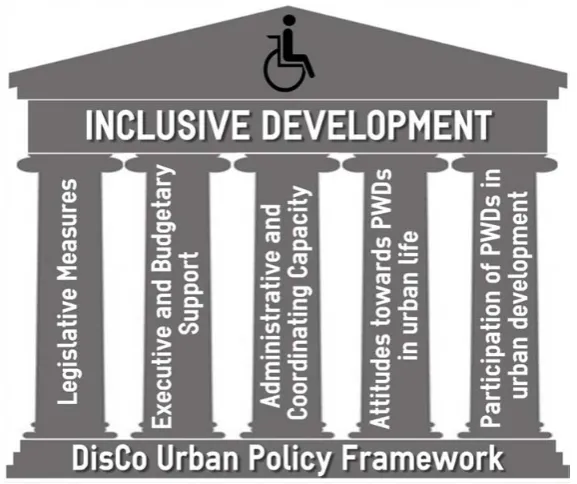
To support global reporting efforts, we offer herein five interrelated criteria or pillars for evaluation and assessment of inclusive urban development. With the following evaluative criteria, member states can easily conduct rapid assessments at the level of a
neighborhood, city, or state or nation. The five pillars of the DisCo Policy Framework developed by Victor Pineda (2010) help structure data collection efforts and help city managers to determine the concrete steps needed to ensure that local efforts are aligned to international normative framework. These include:
1. Legislative Measures
2. Executive and Budgetary Support
3. Administrative and Coordinating Capacity 4. Attitudes towards PWDs in urban life
Victor Santiago Pineda, Stephen Meyers, John Paul Cruz
Figure 1: Urban Policy Framework based on the UN Convention on the Rights of Persons with Disabilities can be used to conduct rapid assessments of inclusive urban development.
1) Legislative Measures: States parties must monitor legal or regulatory changes, policies or
reforms at various levels of government, from local ordinances to national laws.
Furthermore states and local municipalities must document the local level laws exist to guide implementation of accessibility and disability related policies at the local level. By looking at legislative measures, local governments can work to address
non-compliance.
2) Executive and budgetary support: States parties develop and implement urban policy
under varying types of political and financial structures. Public commitments, financial or budgetary appropriations should be continuously assessed. This can be done by reviewing government reports, official press releases or from expert interviews with key stakeholders. Strategies should be developed to remove institutional barriers and secure political and financial commitments.
3) Administrative and coordinating capacity: Local agencies often lack institutional capacity
and may have a deficit of capable human resources to implement substantive changes. States parties should report on the governance mechanisms. Governments must conduct stakeholder mapping to better understand possible deficits in administrative and coordinating capacity. Are the responsible parties effectively working across sectors and scales? By looking closely at this pillar, program fragmentation and overlap can be avoided.
4) Participation of targeted group: States parties must report on the level of participation of
The Inclusion Imperative
5) Awareness of needs and attitudes towards targeted group: States parties must report on
their efforts to promote and monitor awareness raising efforts. States can report on the metrics they use to assess communication and outreach initiatives (social media and traditional media). In addition, states parties should continuously study the prevalence of biases and negative attitudes towards people with disabilities. Negative attitudes towards people with disabilities can inhibit progress from being made. For all the data collection efforts listed above, states must ensure strong, multi-stakeholder efforts that promote sustained collaboration, information sharing and knowledge exchange between all disability and development actors. Strong coordination of data collection efforts can help ensure that public sector efforts generate the desired changes.
Recommendations for an Inclusive Urban Agenda
A New Urban Agenda must ensure that all elements of the built environment, including land use, transportation, housing, energy, and infrastructure, work together to provide accessible, and affordable places for living, working, and recreation, with a high quality of life that meets the livelihood needs of all citizens and groups. In addition, the agenda must ensure that the planning process actively involves all segments of the community and includes persons with various types of disabilities in analyzing issues, generating visions, developing plans, and monitoring outcomes.
The following recommendations can help realize this goal:
I. Recommendations to ensure access in the built environment
1.1 Plan for Multimodal Transportation
A multimodal transportation system allows people to use a variety of transportation modes, including walking, biking, and other mobility devices (e.g., wheelchairs), as well as transit where possible. According to Arnot and Swartz (2012) such a system reduces dependence on automobiles and encourages more active forms of personal transportation, improving health outcomes and increasing the mobility of those who are unable or unwilling to drive (e.g., youth, persons with disabilities, the elderly). Fewer cars on the road also translate to reduced air pollution and greenhouse gas emissions with associated health and environmental benefits (Audirac, 2008).
1.2 Plan for Transit Oriented Development
Transit-oriented development (TOD) is characterized by a concentration of higher density mixed use development around transit stations and along transit lines, such that the location and the design of the development encourage transit use and pedestrian activity. TOD allows communities to focus new residential and commercial development in areas that are well connected to public transit. This enables residents to more easily use transit service, which can reduce vehicle-miles traveled and fossil fuels consumed and associated pollution and greenhouse gas emissions. It can also reduce the need for personal automobile ownership, resulting in a decreased need for parking spaces and other automobile-oriented infrastructure.
1.3 Provide complete streets serving multiple functions
Victor Santiago Pineda, Stephen Meyers, John Paul Cruz
modes or functions will be equally prioritized on any given street segment. Streets that serve multiple functions can accommodate travel, social interaction, and commerce, to provide for more vibrant neighborhoods and more livable communities.
1.4 Plan for mixed land-use patterns that are walkable and bikeable
Mixed land-use patterns are characterized by residential and nonresidential land uses located in close proximity to one another. Mixing land uses and providing housing in close proximity to everyday destinations (e.g., shops, civic places, workplaces) can increase walking and biking and increase personal mobility. Mixed land-use patterns should incorporate safe, convenient, accessible, and attractive design features (e.g., sidewalks, bike street furniture, bicycle facilities, street trees) to promote walking and biking.
1.5 Prioritize access with infill development
Infill development is characterized by development or redevelopment of undeveloped or underutilized parcels of land in otherwise built-up areas, which are usually served by or have ready access to existing infrastructure and services.
1.6 Encourage design standards appropriate to the community context
Design standards are specific criteria and requirements for the form and appearance of development within a neighborhood, corridor, special district, or jurisdiction as a whole. These standards serve to improve accessibility or protect the function and aesthetic appeal of a community or neighborhood. Design standards typically address building placement, building massing and materials, and the location and appearance of elements (such as landscaping, signage, and street furniture.) All these features have accessibility and design considerations for people with disabilities. Access considerations can encourage development that is compatible with the community context and that enhances sense of place. While accessible design standards will not be specified in a comprehensive city-wide master plan, the plan can establish the direction and objectives that detailed accessibility standards should achieve.
1.7 Provide accessible public facilities and spaces
Public facilities play an important role in every city, and they should be able to accommodate persons of all ages and abilities. Public facilities and spaces such as schools, parks, civic or community centers, public safety facilities, arts and cultural facilities, recreational facilities, plazas, should be equitably distributed throughout the city. They should be located and designed to be safe, served by different transportation modes, and accessible to visitors with mobility impairments.
1.8 Conserve and enhance historic resources
Historic resources are buildings, sites, landmarks, or districts with exceptional value or quality for illustrating or interpreting the cultural heritage of a city. It is important to address accessibility in the conservation and enhancement of historic resources. Examples of how to do this effectively exist.
1.9 Implement accessibility standards into green building design and energy conservation
The Inclusion Imperative
II. Recommendations to Ensure Equity
2.1 Plan for improved health and safety for at-risk populations
An at-risk population is characterized by vulnerability to health or safety impacts through factors such as race or ethnicity, socioeconomic status, geography, gender, age, behavior, or disability status. These populations may have additional needs before, during, and after a destabilizing event such as a natural or human-made disaster or period of extreme weather, or throughout an indefinite period of localized instability related to an economic downturn or a period of social turmoil. At-risk populations include children, the elderly, and persons with disabilities, those living in institutionalized settings, those with limited language proficiency, and those who are transportation disadvantaged.
2.2 Provide a range of housing types
A range of housing types is characterized by the presence of residential units of different sizes, configurations, tenures, and price points located in buildings of different sizes.
2.3 Provide accessible and quality public services, facilities, and health care to minority and
low-income neighborhoods
A public service is a service performed for the benefit of the people who live in (and sometimes those who visit) the jurisdiction. A public facility is any building or property—such as a library, park, or community center—owned, leased, or funded by a public entity. Public services, facilities, and health care should be located so that all members of the public have safe and convenient transportation options to reach quality services and facilities that meet or exceed industry standards for service provision. Public services and facilities and healthcare providers often underserve minority and low-income neighborhoods.
2.4 Protect vulnerable populations from natural hazards
A natural hazard is a natural event that threatens lives, property, and other assets. Natural hazards include floods, high wind events, landslides, earthquakes, and wildfires. Vulnerable neighborhoods face higher risks than others when disaster events occur. A population may be vulnerable for a variety of reasons, including location, socioeconomic status or access to resources, lack of leadership and organization, and lack of planning.
III. Recommendations for Authentic Participation
3.1Engage stakeholders at all stages of the planning process
Engaging stakeholders throughout the planning process—from creating a community vision to defining goals, principles, objectives, and action steps, as well as in implementation and evaluation—is important to ensure that the plan accurately reflects community values and addresses community priority and needs. In addition, engagement builds public understanding and ownership of the adopted plan, leading to more effective implementation.
3.2Seek diverse participation in the plan development process
Victor Santiago Pineda, Stephen Meyers, John Paul Cruz
Leaders and respected members of disadvantaged communities can act as important contacts and liaisons for planners in order to engage and empower community members throughout the planning process. Participation in the process can encourage development of emerging leaders, especially from within communities that may not have participated in planning previously.
3.4Provide ongoing and understandable information for all participants
Information available in multiple, easily accessible formats and languages are key to communicating with all constituents, including non-English speakers. Such communication may involve translating professional terms into more common lay vocabulary.
3.5Continue to engage the public after the comprehensive plan is adopted
Stakeholder engagement should not end with the adoption of the comprehensive plan. An effective planning process continues to engage stakeholders during the implementing, updating, and amending of the plan, so that the public remains involved with ongoing proposals and decisions.
IV. Recommendations for implementation and coordination
4.1 Be Persuasive in communicating a plan for accessibility
A persuasive plan communicates key principles and ideas in a readable and attractive manner in order to inspire, inform, and engage readers. It uses up-to-date visual imagery to highlight and support its recommendations.
4.2 Be Consistent across plan components and modalities
A consistent plan frames proposals barrier removal as sets of mutually reinforcing actions in a systems approach aligning the plan with broader public programs and regulations.
4.3 Coordinate with the plans of other jurisdictions and levels of government
A coordinated plan for disability inclusive development is aligned horizontally with plans, priorities and forecasts of adjacent jurisdictions and vertically with federal, state, and regional plans.
4.4 Comply with applicable anti-discrimination laws and mandates
A compliant plan meets requirements of mandates and laws concerning preparing, adopting, and implementing integrated plans, programs, and policies.
4.5 Be transparent in the plan’s substance
A transparent plan clearly articulates the rationale for all goals, objectives, policies, actions, and key plan maps. It explains the “what, how, and why” of each recommendation.
4.6 Use formats that go beyond paper
A plan that goes beyond paper is produced in a web-based format and/or other accessible, user-friendly formats in addition to a standard printed document. Planning websites can be used both to engage and to inform citizens and different constituencies about the plan.
Conclusion
The Inclusion Imperative
SDG’s and the New Urban Agenda more disability inclusive. The multi-dimensional and interdependent nature of social exclusion demands a comprehensive and integrated set of solutions. This baseline report also noted that the scholarly research community has not sufficiently engaged issues of disability inclusion in cities and human settlements, resulting in a dearth of qualitative and quantitative studies that could contribute theory, methods, and knowledge towards the development of public policy.
This paper demonstrates that human rights and equity-based approaches to inclusive urban development are underway. In the near future, additional energy needs to be put towards not only activating evidence-to-action pathways identified herein, but also addressing more fundamental questions such as improving transparency, accountability and accessibility of services for persons with disabilities; legal reforms necessary to make the SDG’s and CRPD a reality at national, regional, and municipal levels; the type, location and extent of data needed to improve policy deliberations and measure human rights of persons with disabilities; and, indeed, context-specific methods of assessing negative social attitudes, as well as mobilizing civil society to address complex factors and persistent challenges.
The recommendations presented herein can make a meaningful contribution to the effective implementation of SDG’s in urban development. Coordinating efforts to improve and scale up disability inclusive urban development can spur innovations in other areas of urban policy, such as poverty alleviation, environmental sustainability, access to quality education, and increasing participation, and in doing so help eliminate the root causes of persistent inequality, marginality, and dependence not only for persons with disabilities but for other marginalized groups.
It is our belief that a comprehensive, scalable, universal and inclusive approach to urban development can address the ills that confront cities, ills that continue to marginalize, stigmatize, and disenfranchise millions of urban citizens that live with disabilities.
Unnecessary barriers can be identified and eliminated through innovative and cooperative approaches with civil society. The voices of persons with disabilities attest to the urgency and need for global leadership on this vital global development issue.
The disability perspective is opening new efforts towards equity and inclusion and bringing to life key targets of the United Nations Sustainable Development Goals and the New Urban Agenda. Disability responsive urban development helps steer the New Urban Century away from repeating costly mistakes and towards an inclusive, barrier-free, rights based urban future for all.
Bibliography
Abendroth, Lisa M., and Bryan Bell (2015). Public Interest Design Practice Guidebook: SEED Methodology, Case Studies, and Critical Issues. Routledge.
Acuto, Michele (2013), Global Cities, Governance and Diplomacy: The Urban Link. Routledge.
http://books.google.com/books?hl=en&lr=&id=mJaCX0qiRy0C&oi=fnd&pg=PR1&dq=Global +Cities,+Governance+and+Diplomacy&ots=Oia0VlHVWt&sig=fZB8cPrLxL34O_mKS7_IZI Yr5fA.
Ahmmad, M. Roungu, and M. Nurul Islam (2014). “Impact of Disability on Quality of Life of Urban Disabled People in Bangladesh.” International Journal of U-& E-Service, Science & Technology, 7, no. 4. http://www.sersc.org/journals/IJUNESST/vol7_no4/21.pdf.