Original Article
J Reprod Infertil. 2012;13(4):204-210
Current
Chlamydia trachomatis
Infection, A Major Cause of Infertility
Jayanti Mania-Pramanik 1*, Shilpa Kerkar 1, Shobha Sonawane 1, Pratibha Mehta 1, Vinita Salvi 2,3
1- Department of Health Research, Indian Council of Medical Research, National Institute for Research in Reproductive Health, Mumbai, India
2- Seth G S Medical College and KEM Hospital, Parel, Mumbai, India 3- Seven Hills Hospital, Mumbai, India
Abstract
Background: In India, the impact of current Chlamydia trachomatis (C. tracho-matis) in reproductive health remains a neglected area of investigation. The present study evaluates if current Chlamydia infection is associated with any clinical com-plication that needs the attention of clinical investigators.
Methods: In this cross-sectional study, we enrolled 896 women attending the Gyne-cology Out Patient for the detection of C. trachomatis infection. Polymerase chain reaction was used to diagnose current C. trachomatis infection and ELISA for past infections. Bacterial vaginosis, Candida and Trichomonas were screened. The results of symptomatic and asymptomatic groups were compared. The data was analyzed using Epi Info version 6 and "Z" test. A probability value of p≤0.05 was considered as significant.
Results: Statistical analysis revealed significant association between current C. tra-chomatis infection with infertility when comparing infected fertile (18.6% vs. 9.4%, odds ratio: 2.19, p<0.0005) and uninfected infertile women (45.6% vs. 27.3%, odds ratio: 2.24, p<0.0001). Average infection rate was 12.1%, highest in women with in-fertility (18.6%) or with ectopic pregnancy (25%). Significant proportions of infect-ed women with infertility (p<0.01) or with recent pregnancy (p<0.001) were asymp-tomatic. Follow up of infected women who became negative after treatment [28 women from infertility group and 9 women with recurrent spontaneous abortion (RSA)] revealed live birth in 8 (21.6%) women within one year, 4 with infertility and 4 with RSA.
Conclusion: Study findings suggest association between current C. trachomatis in-fection and infertility. Absence of signs and symptoms associated with this inin-fection highlights its diagnosis in women with a history of infertility and RSA for their bet-ter management, as revealed by live births with one year of follow up.
Keywords: Asymptomatic, Chlamydia infection, Current, Infertility.
To cite this article: Mania-Pramanik J, Kerkar S, Sonawane S, Mehta P, Salvi V. Current
Chlamydia trachomatis Infection, A Major Cause of Infertility. J Reprod Infertil. 2012;13(4):204-210.
Introduction
iagnosis, treatment and prevention of sexual-ly transmitted Chlamydia infection has be-come an important public health priority es- pecially, by strong evidence linking this infection withHIVtransmission(1).Consequences of Chla-mydia trachomatis (C. trachomatis) infection are more damaging to the reproductive health of women than to men. A number of clinical condi-
tions like mucopurulent endocervicites, endo-metritis or salpingitis have been attributed to this infection. The potentially serious sequelae of cer-vical infection with C. trachomatis includes infer-tility, ectopic pregnancy, pelvic pain and recurrent pelvic inflammatory diseases (PID) (2−4). How-ever, all the infected individuals do not develop such complications or symptoms, as only a frac-* Corresponding Author:
Jayanti Mania-Pramanik, Infectious Diseases Biolo-gy, National Institute for Research in Reproductive Health, Indian Council of Medical Research, De-partment of Health Re-search, Mumbai, India
E-mail:
jayantimania@rediffmail. com
Received: Jun. 23, 2012
Accepted: Jul. 7, 2012
J Reprod Infertil, Vol 13, No 4, Oct-Dec 2012 205 Mania-Pramanik J, et al.
JRI
tion get upper genital tract infection and a subset of them manifest complications leading to infertil-ity and ectopic pregnancy (5, 6). Direct and indi-rect costs of chlamydial infections are substantial, justifying more attention and a stronger multidis-ciplinary approach. Cates and Wasserheit re-viewed a large number of studies showing statisti-cally significant association between tubal factor infertility, spontaneous abortion (SA) and ectopic pregnancy with previous systemic chlamydial in-fection identified by the presence of C. tracho-matis specific antibody (7). Reports are also avail-able on the prevalence of current C. trachomatis infection in women with different clinical condi-tions like infertility and genitourinary complaints (8-10); however, there is not much reports on its association with infertility or related clinical com-plications. Evaluation of present infection with the aforesaid types of manifestations could help in treatment. In India, the clinical manifestations or sequelae associated with current C. trachomatis infection, is yet to be considered as a major health problem and clinician rarely refer any subject for its diagnosis. Hence, the present study aims to assess whether current C. trachomatis infection is associated with any complications in Indian wom-en that needs to be highlighted for its clinical in-vestigation.
Methods
Subjects: In this cross-sectional study, we en-rolled women attending the Gynecology Out Pa-tient Department (OPD) of Seth G.S. Medical College and King Edward Memorial (KEM) Hos-pital, Parel, Mumbai, between 2003 to 2009. The group comprised of women with histories of re-current spontaneous abortion (RSA, n=143), infer-tility (n=264), symptoms and signs of lower geni-tal tract infections (LGTI, n=213), pregnant wom-en (n=174) attwom-ending the antwom-enatal care (ANC) unit, as well as those who had no symptoms and signs of any infection (asymptomatic controls, n=102) but came for family planning advice.
Ethics Committees of the institute, as well as of KEM Hospital approved the study. Each woman was informed about the study and written consent was obtained from all the women before enroll-ment.
Specimens: The clinician team did a routine gy-necological per speculum examination to record signs of infection and collected endocervical and vaginal swab specimens. First, endocervical swab (Hi-media Laboratories Pvt. Limited, Mumbai,
India) specimens were collected in a sterile con-tainer with 1ml PBS (pH=7.5) for immediate pro-cessing to detect C. trachomatis infection, while second specimens were stored in dry sterile vials at -20°C for confirmatory tests, if required. Vagi-nal specimens were also collected from the poste-rior fornix using a wooden spatula for the diagno-sis of bacterial vaginodiagno-sis (BV) using Nugent's scoring system for Gram stain smears (11)and for the detection of trichomonas and candida by wet mount. Blood specimens collected from the wom-en were used for antibody test using commercially available ELISA kit (Novatech Immuno-diag-nostica, GMBH).
Adequacy of specimens: In order to check speci-men adequacy, each cervical specispeci-men in PBS was vortexed for 30 s, the swab was squeezed and 10 μl of specimen was examined under micro-scope to see the presence of epithelial cells. Four to five epithelial cells per high power field was considered as an adequately collected specimen for further processing.
Signs and symptoms of reproductive tract infections:
Severely eroded cervix with hypertrophic cervical erosions and a mucopurulent endocervical dis-charge or leucorrhoea were recorded as signs while burning micturation and pain in the abdo-men reported by the woabdo-men were recorded as symptoms.
Extraction of DNA: DNA was isolated from cer-vical specimen using a rapid non-enzymatic method. The cells were pelleted and resuspended in Tris-MgCl2-KCl buffer (pH=7.4) and treated with 10% sodium dodecyl sulphate at 55 ºC for 10 min to lyse the cells. The proteins were precipitat-ed using saturatprecipitat-ed sodium chloride solution. DNA was precipitated by 100% ethanol and eluted in Tris EDTA buffer (12). The quantity and quality of DNA was estimated spectrophotometrically and by loading an aliquot of DNA on 0.8% agarose gel. As an internal control PCR for beta-globin gene was also performed for each sample to rule out the presence of inhibitory factors in the extracted specimens.
PCR for diagnosis of C. trachomatis: PCR was per-formed on extracted DNA using primers designed from the conserved region of MOMP gene of C. trachomatis with sense primer: 5' GCC GCT TTG AGT TCT GCT TCC 3' and anti-sense primer: 5' GTC GAA AAC AAA GTC ACC ATA GTA 3' to amplify a 180 bp DNA fragment common to all serotypes (13). The reaction was carried out in a volume of 50 μl. It contained primers (0.5 μm
206 J Reprod Infertil, Vol 13, No 4, Oct-Dec 2012 C. Trachomatis Infection in Indian Women
JRI
each), 0.2 mM dNTP’s, PCR buffer (10 mM Tris buffer; pH=9), 1.25 units of Taq polymerase, 10
μl of DNA specimen and the volume was adjusted with sterile distilled water. Positive and negative controls were also run in each experiment. Reac-tion was performed in a thermal cycler (Perkin Elmer 2400) as per the following protocol: initial denaturation was done for 5 min at 94 °C. This was followed by 35 cycles of 30 s each of dena-turation at 94 °C, annealing at 55 °C and exten-sion at 72 °C for 1 min. The final extension step was carried out at 72 °C for 5 min. The amplified products were run on 2% Agarose gel, observed under a UV transilluminator while the results were being documented. Presence of 180 bp re-peat sequences in positive control specimen and its absence in the negative control indicated reac-tion had been completed satisfactorily. Presence of 180 bp repeat sequences in other clinical spec-imens indicated presence of C. trachomatis infec-tion. Further confirmation of these amplified products was carried out using specific C. tra-chomatis probe in Southern hybridization (14). Probe was prepared using PCR dig-labeling kit (Roche diagnostics). Standard protocol for South-ern blotting was followed for transfer of PCR products to a nylon membrane, which was then processed for hybridization using a generic probe. Instruction manual was followed to detect the probe complex using Dig-luminescence detection kit (Roche diagnostics).
Detection of C. trachomatis IgG antibody: Com-mercially available enzyme-linked immunosorb-ent assay (ELISA) kit was used to detect C. tra-chomatis specific IgG antibody (NovaTec Im-munodiagnostica, GMBH). In brief, microtitre wells precoated with C. trachomatis antigens were incubated with serum specimen at a 1:100 dilution so that any corresponding antibodies present in the serum would bind to the antigen to form com-plexes. After washing the wells to remove all un-bound sample material, horseradish peroxidase (HRP) labeled anti-human IgG conjugate was added which would bind to captured Chlamydia specific antibodies. The immune complex formed by the bound conjugate was visualized by adding tetramethylbenzidine (TMB) substrate, which gives a blue colored reaction product.
After terminating the reaction using a stop solu-tion (Sulphuric acid, 0.2 mol/l), the absorbance of the end product, which is yellow in color, was read at 450 nm using an ELISA plate reader (μ
Quant, Bio-Tek Instruments Inc.). The intensity of
this product is directly proportional to the amount of Chlamydia-specific IgG antibodies in the spec-imen. The specimens with O.D. higher than the cut-off value (0.250−0.900) were considered posi-tive for Chlamydia-specific antibodies and used as an indicator of past Chlamydia infection. Each positive sample was again confirmed using anoth-er sanoth-erum aliquot of the same participant. The re-sults were found to be reproducible.
Follow up of C. trachomatis positive cases: Coun-seled each enrolled women to come back to take the report. Those found to be infected with any of these infections were treated by the clinician.
Statistical analysis: Statistical analysis using Epi Info version 6 software for Chi-squares (χ2) test
was applied to study the association between C. trachomatis infection with the clinical manifesta-tions. The test of significance for proportion be-tween different groups was carried out using "Z" test. A probability value of p≤0.05 was considered as significant.
Results
Study subjects: Eight hundred and ninety-six women were tested for current C. trachomatis infection by PCR. The participants were between 16 to 45 years old with a median age of 29 yrs, and an interquartile range (IQR) value of 10. They belonged to middle socio-economic groups and their personal history did not reveal any high risk behavior. The number of women in asymptomatic control group, as well as those in groups with dif-ferent clinical histories like RSA, infertility, with lower genital tract infection (LGTI), pregnant women from antenatal care (ANC) centers, their age and the infection rate in each group is pre-sented in table 1.
In the RSA group, there were 58 women with 2 pregnancy losses (2SA), 77 women with more than 3 pregnancy losses (>3SA) and 8 with ectop-ic pregnancy. In the ANC group, the gestational period of the pregnant women varied from 2 to 4 months. There were 108 (12.1%) women with cur-rent C. trachomatis, indicating the prevalence of this infection in the study population.
Presence of other reproductive tract infections and past C. trachomatis infection: Of the 108 C. tracho-matis infected women, 4 (3.7%) had concomitant BV while 1 (0.9%) had concomitant Candida albicans. In the rest of participants (n=788), C. trachomatis specific antibody was present in 14 women, one woman had both the antibody and the antigen. Eighty women had other infections such
J Reprod Infertil, Vol 13, No 4, Oct-Dec 2012 207 Mania-Pramanik J, et al.
JRI
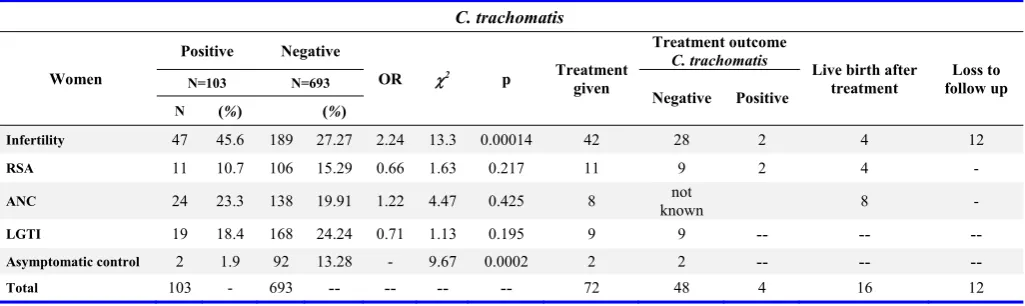
as BV, Candida or Trichomonas infections and the related infection rates were 14.5%, 4.3% and 0.9%, respectively. For further analysis, these women with C. trachomatis antibody (n=15), as well as those with other infections (n=80) were excluded. Hence, there were 693 women without any infection, who were taken into consideration for comparative analysis (Table 2).
Sequelae, symptoms and signs associated with cur-rent C. trachomatis: Infection rate varied from 1.96% to 25.0% among the different groups of participants (Table1). Among the RSA subgroup a significant (p<0.001) proportion of women with ectopic pregnancy (25%) and with more than 2 spontaneous abortions (10.4%) had this infection, compared to women with 2 spontaneous abortions (5.2%). C. trachomatis infection rate was signifi-cantly low in the group of women with children or expecting a child such as asymptomatic controls (n=102),LGTI(n=213)orinANC(n=174) groups,
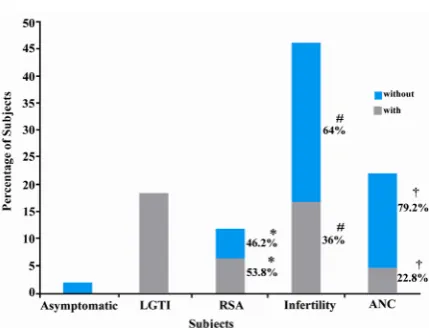
{9.4% (46 of 489); odds ratio: 2.19, p<0.0005)} whencomparedtoinfectedinfertilewomen (18.6%, 49 of 264). Comparison of clinical manifestation of women with only current C. trachomatis infec-tion (n=103) with that of uninfected women (n=693) revealed significant association of C. tra-chomatis infection with infertility (45.6% vs. 27.3%, p=0.0001; Table 2). Another significant observation was the absence of any symptoms or signs on per speculum examination in infertile (64% vs. 36%, p<0.01) and pregnant (79.2% vs. 22.8%, p≤0.001) infected women, indicating asymptomatic nature of this infection (Figure 1).
Age associated with current C. trachomatis infec-tion:C. trachomatis infection was highest (21.8%) among women 20 years old or younger, though not statistically significant, and lowest in 21−25 year old age group. The infection rate again show-ed an increasing trend in women above 26−40 years of age.
Table 1. Defined groups of participant (count and age) and C. trachomatis infection rate
Clinical groups
Participant
(n=896) Age in years Ag C. trachomatis Ab Ag+Ab Other Infections
N (%) Range Median N (%) N (%) N (%) BV Candida Trichomonas
Asymptomatic 102 11.4 18-40 30 2 (1.96) 0 (0.00) 0 (0.00) 6 2 0
LGTI 213 23.8 18-40 30 20 (9.39) 0 (0.00) 0 (0.00) 6 15 5
RSA (n=143, 15.38%)
2 SA 58 6.5 20-43 26 3 (5.2*) -- -- 9 5 0
>2 SA 77 8.6 20-40 28 8 (10.4*) -- -- 3 1 0
Ectopic pregnancy 8 0.9 26-38 31.5 2 (25*) -- -- 0 0 0 Infertility 264 29.5 18-40 26 49 (18.6) 6 0 (0.00) 18 2 2
ANC 174 19.4 19-40 26 24 (13.8) 0 (0.00) 1 1 10 0
*p<0.001,
Notes:Asymptomatic=Healthy women without any sign or symptoms of any infection or disease; LGTI=Lower genital tract infections; RSA=Recurrent spontaneous abortion; Infertility=Women unable to conceive after two years of cohabitation with husband; ANC=Antenatal cases or pregnant women; SA=Spontaneous abortion
Table 2.Frequency of clinical manifestations with or without current C. trachomatis infection in women who did not have any other infec-tion and their treatment outcome
C. trachomatis
Women
Positive Negative
OR χ2 p Treatment
given
Treatment outcome
C. trachomatis
Live birth after
treatment follow up Loss to
N=103 N=693
Negative Positive
N (%) (%)
Infertility 47 45.6 189 27.27 2.24 13.3 0.00014 42 28 2 4 12
RSA 11 10.7 106 15.29 0.66 1.63 0.217 11 9 2 4 -
ANC 24 23.3 138 19.91 1.22 4.47 0.425 8 known not 8 -
LGTI 19 18.4 168 24.24 0.71 1.13 0.195 9 9 -- --
--Asymptomatic control 2 1.9 92 13.28 - 9.67 0.0002 2 2 -- --
--Total 103 - 693 -- -- -- -- 72 48 4 16 12
Notes:Infertility=Women unable to conceive after two years of cohabitation with husband; RSA=Recurrent spontaneous abortion; ANC=Antenatal cases or pregnant women; LGTI=Lower genital tract infections; Asymptomatic controls=Healthy women without any sign or symptoms of any infection or disease
208 J Reprod Infertil, Vol 13, No 4, Oct-Dec 2012 C. Trachomatis Infection in Indian Women
JRI
Association of current C. trachomatis infection with vaginal pH/Microscopic analysis (>10PMNs)/Colour of swab/Bleeds on touch: Among the C. tracho-matis infected women, (20.2%) had high pH (>5), (47.7%) had more than 10 polymorphonuclear leukocytes (PMNs) in their specimens, 2.7% had yellow/grayish coloured discharge and 7.3% had blood on swab or bled during collection of speci-mens.
Follow up of C. trachomatis positive cases: Seven-ty-two women with C. trachomatis infection came for the report, which were subsequently treated. Follow up record on 60 women was available only for one year. Thereafter, they could not be traced due to several reasons. In ANC group, 8 of 24 C. trachomatis positive pregnant women came for follow up and were treated. No further testing was done in these pregnant women after completion of treatment in accordance with the clinician advice to avoid any risk during pregnancy. These eight women had live births. Result of follow up in oth-er groups revealed that four of the 52 infected in-dividuals were positive even after treatment. There were eight live births in these groups fol-lowing treatment (Table 2). Women with other in-fections such as BV, Candida and Trichomonas werealsotreatedasperhospitalroutineprocedure.
Discussion
Results revealed statistically significant associa-tion between current C. trachomatis infection with clinical manifestations or sequelae like infertility in women in Mumbai, India. Women with con-founding variables such as other abnormalities or infections were excluded from comparisons. In
our study, we excluded women positive for C. trachomatis antibody from analysis as presence of C .trachomatis antibody is known to be associated with tubal factor infertility, spontaneous abortion and ectopic pregnancy (7). A recent report in Ghanaian women, also highlighted the presence of Chlamydia-specific IgG (39%) and IgA (14%) antibodies indicating previous C. trachomatis in-fections among women with primary or secondary infertility compared to current infection (2.4%) (15). Further, C. trachomatis infected women with co-infections were also excluded from the study so that a direct correlation could be made between current C. trachomatis infection with its clinical manifestations. In the present study, comparative analysis between women with or without C. tra-chomatis with different types of clinical manifes-tations, showed a statistically significant associa-tion between current C. trachomatis infection with infertility.
The average infection rate was 12.1%. This high rate of infection might be due to the inclusion of women with specific clinical history like infertili-ty, ectopic pregnancy, as well as women with more than two spontaneous abortions. Previous studies in the local population have shown a low infection rate among women with infertility (2.5%) which might have been due to the use of less sensitive techniques like ELISA (16). Our previous study using the same method (ELISA) also showed a similar infection rate (1.7%) in asymptomatic controls, while the present rate (18.6%) of infection in women with infertility using PCR was high compared to 14.3% of wom-en with infertility published earlier using ELISA (17). Another study from Mumbai reported high rates of infection (23.2%) in female sex workers using ELISA (18), indicating presence of this in-fection in the local population. Moreover, women with infertility and recurrent spontaneous abor-tions might be more sexually active to conceive leading to high infection rates. Other studies in women from northern Indian also revealed similar high infection rates (27%, 20 of 74) in women with primary infertility as detected by culture or antigen test (8). High prevalence rate (43.1%) of C. trachomatis was also seen in women (n=430) with genitourinary complaints, even among the slum dwellers (15.3%, n=53) compared to 9.39% observed in our women with LGTI (10). Report also revealed high rates of Chlamydia infection in women with infertility (36%, n=169), compared to our observation of 18.6% (9). Provision of free
Figure 1. Sequelae associated with C. trachomatis infection, with or without symptoms and signs
*p>0.05; #p<0.01; †p<0.001, LGTI=Lower genital tract infection; RSA=Repeated spontaneous abortion; ANC= Antenatal case. Per-centage of subjects=PerPer-centage of infected women in each group of women with different manifestations
J Reprod Infertil, Vol 13, No 4, Oct-Dec 2012 209 Mania-Pramanik J, et al.
JRI
treatment and access to health care system might be responsible for the comparatively low infection rate seen in this western region of the country.
Significant proportion of women with ectopic pregnancy and more than two spontaneous abor-tions had current C. trachomatis infection, which might be the etiology for the aforesaid disorders as reported earlier (7, 19). However, these reports suggest association of C. trachomatis antibody or its past infections with these types of manifesta-tions, whereas our results showed its association, i.e.; one fourth of ectopic pregnancies with current C. trachomatis infection, supporting the recent re-view which attributes one- third of ectopic preg-nancies to chlamydial infection (2).
Age-wise distribution of study population with C. trachomatis infection revealed that a high pro-portion of women younger than 20 years of age had this infection, which is in harmony with other reports that Chlamydia infection rates are inverse-lyrelatedtoage(5−7,20,21).Inthepresent study, a unique trend between infection rate and age was observed.
This infection was mostly asymptomatic; women only came to the clinics when they developed complications such as signs and symptoms of lower genital tract infection, experienced repeated pregnancy loss, and had infertility at later age; thus, present observation revealed an increasing rate of infection with age.
A year of follow up of the treated women was followed by the pregnancy and subsequent live birth in four women with infertility and four women with RSA indicating the association of this infection for such types of manifestations.
Asymptomatic nature of these manifestations al-so correlated with earlier reports (22, 23). Some studies have shown that a count of <10 PMNs per high power field was defined as predicting ab-sence of gonococci and C. trachomatis (24, 25) but only 47.7% of the infected women from the study group had a count of >10 PMNs/hpf. Ab-sence of increased number of PMNs in the rest might be associated with asymptomatic nature of disease manifestations in these women.
We could not establish the cause of high pH of vaginal secretion in 20% of the C. trachomatis infected cases as only 3.7% had BV infection. Hence, our attempt to correlate C. trachomatis infection with any changes in vaginal pH, any changes in the colour of swab collected or bleed-ing while collectbleed-ing specimen was futile.
In C. trachomatis negative women, the rate of other infections like BV, Candida and Tricho-monas correlated well with a previous study con-ducted in Mumbai where the infection rate of BV, Candida and Trichomonas were, 13% (58/446), 0.9% (4/446) and 0.5% (2/446), respectively (26). Infection such as candidiasis (4.3%) was expected to be more common in Mumbai in view of poor and unsatisfactory housing conditions under which many of them lived but this condition was not observed. Even existence of common RTIs along with C. trachomatis infection was observed to be low in this clinic based prevalence study.
These findings could suggest, statistically signif-icant association between current C. trachomatis infection with infertility and immunity to infection which might be correlated to sperm rejection in women leading to infertility.
The limitation of the study was follow up of en-rolled women only up to one year. The enen-rolled women could not be contacted due to frequent change of their phone number.
Absence of signs and symptoms in significant proportions of currently infected women, as well as high infection rate in the younger age group emphasizes the need for C. trachomatis diagnosis. Current C. trachomatis infection could be in-volved in the etiology of infertility and its treat-ment will help in positive pregnancy outcomes.
Conclusion
Study findings suggest, statistically significant association between current C. trachomatis infec-tion with infertility. Absence of signs and symp-toms associated with this infection highlights the need for its investigation in women with a history of infertility and RSA for their better manage-ment, as revealed by live birth with one year of follow up.
Acknowledgement
We thank all the staff members who helped us in this work and the National Institute for Research in Reproductive Health for their support. We thank WHO for providing financial support through WHO-Country budget, as well as partial support from ICMR Adhoc Research Grant5/7/ 129/05-RHN to carry out the study.
Conflict of Interest
There was no conflict of interest in this article.
210 J Reprod Infertil, Vol 13, No 4, Oct-Dec 2012 C. Trachomatis Infection in Indian Women
JRI
References
1. Grosskurth H, Mosha F, Todd J, Mwijarubi E, Klokke A, Senkoro K, et al. Impact of improved treatment of sexually transmitted diseases on HIV infection in rural Tanzania: randomised controlled trial. Lancet. 1995;346(8974):530-6.
2. Bébéar C, de Barbeyrac B. Genital Chlamydia tra-chomatis infections. Clin Microbiol Infect. 2009; 15 (1):4-10.
3. Darville T, Hiltke TJ. Pathogenesis of genital tract disease due to Chlamydia trachomatis. J Infect Dis. 2010;201 Suppl 2:S114-25.
4. Haggerty CL, Gottlieb SL, Taylor BD, Low N, Xu F, Ness RB. Risk of sequelae after Chlamydia tra-chomatis genital infection in women. J Infect Dis. 2010;201 Suppl 2:S134-55.
5. Stamm WE. Chlamydia trachomatis infections of the adult. In: Holmes KK, Sparling PF, Mardh PA, editors. Sexually transmitted diseases. New York: McGraw-Hill; 1999. p. 407-22.
6. Schachter J, Stoner E, Moncada J. Screening for chlamydial infections in women attending family planning clinics. West J Med. 1983;138(3):375-9. 7. Cates W Jr, Wasserheit JN. Genital chlamydial
in-fections: epidemiology and reproductive sequelae. Am J Obstet Gynecol. 1991;164(6 Pt 2):1771-81. 8. Malik A, Jain S, Hakim S, Shukla I, Rizvi M.
Chlamydia trachomatis infection & female infertili-ty. Indian J Med Res. 2006;123(6):770-5.
9. Mittal A, Kapur S, Gupta S. Screening for genital chlamydial infection in symptomatic women. Indi-an J Med Res. 1993;98:119-23.
10.Singh V, Rastogi S, Garg S, Kapur S, Kumar A, Salhan S, et al. Polymerase chain reaction for detec-tion of endocervical Chlamydia trachomatis infec-tion in women attending a gynecology outpatient departmentinIndia.ActaCytol.2002;46(3):540-4. 11.Nugent RP, Krohn MA, Hillier SL. Reliability of
diagnosing bacterial vaginosis is improved by a standardized method of gram stain interpretation. J Clin Microbiol. 1991;29(2):297-301.
12.Lahiri DK, Nurnberger JI Jr. A rapid non-enzymatic method for the preparation of HMW DNA from blood for RFLP studies. Nucleic Acids Res. 1991;19(19):5444.
13.Stephens RS, Mullenbach G, Sanchez-Pescador R, Agabian N. Sequence analysis of the major outer membrane protein gene from Chlamydia trachoma-tis serovar L2. J Bacteriol. 1986;168(3):1277-82. 14. Mania-PramanikJ,PotdarS,KerkarS. Diagnosis of
Chlamydia trachomatis infection. J Clin Lab Anal.
2006;20(1):8-14.
15. Siemer J, Theile O, Larbi Y, Fasching PA, Danso KA, Kreienberg R, et al. Chlamydia trachomatis infection as a risk factor for infertility among women in Ghana, West Africa. Am J Trop Med Hyg. 2008;78(2):323-7.
16. Chandhok N, Datey S, Gaur LN, Saxena NC. Prev-alence of chlamydia trachomatis in women attend-ing different clinics at tertiary hospitals. J Obstet Gynecol India. 2003;53(5):463-7.
17. Mania-Pramanik J, Meherji P, Gokral J, Donde U. Chlamydia trachomatis infection in an urban set-ting. Sex Transm Infect. 2001;77(2):141.
18. Divekar AA, Gogate AS, Shivkar LK, Gogate S, Badhwar VR. Disease prevalence in women at-tending the STD clinic in Mumbai (formerly Bom-bay), India. Int J STD AIDS. 2000;11(1):45-8. 19. WitkinSS,LedgerWJ.AntibodiestoChlamydia
tra-chomatis in sera of women with recurrent sponta-neous abortions. Am J Obstet Gynecol. 1992;167 (1):135-9.
20. Schachter J. Infection and disease epidemiology. In:StephensRS,editor.Chlamydiaintracellular bi-ology,pathogenesis,andimmunity.Washington DC: AmericanSocietyforMicrobiology;1999. p.139-69. 21. Thompson SE, Washington AE. Epidemiology of
sexually transmitted Chlamydia trachomatis infec-tions. Epidemiol Rev. 1983;5:96-123.
22. Sellors JW, Mahony JB, Chernesky MA, Rath DJ. Tubal factor infertility: an association with prior chlamydial infection and asymptomatic salpingitis. Fertil Steril. 1988;49(3):451-7.
23. Osser S, Persson K, Liedholm P. Tubal infertility and silent chlamydial salpingitis. Hum Reprod. 1989;4(3):280-4.
24. Moscicki B, Shafer MA, Millstein SG, Irwin CE Jr, Schachter J. The use and limitations of endocer-vical Gram stains and mucopurulent cervicitis as predictors for Chlamydia trachomatis in female ad-olescents.AmJObstetGynecol.1987;157(1):65-71. 25. Eltabbakh GH, Eltabbakh GD, Broekhuizen FF,
Griner BT. Value of wet mount and cervical cul-tures at the time of cervical cytology in asympto-matic women. Obstet Gynecol. 1995;85(4):499-503.
26. Brabin L, Gogate A, Gogate S, Karande A, Khan-na R, Dollimore N, et al. Reproductive tract infec-tions, gynaecological morbidity and HIV sero-prevalence among women in Mumbai, India. Bull World Health Organ. 1998;76(3):277-87.