FRAMING INDIAN IMAGE IN THE PAKISTANI
URDU PRESS: SPECIAL REFERENCE TO THE
PEACE PROCESS
Farish Ullah Yousafzai
Kasim Sharif
P
akistan and India have sour history of relations since independence. Bothhave extremely divergent and conflicting national ideologies and have been involved in a continuous conflict with each other. Both are very important states of the Southeast Asian region but they are unable to establish mutually acceptable relations. The issue that has bettered the relations between the two states since
partition is the dispute over Kashmir. Pakistan is pressing India that the people of
Kashmir should be given right to self-rule. On the other hand India believes that
Kashmir is an integral part of India.
The need of hour is that India and Pakistan should bring flexibility in their stance to amicably resolve these issues by indulging in media diplomacy. The media of these two countries can play their role in the resolution of the conflict between these two countries if they make sincere efforts in this regard. It will bring hope to the millions of people of South Asia who are under the threat of nuclear war between these two countries and bring happiness and prosperity in the region.
Pakistan and India have a series of wars over the Kashmir issue. The first war was fought in 1948 just after independence of these two states. In September 1965, the second conflict fully exploded across the line of control in South-West Jammu and Kashmir. This seventeen-day war left thousands of soldiers dead and
property of million rupees destroyed. The poor from both states suffered a lot. The third war between India and Pakistan was fought on several fronts including both wings—East and West -- that ended over the secession of East Pakistan which became Bangladesh. During the late 1970s Kashmir again became a bone of contention in mutual relations between the two countries. In late 1980s, Pak-India relations saw heavy ups and downs but with no permanent settlement and solutions of the conflicting issues. Despite the signing of an economic and trade agreements, little progress was made towards normalcy in relations between the two countries. This situation led the two states towards an agreement not to attack each other’s nuclear facilities. It led to a brief phase of friendship in which another agreement regarding trade was signed and negotiations to resolve conflicts over
‘
Siachen Glacier began between 1986 and 1989.
In 1998 Pakistan carried out successful tests of nuclear weapon. Both neighbours became nuclear powers of the South-East Asian region. Just after they became nuclear states, Kargil war took place between the two countries in 1999 that inflicted heavy loses to both countries. It was the fourth adventure over Kashmir disputes. Sixty-three years history of Indo-Pak is evident that attitude of both countries is
against the peace. This situation has taken over peace and strength of the region.
However, it is encouraging that both states do not deny the importance of the dialogue and reaffirm their beliefs time to time on the reconciliation of the issues. During SAARC meeting (2004) both counties announced to continue composite
dialogue for the peace and prosperity in the region. Foreign Ministers and Foreign Secretaries of India and Pakistan announced to revive ‘composite dialogue’ and the
peace process between the two neighbours.
Statement of the Problem
It is generally believed that press has the absolute power to make and mould attitudes of the nation towards some significance national issues. The resolution
of Kashmir dispute through composite dialogue is an important development and
has gained a significant coverage in the national press. What is the attitude of the press—negative vs. positive-towards the resolution of the Pak-India disputes
through composite dialogue is a matter of concern and the main investigation of
this study. More significant is the issue-more frequently framing is used to make opinion of the audience regarding the issue. The following questions were posed to fully investigate the problem i.e., the role of the press to generate favorable vs. unfavorable attitudes towards India and particularly on composite dialogue between the two neighboring countries.
Q-1: Whether and to what extent Pakistani Urdu press framed India as friend or foe? Q-2: Whether the hard and soft news stories framed India as friend or foe?
Q-3: Whether and to what extent Pakistani and other sources framed India as friend or foe in their coverage?
Q-4: Whether the mean story length framing India as friend is greater than the mean
story length framing India as foe.
Q-5: What were the topics that framed India more as friend than foe?
Q-6: Which one of the two newspapers (The Jang and The Nawa i Waqat) framed India more as friend rather than foe?
Literature Review
information in the form of text and images. Media has the power to mold people’s perception through its coverage. Scheufele and Tewksbury (2007) believe that framing deals with the message construction. The activities of many interest groups, policymakers and journalists are helpful in shaping the people’s perception. Framing is constructed through the volume and quality of news message about a specific issue. Ali and Khalid (2008) investigated portrayal of twelve Muslim countries by Time Magazine and Newsweek from 1991-2001. They found that the ratio of negative coverage of Muslim countries was higher than the ratio of positive coverage. Khan and Shakir (2009) compared War and Peace framing in editorials of the two dailies-- The Nation and The Dawn. The findings show that in both newspapers, the issues of terrorism, Kashmir and water dispute were given top priority. Results indicate that both newspapers used war frame more profoundly than the peace frame in covering the three major conflicts between India and Pakistan.
Media play a vital role in telling public what words are appropriate to be used for other countries. Saleem (2005) states that inspite of modern technology, majority of the people do not travel internationally. It is the media that play a powerful role in portraying other country’s images. Actually media enable people to see their neighboring countries through the coverage. This coverage creates positive or negative image regarding the countries and their people. Zahra (2004) notes that South-Asian media has led the dialogue between Pakistan and India in fore front. This act of media has an influence on public diplomacy. Both public and private media of the countries has conducted a number of interviews of experts influencing and shaping public opinion.
Tiung and Hasim (2009) explain that through framing, newspapers can mould the image of a political personality that can affect his or her reputation. News and pictures of the personality is used by media to form public opinion. They conclude that audience’s perception is shaped by their exposure to the newspaper coverage using elements of news source, news content, theme, tone and language used for
framing negative or positive opinion of the readers. These readers see and evaluate
the objects as portrayed by media. Ryan (2004) discusses the most critical month of October 2001 in which war against terrorism was reported by editors of ten largest US newspapers. It created a symbolic representation of military strikes as ‘new war’. Editorial writers pointed historical references, government sources and relative statements to frame the war. Media frame and define problems, diagnose judgments and suggest remedies associated with war on terrorism. He argues that instead of informing the audience about the reality, media played an opinionative role and was appreciated by the public. The analysis of media support for President
Administration thrust for war. Results show that words like war, state, weapon, president, people, resolution, united, Bush and Saddam were used to frame the war. CNN and Fox News used higher proportion of pro-war terminology to portray war on terror. Porte and Azpiroz (2009) believe that European media uses symbols to devise and spread political messages about “civilizations”. The civilisation is perceived in the political conversation and political authorities utilise media to disseminate how
the cultural values should look like.
Theoretical Framework
This inquiry was conducted within the structure of framing theory. The frames of “positive and negative” image of India in the Pakistani media were put and content appeared in the two selected dailies were examined. A number of framing definitions is available in literature but no one of them has gained a popular acceptance from communication scientists. Tankard et. al. (1991) has noted, “Framing stems from a process of selection, emphasis, exclusion, and elaboration,” (p.3). Entman (1993) believes that framing is “to select some aspects of a perceived reality and make them more salient in a communicating text in such a way as to promote a particular problem definition,” about the issue.
After reviewing relevant literature, the following hypotheses and sub hypotheses were formulated to investigate the treatment of the press regarding the image of India with special reference to the peace process in the Pakistani Urdu
dailies.
Hypotheses
Hypothesis-1: India is framed more as foe than friend by the Pakistani Urdu press—The Jang and The Nawa i Waqt.
Sub Hypothesis-1: Both hard and soft news content framed India more as foe than
friend.
Sub Hypothesis-2: Both government and private sources framed India more as foe than friend.
Sub Hypothesis-3: The mean story length of news framing India as foe is greater
than India as friend.
Sub Hypothesis-4: Topics of Kashmir issue framed India more as foe as compared to other topics viz. trade and economic cooperation.
Hypothesis-2: The Nawa-i-waqt framed India more as foe as compared to the
Jang.
Methodology
coverage of “Composite Dialogue between Pakistan and India” in the two Urdu Dailies – The Jang and The Nawa i Waqt from Oct. Ist, 2009 to Sept. 30, 2010 that makes the period of one year. These newspapers were selected on the basis of their huge circulation and reputation as leading and influential dailies of the country. These selected newspapers have a significant contribution in making and molding public opinion in favor of or against the public issues. Population of the study is all the news stories on composite dialogue between Pakistan and India published in both the newspapers during the specified period.
The content in these stories formed the unit of analysis. The units of analysis
were determined according to the formula introduced by Twohey (Twohey, 1941). According to this formula, the content was first classified as ‘relevant or irrelevant.’ Relevancy was determined on basis of coverage given to the composite dialogue. The relevant contents were then classified in the following fashion: Hard and Soft news stories; Government and Private sources; Positive, Negative, and Neutral stories.
Coding Scheme
For the determination of frame (positive, negative and neutral), each paragraph was the coding unit and the whole story the contextual unit. Thus story was the unit of statistical analysis. Comprehensive rules were developed for measuring each variable and its categories in this study. In order to test inter-coder reliability, a small separate study of 35 stories was conducted. The sample study yielded 91% agreement for topic, 89% for type of stories, 85% for sources, and 90% for frame. Cross tabulation, frequency, and difference of proportion were used to analyze the data and Chi-square and t-test were used to test the hypotheses and sub hypotheses. Conceptually, composite dialogue means to negotiate all issues recognised as bone of contention with the determination to reach an honorable solution.
Operationalisation
Composite dialogue: To negotiate all disputes like water, militancy, line of control, Siachen including Kashmir between India and Pakistan. It also includes trade and economic cooperation, visa and transport facilities between the two
states.
Framing: Framing means that how a news story was presented and organised in the context of composite dialogue between India and Pakistan. The present study used three frames regarding Indian image namely Positive, Negative and Neutral
that is neither negative nor positive image.
Slant: The use of language that appreciates or criticizes the Indian government regarding composite dialogue.
Soft news: Stories telling background, draw conclusions, and also offer opinions. It includes columns, features and editorials.
Government source: The story that is originated from the government source
such as APP, press note, government official, press releases and news conferences of the foreign office officials.
Private source: Sources other than government for example, national and international private news agencies.
Mean length: It was measured from counting the number of words in the
relevant stories.
Findings
Hypothesis-1: India is framed more as foe than friend.
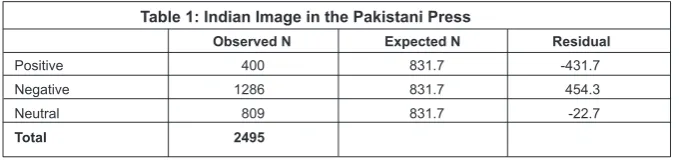
Finding-1: The number of stories that portray India as foe is 1286 (51.54%) whereas the number of stories that portray India as friend is 400 (16.0%). The difference is statistically significant (chi square test=472.868; p=0.000).
Sub Hypothesis-1: Hard and Soft news framed India more as foe rather than
friend.
Table 2: Indian Image - New Cross Tabulation
Hard Soft Total
Indian Positive 326 74 400
image
Negative 902 384 1286
Neutral 652 157 809
Total 1880 615 2495
Table 1: Indian Image in the Pakistani Press
Observed N Expected N Residual
Positive 400 831.7 -431.7
Negative 1286 831.7 454.3
Neutral 809 831.7 -22.7
Total 2495
Finding-2: The amount of hard news stories framing India as foe is 902 (70.13%) whereas the amount of soft news stories framing India as friend is 384 (29.8%) stories. Hard news genre is more inclined to frame India as foe than the soft news and the difference is statistically significant (chi-square test =38.915; p=0.000).
Hypothesis-2: Both government and private sources framed India more as foe
than friend
Finding-3:The number of private stories (1979) is greater than the number of official stories (514) in the coverage of India. Both private and government source
Table 1: Indian Image in the Pakistani Press
Observed N Expected N Residual
Positive 400 831.7 -431.7
Negative 1286 831.7 454.3
Neutral 809 831.7 -22.7
Table 2: Indian Image - New Cross Tabulation
Hard Soft Total
Indian Positive 326 74 400
image
Negative 902 384 1286
Neutral 652 157 809
Total 1880 615 2495
framed India more as foe rather than friend in print media. However, the percentage
of portraying India as foe in private source is higher than the government source.
The difference is statistically significant (chi-square test =17.581; p=0.000). Sub Hypothesis-3: The mean story length framing India as foe is greater than
India as friend.
Finding-4: The mean of stories for India as foe is 646.16 which are greater than the mean of stories for India as friend i.e., 481.35. The difference between the two is statistically significant.
Sub Hypothesis-4: Topics relating to Kashmir issue framed India more as foe as
compared to the topic of trade and economic cooperation.
Finding-5: Stories on Kashmir issue framed India more as foe as compared to
trade and economic cooperation stories and the difference is statistically significant.
Finding-6:The daily Nawa-i-waqt gave more coverage to India i.e., 1528 as compared to the Jang i.e., 967. The amount of news stories farming India as foe in Nawa-i-waqt is 836 (64.9%) that is greater than the amount of news in The Daily Jang i.e., 451 (30.5%). The difference between the two is statistically significant.
Discussion
The analysis of 2495 stories from the two Urdu dailies--- The Jang and the Nawa-i-Waqt--- suggests that India is framed more as foe rather than friend in the Pakistani Urdu press. Thus it supports the hypothesis-1 that the amount of news framing India as an enemy is greater than the amount of news stories framing India as friend. The reason behind this negative framing is most likely Indo-Pak long hostile relations over the region of Kashmir as a bone of contention. Hence, there is a persistent trust deficit between the two states and both have been unable to establish a reciprocally acceptable power equation in South Asia. Pakistani print media is inclined to frame India as foe because in Pakistan it is generally believed that India is
reluctant to create mutual understanding regarding peace and friendly relations. This
long hostile attitude and trust deficit has been transferred to the Pakistani press and is enormously reflected in its content. Every act on behalf of India is negatively viewed and the issue is negotiated with pessimistic approach. The issues involving Indo-Pak relationship include Kashmir, economic collaboration, peace and security, Siachen, water dispute, border, terrorism and friendly exchange remained unresolved till
present.
Hard news stories framed India more as foe rather than as friend. This finding supports the sub hypothesis-1. The amount of hard news stories framing India as foe is greater than the soft news stories. Hard news stories are based on the facts and figure by answering five W’s and the facts showed that peace process is always halted by India in the name of labeling Pakistan as a terrorist country, sponsoring terrorism in India. Another factor behind this phenomenon is that media always serves the national interests of the country and follow the policy guidelines furnished by the
Regarding the news source, both government and private sources framed India more as foe rather than friend. Private source involving correspondents, online sources, and news agencies as well as the government sources are inclined towards
factual reporting framing India as an enemy. Both the sources are vocalising the
same language towards Indian image portrayal. Pakistani press is giving space to all sources that portray India as an enemy. This finding proves sub hypothesis-2.
The mean story length of framing India as foe is greater than mean story length
of framing India as friend. Thus it supports sub hypothesis-3. The reason behind this
phenomenon seems that almost all genres of stories have framed India more as foe and a potential threat to the sovereignty of the state of Pakistan.
Kashmir is an unresolved issue in Pak-India relations and a flash point of future war between the two states. That is why Pakistani print media framed India more as foe in its coverage to Kashmir issue. So, the finding supports sub-hypothesis-4.
Coverage in the Nawa-i-Waqt tends to frame India negatively as compared to The Jang. The reason behind this phenomenon is policy differences between the two groups of publications-- The Nawa-i-waqt is following more ideological approach while The Jang belongs to more commercialised group of publications. The difference in the approaches between the two dailies is statistically significant. Thus, it supports hypothesis-2 that The Nawa-i-waqt is framing India as foe as compared
to The Jang.
Conclusion
Media always serves national interests and frames the issue according to the state policy and wishes of the people. The sincerity of the Indian government is doubtful in the eye of the Pakistani. It believes that India is just plying games with Pakistan on Kashmir issue. That is what Pakistani media did and framed India as foe in its coverage of Pak-India Composite Dialogue. The negative image building of India in the Pakistani print media can be traced in the form of social, political, cultural and economic differences that did not come into an end after partition but tensed further in the form of border, Kashmir, water and a number of other disputes. The need of hour is that India and Pakistan should bring flexibility in their stance to amicably resolve these issues by indulging in media diplomacy. The media of these two countries can play their role in the resolution of the conflict between these two countries if they make sincere efforts in this regard. It will bring hope to the millions of people of South Asia who are under the threat of nuclear war between these two countries and bring happiness and prosperity in the region.
References
Ali, S., & Khalid, S. (2008). US Mass Media and Muslim World: Portrayal of Muslim in ‘News Week’ and ‘Time’. Euro Journals Publishing Inc, vol. 21(4), 554-580. ISSN 1450-216X. www.eurojournals.com/
9 Angelica
10 Arial 6pt
Allen, B., O’Loughlin, P., Jasperson, A., & Sullivan, J. L (1994). The Media and the Gulf War: Framing, Priming, and the Spiral of Silence. Polity, vol. XXVII (2). www.uvm.edu/~dguber/POLS234/articles/ allen.pdf Retrieved on 4th April, 2011
Brewer, P. R. Graf, J., & Willnat, L. (2003). Priming or Framing: Media Influence on Attitudes toward Foreign
Countries. Gazette: International Journal of Communication Studies-Sage Publications, London, vol.
65 (6), 493-508, 0016-5492(200312). ics.leeds.ac.uk/papers/pmt/exhibits/1813/mediaforeign.pdf Retrieved on 6th April, 2011.
Entman, R. M. (1993). Framing: Toward Clarification of a Fractured Paradigm Journal of Communication.
43(4), pp52-57. 0021-9916www.unc.edu/~fbaum/teaching/.../J-Communication-1993-Entman.pdf Retrieved on 4th April, 2011.
Giles, D. (2008). Media Framing Analysis. Media Psychology Review, vol. 1(1) http://mprcenter.org/mpr/ index.php?option=com_content&view=article&id=185&Itemid=116 Retrieved on 4th April, 2011. Greensboro Truth and Reconciliation Commission (2005). Reporting the Story: Media Portrayals and Public
Opinion- Greensboro Truth and Reconciliation Commission Final Report, 149-165. www.ictj.org/static/ GTRC.FinalReport/13.post1979.media.eng.pdf Retrieved on 7th April, 2011.
Harmon, M., & Muenchen, R. (2009). Semantic Framing in the Build-up to the Iraq War: fox CNN and other US, broadcast news program, 12-26.
Jafri, G. J. (1998). The Portrayal of Muslim Women in Canadian Mainstream Media: A Community-Based Analysis. Afghan’s Women Organisation, 1-50. www.education- medias.ca/.../Portrayal-of-Muslim-Women-in-Mainstream- Media-Report-pdf.pdf Retrieved on 14th April, 2011.
Joshi, U., Pahad, A., & Maniar, A. (2006). Images of Women in Print Media
Khan, M. A., & Shakir, S. (2009). A Comparative Study of Editorial Treatment on Indo-Pak Conflicts in the
Dailies Dawn and the Nation: A War & Peace Journalism Perspective. European Journal of Social Sciences, vol. 19 (2), 320-330. www.eurojournals.com/EJSS_19_2_15.pdf Retrieved on 20th April, 2011.
Lockyer, A. (2003). The Relationship between the Media and Terrorism. The Australian National University. rspas.anu.edu.au/papers/sdsc/viewpoint/paper_030818.pdf Retrieved on 25th April, 2011.
Munil, S. D. (2008). India-Pakistan Composite Dialogue: Towards A “Grand Reconciliation”? Institute of South Asian Studies (ISAS), National University of Singapore. www.isas.nus.edu.sg. Retrieved on April 17, 2011.
Nawaz, M., Yaser, N., & Riaz, S. (2009). Treatment of Iran-Us Stand off by the Pakistan English Press. Global Media Journal Allama Iqbal Open University, Islamabad, vol. II (II). ISSN 2070-2469. http://www.aiou. edu.pk/gmj/TREATMENT%20OF%20IRAN- US%20STAND7.asp Retrieved on 17th April, 2011. Porte, T. L., & Azpiroz, M. L. (2009). Framing the “Clash of Civilization” in Europe: Interaction between
political and media frames. Journal Media and Communication Studies, vol. 1(1), 011-022. www. academicjournals.org/jmcs/PDF/pdf2009/Jun/La%20Porte.pdf Retrieved on 24th April, 2011. Press Trust of India, (2011). Srinagar, Monday, 12 Safar 1432 Ah ; 17 January 2011 CE, http://www.
greaterkashmir.com/news/2011/Jan/17/pakistan-seeks-full-resumption-of-composite-dialogue-51.asp Retrieved on 24th April, 2011.
Rabinowitz, A. (2010).Media Framing and Political Advertising in the Patients’ Bill of Rights Debat. Journal
of Health Politics, Policy and Law, 35 (5), 771-795. DOI:10.1215/03616878-2010-027. http://jhppl. dukejournals.org/cgi/content/abstract/35/5/771 Retrieved on 26th April, 2011.
Ryan, M. (2004). Framing the War against Terrorism: US Newspaper Editorials and Military Action in Afghanistan. International Journal for Communication Studies, London, vol. 66 (5), 363–382. DOI:10.1177/016549204045918.www.promusica.se/Library/Electronic%20texts/Ryan2004.pdf Retrieved on 14th April, 2011.
Saleem, N. (2005). U.S. Media Framing of Foreign Countries Image: An Analytical Perspective. Canadian
Journal of Media Studies, vol. 2 (1), 130-162. cjms.fims.uwo.ca/issues/02-01/saleem.pdf Retrieved on
12th April, 2011.
Scheufele, D. A., & Tewksbury, D. (2007). Framing, Agenda Setting, and Priming: The Evolution of Three Media Effects Models. Journal of Communication, vol. 57, 9–20, ISSN 0021-9916. http://docs.google. com/viewer?a=v&q=cache:wecOPP_OgTUJ:www.scienzepolitiche.unimi.it/files/_ITA_/COM/3-Framing-AgendaSetting.pdf+17.+Scheufele,+D.A.,+%26+Tewksbury,+D.+(2007 Retrieved on 7th April, 2011.
Shah, D., Watts, M. D., Domke, D., & Fan, D. (2002). News Framing and Cueing of Issue Regimes. Explaining Clinton’ Public Approval in spite of Scandal. Public Opinion Quarterly, 66, 339–370. http://poq. oxfordjournals.org/content/66/3/339.abstract. Retrieved on 11th April, 2011.
Farish Ullah Yousafzai is Dean of Faculty of Arts at University of Gujrat, Pakistan. He holds a PhD degree in Health Communication from Karachi University, Pakistan. He has contributed a number of research articles in national and international journals in the area of development communication.
Kasim Sharif Lecturer at the Department of Communication and Media Studies, Fatima Jinnah Women University, Rawalpindi, Pakistan. He holds an MS degree in Media and Communication from International Islamic University, Islamabad, Pakistan. His areas of research are peace journalism, media ethics, international communication and environmental journalism.
Vreese, C. H. (2005). News Framing: Theory and Typology. Information Design News Framing:Theory and typology Journal - Document Design. John Benjamins Publishing Company, 13 (1), 51–62. www.jcmcr.
com/upload/Studies_file/1233468300.pdf Retrieved on 3rd April, 2011.
Zehra, Nasim. (2004). Role of the Media in Conflict Resolution. Islamabad Policy Research Institute, 166-173. http://ipripak.org/books/conflict.shtml. Retrieved on 30th April, 2011.
Table 1: Indian Image in the Pakistani Press
Observed N Expected N Residual
Positive 400 831.7 -431.7
Negative 1286 831.7 454.3
Neutral 809 831.7 -22.7