49 | http://mojes.um.edu.my/ EISSN: 2289-3024
MALAYSIAN ONLINE JOURNAL OF EDUCATIONAL SCIENCES
JULY 2018, 6 (3)INTRODUCTION
Teacher and teacher training which are the most important elements of education have been one of the most important issues of the education system. This is because the success of the education system largely is directly affected by the features of the teachers who will have great knowledge and put it into practice. The training of high-quality teachers also depends on a quality education system that raises the living standards of its citizens. The main determinants of the quality of an education system of a country are the teachers who are practitioners of the system (Şanal & Özen, 2018). The fact that no training model can serve above the quality of the human resource that will run that model makes the training process of teachers a key process for the quality of educational activities at schools (Ataç, 2003).
When the history of teacher training system in Turkey is examined, the most striking improvement came as the result of the foundation of "Darülmuallimin" in 1848 that aimed to train teachers for THE VALIDITY AND RELIABILITY STUDIES OF THE SCALE ATTITUDE TOWARD PEDAGOGICAL
TEACHER TRAINING PROGRAMME
*Şenol Orakcı Çetin Toraman Ministry of National Education
Ankara, Turkey *[email protected]
ABSTRACT
The goal of the study is to develop a scale of “Attitude toward Pedagogical Teacher Training Programme” (APTT) for finding out faculty members’ attitudes toward pedagogical teacher training programme. Two study groups (“Exploratory Factor Analysis and Reliability Group” and “Confirmatory Factor Analysis Group”) were employed to develop the scale. The main aim of “Exploratory Factor Analysis and Reliability Group” that consisted of faculty members is to determine the technical properties especially the construct validity and reliability of APPT scale. The aim of “Confirmatory Factor Analysis Group” that consisted of faculty members is to determine whether the factor structure acquired by APTT was confirmed or not. At the end of the analyses, it has been found that 14 items in the scale grouped under one factor. The study shows that “Attitude toward Pedagogical Teacher Training Programme (APTT)” is a valid and reliable tool. Using APTT with other data collection instruments about pedagogical teacher training and comparing the attitudes of faculty members with the attitudes of students toward pedagogical teacher training will be beneficial. The final form of the scale measures to which degree Pedagogical Teacher Training Programme is necessary and valuable for the teaching profession.
50 | http://mojes.um.edu.my/ EISSN: 2289-3024
MALAYSIAN ONLINE JOURNAL OF EDUCATIONAL SCIENCES
JULY 2018, 6 (3)“rüştiye” (Ottoman junior high school). When considered this year, the teacher training system in Turkey has a history of 150 years (Aydın, 1998). When teacher training institutions of the Republican era are examined, it is seen that the task of educating teachers to different stages of the formal education has been carried out by education institutions of different types and levels.
In fact, Turkey has attempted to improve the quality of future educators for decades. For this purpose, different policies have been realized and practiced to train teachers at different school levels in Turkey. These policies brought with them an extensive wide range of teacher training practices. They were, “Village teachers (1940-1954)” that trained students and taught modern agricultural methods to the villagers after they were trained for two years of education after primary school, “Reserve officer teachers (1960-1963)” that were trained in summer months through short courses to serve as a village teacher when village teachers were discharged, “Substitute teachers (1961)” that are employed in place of absent teachers for a small fee, “Peace volunteers (1962-1969)” that were composed of American experts came to Turkey in 1962 and taught English until 1970, “Soldier teachers (1987-…)” whose jobs are teaching profession and work as a teacher to complete their compulsory military service as a teacher after having completed basic military training for a short time, “Correspondence teachers training (1974)” that aimed to offer higher education to high school graduates by making it possible for them to be a teacher during 15 weeks in three years, “Accelerated education (1975-1980)” by which that teachers were trained through 3 month long and “Pedagogical Formation (1970-…)”. From time to time, these training practices were also applied in Turkey to reduce the lack of teachers as soon as possible in different periods (Akyüz, 2013; Çelebi, 2014).
Looking at the teacher training programs in today’s Turkey, two types of systems are dominant. According to the legal arrangements made by “The Council of Higher Education” (YÖK) in 2010, students who graduated from faculties of education have the right to work as a teacher. Undergraduate students who graduated from certain departments and successfully completed pedagogical formation education have the right to work as teachers as well (YÖK, 2015).
Among these teacher training practices, the Pedagogical Formation Certificate Program that involves teaching pedagogy for the ones that have field education about how to teach their field was established in 1970 and ended in 1998 (Akyüz, 2004; Baki, 2009). It has been begun again partially in 2001, but entirely begun in 2010 (Azar, 2011; Bilir, 2011). The aim of the program is to provide undergraduates with teaching competency. From this point forward, formation programs began to have a great importance in teacher training (Akdemir, 2013; Bikmaz, 2015).
In fact, students attending the Pedagogical Formation Certificate Program in Turkey are the ones that did not choose teaching as a first profession and then decided to be a teacher for various reasons. “Pedagogical Formation Certificate Programs” go on in Turkish universities where YÖK has approved the opening and later determines the content of the program. Students attending Pedagogical Formation Certificate Program take courses that are in parallel to courses in education faculty programmes. These courses are composed of both theoretical and applied courses. “Introduction to Education”, “Instructional Principles and Methods”, “Measurement and Evaluation in Education”, “Educational Psychology” and “Classroom Management” are core theoretical courses while “Special Teaching Methods”, “Instructional Technologies and Material Design” and “Teaching Practice” are core applied courses and the programme includes some elective courses. The programme lasts almost a year consisting of two academic semesters or at least seven weeks zip programmes with 25 credits (YÖK, 2015).
51 | http://mojes.um.edu.my/ EISSN: 2289-3024
MALAYSIAN ONLINE JOURNAL OF EDUCATIONAL SCIENCES
JULY 2018, 6 (3)profession, which is of great importance in terms of developing positive attitudes and qualified teacher training (Temizkan, 2008). Faculty members’ attitudes toward the Pedagogical Formation Certificate Programs are also important because they train future educators.
Reviewing the studies in the field, it is obvious that in studies conducted towards the Pedagogical Formation Certificate Program, mostly, teacher candidates’ attitudes toward the “Pedagogical Formation Certificate Program” are analysed (Şenel, 1999; Eraslan & Çakıcı, 2011; Şen & Göğüş, 2011; Özkan, 2012; Dündar & Karaca, 2013; Polat, 2013; Yapıcı & Yapıcı, 2013; Altınkurt, Yılmaz & Erol, 2014; Aykaç, Bilgin, & Toraman, 2015; Önder & Tagay, 2015; Aydin & Aslan, 2016; Taşpınar, Ünal, & Aydin, 2016; Ulubey, Aydin, & Toraman, 2016). In some of these studies, the conclusion reached is that student teachers attending the Pedagogical Formation Certificate Program developed positive attitudes towards the profession of teaching (Eraslan & Çakıcı, 2011; Dündar & Karaca, 2013; Altınkurt et al., 2014; Aykaç et al., 2015) while Yapıcı & Yapıcı (2013) and Taşpınar et al. (2016) in their studies found out that student teachers produced more negative metaphors towards teacher concepts. However, research on attitudes of the Faculty Members who lecture within the Pedagogical Formation Training Certification Program towards the programme is limited. Therefore, this study is important in terms of determining the attitudes of faculty members towards the Pedagogical Formation Certificate Programs.
THE PURPOSE OF THE RESEARCH
In this study, its aim was to develop a scale of “Attitude toward Pedagogical Teacher Training” (APTT) that determines the faculty members’ attitudes toward Pedagogical Formation Certificate Program including the psychometric properties (validity and reliability) of the scale. In keeping with this aim, there was an attempt to find out a) the “Exploratory and Confirmatory Factor Analysis” results of “Attitude toward Pedagogical Teacher Training” scale (APTT) and b) the reliability test results of “Attitude toward Pedagogical Teacher Training” scale (APTT).
METHODOLOGY
The aim was to develop a scale for finding out faculty members’ attitudes toward “Pedagogical Teacher Training”. Researchers also investigate how to develop it and describe the psychometric properties (validity-reliability) of this scale.
Participants
The scale development group of this research is composed of two groups. There are different explanations about the sample size for scale development in the literature review. For example, there should be at least 10 cases for each item in the instrument being used Marascuilor & Levin (1983) as cited in Velicer & Fava (1998) the subjects-to-variables ratio should be no lower than 5 as mentioned by Gorsuch (1983) as cited in MacCallum, Widaman, Zhang & Hong (1999) and Hutcheson and Sofroniou (1999) who recommends at least 150 - 300 cases, more toward the 150 end when there are a few highly correlated variables, as would be the case when collapsing highly multicollinear variables. In this study, the sample size for both groups (“Exploratory Factor Analysis and Reliability Group”, “Confirmatory Factor Analysis”) was reached as much as possible by taking into account the literature review above.
Group 1
The main aim of “Exploratory Factor Analysis and Reliability Group” that consisted of 196 faculty members who work at universities in different cities of Turkey was to find out the construct validity and reliability of APPT scale.
52 | http://mojes.um.edu.my/ EISSN: 2289-3024
MALAYSIAN ONLINE JOURNAL OF EDUCATIONAL SCIENCES
JULY 2018, 6 (3)11-20 years, 52 for 21-30 years, and 4 for 31 years and above. Different departments were represented in the sample: “Educational Administration and Supervision (14)”, “Curriculum and Instruction (46)”, “Educational Psychology (4)”, “Guidance and psychological counselling (11)”, “Educational Measurement and Evaluation (6)”, “Primary Education (28)”, “Special education (31)”, “Science Education (15)”, “Social Sciences Education (11)”, “Fine Arts Education (5)”, “Mathematics education (2)”, other departments (23).
Faculty members’ philosophy of doctor are as followed: faculty members from faculty of arts and sciences (29) (e.g. faculty members in fields such as physics, chemistry, literature, history and so on), field educational sciences (73) (e.g. faculty members in fields such as physics, chemistry, literature, history teaching and so on), educational sciences (94), faculty members that train candidate teachers through pedagogical teacher training education (183), and faculty members that did not train candidate teachers through pedagogical teacher training education (13).
Group 2
This group was used to discover if the factor structure acquired by APTT as a result of “Confirmatory Factor Analysis” was confirmed. The participants of this group were the faculty members that work at universities in different cities of Turkey. This group was composed of 154 faculty members.
Of all faculty members, 71 were female and 83 were male. Faculty members from different status were represented in the sample: “Professor (26)”, “Associate Professor (22)”, “Assistant Professor (83)”, “Research Assistants (15)”, “Teaching Assistant (5)”, and “Instructors (3)”. As for the service period of the faculty members, 61 of them have been working in their institutes for 1-10 years, 48 people for 11-20 years, 41 people for 21-30 years, and 4 members who worked for 31 years and above. Different departments were represented in the sample: “Educational Administration and Supervision (14)”, “Curriculum and Instruction (32)”, “Guidance and Psychological Counselling (11)”, “Primary Education (31)”, “Special education (11)”, “Science Education (17)”, “Social Sciences Education (11)”, “Fine Arts Education (5)”, other departments (22).
Faculty members’ philosophy of doctor are as follows: faculty members from faculty of arts and sciences (25) (e.g. faculty members in fields such as physics, chemistry, literature, history and so on), field educational sciences (65) (e.g. faculty members in fields such as physics, chemistry, literature, history teaching and so on), educational sciences (64), faculty members that train candidate teachers through pedagogical teacher training education (141), and faculty members that did not train candidate teachers through pedagogical teacher training education (13).
Scale Development Process
In this study, the steps of the scale development have been followed in the literature of Crocker and Algina (1986), Cohen and Swerdlik (2013), and DeVellis (2014). In this study, scale development steps listed below are as follows: Determining the target audience (faculty members) and objective of the scale (determining faculty members’ attitudes toward pedagogical teacher training programme); Specifying the nature and scope of the features (attitude) intended to be specified in the scale; Writing test items for these features; Revision of the items and turning them into a form; Determining how to score the items and how to analyse the data; Doing a trial application; Determining how to score and analyse the items; Presentation of the real scale based on the results acquired.
Data Collection Instrument
53 | http://mojes.um.edu.my/ EISSN: 2289-3024
MALAYSIAN ONLINE JOURNAL OF EDUCATIONAL SCIENCES
JULY 2018, 6 (3)scale is 70, while the lowest score is 14. Items 1, 2, 3 and 9 on the scale are scored by coding reversely. These items confirm that undergraduate students other than education faculties receive pedagogical teacher training. The left items of the scale show that Pedagogical Formation Certificate Program is inappropriate and undergraduate students from only education faculties should become a teacher. When items 1, 2, 3 and 9 on the scale are scored reversely, all the items of the scale show a congruity. Obtaining high score from the scale demonstrates that there is a negative attitude toward pedagogical teacher training program and this program should not be offered because of its creating a feeling of unfairness for the graduate students from faculty of education. Obtaining low score from the scale demonstrates that there is a positive attitude toward Pedagogical Formation Certificate Program.
Analysis of Data
The data acquired from the study were analysed using statistical software. In order to calculate the validity and reliability of APTT, “Kaiser–Meyer–Olkin (KMO) test”, “Bartlett Sphericity test”, “Varimax Rotation”, “Anti-Image Correlation”, “Cronbach Alpha Coefficient”, and “Confirmatory Factor Analysis” procedures were realized (Büyüköztürk, 2013; Özdamar, 2013).
FINDINGS
Psychometric properties of APTT (validity and reliability)
54 | http://mojes.um.edu.my/ EISSN: 2289-3024
MALAYSIAN ONLINE JOURNAL OF EDUCATIONAL SCIENCES
JULY 2018, 6 (3)Table 1
Exploratory Factor Analysis and the results of Reliability Analysis
Number of
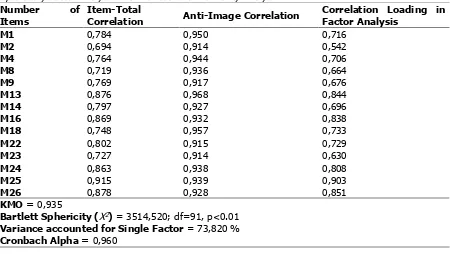
Items Item-Total Correlation Anti-Image Correlation Correlation Loading in Factor Analysis M1 0,784 0,950 0,716
M2 0,694 0,914 0,542 M4 0,764 0,944 0,706 M8 0,719 0,936 0,664 M9 0,769 0,917 0,676 M13 0,876 0,968 0,844 M14 0,797 0,927 0,696 M16 0,869 0,932 0,838 M18 0,748 0,957 0,733 M22 0,802 0,915 0,729 M23 0,727 0,914 0,630 M24 0,863 0,938 0,808 M25 0,915 0,939 0,903 M26 0,878 0,928 0,851 KMO = 0,935
Bartlett Sphericity (X2) = 3514,520; df=91, p<0.01
Variance accounted for Single Factor = 73,820 % Cronbach Alpha = 0,960
The construct validity of APTT was identified with the help of principal component analysis. This analysis is also composed of “Kaiser Meyer Olkin (KMO)” and “Bartlett Test”, which were conducted to make sure that the assumptions of principal components analysis were met by the data set. As seen in Table 1 above, “KMO” value was found to be 0.935. This value should be over 0.50 at a minimum. The acquired “KMO” value shows that the data set is suitable for analysis. The “Bartlett Test” result was [X2=3514, 520; df=91 (p<0.01)]. The meaningful value was found lower than 0.05. In other words, it
means that factor analysis can be realized.
55 | http://mojes.um.edu.my/ EISSN: 2289-3024
MALAYSIAN ONLINE JOURNAL OF EDUCATIONAL SCIENCES
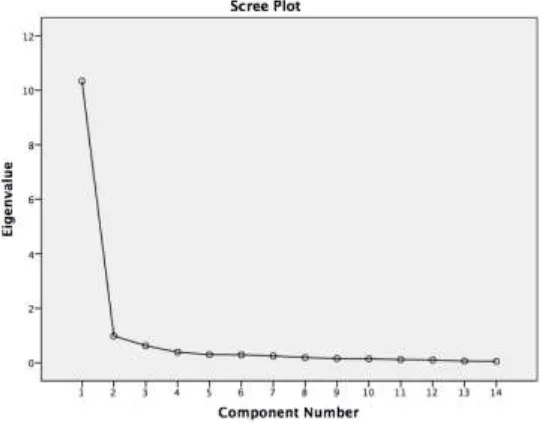
JULY 2018, 6 (3)Figure 1. Scree plot of APTT. This figure verifies that the scale is composed of a single dimension.
As a result of the items extracted from the scale, the remaining 14 items were grouped under a single dimension. The numbers left (1, 2, 4, 8, 9, 13, 14, 16, 18, 22, 23, 24, 25 and 26) were renumbered as (1, 2, 3, 4, 5, 6, 7, 8, 9, 10, 11, 12, 13 and 14). The final form of APPT scale tests the attitude of faculty members toward pedagogical teacher training program. “Tukey Nonadditivity test” was conducted whether or not the scale is collectable. The results were given in Table 2.
Table 2
Cronbach’s Alpha and Additivity Test Results for APTT Cronbach
Alpha Variance Root Sum of Squares Mean of Squares F df p
0,960 Nonadditivity 0,227 0,227 0,412 1 0,521
Table 2 above shows that the reliability value of the scale is 0,960. In view of scales, 0.70 and higher values of “Cronbach’s Alpha coefficient” indicate high reliability (Özdamar, 2013). This factor shows high reliability level and is also additive in view of scoring (Tukey Nonadditivity p>.05).
56 | http://mojes.um.edu.my/ EISSN: 2289-3024
MALAYSIAN ONLINE JOURNAL OF EDUCATIONAL SCIENCES
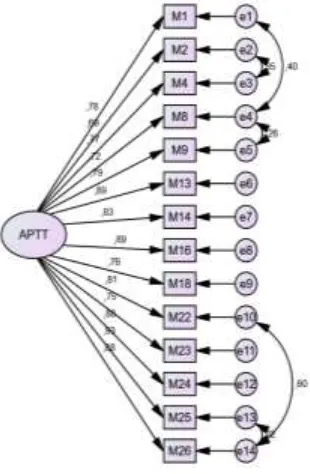
JULY 2018, 6 (3)Figure 2. APTT Confirmatory Factor Analysis Model (Standardized Values)
As is seen in Figure 2 above, the values of Chi-square and degree of freedom acquired from “Confirmatory Factor Analysis (CFA)” were χ2 = 112,08, (df=53, p<.01), and χ2/sd = 2,11 value was obtained. That the value acquired from the selected samples is less than 3 shows a perfect match (Joreskog & Sorbom, 1993; Sumer, 2000; Kline, 2005). Therefore, it may be said that the match between the data set and the model acquired in CFA is perfect. The other goodness of fit values acquired from CFA are given in Table 3.
Table 3
Fit indexes acquired from CFA
χ2 sd χ2/sd RMSEA AGFI RMR CFI
111,07 53 2,09 0,056 0,930 0,060 0,94
Table 3 above shows that “RMSEA” value is 0.056 and it is at an acceptable level as “RMSEA” value between 0 and 0.05 shows ideal consistency level. That the “AGFI” value is over 0.80 and the “RMR” value is below can be considered acceptable for consistency with authentic data (Anderson & Gerbing, 1984; Marsh, Balla, & McDonald, 1988). Table 3 above shows that “AGFI” value is 0.930 and “RMR” value is 0.060. In view of these values, it may be said that they are at an acceptable level.
According to the results of “Confirmatory Factor Analyses” explained above, it may be said that one-component structure of APTT was confirmed.
DISCUSSION
57 | http://mojes.um.edu.my/ EISSN: 2289-3024
MALAYSIAN ONLINE JOURNAL OF EDUCATIONAL SCIENCES
JULY 2018, 6 (3)promised undergraduate students other than the graduates from the faculty of education to become a teacher through pedagogical teacher training programmes.
Throughout the years of 2006-2010, pedagogical teacher training programmes were applied in the form of non-thesis master’s programs. Since 2010, these programmes have been given over a very short time frame just like a short course. During the early years, education faculties did not want to offer these programmes and they were applied under the control of the faculty members except the ones from education faculties.
In recent years, faculty members that work at education faculties have given up the tendency not to provide training for undergraduate students within the scope of pedagogical teacher training programme. Moreover, they have come to terms with it. Are these judgments correct or are they just speculations? The answer for it can be given through scientific researches. Above all, this requires the collection of data for it. Therefore, the study has aimed to develop a data collection instrument.
As a result of this study, the fact that the Pedagogical Formation Certificate Program allowed students who graduate from faculties other than faculties of education to become teachers through pedagogical formation is generally considered as a negative situation and some of the items in the scale show that teacher training should be done only through faculty of education. These are as follows: “If I were authorized, I would lift Pedagogical Formation Certificate Program in practice.” (item 5), “I would say that the implementation must be ended if I were asked what I thought about Pedagogical Formation Certificate Program.” (item 6) and “It is unfair that those who have Pedagogical Formation Certificate Program to become a teacher have the same rights as those from faculty of education.” (item 7). The fact that faculty members think negatively about the Pedagogical Formation Certificate Program can be resulted from the nature and importance of the teaching profession. This finding overlaps with the finding of the study by Köse (2017). Özoğlu (2010) also emphasized in his study that whether or not Pedagogical Formation Certificate Program is satisfactory for teacher competence in the education world is still main problem, which led to the belief that pedagogical formation education will not be professionally sufficient for students to be a teacher.
Teaching profession is a profession that guides societies. As Topçu (2016) said, the direction of the education and the teacher determines the direction of the society. Just as every profession requires field of specialization and duration, so does teaching profession. The way to be a teacher is to complete teacher training programs in faculty of education. Making it possible for those who graduate from faculty of arts and sciences to be a teacher may provide limited benefits for a short term. However, these limited benefits can cause key issues in the long term. Therefore, opening the way for graduates of faculties other than faculties of education to become a teacher should not be authorized and pedagogical formation programs should be lifted for a long term.
To sum up, the task of teacher training should be undertaken by faculties of education with the main aim of training teachers. Opening paths for those who want to be a teacher through pedagogical formation education programs may lead to very serious public worries about training qualified teachers as the requirement and competencies for teachers have been ignored.
CONCLUSION
58 | http://mojes.um.edu.my/ EISSN: 2289-3024
MALAYSIAN ONLINE JOURNAL OF EDUCATIONAL SCIENCES
JULY 2018, 6 (3)One-factor structure model acquired as a result of “Exploratory Factor Analysis” was also confirmed in “Confirmatory Factor Analysis”.
RECOMMENDATIONS
The scale that measures the value and necessity of Pedagogical Teacher Training Programme for the teaching profession in terms of faculty members can be used in other studies, which will enhance the validity and reliability of the scale with the help of the findings of additional studies. In review of literature, there have been studies that aim to determine the attitudes of students receiving “Pedagogical Teacher Training” (Aydin & Aslan, 2016). There have also been studies that collect data using a scale (Ulubey et al., 2016). Using APTT with other data collection instruments about pedagogical teacher training and comparing the attitudes of faculty members with the attitudes of students toward pedagogical teacher training will make contribute to the field literature. When the applications are considered in Turkey, the belief that pedagogical teacher training programme will be applied in the future is dominant. Therefore, the studies examining the issue in detail and focusing on the role of this training on teacher training are recommended.
REFERENCES
Akdemir, A. S. (2013). Türkiye’de öğretmen yetiştirme programlarının tarihçesi ve sorunları. [A History of Teacher Training Programmes and Their Problems in Turkey]. Turkish Studies, 8(12), 15-28.
Akyüz, Y. (2004). Türk Eğitim Tarihi [History of Turkish Education] (9th ed.).Turkey: PegemA.
Akyüz, Y. (2013). Türk Eğitim Tarihi (M.Ö. 1000 - M.S. 2013). [History of Turkish Education (1000 BC - 2013)]. Turkey: PegemA.
Altınkurt, Y., Yılmaz, K., & Erol, E. (2014). Pedagojik formasyon programı öğrencilerinin öğretmenlik mesleğine yönelik motivasyonları. [The motivation of the pedagogical formation program students towards the teaching profession]. Trakya University Journal of Education, 4(1), 48-62.
Anderson, J. C., & Gerbing, D. W. (1984). The effect of sampling error on convergence, improper solutions, and goodness of fit ındices for maximum likelihood confirmatory factor analysis. Psychometrika, 49, 155-73.
Ataç, E. (2003). 21 Yüzyılda Öğretmen Eğitimi: Türkiye’de Öğretmen Eğitiminin Değerlendirilmesi. [21st
Century Teacher Education: Assessment of Teacher Education in Turkey]. Anadolu University Education Faculty, 13(2), 1-31.
Aydın, A. (1998). Eğitim Fakültelerinin Yeniden Yapılandırılması ve Öğretmen Yetiştirme Sorunu. [Restructuring of Education Faculties and Problem of Teacher Training]. Educational Management in Theory and Practice, 15, 275-286.
Aydin, H., & Aslan, D. (2016). Determining Attitudes towards Pedagogical Teacher Training: A Scale Development Study. Journal of Education and Learning, 5(3), 1-9.
Aykaç, N., Bilgin, H., & Toraman, Ç. (2015). Pedagojik formasyon programının öğretmen adaylarının görüşlerine göre değerlendirilmesi [Evaluation of pedagogical formation program based on the opinions of pre-service teachers]. Journal of Educational Sciences Research, 5(1), 127-148. Azar, A. (2011). Türkiye’deki öğretmen eğitimi üzerine bir söylem: Nitelik mi, nicelik mi? [A discourse
on teacher education in Turkey: Nature, is the quantity?] Journal of Higher Education and Science, 1(1), 36-38.
Baki, A. (2009). Evaluation of The Teacher Training Teaching Profession. Kastamonu Eğitim Dergisi, Programs and Policies in Turkey. Paper presented at the National Symposium on Teacher Education Impasse in Turkey (pp. 56-65). Turkey: Teacher Hüseyin Hüsnü Tekışık Education Research and Development Foundation.
59 | http://mojes.um.edu.my/ EISSN: 2289-3024
MALAYSIAN ONLINE JOURNAL OF EDUCATIONAL SCIENCES
JULY 2018, 6 (3)Bilir, A. (2011). Türkiye’de öğretmen yetiştirmenin tarihsel evrimi ve istihdam politikaları. [The historical evolution of teacher training and employment policies in Turkey]. Ankara University Journal of Education Sciences Faculty, 44(2), 223-246.
Büyüköztürk, Ş. (2013). Sosyal bilimler için veri analizi el kitabı. [Manual of data analysis for social sciences]. Turkey: Pegem.
Çelebi, N. (2014). Eğitim Bilimine Giriş. [Introduction to Educational Science]. A. Bakioğlu (Ed.). Turkey: Nobel.
Cohen, R. J., & Swerdlik, M. E. (2013). Psychological testing and assessment, an introduction of test and measurement. E. Tavşancıl (Ed.). Turkey: Nobel.
Crocker, L., & Algina, J. (1986). Introduction to classical and modern test theory. USA: CBS College Publishing Company.
DeVellis, R. F. (2014). Ölçek geliştirme, kuram ve uygulamalar. [Scale development, theory and applications]. T. Totan (Ed.). Turkey: Nobel.
Dündar, H., & Karaca, E. T. (2013). Formasyon öğrencilerinin pedagojik formasyon programı’na ilişkin sahip oldukları metaforlar. Journal of Industrial Art Education of Gazi University, 30, 19-34. Eraslan, L., & Çakıcı, D. (2011). Pedagojik formasyon programı öğrencilerinin öğretmenlik mesleğine
yönelik tutumları. [The attitudes of the pedagogical formation program students towards the teaching profession]. Journal of Education Faculty of Kastamonu, 19(2), 427-438.
Hutcheson, G., & Sofroniou, N. (1999). The Multivariate Social Scientist: Introductory Statistics Using Generalized Linear Models. CA: Sage.
Köse, A. (2017). Pedagojik formasyon eğitiminde görevli akademisyenlere göre pedagojik formasyon uygulaması: Sorunlar, Çözüm Önerileri. [Pedagogical formation according to academicians in pedagogical formation training: Problems, Solution Proposals]. Ahi Evran University Kırşehir Education Faculty, 18(2), 709-732.
MacCallum, R. C., Widaman, K. F., Zhang, S., & Hong, S. (1999). Sample size in factor analysis. Psychological Methods, 4, 84-99.
Marsh, H. W., Balla, J. R., & McDonald, R. P. (1988). Goodness-of-fit indices in confirmatory factor analysis: the effect of sample size. Psychological Bulletin, 103(3), 391-410.
Orakcı, Ş. (2015). Şangay, Hong Kong, Singapur, Japonya ve Güney Kore’nin Öğretmen Yetiştirme Sistemlerinin İncelenmesi. [Review of Teacher Training Systems in Shanghai, Hong Kong, Singapore, Japan and South Korea]. Asian Journal of Instruction, 3(2), 26-43.
Önder, E., & Tagay, Ö. (2015). Opinions of students participating in the pedagogical formation certificate program with regard to the profession and the program. International Journal of Human Sciences, 12(1), 293-314.
Özdamar, K. (2013). Paket programlar ile istatistiksel veri analizi. [Statistical data analysis with packet programs] (9th ed.). Eskişehir: Nisan Kitabevi.
Özen, F. (2017). Sınıf öğretmenlerinin ve öğrenci sınıf öğretmenlerinin zamanla öğretmenlik meslek etiği algılarındaki değişme. [Change in the Perception of Teaching Profession Ethics by Primary School Teachers and Student Primary School Teachers Over Time]. OPUS – Uluslararası Toplum Araştırmaları Dergisi, 7(13), 379-397. Doi: 10.26466/opus.331158.
Özkan, H. H. (2012). Öğretmenlik formasyon programındaki öğretmen adaylarının öğretmenlik
mesleğine ilişkin tutumlarının incelenmesi (SDÜ örneği). [Examination of the attitudes of
prospective teachers in the teaching formation program to the teaching profession (SDU example)]. Journal of Ahi Evran University Education Faculty, 13(2), 29-48.
Özoğlu, M. (2010). Türkiye’de öğretmen yetiştirme sisteminin sorunları. Seta Analiz, Sayı:17. [The problems of teacher training system in Turkey. Seta Analysis Number: 17].
Polat, S. (2013). Pedagojik formasyon sertifika programı ve eğitim fakültesi öğrencilerinin öğretmenlik mesleğine yönelik tutumlarının incelenmesi. [A review of the pedagogical formation certification program and attitudes of education faculty students towards the teaching profession]. International Journal of Educational Research,4(2), 48-60.
Taşpınar, Ş. Z., Ünal, H., & Aydin, H. (2016). Using Metaphors to Investigate Preservice Secondary Mathematics Teachers’ Perceptions of Mathematics and Mathematics Teacher Concepts. Anthropologist, 23, 291-302.
60 | http://mojes.um.edu.my/ EISSN: 2289-3024
MALAYSIAN ONLINE JOURNAL OF EDUCATIONAL SCIENCES
JULY 2018, 6 (3)Şanal, M., & Özen, F. (2018). The quest for quality in teacher education in Turkey: The abrogation of teacher programs from secondary education. European Journal of Educational Research, 7(3). Şen, Z., & Göğüş, N. (2011, October 05-08). Pedagojik formasyon sertifika programı katılımcıları ile
eğitim fakültesi öğrencilerinin öğretmenlik mesleğine ilişkin tutumlarının karşılaştırılması. [Comparisons of pedagogical formation certification program participants and attitudes of education faculty students to the teaching profession]. Paper presented at First International
Congress of Education in Curriculum and Instruction. Retrieved from
http://inccui.anadolu.edu.tr/eng/pdf/Bildiriprogram-kitabi.pdf
Şenel, A. (1999). Öğretmenlik sertifikası programına katılan öğretmen adaylarının öğretmenlik mesleğine yönelik tutumlarına öğretmenlik uygulamalarının etkisi. [The effect of teaching practices on the attitudes of prospective teachers attending the teaching certificate program towards the teaching profession]. (Unpublished Master Dissertation). Eskişehir: Anadolu University. Temizkan, M. (2008). Türkçe öğretmeni adaylarının öğretmenlik mesleğine yönelik tutumları üzerine bir
araştırma. [A survey on the attitudes of the Turkish teacher candidates towards the teaching profession]. Journal of Turkish Educational Sciences, 6(3), 461-486.
Ulubey, O., Aydin, H., & Toraman, C. (2016). Determining to Which Degree Pedagogical eacher Training Serves the Teaching Profession: A Scale Development Study, International Online Journal of Educational Science, 8(1), 56-73.
Velicer, W. F., & Fava, J. L. (1998). Effects of variable and subject sampling on factor pattern recovery. Psychological Methods, 3, 231-251.
61 | http://mojes.um.edu.my/ EISSN: 2289-3024
MALAYSIAN ONLINE JOURNAL OF EDUCATIONAL SCIENCES
JULY 2018, 6 (3)The Scale of Attitude toward Pedagogical Teacher Training Programme (APTT)
Dear participant,
This scale was prepared to determine aims to develop a scale of “Attitude toward Pedagogical Teacher Training” (APTT) that determines the faculty members’ attitudes toward Pedagogical Formation Certificate Program.
You are expected to read each statement (item) in the scale and depending on how much you agree with it you are expected to mark an appropriate choice for you (“Disagree Strongly”, “Disagree Slightly”, “Agree”, “Agree”, “Agree Strongly”) with an X. The data collected will only be used for a scientific study. It is important to openly express your opinions for the reliability of the study. Therefore do not write your name on the scale.
Order Statements
Dis
agre
e
S
tron
gl
y
Dis
agre
e
S
lig
ht
ly A
gre
e
Agre
e
Agre
e
S
tron
gl
y
1 Pedagogical formation training is the right of every undergraduate. ① ② ③ ④ ⑤
2 That fact that pedagogical formation training has a wider audience makes me happy. ① ② ③ ④ ⑤
3 If I have the authority, I enable the pedagogical formation training to become more widespread. ① ② ③ ④ ⑤
4 Each undergraduate student can receive pedagogical formation training. ① ② ③ ④ ⑤
5 If have the authority, I abolish pedagogical formation training. ① ② ③ ④ ⑤
6 If I were asked my opinion about pedagogical formation training, I would say the application would
be finalized. ① ② ③ ④ ⑤
7 It is unfair that those who do not have aim to become teachers have the same rights as the education faculty
students. ① ② ③ ④ ⑤
8 It is unfair that every undergraduate becomes a teacher. ① ② ③ ④ ⑤
9 It is possible to internalize the teaching profession with pedagogical formation training. ① ② ③ ④ ⑤
10 Pedagogical formation training threatens the future. ① ② ③ ④ ⑤
11 I feel uncomfortable that my child will be trained by a teacher trained in pedagogical formation training in the
future. ① ② ③ ④ ⑤
12 Pedagogical formation training is unnecessary because it serves to take certificate for money. ① ② ③ ④ ⑤
13 Education faculty students feel the sense of injustice about pedagogical formation training. ① ② ③ ④ ⑤