INTRODUCTION
The use of paper electrophoresis for the study of metal complex system seems to be well established1-5. The present work is an extension of the technique. It is to be mention here that the solution electrophoresis is used for the first time in which metal ion travels in electrophoretic tube under constant potential gradient. The present paper reports some of our observation on Th (IV), Fe (III) Cr (III) and Al (III) - Methionine system at 35ºC and Ionic strength 0.1.
Theoretical
Electrophoretic technique used in these studies consists in examining the speed of metal ions in a mixture containing ligand solution under a definite potential gradient in a tube. The absorbance are recorded at different pH’s of the mixture solution. A ligand may be assumed to be poly basic acid dissociating in stages as follows :
HnL Kn Hn-1 L + H
HPL Kp HP-1 L + H
HL K1 H1 L + H
Materials Science Research india Vol. 4(1), 203-207 (2007)
Determination of stability constants of Th (IV), Fe(III), Cr(III),
Al(III) binary complexes with methionine by
solution electrophoresis
ASHISH KUMAR PANDEY and SATYENDRA SINGH*
Electrochemical Laboratory, Kashi Naresh Government Post Graduate College, Gyanpur, Sant Ravi Das Nagar, Bhadohi - 221 304 (India)
(Received: March 08, 2007; Accepted: April 27, 2007)
ABSTRACT
A method involving the use of solution electrophoresis is described for the study of equilibria in metal-ligand binary complex systems in solution. The technique is based on the migration of metal ion in solution under an electric field with the complexants added to the background electrolyte at different pH in an electrophoretic tube.
Key words : Solution electrophoresis, stability constant, methionine.
(charges have been ignored)
the concentration of protonated species HPL can be expressed as :
[HPL] = KP [HP-1L] [H] = KP. KP-1 ... K1 [L]. [H] P
= P[H] P [L] ...(1)
Where αp = K1. K2 ... KP
Total poly basic acid thus distributes it self in the form of different anionic species. The following expression holds good for the total concentration :
....(2)
In view of this expression, eq. (1) becomes,
A metal ion M may complex with any deprotonated species of acid and the reaction can be expressed as follows (Charges being ignored) :
M + HPL K1P M[HPL]
M + [HPL] + HPL K2P M [HPL]2
The concentration of a general complex species can be expressed as :
[M (HPL)x] = KXP [M (HPL)X-1] [HPL] = β X.P[HPL]X. [M]
Where as βx, p is the overall stability constant of the complex acid is given by the expression:
βxp = K1p. K2p... Kxp ... (4)
The speed of complex, under the unit potential gradient can be given by the well known equation of Jokl6.
U = Ux.p. f x.p. ... (5)
Where UX.P. is the speed and fxp is the mole fraction of the general complex M[HPL]X present in the conglomeration.
obviously,
This expression, in view of equation (3) simplifies to :
Now, equation (5) can be expressed as : . ...(6)
Yadav et al.7 have pioneered the relation between the mobility of metal ion and its concentration in the cathodic compartment, with the help of spectrometer, measuring the absorbance of the solution, before and after electrolysis. This was found experimentally that mobility of ion were reciprocally related to the difference of absorbance.
For the calculation of stability constants equation (6) can be simplified as
Where K1, K2, K3 are stability constants of complexes, expressed as :
K1 = ML/M.L K2 = ML2 / ML.L K3 = ML3 / ML2. L
The concentration of liganding species L or HL at different pH’s during process of neur tralization of background electrolyte with sodium hydroxide have been calculated with well known mathematical calculation :
Where as LT is the total concentration of amino acid existing in different stages of protonation. K1, K2 and K3 are dissociation constants of amino acids. The technique of mean mobility has been used to find out the stability constants.
Experimental
Instruments
Electrophoretic tube
A simple Electrophoretic tube, 18 cm long and of 5 mm bore with a stopper in middle and is fused perpendicularly at the ends with short wider tubes of 1.2 cm bore, arms have been utilized to insert the platinum electrodes. These electrodes are connected with an Electrophoresis voltage supply. The voltage can be varied through three different ranges viz. 0 - 100, 100 - 200, and 200 - 300 volts.
pH - Indicator and Accessories
CP901 Century digital pH - meter having glass electrode assembly and working on 220 volts / 50 cycles stabilized A.C. main was used.
Colorimeter
A colorimeter of visible range 400 - 750 nm of carlzeiss (Jena Specol) was employed.
Chemicals
treated with AR grade 1% Perchloric Acid. These were boiled on a water bath and filtered to get stock solution of the Metal Perchlorate 5.0 × 10⁻³ M (Approx)
• Stock solution of the complexing reagents Methionine were prepared by dissolving accurately weighted amounts in water. Solutions of required strengths were then prepared by suitable dilutions.
Perchloric acid as background electrolyte • A stock solution (1.0 M) was prepared by
suitable dilution of 70% Perchloric Acid. The solution was standarised by titrating a suitable volume of its dilute solution against a standard NaOH solution.
Detecting Reagent for Th (IV), Fe (III), Cr (III) and Al (III)
1-(O-arsonophenyl azo)-2- naphthol-3, 6-disulphonic acid, for Th (IV), Ammonium thio cyanate solution for Fe (III), 1, 5-diphenyl carbazide for Cr (III) and Eriochrome Cyanine R solution for Al (III) is being used as developing Regents8.
Procedure
At the outset a solution containing 1.0 × 10⁻² M and Methionine, 0.1 M Perchloric Acid solution and respective amount of metal ion solution [2.0 × 10⁻³ Th (IV), 2.0 × 10⁻³ Fe (III) or 1 × 10⁻⁴ Cr (III), and Al (III) were prepared Respectively. The pH of the solution was adjusted by adding sodium hydroxide solution. An Aliquot of 10 ml ion taken in the electrophoretic tube and then thermostated at 30ºC. After allowing electrolysis 30 minutes, the middle stopper was closed and developing the solution of anodic Compar tment by adding developers. The absorbance of the solution was taken at λmax 625 nm respectively.
The observed mobility of migrating cation was calculated by measuring the change in the absorbance of the solution contained in anodic compartment.
Firstly the absorbance taken before electrolysis (A0) and the after passing electricity for 30 minutes at potential diff 50V, the middle stopper was closed. This was At. The difference between these two give the mobility of respective Ion. Under
a potential gradient, a metal ion will more in the field, the speed and its direction depending upon the charges and size of the ion.
RESULTS AND DISCUSSION
A plot of Absorption difference against pH gives a conve with a number of plateaus (Fig. 1). The figure shows two plateau with Th (IV) Three plateau for the trivalent metal ion viz., Fe (III) Cr (III) and Al (III). The first plateau represent the region of uncomplexed metal ion while the remaining plateau indicate the formation of different complexes hence Fe (III) Cr (III) Al (III) from two complexes while one complex is formed by Th (IV). It is apparent from the present studies that only one coordinating species is assumed to have complex with tetravalent, Thorium to give a 1 : 1 cationic complex. Since the absorption difference of the second and third plateau for Fe (III) Cr (III) and Al (III) in case of Methionine lie in a positive region, a cationic nature of both 1 : 1 and 1 : 2 complexes is indicated. No change in the absorbance beyond the third plateau is evinced even at higher pH values. Thus 1:2 binary complex of Fe (III) Cr (III) and Al (III) with anionic species of the Ligand is the ultimate complex. A strong coordinating ability is attributed to anionic species of methionine in literature9-14.
In view of the above observations the complexation of metal ions with these ligands may be represented as
M + L K1 ML
ML + L K2 ML2
The metal ion is conglomeration of uncomplexed metal ions, 1 : 1 & 1 : 2 complexes. The metal ion moving under the influence of electrical field, the overall mobility is given by the equation (1).
Fig. - 1: Absorbance cuve [M-Methionine system] [ Temp-30°C, ; Ionic strength 01]
(Charges being ignored)
Whose u0 u1 and u2 are motilities of uncomplexed metal ion, 1 : 1 metal complex and 1:2 metal complex respectively. The equation has been used for the calculation of stability constants of the complexes of metal ion with anionic species of Ligands the region between the First and Second plateau is pertinent for the calculation of First stability constant K1. The overall mobility u will be
equal to the arithmetic mean of nobilities of uncomplexed metal ion u0 and that of first complex u 1 at a pH, where K1 = 1/[L] . With the help of dissociation constant of Methionine (electrophoretically obtained values K1 = 102.25 K
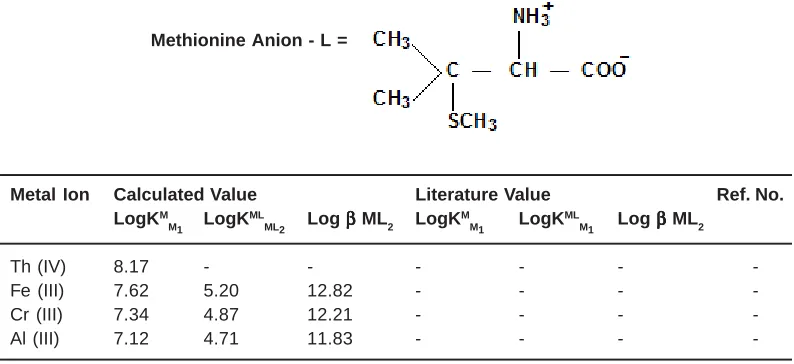
2 = 109.008,9, the concentration of complexing species [L] was determined at particular pH, from which K1 can be calculated. The stability constant K2 of second complex can be calculated by taking in to consideration the region between second and third plateau of the mobility carves. The calculated values are given in table 1.
Th(IV) - Methionine Fe(III) - Methionine
1. Singh, S., Yadav, K.L. : Annli Di Chimica, 75, 377 (1985).
2. Tiwari B.B. and Yadav, K.L. ; Trans. Saest. 25 (4), 124 (1990).
3. Tewari B.B. and Yadav, K.L. : J. Chromatogr. 542-537 (1991).
4. Tewari B.B. and Yadav, K.L. : Biomed. Chromatogr. 10 (5), 221 (1996).
5. Tewari B.B. : J. Chromatogr. 910 (1), 181 (2001).
6. Jokl, V. : J. Chromatography 14, 71, 1964. 7. Tewari B.B. and Pandey A.K. and Singh
R.K.P. : Proc. Nat. Acad. Sci. 65 (A), 35, (1995).
8. Wagner, W., Hull, C.J., and Markle, G.E. :
REFERENCES
Pandey & Singh, Mat. Sci. Res. Ind., Vol. 4(1), 203-207 (2007) 207
Advanced Analytical Chemistry Reinhold Publishing Corporation, New York (1956). 9. Walker, D.M. and Williams, R.D. : J. Chem.
Soc. Dalton, 1186 (1974).
10. Hojo, Y., Sugivra, Y. and Tankaka, H. : J. Inorg. Nucl. Chem., 38, 641 (1976).
11. Change, W.J. and Martin : J. Phys. Chem., 73, 4277 (1969).
12. Muskar, K.W. and Neagley, H.C. : Inorg. Chem., 14, 1728 (1975).
13. Murray, S.K. and Newaman, J.P. : August J. Chem. 28, 773 (1975).
14. Schugar, J.H. Thich, A.J. Ou. C., Potenza, A.J., Lalancette, A.R. and Jr. Purey, W. : J. Amer. Chem. Soc. 98, 3047 (1976). Table - 1: Stability constants of binary complexes Th (IV), Fe (III), Cr (III) and Al (III)
with Methionine (Temp - 35°C, Ionic strength = 0.1)
Metal Ion Calculated Value Literature Value Ref. No.
LogKM
M1 LogK
ML
ML2 Log βββββ ML2 LogK M
M1 LogK
ML
M1 Log βββββ ML2
Th (IV) 8.17 - - -
-Fe (III) 7.62 5.20 12.82 - - -
-Cr (III) 7.34 4.87 12.21 - - -
-Al (III) 7.12 4.71 11.83 - - -
![Fig. - 1: Absorbance cuve [M-Methionine system] [ Temp-30°C, ; Ionic strength 01]](https://thumb-us.123doks.com/thumbv2/123dok_us/9793549.1965154/4.576.92.490.105.451/fig-absorbance-cuve-m-methionine-temp-ionic-strength.webp)