Vol. 11, No. 4, 2019 Article ID IJIM-0843, 10 pages Research Article
Optimization the Availability of a System with Short Circuit and
Common Cause Failures
M. Sharifi ∗†, MR. Shahriari ‡, Sh. Khoshniat §
Received Date: 2016-12-15 Revised Date: 2019-01-31 Accepted Date: 2019-03-04
————————————————————————————————–
Abstract
Redundancy allocation problem is one of the most important problems in reliability field. In this problem, the reliability and availability of the systems are maximized via allocating redundant com-ponents to subsystems. Many different assumptions are considered to draw this problem near to real conditions. In this paper, we work on a system with k-out-o-n subsystems as well as considering short circuit and common cause failures for the components in each subs in addition to ordinary components failures. Obviously, the components are repairable. We present a Markov model to show the effects of these two failures on system availability. For solving the presented model, we used Biographic Based Optimization (BBO) algorithm and minimize the system cost to achieve the predetermined system availability. We used the BBO algorithm for calculating the availability of the system, and response surface methodology for tuning the algorithm parameters.
Keywords: Availability; Short circuit; Common cause failure; K-out-of-n; repairable; Biographic based optimization algorithm
—————————————————————————————————–
1
Introduction
R
eliability is one of the most important featuresof each system. Many researchers have tried to maximize system reliability by increasing ponents failure rates and adding redundant com-ponents to the system. RAP (Redundancy Allo-cation Problem) is a problem that increases sys-tem reliability via adding some redundantcom-∗Corresponding author. [email protected], Tel: +98(912)2825776.
†Department of Industrial & Mechanical Engineering, Qazvin Branch, Islamic Azad University, Qazvin, Iran.
‡Department of Management & Accounting, South Tehran Branch, Islamic Azad University, Tehran, Iran.
§Department of Industrial & Mechanical Engineering, Qazvin Branch, Islamic Azad University, Qazvin, Iran.
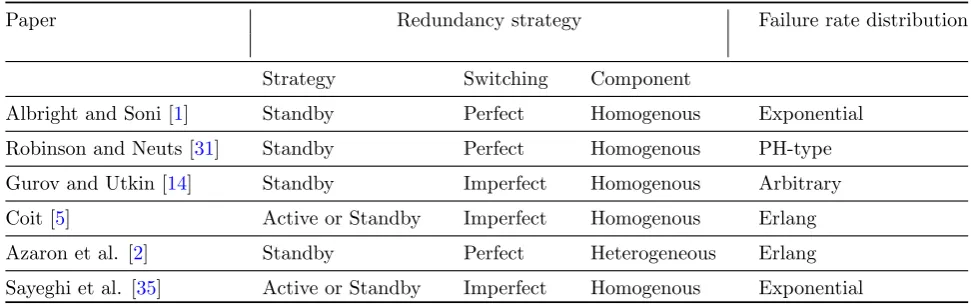
ponents to each subs. This problem has some constraints like system weight, cost, etc. In this paper we work on a system with s serially con-nected k-out-of-n subs. The components in each subs are repairable and have constant failure rate. In addition to ordinary failures, the components have two other failure modes: short circuit fail-ure and common cause failfail-ure. The major studies that have been conducted so far are summarized in Table1.
Short circuit failure for an electrical system hap-pened when a trouble haphap-pened and lets elec-tric current goes on an unwelcomed direction. CCF (Common Cause Failure) happens for more than one component at a moment. The causes of CCF are environmental factors like chang-ing electrical current. Moore and Shannon was
Table 1: Major studies on systems with standby redundancy.
Paper Redundancy strategy Failure rate distribution
Strategy Switching Component
Albright and Soni [1] Standby Perfect Homogenous Exponential Robinson and Neuts [31] Standby Perfect Homogenous PH-type Gurov and Utkin [14] Standby Imperfect Homogenous Arbitrary Coit [5] Active or Standby Imperfect Homogenous Erlang Azaron et al. [2] Standby Perfect Heterogeneous Erlang Sayeghi et al. [35] Active or Standby Imperfect Homogenous Exponential
first studied CCF for three state components; two failure modes and one workings state [26]. Price [30] studied the reliability of the three state components in a series-parallel systems and tried to optimize the system redundant compo-nents. Jenney and Sherwin [16] studied a system with series-parallel and parallel-series configura-tion with identical components and determined the relations between open failure and short cir-cuit failure of components. They showed that if one of the components in a parallel system fails for a short circuit failure, the system stops work-ing. Hagan [15] made a brief study on CCF and the some similar terms like “common disaster,” “systematic failures,” and “cross-linked failure.” In this decade, all the other terms have referred to CCF. In 1977, Dhillon [6] investigated CCF reasons in a system with two non-identical redun-dant components and determined the availability equations of the system. He considered that if one of the redundant components fails, this com-ponent will be repaired and added to system. He defined three types of failures for the components. Dhillon [7] presented a model with three kinds of failures: short circuit, open failure, and CCF. When the system is active the failure is con-sidered a repair state. He solved the system equations using Laplace transform and expanded these equations. Chung [4] presented a model with three kinds of failures and the components of repair and replacement possibility.
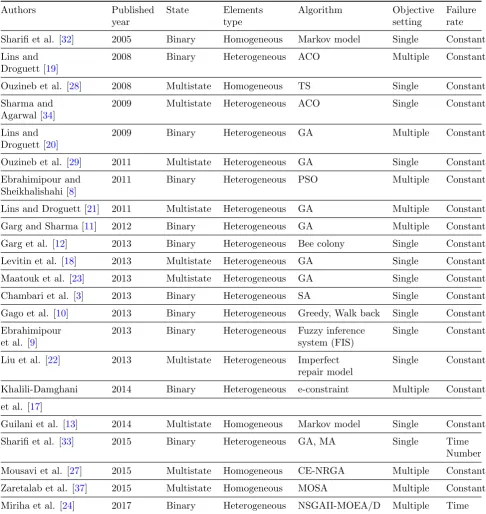
Table 2 contains a number of recent studies on reliability area, along with a summary of the model behaviors.
In this paper, we solved an RAP with
k-out-of-n subs and repairable components. Also in addition to ordinary failure of components, CCF and short circuit failures are considered for com-ponents. For solving the presented model, BBO (Biographic Based Optimization) algorithm has been used. The paper comprises five sections. In the second section, we discuss Markov model. In the third section, the model definition is pre-sented and section four deals with BBO algo-rithm. A numerical example is presented in sec-tion five and the last part is devoted to conclusion and further studies.
2
Markov model
Markov process is a process in which the future probabilities only depend on the process situation in the present. If the time is divided into past, present and future, the future of the process only depends on the present and not the past. Three principles of Markov process are being stationary of the process states, identifiable and memoryless-ness of system states. Because the components in this paper have constant failure rate, all the Markov model necessaries are established. Figure
1illustrates the states of a k-out-of-n system with CCF and short circuit failures (Dhillon) [7].
3
System definition
3.1 Parameters of the model
i: Subsystem component index,
Table 2: Some recent studies on reliability area
Authors Published State Elements Algorithm Objective Failure
year type setting rate
Sharifi et al. [32] 2005 Binary Homogeneous Markov model Single Constant Lins and 2008 Binary Heterogeneous ACO Multiple Constant Droguett [19]
Ouzineb et al. [28] 2008 Multistate Homogeneous TS Single Constant Sharma and 2009 Multistate Heterogeneous ACO Single Constant Agarwal [34]
Lins and 2009 Binary Heterogeneous GA Multiple Constant Droguett [20]
Ouzineb et al. [29] 2011 Multistate Heterogeneous GA Single Constant Ebrahimipour and 2011 Binary Heterogeneous PSO Multiple Constant Sheikhalishahi [8]
Lins and Droguett [21] 2011 Multistate Heterogeneous GA Multiple Constant Garg and Sharma [11] 2012 Binary Heterogeneous GA Multiple Constant Garg et al. [12] 2013 Binary Heterogeneous Bee colony Single Constant Levitin et al. [18] 2013 Multistate Heterogeneous GA Single Constant Maatouk et al. [23] 2013 Multistate Heterogeneous GA Single Constant Chambari et al. [3] 2013 Binary Heterogeneous SA Single Constant Gago et al. [10] 2013 Binary Heterogeneous Greedy, Walk back Single Constant Ebrahimipour 2013 Binary Heterogeneous Fuzzy inference Single Constant
et al. [9] system (FIS)
Liu et al. [22] 2013 Multistate Heterogeneous Imperfect Single Constant repair model
Khalili-Damghani 2014 Binary Heterogeneous e-constraint Multiple Constant et al. [17]
Guilani et al. [13] 2014 Multistate Homogeneous Markov model Single Constant Sharifi et al. [33] 2015 Binary Heterogeneous GA, MA Single Time
Number Mousavi et al. [27] 2015 Multistate Homogeneous CE-NRGA Multiple Constant Zaretalab et al. [37] 2015 Multistate Homogeneous MOSA Multiple Constant Miriha et al. [24] 2017 Binary Heterogeneous NSGAII-MOEA/D Multiple Time
Table 3: Lower and upper bound of BBO algorithm parameter
Lower value Upper value
N Pop 24 50
M −M ax 0.05 0.2
I 1 2
E 1 2
Table 4: Best solution of BBO algorithm parameter
Best
N pop 46
M−M ax 0.07515
I 1.4352
Table 5: Failure rates of all kinds of components failures
i Choice 1 Choice 2 Choice 3 Choice 4
λi1 αi1 γi1 λi2 αi2 γi2 λi3 αi3 γi3 λi4 αi4 γi4 1 0.0011 0.4216 0.0005 0.0007 0.2904 0.0004 0.0009 0.3772 0.0005 0.0005 0.2052 0.0003 2 0.0005 0.2052 0.0003 0.0006 0.2476 0.0003 0.0007 0.2904 0.0004 - - -3 0.0016 0.6500 0.0008 0.0011 0.4216 0.0005 0.0014 0.5572 0.0007 0.0008 0.3336 0.0004 4 0.0019 0.7452 0.0009 0.0014 0.5572 0.0007 0.0016 0.6500 0.0008 - - -5 0.0006 0.2476 0.0003 0.0007 0.2904 0.0004 0.0005 0.2052 0.0003 - - -6 0.0001 0.0404 0.0001 0.0002 0.0808 0.0001 0.0003 0.1220 0.0002 0.0004 0.1632 0.0002 7 0.0009 0.3772 0.0005 0.0008 0.3336 0.0004 0.0006 0.2476 0.0003 - - -8 0.0021 0.8428 0.0011 0.0011 0.4216 0.0005 0.0009 0.3772 0.0005 - - -9 0.0003 0.1220 0.0002 0.0001 0.0404 0.0001 0.0004 0.1632 0.0002 0.0009 0.3772 0.0005 10 0.0019 0.7452 0.0009 0.0016 0.6500 0.0008 0.0011 0.4216 0.0005 - - -11 0.0006 0.2476 0.0003 0.0005 0.2052 0.0003 0.0004 0.1632 0.0002 - - -12 0.0024 0.9428 0.0012 0.0020 0.7940 0.0010 0.0016 0.6500 0.0008 0.0011 0.4216 0.0005 13 0.0002 0.0808 0.0001 0.0001 0.0404 0.0001 0.0003 0.1220 0.0002 - - -14 0.0011 0.4216 0.0005 0.0008 0.3336 0.0004 0.0005 0.2052 0.0003 0.0001 0.0404 0.0001
Table 6: Repair rates of components
i Choice 1 Choice 2 Choice 3 Choice 4
µ0i1 µci1 µshi1 µ0i2 µci2 µshi2 µ0i3 µci3 µshi3 µ0i4 µci4 µshi4 1 0.0042 0.0032 0.0021 0.0029 0.0022 0.0015 0.0038 0.0028 0.0019 0.0021 0.0015 0.0010 2 0.0021 0.0015 0.0010 0.0025 0.0019 0.0012 0.0029 0.0022 0.0015 - - -3 0.0065 0.0049 0.0032 0.0042 0.0032 0.0021 0.0056 0.0042 0.0028 0.0033 0.0025 0.0017 4 0.0075 0.0056 0.0037 0.0056 0.0042 0.0028 0.0065 0.0049 0.0032 - - -5 0.0025 0.0019 0.0012 0.0029 0.0022 0.0015 0.0021 0.0015 0.0010 - - -6 0.0004 0.0003 0.0002 0.0008 0.0006 0.0004 0.0012 0.0009 0.0006 0.0016 0.0012 0.0008 7 0.0038 0.0028 0.0019 0.0033 0.0025 0.0017 0.0025 0.0019 0.0012 - - -8 0.0084 0.0063 0.0042 0.0042 0.0032 0.0021 0.0038 0.0028 0.0019 - - -9 0.0012 0.0009 0.0006 0.0004 0.0003 0.0002 0.0016 0.0012 0.0008 0.0038 0.0028 0.0019 10 0.0075 0.0056 0.0037 0.0065 0.0049 0.0032 0.0042 0.0032 0.0021 - - -11 0.0025 0.0019 0.0012 0.0021 0.0015 0.0010 0.0016 0.0012 0.0008 - - -12 0.0094 0.0071 0.0047 0.0079 0.0060 0.0040 0.0065 0.0049 0.0032 0.0042 0.0032 0.0021 13 0.0008 0.0006 0.0004 0.0004 0.0003 0.0002 0.0012 0.0009 0.0006 - - -14 0.0042 0.0032 0.0021 0.0033 0.0025 0.0017 0.0021 0.0015 0.0010 0.0004 0.0003 0.0002
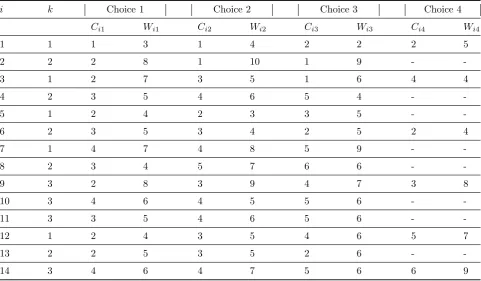
Table 7: Weight and cost of components.
i k Choice 1 Choice 2 Choice 3 Choice 4
Ci1 Wi1 Ci2 Wi2 Ci3 Wi3 Ci4 Wi4
1 1 1 3 1 4 2 2 2 5
2 2 2 8 1 10 1 9 -
-3 1 2 7 3 5 1 6 4 4
4 2 3 5 4 6 5 4 -
-5 1 2 4 2 3 3 5 -
-6 2 3 5 3 4 2 5 2 4
7 1 4 7 4 8 5 9 -
-8 2 3 4 5 7 6 6 -
-9 3 2 8 3 9 4 7 3 8
10 3 4 6 4 5 5 6 -
-11 3 3 5 4 6 5 6 -
-12 1 2 4 3 5 4 6 5 7
13 2 2 5 3 5 2 6 -
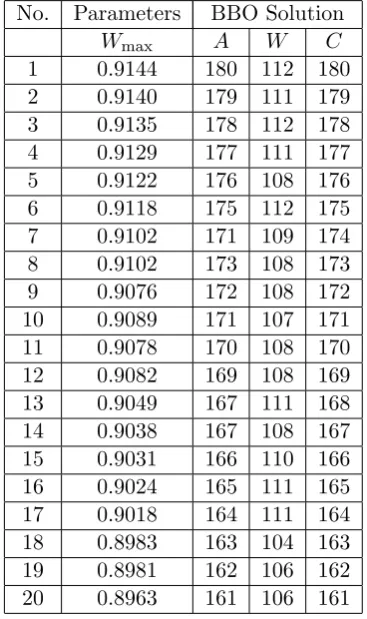
Table 8: The results of algorithm
No. Parameters BBO Solution
Wmax A W C
1 0.9144 180 112 180
2 0.9140 179 111 179
3 0.9135 178 112 178
4 0.9129 177 111 177
5 0.9122 176 108 176
6 0.9118 175 112 175
7 0.9102 171 109 174
8 0.9102 173 108 173
9 0.9076 172 108 172
10 0.9089 171 107 171
11 0.9078 170 108 170
12 0.9082 169 108 169
13 0.9049 167 111 168
14 0.9038 167 108 167
15 0.9031 166 110 166
16 0.9024 165 111 165
17 0.9018 164 111 164
18 0.8983 163 104 163
19 0.8981 162 106 162
20 0.8963 161 106 161
Figure 1: State space diagram of the system [7]
λi: Open failure rate of the subsystem
components, i= 1,2, ..., k,
αi: Short circuit failure rate of subsystem
com-ponents,i= 1,2, ..., k,
γi: Common cause failure rate of subsystem
components, i= 0,1,2, ...,(k−1),
nM ax,i: Upper limit of ni,
µo: Open (failure) repair rate of subsystem
com-ponents,
µsh: Short circuit (failure) repair rate of
subsys-tem components,
µc: Common cause (failure) repair rate of
sub-system components,
Pi(t) : The probability that the subsystem is in
stateiat the time t,
Psh(t) : The probability that the subsystem is in
short circuit failure mode at the time t,
Pc(t) : The probability that the subsystem is in
CCF mode at the timet,
N : Total components number of the subsystem,
A(t) : System availability at the time t,
C: Upper limit of in hand budget,
ni: Number of components in subsystem i,
zi: Component type index for subsystemi,zi ∈ {1,2, ..., mi},
mi: Maximum of component types for subsystem
i,
ki: Minimum number of components needed to
be work in order to run subsystemi,
cij : The cost of j th component in subsystem i,
wij : The weight of j th component in subsystem
i,
W : Upper limit of system acceptable weight,
3.2 System assumptions
The system assumptions are as follows:
• The system is series-parallel, • The subsystems are k-out-of-n,
• Redundancy strategy of subsystem compo-nents are active,
• The components of each subsystem are iden-tical,
• A subsystem is considered as repairable due to open failure, short circuit failure, and CCF,
• CCF may happens when at least two com-ponents working in a subsystem,
• Only one kind of failure may happen at a time,
3.3 Mathematical model
The equations of the subsystem states are as fol-lows (Dhillon, 1978):
p′0(t) =−(λ0+α0+γ0)p0(t) +psh(t)µsh
+pc(t)µc+p0(t)µ0
p′1(t) =−(λ1+α1+γ1)p1(t) +p0(t)λ0
p′2(t) =−(λ2+α2+γ2)p2(t) +p1(t)λ1 ..
.
p′k−1(t) =−(λk−1+αk−1+γk−1)pk−1(t) +pk−2(t) λk−22,3,4, . . . , n−1
p′k(t) = (λk+αk)pk(t) +pk−1(t)λk−1 k = (n−1)
.. .
p′n(t) =−µ0pn(t) +pk(t)λk
Considering two types of short circuit and CCF (the system of Figure 1, the equations are as fol-lows (Dhillon, 1978):
p′sh(t) =−µshpsh(t) + k
∑
i=0
αipi(t)
p′c(t) =−µcpc(t) + k−1 ∑
i=0
γipi(t)
For both equations, k = n−1. Because the re-dundancy strategy of the subsystems is active, we have:
n=N ; N ≥2
λi = (N − i)λ; i = 1,2, . . . , N
After solving the above equations, the probability of each state in each subsystem is determined. The mathematical model is as follows:
maxA(t) St :
N
∑
i=1
ci.zi.ni≤C
N
∑
i=1
wi.zi.ni ≤W
Ki ≤ni≤nmax,i
1≤Zi ≤mi
ni, zi∈N
4
Solving method
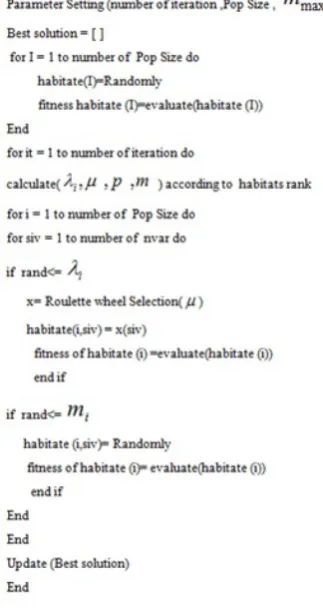
As RAP belongs to Np-hard problems, the meta-heuristic algorithms are suitable for solving this problem. In this paper, we used BBO algorithm. This algorithm is inspired by the nature of bio-graphic for searching in solution region. Simon [36] established the principle of this algorithm. This algorithm is a population based algorithm like GA. It means that this algorithm uses the single solutions for achieving the better solutions. In BBO, each environmental region is known as a particular member and has its own HSI1 and the greater values for HSI defines the better solution. The regions with less HSI try to attract the prop-erties of the region with higher HSI to improve themselves and be more similar to these regions. Two patterns are available for these emigrations: external immigration and internal immigration. The external immigration is proposed for the so-lutions with high HIS that share their properties and the internal immigrations are for the regions with less HIS that attract these properties. The external immigration rate is µi and the internal
immigration rate is λi. The pseudo-code of BBO
algorithm is as follows:
1
Figure 2: Pseudo cod of BBO algorithm
5
Parameter tuning
The result of metaheuristic algorithms depends on the parameter values. We used RSM2 pre-sented by Montgomery [25]. BBO algorithm pa-rameters are population size (N pop), mutation rate (M−M ax), maximum internal immigration rate (I) and the maximum external immigration rate (E). The algorithm stop condition is 50 al-gorithm iterations. The lower and upper bond of these parameters are presented in Table3and the best solution of these parameters using RSM are presented in Table4.
6
Numerical example
In this paper, we considered a system with 14 subsystems. For each subs, four different kind of component are available at most. Also three kinds of failures may happen: open failure, short circuit failure and CCF. By changing the maxi-mum acceptable weight of the system we create
2
Response Surface Methodology
20 different problems and the entire problem was solved using BBO. The failure rates of the pa-rameters are presented in Table 5 and the repair rates are in Table 6. Other components param-eters are presented in Table 7. The result for 20 solved problems are presented in Table8.
7
Conclusion and further
stud-ies
Short circuit and CCF are the two important fac-tors that need to tend to. In short circuit fail-ure, K subsystems are used out of N subsystems. Since it is impossible for a component to fail in both short circuit and common cause, failure in each component of a system is regarded indepen-dent from the other components of that system. The simultaneous effect of these three failures in a k out of n system is very important. Due to the nature of common cause failure, if one com-ponent of the system fails, the whole subsystem will fail since the same kind of component is used in each subsystem. One of the objectives of reli-ability is designing systems with high relireli-ability. Therefore, the reliability of the system has been improved using BBO.
In this paper, we work on a RAP with three kinds of failures. The subs are considered as k-out-of-n and the components are repairable. For calculating the availability of the system we used BBO algorithm and for tuning the algorithm pa-rameters RSM has been used. It seems that this model works close to real world.
For further studies one can work on the same system with multistate components. Also this problem may be solved using different algorithms.
References
[1] S. C. Albright, A. Soni, Evaluation of costs of ordering policies in large machine repair problems, Naval Research Logistics (NRL)
31 (1984) 387-398.
[2] A. Azaron, Reliability evaluation of multi-component cold-standby redundant systems,
[3] A. Chambari, An efficient simulated anneal-ing algorithm for the redundancy alloca-tion problem with a choice of redundancy strategies, Reliability Engineering & System Safety 119 (2013) 158-164.
[4] W. K. Chung, A k-out-of-n: G three-state unit redundant system with common-cause failures and replacements, Microelectronics Reliability 21 (1981) 589-591.
[5] D. W. Coit, Maximization of system relia-bility with a choice of redundancy strategies,
Iie Transactions 35 (2003) 535-543.
[6] B. S. Dhillon, A common cause failure avail-ability model, Microelectronics Reliability
17 (1978) 583-584.
[7] B. S. Dhillon, A k-out-of-N three-state de-vices system with common-cause failures,
Microelectronics Reliability 18 (1978) 447-448.
[8] V. Ebrahimipour, M. Sheikhalishahi, Appli-cation of multi-objective particle swarm op-timization to solve a fuzzy multi-objective reliability redundancy allocation problem,
in Systems Conference (SysCon), 2011 IEEE International (2011).
[9] V. Ebrahimipour, S. Asadzadeh, A. Azadeh, An emotional learning-based fuzzy inference system for improvement of system reliability evaluation in redundancy allocation prob-lem,The International Journal of Advanced Manufacturing Technology 11 (2013) 1-16. [10] J. Gago, Exact cost minimization of a
series-parallel reliable system with multiple com-ponent choices using an algebraic method,
Computers & Operations Research 40 (2013) 2752-2759.
[11] H. Garg, S. Sharma, Multi-objective reliability-redundancy allocation problem using particle swarm optimization, Com-puters & Industrial Engineering 64 (2013) 247-255.
[12] H. Garg, M. Rani, S. Sharma, An efficient two phase approach for solving reliability re-dundancy allocation problem using artificial
bee colony technique, Computers & Opera-tions Research 40 (2013) 2961-2969.
[13] P. P. Guilani, Reliability evaluation of non-reparable three-state systems using Markov model and its comparison with the UGF and the recursive methods, Reliability Engineer-ing & System Safety 129 (2014) 29-35. [14] S. V. Gurov, L. V. Utkin, Cold standby
sys-tems with imperfect and noninstantaneous switch-over mechanism, Microelectronics Reliability 36 (1996) 1425-1438.
[15] E. W. Hagan, Common Mode / Common -Cause Failure: A Review and Bibliography,
Nuclear safety information Center, (1979). [16] B. Jenney, D. Sherwin, Open & short
cir-cuit reliability of systems of identical items,
IEEE Transactions on Reliability 35 (1986) 532-538.
[17] K. Khalili Damghani, A. R. Abtahi, M. Ta-vana, A Decision Support System for Solv-ing Multi Objective Redundancy Allocation Problems, Quality and Reliability Engineer-ing International 30 (2014) 1249-1262. [18] G. Levitin, Reliability of series-parallel
sys-tems with random failure propagation time,
IEEE Transactions on Reliability 62 (2013) 637-647.
[19] I. Lins, E. Droguett. Multiobjective opti-mization of redundancy allocation problems in systems with imperfect repairs via ant colony and discrete event simulation, in Proceedings of the European Safety & Relia-bility Conference (ESREL). Valencia, Spain, (2008).
[20] I. D. Lins, E. L. Droguett, Multiobjec-tive optimization of availability and cost in repairable systems design via genetic algorithms and discrete event simulation,
Pesquisa Operacional 29 (2009) 43-66. [21] I. D. Lins, E. L. Droguett, Redundancy
[22] Y. Liu, A joint redundancy and imperfect maintenance strategy optimization for multi-state systems, IEEE Transactions on Reli-ability 62 (2013) 368-378.
[23] I. Maatouk, E. Chtelet, N. Chebbo, Avail-ability maximization and cost study in multi-state systems, in Reliability and Maintainability Symposium (RAMS), 2013 Proceedings-Annual, IEEE.
[24] M. Miriha, Bi-objective Reliability Opti-mization of Switch-Mode k-out-of-n Series Parallel Systems with Active and Cold Standby Components Having Failure Rates Dependent on the Number of Components,
Arabian Journal for Science and Engineer-ing 42 (2017) 5305-5320.
[25] D. C. Montgomery, Design and Analysis of Experiments 6th Edition with Design Expert Software, (2004), John Wiley & Sons.
[26] E. F. Moore, C. E. Shannon, Reliable cir-cuits using less reliable relays, Journal of the Franklin Institute 262 (1956) 191-208. [27] S. M. Mousavi, Two tuned multi-objective
meta-heuristic algorithms for solving a fuzzy multi-state redundancy allocation problem under discount strategies, Applied Mathe-matical Modelling 39 (2015) 6968-6989. [28] M. Ouzineb, M. Nourelfath, M. Gendreau,
Tabu search for the redundancy allocation problem of homogenous series parallel multi-state systems, Reliability Engineering & System Safety 93 (2008) 1257-1272.
[29] M. Ouzineb, M. Nourelfath, M. Gendreau, A heuristic method for non-homogeneous redundancy optimization of series-parallel multi-state systems, Journal of Heuristics
17 (2011) 1-22.
[30] H. W. Price, Reliability of parallel electronic components, IRE Transactions on Reliabil-ity and QualReliabil-ity Control 11 (1960) 35-39. [31] D. G. Robinson, M. F. Neuts, An
algorith-mic approach to increased reliability through standby redundancy, IEEE Transactions on Reliability 38 (1989) 430-435.
[32] M. Sharifi, M. Ganjian, H. Ghajar. Expan-sion of Reliability Models based on Markov Chain with Consideration of Fuzzy Failure Rates: System with two Parallel and Iden-tical Elements with Constant Failure Rates,
in Computational Intelligence for Modelling, Control and Automation, 2005 and Interna-tional Conference on Intelligent Agents, Web Technologies and Internet Commerce, Inter-national Conference on (2005). IEEE.
[33] M. Sharifi, Reliability optinization of a series-parallel k-out–of-N system with fail-ure pate depends on working components of system, International Journal of Industrial Engineering 22 (2015) 4-14.
[34] V. K. Sharma, M. Agarwal. Ant colony opti-mization approach to heterogeneous redun-dancy in state systems with multi-state components. in Reliability, Maintain-ability and Safety, ICRMS 2009. 8th Inter-national Conference on 2009. IEEE.
[35] H. Shayeghi, Reliability Optimization of Series-Parallels Systems Using PSO Tech-nique, in IC-AI 2008.
[36] D. Simon, Biogeography-based optimization,
IEEE transactions on evolutionary computa-tion 12 (2008) 702-713.
[37] A. Zaretalab, A knowledge-based archive multi-objective simulated annealing algo-rithm to optimize series parallel system with choice of redundancy strategies, Computers & Industrial Engineering 80 (2015) 33-44.
the president of Iran National Steel Industrial Group (INSIG) and vice-president and member of board of directors of Esteghlal Khouzestan F.C.
Mohammadreza Shahriari received his Ph.D. in Operational Research from the Islamic Azad University in 2009. He worked out more than 2 years to find out he how can present and solve a Time -Cost Trade off problem based on time value of money, considering to each crashing. He was also six years in charge of chancellor of Is-lamic Azad University in Dubai (UAE) and more than one year at the same position in Islamic Azad University in Oxford (UK). He has had another executive academic mandate, like, es-tablishing an Irani University in Germany, Italy, Russia and Oman. After almost running the abovementioned mandate, he again backed to his academic and teaching activities in the university.