Advanced Ceramics Progress
J o u r n a l H o m e p a g e : w w w . a c e r p . i r
Investigation of Effective Parameters on Densification of ZrB
2-SiC Based
Composites Using Taguchi Method
Z. Balak a*, M. Zakerib, M. R. Rahimipourb, E. Salahib, M. Azizieha, H. Kafashana
aDepartment of Materials Science and Engineering, Ahvaz Branch, Islamic Azad University, Ahvaz, Iran bDepartment of Materials Science and Engineering, Materials and Energy Research Center, Karaj, Iran
P A P E R I N F O
Paper history:
Received 16 January 2015
Accepted in revised form 14 February 2016
Keywords:
ZrB2-SiC composites
densification Spark plasma sintering Taguchi method
A B S T R A C T
The main goal of this study is optimization of densification of ZrB2-SiC composites reinforcedwith
chopped Cf prepared by SPS. Taguchi method is employed as statistical design of experiment (DOE) to
optimize densification parameters including SiC, Cf, MoSi2, HfB2 and ZrC content, milling time of Cf
and SPS parameters such as temperature, time and pressure. Each of these factors was examined on four levels in order to obtain the optimum conditions. A total of 32 samples were prepared in accordance to the L32 array proposed by the Taguchi method.
By using statistical analysis of variance (ANOVA), it has been concluded that the most significant effect on the densification is related to temperature, MoSi2 and time by 50.2%, 20.7% and 9.8%
portion, respectively. Also, the results showed that pressure with 0.8%, ZrC with 1.9% and HfB2 with 1.9% portion have the least effect on open porosity. The other parameters including SiC, milling time (M.t) and Cf have 2.9%, 3.6% and 3.8% portion on open porosity respectively.
1. INTRODUCTION1
Zirconium diboride (ZrB2) is a Group IV metal diboride which belongs to the family of ultra-high-temperature ceramics (UHTCs) known for their combination of thermo physical properties, such as high melting point (3245 °C), high hardness (22 GPa), high thermal conductivity (60–140 W·m−1·K−1), high electrical conductivity (9.2×10⁻⁶Ω·cm), and good corrosion resistance. As a result, ZrB2-based composite has attracted much attention for various applications, such as thermal protection materials and sharp-leading-edge components in future high Mach (7–20M) hypersonic flight, atmospheric re-entry vehicles as well as rocket propulsion hardware [1-3].
However, it is acknowledged that ZrB2 has poor sinterability due to its strong covalent bonding and low volume and grain boundary diffusion rate. In studies, nominally stoichiometric ZrB2 without additives has only been densified by hot-pressing at 2000 °C or higher with pressures of 20–30 MPa, or at reduced temperatures (1790–1840 °C) with much higher pressures (800–1500 MPa)[4].
1*Corresponding Author’s Email:[email protected] (Z. Balak)
Sintering aids are needed to obtain a fully dense bulk material. To improve sinterability of ZrB2, various metals, nitrides, silicides and carbides, such as Cu, Ni, Fe, Mo, Nb [4] AlN, HfN, ZrN [5,6] Si3N4, MoSi2, ZrSi2 ,TaSi2 [5,6,9] B4C, WC, VC, Y2O3 [5-9] and SiC have been used as sintering aids[5, 10].
Even though such sintering aids have successfully lowered the sintering temperatures by few hundred degrees, more often they have resulted in the formation of deleterious grain boundary phases due to sintering reactions [11]. As an example, the strength of ZrB2 containing ~3 volume percent Ni has been shown to drop by about 60% between 800 and 1000°C [12]. Recent efforts have directed towards sintering of ZrB2 -based ceramics using spark plasma sintering (SPS), which offers much higher heating rates, lower sintering temperatures and shorter holding times in the presence of pulsed DC electric field and external pressure. SPS technique has yielded favourable results, with respect to lowering of sintering temperature and concomitantly controlling grain growth and formation of secondary phases [11].
In addition, some studies were done to adjust the sintering parameters such as temperature, time and pressure to achieve nearly full densification. So, it is clear that many factors (different additives, sintering
method and parameters of sintering method) can influence on densification.
Investigating all of these parameters in a single work may not be possible. In order to investigate the effect of each factor and attain the maximum density, an optimization strategy is required to find the best experimental conditions. Taguchi method is a very useful tool to solve the complex and confusing problems with fewest variables and fewer tests in many areas. It includes the design of an experiment process using orthogonal arrays that allows independent evaluation of factors through a small number of runs [13].
In this perspective, we focus on the effect of different additives, temperatures, holding times and pressures on densification of ZrB2-based ceramics. With applying the Taguchi method, the effect of nine parameters such as SiC, Cf, MoSi2, HfB2 and ZrC content, milling time of Cf and SPS parameters such as temperature, time and pressure at four levels on densification were evaluated and discussed.
2. EXPERIMENTAL PROCEDURES
2.1. Materials Six basic raw materials
including ZrB2 (20 µm, Northwest Institute for Non-Ferrous Metal Research, China, 99% purity), SiC (25µm), ZrC (20 µm, Alfa-Aesar, 99.5% purity), MoSi2 (25 µm, 99% purity), HfB2 (30 µm, 99% purity), and T800H fiber (5 µm in diameter) were used to produce the composites. XRD analyses of raw powders are shown in Figure 1.
2.2. Experimental Design In this study,
the Taguchi method was used to design the experiments and to obtain the optimum experimental design by considering the effects of factors on their densification. Nine primary factors were examined followed by a statistical study of the SiC vol% (designated as “A”); the carbon fiber (Cf) vol% as ‘‘B’’; the milling time as ‘‘C’’ the MoSi2 vol% as ‘‘D’’; HfB2 vol% as ‘‘E’’; temperature as ‘‘F’’; pressure as ‘‘G’’ and time as ‘‘H’’. Each factor was examined at four levels. The used factors and levels are presented in TABLE 1. The level of each factor and the values of the tested factors were chosen based on previous researches. Normally, the full factorial design would require 49 = 262144 experimental runs. Apparently, doing these experimental runs is impossible and accompanies with very high cost, while with using Taguchi method only 32 experiments are needed based on the orthogonal array L32. Preparing conditions of each sample are shown in TABLE 2.
2.3. Manufacturing and Characterization
The powders corresponding to the 32 compositions, according to TABLE 2. were mixed by wet planetary ball-milling at 200 rpm for 3 h in a zirconia bottle, using zirconia balls and ethanol as media. The mixtures were then dried.
Figure 1. XRD analysis of raw powders.
TABLE 1. Process factors and their levels used in the experiments.
Factors unit Sym. L.1 L.2 L.3 L.4
A: SiC vol% SiC 5 10 15 20
B: Cf vol% Cf 0 2.5 5 7.5
C: M.t hr M.t 0 2.5 5 7.5
D: MoSi2 vol% MoSi2 0 2 4 6
E: HfB2 vol% HfB2 0 5 10 15
F: ZrC vol% ZrC 0 5 10 15
G:Temperature °C T 1600 1700 1800 1900
H: Pressure MPa P 10 20 30 40
TABLE 2. Preparing conditions for each sample t P T ZrC HfB2 MoSi2 M.t Cf SiC TEST 4 10 1600 0 0 0 0 0 5 1 8 20 1700 5 5 2 2.5 2.5 5 2 12 30 1800 10 10 4 5 5 5 3 16 40 1900 15 15 6 7.5 7.5 5 4 16 40 1800 10 5 2 0 0 10 5 12 30 1900 15 0 0 2.5 2.5 10 6 8 20 1600 0 15 6 5 5 10 7 4 10 1700 5 10 4 7.5 7.5 10 8 16 30 1700 0 15 4 2.5 0 15 9 12 40 1600 5 10 6 0 2.5 15 10 8 10 1900 10 5 0 7.5 5 15 11 4 20 1800 15 0 2 5 7.5 15 12 4 20 1900 10 10 6 2.5 0 20 13 8 10 1800 15 15 4 0 2.5 20 14 12 40 1700 0 0 2 7.5 5 20 15 16 30 1600 5 5 0 5 7.5 20 16 12 20 1800 5 15 0 7.5 0 5 17 16 10 1900 0 10 2 5 2.5 5 18 4 40 1600 15 5 4 2.5 5 5 19 8 30 1700 10 0 6 0 7.5 5 20 8 30 1600 15 10 2 7.5 0 10 21 4 40 1700 10 15 0 5 2.5 10 22 16 10 1800 5 0 6 2.5 5 10 23 12 20 1900 0 5 4 0 7.5 10 24 8 40 1900 5 0 4 5 0 15 25 4 30 1800 0 5 6 7.5 2.5 15 26 16 20 1700 15 10 0 0 5 15 27 12 10 1600 10 15 2 2.5 7.5 15 28 12 10 1700 15 5 6 5 0 20 29 16 20 1600 10 0 4 7.5 2.5 20 30 4 30 1900 5 15 2 0 5 20 31 8 40 1800 0 10 0 2.5 7.5 20 32
The powder mixture was put into graphite die lines with graphite foil which has an inner diameter of 50 mm and sintered using SPS apparatus (SPS-20T-10, China). The sintering was performed at Different temperatures (between 1600°C and 1900°C), different pressures (between 10 MPa and 40 MPa) and different holding times (between 4 min and 16 min) based on Taguchi design (TABLE 2.) in vacuum. Final sintered specimen size was 50 mm in diameter and different thicknesses of 2.8 mm and 6.5 mm related to their compositions and SPS conditions. After grinding the surface layer of the obtained disk, the bulk density was measured according to ASTM C 373-88. Then the phase composition was determined by X- ray diffraction (XRD, Siemens, D500) using Cu-Ka radiation on polished composite. Scanning electron microscopy (Sigma / VP, Zeiss) was performed to observe the microstructures of the
composites equipped with backscattered electron imaging (BSE).
3. RESULT AND DISCUSSION
In this study, some of ZrB2–based composites, such as 11, 12, 24 samples, sintered by SPS had a bulk density of 6.22 g/cm3, 5.67 g/cm3 and 5.98 g/cm3 respectively. By conducting the rule of mixture calculation while assuming the true densities were 6.09 g/cm3 for ZrB2, 3.21 g/cm3 for SiC, 6.65 g/cm3 for ZrC, 11.212 g/cm3 for HfB2, 6.24 g/cm3 for MoSi2 and 1.8 g/cm3 for Cf, the theoretical densities of composites, 11. 12 and 24 were calculated to be 5.74 g/cm3, 5.40g/cm3 and 5.73 g/cm3 respectively. Based on these true density values, the relative densities of composites 11, 12 and 24 sintered via SPS exceeded 100% because of the phase transformations. So calculating the relative density is impossible and the open porosity percent was chosen instead to evaluate the densification behaviour of the composites in this study.
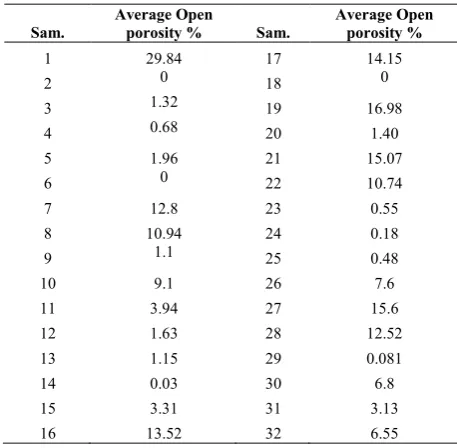
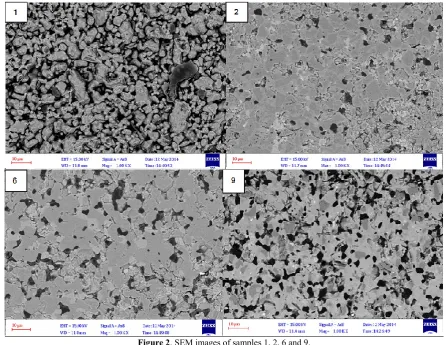
TABLE 3. shows the results of the open porosity percent for the 32 mixtures prepared. It was repeated four times for each mixture. The results of each times are shown as Trial 1 to 4 in TABLE 4. It is apparent that the average open porosity percent in samples 1, 7, 8, 16, 17, 19, 21, 22, 27 and 28 is more than 10% while it is less than 1% in samples 2, 6, 9, 14, 18, 23, 24, 25 and 29. In other words, these samples have the best densification. SEM images of some of these samples are shown in Figure 2. These images are in accordance with the open porosity results (TABLE3).
TABLE 3. Results of open porosity percent of all samples
Sam.
Average Open
porosity % Sam.
Average Open porosity %
1 29.84 17 14.15
2 0 18 0
3 1.32 19 16.98
4 0.68 20 1.40
5 1.96 21 15.07
6 0 22 10.74
7 12.8 23 0.55
8 10.94 24 0.18
9 1.1 25 0.48
10 9.1 26 7.6
11 3.94 27 15.6
12 1.63 28 12.52
13 1.15 29 0.081
14 0.03 30 6.8
15 3.31 31 3.13
16 13.52 32 6.55
clear that temperature with 50.2%, MoSi2 with 20.7% and time with 9.8% have the most portions on the open porosity, respectively. These results indicated that the
SPS conditions (temperature and time) and MoSi2 as sintering aid are very important parameters on densification.
Figure 2. SEM images of samples 1, 2, 6 and 9. Pressure with 0.8%, ZrC with 1.9%, and HfB2 with
1.9% have the least portion on open porosity. The other parameters including SiC, M.t, and Cf have 2.9%, 3.6% and 3.8% on open porosity, respectively. Generally, it can be seen that there is no significant difference between data before and after pooling. The only difference is the total error which is higher after pooling due to addition of minor factors portion to it.Standard analysis method was used to investigate the effect of each parameter on densification behaviour.
TABLE 4. ANOVA analysis results for all parameters before pooling.
Fac. f S V F s’ P
SiC 3 186.5 62.2 29.3 180.2 2.9
Cf 3 249.1 83 39.2 242.8 3.85
M.t 3 232.9 77.6 36.6 226.53 3.6
MoSi2 3 1313 437.7 206.6 1306.7 20.7
HfB2 3 124.9 41.6 19.7 118.6 1.9
ZrC 3 129.1 43 20.3 122.8 1.95
Temp. 3 3168 1056 498.6 3161.6 50.2
Press. 3 57.6 19.2 9 51.3 0.8
Time 3 626.1 208.7 98.5 620 9.8
Error 211.8 2.1 4.2
Total 100
TABLE 5. ANOVA analysis results for all parameters after pooling.
Fac. f S V F s’ P
SiC 3 186.5 62.2 12.9 172.1 2.8
Cf 3 249.1 83 17.3 234.7 3.7
M.t 3 232.9 77.6 16.2 218.5 3.4
MoSi2 3 1313 437.7 91.1 1298.6 20.7
HfB2 3 124.9 Pooled
ZrC 3 129.1 Pooled
Temp. 3 3168 1056 219.9 3153.6 50
Press. 3 57.6 Pooled
Time 3 626.1 208.7 43.4 611 9.7
Error 211.8 2.1 9.6
Total 100
3.1. Effect of SiC, Cf and M.t on Open Porosity
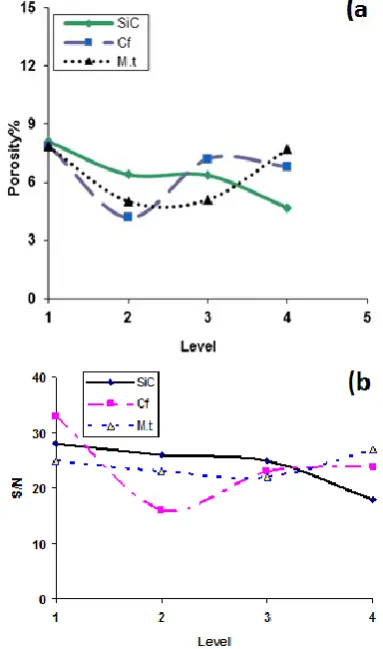
Percent Figure 3. shows the effect of SiC,
It is well-known that the densification of deboride powders like TiB2, ZrB2 and HfB2 are difficult and generally requires high temperatures and external pressures due to their strong covalent bonding and low self-diffusion. In addition, oxygen impurities (B2O3 and ZrO2) present on the surface of starting powder have been shown to inhibit densification because of evaporation of B2O3 in the non-oxide ceramic systems[4,8].
Monteverde [4] showed that ZrB2 with 10 vol% ultra-fine SiC (d90 = 0.8µm) achieved full density by HP at 1900 °C and 40 MPa for 20 min in vacuo. Hwang et al. [14] investigated the effect of SiC content on densification behaviour of ZrB2-based ceramics prepared by HP and reported the same results. The improvement of densification upon addition of SiC was attributed to the formation of intergranular liquid phases during hot-pressing, assisting in densification at lower temperatures. M. Ikegami et al. reported the similar results in ZrB2-SiC composite prepared by SPS [8].
Figure 3.Effect of SiC, Cf and M.t on open porosity percent by a) standard analysis, b) S/N.
Apparently, the presence of SiO2 prevents evaporation of B2O3 during hot pressing and results in formation of a stable liquid phase among the grains, hence improving the sinterability. It is common for B2O3 and SiO2 films to be present on the surfaces of the starting ZrB2 and SiC powder particles, respectively. According to the
phase diagram for B2O3–SiO2, a stable Si–B–O liquid phase is formed among the grains when B2O3 and SiO2 coexist [8].
In our work, we can conclude that the densification improvement is due to the formation of similar intergranular liquid phase.
In fact, the presence of an intergranular liquid phase favours the process of grain rearrangement and improves the packing density of particles, hence improving the densification. In addition, the amount of the intergranular liquid phase increases with increasing SiC content[28].
Figure 3. shows the effect of chopped Cf on open porosity percent. It appears that by increasing Cf content, open porosity percent initially decreased up to 2.5 vol% and then increased with further increasing. It means that low Cf content promotes densification while higher amounts inhibit densification. S. Guo et al. [15] investigated the effect of Short Pitch-based carbon reinforced fibre HfB2 matrix composites containing 20vol%SiC, with fibre volume fractions in the range of 20–50%, manufactured by hot-press process at 2100 °C and 20 MPa for 60 min. They concluded that the shrinkage behaviour of the composites was linked to fibre volume fraction. The onset temperature of densification was determined to be ~ 1490 °C for HSGF20, ~1510 °C for HSGF30, ~1550 °C for HSGF40, and ~1820 °C for HSGF50. It is evident that the onset temperature of densification was raised with increasing of fibre volume fraction. This indicated that the densifying muechanism of the HfB2–SiC matrix powder, such as grainboundary diffusion and grainboundary migration, was inhibited due to the presence of the fibre.
In our research, Cf content does not exceed 7.5 vol%. So the effect of Cf on densification is negligible due to its low content (TABLE 5. 3.8%). Also, we concluded that Cf up to 2.5 vol% is not enough to inhibit grainboundary
diffusion and grain-boundary migration. So
densification does not reduce.
Milling time of Cf up to 5 hr decreases open porosity percent and then increases it by more increasing, as shown in Figure 3.
Figure 4. SEM images of Cf ball milled for a) 0, b) 2.5 hr, c) 5 hr d) 7.5 hr.
3.2. Effect of MoSi2, HfB2 and ZrC on Open
Porosity Percent Effect of MoSi2, HfB2
and ZrC on open porosity is shown in Figure 5. Open porosity percent decreased by increasing MoSi2 content, as shown in Figure 5. MoSi2 is the best sintering aid among other additives used in this paper. According to TABLE 5. its portion on densification is 20.7%. This result is in good acordence with findings of other researches. In the early 1970s, Kinoshita et al. [4] systematically investigated densification behaviour of ZrB2-based composites with MoSi2. They found that MoSi2 significantly improved sinterability of ZrB2 powder and relative density exceeding 95% was obtained for ≥20 vol% MoSi2-containing ZrB2 powder at 2000 °C and 20MPa for 20 min.
The role of MoSi2 was to activate densification by means of chemical reactions involving surface oxides. The reactions lead to the removal of oxide species from ZrB2 particle surfaces by the formation of a (transient) liquid phase[16-18]. In our study, it is expected that similar intergranular liquid phase forms and improves densification.
F. Monteverde [16] also studied the effect of MoSi2 on densification of ZrB2 prepared by hot press (HP). He concluded that the rapid increase in the shrinkage rate for the MoSi2-doped compositions above 1650 °C was attributed to the formation of a liquid phase which favours the process of grain rearrangement and also improves the packing density of particles, resulting in improved densification. According to TABLE 4. it can be seen that composites which prepared by sintering at
1600 °C (i.e. composites 1, 7, 10, 16, 19, 21, 28, 30), the open porosity percents are more than 6%.
It means, it is impossible to reach nearly full densification in 1600 °C even with 6 vol% MoSi2 sintering aid (i.e. composites 7 and 10) while the open porosity percent in composite 2, containing only 2 vol% MoSi2 sintered at 1700 °C, is zero. So, we can conclude that there is a critical temperature for MoSi2 to act as a sintering aid (T≥1700 °C). It is due to the melting point of SiO2, (~1725 °C)[17]. SiO2 and Mo borides are produced as a result of reactions between MoSi2 and oxide species (impurity on the surfaces of starting powders). Therefore, sintering temperatures more than 1700 °C is necessary for liquid phase formation. S. Q. Gue [19] studied densification of ZrB2-MoSi2-SiC composite and reported similar results.
The ability of MoSi2 as a very good sintering aid, can be clearly seen by comparing the open porosity percent in composites 2 and 6 (TABLE 4). The open porosity percent of both composites is zero. With respect to TABLE 3. the composite 6 was sintered at 1900 °C, 30 MPa for 12 min without MoSi2 while composite 2 was sintered at 1700 °C, 20 MPa for 8 min with only 2 vol% MoSi2. It is concluded that using only 2 vol% MoSi2 can reduces SPS temperature for several hundreds centigrade. In addition, with respect to Tables 3 and 4. it is clear that 2 vol% MoSi2 is enough to reach nearly full densification for composites which were sintered at 1700 °C and 1800 °C by SPS method. Higher MoSi2 does not have more effect. Also, for composites with 1900 °C sintering temperature, no MoSi2 is required to reach nearly full densification (e.g. composite 6). It seems that it is possible to reach full densification by SPS method without using any sintering aid while it is impossible in HP and PLS methods at temperatures lower than 2100°C. This improvement should be reasonably attributed to the higher heating rate and dielectric breakdown mechanisms occurring during the spark plasma sintering process than HP and PLS. The effect of HfB2 on the open porosity percent is shown in Figure 5. It is observed that by increasing HfB2, open porosity percent increases a little at first, then keep nearly constant at higher HfB2 content. With respect to Zr-Hf-B ternary diagram phase [20], addition of HfB2 to ZrB2 causes to inform (Zr, Hf)B2 solid solution due to their nearly equal lattice parameters. According to E. Rudy [20], by increasing HfB2 amount, melting point of (Zr, Hf)B2 solid solution does not change significantly. It originates from nearly equal melting points of ZrB2 (3245 °C) and HfB2 (3380 °C). According to TABLE 5. HfB2 portion on open porosity is very little, 1.9%, which is in accordance with Rudy’ s data. We can conclude that HfB2 does not have any significant effect on open porosity percent and does not act as sintering aid.
Figure 5. shows the effect of ZrC on the open porosity percent. It can be seen that ZrC first decreases open porosity percent (up to 10 vol%), so improves densification. The phase diagram for the Zr–B–C
system shows that, the solubility limit for ZrC in ZrB2 is 4.5 wt%. Also binary diagram phase of ZrB2-ZrC
shows, addition of ZrC decreases liquidus
temperature[20].
V. M. Gropyanov and et. al [21] investigated the effect of ZrC and ZrB2 addition to each other. They found that the sinterability of ZrB2 is greatly inferior to that of ZrC and that the addition of as little as 10 wt% ZrC to ZrB2 or 10 wt% ZrB2 to ZrC substantially improves the sinterability of these materials. A. Snyder et al [22] reported the same results for the effect of ZrC in ZrB2– SiC–ZrC ultra high temperature composites with four different compositions prepared via SPS at a maximum temperature of 1800 °C.
According to TABLE 5. its portion on open porosity percent is only 1.9%. So, it can be concluded that ZrC does not act as a very good sintering aid like MoSi2. This can be attributed to its strong covalent Zr-C bond which gives this material a very high melting point (~3530 °C). However ZrC is very good grain growth inhibitor which will be discussed in our future work.
3.3. Effect of SPS Conditions on Open Porosity
Percent Figure 6. shows the effect of SPS
conditions on open porosity percent. It is observed that the open porosity percent decreased significantly by increasing temperature, as shown in Figure 6. A. Teber et al. [23] reached same results by sintering TiC in different temperatures by SPS method. By increasing the temperature from 1350 °C to 1800 °C, the density increases from 93.1 % to about 99.4 %, for 5 min holding time under 80 MPa. They considered that diffusion bounding at the particle boundaries and other high diffusivity paths are enhanced at higher temperatures. So, reorientation of TiC particles occurs and pores are filled as a result of boundary sliding and grain rotation, resulting in higher density materials. In our work, we concluded that the similar mechanism involves in improving densification by increasing temperature.
Figure 6. shows the effect of pressure on the porosity percent. Open porosity percent decreases slightly by increasing pressure up to level 3(30 MPa) and then iexperiences a little increase.
With respect to TABLE 5. the results indicate that, compared with pressure condition (0.8 % portion on densification), temperature and holding time play a more significant role in densification in SPS method by 50.2% and 20.7% portion on densification, respectively. These results are completely consistent with literatures [23, 24].
increases with rising applied pressure, and such a process also accelerates densification.
Figure 6. Effect of SPS conditions Temperature, Pressure and Time on open porosity percent by a) standard analysis, b) S/N.
Hu et al. [26] concluded that pressure contributes to the densification by compacting the grains and causing the plastic deformation.
The effect of time on open porosity percent is shown in Figure 6. It is clearly observed that by increasing the holding time open porosity percent decreases.
4. CONCLUSION
1.It has been concluded that the most significant effect on the densification is related to the sintering temperature, MoSi2 content and time by 48.4%, 20.7% and 9.8% portion, respectively.
2. Pressure by 0.9%, ZrC and HfB2 by 1.9% have the least effect on the densification.
3. Other parameters including SiC, M.t, and Cf have 2.9%, 3.6% and 3.8% effect on open porosity percent, respectively.
4. By increasing the temperature, time, MoSi2 and SiC from level 1 to 4, densification improved continuously while by increasing HfB2 from level 1 to 4, densification decreased consistently.
5. The optimum condition, to reach the most desiccation is T4, t4, P3, SiC4, Cf2, M.t2 or 3, MoSi24, HfB21 and ZrC3. The numbers indicate the level of each parameter.
5. ACKNOWLEDGMENTS
The authors would like to acknowledge the financial support of University of Islamic Azad university, Ahvaz Branch and Materials & Energy Research Center of Iran for this research.
REFERENCES
1. Zoua, J., Zhang, G.J., Zhang, H., Huang, Z.R., Vleugels, J. and Vander Biest, O., "Improving high temperature properties of hot pressed ZrB2–20 vol% SiC ceramic using high purity powders",
Ceramics International, Vol. 39, (2013), 871–876.
2. Yuan, H., Li, J., Shen, Q. and Zhang, L., "Preparation and thermal conductivity characterization of ZrB2 porous ceramics fabricated by spark plasma sintering",International Journal of
Refractory Metals and Hard, Vol. 36, (2013), 225–231
3. Ni, W.N., Liu, J.X. and Zhang, G.J., "Pressureless sintering of
HfB2–SiC ceramics doped with WC", Journal of the European
Ceramic Society, Vol. 32, (2012), 3627–3635.
4. Peng, F., "Pressureless sintering and oxidation resistance of ZrB2 based ceramic composites", P.H.D Thesis, Georgia
institute, 2009.
5. Zamora, V., Ortiza, A.L., Guiberteaua, F. and Nygren, M., "In situ formation of ZrB2–ZrO2 ultra-high-temperature ceramic
composites from high-energy ball-milled ZrB2 powders",
Journal of Alloys and Compounds, Vol. 518, (2012), 38– 43.
6. Wu, W.W., Zhang, G.J., Kan, Y.M., Wang, P.L., Vanmeensel, K., Vleugels, J. and Van der Biest, O., "Synthesis and microstructural features of ZrB2–SiC-based composites by
reactive spark plasma sintering and reactive hot pressing",
Scripta Materialia, Vol. 57, (2007), 317–320.
7. Guo, W.M., Yang, Z.G. and Zhang, G.J., "Comparison of ZrB2–
SiC ceramics with Yb2O3 additive prepared by hot pressing and
spark plasma sintering", International Journal of Refractory
Metals and Hard, Vol. 29, (2011), 452–455.
8. Ikegami, M., Guo, S. and Kagawa, Y., "Densification behavior and microstructure of spark plasma sintered ZrB2-based
composites with SiC particle", Ceramics International, Vol. 38, (2012), 769–774.
9. Guo, W.M., Yang, Z.G., Vleugels, J. and Zhang, G.J., "Effect of pressure loading cycle on spark plasma sintered ZrB2–SiC–
Yb2O3 ceramics", Ceramics International, Vol. 38, (2012),
5293–5297.
10. Zhang, X., Xu, L., Du, S., Liu, C. and Han, J., "Han W, Spark plasma sintering and hot pressing of ZrB2–SiCW ultra-high
temperature ceramics", Journal of Alloys and Compounds,
Vol. 466, (2008), 241–245.
11. Gupta, N., Mukhopadhyay, V., Pavania, K. and Basu, B., "Spark plasma sintering of novel ZrB2–SiC–TiSi2 composites
with better mechanical properties", Materials Science and
Engineering A, Vol. 534, (2012), 111– 118.
12. Rezaie, A., Fahrenholtz, W.G. and Hilmas, G.E., "Effect of hot pressing time and temperature on the microstructure and mechanical properties of ZrB2–SiC", Journal of Materials
Science, Vol. 42, (2007), 2735–2744.
13. Naghibi, S., FaghihiSani, M.A. and Madaah Hosseini, H.R., "Application of the statistical Taguchi method to optimize
TiO2nanoparticles synthesis by the hydrothermal assisted sol–
gel technique", Ceramics International, Vol. 40, (2014), 4193–
4201.
Materials Science and Engineering A, Vol. 464, (2007), 216– 224.
15. Guo, S., Naito, K. and Kagaw, K., "Mechanical and physical behaviors of short pitch-based carbon fiber-reinforced HfB2–
SiC matrix composites", Ceramics International, Vol. 39, (2013),1567–1574.
16. Monteverde, F., "The addition of SiC particles into a MoSi2
-doped ZrB2 matrix: Effects on densification, microstructure and
thermo-physical properties", Materials Chemistry and Physics,
Vol. 113, (2009), 626–63.
17. Sciti, D., Silvestroni, L. and Nygren, M., "Spark plasma sintering of Zr- and Hf-borides with decreasing amounts of MoSi2 as sintering aid", Journal of the European Ceramic
Society, Vol. 28, (2008), 1287–1296.
18. Sciti, D., Guicciardi, S. and Silvestroni, L., "SiC chopped fibers
reinforced ZrB2: Effect of the sintering aid", Scripta Materialia,
Vol. 64, (2011), 769–772.
19. Guo, S.G., Nishimura, T., Mizuguchi, T. and Kagawa, Y., "Mechanical properties of hot-pressed ZrB2–MoSi2–SiC
composites", Journal of the European Ceramic Society, Vol. 28, (2008), 1891–1898.
20. Rudy, E., "Ternary phase equilibria in transition-metal-boron-carbon-silicon systems", part V, compendium of phase
diagram data, (1969), 562-581.
21. Gropyanov, V.M. and Bel'tyukova, L.M., "Institute of Refractories", Leningrad. Translated from Poroshkovaya Metallurgiya, Vol. 67, No. 7, 25-32.
22. Snyder, A., Quach, D., Joanna, R., Fisher,T., Hodson, F. and Stanciu, L.A., "Plasma Sintering of ZrB2–SiC–ZrC ultra-high temperature ceramics at 1800 °C", Materials Science and
Engineering A, Vol. 528, (2011), 6079–6082.
23. Teber, A., Schoenstein, F., Têtard, F., Abdellaoui, M. and Jouini, N., "Effect of SPS process sintering on the microstructure and mechanical properties of nanocrystalline TiC for tools application",International Journal of Refractory
Metals and Hard, Vol. 30, (2012), 64–70.
24. Zhao, Y., Wang, L.J., Zhang, G.J., Jiang, W. and Chen, L.D., "Effect of holding time and pressure on properties of ZrB2–SiC composite fabricated by the spark plasma sintering reactive synthesis method", International Journal of Refractory Metals
and Hard, Vol. 27, (2009), 177–180.
25. Shen, Z., Johnsson, M., Zhao, Z. and Nygren, M., "Spark plasma sintering of alumina", Journal of the American
Ceramic Society, Vol. 85, (2002), 1921–1927.
26. Hu, C., Sakka, Y., Gaod, J., Tanaka, H. and Grasso, S., "Microstructure characterization of ZrB2–SiC composite
fabricated by spark plasma sintering with TaSi2 additive”,
Journal of the European Ceramic Society,Vol. 32, (2012),