VOLUME 40, ARTICLE 21, PAGES 561
-
598
PUBLISHED 14 MARCH 2019
http://www.demographic-research.org/Volumes/Vol40/21/ DOI: 10.4054/DemRes.2019.40.21
Research Article
Is there an association between marital exogamy
of immigrants and nonmigrants and their mental
health? A two-partners approach
Nadja Milewski
Annegret Gawron
This publication is part of the Special Collection “A New Look Into the Dynamics of Mixed Couples in Europe,” organized by Guest Editors Amparo González-Ferrer, Laura Bernardi, and Alícia Adserà.
© 2019 Nadja Milewski & Annegret Gawron.
This open-access work is published under the terms of the Creative Commons Attribution 3.0 Germany (CC BY 3.0 DE), which permits use, reproduction, and distribution in any medium, provided the original author(s) and source are given credit.
1 Introduction 562
2 Background 563
2.1 Bridging interethnic social capital: The exogamy gain hypothesis 565
2.2 Cultural difference: The exogamy-strain hypothesis 566
2.3 Confounding and moderating effects related to marriage type 567
2.4 Compositional differences in individual covariates 569
2.5 Within-migrant variation 570
3 Data and methods 571
3.1 Data and sample 571
3.2 Variables 573
3.3 Modeling strategy 576
4 Results 577
4.1 Exogamy vs. endogamy 577
4.2 Within-migrant variation 582
4.3 Checks for robustness and further explorations 583
5 Discussion 584
6 Acknowledgements 589
References 590
Is there an association between marital exogamy of immigrants and
nonmigrants and their mental health? A two-partners approach
Nadja Milewski1
Annegret Gawron2
Abstract
OBJECTIVE
We study mental health in immigrants and nonmigrants, distinguishing between people in exogamous and endogamous marriages. Our theoretical considerations are based on concepts of the economics of marriage, resources, and conflict. We test two competing hypotheses: Intermarriage may be associated with a gain effect or it may be related to a negative strain effect.
METHODS
We use SHARE data from waves 1, 2, and 4–6 (2004–2015). Our sample consists of
20,383 individuals living in nine European countries (15% migrants, 85% nonmigrants). The dependent variable is depression measured in the EURO-D scale; we applied mixed-effects linear regression models for repeated observations.
RESULTS
Overall, we found that migrants in exogamous marriages were more likely to report lower levels of depression than their counterparts in endogamous marriages, whereas nonmigrants in an exogamous marriage reported higher levels of depression. Several types of independent variables explained the total effect of the marriage type on mental health for migrants and nonmigrant men; for nonmigrant women the negative effect remained small but significant.
CONCLUSIONS
Our results support partially the hypothesis of a gain effect of a mixed marriage for mental health among immigrants, while at the same time suggesting that being in an exogamous marriage has a negative strain effect on mental health for nonmigrants.
1
Universität Rostock, Germany. Email:[email protected].
CONTRIBUTION
Our results suggest that the question of the costs and benefits of a mixed marriage should be investigated for migrants as well as for nonmigrants, in order to determine whether such marriages can contribute to a two-sided understanding of immigrant integration.
1. Introduction
Intermarriage, i.e., a marriage between members of different social groups, is one of the core indicators of social cohesion and intergroup relations. In classic assimilation theory an exogamous marriage between an immigrant and a nonmigrant at destination is seen as a result of the assimilation process of a migrant at destination, and also as a means to it (Gordon 1964). However, most research examines mixed marriages as the dependent variable, in that they are seen as an indicator of assimilation or integration. Relatively little is known about the scope, internal dynamics of conflict and negotiation, and social consequences of marital mixedness (Rodríguez-García 2015).
Our paper investigates how marital exogamy is related to individual life conditions. We ask whether there is an association between marriage type and the mental health of both spouses.
Our study is motivated by two perspectives. First, previous research on mixed marriages primarily looks at the migrant partner, framing questions from a wellbeing-or resource-wellbeing-oriented perspective fwellbeing-or the immigrant (Chang 2016). The marriage type indicates the social networks in which each spouse – and, most likely, the couple – acts and communicates. Having access to host-country-specific social capital may bridge the social/ethnic boundaries between the respective groups to which the spouses belong (Putnam 2007). The previous literature has suggested that there is an intermarriage gain (or ‘premium’) effect, whereby the migrant spouse benefits from being married to a nonmigrant of the country of settlement (reflected by, e.g., employment indicators (Furtado and Song 2015) and upward social mobility (Chang 2016)). We extend this research on the role of intermarriage in migrant integration by including in the analysis the dimension of mental health.
marriage stability and divorce in such couples. The results of these analyses show that, on average, exogamous marriages are less stable and are more likely to dissolve than endogamous marriages (e.g., Kalmijn, de Graaf, and Janssen 2005; Dribe and Lundh 2012; Feng et al. 2012; Smith, Maas, and Van Tubergen 2012; Milewski and Kulu 2014). In explaining this marital instability, these authors point to the cultural distance between the spouses and to heterogamy with regard to other sociodemographic traits. Yet they provide evidence of an elevated frailty risk of mixed marriages only at the couple level. The question of whether the spouses, i.e., both the migrant and the nonmigrant spouse, experience costs and benefits of such a union similarly, or not, has not been addressed. Hence, we include both spouses – the migrant and the nonmigrant – in our study. Whereas divorce risks refer to the couple as a joint unit, we use mental health as an indicator at the individual level because it can vary between the spouses within the couple and it is influenced by social health (Suls and Rothman 2004).
The geographical context of our study is Europe, where levels of cultural and/or ethnic heterogeneity in populations have increased since the 1950s due to continuous or growing immigration streams (Coleman 2006). Scholarly works on marriage types among immigrants in Europe have found that both the numbers and the rates of exogamous marriages have been increasing in recent decades, despite some variation between countries and migrant groups (Lanzieri 2012). We use data from five waves of the Survey of Health, Aging, and Retirement in Europe (SHARE) (2004–2015) for nine European countries. We carry out separate analyses by migrant status and sex: migrant women and men as well as nonmigrant women and men (migrants comprising persons who moved from their country of birth to another country as well as their children). The dependent variable is depression measured on the EURO-D scale; we apply mixed-effects linear regression models for repeated observations and focus on the health differentials by marriage type (within the same sex and migrant status). As the SHARE focuses on the elderly (i.e., aged 50+), this data includes mainly marriages of long duration. This offers, on one hand, the advantage of studying a part of the life course where health deteriorates in general and where marital strain may accelerate a decline in mental health (Umberson et al. 2006); on the other hand, different selection processes may operate, which must be considered in the analyses and in the interpretation of the results.
2. Background
Bratter and Eschbach (2006) investigate wellbeing by racial self-identification of spouses in the United States, but not by migrant status. We chose mental health as the dependent variable in our analyses because it is an individual-level indicator that may vary between the spouses in a marriage and because we wanted to investigate the interplay between marriage type and another life domain. Yet using health as the dependent variable also poses questions regarding the mechanisms which link the main explanatory and other independent variables to the outcome. In theoretical considerations on health there is no reason to assume a direct effect of the marriage type: there are always confounders, i.e., variables which influence both the main explanatory and the dependent variables, or mediators, i.e., variables lying on the causal pathway from X (i.e., marriage type) to Y (i.e., health). Other variables may moderate the effect of the main explanatory variable in the sense of an interaction effect, while others may work as covariates, exerting an effect independent from the main explanatory variable on the outcome. In this chapter we summarize the theoretical explanations which may link marriage type and mental health via the mediating role of marital quality and social resources, several confounders and moderators related to marital heterogamy, and sociodemographic covariates (Figure 1 illustrates the theoretical framing of our study). We also discuss the question of migrants’ selection into a mixed marriage.
Figure 1: Theoretical conceptionalization of the association between marriage type and mental health
2.1 Bridging interethnic social capital: The exogamy gain hypothesis
We begin our considerations by framing the exogamous marriage as a resource for the immigrant partner (Chang 2016), where social capital is seen as a mediator. To date, the literature has shown that international migration affects all domains of a person’s life course, that the effects of migration are discernible even decades after the move, and that these effects appear even in subsequent migrant generations. While it is generally understood that immigrants may benefit from new opportunities in the destination country, a number of studies have shown that migration is one of the most demanding events in life, as it is often associated with loss and can disrupt the life course (Kuo 1976; Bhugra 2004; Carta et al. 2005). A number of studies have demonstrated that elderly migrants report having worse mental health than nonmigrants (Rosmond, Nilsson, and Björntorp 2000; Silveira et al. 2002; Abbott et al. 1999; Fokkema and Naderi 2013; Milewski and Doblhammer 2015) and that migrants’ mental health decreases as their duration of stay increases (Wu and Schimmele 2005; Kotwal 2010).
The mental health of migrants appears to be the result of an additive disadvantage of various risk factors, whose effects may become visible particularly at older ages and/or at longer stay durations. According to the classic assimilation theory, intermarriage may enhance the integration processes (Gordon 1964). The nonmigrant spouse may be a source of host-country-specific social capital for the migrant partner, such as for language use or institutional knowledge about the healthcare system. The nonmigrant is more likely than the migrant to have family networks living close by that can provide support. In addition, the nonmigrant spouse may have broader social networks, which could mean that the migrant spouse has a better chance than migrants in an endogamous couple of making contact with members of the majority population. Social networks influence mental health (Kawachi and Berkman 2001), and weak ties are important for innovative behavior, as well as for ideational changes (Granovetter 1973). Moreover, these social contacts with majority group members may serve to bridge social capital (Putnam 2007) and facilitate the integration processes, and this may in turn be conducive to better mental health. For instance, the literature so far has reported that being in a mixed marriage has positive effects on the economic integration of migrants due to the exchange of social capital (Meng and Gregory 2005; Meng and Meurs 2009; Dribe and Nystadt 2015). Therefore, a migrant’s marriage to a nonmigrant may contribute to improving the migrant’s mental health, compared to those who are married to a fellow migrant.
We thus formulate our first working hypothesis regarding an intermarriage-gain effect:
Hypothesis 1: Marital exogamy is associated with better mental health for
When examining the association between union type and other life domains, we should not neglect the possibility that intermarriage is the result, rather than a cause, of a migrant’s successful integration, which occurs via opportunity structures, structural integration, and cultural adaptation (Gordon 1964). Migrants in exogamous marriages generally have comparatively high levels of labor force participation, work in higher status occupations, and have relatively high earnings (Kantarevic 2004; Nottmeyer 2010). Consequently, intermarriage could be a proxy for the tendency of intermarried migrants to be more economically integrated than other migrants, rather than a cause of their higher levels of wellbeing (Nottmeyer 2010). These dimensions of integration may have provided these migrants with opportunity structures that allowed them to meet nonmigrants in the marriage market. At the same time, these factors are conducive to higher levels of mental health, as they may, e.g., foster better socioeconomic conditions and utilization of healthcare services, or they could help migrants overcome conflicts and obstacles related to processes of adaptation and acculturation. Thus, if migrants in a mixed marriage have relatively good mental health, this may not be a causal effect of the mixed marriage, but may instead be an indicator of the migrant’s own host-country-specific human and social capital. Nonetheless, we would expect to find better health among migrants in exogamous marriages than among migrants in endogamous migrant marriages. Note: Ideally, longitudinal information would allow us to separate selection into mixed marriage from a health-fostering effect of intermarriage in later life stages. Unfortunately, our data does not contain information over such a long time span.
2.2 Cultural difference: The exogamy-strain hypothesis
For both migrants and nonmigrants, marriage type and mental health can be linked by marital quality as a mediator. Marital quality depends on both spouses, but it may affect them differently. Following household economic considerations and preference theory, marital quality is higher when the degree of similarity between the spouses is higher (Becker 1981). Empirical evidence shows that marital satisfaction is lower in exogamous than in endogamous couples (Hohmann-Marriott and Amato 2008). The stress model implies that higher marital strain is correlated with lower mental health of the spouses (Umberson et al. 2006; Chapman and Guven 2016; Kalmijn 2017). Bratter and Eschbach (2006) investigate wellbeing according to the racial self-identification of spouses in the United States (but not by migrant status) and find that some, although not all, types of exogamous couples do indeed have elevated levels of psychological distress.
socialization environments, and they may also belong to different ethnic and/or religious groups. Therefore, it is likely that each partner in a mixed marriage has a different set of preferences, values, and norms (whereas endogamous couples are more likely to share these). Dissimilarities in preferences, values, and norms may reduce the time spent in joint activities, lead to misunderstandings between the spouses, and be a constant source of conflict (Kalmijn, de Graaf, and Janssen 2005; Zhang and van Hook 2009). Moreover, theories regarding power relations and the distribution of resources in marriages (as well as in any other social group) suggest that a high degree of similarity between the spouses coincides with more balanced power relations. This in turn affects the wellbeing of the spouses. Conversely, the potential for tension and stress is expected to be lower in homogamous couples (Straus and Yodanis 1995). In addition, exogamy with regard to migrant background may coincide with heterogamy in other traits: one of the spouses may struggle with unfamiliar power relations or a reversal of gender roles (Lievens 1999; Chang 2016).
Second, there is an exchange of social capital between the spouses. This is one of the main contributors of the health-protection effect of a marriage, partly due to its role in affecting marital quality. Marital quality is both a prerequisite for and a product of the exchange of social capital and social support between the spouses (e.g., Umberson et al. 2006). The quality of this exchange will presumably be higher as the degree of similarity between the spouses increases (Schroedter and Kalter 2008). As spouses in exogamous unions differ with respect to their migrant status – which indicates dissimilarity in language, culture, and other sociodemographic traits between the spouses – the social capital exchange may be lower than in endogamous couples.
These findings illustrate that both the migrant and the nonmigrant spouse in an exogamous marriage may experience higher marital strain, i.e., lower marital quality, which is associated with the greater degree of dissimilarity between the spouses. Therefore, our second working hypothesis postulates an exogamy-strain effect:
Hypothesis 2: Being in a mixed marriage is associated with a lower level of mental
health relative to being in an endogamous marriage for both migrants and nonmigrants.
2.3 Confounding and moderating effects related to marriage type
heterogamy between the spouses, which – again – affects marital quality and the exchange of social capital, and thereby mental health. With respect to migrant status, exogamous marriages are known to also be heterogamous in relation to other traits, such as educational heterogamy (and particularly female hypergamy), large age difference, and religious difference (Curtis and Ellison 2002; Chan and Halpin 2002). These greater levels of dissimilarity are associated with a greater potential for conflict, which could negatively affect the quality of the marriage. It has been shown that exogamous couples have a higher risk of divorce than endogamous couples because spouses in mixed marriages tend to have other compositional traits that render their marriages unstable (Burchinal and Chancellor 1963; Bumpass and Sweet 1972; Kalmijn, de Graaf, and Janssen 2005; Feng et al. 2012; Milewski and Kulu 2014). Heterogamy is expected to be associated with lower levels of mental wellbeing, especially in cases in which the woman is older or has more education than her husband (Chang 2016).
A crucial moderator in our considerations is marriage duration. The literature indicates that the effect of marriage duration on mental health may not be continuous. The manner in which dissimilarities in relationships affect married couples and their relationship quality depends on the marriage duration, as well as on the different phases of the family life cycle. On one hand, at the beginning of a marriage the general wellbeing may be elevated because of the act of getting married in the first place (Kalmijn 2017). Singla and Holm (2012) distinguish three phases for bicultural couples: During the “honeymoon phase” the spouses see their differences as interesting, and their attitudes about the future are generally positive, although they may have to make compromises. In the “phase of family establishment” the negotiation of gender roles, parenting roles, and family and work balance makes these differences more obvious and problematic, even as the joint identity becomes more clearly defined. Beyond this phase, and as a consequence of the increasing relationship duration, the couple reaches the “reclining phase.” Everyday arguments and differences do not threaten the marriage, as the joint identity has been clearly constructed in the form of shared opinions and a constructed ‘we.’ The model by Singla and Holm (2012) suggests that the relevance of cultural dissimilarities may decrease over time. If so, then mental health may decrease in the second phase, but increase the longer a marriage persists. On the other hand, the marriages that face unresolvable problems (which may also be associated with lower mental health) may dissolve rather quickly; the divorce risk has been shown to be higher in exogamous unions (see above). Hence, overall mental health may increase over time because it is primarily the ‘successful’ marriages that survive.
Hypothesis 3: When we control for confounding and moderating variables related to the heterogamy of a couple, the health differentials between exogamous and endogamous marriages may decrease or vanish.
This would indicate that heterogamy in terms of factors other than the national origin of the partners contributes to health differentials. We test this hypothesis using the age difference between the partners and their relative educational achievement, as well as the marriage duration.
2.4 Compositional differences in individual covariates
Our analyses also include covariates at the individual level (age, education), which are known to affect mental health, as well as the country of residence and the calendar period. Previous research has found wellbeing differentials among various European countries. Socioeconomic status is seen as a crucial variable in the wellbeing of elderly people in European countries, both at the individual level (Read, Grundy, and Foverskov 2016) and the macro level (Olsen and Dahl 2007). In addition, European welfare states may mediate the impact of socioeconomic status on health (Eikemo et al. 2008). Individuals living in eastern European regions (or welfare systems) have lower levels of mental health than others (Ferrari et al. 2013). Mental wellbeing has been shown to decrease with age, primarily because somatic health decreases with age (Blazer et al. 1991; Buber and Engelhardt 2008). Having a higher level of education is associated with better mental wellbeing (Buber and Engelhardt 2008).
Our working Hypothesis 4 is as follows:
Hypothesis 4: Any health differentials by marriage type may change when
controlling for these covariates (compositional hypothesis).
Note that these variables have been shown to impact (mental) health especially at older ages when the variation in health increases; these variables do not account for selection into mixed marriages. One exception may be educational attainment, for which a positive correlation has been found for migrants’ exogamy (González-Ferrer 2006). At the same time, higher education is associated with higher divorce risks; therefore, we perceive education in the remaining – i.e., surviving – marriages as a covariate for mental health, rather than a confounding effect.
within sex, we do not treat sex as a covariate; instead we test our hypotheses for women and men in separate models.
2.5 Within-migrant variation
Finally, we also study within-migrant variation. First, we distinguish between the first generation and migrant descendants (Rumbaut 2004). Usually, international migration is associated with a social downward trend in the first generation. This includes educational attainment, in the sense that the educational qualifications of immigrants are, on average, lower than those of nonmigrants, or immigrants cannot utilize their education to the fullest in the labor market. This disadvantage also continues into their children’s generation. Yet a general trend towards higher education has become visible among migrant descendants (Fassmann 1997; Constant and Massey 2005). Migrant descendants experience the educational system in the host country at least partially, and therefore are likely to have a better command of the host-country language than their parents; their information and utilization of the healthcare service may be facilitated. Therefore, we assume that the gain (if any) of mixed marriage may be lower in the subsequent migrant generation because migrant children may be more integrated than the first generation.
Similarly, we assume that the mental health disadvantages will be smaller for exogamous marriages in which either of the spouses is a migrant descendant, compared to mixed marriages with a first-generation migrant, because the potential for conflict will be reduced among the descendants due to their assumed higher degree of acculturation. Therefore, in our fifth hypothesis we expect that:
Hypothesis 5a: The gain or strain effect (if any) of an exogamous marriage is
lower among migrant descendants, i.e., the mental health of the descendants will be between that of the first generation in exogamous marriages and that of the migrants in endogamous marriages.
countries – religion tends to be viewed as less important, there is more support for gender equality, and individual wellbeing is more highly regarded than collective interests (cf. Huntington 1993). Acculturative stress may increase with greater cultural distance between the societies of origin and destination, increasing the need for greater culture learning (Berry 1997). Previous research on divorce risks has shown that the higher the cultural distance the greater the risk of union dissolution (Kalmijn, de Graaf, and Janssen 2005; Dribe and Lundh 2012; Smith, Maas, and Van Tubergen 2012; Milewski and Kulu 2014).
The second part of our hypothesis on within-migrant generation is as follows:
Hypothesis 5b: The higher the cultural distance between the partners is, the lower
their mental health will be (greater exogamy-strain effect).
3. Data and methods
3.1 Data and sample
The data used in this study comes from SHARE (Malter and Börsch-Supan 2015; Malter, Schuller and Börsch-Supan 2016). SHARE was designed as a longitudinal survey and was established in 2002: it currently comprises six waves. The sampling population of SHARE is women and men aged 50+ who live in private households and members of their households. For our analyses we used data from waves 1, 2, and 4–6; wave 3 was omitted because it does not contain information on health status.
A person was defined as a migrant if his/her country of birth was not the same as his/her country of residence or if either of his/her parents was an immigrant. Conversely, a nonmigrant was defined as a person who was living in his/her country of birth at the time of the survey interview. The crucial explanatory variable that defines our sample selection is the type of marriage. Based on the migrant status of both partners, exogamous marriages were defined as those in which one of the spouses belonged to the migrant group and the other one was categorized as a nonmigrant. If the spouses were both migrants and reported the same country of origin, or if both partners were nonmigrants, their partnership was defined as endogamous.3
In the main part of our analyses we used a joint indicator for all migrants, regardless of their age at arrival or place of birth. In the second part we accounted for heterogeneity within the migrant group. First, we distinguished by migrant generation:
3
The first generation consisted of those who moved to the country at the age of 15 or older. Their descendants were grouped into the same category, comprising the generation 1.5 – i.e., those who migrated as children up to age 14 – and the second generation – i.e., those born at destination (Rumbaut 2004). A second variable taking into account within-migrant heterogeneity is the grouping by region of origin: We differentiated between migrants from Western and non-Western countries, based on the dividing lines between the Western tradition of the Christian religion and other religions (Huntington 1993; Inglehart 1997). Consequently, the United States, Australia, Greenland, New Zealand, and the European countries were grouped into Western regions of origin. The non-Western group included countries of origin in Asia, Africa, South America, and Oceania.
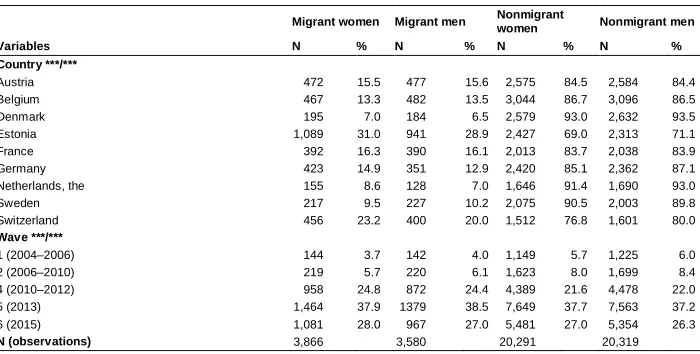
In general, the SHARE data allows us to make cross-country comparisons. European countries vary not only in terms of the mental health levels of the population but in terms of in- and outmigration histories (Foders 2004; Salt 2011), integration policies (Meuleman and Reeskens 2008; Malmusi 2015), share of immigrants in the population (Eurostat 2016), and percentage of mixed marriages. Whereas the rates of nonmigrants who are in mixed marriages differ little across countries, the mixed-marriage rates among migrants vary markedly across different destination countries, from about 21% in Latvia to 0.1% in Romania (Lanzieri 2012). In order to construct a relatively homogenous sample, we used only those countries that had a relatively long immigration history (starting with labor recruitment in the 1950s) and where the share of migrants in the total population was therefore relatively high. The nine countries selected were Austria, Belgium, Denmark, Estonia, France, Germany, Sweden, Switzerland, and the Netherlands. The share of mixed marriages in these countries was between 11% in Denmark and 24% in Estonia.
Our sample consisted of persons aged 50 to 80 who were living in the same household as a couple with a person of the opposite sex. As we needed individual information on both partners we used only those cases in which both spouses were interviewed. We excluded the few cases in which the information on a crucial variable (i.e., the dependent variable) was missing.4
Our sample included only married couples, about 98% of which were presumably first marriages (note: the SHARE data does not contain any explicit questions on the order of the marriage). We excluded nonmarital unions because we control for the marriage duration and we did not have information on the beginning of cohabitations.5
4
If a marriage was dissolved, either by divorce or by the death of either partner, the remaining partner was no longer included in our sample. Thus, our analyses did not contain any information about the mental health of the surviving spouse after union dissolution or death.
5
Our final sample consisted of 20,383 persons in total. About 60% of these cases were observed once or twice, whereas for about 40% of the sample three to five observations were used (see Table 1). The sample included 17,141 nonmigrants (corresponding to 85% of the observations), and about 3,242 of the sample were migrants (corresponding to about 15% of the observations). Regarding the within-migrant variation, among the within-migrants 39% of the cases belonged to the first within-migrant generation, 19% migrated under the age of 15 (generation 1.5), and 42% belonged to the second generation (children of migrants born in their parents’ destination country). By region of origin, 58% of the migrants were from Western countries and 42% from non-Western countries.
Table 1: Overview of the sample
Number of observations per person Number of persons % Number of observations
1 5,005 24.6 5,005
2 7,195 35.3 14,390
3 5,302 26.0 15,906
4 1,650 8.1 6,600
5 1,231 6.0 6,155
Total 20,383 100 48,056
Source: Calculations based on SHARE, waves 1, 2, 4, 5, 6 (2004–2015), N = 48,056.
3.2 Variables
The dependent variable in our analyses was depression, as measured by the EURO-D scale. This depressive symptoms scale was developed to allow for a valid comparison of mental health between European countries, and it is based on 12 items related to depression, pessimism, feelings of guilt, irritability, wishing for death, sleep, interests, appetite, fatigue, concentration, enjoyment, or tearfulness (Castro-Costa et al. 2008).
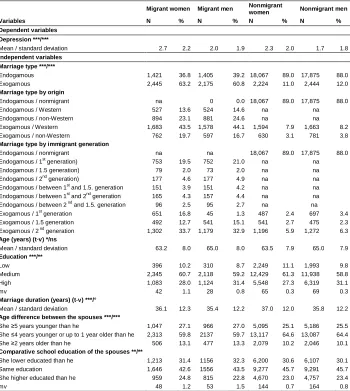
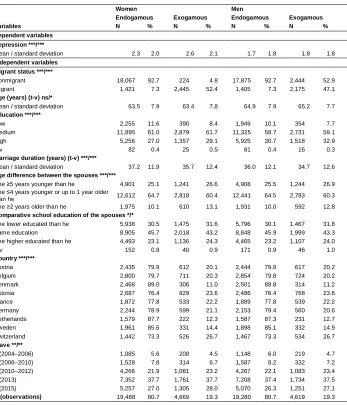
The independent variables covered the confounders related to marital heterogamy, the marriage duration as a moderator, as well as covariates at the individual and macro level (for sample statistics by migrant status and sex see Table 2; by marriage type see Table A-1 in the Appendix).
Table 2: Descriptive overview of the sample, by sex and migrant status
Migrant women Migrant men Nonmigrant
women Nonmigrant men
Variables N % N % N % N %
Dependent variables
Depression ***/***
Mean / standard deviation 2.7 2.2 2.0 1.9 2.3 2.0 1.7 1.8
Independent variables
Marriage type ***/***
Endogamous 1,421 36.8 1,405 39.2 18,067 89.0 17,875 88.0
Exogamous 2,445 63.2 2,175 60.8 2,224 11.0 2,444 12.0
Marriage type by origin
Endogamous / nonmigrant na 0 0.0 18,067 89.0 17,875 88.0
Endogamous / Western 527 13.6 524 14.6 na na
Endogamous / non-Western 894 23.1 881 24.6 na na
Exogamous / Western 1,683 43.5 1,578 44.1 1,594 7.9 1,663 8.2
Exogamous / non-Western 762 19.7 597 16.7 630 3.1 781 3.8
Marriage type by immigrant generation
Endogamous / nonmigrant na na 18,067 89.0 17,875 88.0
Endogamous / 1st generation) 753 19.5 752 21.0 na na
Endogamous / 1.5 generation) 79 2.0 73 2.0 na na
Endogamous / 2nd generation) 177 4.6 177 4.9 na na
Endogamous / between 1st and 1.5. generation 151 3.9 151 4.2 na na Endogamous / between 1st and 2nd generation 165 4.3 157 4.4 na na Endogamous / between 2nd and 1.5. generation 96 2.5 95 2.7 na na
Exogamous / 1st generation 651 16.8 45 1.3 487 2.4 697 3.4
Exogamous / 1.5 generation 492 12.7 541 15.1 541 2.7 475 2.3
Exogamous / 2nd generation 1,302 33.7 1,179 32.9 1,196 5.9 1,272 6.3 Age (years) (t-v) */ns
Mean / standard deviation 63.2 8.0 65.0 8.0 63.5 7.9 65.0 7.9
Education ***/**
Low 396 10.2 310 8.7 2,249 11.1 1,993 9.8
Medium 2,345 60.7 2,118 59.2 12,429 61.3 11,938 58.8
High 1,083 28.0 1,124 31.4 5,548 27.3 6,319 31.1
mv 42 1.1 28 0.8 65 0.3 69 0.3
Marriage duration (years) (t-v) ***/°
Mean / standard deviation 36.1 12.3 35.4 12.2 37.0 12.0 35.8 12.2 Age difference between the spouses ***/***
She ≥5 years younger than he 1,047 27.1 966 27.0 5,095 25.1 5,186 25.5 She ≤4 years younger or up to 1 year older than he 2,313 59.8 2137 59.7 13,117 64.6 13,087 64.4 She ≥2 years older than he 506 13.1 477 13.3 2,079 10.2 2,046 10.1 Comparative school education of the spouses **/**
She lower educated than he 1,213 31.4 1156 32.3 6,200 30.6 6,107 30.1
Same education 1,646 42.6 1556 43.5 9,277 45.7 9,291 45.7
She higher educated than he 959 24.8 815 22.8 4,670 23.0 4,757 23.4
Table 2: (Continued)
Migrant women Migrant men Nonmigrant
women Nonmigrant men
Variables N % N % N % N %
Country ***/***
Austria 472 15.5 477 15.6 2,575 84.5 2,584 84.4
Belgium 467 13.3 482 13.5 3,044 86.7 3,096 86.5
Denmark 195 7.0 184 6.5 2,579 93.0 2,632 93.5
Estonia 1,089 31.0 941 28.9 2,427 69.0 2,313 71.1
France 392 16.3 390 16.1 2,013 83.7 2,038 83.9
Germany 423 14.9 351 12.9 2,420 85.1 2,362 87.1
Netherlands, the 155 8.6 128 7.0 1,646 91.4 1,690 93.0
Sweden 217 9.5 227 10.2 2,075 90.5 2,003 89.8
Switzerland 456 23.2 400 20.0 1,512 76.8 1,601 80.0
Wave ***/***
1 (2004–2006) 144 3.7 142 4.0 1,149 5.7 1,225 6.0
2 (2006–2010) 219 5.7 220 6.1 1,623 8.0 1,699 8.4
4 (2010–2012) 958 24.8 872 24.4 4,389 21.6 4,478 22.0
5 (2013) 1,464 37.9 1379 38.5 7,649 37.7 7,563 37.2
6 (2015) 1,081 28.0 967 27.0 5,481 27.0 5,354 26.3
N (observations) 3,866 3,580 20,291 20,319
Source: Calculations based on SHARE, waves 1, 2, 4, 5, 6 (2004–2015), N = 48,056.
Note: Sig.: *** p<0,001; ** p<0,01; * p<0,05; ° p<0,1; ns = not significant; the chi2 test statistics for categorical variables and the t-test statistics for metric variables refer to the differences between migrants and nonmigrants with regard to the respective variable (for women/for men). t-v = time-varying covariate, mv = missing values, na = not applicable.
At the individual level we used age as a metric variable (mean-centered). Educational attainment was based on the ISCED framework. We combined the pre-primary, pre-primary, and lower secondary educational levels to form the low education category; the upper secondary and post-secondary non-tertiary levels to form the medium education category; and the first and second stages of tertiary levels to form the high education category. Further covariates were the respondents’ country of residence and the calendar year.
Confounding and moderating variables related to marital heterogamy were the following: The age difference between the spouses was measured in three categories (the wife was 5+ years younger than the husband, the wife was between 4+ years younger or 1 year older than the husband, the wife was 2+ years older than the husband). Comparative education captured homogamy, hypogamy, and hypergamy. Marriage duration was used as a metric variable (mean-centered). Note here that due to the age structure of the sample the majority was in a long-term marriage; the mean duration in the four groups was between about 35 and 37 years, whereas only roughly fewer than 4% of the observations had marriage durations of less than 10 years.
results in the literature. Based on the EURO-D cut-off point of ≥4, which according to the literature is indicative of a case of depression in the sense of a disabling psychiatric condition (Castro-Costa et al. 2008; Guerra et al. 2009), nearly 26% of the women in our sample felt depressed compared to 15% of the men. This pattern is in line with other literature (Kuehner 2017).
3.3 Modeling strategy
We used five survey waves with repeated observations; we accounted for the possible lack of independence of the repeated measurements by applying linear mixed effects models with a random intercept. The model estimated the mean effects of the independent variables on depression by weighing both within- and between-subject variance over the five survey waves. Thus, higher values indicate more symptoms of depression corresponding to lower mental health. As in other linear random effects regression models, the method of linear mixed effects models for repeated measures allows us to take time-invariant variables into account (Cameron and Trivedi 2009; Kohler and Kreuter 2012). Moreover, the method considers the correlation between repeated observations of the same person as well as the differences in the numbers of observations per person in an unbalanced panel (Rabe-Hesketh and Skrondal 2008). The model can be described as:
Yit= a + bXit + ui + ei.
Yjt represents depression, a captures the estimated constant, Xjt is the observed
time-dependent (calendar period, country, age, marital duration) and time-invariant (marriage type, education, age difference, comparative education) predictor, andbis the estimated parameter. The termuidenotes the errors between persons across time, andei
describes the errors within persons. The variation between individuals is assumed to be random and is not correlated with the dependent variable. To fit the models, we used the restricted maximum likelihood estimation (REML).
the confounding variables related to the marital heterogamy (i.e., differences between the partners in age and education) and the marriage duration.
In a second step we carried out the same modeling steps, further distinguishing among the migrants by migrant generation. In a third part of the analyses we repeated the same steps using an indicator for the regional origin of the migrants.
In addition, we carried out several tests for robustness, which are described at the end of the results section.
4. Results
The goal of our analyses was to compare individuals in exogamous marriages to those in endogamous marriages. Thus, our strategy of separate modeling by migrant status and by sex did not allow for comparisons within these groups. We will describe the sample now, before presenting the results. The migrant women in our sample reported the highest mean values of depression, followed by the nonmigrant women. Among men, the mean of depression was higher among migrants than among nonmigrants. The migrants in our sample were more likely than the nonmigrants to indicate that they were depressed, which corresponds to findings in the literature (Rosmond, Nilsson, and Björntorp 2000; Silveira et al. 2002; Abbott et al. 1999; Milewski and Doblhammer 2015).
The share of migrants who were in an exogamous marriage was about 63% of women and 61% of men. Among nonmigrants, 11% of women and 12% of men were in an exogamous marriage. Looking at the marriage type, both the women and the men in our sample had significantly higher mean values of depression if they were in a mixed marriage than if they were in an endogamous marriage. Regarding the independent variables, being in a mixed marriage was associated with the wife being older or better educated than the husband.
4.1 Exogamy vs. endogamy
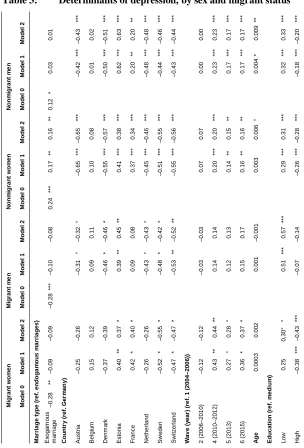
counterparts in endogamous marriages, thus suggesting an exogamy-gain effect (Hypothesis 1). By contrast, nonmigrant women and men who were in a mixed marriage had significantly higher levels of depression, indicating a negative exogamy effect on mental health (Hypothesis 2).
These overall patterns persisted when the calendar period and country of residence as well as the age and education were inserted into the Models 1. However, the effect size declined in all four groups, and the effect of the marriage type on depression remained significant only in the group of nonmigrant women. Thus, age and educational level mainly explained variation in depression, supporting the hypothesis of compositional effects (Hypothesis 4).
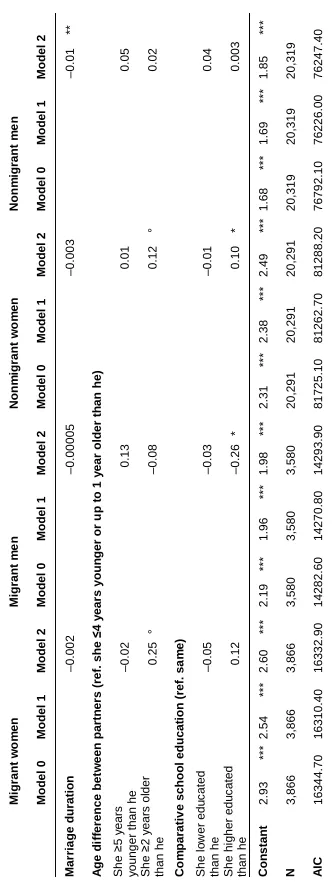
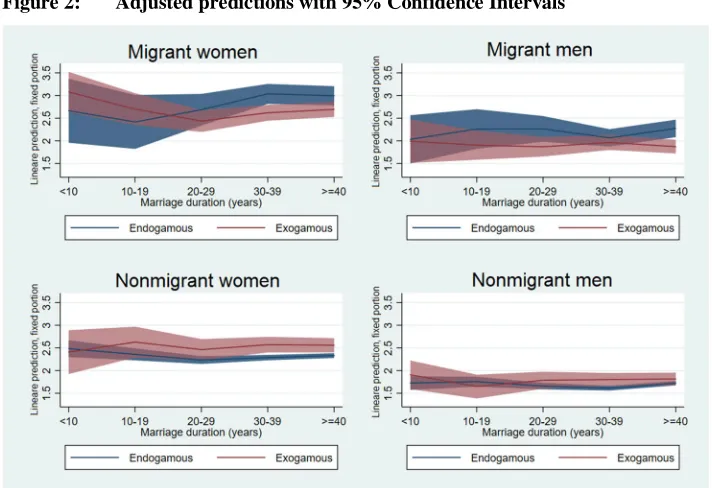
In the Models 2 we added the confounding variables that accounted for the heterogamy related to the age difference and the educational attainments of the spouses as well as the moderator for marriage duration. For nonmigrant women the effect remained similar in size, and significantly so. For both sexes in the migrant group and for nonmigrant men the effect sizes decreased slightly and remained insignificant. These findings partially support the heterogamy hypothesis (Hypothesis 3).
Table 3: Determinants of depression, by sex and migrant status Migrant w o m en Migrant m e n Non m igrant w o m en Non m igrant m e n Mod el 0 Mod el 1 Mod el 2 Mod el 0 Mod el 1 Mod el 2 Mod el 0 Mod el 1 Mod el 2 Mod el 0 Mod el 1 Mod el 2 Mar ria ge t y pe ( re f. en do ga m ou s m ar ria ges) Ex ogam ous m arr iage – 0.28 ** –0.09 –0.09 – 0.28 ** * –0.10 –0.08 0.24 ** * 0.17 ** 0.16 ** 0.12 * 0.03 0.01 Cou nt ry (ref. G er m an y) Au s tria –0.25 –0.26 –0.31 ° –0.32 ° –0.65 ** * –0.65 ** * –0.42 ** * –0.43 ** * Be lgi u m 0.15 0.12 0.09 0.11 0.10 0.08 0.01 0.02 Denm ar k –0.37 –0.39 –0.46 * –0.46 * –0.55 ** * –0.57 ** * –0.50 ** * –0.51 ** * Es ton ia 0.40 ** 0.37 * 0.39 ** 0.45 ** 0.41 ** * 0.38 ** * 0.62 ** * 0.63 ** * Fr anc e 0.42 * 0.40 * 0.09 0.08 0.37 ** * 0.34 ** * 0.20 ** 0.20 ** Netherl and –0.26 –0.26 –0.43 ° –0.43 ° –0.45 ** * –0.46 ** * –0.48 ** * –0.48 ** * Sw ed en –0.52 * –0.55 * –0.48 * –0.42 * –0.51 ** * –0.55 ** * –0.44 ** * –0.46 ** * Swi tz erlan d –0.47 * –0.47 * –0.53 ** –0.52 ** –0.55 ** * –0.56 ** * –0.43 ** * –0.44 ** * W av e (y ear ) ( re
f. 1 (
Table 3: (Continued) Migrant w o m en Migrant m e n Non m igrant w o m en Non m igrant m e n Mod el 0 Mod el 1 Mod el 2 Mod el 0 Mod el 1 Mod el 2 Mod el 0 Mod el 1 Mod el 2 Mod el 0 Mod el 1 Mod el 2 Mar ria ge d uratio n –0.00 2 –0.00 005 –0.00 3 –0.01 ** A ge d iff er ence bet w een partn er
s (ref. she
≤
4 y
ear
s youn
ger or u
p t o 1 y ear old er th an he) Sh e ≥ 5 y ears y oung
er than he
–0.02 0.13 0.01 0.05 Sh e ≥ 2 y ears ol der than he 0.25 ° –0.08 0.12 ° 0.02 Co m parativ e schoo l educat ion (ref. sa m e) Sh e l o w er edu c ated than he –0.05 –0.03 –0.01 0.04 Sh e hi gher edu c ated than he 0.12 –0.26 * 0.10 * 0.003 Con stan t 2.93 ** * 2.54 ** * 2.60 ** * 2.19 ** * 1.96 ** * 1.98 ** * 2.31 ** * 2.38 ** * 2.49 ** * 1.68 ** * 1.69 ** * 1.85 ** * N 3,866 3,866 3,866 3,580 3,580 3,580 20,29 1 20,29 1 20,29 1 20,31 9 20,31 9 20,31 9 A IC 1634 4.70 1631 0.40 1633 2.90 1428 2.60 1427 0.80 1429 3.90 8172 5.10 8126 2.70 8128 8.20 7679 2.10 7622 6.00 7624 7.40 So urce : Cal c ul ati on s ba s ed on S H ARE , w av es 1, 2, 4, 5, 6 (2004–2
015), N =
48,0
5
6.
Note
: ° p <
Figure 2: Adjusted predictions with 95% Confidence Intervals
The effects of the independent variables were in line with those described in the literature, and they were similar in both direction and magnitude for all groups. Depression has increased slightly in recent years and was higher in Estonia and lower in Denmark and Sweden compared to Germany (which served as the reference category). In addition, there was also variation among the western European countries. At the individual level, those with higher education had lower values of depression. Depression hardly changed by age, which may be due to the correlation of age and marriage duration.
4.2 Within-migrant variation
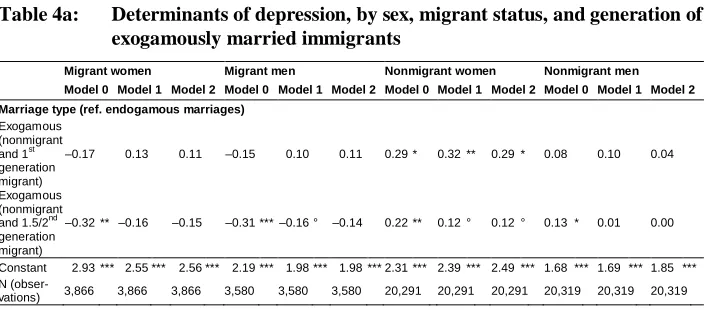
Next we investigated the question of within-migrant variation (see Tables 4a and 4b). The upper panel (a) shows the results of the stepwise modeling process, in which we repeated the same steps as in the analyses displayed in Table 3. We replaced the dichotomous variable of the marriage type with a variable that distinguished the migrant generations.6 Overall, these analyses produced results similar to those for the dichotomous migrant status in section 4.1: Both migrant women and men had lower levels of depression in exogamous marriages, whereas nonmigrants had higher levels of depression when they were in a mixed marriage compared to endogamous unions, regardless of whether the migrant partner belonged to the first generation or was a migrant descendant. The sizes of these effects were similar, but the confidence levels varied due to the sample size. This is a reason for us not to exaggerate the interpretation of these findings. However, we do want to emphasize that there is not much variation by migrant generation on depression levels by union type. Also, keeping all other variables constant, nonmigrant women married to either a first- or second-generation migrant had higher levels of depression (Table 4a).
The final step was to differentiate by region of origin. Panel b in Table 4 displays the results when we distinguished the marriages by Western / non-Western origin of the migrants. Among migrants, both women and men had mental health gains mainly from an exogamous marriage when they came from Western countries. In these two groups the exogamy-effect on depression decreased when taking the covariates and confounders into account, but remained significant. By contrast, those migrants who originated from non-Western countries had elevated depression levels when they were in a mixed marriage compared to those in endogamous marriages. Among nonmigrants, women in exogamous marriages had elevated depression levels, but these were even higher in the non-Western group. For nonmigrant men, depression was elevated only in marriages with a spouse from a non-Western country, and this was explained by the independent variables.
Note: Ideally we would differentiate by migrant generation and region of origin simultaneously, but the sample size did not permit this. We want to acknowledge that this differentiation is already based on small sub-samples and that we do not want to exaggerate the interpretation of these patterns in greater detail.
6
Table 4a: Determinants of depression, by sex, migrant status, and generation of exogamously married immigrants
Migrant women Migrant men Nonmigrant women Nonmigrant men
Model 0 Model 1 Model 2 Model 0 Model 1 Model 2 Model 0 Model 1 Model 2 Model 0 Model 1 Model 2
Marriage type (ref. endogamous marriages) Exogamous
(nonmigrant and 1st generation migrant)
–0.17 0.13 0.11 –0.15 0.10 0.11 0.29 * 0.32 ** 0.29 * 0.08 0.10 0.04
Exogamous (nonmigrant and 1.5/2nd generation migrant)
–0.32 ** –0.16 –0.15 –0.31 *** –0.16 ° –0.14 0.22 ** 0.12 ° 0.12 ° 0.13 * 0.01 0.00
Constant 2.93 *** 2.55 *** 2.56 *** 2.19 *** 1.98 *** 1.98 *** 2.31 *** 2.39 *** 2.49 *** 1.68 *** 1.69 *** 1.85 *** N
(obser-vations) 3,866 3,866 3,866 3,580 3,580 3,580 20,291 20,291 20,291 20,319 20,319 20,319
Table 4b: Determinants of depression, by sex, migrant status, and country of origin of exogamously married immigrants
Migrant women Migrant men Nonmigrant women Nonmigrant men
Model 0 Model 1 Model 2 Model 0 Model 1 Model 2 Model 0 Model 1 Model 2 Model 0 Model 1 Model 2
Marriage type (ref. endogamous marriages) Exogamous
(W estern) –0.45 *** –0.21 ° –0.21 ° –0.47 *** –0.28 ** –0.26 ** 0.12 ° 0.14 * 0.13 ° –0.07 –0.01 –0.02 Exogamous
(non-Western)
0.10 0.10 0.09 0.20 ° 0.20 ° 0.22 ° 0.52 *** 0.23 * 0.22 * 0.50*** 0.13 0.10
Constant 2.93 *** 2.61 *** 2.64 *** 2.19 *** 2.08 *** 2.11 *** 2.31 *** 2.39 *** 2.49 *** 1.68 *** 1.69 *** 1.85 *** N
(obser-vations) 3,866 3,866 3,866 3,580 3,580 3,580 20,291 20,291 20,291 20,319 20,319 20,319
Source: Calculations based on SHARE, waves 1, 2, 4, 5, 6 (2004–2015), N = 48,056.
Note: ° p < 0.10, * p < 0.05, ** p < 0.01, *** p < 0.001. Models 1 controlled for country, wave, age, education; Models 2 in addition controlled for educational heterogamy, age difference, and marriage duration.
4.3 Checks for robustness and further explorations
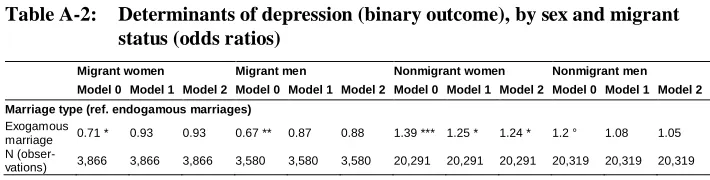
These effects diminished when holding all other variables constant (Table A-2 in the Appendix).
We then used different subsamples, mainly in order to tackle the question of sample bias due to the different time-dependent processes related to in- and out-migration as well as union dissolution. The sample was restricted to migrants who had spent at least 10 years in the country of destination, thereby eliminating an arrival effect in regard to mental health. According to Sluzki (1979), decreased mental health shortly after immigration is expected as a consequence of the migration process and related difficulties. However, the number of observations with a stay duration of less than 10 years was very small (less than 300 observations). As the age range in our sample was rather large, we restricted the analyses to those who were aged 50 to 70 at the time of the survey interview. We restricted the sample to those who were presumably married for the first time. Basically, all these variations in the modeling procedure produced similar results (albeit with lower levels of significance due to the smaller sizes of the respective subsamples): Exogamy was associated with more symptoms of depression for nonmigrant women and men, while migrant women and men appeared less depressed.
Finally, we carried out some exploratory analyses. We were interested in the variation in the effects of exogamy by country of residence. While it was beyond the scope of this paper to make distinctions along these lines, some preliminary results using the full SHARE sample (all countries included) indicated that mental health in mixed marriages is worse when immigration is fairly recent (as is the case for eastern European countries) or when there are no policies in place to help migrants integrate (especially in countries with exclusionist or collectivistic-ethnic policies, such as Austria, Denmark, Germany, and eastern European countries (Meuleman and Reeskens 2008)). The country of residence affected both migrants and their nonmigrant spouses in mixed marriages, and the results of this exploratory analysis pointed in the same direction: gain effects for migrants and strain effects for nonmigrants.
5. Discussion
migrant integration processes in the increasingly multicultural demographic context of contemporary Europe.
Our analysis was guided by competing working hypotheses derived from theoretical considerations regarding the economics of marriage, the mediating role of bridging interethnic social capital, and marital quality, as well as the impact of confounding and moderating variables related to marital heterogamy and other covariates controlling for compositional differences in the samples. We carried out our analyses separately for women and men due to the mental-health differentials known to exist between the sexes. Our hypotheses were formulated for both migrants and nonmigrants in a largely similar way.
Our analyses produced different results by migrant status. Migrants, both women and men, were found to be in better mental health (i.e., less depressed) when they were in a mixed marriage compared to endogamously married migrants. This finding seemed to support our working Hypothesis 1 on an exogamy-gain effect, which was based on considerations that the nonmigrant spouse may be a source of bridging interethnic social capital for the migrant partner. At the same time, this finding rejects the hypothesis of an exogamy-strain effect (Hypothesis 2) for migrants. The exogamy-gain effect was, however, mainly a brut effect in a model without further independent variables and could be explained to a large extent by further independent variables. In our working hypothesis (Hypothesis 3) regarding a heterogamy effect, we had assumed that any health differentials by marriage type would decrease when controlling for confounders – traits referring to the degree of mixedness of the spouses other than migrant background. Similarly, our working Hypothesis 4 considered the role of compositional differences between the groups. We had assumed that controlling for the covariates at the individual level, calendar period, and country of residence would shrink the effect of the marriage type on the health outcome. Our results delivered evidence for both of these hypotheses. Controlling for these variables substantially decreased the effect of the marriage type on mental health and rendered it insignificant for migrant women and men.
shown, e.g., for income (Dribe and Nystedt 2015), it may do so less for acculturation. Further research must also examine the short-term implications of mixed marriage on (mental) health.
These conclusions cannot be generalized for all migrant sub-groups, however. We also tested our working hypothesis on within-migrant variation (Hypothesis 5). For both women and men, the gain effect of the marriage type on mental health was larger when they did not belong to the first generation. This contradicts our fifth working hypothesis, in which we assumed that especially for the first generation the nonmigrant partner may serve as a resource for bridging interethnic social capital (Hypothesis 5a). Our results suggest that the difficulties related to the migration process may be more severe in the first generation. The long-term demands associated with the migration process, partnership in a mixed marriage, and a family life that may need to be organized between members of the extended family over several countries even decades after the move may overshadow the positive effects of a mixed marriage. The second aspect of within-migrant variation – the cultural distance – offers support for this explanation. By region of origin, the health benefit diminished with greater cultural distance, and a negative effect was observed for men when they came from non-Western countries compared to those from non-Western countries (Hypothesis 5b).
For nonmigrants, our analyses produced results that were opposite to those for migrants. Being in a mixed marriage was correlated with lower mental health for nonmigrant women and men. This supports our working Hypothesis 2, which postulated an exogamy-strain effect on mental health, and rejects Hypothesis 1, regarding an exogamy-gain effect. Another difference compared to the results for migrants was that these differences between mixed-marriage individuals and individuals in endogamous marriages remained significant after controlling for the covariates at the macro level and of the individuals, as well as for the confounders of the marital heterogamy for nonmigrant women. Thus, the hypothesis regarding the confounding role of marital heterogamy (Hypothesis 3) and the hypothesis of compositional differences (Hypothesis 4) were only partially supported in our nonmigrant groups.
Taken together, our results on migrants and nonmigrants suggest that the pairing of a migrant man and a nonmigrant woman leads to greater marital strain than a marriage between a nonmigrant man and a migrant woman. This is especially evident among exogamously married nonmigrant women and exogamously married migrant men from non-Western countries. This finding is in line with previous evidence on divorce and marriage dissolution (Dribe and Lundh 2012; Milewski and Kulu 2014). It has been argued that gender role expectations and gender role behavior may explain the differences in marriage dissolution rates. We are inclined to apply this assumption to our findings. Migrant men may not appreciate their nonmigrant wife having an advantage in terms of host-country specific social capital, especially if the men come from a country with family structures and attitudes towards gender equality that differ from those of the destination country. The power relations within a couple may be shifted against expectations, or at least for a longer time span than was anticipated after an initial reverse-role period. Our findings suggest that future research should investigate in more depth the power relations and their consequences in mixed marriages, by sex, gender role expectations, and behavior. Moreover, if a nonmigrant spouse is perceived as a source of bridging social capital, then it seems important to consider variation by gender as well. In this case, the role of the social network may come into play. For example, the processes of social control or discrimination may affect migrant women and men in mixed marriages differently.
These considerations lead us to pose several questions which could not be addressed in our study, and that we must leave to future research. First, what does it mean if we are observing negative effects of the marriage type in such long-term marriages? Can we compare marital exogamy with regard to migrant background to heterogamy in other sociodemographic characteristics (such as education), or what remains specific about exogamy with respect to migrant background? As exogamous marriages between spouses from Western and non-Western regions seem to be associated with greater risks of union dissolution (Milewski and Kulu 2014), future research should also investigate the role of religious exogamy. Migrants from non-Western countries are likely to have been raised according to Islam, and Islam prohibits the outmarriage of women. Hence, the experience of discrimination may vary by religious exogamy and sex.
processes explain the differences between individuals and, more importantly, between social groups. Another issue is the question of return migration. To what extent and in which direction does return migration bias our results on mental health? What role does the marriage type play for return to the country of origin? And are there differences between men and women? These are only a few of the questions that we shall leave for future research.
Third, we suggest that future research efforts investigate the variation in the effects of exogamy by country of residence. While it was beyond the scope of this paper to make distinctions along these lines, some preliminary results using the full SHARE sample indicated that mental health in mixed marriages is worse when immigration is fairly recent or when there are no policies in place to help migrants integrate, especially in countries with exclusionist or collectivistic-ethnic policies (Meuleman and Reeskens 2008). Importantly, in mixed marriages the societal climate affects both migrants and their nonmigrant spouses. This suggests that the couple may take on potential obstacles faced by migrants, as marriage represents a form of social capital that can help migrants cope with daily life, but that the nonmigrant spouse may suffer in the process of helping his or her migrant spouse. Moreover, nothing is known about any discrimination experienced by mixed marriages in Europe. Such experiences may exist – as have been observed for multiracial couples in the United States – and they may vary by societal context. Thus, our results suggest that a mixed marriage may be another step in a two-sided integration process of international migrants, but that it may not be the final one. Hence, (institutional) support networks and counseling efforts for mixed couples should not end on the day of the wedding, and research will need to track the subsequent family dynamics of both migrants and nonmigrants in mixed marriages as well as the reactions to these couples by third parties.
6. Acknowledgements
We thank Sarah Carol, Rasmus Hoffmann, Clemens Kroneberg, two anonymous reviewers, and the guest editors of the Special Collection on “A New Look Into the Dynamics of Mixed Couples in Europe” for their comments and suggestions.
This paper uses data from SHARE Waves 1, 2, 3 (SHARELIFE), 4, 5 and 6 (DOIs: 10.6103/SHARE.w1.600, 10.6103/SHARE.w2.600, 10.6103/SHARE.w3.600, 10.6103/SHARE.w4.600, 10.6103/SHARE.w5.600, 10.6103/SHARE.w6.600), see Börsch-Supan et al. (2013) for methodological details.
References
Abbott, M.W., Wong, S., Williams, M., Au, M., and Young, W. (1999). Chinese migrants’ mental health and adjustment to life in New Zealand.Australian and
New Zealand Journal of Psychiatry 33(1): 13–21. doi:10.1046/j.1440-1614.
1999.00519.x.
Becker, G.S. (1981).A treatise on the family. Cambridge: Harvard University Press.
Berry, J.W. (1997). Immigration, acculturation, and adaptation.Applied Psychology: An
International Review46(1): 5–68.doi:10.1111/j.1464-0597.1997.tb01087.x.
Bhugra, D. (2004). Migration and mental health. Acta Psychiatrica Scandinavica
109(4): 243–258.doi:10.1046/j.0001-690X.2003.00246.x.
Blazer, D., Burchett, B., Service, C., and George, L.K. (1991). The association of age and depression among the elderly: An epidemiologic exploration. Journal of
Gerontology46(6): M210–M215.doi:10.1093/geronj/46.6.M210.
Börsch-Supan, A., Brandt, M., Hunkler, C., Kneip, T., Korbmacher, J., Malter, F., Schaan, B., Stuck, S., and Zuber, S. (2013). Data resource profile: The Survey of Health, Ageing and Retirement in Europe (SHARE). International Journal of
Epidemiology 42(4): 992–1001.doi:10.1093/ije/dyt088.
Bratter, J.L. and Eschbach, K. (2006). ‘What about the couple?’ Interracial marriage and psychological distress. Social Science Research 35(4): 1025–1047.
doi:10.1016/j.ssresearch.2005.09.001.
Buber, I. and Engelhardt, H. (2008). Children’s impact on the mental health of their older mothers and fathers: Findings from the Survey of Health, Ageing and Retirement in Europe. European Journal of Ageing 5(1): 31–45. doi:10.1007/
s10433-008-0074-8.
Bumpass, L.L. and Sweet, J.A. (1972). Differentials in marital instability: 1970.
American Sociological Review37(6): 754–766.doi:10.2307/2093585.
Burchinal, L.B. and Chancellor, L.E. (1963). Survival rates among religiously homogamous and interreligious marriages. Social Forces 41(4): 353–362.
doi:10.2307/2573280.
Carta, M.G., Bernal, M., Hardoy, M.C., and Haro-Abad, J.M. (2005). Migration and mental health in Europe (The state of the mental health in Europe working group: Appendix 1).Clinical Practice and Epidemiology in Mental Health1: 13.
doi:10.1186/1745-0179-1-13.
Castro-Costa, E., Dewey, M., Stewart, R., Banerjee, S., Huppert, F., Mendonca-Lima, C., and Prince, M. (2008). Ascertaining late-life depressive symptoms in Europe: An evaluation of the survey version of the EURO-D scale in 10 nations: The SHARE project. International Journal of Methods in Psychiatric Research
17(1): 12–29.doi:10.1002/mpr.236.
Chan, T.W. and Halpin, B. (2002). Union dissolution in the United Kingdom.
International Journal of Sociology 32(4): 76–93. doi:10.1080/15579336.2002.
11770260.
Chang, H.-C. (2016). Marital power dynamics and well-being of marriage migrants.
Journal of Family Issues37(4): 1994–2020.doi:10.1177/0192513X15570317.
Chang, H.-C. and Wallace, S.P. (2016). Migration processes and self-rated health among marriage migrants in South Korea. Ethnicity and Health 21(1): 20–38.
doi:10.1080/13557858.2014.992299.
Chapman, B. and Guven, C. (2016). Revisiting the relationship between marriage and wellbeing: Does marriage quality matter? Journal of Happiness Studies 17(2): 533–551.doi:10.1007/s10902-014-9607-3.
Coleman, D. (2006). Immigration and ethnic change in low-fertility countries: A third demographic transition. Population and Development Review 32(3): 401–446.
doi:10.1111/j.1728-4457.2006.00131.x.
Constant, A. and Massey, D.S. (2005). Labour market segmentation and the earnings of German guestworkers.Population Research and Policy Review24(5): 489–512.
doi:10.1007/s11113-005-4675-z.
Curtis, K.T. and Ellison, C.G. (2002). Religious heterogamy and marital conflict.
Journal of Family Issues 23(4): 551–576.doi:10.1177/0192513X02023004005.
Dribe, M. and Lundh, C. (2012). Intermarriage, value context and union dissolution: Sweden 1990–2005. European Journal of Population 28(2): 139–158.
doi:10.1007/s10680-011-9253-y.
Dribe, M. and Nystedt, P. (2015). Is there an intermarriage premium for male immigrants? Exogamy and earnings in Sweden 1990–2009. International