Available Online at www.ijpret.com 758
INTERNATIONAL JOURNAL OF PURE AND
APPLIED RESEARCH IN ENGINEERING AND
TECHNOLOGY
A PATH FOR HORIZING YOUR INNOVATIVE WORK
EVOLUTIONARY ALGORITHM: A CLASSICAL SEARCH AND OPTIMIZATION
TECHNIQUE
PRADNYA A. VIKHAR
Research Scholar, SSBG Amravati University, Amravati
Accepted Date: 15/03/2016; Published Date: 01/05/2016
\
Abstract: Evolutionary algorithm (EA) becomes important optimization and search technique
in last decade. EA belongs to set of modern heuristics search method which can use successfully in many applications with high complexity. Its success in difficult problem solving has been adopted from field of Evolutionary Computation (EC). Basically EA is a subset of Evolutionary Computation. Its flexible nature and robust behavior marks it as most widely used optimization technique. This paper gives an overview of Evolutionary algorithm along with a generic procedure to implement it. It includes terminology used in the field of EA. Further it discusses the various issues related to Evolutionary algorithm and its invariants like Evolutionary Programming (EP), Evolution Strategies (ES), Genetic Programming (GP) and Genetic Algorithm (GA). It also includes various possible areas in which EA can mostly applicable.
Keywords: Evolutionary computation, Evolutionary Algorithm, Metaheuristic, Genetic
Algorithm, Genetic Programming, Evolutionary Strategies
.
Corresponding Author: MS. PRADNYA A. VIKHAR Access Online On:
www.ijpret.com
How to Cite This Article:
Available Online at www.ijpret.com 759
INTRODUCTION
The real world applications like robotics, operation research, decision making, bioinformatics, machine learning, data mining and many more are very complex and hard to solve[1][2]. An approach to tackle such problems inspired by natural evolution is referred as Evolutionary Computations. The algorithms involved in the Evolutionary computing are called as Evolutionary Algorithms (EAs)[2][4].During last two decades Evolutionary Algorithms become very popular tool for searching and optimization [3].Following figure shows the place of Evolutionary Algorithm in different searching methods.
Evolutionary algorithm is based on the principle of evolution (survival of the fittest). It is highly inspired by Darwinian evolutionary [10] system in sense to describe a system that changes incrementally over time. It searches the space of possible forms (the fitness landscape) for the ones that are best adapted. In nature, individuals have to adapt to their environment in order to survive in a process called evolution. Those features that make an individual more suited to compete are preserved when it reproduces, and those features that make it weaker are eliminated. Such features are controlled by units called genes which form sets called chromosomes. Over subsequent generations not only the fittest individuals survive, but also their fittest genes which are transmitted to their descendants during the sexual recombination process which is called crossover [5][7].The mechanism of natural selection and a learning (or optimization) process led to the development of the so-called “evolutionary algorithms”[9].
Fig.1 Searching Methods
Search methods
Calculus- Based Techniques
Guided Random Search Techniques
Enumerative Techniques
Direct Methods
Indirect Methods
Simulated Annealing
Evolutionary Algorithms
Dynamic Programming
Evolutionary Strategies
Genetic Algorithm
Genetic Programming
Available Online at www.ijpret.com 760
II. EVOLUTIONARY ALGORITHM
Evolutionary algorithm belongs to class of general stochastic search algorithm. It is a subset of Evolutionary computation which is a generic population based metaheuristic optimization algorithm [4].Metaheuristic is a higher-level procedure or heuristic designed to find, generate, or select a lower- level procedure or heuristic (partial search algorithm) that may provide a sufficiently good solution to an optimization problem, especially with incomplete or imperfect information or limited computation capacity. Simply evolutionary algorithms refer to a set of programming methods that draw inspiration from concepts stemming from evolutionary biology [11].An EA uses mechanisms inspired by biological evolution, such as reproduction, mutation, recombination, and selection. To maximize the quality function, randomly a set of candidate solution is created i.e. elements of function domain. Then quality function as an abstract fitness function is applied. Based on this fitness function, some better candidates are selected for next generation by applying recombination and/or mutation to them. Recombination is binary operator which can be applied to two or more selected candidates (parents) and results one or more new candidates (children). Mutation is applied to one candidate and results in one new candidate. Executing recombination as mutation leads to a set of new candidates that completely based on their fitness function. This process can be iterated until the candidate with sufficient quality is found [1][2].
A procedure for simple Evolutionary Algorithm
B. Components of Evolutionary algorithm
The figure shows the generic view of evolutionary algorithm. It can be explain with following components [1][2].
BEGIN
INITIALISE to initialize population with random candidate solution;
EVALUATE each candidate;
REPEAT UNITL (TERMINATION CONDITION is satisfied) DO
1 SELECT parents;
2 RECOMBINE pairs of parents; 3 MUTATE the resulting offspring; 4 EVALUATE new candidates;
5 SELECT individuals for the next generation; OD
Available Online at www.ijpret.com 761
Fig.2 A generic view for simple Evolutionary Algorithm
1) Representation
The first step to define EA is to bridge the gap between real world problem to EA world i.e. to map the original problem space and the problem solving space where the evolution takes place. Objects forming possible solutions within the original problem space referred as phenotypes, their encoding, the individuals within EA are referred as genotype. Thus representation is mapping from the phenotypes onto a set of genotypes that are said to represent these phenotypes.
2) Evaluation Function (Fitness Function)
Evaluation Function (Fitness Function) forms the basis for selection, and thereby enables improvements. It represents the task to solve in the evolutionary context. Technically, it is a function or procedure that assigns quality measure to genotype.
3) Population
Once defining representation population holds possible solution. It is a multiset of genotype which forms the unit of evolution. For given representation, population is number of individuals in it. In some EAs population can be defined with distance measure or neighborhood relationships. Then additional structure has to specify to fully define the population.
4) Parent Selection Mechanism
Available Online at www.ijpret.com 762 5) Variation Operators
Variation operators create new operators from the old one. There are two types of variation operators namely mutation and recombination. Mutation is unary operator which applied to one genotype and generates the child of it. Whereas recombination is a binary operator which merges information of two parent genotypes into one or two offspring genotypes. Both are stochastic operators.
6) Survivor Selection Mechanism
Survivor section distinguishes individuals based on their quality. It is similar to parent selection, but it is used indifferent stages of the evolution. This mechanism is called after having the offspring of selected parents.
7) Initialization and Termination Condition
The first population is set by randomly generated individual .Mostly problem specific heuristic is used to set an initial population with higher fitness. For termination condition two cases are distinguish. The problem knows optimum fitness level, then reaching this level can stop condition. Mostly in EA, there is no guarantee to reach to optimal solution, therefore algorithm may not stop. In such a case termination condition may depend on the number of generation, CPU time etc
III. FEATURES OF EVOLUTIONARY ALGORITHM
Evolutionary algorithm have been successfully applied to various areas do to certain features [4][5].
It is conceptually simple and flexible.
It utilizes prior information. It is obvious that the method that considers prior information about problem will outperform a method using less information and it will restrict the search space.
Other numeric techniques might be applicable for only continuous values or other constrained sets. But EA is representation independent.
Available Online at www.ijpret.com 763
Traditional methods of optimization are not robust to dynamic changes in problem the environment and often require a complete restart in order to provide a solution. In contrast evolutionary algorithms can be used to adapt solution to changing circumstances.
It has an ability to address problems for which there are no human experts. Although human expertise should be used when it is available, it often proves less than adequate for automating problem solving routines.
With these advantages it also faces some disadvantages:
Evolutionary algorithms always not guaranteed to give an optimal solution for any problem within finite time.
May need parameter tuning by trial-and-error.
It needs for lots of computational resources.
IV. DIFFERENT TYPES OF EAs
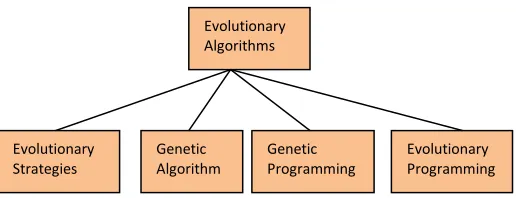
Sub area of Evolutionary algorithm includes Evolutionary Programming (EP), Evolution Strategies (ES), Genetic Programming (GP) and Genetic Algorithm (GA) [6][9].They all share a common conceptual base of simulating the evolution of individual via process of selection, mutation and reproduction. But these techniques can differ on the implementation details and the nature of the particular applied problem.
Fig 3. Classification of Evolutionary Algorithms
Genetic algorithm - This is the most popular type of EA often used for learning and optimization problem. It was first proposed by Holland and his student in 1970, primarily used for adaptive search and adaptive systemdesign.GA seeks the solution of a problem in the form of strings of numbers (traditionally binary) i.e. a Bit-String representing the genes, by applying operators such as recombination and mutation.
Genetic programming – It was developed by Koza in 1992.Instead of representing attributes in a general binary coding like GA, Genetic Programming is specialized on representing
Evolutionary Algorithms
Evolutionary Strategies
Genetic Algorithm
Genetic Programming
Available Online at www.ijpret.com 764 programs or instruction sets as attributes. So in GP solutions are in the form of computer programs, and their ability to solve a computational problem is determined by their fitness.
Evolution strategy – It was first proposed in 1973 by Rechenberg as an optimization method for complex, multimodal and non-differentiable function. It stresses the actual expression of an attribute and omits any redundant coding. Thus the solution is represented with vectors of real numbers and uses self-adaptive mutation rates.
Evolutionary programming – EP was first proposed by Fogel in 1966 as an approach to achieve artificial intelligence. It similar to the Evolutionary Strategies, but it was developed independently and it has virtually no restrictions regarding the data types of attributes. The structure of the program is fixed and its numerical parameters are allowed to evolve.
Which flavors of EAs is good to used, it have been associated with different representations. So the best strategy is to choose representation to suit problem and then choose variation operators to suit representation. Selection operators only use fitness and so they are independent of representation.
V. APPLICATIONS OF EAs
Evolutionary algorithms are typically used to provide good approximate solutions to problems that cannot be solved easily using other techniques. Many optimization problems fall into this category like scheduling, function optimization, process optimization etc. Sometimes it may be too computationally-intensive to find an exact solution but near optimal solution is sufficient. In such situations evolutionary techniques proves to be effective. Because of random nature, evolutionary algorithms are never guaranteed to find an optimal solution for any problem, but they will often find a good solution if it exists [3][8].Along with optimization EAs due to its simplicity can be easily tailored to applications like Evolutionary Art, Electronic Hardware Design, Robot Control and many more. According to their features different Evolutionary Algorithms are easily adopted to solve typical problems in particular area. Their applications are as follows –
Some areas where genetic algorithms best applicable are as follows [8]-
Optimization (numerical, combinatorial, etc.).
Machine learning.
Databases (optimization of queries, etc.).
Pattern recognition.
Available Online at www.ijpret.com 765
Robot motion planning.
Forecasting.
Due to trees based encoding genetic programming , applicable in following areas [8]-
Arithmetic operations (e.g., +, -, * ,/ )
Mathematical functions (e.g., sine, cosine, alogarithms, etc.)
Boolean Operations (e.g., AND, OR, NOT)
Conditionals (IF-THEN-ELSE)
Loops (DO-UNTIL)
Recursive Functions
Any other domain-specific function
Some well-known applications of evolution strategies are the following [8]-
Routing and networking.
Biochemistry.
Optics.
Engineering design.
Magnetism.
Some suitable areas of application of evolutionary programming are the following [8]-
Forecasting.
Generalization.
Games.
Automatic control.
Traveling salesperson problem.
Route planning.
Available Online at www.ijpret.com 766
Neural networks training.
VI. CONLUSION
Evolutionary algorithm (EA) or evolutionary computation (EC) is inspired by the natural evolution. It leads to be one of the promising areas to solve wide range of problem in learning and optimization. Due to simplicity in approach, its flexibility and robustness, it becomes important problem solving methodology among many research areas. Sometimes it gives surprising results better than human efforts and it can also be used to handle the problems that humans don't know how to solve.
REFERENCES
1. Kenneth A. DeJong, Evolutionary Computation: A unified Approach,the MIT Press, Cambridge, Massachusetts, Landon, England., 2006
2. A.E.Eiben and J.E. Smith, Introduction to Evolutionary Computing, Springer-Verlag, Berlin, Hedelberg, Germany, 2003.
3. Xin Yao, “Global Optimization by Evolutionary Algorithms” IEEE Transactions on Evolutionary Computation,Vol:3 , Issue: 2, pp.82 -102 , Jul. 1999.
4. Nada M.A. AL-Salami, “Evolutionary Algorithm Definition”, American J. of Engineering and Applied Sciences, Vol 2, Issue. 4,pp.789-795, 2009,
5. Darrell Whitley, “An Overview of Evolutionary Algorithms: Practical Issues and Common Pitfalls”, Elsevier, Information and Software Technology, Vol. 43 , Issue. 14, pp. 817-831, Nov. 2001.
6. Kenneth De Jong, David B Fogel and Hans-Paul Schwefel, “A history of evolutionary computation”, 1997 IOP Publishing Ltd and Oxford University Press Handbook of Evolutionary Computation release 97/1.
7. Zbigniew Michalewicz, Robert Hinterdingy ,Maciej Michalewiczz, “Evolutionary Algorithms”, Fuzzy Evolutionary Computation, pp 3-31,1997,
8. Carlos A. Coello Coello, ‘An Introduction to Evolutionary Algorithms and Their Applications” Advanced Distributed Systems Lecture Notes in Computer Science Volume 3563, 2005, pp 425-442, 2005.
9. Available: http: //neo.lcc. uma.es/ opticomm/ introea. Html
10. Karthik Sindhya, “An Introduction to Evolutionary Algorithms”,Industrial Optimization Group, Department of Mathematical Information Technology, University of Tyvaskyla.