Co 1. 2. 3. 4. 5. 6. Med Med _______________ orresponding autho
Department of He Azad University, Te Department of H Information Scienc Faculty member Ministry of Health NCD Research C University of Medi Iranian Center o Services Managem University of Medi
Department of he Tabriz University o
Sustaina
selected
countrie
Hamideh Java
Received: 4 Ju
Abstract
Background
aimed to invest in Iran in 2018
Methods: Th
selected countr study, through of the documen Results: Bas services: excis capacities of s According to th sub issues were
Conclusion:
country. The pr these elements
Keywords: He
Conflicts of Interes Funding:None
*This work has bee
Copyright© Iran
Cite this article countries: Best ex
Introducti Non-comm worldwide bu account for 6 and 73% of a the annual de
dical Journa
J Islam Repub Ir
________________ or: Dr Iravan Masou
ealth Services Mana ehran, Iran Health Services Man
ces, Iran University of secretariate for and Medical Educa Center, Endocrine ical Sciences and He of Excellence in H ment, School of M ical Sciences, Tabriz
ealth economics, Sc of Medical Sciences,
able finan
d countrie
es
adinasab1, Irav
l 2018
d: Sustainable h tigate the sustai .
his was a comp ries- Australia,
a qualitative m nts was done us ed on the main se taxes on go social insurance he results of do e identified.
Using any of t rovisions of the are of significa
ealth promotion
st: None declared
en published under
University of Medi
e as:Javadinasab xperience for dev
on
municable dise urden of dise 60% of the to all deaths. The aths and 60%
al of the Islam
ran. 2019(5 Jun);
_
udi Asl, masoudi@m
agement, Science a
nagement, School of Medical Science r supreme council o ation, Tehran, Iran
and Metabolism ealth Services, Tehr Health Manageme Management and M
z, Iran
chool of Manageme Tabriz, Iran
ncing of
es: Best
van Masoudi
Published: 5 Ju
health financin inable financing
parative and qu England, Germ method of conten sing the Scott m findings of the oods; health-rel
e funds in Ger ocuments analy
these methods e law seem to b ant importance.
n, Iran, Excise t
rCC BY-NC-SA 1.0 li
ical Sciences
b H, Masoudi As veloping countrie
eases account eases and the otal burden of ese diseases a % of the burden
mic Republic
33.52. https://doi
majles.ir
nd Research Branch
of Health Managem s, Tehran, Iran of health and food
Research Institute ran, Iran. ent, Department o
Medical Informatic
ent and Medical Inf
health p
experien
Asl*2, Abbas V
n 2019
ng is one of the g of health prom
ualitative study many, Japan, Tu nt analysis, 60 r method and data e study, there w lated behaviors rmany and Tur ysis related to th
or a combinati be almost comp
ax, Sustainable
icense.
l I, Vosoogh-Mo es. Med J Islam R
t for 43% of y are expecte f diseases by
ccount for 50 n of diseases i
c of Iran (MJ
i.org/10.34171/mj h, Islamic ment and d security, e, Tehran of Health cs, Tabriz formatics, ↑W Re cha pri and imp and → Th hea foo soc
promotio
nce for d
Vosoogh-Mog
e main challen motion services
y (document an urkey, Sweden,
related docume a were analyzed were a variety of s regarding tob rkey; and relyi
he sustainable
ion of them dep prehensive; how
e financing, Sin
oghaddam A, Naja Repub Iran. 2019
f the ed to 2020 0% of in the East ease bete (1). for 4
IRI)
mjiri.33.52
What is “already
sources allocate ange accordin
orities. The acc d services and prove the publ d imposed costs
→What this artic
ere are a varie alth promotion ods, sweetened cial insurance fu
on service
developin
ghaddam3,4, B
nges of policym s in 7 selected c
nalysis). In the and Denmark-nts were exami d using Nvivo 8 f approaches to bacco and alc ng on the gov financing of he
pends on the p wever, impleme
tax
afi B. Sustainable (5 Jun);33:52. htt
tern Mediterra es, chronic pul es account for In Iran, non-45% and 33%
y known” in th
ed to health pro g to the cou cumulation of t d allocating th ic health and r s on the health s
cle adds:
ty of approach services in Ira beverages & se unds; and relyin
es in
ng
ehzad Najafi5,
makers in the h ountries and to
comparative ph were investiga ned from 2005 8 software.
the sustainable ohol consumpt ernment budge ealth promotion
olitical, social, entation, operat
e financing of hea tps://doi.org/10.3
anean region. lmonary disea 3 causes of th -communicab % of the burd
his topic:
omotion are not untry's budget taxes/ sin tax o hem to health reduce the bur system.
hes to sustainab an: taxes/sin ta ervices; using t ng on governm
,6
health system. T analyze the rel
hase, the studie ated. In the seco to 2018. The in
e financing of h tion and gamb et in all the stu n in Iran, 3 mai
and cultural st tionalization an
ealth promotion se 34171/mjiri.33.52
. Thus, cardi ases, stroke, a he first 6 caus ble diseases a den of disease
t sustainable and t policies and f harmful good
promotion can rden of disease
ble financing o ax on unhealthy the capacities o
ent’s budget.
Thus, this study lated document
es related to th ond phase of th nitial evaluation
health promotion bling; using th
udied countries in issues and 1
tructure of each nd monitoring o
ervices in selecte 2
ovascular dis and type 2 dia es of mortality re responsible es in men and
d d ds n es of y of y ts e e n n e s. 1 h of d s- a-y e d
Sustainable financing for health promotion services
women with any causes. Obesity and overweight, hyper-tension, inadequate physical activity, hypercholesteremia, and addiction are among the first 5 risk factors that ac-count for 11% of the total burden, 68% of the burden of risk factors, and 1.6 million of DALYs (2). Tobacco use, unhealthy diet, inadequate physical activity, and alcohol abuse are among the most important risk factors for non-communicable diseases. Therefore, designing public and private interventions, such as health promotion programs, are necessary to reduce the contribution of these factors (3).
Health promotion is one of the principals of the com-munity health development that helps to improve health. Health promotion not only involves direct actions to strengthen the skills and abilities of individuals, but also focuses on changing social, environmental, and economic situations to reduce their impact on the health of individu-als and the general population (4). With this comprehen-sive definition of health promotion, the 1986 Ottawa Dec-laration urged countries and organizations to align their health services with basic infrastructure, such as shelter, education, food, income, social justice and justice, and resources, to redirect to health promotion. In 1997, the Jakarta Declaration emphasized the importance of shifting resources towards health promotion. In 2005, the Bangkok Declaration encouraged countries to promote health pro-motion as the primary responsibility of governments by shifting the priority of investments inside and outside the health sector and providing sustainable resources for health promotion (5).
Funding resources are vital elements of health care; however, spending more does not necessarily have better health outcomes (6). By changing the lifestyle and the age pyramid of the society, attention is paid to preventive ap-proaches and health promotion (7, 8). Health promotion, which is a cost-effective method to improve and maintain the population health, needs support; however, health fi-nancing has not been sufficiently considered, and this is-sue has not gained importance compared to health care services (9, 10). On the other hand, in many countries, funding is limited to hospitals and health care organiza-tions; for example, in Asia and Oceania, 70% of the essen-tial interventions, including primary prevention and care, account for less than 10% of the resources (11).
Choosing the best method to provide sustainable finan-cial resources is one of the most important challenges of policymakers and health system planners; and this chal-lenge becomes more complicated as the need for public services increases (12, 13). On the other hand, citizen health care costs have increased at a considerable pace, which in turn has created additional pressure on insurers, policymakers, and the public (14). To stabilize the health system, its financing needs to be sustained, and the em-phasis on the need for sustainability of health financing sources will make the services available to health appli-cants without any concern or interruption (15).
Andreyeva et al (2011) have shown that excise taxes on sugar sweetened beverages by the government can di-rectly prevent obesity (16). Moody et al (2013) also point-ed out that market interventions and formulation of
gen-eral rules are necessary given the harmful effects of smok-ing, alcohol, and some foods and drinks, and they also indicated that the benefits of preventing harmful effects should be investigated (17). In the study of Miton (2007), the effect of the value added tax (VAT) on nutrition and health in England was estimated (18). The main challenge of improving the health system in any economy is its fi-nancial resources, and policymakers always aim to obtain these sources to improve the health standards of their community. Health promotion resources in different coun-tries can be provided through public budgets, insurance funds, and designing specific interventions to increase the financial capacity of health promotion (19-21).
Therefore, given the mentioned challenges and the ne-cessity of implementing the above rules, identifying sus-tainable sources of funding for health promotion services is essential. Hence, the present study aimed to compare sustainable financing in the field of health promotion in selected countries and to analyze the existing policy doc-uments in Iran in 2018.
Methods
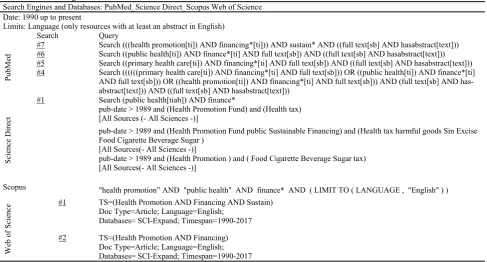
This was a comparative and qualitative study (policy analysis). Web of Science, PubMed, Science Direct, and Scopus were searched to find relevant studies conducted since 1990. In the comparative phase, the retrieved studies were reviewed. Presence of an English abstract as a search restriction was identified, and searching was done using
the search strategies (Table 1).
In the first step, articles were extracted: PubMed: 820, Web of Science: 1212, Science Direct: 752, Scopus: 506.
The articles were given to the authors for review of the abstracts and selection of more related articles; the num-ber of articles was reduced at the end of this step: Pub-Med: 115, Web of Science: 234, Science Direct: 175, Scopus: 86.
In the next step, the selected articles were fully read and the items were extracted based on the framework of the article.
Furthermore, to find more reports and documents, vari-ous databases, such as the World Health Organization (WHO), the World Bank, and Google search engine, were searched with the following key words: "Financing of Health Promotion Services" and "Health Tax". In this study, there were countries with experiences in sustainable financing of health promotion services, and there were also reliable and accessible sources and articles. The next criterion for choosing countries was their similarity to Iran in gross domestic product (GDP). Samples have also been selected from all economic systems around the world (eg, countries with free market economy, etc.). Therefore, all selected countries had one or more of the mentioned crite-ria (Australia, England, Germany, Japan, Turkey, Sweden, and Denmark).
In this study, to collect related data from the selected countries, a data extraction form, which was designed based on the purpose of the study, was used. To analyze and compare the data, comparative tables were used in this stage, which included comparing the dimensions ob-tained from the study of sustainable financing in the area
of health promotion in selected countries. Therefore, the comparative table was completed with the extracted data and it was the basis for analyzing and comparing the countries.
In the second phase of the research, by qualitative method of content analysis, the existing documents related to the topic were investigated from the beginning of the fourth program of economic, social and cultural develop-ment of IR. Iran (1985-2007). In this phase, all the policy documents dealing with the issue of sustainable financing for the improvement of health and the health system as a whole were purposely selected and analyzed during 2005-2017, which were as follow: fourth, fifth, and sixth pro-grams for social, economic, and cultural development of the country (3 documents); budget laws and their imple-menting rules (2005-2017) (26 documents); and docu-ments related to sustainable financing and promotion of health, including the law of the incorporation of certain articles into the law of regulating part of the financial reg-ulations of the government, the law of the permanent regulations of the country development plans, the law of value added tax, subsidy programs (5 documents), policies related to the provision of sustainable financing and pro-motion of health (9 documents), and other laws and doc-uments (17 docdoc-uments). After collecting the docdoc-uments, the four-step Scott method (Authentication, Validation, Data Representation, and Meaningfulness) was used to extract the desired documents. The originality of the Scott method means that the reference to these documents, di-rectives, and circulars is authentic. The criterion of validi-ty, referring to the belief in the objective and subjective components, has a source or message. Valid documents should not be misleading; they should be free of errors, and in general, should not have personal and organization-al advantage. Representation means that the examined
documents are representative of the general policies or specified keywords. Meaningfulness, the last step in the Scott method, means that the document is transparent and comprehensive and has some form of face and content validity, indicating that all the dimensions of appearance, format, and content are valid. The Scott method, which proposes a 4-step procedure for document review, has been used to extract the related documents in this study.
After implementing the Scott method, documents were explicitly and implicitly analyzed. Nvivo 8 software was used for content analysis.
Results
The findings of the comparative phase were divided into 4 areas: (1) the mode and type of health system budget allocation, (2) taxable goods and services, (3) the rules and regulations for obtaining taxes, and (4) stakeholders involved in sustainable financing of health promotion (22-27) (Table 2).
Based on the results of the analysis of documents relat-ed to sustainable financing of health promotion in Iran, 3 main issues and 11 sub issues were identified.
1- Financing
1-1 Sustainable financing:Increasing the health contri-bution of the GDP and the government budget; providing sustainable health financing in the health sector with an emphasis on transparency of incomes, costs and activities; allocating 40% of the health expenditure to free villagers' insurance program for providing first-level services by the Ministry of Health; increasing the price of drugs with an abusive potential by100%; using taxes and popular contri-butions to increase health care revenues; providing 5% of the total health resources from revenues from tourism therapy; allocating 10% refunds of the sin tax in Article
Table 1.Search strategies
Search Engines and Databases: PubMed_Science Direct_Scopus Web of Science Date: 1990 up to present
Limits: Language (only resources with at least an abstract in English)
PubM
ed
Search Query
#7 Search (((health promotion[ti]) AND financing*[ti])) AND sustain* AND ((full text[sb] AND hasabstract[text])) #6 Search ((public health[ti]) AND finance*[ti] AND full text[sb]) AND ((full text[sb] AND hasabstract[text])) #5 Search ((primary health care[ti]) AND financing*[ti] AND full text[sb]) AND ((full text[sb] AND hasabstract[text])) #4 Search ((((((primary health care[ti]) AND financing*[ti] AND full text[sb])) OR ((public health[ti]) AND finance*[ti]
AND full text[sb])) OR ((health promotion[ti]) AND financing*[ti] AND full text[sb])) AND (full text[sb] AND has-abstract[text])) AND ((full text[sb] AND hashas-abstract[text]))
#1 Search (public health[tiab]) AND finance*
Science Di
rect
pub-date > 1989 and (Health Promotion Fund) and (Health tax) [All Sources (- All Sciences -)]
pub-date > 1989 and (Health Promotion Fund public Sustainable Financing) and (Health tax harmful goods Sin Excise Food Cigarette Beverage Sugar )
[All Sources(- All Sciences -)]
pub-date > 1989 and (Health Promotion ) and ( Food Cigarette Beverage Sugar tax) [All Sources(- All Sciences -)]
Scopus "health promotion” AND "public health" AND finance* AND ( LIMIT TO ( LANGUAGE , "English" ) )
Web of Science
#1 TS=(Health Promotion AND Financing AND Sustain) Doc Type=Article; Language=English;
Databases= SCI-Expand; Timespan=1990-2017
#2 TS=(Health Promotion AND Financing) Doc Type=Article; Language=English; Databases= SCI-Expand; Timespan=1990-2017
Sustainable financing for health promotion services
38 (section A) of the value added tax law to improve the health and skills of employees; providing sustainable fi-nancing for the health sector; and the quantitative and qualitative development of health insurance.
1-2 Sin tax for unhealthy foods, sweetened beverages, and services: Providing a list of measures and unhealthy (or less healthy) foods, sweetened beverages & services,
and drugs; percentage of excise tax for the mentioned
commodities at the beginning of each year by the working group supervised by the Ministry of Health and Medical Education and with the membership of the Ministries of Economic Affairs and Finance, Commerce, Welfare and Social Security, Industries and Mines, and the Plan and Budget Organization; Prohibition of advertising health threatening goods; and setting tax on unhealthy foods, sweetened beverages, and services.
1-3 Tobacco tax: Taxing each packet of any kinds of cigarettes, pipe tobacco, and ready to use tobacco; impos-ing tax on cigarette retailers to reduce tobacco
consump-tion and to educate, prevent, and treat related illnesses; providing rehabilitation and treatment to those with com-plications resulting from tobacco consumption and pro-moting sports, especially general sports at schools; and limiting tobacco products entry by foreign travelers through collecting taxes (The VAT rate of tobacco prod-ucts is 12%.).
1-4 Value added tax (VAT): Allocating a percentage of VAT as a health tax.
1-5 Subsidy program: Allocating 10% of subsidy pro-gram, in addition to health sector budget, to health equity and reducing out-of-pockets to 30% of health costs; providing fair access to health services; helping to pay for catastrophic health expenses, drug coverage, offering treatment to those with specific or severe health problems; and reducing dependency in health care affairs.
1-6 Pollution charges: Obtaining pollution charges in cities with population of over 1 million to deal with envi-ronmental pollution and to help develop public
transporta-Table 2. Budget allocation, taxable goods, rules and regulations for obtaining taxes, and stakeholders involved in sustainable financing in the selected
countries
Obligations to collect taxes and the way to monitor the implementation
Stakeholders involved in the sus-tainable financing
Taxable goods and services Mode and type of health
system budget allocation
Countr
y
The tax on alcohol in terms of concentration in liters.
The tax on cigarettes with 0.8 grams of to-bacco per cigarette.
The rates have doubled according to con-sumer price index.
The tax on luxury cars based on the GST list. The tax on gambling varies from country to country
Ministry of Health and Paramedics Central government
State and local governments Tax office
People paying taxes Alcohol
Tobacco Luxury cars Gambling Global flexible budget
Allocation of the basis of service volume and service cost
Federal-controlled allocation Allocated tax method
Australia
The tax on alcohol and tobacco varies by type. In addition, general goods tax is also obtained
The gambling tax varies according to its type. National Medical Office
zonal and regional health offices Public funds managers Ministry of Finance Alcohol
Tobacco
Gambling Global flexible budget
Allocation based on priorities and constraints
E
ngland
In addition to 19% of the general tax, excise taxes are also imposed on these goods. Currently tobacco tax is 52%
Coffee taxes vary from $ 2.19 to $4.78 per kilo.
The alcohol tax varies depending on its type. Health insurance funds
Pension funds Fund and municipalities Federal government Local government Alcohol
Tobacco Coffee Energy tax on natural resources such as oil, coal and gas Global flexible budget
Allocation criteria: Quality of service, cost of services, volume of services, number of people covered by services
Germ
any
There are no tax revenues in this country specifically for healthcare costs. Federal and local government
Ministry of Health, Welfare and Finance
Alcohol Gasoline Tobacco Central budget
Local budget
Allocation and oversight by the government
Japan
In addition to 25% of the general tax, excise taxes are also levied on these goods Currently tobacco tax is 48.5%
The alcohol tax varies depending on its type The gambling tax is 30%
Department of Finance Local councils Ministry of Health Alcohol and
gam-bling Tobacco Fuel, energy, and motor vehicles Central budget
Allocation by local councils according to the councils and covered population
Sweden
The tax on alcohol varies according to the type and amount of alcohol.
All kinds of alcoholic beverages are taxed. The tax rate for tobacco is now 74%. Ministry of Health
Social Security Insurance Insurance funds Department of Finance Alcohol
Tobacco Central budget
By the Ministry of Health and allocations based on costs incurred and inflation rates
Tu
rk
ey
Alcohol is taxed as a consumable commodity. The tobacco tax rate is 54.75%.
Ministry of Health at the state level Local and regional governments Municipalities
Alcohol Tobacco Central budget based on
demographic and regional differences.
Municipalities and councils
Denmark
tion; and having oil refineries and petrochemical units pay 1% of their selling price as pollution costs until the elimi-nation of pollution.
2- Health promotion
2-1 Health and prevention:Promoting public health and education; controlling and preventing contagious diseases and pests; coping with and mitigating the effects of natural and public disasters as governance affairs; knowledge of prevention and promotion of health with an emphasis on high burden diseases and indigenous dilemmas; healthy lifestyle patterns consistent with the Islamic teachings; using indigenous nutrition patterns of health and technol-ogy priorities; informing people about dangers of cigarette smoke and tobacco products; setting bills and laws by the Ministry of Health to control tobacco; allocating at least 5% of public health budgets to health promotion; increas-ing the allocation of family doctor's resources and referral system to at least 50% of all health resources; and tobacco control at the national, regional, and international levels.
2-2 Reducing health risks: Preparing a bill to reduce health risks in the workplace, air, water, and soil, agricul-tural and livestock products pollutants and specification; the amount and method of collecting compensatory charg-es and offenscharg-es and the way of using rcharg-esourccharg-es should be approved in the parliament; and preventing the advertise-ment of services and health-damaging goods based on Article 48 of the incorporation law, and controlling the environmental pollution.
3- Justice in health
3-1 Reducing out-of-pocket payments:Allocating credit for vulnerable households in the annual budget bill; reduc-ing the share of low-income and vulnerable households in their health and treatment costs; developing a mechanism to cover those who cannot afford to participate; and using charities to pay high costs.
3-2 Expanding social insurance: Providing free basic insurance packages for all groups based on their afforda-bility through referral system and family physicians at university centers and charging a premium in the case they need more services; and allocating part of the subsidy program for provision of social insurance, health services, community health, and a coverage for drugs and treatment of refractory diseases.
3-3 Leveling health services: Designing a system for providing the minimum standard of health care services in the country based on service levels to provide fair access to health services, and rationalizing it in accordance with the needs of different regions.
Discussion
Conducting studies and evaluating sustainable financing in the field of health promotion can help to improve the general health, reduce the burden of diseases, and costs imposed on health systems (28). The present study aimed to investigate sustainable financing methods for health promotion services in 7 selected countries and to analyze the related documents in Iran. The effectiveness of
poli-cies developed in different countries and their impact on the consumption of unhealthy foods, sweetened beverages & services, and choosing the type of resources allocation from these policies to health promotion activities are 2 important issues in the sustainable financing of health promotion services. The findings of this study showed that excise tax on unhealthy foods, sweetened beverages & services, and allocation of these resources to health pro-motion services have been done in most of the studied countries. In this regard, the main products, with a maxi-mum agreement, were tobacco and alcohol. The analysis of documents in Iran also showed that attempts have been made to impose charges on tobacco products in the coun-try, which was first considered in Iran’s budget law in 2005; however, it has not been promoted as an accepted approach among all policymakers of the country. In other words, basic steps have been taken in this field, but more attention is needed to achieve effective outcomes. Gener-ally, taxing unhealthy foods, sweetened beverages & vices is a successful way to finance health promotion ser-vices. In these commodities, determining sin tax can lead to behavioral change and also provide appropriate re-sources for health promotion activities (29). Evans and Pabloos Mendez (2016) showed that settling taxes/sin tax on unhealthy foods, sweetened beverages & services and increasing the price had reduced their consumption. Thus, for 10% increase in the price of harmful commodities, the total consumption would be reduced to 4% in developed countries and 8% in developing countries (30). Good Child et al (2016), by examining the impact of an increase of $1 on a 20-digit cigarette pack in 181 countries and quantifying this impact, concluded that the increase in tobacco taxes, in addition to the impact of preventing the death rate and helping to achieve sustainable development goals, can be considered as an appropriate source for in-creasing the financial capacity of the health system (31). The price of cigarettes in Iran is very low compared to their global price, and due to their low price, the excise tax policy on them is in the early stages. By tax/sin tax levied on smoking as a control tool, the long-term public health can be improved and smoking can be reduced. Moreover, more taxes/charges on smoking and tobacco can create an important source of income and sustainable financing to control and prevent non-communicable diseases and pro-mote public health (32).
Based on the study findings, the use of capacities of so-cial insurance funds in Turkey and Germany is one of these methods. In Iran, the expansion of social insurance for health promotion services was shown in the analysis of policy documents. The same insurance methods used in the sustainable financing of health promotion services in Mongolia in the study of Bayarsayekhan and Nakamura (2009) also demonstrated the effectiveness of this financ-ing method. Although financfinanc-ing specification of health promotion services through social insurance is a new ap-proach, this study showed that in the long run, investing in health promotion services has a significant role in reduc-ing the costs of social insurance funds (21). Increasreduc-ing financial capacity in health promotion services, either through public funds or through social funds depending on
Sustainable financing for health promotion services
the country financing system, can lead to more preventive measures in this service.
The resources of taxes/sin tax can be used to reduce consumption, prevention, and treatment to develop educa-tion and to promote sports. One of the most important methods of reducing the consumption of unhealthy foods, sweetened beverages & services is to increase their prices and excise taxes. Various research studies have also ap-proved this method. Comparative findings and analysis of documents generally address the following 6 pillars: (1) access forbidden for minors, (2) consumption prohibition in public places, (3) providing more information to the public in terms of the risk of consumption, (4) providing a field of smoking cessation, (5) increasing prices through taxation, and (6) researching and monitoring about the implementation of these policies, which are the essential parts of the executive strategies.
Comparative research studies have some limitations. The information is published in the form of official reports on the websites of the Ministry of Health, and is often in Farsi, and not published in scientific journals, which makes it difficult to achieve comprehensive findings.
On the other hand, in the present study, although the ex-perience of different countries in the field of legal and policy issues has been addressed, the executive fate of the enacted laws remains unclear and the way of spending credits is not clear.
Conclusion
The present study showed that there are various ap-proaches to sustainable financing of health promotion services in selected countries and in Iran, including tax-es/sin tax on unhealthy foods, sweetened beverages & services, using the capacities of social insurance funds, and reliance on government public budget. The use of any of these methods or any combination of them depends on the political, social, and cultural structure of each country. Health stewardship in Iran in the policy documents is done by the Ministry of Health. Furthermore, managing the consumption and even interventions that can ultimately lead to the reduction of tobacco addiction should also be defined as health stewardship. In the policymaking sys-tem, there is also a need for harmonization of policies for the production, import, and distribution of tobacco and unhealthy foods, sweetened beverages & services. This monitoring should not be limited to monitoring and con-trolling the manufacturer and distributor. However, to date, no comprehensive policy has been put in place to address this issue and reduce the consumption of these commodities or their production and distribution process.
Acknowledgement
The present article was extracted from a Ph.D. thesis in College of Medical Science and Technology, Science and Research Branch, Islamic Azad University.
Conflict of Interests
The authors declare that they have no competing interests.
References
1.Lozano R, Naghavi M, Foreman K, Lim S, Shibuya K, Aboyans V, et al. Global and regional mortality from 235 causes of death for 20 age groups in 1990 and 2010: a systematic analysis for the Global Burden of Disease Study 2010. Lancet (London, England). 2012;380(9859):2095-128
2. Alikhani S, Delavari A, Alaedini F, Kelishadi R, Rohbani S, Safaei A. A province-based surveillance system for the risk factors of non-communicable diseases: A prototype for integration of risk factor surveillance into primary healthcare systems of developing countries. Public Health. 2009;123(5):358-64.
3.Beaglehole R, Bonita R, Horton R, Adams C, Alleyne G, Asaria P, et al. Priority actions for the non-communicable disease crisis. Lancet (London, England). 2011;377(9775):143.٤٧ -٨
4.Tangcharoensathien V, Prakongsai P, Patcharanarumol W, Limwattananon S, Buasai S. Innovative financing of health promotion. 2008.
5.Organization WH. Preventing chronic diseases: a vital investment: World Health Organization; 2005.
6.Hsiao WC. Why is a systemic view of health financing necessary? Health Aff. 2007;26(4):950-61.
7.Corbin JH, Mittelmark MB. Partnership lessons from the Global Programme for Health Promotion Effectiveness: a case study.Health Promot Int. 2008;23(4):365-71.
8.Akerman M, Arroyo H, Jones CM, O'Neil M, Roca A, Wallerstein N. Evaluation of health promotion effectiveness: a political debate and/or a technical exercise? Promot Educ. 2007;Suppl 1:13-5.
9.Woolf SH, Dekker MM, Byrne FR, Miller WD. Citizen-centered health promotion: building collaborations to facilitate healthy living. Am J Prev Med. 2011;40(1 Suppl 1):S38-47.
10.McManus A. Health promotion innovation in primary health care. Australas Med J. 2013;6(1):15-8.
11.Schieber G, Maeda A. Health care financing and delivery in developing countries. Health Aff. 1999;18(3):193-205.
12.McQuestion M, Gnawali D, Kamara C, Kizza D, Mambu-Ma-Disu H, Mbwangue J, et al .Creating sustainable financing and support for immunization programs in fifteen developing countries. Health Aff. 2011;30(6):1134-40.
13.Dain K. Sustainable financing: the Achilles heel of the non-communicable diseases response. Lancet Diabetes Endocrinol. 2015;3(12):923-5.
14.Kirigia JM, Preker A, Carrin G, Mwikisa C, Diarra-Nama AJ. An overview of health financing patterns and the way forward in the WHO African Region. East Afr Med J. 2006;83(9 Suppl):S1-28. 15.Moszynski P. Cambodia's AIDS strategy could fail without
sustainable financing. BMJ. 2010;341:c7301.
16.Andreyeva T, Long MW, Brownell KD. The impact of food prices on consumption: a systematic review of research on the price elasticity of demand for food. Am J Public Health. 2010;100(2):216-22.
17.Moodie R, Stuckler D, Monteiro C, Sheron N, Neal B, Thamarangsi T, et al. Profits and pandemics: prevention of harmful effects of tobacco, alcohol, and ultra-processed food and drink industries. Lancet (London, England). 2013;381(9867):670-9.
18.Mytton O, Gray A, Rayner M, Rutter H. Could targeted food taxes improve health? J Epidemiol Community Health. 2007;61(8):689-94. 19.Bayarsaikhan D. Financing health promotion in Japan and
Mongolia. Bulletin of the World Health Organization. 2008;86(11):896-7.
20.Bayarsaikhan D, Nakamura K. Health promotion financing with Mongolia's social health insurance. Asia-Pac J Public Health. 2015;27(2):887-96.
21.Bayarsaikhan D, Nakamura K. Health promotion financing with Mongolia's social health insurance. Asia-Pac J Public Health. 2009;21(4):399-409.
22.Cashin C, Sparkes S, Bloom D. Earmarking for health: from theory to practice. Geneva :World Health Organization; 2017. Report No.: 9241512202.
23.Vathesatogkit P, Lian T, Ritthiphakdee B. Health promotion fund: sustainable financing and governance. Bangkok: Thai Health Promotion Foundation. 2013.
24.Arsenijevic J, Groot W, Tambor M, Golinowska S, Sowada C, Pavlova M. A review of health promotion funding for older adults in Europe: a cross-country comparison. BMC Health Serv Res. 2016;16 Suppl 5:288.
25.Elovainio R, Evans DB. Raising more domestic money for health: prospects for low- and middle-income countries. Health Econ Policy Law. 2017;12(2):139-57.
26.Slama K. Background information for adopting a policy encouraging earmarked tobacco and alcohol taxes for the creation of health promotion foundations. Promot Educ. 2006;13(1):30-5, 56-62, 74-9.
27.Prakongsai P, Patcharanarumol W, Tangcharoensathien V. Can earmarking mobilize and sustain resources to the health sector? Bulletin of the World Health Organization. 2008;86(11):898-901. 28.Nam EW, De Leeuw E, Moon JY, Ikeda N, Dorjsuren B, Park MB.
Sustainable funding of health initiatives in Wonju, Republic of Korea via a tobacco consumption tax.Health Promot Int. 2011;26(4):457-64. 29.Jimenez-Ruiz JA, Saenz de Miera B, Reynales-Shigematsu LM, Waters HR, Hernandez-Avila M. The impact of taxation on tobacco consumption in Mexico. Tob Control. 2008;17(2):105-10.
30.Evans T, Pablos-Mendez A. Shaping of a new era for health financing. Lancet (London, England). 2016;387(10037):2482-4. 31.Goodchild M, Perucic AM, Nargis N. Modelling the impact of
raising tobacco taxes on public health and finance. Bulletin of the World Health Organization. 2016;94(4):250-7.
32.Banks C, Rawaf S, Hassounah S. Factors influencing the tobacco control policy process in Egypt and Iran: a scoping review. Glob Health Res Policy. 2017;2:19.