Southern African Journal of Anaesthesia and Analgesia is co-published by Medpharm Publications, NISC (Pty) Ltd and Informa UK Limited [trading as the Taylor & Francis Group]
South Afr J Anaesth Analg
ISSN 2220-1181 EISSN 2220-1173© 2017 The Author(s)
RESEARCH
Southern African Journal of Anaesthesia and Analgesia 2017; 23(4):90–95https://doi.org/10.1080/22201181.2017.1349361
Open Access article distributed under the terms of the Creative Commons License [CC BY-NC 3.0]
http://creativecommons.org/licenses/by-nc/3.0
Transversus abdominis plane block after Caesarean section in an area with
limited resources
Desale Tewelde Kahsaya*, Waltraud Elsholza and Habteselassie Zerezghi Bahtab
a Department of Anesthesia and Critical Care, Asmara College of Health Sciences, Asmara, Eritrea
b Department of Obstetrics and Gynecology, Orotta School of Medicine, Asmara, Eritrea
*Corresponding author, email: [email protected]
Background: The primary objective of this study was to assess whether transversus abdominis plane (TAP) block is effective as part of multimodal pain management following Caesarean section in an area with limited resources. The study also looked at the advantage of this block in reducing the consumption of morphine and diclofenac postoperatively.
Methods: After approval by the institutional ethics committee and informed consent of participants, 108 ASA I and II patients for Caesarean section under spinal anaesthesia were randomly allocated to either the TAP block group or the control. The TAP block group received a landmark-orientated, bilateral TAP block in the triangle of Petit. Postoperative pain treatment followed the same protocol for both groups. Visual analogue scale (VAS) pain scores were measured at 2, 4, 6, 8, 12, 18 and 24 h postoperatively. At the same time, consumption of diclofenac and morphine was measured and compared.
Results: No adverse effects of the TAP block were detected. VAS pain scores were significantly lower in the TAP block group at rest, deep breathing, intentional coughing, and mobilisation in all cases (p < 0. 05). Morphine and diclofenac consumption was significantly higher in the control group (p < 0. 001).
Conclusion: TAP block reduced the VAS pain scores significantly both at rest and during stressors. As a result, morphine and diclofenac consumption was significantly reduced in the TAP block group. Therefore, it is feasible to implement TAP block as part of a multimodal analgesia regimen after Caesarean section in a tertiary health care centre in a developing nation.
Keywords: Caesarean section, pain management, regional anaesthesia, transversus abdominis plane block, visual analogue scale
Introduction
Relief from pain is part of the fundamental human right to health.1 However, available evidence indicates an increasingly detailed understanding of the pathophysiology of pain and general inadequacy of its treatment.1 Lack of trained staff to deliver and monitor effective pain management is a known problem in low-income countries. Simple regimens, relying on inexpensive but effective drugs, could be employed but are often not followed due to inadequate healthcare systems.1,2 Consequently, many patients from low-income countries have no access even to basic postoperative pain therapy.2
One of the most common major operations in sub-Saharan Africa is Caesarean section.3 However, obstetric services including pain management are poorly developed.2 This poor pain management may result in significant suffering for mothers. Inadequate postoperative facilities, equipment and staff shortages limit the introduction of the more advanced options in low-income countries. At the same time, single-injection local anaesthetic blocks, which have a low incidence of adverse effects, are underutilised.2 One of the possible alternatives in postoperative pain treatment after abdominal surgery is the landmark-approach transversus abdominis plane block (TAP block). This technique is relatively simple and can be done in facilities with limited resources using locally available equipment, drugs and human resource.2,4
TAP block requires administration of a bolus of local anaesthetic into the transversus abdominis plane, a space between the internal oblique and transversus abdominis muscles.4 The landmark technique was first described in 2001 by Rafi5,6 as the one-pop technique and was modified by McDonnell who described a ‘two pop’ method using a blind insertion of a regional
anaesthesia needle perpendicular to the skin, just superior to the iliac crest and behind the mid-axillary line.5,7 McDonnell et al. have also shown that landmark-based TAP block can be used successfully to provide postoperative pain relief after Caesarean delivery.7 The reported success rate with the landmark technique was found to be around 85% amongst experienced practitioners.4
All the studies mentioned above were done in developed nations where there were adequate alternatives for pain management and sophisticated monitoring methods as well as well-trained health professionals who can detect and manage post-anaesthetic complications. The aim of this study was to establish if a TAP block provides sufficient pain relief in combination with low-dose systemic multimodal analgesics so that life-threatening side effects are unlikely to occur in an area where proper equipment and trained staff for postoperative monitoring are rare.
Methods
After approval of the institutional ethics committees (Ministry of Health) and informed consent, 108 ASA I and II mothers who presented for Caesarean section with Pfannenstiel incision under spinal anaesthesia were included in the study. Patients with any history of allergy to the drugs used in this study, obesity (body mass index ≥ 30 kg/m2), local infection at the injection site of the TAP, patients with cardiovascular, pulmonary and neurological diseases, patients requiring general anaesthesia for obstetric or anaesthetic reasons, patients undergoing upper segment Caesarean section and severe maternal or foetal compromise were excluded.
The page number in the footer is not for bibliographic referencing www.tandfonline.com/ojaa 21
Southern African Journal of Anaesthesia and Analgesia is co-published by Medpharm Publications, NISC (Pty) Ltd and Informa UK Limited
RESEARCH
Creative Commons License [CC BY-NC 3.0]http://creativecommons.org/licenses/by-nc/3.0
Transversus abdominis plane block after Caesarean section in an area with
limited resources
Desale Tewelde Kahsaya*, Waltraud Elsholza and Habteselassie Zerezghi Bahtab
a Department of Anesthesia and Critical Care, Asmara College of Health Sciences, Asmara, Eritrea
b Department of Obstetrics and Gynecology, Orotta School of Medicine, Asmara, Eritrea
*Corresponding author, email: [email protected]
Background: The primary objective of this study was to assess whether transversus abdominis plane (TAP) block is effective as part of multimodal pain management following Caesarean section in an area with limited resources. The study also looked at the advantage of this block in reducing the consumption of morphine and diclofenac postoperatively.
Methods: After approval by the institutional ethics committee and informed consent of participants, 108 ASA I and II patients for Caesarean section under spinal anaesthesia were randomly allocated to either the TAP block group or the control. The TAP block group received a landmark-orientated, bilateral TAP block in the triangle of Petit. Postoperative pain treatment followed the same protocol for both groups. Visual analogue scale (VAS) pain scores were measured at 2, 4, 6, 8, 12, 18 and 24 h postoperatively. At the same time, consumption of diclofenac and morphine was measured and compared.
Results: No adverse effects of the TAP block were detected. VAS pain scores were significantly lower in the TAP block group at rest, deep breathing, intentional coughing, and mobilisation in all cases (p < 0. 05). Morphine and diclofenac consumption was significantly higher in the control group (p < 0. 001).
Conclusion: TAP block reduced the VAS pain scores significantly both at rest and during stressors. As a result, morphine and diclofenac consumption was significantly reduced in the TAP block group. Therefore, it is feasible to implement TAP block as part of a multimodal analgesia regimen after Caesarean section in a tertiary health care centre in a developing nation.
Keywords: Caesarean section, pain management, regional anaesthesia, transversus abdominis plane block, visual analogue scale
Introduction
Relief from pain is part of the fundamental human right to health.1 However, available evidence indicates an increasingly detailed understanding of the pathophysiology of pain and general inadequacy of its treatment.1 Lack of trained staff to deliver and monitor effective pain management is a known problem in low-income countries. Simple regimens, relying on inexpensive but effective drugs, could be employed but are often not followed due to inadequate healthcare systems.1,2 Consequently, many patients from low-income countries have no access even to basic postoperative pain therapy.2
One of the most common major operations in sub-Saharan Africa is Caesarean section.3 However, obstetric services including pain management are poorly developed.2 This poor pain management may result in significant suffering for mothers. Inadequate postoperative facilities, equipment and staff shortages limit the introduction of the more advanced options in low-income countries. At the same time, single-injection local anaesthetic blocks, which have a low incidence of adverse effects, are underutilised.2 One of the possible alternatives in postoperative pain treatment after abdominal surgery is the landmark-approach transversus abdominis plane block (TAP block). This technique is relatively simple and can be done in facilities with limited resources using locally available equipment, drugs and human resource.2,4
TAP block requires administration of a bolus of local anaesthetic into the transversus abdominis plane, a space between the internal oblique and transversus abdominis muscles.4 The landmark technique was first described in 2001 by Rafi5,6 as the one-pop technique and was modified by McDonnell who described a ‘two pop’ method using a blind insertion of a regional
anaesthesia needle perpendicular to the skin, just superior to the iliac crest and behind the mid-axillary line.5,7 McDonnell et al. have also shown that landmark-based TAP block can be used successfully to provide postoperative pain relief after Caesarean delivery.7 The reported success rate with the landmark technique was found to be around 85% amongst experienced practitioners.4
All the studies mentioned above were done in developed nations where there were adequate alternatives for pain management and sophisticated monitoring methods as well as well-trained health professionals who can detect and manage post-anaesthetic complications. The aim of this study was to establish if a TAP block provides sufficient pain relief in combination with low-dose systemic multimodal analgesics so that life-threatening side effects are unlikely to occur in an area where proper equipment and trained staff for postoperative monitoring are rare.
Methods
After approval of the institutional ethics committees (Ministry of Health) and informed consent, 108 ASA I and II mothers who presented for Caesarean section with Pfannenstiel incision under spinal anaesthesia were included in the study. Patients with any history of allergy to the drugs used in this study, obesity (body mass index ≥ 30 kg/m2), local infection at the injection site of the TAP, patients with cardiovascular, pulmonary and neurological diseases, patients requiring general anaesthesia for obstetric or anaesthetic reasons, patients undergoing upper segment Caesarean section and severe maternal or foetal compromise were excluded.
Sample size calculation determined the sample size for randomised controlled trials. To the best of our knowledge, no previous study has used VAS pain scores in Eritrea. Therefore, the sample size determination in this study was based on the VAS
scores from a previous study conducted in Denmark.8 We considered a 30% reduction in VAS pain scores in TAP block to be clinically relevant. With a type I error of 0.05 and a type II error of 0.20, sample size calculation determined that 98 patients would be needed in the study. To allow for dropouts and exclusions, the researchers recruited an additional 10 patients for the study. After thorough pre-anaesthetic check-up for the possible presence of any problem that might put them into the exclusion criteria and informed consent to voluntary participation, patients were randomised by sealed envelopes of unknown contents, to undergo TAP block (n = 54) or to receive conventional care (n = 54).
All participants were monitored by non-invasive arterial blood pressure monitoring, electrocardiogram and pulse oximeter for the duration of the study period. After administration of IV metoclopramide 10 mg, a conventional spinal anaesthetic was initiated in sitting position with 10–12 mg 0.5% hyperbaric bupivacaine. Surgery was allowed to proceed after T6 to T4 sensory blockades to cold sensation had been established. IV crystalloids (normal saline/Ringer lactate) and ephedrine were administered as needed to treat hypotension. All patients received an IV infusion of oxytocin 30 IU after delivery. At the end of surgery patients in both groups received rectal paracetamol 1000 mg.
The TAP block group received a landmark-orientated bilateral TAP block in the triangle of Petit with 0.3 ml/kg body weight 0.25% isobaric bupivacaine in each side and the injection sites were covered with sterile gauze. Continuous aspiration of the syringes after every 5 ml of bupivacaine administration was maintained to avoid accidental injection of the drug to the blood vessels. Additionally, all mothers were strictly followed by the practitioner who performed the TAP block for any sign of local anaesthetic systemic toxicity (LAST) for one hour after administration of the drug. The TAP block was done immediately after the last suture. Therefore, the injection was painless and could not be detected by the patients as they were still under spinal anaesthesia and drapes from surgery still obstructed their view. After some non-invasive manipulations, the control group received only a sterile cover at the potential injection site.
Postoperative pain was evaluated, and possible complications were assessed, by trained, procedure-blinded nurse anaesthetists and physicians. Therefore, this clinical trial was conducted in a double-blinded manner, in which participants and the observers were blinded to group assignments. The practitioner who performed the TAP block did not participate in evaluating patients’ outcome. Hence, to decrease the risk of possible complications secondary to the procedure such as internal organ injury, researchers agreed to avoid placebo administration to the control group.
Postoperative management of pain followed the same protocol for both groups:
• Mild pain (visual analogue scale 0 to < 4 cm); Paracetamol 15 mg/kg orally every six hours for the first 24 h postopera-tively as a continuation of the rectal paracetamol.
• Moderate pain (visual analogue scale 4 to < 7 cm); in addi-tion to the paracetamol, diclofenac 1 mg/kg intramuscularly (IM) every 8 h was administered if required starting 2 h post-operatively for the first 24 postoperative hours.
• Severe pain (visual analogue scale 7–10 cm); in addition to paracetamol, patients received diclofenac 1 mg/kg IM every 8 h and morphine 0.1 mg/kg intravenously (IV) every 4 h as required starting at 2 h postoperatively for the first 24 post-operative hours.
Hence, patients received analgesics depending on the severity of reported pain. Every dose of morphine and diclofenac administered to each patient in 24 h was registered on a special report form prepared by the investigators. In the end, 24 hours’ diclofenac and morphine consumption was measured and compared.
VAS pain scores at rest and under stress (on deep breathing, intentional cough and mobilisation) were measured at 2, 4, 6, 8, 12, 18 and 24 h and treated accordingly. Respiratory depression (0 = SPO2 > 94 on room air and/or respiratory rate (RR) 12–20 breaths per minute, 1 = SPO2 90–94 on room air and/or RR 8–11 breaths per minute, 2 = SPO2 < 90 on room air, and/or RR < 8 breaths per minute), nausea and vomiting (0 = no nausea/ vomiting, 1 = nausea only, 2 = vomiting), sedation (0 = awake and alert, 1 = lightly sedated, 2 = asleep but rousable) and pruritus (0 = none, 1= mild, 2 = moderate to severe) were investigated at the same times and treated appropriately.
Data were entered and cleaned in Microsoft Excel® 2013 (Microsoft Corp, Redmond, WA, USA). The Statistical Package for Social Science Version 20 (SPSS® 20; IBM Corp, Armonk, NY, USA) was used to analyse the validated data. Demographic data were analysed using Student’s t-test or Fisher’s exact test as appropriate. VAS pain scores were reported as a mean ± standard deviation (SD) and were analysed using the t-test. The significance of post-Caesarean section morphine and diclofenac consumption between the two study groups was determined using Student’s t-test. The incidence of postoperative side effects was reported as numbers and percentages and significance was analysed using Fisher’s exact test. Chi-square for 2 × 3 contingency table was not applicable in this case since more than 20% of the cells had expected value of less than 5. Similarly, using Fisher’s exact test for a 2 × 3 table was not convenient. Therefore, researchers used a 2 × 2 table Fisher’s exact test to compare scores 1 and 2 separately using score 0 as a baseline. Results were defined as statistically significant when the p-value was less than 0.05.
Results
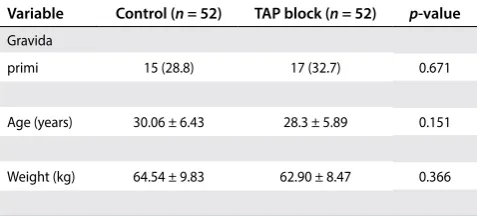
From the original sample size of 108, we had a total of four dropouts, two from each group (control and treatment group). Of the four dropouts, two patients had postoperative bleeding and received general anaesthesia for re-exploration of the abdomen, one patient who was scheduled for lower segment incision was changed to longitudinal incision, and the fourth patient declined continuous pain assessment after receiving the TAP block complaining that it was disturbing her sleep patterns. Both groups were comparable in gravida, age and weight; in all variables, the p-value was > 0.05 (Table 1).
Table 1: Demographic characteristic of patients in the two study groups
Note: Categorical data are presented as n (%), and continuous data are presented as mean ± SD.
Variable Control (n = 52) TAP block (n = 52) p-value
Gravida
primi 15 (28.8) 17 (32.7) 0.671
Age (years) 30.06 ± 6.43 28.3 ± 5.89 0.151
Southern African Journal of Anaesthesia and Analgesia 2017; 23(4)
The page number in the footer is not for bibliographic referencing www.tandfonline.com/ojaa 22
Transversus abdominis plane block after Caesarean section in an area with limited resources 92
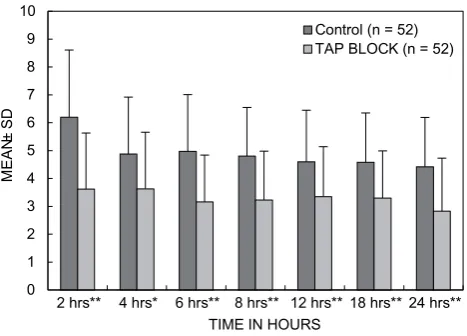
The visual analogue scale pain assessment during mobilisation was planned to start at 8 h, because of the inconvenience for mothers to move around the room with a urinary catheter in place in the first eight postoperative hours. Nevertheless, postoperative pain scores were significantly reduced (p < 0.05) at all time points in the TAP block group, both at rest (Figure 1), and during stressors (on deep breath, intentional coughing and mobilisation) (Figures 2, 3 and 4) respectively. Patients undergoing TAP block had reduced overall morphine and diclofenac requirements. TAP block reduced 24 h cumulative postoperative morphine consumption (95% CI 3.74–7.08; p < 0.001) and 24 h cumulative diclofenac consumption (95% CI 38.84–76.36; p < 0.001) (Table 2).
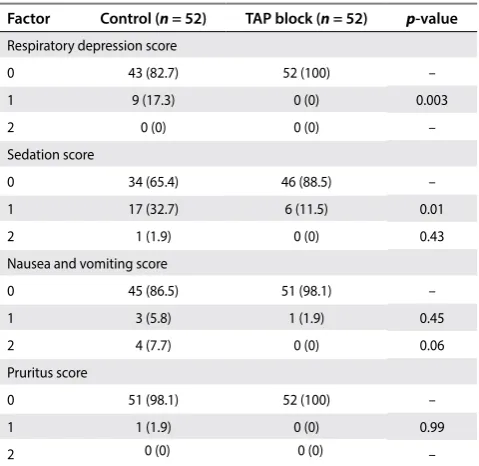
Side effects of the TAP block and morphine were observed over the first 24 postoperative hours. No side effects or complications were detected related to the injection of the TAP block. In patients who received the TAP block, postoperative respiratory depression score 1 was significantly reduced at 24 h postoperatively (0% vs. 17.3%; p = 0.003), but no patient had score 2 (severe) respiratory depressions in either of the study groups (Table 3). Even though more patients in the control group had postoperative nausea and vomiting, there was no statistically
significant difference between the two study groups; nausea (5.8% vs. 1.9%; p = 0.45) and vomiting (7.7% vs. 0%; p = 0.06) respectively (Table 3). When we looked at the postoperative sedation, patients who received the TAP block had a lower incidence of score 1 sedation (11.5% vs. 32.7%; p = 0.01). However, no significant difference was found in score 2 sedations (0% vs. 1.9%; p = 0.43). In the TAP block group, no patient had pruritus while in the control group there was one patient who had score 1 pruritus (see Table 3). No score 2 pruritus was found in either study group.
Discussion
TAP block has been considered to have a low incidence of complications. Only a few complications have been reported secondary to the TAP block: intrahepatic injection in a patient with hepatomegaly,9 intraperitoneal TAP catheter misplacement without abdominal organ damage and an anaphylactic reaction after ropivacaine injection.10,11 Short-term femoral nerve palsy is a potential complication because of the proximity of the TAP and the femoral nerve.4 Even though reported systemic toxicity was not found in the literature as a complication of TAP block, it remains a possibility. In our study, no complications were found that could be attributed to the TAP block, but they should be kept in mind while performing the block.
0 1 2 3 4 5 6
2 hrs** 4 hrs* 6 hrs** 8 hrs** 12 hrs** 18 hrs* 24 hrs*
MEAN
±S
D
TIME IN HOURS
Control (n = 52) TAP BLOCK (n = 52)
Figure 1: Visual analogue scale pain scores at rest in each group over the first 24 postoperative hours. Boxes represent mean, the middle line in each box represents ± standard deviation. *p < 0.05; **p < 0.001.
0 1 2 3 4 5 6 7 8
2 hrs ** 4 hrs ** 6 hrs ** 8 hrs ** 12 hrs ** 18 hrs * 24 hrs *
MEAN
±S
D
TIME IN HOURS
Control (n = 52) TAP BLOCK (n = 52)
Figure 2: Visual analogue scale pain scores during a deep breath in each group over the first 24 postoperative hours. Boxes represent mean, the middle line in each box represents ± standard deviation. *p < 0.05; **p
< 0.001.
Table 2: Morphine and diclofenac consumption during the first 24 postoperative hours
Note: Data are presented as mean ± SD and 95% confidence interval. Factor Mean ± SD Mean ± SD 95% CI p-value
Morphine (mg) con-sumption in 24 h
6.23 ± 5.62 0.82 ± 2.43 3.74–7.08 < 0.001
Diclofenac (mg) con-sumption in 24 h
144.81 ± 46.23 87.21 ± 51.20 38.84–76.36 < 0.001
Table 3: Incidence of postoperative side effects due to the administration of systemic morphine
Note: Data are presented as n (%).
Factor Control (n = 52) TAP block (n = 52) p-value
Respiratory depression score
0 43 (82.7) 52 (100) –
1 9 (17.3) 0 (0) 0.003
2 0 (0) 0 (0) –
Sedation score
0 34 (65.4) 46 (88.5) –
1 17 (32.7) 6 (11.5) 0.01
2 1 (1.9) 0 (0) 0.43
Nausea and vomiting score
0 45 (86.5) 51 (98.1) –
1 3 (5.8) 1 (1.9) 0.45
2 4 (7.7) 0 (0) 0.06
Pruritus score
0 51 (98.1) 52 (100) –
1 1 (1.9) 0 (0) 0.99
23 The visual analogue scale pain assessment during mobilisation
was planned to start at 8 h, because of the inconvenience for mothers to move around the room with a urinary catheter in place in the first eight postoperative hours. Nevertheless, postoperative pain scores were significantly reduced (p < 0.05) at all time points in the TAP block group, both at rest (Figure 1), and during stressors (on deep breath, intentional coughing and mobilisation) (Figures 2, 3 and 4) respectively. Patients undergoing TAP block had reduced overall morphine and diclofenac requirements. TAP block reduced 24 h cumulative postoperative morphine consumption (95% CI 3.74–7.08; p < 0.001) and 24 h cumulative diclofenac consumption (95% CI 38.84–76.36; p < 0.001) (Table 2).
Side effects of the TAP block and morphine were observed over the first 24 postoperative hours. No side effects or complications were detected related to the injection of the TAP block. In patients who received the TAP block, postoperative respiratory depression score 1 was significantly reduced at 24 h postoperatively (0% vs. 17.3%; p = 0.003), but no patient had score 2 (severe) respiratory depressions in either of the study groups (Table 3). Even though more patients in the control group had postoperative nausea and vomiting, there was no statistically
significant difference between the two study groups; nausea (5.8% vs. 1.9%; p = 0.45) and vomiting (7.7% vs. 0%; p = 0.06) respectively (Table 3). When we looked at the postoperative sedation, patients who received the TAP block had a lower incidence of score 1 sedation (11.5% vs. 32.7%; p = 0.01). However, no significant difference was found in score 2 sedations (0% vs. 1.9%; p = 0.43). In the TAP block group, no patient had pruritus while in the control group there was one patient who had score 1 pruritus (see Table 3). No score 2 pruritus was found in either study group.
Discussion
TAP block has been considered to have a low incidence of complications. Only a few complications have been reported secondary to the TAP block: intrahepatic injection in a patient with hepatomegaly,9 intraperitoneal TAP catheter misplacement without abdominal organ damage and an anaphylactic reaction after ropivacaine injection.10,11 Short-term femoral nerve palsy is a potential complication because of the proximity of the TAP and the femoral nerve.4 Even though reported systemic toxicity was not found in the literature as a complication of TAP block, it remains a possibility. In our study, no complications were found that could be attributed to the TAP block, but they should be kept in mind while performing the block.
0 1 2 3 4 5 6
2 hrs** 4 hrs* 6 hrs** 8 hrs** 12 hrs** 18 hrs* 24 hrs*
MEAN
±S
D
TIME IN HOURS
Control (n = 52) TAP BLOCK (n = 52)
Figure 1: Visual analogue scale pain scores at rest in each group over the first 24 postoperative hours. Boxes represent mean, the middle line in each box represents ± standard deviation. *p < 0.05; **p < 0.001.
0 1 2 3 4 5 6 7 8
2 hrs ** 4 hrs ** 6 hrs ** 8 hrs ** 12 hrs ** 18 hrs * 24 hrs *
MEAN
±S
D
TIME IN HOURS
Control (n = 52) TAP BLOCK (n = 52)
Figure 2: Visual analogue scale pain scores during a deep breath in each group over the first 24 postoperative hours. Boxes represent mean, the middle line in each box represents ± standard deviation. *p < 0.05; **p
< 0.001.
Table 2: Morphine and diclofenac consumption during the first 24 postoperative hours
Note: Data are presented as mean ± SD and 95% confidence interval. Factor Mean ± SD Mean ± SD 95% CI p-value
Morphine (mg) con-sumption in 24 h
6.23 ± 5.62 0.82 ± 2.43 3.74–7.08 < 0.001
Diclofenac (mg) con-sumption in 24 h
144.81 ± 46.23 87.21 ± 51.20 38.84–76.36 < 0.001
Table 3: Incidence of postoperative side effects due to the administration of systemic morphine
Note: Data are presented as n (%).
Factor Control (n = 52) TAP block (n = 52) p-value
Respiratory depression score
0 43 (82.7) 52 (100) –
1 9 (17.3) 0 (0) 0.003
2 0 (0) 0 (0) –
Sedation score
0 34 (65.4) 46 (88.5) –
1 17 (32.7) 6 (11.5) 0.01
2 1 (1.9) 0 (0) 0.43
Nausea and vomiting score
0 45 (86.5) 51 (98.1) –
1 3 (5.8) 1 (1.9) 0.45
2 4 (7.7) 0 (0) 0.06
Pruritus score
0 51 (98.1) 52 (100) –
1 1 (1.9) 0 (0) 0.99
2 0 (0) 0 (0) –
transverse surgery that extends for at least the first 48 postoperative hours.18 Similarly, another retrospective study conducted by Yoshiyama et al.19 showed posterior TAP block technique to be more efficient than lateral TAP block in laparoscopic gynaecologic surgery, which needs to be confirmed in randomised clinical trials of other operations including Caesarean section.
We found lower VAS pain scores and opioid consumption in both our study groups compared with other studies.11,13,14 There are different possible explanations: in Orotta Maternity National Referral Hospital pain management is in an early state; no standard labour and post-Caesarean section pain management protocols exist. No analgesia is administered for labour pain, and clinicians rarely try to manage post-Caesarean section pain using diclofenac intramuscularly (IM) unless mothers complain of severe pain. However, during the study period, researchers drafted a new pain management protocol considering the available resources in the country and the study area to ensure adequate intervention. Most of the patients who participated in this study were multiparas. As a result, they might have easily appreciated that they had relatively less pain compared with previous experiences or with other patients in the same room who were not included in the study and therefore tended to report lower VAS pain scores, which led to the reduced morphine consumption in both study groups. Similarly, the low average weight of the mothers in this study group might also make a contribution to the relatively higher success rate of TAP block that resulted in lower VAS pain score.
Furthermore, in previous studies of TAP block, most opioids were administered using patient-controlled analgesia (PCA) that required special instrumentation and well-trained nurses to take care of the patients.7,11–14 In these cases, the opioid requirement was determined by calculating the amount of morphine consumed at a particular time depending on the patient’s needs, no matter how severe the pain. On the other hand, PCA is not available in many of the low-income countries. Therefore, patients in this study received morphine only if they had reported severe pain according to the VAS pain score. Every dose of morphine and diclofenac administered to each patient in 24 h was registered in a special document prepared by the investigators. Finally, the amount of morphine and diclofenac administered, depending on the reported VAS pain score, was measured and compared. In consequence of these methodological differences between the current and previous studies, relatively less morphine consumption might have also resulted.
The cultural background of our patients might have also contributed to low morphine consumption as societal attitudes toward pain relief illustrate the complex interactions between cultural concepts of pain, pain relief and human behaviour.1 The perception and intensity of pain during childbirth is profoundly influenced by the cultural and social background of mothers. In Western society, the availability of relatively better analgesics and their use and the assumption that health professionals are accountable for pain relief may be associated with greater expression of pain.20 On the other hand, in developing countries where resources to manage pain are very limited, pain after surgery and during childbirth can be considered to be natural and inevitable. Therefore, mothers may cry inwardly without showing any sign of pain.21 Also, women who were active in their religious faith seemed to accept pain as an important part of life and relied on a higher power to give them strength.21,22 Even The clinical efficacy of the TAP block has been demonstrated in
different randomised controlled clinical trials of adults undergoing both lower and upper abdominal surgeries.7,8,12 Most reports showed the effectiveness of TAP blocks by looking at reduced postoperative opioid requirement, lower pain scores and reduction in opioid-related side effects. Jankovic reviewed the development of TAP block within 10 years, considering both landmark technique and ultrasound-guided technique. He summarised that several of the randomised controlled single-shot TAP block studies showed this to be effective up to 48 h and to decrease postoperative morphine consumption by 70–85%.4 Other studies confirmed the effectiveness after Caesarean section with lower pain scores, less opioid requirement and thereby fewer side effects.11,13–15
Even though the effect of TAP block as multimodal analgesia has been confirmed in different randomised clinical trials,11,13–17 whether posterior and lateral approach TAP block have differences in efficacy and duration of analgesic effect has remained controversial. However, in one meta-analysis study, the posterior TAP block technique appeared to have more prolonged analgesia effect than the lateral TAP block in lower abdominal
0 1 2 3 4 5 6 7 8 9 10
2 hrs** 4 hrs* 6 hrs** 8 hrs** 12 hrs** 18 hrs** 24 hrs**
MEAN
±S
D
TIME IN HOURS
Control (n = 52) TAP BLOCK (n = 52)
Figure 3: Visual analogue scale pain scores during an intentional cough in each group over the first 24 postoperative hours. Boxes represent mean, the middle line in each box represents ± standard deviation. *p < 0.05; **p < 0.001.
0 1 2 3 4 5 6 7
8 hrs** 12 hrs* 18 hrs** 24 hrs**
MEAN
±S
D
TIME IN HOURS
Control (n = 52) TAP BLOCK (n = 52)
Southern African Journal of Anaesthesia and Analgesia 2017; 23(4)
The page number in the footer is not for bibliographic referencing www.tandfonline.com/ojaa 24
Transversus abdominis plane block after Caesarean section in an area with limited resources 94
significant (nausea 5.8% vs. 1.9%, p = 0.45 and vomiting 7.7% vs. 0%, p = 0.06) (see Table 2). In this study, both groups were similar regarding administration of spinal anaesthesia, operative technique and administration of metoclopramide; therefore we believe that the difference in the incidence of nausea and vomiting between the TAP block and control group is attributed mainly to the differences in the consumption of opioids.
In several studies, sedation was significantly reduced for TAP block compared with placebo.12,14 In line with the above reports, we found a significant difference in the score 1 sedation (34.5% vs. 11.5%, p = 0.01) in favour of the TAP group. Relevant differences in pruritus were not found as there was only one patient who developed score 1 (mild) pruritus from the control group (Table 2).
We had two potential limitations on the timing of the postoperative pain assessment. First, postoperative pain assessment was planned to be started 2 h after completion of skin closure, assuming the analgesia effect of spinal anaesthesia would stay for an average of 2 h. However, as indicated in the results (see Figures 1, 2, 3 and 4), the highest VAS pain score was reported at 2 h, mainly in the control groups, in all situations (at rest, and on breathing, coughing and mobilisation). This result can tell us now that, many patients might have suffered from significant pain before the two postoperative hours. Second, the study was limited to the first 24 postoperative hours, though at 24 postoperative hours the VAS pain score still showed a significant difference between the two groups, which suggests that the TAP block duration of analgesia effect may extend well beyond 24 postoperative hours. Even though the patients’ abdomens were not examined, and dressings covered the TAP block sites in all participants, adequate blinding of the study cannot be assured because of the loss of sensation in the abdomen and swelling at the location of the local anaesthetic injection in the TAP block group.
Conclusion
Based on our findings, it is both feasible and relatively safe to implement TAP block as part of a multimodal analgesia regimen after Caesarean section in a tertiary health care centre in developing nations. It reduces pain and its adverse effects on postoperative recovery. It reduces NSAID and opiate consumption and thereby potential side effects of those drugs to a non-dangerous level. In the environment of low-income nations, where adequate pain treatment is at a very early stage due to lack of appropriately trained staff and advanced technology to detect early opioid side effects, the single-shot TAP block performed by trained anaesthetists offers considerable advantages concerning the effectiveness of pain management.
Acknowledgements – The authors would like to thank the Eritrea Research Fund for sponsoring the research, and Mr Fitsum Kibreab, a statistician in the Department of Communicable Diseases Control, for his statistical analysis.
Funding – The Eritrean Research Fund sponsored all the work of this study. It made no contribution to conducting the research.
Conflict of interest – The authors declare that the research was conducted in the absence of any commercial or financial relationships that could be construed as a potential conflict of interest. Therefore, they declare that they have no financial or personal relationship which may have inappropriately influenced them in writing this paper.
though how the religious background of mothers has affected the intensity of pain and morphine consumption was not the scope of this study, the fact that almost all Eritreans are either Muslims or Christians might have an effect on the reported less pain and this may need further study.
We could find no studies showing that a TAP block reduced the postoperative use of non-steroidal anti-inflammatory drugs (NSAIDs). NSAIDs were usually administered in a regular time-based manner.14,15 In our study, we found a significant reduction of diclofenac consumption (40%, p < 0.001) in patients with TAP block as diclofenac was administered every 8 h only if a mother reported moderate to severe pain (VAS > 4 cm). As Abdallah et al.23 suggested, patients with conditions that prohibit them from taking NSAIDs (allergy, peptic ulcer, abnormal platelets and renal impairment) might benefit from TAP block.
Higher intensity pain was recorded during an intentional cough and mobilisation in both study groups. Patients who are comfortable at rest may have significant pain during coughing and mobilisation, which, in turn, could interfere with the normal physiology and daily activity of the mother. Poorly controlled pain under these circumstances may produce a range of detrimental acute adverse physiologic responses, including decreased respiratory motion, cough and sputum excretion leading to atelectasis, retention of secretions and pneumonia.24 Caesarean section patients have additional compelling reasons to receive adequate pain relief, as early mobilisation is a key factor in reducing the risk of thromboembolic disease, which is increased during pregnancy. Besides, these patients need to be pain free to care for their newborns and to breastfeed them effectively5. Sousa et al.25 conducted a research study to measure and to characterise the post-Caesarean section pain and verify its relationship with daily activity limitations. The daily activity limitations were present for 100% of the participants related to sitting down and standing up, 95% regarding walking, and 55% concerning personal hygiene. Pain that occurs during mobilisation, particularly after a Caesarean section, delays bonding, good breastfeeding, self-care, newborn care and limits daily activities.26
The incidence of postoperative respiratory depression secondary to opioids is not known but is probably low.5 Despite this, frequent monitoring of vital signs and respiratory patterns is necessary to prevent such rare complications.5 In developing nations this is a real problem due to lack of well-trained staff and advanced technology to detect early adverse respiratory events. One of the main reasons for the small amount of opioid prescribed is fear of undetected potentially dangerous side effects (personal observation). In our study, nine (17.3%) patients in the control group had a score of 1 (SpO2 90–94) for respiratory depression, which was easily treated by 2 litres/minute of oxygen. There was no respiratory depression in the TAP group.
25 significant (nausea 5.8% vs. 1.9%, p = 0.45 and vomiting 7.7% vs.
0%, p = 0.06) (see Table 2). In this study, both groups were similar regarding administration of spinal anaesthesia, operative technique and administration of metoclopramide; therefore we believe that the difference in the incidence of nausea and vomiting between the TAP block and control group is attributed mainly to the differences in the consumption of opioids.
In several studies, sedation was significantly reduced for TAP block compared with placebo.12,14 In line with the above reports, we found a significant difference in the score 1 sedation (34.5% vs. 11.5%, p = 0.01) in favour of the TAP group. Relevant differences in pruritus were not found as there was only one patient who developed score 1 (mild) pruritus from the control group (Table 2).
We had two potential limitations on the timing of the postoperative pain assessment. First, postoperative pain assessment was planned to be started 2 h after completion of skin closure, assuming the analgesia effect of spinal anaesthesia would stay for an average of 2 h. However, as indicated in the results (see Figures 1, 2, 3 and 4), the highest VAS pain score was reported at 2 h, mainly in the control groups, in all situations (at rest, and on breathing, coughing and mobilisation). This result can tell us now that, many patients might have suffered from significant pain before the two postoperative hours. Second, the study was limited to the first 24 postoperative hours, though at 24 postoperative hours the VAS pain score still showed a significant difference between the two groups, which suggests that the TAP block duration of analgesia effect may extend well beyond 24 postoperative hours. Even though the patients’ abdomens were not examined, and dressings covered the TAP block sites in all participants, adequate blinding of the study cannot be assured because of the loss of sensation in the abdomen and swelling at the location of the local anaesthetic injection in the TAP block group.
Conclusion
Based on our findings, it is both feasible and relatively safe to implement TAP block as part of a multimodal analgesia regimen after Caesarean section in a tertiary health care centre in developing nations. It reduces pain and its adverse effects on postoperative recovery. It reduces NSAID and opiate consumption and thereby potential side effects of those drugs to a non-dangerous level. In the environment of low-income nations, where adequate pain treatment is at a very early stage due to lack of appropriately trained staff and advanced technology to detect early opioid side effects, the single-shot TAP block performed by trained anaesthetists offers considerable advantages concerning the effectiveness of pain management.
Acknowledgements – The authors would like to thank the Eritrea Research Fund for sponsoring the research, and Mr Fitsum Kibreab, a statistician in the Department of Communicable Diseases Control, for his statistical analysis.
Funding – The Eritrean Research Fund sponsored all the work of this study. It made no contribution to conducting the research.
Conflict of interest – The authors declare that the research was conducted in the absence of any commercial or financial relationships that could be construed as a potential conflict of interest. Therefore, they declare that they have no financial or personal relationship which may have inappropriately influenced them in writing this paper.
though how the religious background of mothers has affected the intensity of pain and morphine consumption was not the scope of this study, the fact that almost all Eritreans are either Muslims or Christians might have an effect on the reported less pain and this may need further study.
We could find no studies showing that a TAP block reduced the postoperative use of non-steroidal anti-inflammatory drugs (NSAIDs). NSAIDs were usually administered in a regular time-based manner.14,15 In our study, we found a significant reduction of diclofenac consumption (40%, p < 0.001) in patients with TAP block as diclofenac was administered every 8 h only if a mother reported moderate to severe pain (VAS > 4 cm). As Abdallah et al.23 suggested, patients with conditions that prohibit them from taking NSAIDs (allergy, peptic ulcer, abnormal platelets and renal impairment) might benefit from TAP block.
Higher intensity pain was recorded during an intentional cough and mobilisation in both study groups. Patients who are comfortable at rest may have significant pain during coughing and mobilisation, which, in turn, could interfere with the normal physiology and daily activity of the mother. Poorly controlled pain under these circumstances may produce a range of detrimental acute adverse physiologic responses, including decreased respiratory motion, cough and sputum excretion leading to atelectasis, retention of secretions and pneumonia.24 Caesarean section patients have additional compelling reasons to receive adequate pain relief, as early mobilisation is a key factor in reducing the risk of thromboembolic disease, which is increased during pregnancy. Besides, these patients need to be pain free to care for their newborns and to breastfeed them effectively5. Sousa et al.25 conducted a research study to measure and to characterise the post-Caesarean section pain and verify its relationship with daily activity limitations. The daily activity limitations were present for 100% of the participants related to sitting down and standing up, 95% regarding walking, and 55% concerning personal hygiene. Pain that occurs during mobilisation, particularly after a Caesarean section, delays bonding, good breastfeeding, self-care, newborn care and limits daily activities.26
The incidence of postoperative respiratory depression secondary to opioids is not known but is probably low.5 Despite this, frequent monitoring of vital signs and respiratory patterns is necessary to prevent such rare complications.5 In developing nations this is a real problem due to lack of well-trained staff and advanced technology to detect early adverse respiratory events. One of the main reasons for the small amount of opioid prescribed is fear of undetected potentially dangerous side effects (personal observation). In our study, nine (17.3%) patients in the control group had a score of 1 (SpO2 90–94) for respiratory depression, which was easily treated by 2 litres/minute of oxygen. There was no respiratory depression in the TAP group.
Multiple factors can cause nausea and vomiting during spinal anaesthesia for Caesarean section. However, hypotension which decreases cerebral blood flow that results in hypoxia, irritation of the abdominal viscera that transmit the stimuli via the vagus nerve to stimulate the vomiting centre, and administration of opioids are considered to be the most common causes.27,28 After TAP block, differences in nausea and vomiting and pruritus were controversial in the literature, though most publications describe a higher incidence in the control groups for nausea and vomiting.1,12,14–16 Similarly, in our study, more patients in the control group had nausea and vomiting in the first 24 postoperative hours, though the difference was not statistically
16. McMorrow RCN, Ni Mhuircheartaigh RJ, Ahmed KA, et al. Comparison of transversus abdominis plane block vs spinal morphine for pain relief after Caesarean section. Br J Anaesth. 2011;106(5):706–12. https://doi.org/10.1093/bja/aer061
17. Carney J, McDonnell JG, Ochana A, et al. The transversus abdominis plane block provides effective postoperative analgesia in patients undergoing total abdominal hysterectomy. Anesth Analg. 2008;107(6):2056–60. https://doi.org/10.1213/ ane.0b013e3181871313
18. Abdallah FW, Laffey JG, Halpern SH, et al. Duration of analgesic effectiveness after the posterior and lateral transversus abdominis plane block techniques for transverse lower abdominal incisions: A meta-analysis. Br J Anaesth. 2013;111(5):721–35. https://doi. org/10.1093/bja/aet214
19. Yoshiyama S, Ueshima H, Sakai R, et al. A posterior TAP block provides more effective analgesia than a lateral TAP block in patients undergoing laparoscopic gynecologic surgery: a retrospective study. Anesthesiol Res Pract. 2016;2016(1895):1–5.
20. Callister LC. Cultural Influences on Pain Perceptions and Behaviors. Home Health Care Manag Pract [Internet]. 2003;15(3):207–11. Available from:http://journals.sagepub.com/doi/10.1177/1084822302250687 21. Aziato L, Acheampong AK, Umoar KL. Labour pain experiences
and perceptions: a qualitative study among post-partum women in Ghana. BMC Pregnancy Childbirth [Internet]. 2017;17(1):73. Available from:http://bmcpregnancychildbirth.biomedcentral.com/ articles/10.1186/s12884-017-1248-1
22. Chiejina EN, Odira CC, Sibeudu FT, et al. Childbirth pain perception and behaviour: socio-cultural diversity. Am J Sci Res. 2012;75:40–6. 23. Abdallah FW, Halpern SH, Margarido CB. Transversus abdominis
plane block for postoperative analgesia after Caesarean delivery performed under spinal anaesthesia? A systematic review and meta-analysis. Br J Anaesth [Internet]. 2012;109(5):679–87. Available from: https://academic.oup.com/bja/article/109/5/679/306519
24. Nalini Vadivelu MD, Mitra S, Narayan D. Recent advances in postoperative pain management. Yale J Biol Med. 2010;83:11–25. 25. Sousa L De, Pitangui ACR, Gomes FA, et al. Measurement and
characteristics of post-cesarean section pain and the relationship to limitation of physical activities*. Acta. 2009;22(6): 741–7
26. Granot M, Lowenstein L, Yarnitsky D, et al. Postcesarean section pain prediction by preoperative experimental pain assessment. Anesthesiol [Internet]. 2003;98(6):1422–6. Available from: http:// www.ncbi.nlm.nih.gov/pubmed/12766652
27. Datta S. Obstetric Anesthesia Handbook. 4th ed. Boston, MA: Hanley & Belfus;2006.
28. Shahriari A, Khooshideh M, Heidari MH. Prevention of nausea and vomiting in caesarean section under spinal anaesthesia with midazolam or metoclopramide? J Pak Med Assoc. 2009;59(11):756–9.
Received: 11-03-2017 Accepted: 28-06-2017
References
1. Brennan F, Carr DB, Cousins M. Pain management: a fundamental human right. Anesth Analg. 2007;105(1):205–21. https://doi.org/10.1213/01.ane.0000268145.52345.55
2. Size M, Soyannwo OA, Justins DM. Pain management in developing countries. Anaesthesia. 2007;62(1):38–43. https://doi.org/10.1111/ ana.2007.62.issue-s1
3. Ajayi OO. Surgery in Nigeria. Arch Surg [Internet]. 1999;134(2):[206– 11]. Available from: http://archsurg.jamanetwork.com/article. aspx?doi=10.1001/archsurg.134.2.206
4. Jankovic Z. Transversus abdominis plane block: the holy grail of anaesthesia for (lower) abdominal surgery. Period Biol. 2009;111(2):203–8.
5. Ismail S. What is new in postoperative analgesia after caesarean sections? Anaesthesia, Pain Intensive Care. 2012;16(2):123–6. 6. Rafi AN. Abdominal field block via the lumbar triangle revisited.
Anaesthesia. 2012;67(12):1399–401. https://doi.org/10.1111/anae.12077 7. McDonnell JG, O’Donnell B, Curley G, et al. The analgesic efficacy
of transversus abdominis plane block after abdominal surgery: a prospective randomized controlled trial. Anesth Analg. 2007;104(1): 193–7. https://doi.org/10.1213/01.ane.0000250223.49963.0f
8. Petersen PL, Stjernholm P, Kristiansen VB, et al. The beneficial effect of transversus abdominis plane block after laparoscopic cholecystectomy in day-case surgery: a randomized clinical trial. Anesth Analg. 2012;115(3):527–33.
9. Farooq MCM. A Case of Liver Trauma With a Blunt Regional Anesthesia Needle While Performing Transversus Abdominis Plane Block. Reg Anesth Pain Med [Internet]. 2008;33(3):274–5. Available from:https:// www.ncbi.nlm.nih.gov/pubmed/18433683
10. Jankovic Z, Ahmad N, Ravishankar N AF. Transversus Abdominis Plane Block: How Safe is it?. Anesth Analg [Internet]. 2008;107(5):1758–9. Available from:https://insights.ovid.com/pubmed?pmid=18931248 11. Belavy D, Cowlishaw PJ, Howes M, et al. Ultrasound-guided
transversus abdominis plane block for analgesia after Caesarean delivery. Br J Anaesth. 2009;103(5):726–30. https://doi.org/10.1093/ bja/aep235
12. Hussein M, Youssef K, Hassan M. Comparative Study between Continuous transversus abdominis plane block and ON-Q anesthetic pump for postoperative analgesia following caesarean section. Life Sci J. 2012;9(1s):179–83.
13. Baaj JM, Alsatli RA, Majaj HA, et.al. Efficacy of ultrasound-guided transversus abdominis plane (TAP) block for post-cesarean section delivery analgesia: a double-blind, placebo-controlled. Randomized Study. Middle East J Anesthesiol. 2010;20(6):821–6.
14. McDonnell JG, Curley G, Carney J, et al. The analgesic efficacy of transversus abdominis plane block after cesarean delivery: a randomized controlled trial. Anesth Analg. 2008;106(1):186–91. https://doi.org/10.1213/01.ane.0000290294.64090.f3