INTEGRATED RESOURCE PLANNING AND INCENTIVE REGULATION
Patrick C. Mann
Professor of Economics West Virginia UniversityINTRODUCTION
For state-regulated investor-owned utilities, integrated resource planning is not easily divorced from the issue of incen tive regulation (Beecher, et al., 1991 and 1994). Least-cost planning can an d has been im plemented under traditional rate base/r ate-of-retur n regul ation. E xperien ce in this area is far more extensi ve for elect ric t han for water utilities. However, a growing literature emphasi zes the inh eren t lim itat ions of traditional economic regulation, particularly in terms of providing performan ce and planning incentives. A frequently held view is that traditional ratemakin g presents barr iers both to cost efficiency and technological innovation (Bonbright, et al., 1988).
THE NEED FOR INCENTIVES
With r espect to electric utilities, David Moskovitz points out that: (1) each kil owatthour a utility sells, no matter how much it costs to produce or how little it sells for, adds to revenues; (2) each kilowatt hour saved or replaced with an energy efficiency measure, no matter how little it costs, reduces utility revenues; (3) the only direct financial aspect of regulation that encourages utilities to pursue cost-effect ive conservation is the risk that dissati sfied regulators may disallow costs; an d (4) purch ases of power from cogeneration, renewable resources, or other nonutility sources add little to utility profits, no matter how cost-effective they are. For their part, utility managers are motivat ed to pursue str ategies that increase revenues, keep expenses down, and increase capital investments on which a return can be earned.
Thus, traditional regulation may incorporate substantial disincentives for some import ant asp ects of integra ted resource planning. For example, least-cost planning emphasi zes provi ding utili ty services with the least-cost mix of supplies and efficiency improvements. However, even if cost-effective, conservation and demand management may add little to utility earnings and thus discourage utility managers from including these options
in long-term plans. Incentive regulation can be used to help overcome this problem.
Incen tive regul ation in gener al con sists of inn ovative regulatory approaches designed to provide utilities with incenti ves to achieve specified per formance goals or standard s. Most in centi ve regulation programs that have been initiated or proposed have occurred in either the energy or telecommunications sectors. In many cases, incenti ves have been provided in a parti ally deregula ted environment.
Each form of incentive regulation generally involves a mechanism by which utilit ies are induced to increase efficiency through a system of rewards and penalties. One form incorpor ates rates of return tied to cost perform ance while another form involves cost-of-service indexing. Another form incorporates price regulation, with the purpose of providing the utility with enhanced pricing flexibility. Yet another form consis ts of in centi ves for capital investment in demand managemen t. Most forms, whether i nvolving per formance assessment or price caps replacing rate of return restraints, have the intent of promoting cost effici ency. In centi ve regulati on addresses the problem of cost control under traditional regulation. Incen tive regulation can incorporate th e yardstick or benchmark approach in which the performance of the target utility is evaluated on the basis of the perform ance of the same utility over time or through the use of an index or a control group of comparable uti lities. These forms of regulatory innovation obviously can affect utility costs, rates, a nd qual ity of service. Some forms of incentive regulation can reduce regulatory costs, but this is not typically the case with demand management and conservation incentives.
DEMAND-MANAGEMENT INCENTIVES
more efficient than either producing or purchasing the incremental supplies, cost recovery is easier for the supply-side investment. The bias against demand-side investment in traditional ratemaking is simple. With traditional regulation, short-term profit considerations motivate utility manager s to increase utility sales; conser vation poses th e thr eat of revenue erosion , which in turn threatens earnin gs. If the utility inst alls conser vation equipment on the pr emises of the ratepayer , it m ay be allowed to recover its capital investmen t (with a l esser possibility of a return on that investment) from ra tepayers. However, the real savings from t he con servation investment accrues to the ratepayer. Thus, there persists an incentive-driven bias toward meeting incremental demand by increasing supplies.
Because traditional regulation does not necessarily provide utilities with incen tives t o implement conservation and load m ana gemen t, a n umber of altern ative ratemaking approaches have been proposed. The goal is to make cost-effective conservation and demand man agement at least as attractive an investment as supply alternatives. Some of the incentive mechanisms that have been proposed for use in promoting demand-side manag ement by electric ut ilities in clude: shared savings, bon uses based on units saved, adjustments to overall rates of return and return on equity, mark-up on expenditures, ratebasing of demand management investments, an employee bonus pool, and various other cost recovery and revenue recovery mechanisms. Thus far, the a pplication of these methods in the water sector is almost non existent. Their use, of course, would require commission approval.
State regulat ors have recogn ized the argum ent for providing utility incentives for conservation programs and other means of implementin g integrat ed resource planning. According to Oregon Commissioner Myron Katz, treating conservation as a resource is an approach that provid es utiliti es with incen tives to invest in cost-effective conservation, achieves least-cost system objectives, is theoretically sound, an d is fair to all ratepayers. In thi s view, allowing u tiliti es to charge consumers for conservation services serves equity and efficiency policy goals.
Nevada Commi ssioner Stephen Weil h as advocated several regulatory incentives for the utility to make conser vation investment. One is to establish a revenue adjustment mechan ism tha t insur es that un expected changes in sa les volume do not affect earnings; this revenue adjustmen t mechanism would eliminate the
shor t-ter m disi ncen tive of potential revenue erosion with demand-side programs. Another regulatory incentive is commission allowa nce of both capital recovery and return on demand-side investment. Most state commissions permit both recovery and a rate of return on supply-side investment but permit only the recovery of demand-side investment as an operating expense. All owing a rate of return on dem and-side i nvestment would provide equal treatment for demand-side and supply-side programs. The incentives for demand management can serve either as an altern ative to the con struction or leasin g of new capacity. Similar incentives could be designed to induce water utilities to develop automatic meter reading capability that could be marketed to other ut ilities. Incen tives cou ld be employed to induce water utiliti es to develop new services incl uding m ainten ance services for water consum ing equipment (for exa mple, fire pr otection systems) and the marketing of both water-using and water-conserving equipment.
Most incenti ves are direct ed toward utility investors; that is, they provide ways for investors to earn a higher return on their investment. The l ogic beh ind invest or incenti ves is that higher earnings are linked, in part, to demand growth. There is some limited evidence to suggest, however, that growth is n ot a necessar y condition of profit abi lity. According to one study, changing the corporate culture of public utilities may prove more essential to the adopti on of demand- side management programs:
There is a widespr ead mi sconcep tion that limiting utility sales growth is bad for [electricity] utility investors. The evidence overwhelmin gly cont radicts this vi ew. Limiting sales growth via [demand-side management] programs should not, therefore, be assumed to be financially unattractive to utility investors. Growth-limiting [demand-side man agement] p rogr ams m ay be una ttractive to utility managers, however, because less growth could mean lower salar ies and less p ower and pr estige. The analysis suggests that the focus of [demand-side management] incentive programs should be on utility employees, not on the stockholders. The ultimate challenge for utilities and commissions is to find ways to change utility corporate cultures to be more suppor tive of [demand-side management].
design of incentive regulation programs, therefore, it might be worth while to consider man ager ial i ncen tives for adopting conservation and demand management along with incentives directed toward utility investors. It is particularly important that managers do not perceive the regulatory interest in integrated water resource planning as punit ive in na ture.
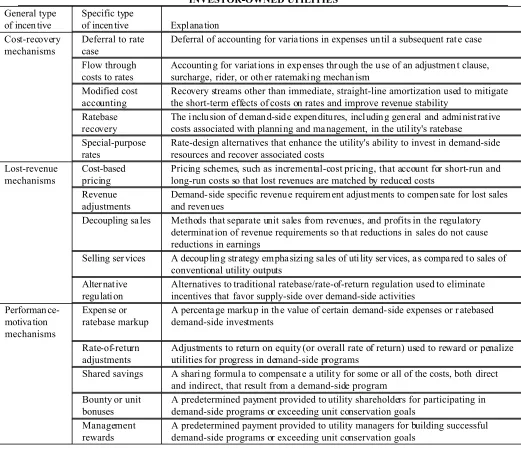
A number of incentives have been specifically designed to encourage dem and-m anagement by energy, and now water, utilit ies. T hese ca n be cat egorized as follows (Beecher, et al., 1994):
C
Cost-recovery mechanisms to improve revenue sta bility, reduce regul atory lag, a nd ensure that the util ity would be able to promptly recover in rates all prudently incur red costs of demand-side program s.C
Lost-revenue mechanisms that would adjust rates to compensate for the short-term loss in base sales, revenues, and profits that result from successful demand-side pr ograms.C
Performance-motivation mechanisms that provide bonuses (or penal ties) for meeting (or not meeting) program goals to help offset the risks perceived by utility managers, and motivate utility shareholders to expand cost-effective demand-side program s.The key vari ation s of these incentives are provided in Table 1.
IMPLEMENTATION ISSUES
Demand man agement r aises s everal impl ement ation issues. Obviously, the selection of the reward mechan ism (for example, rate of return versus management bonuses), the specification of how savings from demand-side programs are to be shared between the utility and its ratepayers, and regulatory treatment of demand-side investments relative to supply-side investments are the key regulat ory issues. Other implemen tation i ssues are of a more techn ical nature, such as those relating to measuring the effectiveness of demand-management incentives.
Incenti ve regulation aimed at demand management provides the potent ial for cost effici ency but d oes not reduce regulatory costs as would incentive regulation aimed at pricing. The deman d man agement incen tive approach suffers an acceptability problem in the context of regulators being reluctant to provide parallel treatment for demand-side and supply-side investment. By contrast,
there ar e no specific char acteristi cs of water utilities that would hinder the application of demand management incentives to water utility regulation. Indeed, some demand management incentives may have more potential benefits in water than in other uti lity sectors.
The various in centi ve appr oaches need t o be examined in the context of standard regulatory practice and operating procedures. The key issue is whether incen tive r egula tion can impr ove the p erformance of water uti lities un der commission jurisdiction. As Dennis Goins indicates, the answer to this quest ion is a fun ction of answer s to a set of other questions including:
C
Which aspect of water utility operations should the incentive approach be directed at improving? h o u l d performance of this operation compon ent be measured?C
Should performan ce be evaluated agai nst an index group of similar util ities?C
How should the utility receive the rewards and penalti es associated with its perform ance?C
What level of rewards and penalties is required to induce performan ce improvements?Concep tual ly, in centi ve regulati on approaches sh ould be based on comprehensive performance measures to avoid the deliber ate sa crifi ce of one per forma nce di mension for another. The incentive approach should be easy to understand and reliable in achieving cost efficiency. The incen tive approach should address only the aspects of utility performance under management control; it should avoid pena lizi ng or rewarding for performance results beyond management control. An effective appr oach should provide a framework to promote efficiency through management decision making; that is, ma nagement m ust have appropriate and fair in centi ves to im prove performan ce. The approach should provide signals to management to be efficient in both the short-term and the long-term, and not sacrifice long-term for short-term performance.
REFERENCES
Beecher, J.A., P.C. Mann, Y. Hegazy, and J.D. Standford. 1994. Revenue Effects of Water Conservation and Conservation Pricing Issues and Practices. Columbus, OH: The National Regula tory Research Instit ute.
Beecher, J.A., J.R. Landers, and P.C. Mann. 1991. Integrated Resource Planning f or Water Utilities. Columbus, OH: The Nationa l Regul atory Research Instit ute.
Bonbright, J.C., A.L. Danielsen, and D.R. Kamerschen. 1988. Principles of Public Utility Rates (Arlington, VA: Public Utilities Reports, 1988).
Chamberlin, J.H. and P.E. Hanser. 1991. "Current Designs of Regulatory Techniques to Encourage DSM," a paper presented at the NARUC Third National Conference on I ntegra ted Resource Planning, April 8-10, 1991 in San ta Fe, New Mexico.
Chicchetti, C. J. and W. Hogan. 1989. "Including Demand-Side Options in Electric Utility Bidding Programs," Public Utilities Fortnightly 123: 9-20. Goins, D. 198 5. "Ca n In centi ve Regula tion Impr ove
Utility Performance?" Public Utilities Fortnightly 115: 20-3.
Hirst, E., C. Goldman, and M.E. Hopkins. 1990. "Int egra ted Resource Plann ing for Electric and Gas Utilities," Conference on E nergy Efficiency in Buildings Sponsored by the American Council for an Energy-E fficien t Economy.
Katz, M.B. 1989. "Utility Conservation: Everyone Wins," The Electricity Journal 2 no. 8: 27.
Kihm, S.G. 1991. "Do Electric Utilities Need Financial Incenti ves to Promote Demand-Side Measures? Invest or and Man ager ial Perspectives, " NARUC Third Nationa l Conference on Integr ated Resource Planning, April 8- 10, 1991 i n Sant a Fe, New Mexico.
Moskovitz, D. 1989. Profits and Progress Through Least-Cost Planning. Washington, DC: The National Association of Regulatory Utility Commissioners.
NARUC. 1988. Least-Cost Utility Planning Handbook for Public Utilities Commissioners, Volume 2. Washington, DC: The National Associati on of Regulatory Utility Commissioners.
Weil, S. 1989. "Making Electric Efficiency Profitable," Public Utilities Fortnightly 124: 9-16.
Whittaker, M.C. 1988. "Conservati on and Un regulat ed Utility Profits: Redefining the Conservation Market," Public Utilities Fortnightly 122: 18-22.
Wilson, R.F. 1986. "The Role of Regulation in Increasing the Producti vity of Utilities," Proceedings of the Fifth NARUC Biennial Regulatory Information Conference, Volume 2 (Columbus, OH: The National Regulatory Research Institu te, 1986): 789-829.
THE AUTHOR
TABLE 1
REGULATORY INCENTIVES FOR DEMAND MANAGEMENT BY INVESTOR-OWNED UTILITIES
General type of incen tive
Specific type
of incen tive Expl ana tion Cost-recovery
mechanisms
Deferral to rate case
Deferral of accounting for varia tions in expenses un til a subsequent rat e case Flow through
costs to rates
Accountin g for variat ions in exp enses thr ough the u se of an adjustmen t clause, surcharge, rider, or oth er ratemaki ng mechan ism
Modified cost accounting
Recovery streams other than immediate, straight-line amortization used to mitigate the short-term effects of costs on rates and improve revenue stability
Ratebase recovery
The i nclu sion of deman d-sid e expen ditures, incl udin g general and admi nist rative costs associated with planni ng and ma nagement, in the util ity's ratebase
Special-purpose rates
Rate-design alternatives that enhance the utility's ability to invest in demand-side resources and recover associated costs
Lost-revenue mechanisms
Cost-based pricing
Pricing schemes, such as incremental-cost pricing, that account for short-run and long-run costs so that lost revenues are matched by reduced costs
Revenue adjustments
Demand- side specific revenu e requirem ent adjust ments to compen sate for lost sales and reven ues
Decoupling sa les Methods that separate unit sales from revenues, and profits in the regulatory determinat ion of revenue requirements so th at reductions in sales do not cause reductions in earnings
Selling ser vices A decoupling str ategy em phasizing sa les of uti lity ser vices, a s compa red to sales of conventional utility outputs
Alter nat ive regulati on
Alternatives to traditional ratebase/rate-of-return regulation used to eliminate incentives that favor supply-side over demand-side activities
Performan ce-motiva tion mechanisms
Expen se or ratebase markup
A percenta ge marku p in th e value of certain demand- side expenses or r atebased demand-side investments
Rate-of-return adjustments
Adjustments to return on equity (or overall rate of return) used to reward or penalize utilities for progress in demand-side programs
Shared savings A shari ng formul a to compensat e a utilit y for some or all of the costs, both direct and indirect, that result from a demand-side program
Bounty or unit bonuses
A predetermined payment provided to utility shareholders for participating in demand-side programs or exceeding unit conservation goals
Management rewards
A predetermined payment provided to utility managers for building successful demand-side programs or exceeding unit conservation goals