Research Journal
Volume 12, No. 2, June 2018, pages 52–58
DOI: 10.12913/22998624/79829 Research Article
NUMERICAL ANALYSIS OF THE POSTBUCKLING OF THIN-WALLED
COMPOSITE STRUCTURE WITH Z-PROFILE CROSS SECTION
Patryk Różyło1
1 Faculty of Mechanical Engineering, Lublin University of Technology, Nadbystrzycka 36, 20-618 Lublin, Poland,
e-mail: [email protected]
ABSTRACT
The object of the study was a thin-walled sample made of carbon composite. The
stud-ied profile was a z-shaped cross section. The aim of the study was a post critical state
analysis by the use of four independent destruction initiation criteria. The numerical analysis was conducted in ABAQUS®. The study presents the critical areas of the composite sample and determines the load values at which initiation criteria were met. The post critical state examination was confronted with previously obtained results
of the critical state. In addition, the effect of the laminate layer configuration on the
stability and load capacity of the structure is shown.
Keywords: Finite element method, Numerical analysis, Initiation criteria of destruction.
INTRODUCTION
A contemporary engineering approach contin -uously seeks new possibilities and improvement
of existing techniques that allow for an unam
-biguous assessment of the strength of materials. The potential resulting from existing advanced
numerical computational systems demonstrates
high-quality possibilities for critical and bound -ary states in the case of isotropic structures. The
attempt to estimate the critical areas and unambig
-uous assessment of the boundary states is getting
more complex with the use of composite
materi-als. Composites are characterized by orthotropic
properties varied layered laminate layouts and
operations exceeding the critical range until the
load capacity is completely reduced [2, 4, 10÷12, 15÷18, 23]. These features represent a completely separate behaviour of structures made of compos-ite materials from structures made of traditional
materials [7, 14, 20, 24]. The advantage resulting
from the use of composite structures is the ability
to control the layer system without changing the thickness of the laminate to achieve better stiff
-ness or energy-absorbing properties.
Structural stability is the issue concerning the
possibility of determination of the operations load limits values, initially within the critical state and the evaluation of the structure’s operations in the post-critical state, with axial compression [3, 8,
21, 25, 26, 29]. The range of work of the com -posite structure can be broadly divided into three
overriding stages. In the first stage, the composite
structure on the example of the plate structure op-erates in the pre-critical state. In this state, only
the process of compressing the structure of the laminate takes place without any rise in deflec -tion. The second state commonly known as
buck-ling is burdened by the phenomenon of loss of stability, where bifurcation takes place - chang
-ing linear range of work to non-linear. Once the
bifurcation point has been reached, the structure has the opportunity to continue the operations in
the post-critical range - at the same time it consti -tutes the third characteristic state of operations of the composite structures. In some cases the post-critical state value can even be several times the
entire range of operations in critical state. This
implies that the load capacity of the laminate can be reached with a compressive load several times Received: 2017.09.25
higher than the force at the loss of stability. The
total loss of load capacity associated with the complete destruction of the laminate continues to show the lack of uniformity of the boundary state
evaluation methodology.
Fundamental theory of laminate destruction presented in the literature is commonly known as FPF (First Ply Failure), in which the composite
is destroyed at the moment of damage of its first
layer, as presented by Reddy and Pandey [19]. However, numerical publications have shown
that the destruction of the first layer does not
exhaust the total load capability reserve of the
composite structure, but significantly weakens
the structure [4, 5, 6]. Due to the varied
pro-cesses occurring as a result of the destruction of the laminate, such as: damage to fibers, matrix or
interlayer delaminations, it is necessary to
pre-cisely estimate the factors directly affecting the weakening of the structural properties.
The paper attempted to develop the research
pre-sented in the publication [21] in the range of post-critical operations until signs of destruction initiation occur. Commonly used destruction initiating criteria, supporting the computational process, are the criteria for maximum stress [11], Tsai-Hill’s [28],
Azzi-Tsai-Hill’s [9], Tsai-Wu [27]. First ply failure initiation
criteria [18] make it possible to assess the damage
of a laminate due to the loss of the load capacity of
any single layer of the composite structure. It is pos -sible to further analyse the work of the laminate as part of the evolution of destruction - based on the
progressive destruction criterion, directly reducing the rigidity of the composite upon reaching the limit
values. The analysis of the behaviour of thin-walled
composite structures using the progressive criterion will be the future stage of the research.
SUBJECT OF THE STUDY
The subject of the study is a thin-wall com-posite structure, made of carbon-epoxy comcom-posite.
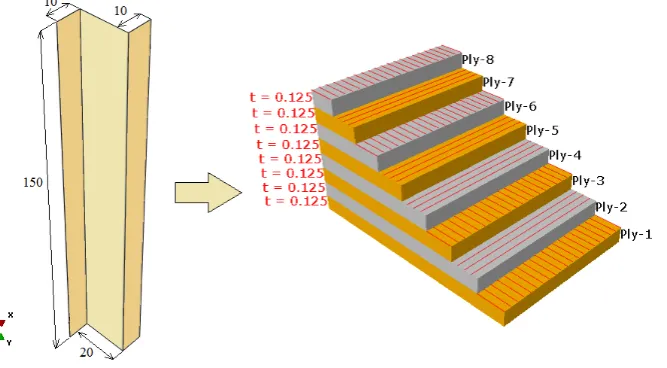
The height of the test sample is 150 mm, due to the need of obtaining the correct form of deformation in a form of half-waves appearing in the axial com
-pression process. The thickness of a single layer of
laminate is 0.131 mm. The composite consists of
8 layers with differentiated symmetrical fibers con
-figurations. Four different laminate layouts were in
-vestigated, two cross [0/90/0/90]s and [90/0/90/0]s and the other two [45/-45/0/90]s and [90/0/-45/45]
s. Mechanical properties of the laminate were
de-termined by experimental testing, using a universal testing machine [5]. The values of materials param
-eters defining the mechanical properties included in
the analysis are shown in Table 1.
Table 1. Material properties [5]
Mechanical properties Limit properties Young's modulus in
the direction of fiber
E1 [MPa] 130710
Compression strength in the
direction of fiber
[MPa]
1531
Young's modulus in the direction perpendicular to
the fiber
E2 [MPa]
6360
Compression strength in the direction
perpen-dicular to the fiber
[MPa]
214
Poisson's ratio 0.32 Shear strength [MPa] 100
Kirchhoff's modulus
[MPa] 4180
The test specimen with a z-shaped cross section contains specific geometric parameters, as shown in Figure 1.
METHODOLOGY OF THE RESEARCH
Investigations of the post-critical state until reaching the limit values of load capacity have been per
-formed in the ABAQUS® program. The study was conducted exclusively at the numerical computation
-al stage as a continuation of the issues presented in the publication [21]. After defining the behaviour of
the analysed structure in critical condition, an attempt was made to determine the post-critical structural behaviour - with particular emphasis on the loss of load capacity due to the destruction of the laminate.
The continuation of the study consisted initially of taking into account the form of buckling obtained for each of the considered configurations, as a part of the further post-critical analysis. Post-critical analysis was performed based on the Newton-Raphson algorithm calculations [1, 30]. The iterative incremental
method has allowed to analyse the behaviour of the compressed thin-walled structures until the deeply
post-critical state, taking into account the signs of laminate damage. The assessment of the degree of destruction was made on the basis of commonly known initiating criteria.
The first criterion used to estimate damage to the laminate structure at the load capacity loss is the
Maximum Stress Criterion (MSTRS). This criterion is considered only in a plane state of stress and
as-sumes that the stresses in each component of the laminate layers in the fiber direction and perpendicular to the fibers should be less than the limit values (X - in the fiber direction, Y - perpendicular to the fibers,
S in the plane Layers), as shown by relations (1):
(1)
where: σ1 i σ2 – stress in the main directions of orthotropy, τ12 – shear stress in the plane of the layer. The second criterion used in numerical calculations is the Tsai-Hill criterion (TSAIH). This criterion
takes into account different strength levels of the laminate layer in the major directions of orthotropy of
the composite material and is described by the relation (2):
(2)
The third criterion is the Azzi-Tsai-Hill criterion (AZZIT), which assumes that the strength of the
laminate is mostly determined by the reach of the linear-elastic state. The form of the criterion was
pre-sented according to the relation (3):
(3)
The next, fourth initiating criterion is the Tsai-Wu criterion (TSAIW). This criterion is a tensor solu
-tion to the problem of destruc-tion, where it is proved that any interac-tions due to loading occur between
the stress tensor components in the major directions of orthotropy. The Tsai-Wu criterion is described by the relation (4):
(4) where: F1, F2, F6 i F11, F22, F66 – are components of composite strength tensors which can be determined
in the strength test for uniaxial compression, tensile and shear, respectively; F12 - strength ten
-sor component related to the interaction of normal stresses σ1 and σ2, which can be determined in a biaxial test.
The above criteria were used in the numerical calculations of the post-critical state. Each of the
aforementioned criteria made it possible to estimate potential areas of laminate damage. Additionally, limiting strength was determined as a result of the limit values of the material strength parameters.
The numerical model was based on the use of shell type elements. It was possible to correctly define
the orthotropic properties of the material within the used element type. The boundary conditions used in
the work are analogous to the original assumption presented in [21] in the critical state condition analy
The discretization process was based on the use of S8R shell elements - which are eight-lay
-ered coating elements with 6 degrees of freedom in each node, with reduced integration. In general terms, the technique of reduced integration en -ables the elimination of false deformation forms
within the framework of existing numerical cal
-culations [30]. As a result of the discretization
process, 1500 mesh elements with a total number of computational nodes of 4691 were obtained.
The graphical representation of the discrete mod
-el is shown in Figure 3.
RESULTS OF THE RESEARCH
As part of the research, potential areas of
laminate damage, depending on the configuration
of the layers have been identified. Because of the
analysis of the post-critical state exclusively, the
results are related both to the designation of the damage areas and the determination of the force
values at which initiation of the destruction
oc-curred. The first case assumed an analysis of the post-critical state in the [0/90/0/90]s configura
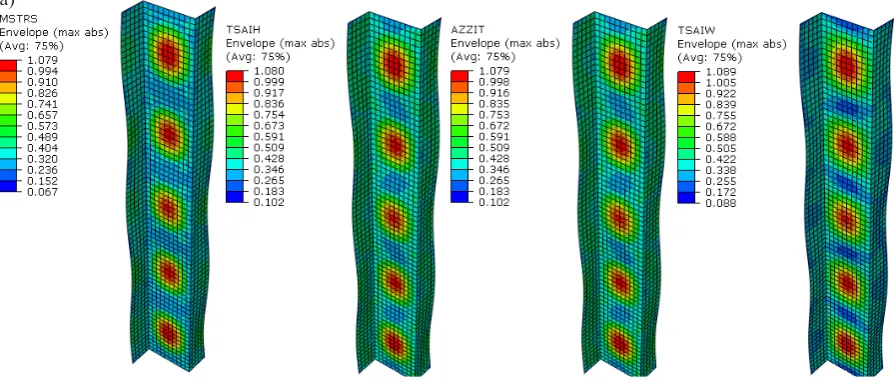
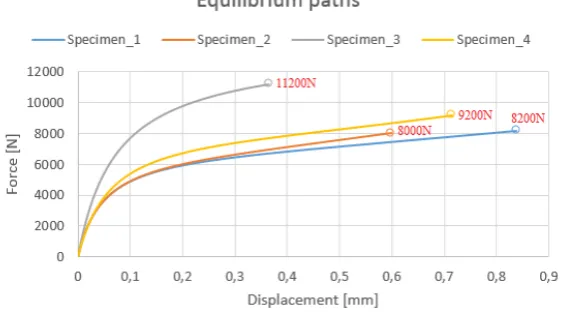
-tion. Regarding the tested configuration, the ini -tiation criteria were met with Pini = 8200 N. The
graphical representation of the initiation criteria compliance is shown in Figure 4.
A detailed breakdown of damage initiating
values is shown in Table 2, for each of the
ana-lysed laminate layering configurations. Further
-more, damage initiation parameters for the four initialization criteria were included. In case the value of the destructor initialization parameter for
Fig. 2. Boundary conditions Fig. 3. Discrete model of the thin-walled composite structure
Fig. 4. Graphical representation of the compliance of the initiation criteria: a) Maximum stress criterion, b)
Tsai-Hill criterion, c) Azzi-Tsai-Tsai-Hill criterion, d) Tsai-Wu criterion
any criterion MSTRS, TSAIH, AZZIT, TSAIW >
1 - this means the initiation of the destruction. Each initiation criterion was met with the
es-timated load values initiating the destruction, be
-sides the Tsai-Wu criterion for configuration [45/-45/0/90]s. This case of layer configuration is an exception to the rule, showing relatively conver
-gent values of destructive initiation parameters.
In addition, critical load analysis has been shown in [20] where critical load of Pcr = 12484 N. The
damage initiating value is exactly Pini = 11200 N, which represents 87% of the critical load. This
shows the potential first signs of damage, already at the stage of structural operations in the state of
loss of stability.
The remaining configurations, in regard to the
critical loads obtained in the paper [21], show the
initiation of destruction at load values significant
-ly higher than the original-ly determined critical
forces. This constitutes the relevance of the work of compressed thin-walled composite structures,
where only after reaching critical value, there are further consequences in the form of initiation of damage to the laminate. Table 3 summarizes the
values of the critical loads determined by the publi-cation [21] and the forces of destruction initiation.
In addition, the load-displacement
character-istics illustrating the initiation points of laminate destruction are shown. The equilibrium paths shown in Figure 5 are based on the measurement of deflection of the central parts of the half-waves demonstrating the greatest deformations, as pre -sented in the publication [21].
The analysis of deep post-critical state - di-rectly related to the study of total destruction of the laminate due to loss of load capacity will be the subject of further research. The post-critical state will be obtained on the basis of the Hashin’s initial
criterion and the progressive destruction criterion - enabling the testing of the boundary load capac -ity of the thin-walled composite structures.
CONCLUSIONS
The analysis of the post-critical state revealed
significant correlations between the conducted studies. The sample with the highest degree of stiff
-ness [45/-45/0/90]s configuration proved to be the most susceptible to observing the initiation of lam -inate destruction. At the moment of loss of stability (when critical force reached), the phenomenon of
initiation of damage to the sample occurred. Sam
-ples of the other configurations showed similarity
Table 2. Damage values initiating the destruction de
-pending on the criteria used to destroy the laminate and layering layouts
Pini [N] MSTRS TSAIH AZZIT TSAIW [0/90/0/90]s 8200 1.079 1.080 1.079 1.089 [90/0/90/0]s 8000 1.059 1.059 1.059 1.059 [45/-45/0/90]s 11200 1.020 1.004 1.004 0.712 [90/0/-45/45]s 9200 1.016 1.007 1.007 1.003
Table 3. A summary of the critical and initiating bur
-dens depending on the configuration of the laminate
layers
Pcr [20] Pini % [0/90/0/90]s 7311,2 8200 10,8 [90/0/90/0]s 7227,6 8000 9,7 [45/-45/0/90]s 12848 11200 12,8 [90/0/-45/45]s 8440,7 9200 8,3
in the attainment of the initiation of destruction
that occurred only within the range of the original
critical load achieved by 8.3 - 10.8%. The
analy-sis of the specific failure criteria of the laminate was performed, showing a convergence of results
within the obtained destruction parameters (the ini-tiation parameter coincides with four independent
criteria). In summary, both quantitative and quali
-tative convergences of initialization parameters for each configuration were obtained.
REFERENCES
1. Abaqus HTML Documentation.
2. Czapski P., Kubiak T.: Numerical and experimen
-tal investigations of the postbuckling behaviour of square cross-section composite tubes. Composite
Structures (2015), 132, pp. 1160-1167.
3. Davis J.G.: Compressive Strength of Fiber Reinforced Composite Materials. NASA TM X-71992, 1974.
4. Debski H., Teter A., Kubiak T., Samborski S.: Local buckling, post-buckling and collapse of
thin-walled channel section composite columns
subjected to quasi-static compression. Composite Structures (2016); 136:593-601.
5. Dębski H.: Badania numeryczne i doświadczalne stateczności i nośności kompozytowych słupów cienkościennych poddanych ściskaniu. Zeszyty
naukowe nr 1161, Wydawnictwo Politechniki
Łódzkiej, Łódź, 2013.
6. Dębski H.: Experimental investigation post-buck
-ling behaviour of composite column with top-hat cross section. Eksploatacja i Niezawodnosc – Maintenance and Reliability (2013); 2:106-110.
7. Falkowicz K., Ferdynus M., Dębski H.: Numeri -cal analysis of compressed plates with a cut-out
operating in the geometrically nonlinear range. Eksploatacja i Niezawodnosc – Maintenance and Reliability (2015); 17(2):222-227.
8. Falkowicz K., Mazurek P., Rozylo P., Wysmul
-ski P., Smagow-ski P.: Experimental and numerical
analysis of the compression of a thin-walled
com-posite plate. Advances in Science and Technology - Research Journal (2016); 10(31):177-184.
9. German J.: Podstawy mechaniki kompozytów włóknistych. Politechnika Krakowska, Kraków, 2001.
10. Gliszczynski A., Czechowski L. Collapse of chan
-nel section composite profile subjected to bending. Part I: Numerical investigations, Composite Struc -tures 178, 2017, 383-394.
11. Gliszczynski A., Kubiak T. Load-carrying capacity
of thin-walled composite beams subjected to pure
bending, Thin-Walled Structures 115, 2017, 76-85.
12. Gliszczynski A., Kubiak T. Progressive failure
analysis of thin-walled composite columns
sub-jected to uniaxial compression, Composite Struc-tures 169, 2017, 52-61.
13. Jenkins C.F.: Materials of construction used in
air-craft and airair-craft engines. Report to the Great Brit -ain Aeronautical Research Committee, 1920. 14. Klepka T., Dębski H., Rydarowski H. Characteris
-tics of high-density polyethylene and its properties simulation with use of finite element method. Po -limery (2009), Vol. 54 Issue 9, 668-672.
15. Kopecki, T., Mazurek, P.: Problems of numerical bifurcation reproducing in postcritical deformation
states of aircraft structures. J. Theor. Appl. Mech. 51(4), 969–977 (2013)
16. Kubiak T, Kolakowski Z, Swiniarski J, Urbaniak M, Gliszczynski A.: Local buckling and post-buck
-ling of composite channel-section beams - Numeri
-cal and experimental investigations, Composites Part B 2016; 91; 176-188.
17. Molnar V, Fedorko G, Husakova N, Kral J, Ferdy
-nus M.: Energy calculation model of an outgoing
conveyor with application of a transfer chute with
the damping plate. Mechanical Sciences, vol. 7, is -sue 2, 2016, pp.167-177.
18. Pignataro M, Luongo A, Rizzi N.: On the effect of the local overall interaction on the postbuckling
of uniformaly compressed channels. Thin-Walled
Structures 3:283-321;1985.
19. Reddy JN, Pandey AK.: A first-ply failure analysis
of composite laminates. Computation Structures, vol. 25, no 3, 1987, pp.371–393.
20. Rozylo P.: Numerical thermal analysis of a car braking system. Advances in Science and Tech
-nology - Research Journal (2017); vol. 11, issue 2,
pp.38-43.
21. Rozylo P., Lukasik D.: Numerical analysis of the criti
-cal state of thin-walled structure with z-profile cross section. Advances in Science and Technology - Re
-search Journal (2017); vol. 11, issue 1, pp.194-200.
22. Rozylo P.: Optimization of I-section profile design by the finite element method. Advances in Science and Technology - Research Journal 2016, 10 (29),
pp.52-56.
23. Rozylo P.: Experimental-numerical test of open
section composite columns stability subjected to axial compression. Archives of Material Science
and Engineering 2017, 84(2), pp.58-64.
24. Rozylo P., Wrzesinska K.: Numerical analysis of
the behaviour of compressed thin-walled elements
with holes. Advances in Science and Technology - Research Journal (2016); 10(31):199-206.
25. Singer J, Arbocz J, Weller T.: Buckling Experi
-ments. Experimental methods in buckling of
26. Teter, A., Kolakowski, Z.: Load carrying capacity of functionally graded columns with open
cross-sections under static compression. Compos. Struct. 129, 1–7 (2015).
27. Tsai SW., Wu EM.: A general theory of strength for
anisotropic materials. Journal of Composite Mate-rials, vol. 5, nr 1, 1971, str.58–80.
28. Tsai SW.: Strength Theories of Filamentary Struc -tures, in Fundamental Aspects on Fibre Reinforced
Plastic Composites. Conference Proceedings, R.
T. Schwartz and H. S. Schwartz (Editors), Dayton, Ohio, 24 – 26 May 1966, Wiley Interscience, str. 3-11, New York, 1968.
29. Wysmulski P., Dębski H., Rozylo P., Falkowicz K.:
A study of stability and post-critical behaviour of
thin-walled composite profiles under compression. Eksploatacja i Niezawodnosc – Maintenance and Reliability 2016; 18 (4): 632–637.