International Journal
of Cross-Cultural Studies
and Environmental
Communication
DIALOGUE AS GLOBAL ACTION:
INTERACTING VOICES AND VISIONS
ACROSS CULTURES
Volume 4, Issue 2, 2015
ISSN 2285 – 3324
ISSN-L = 2285 – 3324
2
IJCCSEC
V
ol
ume 4
, Issue 2
, 2015
EDITOR-IN-CHIEF
Ana-Maria Munteanu
Universitatea Ovidius Constan
ț
a, RO
[email protected]
EDITOR
Cornel Grigoruţ
Ovidius University of Constanta, RO
3 Dante IJCCS
E
C Volum
e 4
, Issue 1
, 2015
2012 2,
Issue 1,
olume V
IJCC SEC
3
2012 2,
Issue 1,
olume V
IJCC SEC
3
International Journal
of Cross-Cultural Studies
and Environmental Communication
http://crossculturenvironment.wordpress.com/
DIALOGUE AS GLOBAL ACTION:
INTERACTING VOICES AND VISIONS
ACROSS CULTURES
Volume 4, Issue 2, 2015
Coordinator
Cornelia Ilie
Editura Universitarã
www.editurauniversitara.ro
&
4
IJCCSEC
V
ol
ume 4
, Issue 2
, 2015
ADVISORY BOARD
Marta Árkossy Ghezzo
Lehman College, New York, USA [email protected]
Adina Ciugureanu
Universitatea Ovidius Constanþa, RO [email protected]
Augusto Rodrigues Da Silva Junior
Universidade de Brasilia, Brasil [email protected]
Timothy Ehlinger
University of Wisconsin, Milwaukee, USA
Victor A. Friedman
University of Chicago, USA [email protected]
Ana-Cristina Halichias
University of Bucharest, RO [email protected]
Ioan Ianos
University of Bucharest, RO [email protected]
Cornelia Ilie
Malmö University, Sweden [email protected]
Mihai Coman
University of Bucharest, RO [email protected]
Cristina Coman
University of Bucharest, RO [email protected]
Claudia Jensen
University of Washington, Seattle, USA [email protected]
Maria Do Rósario Laureano Santos
Universidade Nova de Lisboa, Portugal [email protected]
Ileana Marin
University of Washington, Seattle, USA [email protected]
Ludmila Patlanjoglu
National University of Theatre and Cinematography ¨I.L. Caragiale¨ of Bucharest, RO
Charles Moseley
University of Cambridge, UK [email protected]
Stephen Prickett
Professor Emeritus, University of Glasgow/Kent
Giovanni Rotiroti
Universita Occidentale, Naples, Italy [email protected]
Daniela Rovenţa – Frumuşani
University of Bucharest, RO [email protected]
Leonor Santa Bárbara
Universidade Nova de Lisboa, Portugal [email protected]
Ana Rodica Stăiculescu
Ovidius University Constanta, RO [email protected]
Aida Todi (+)
Ovidius University of Constanta, RO [email protected]
Florentina Nicolae
Ovidius University of Constanta, RO [email protected]
Eduard Vlad
5 IJCCSEC
V
ol
ume 4
, Issue 2
, 2015
International Journal of Cross-Cultural Studies and
Environmental Communication
Volume 4, Issue 2, 2015
SELECTED PAPERS FROM THE 3
rdESTIDIA
CONFERENCE
CONTENTS
Cornelia ILIE
Dialogue as Global Action: Interacting Voices and Visions Across Cultures .... 7
Multimodality of Public-Private Intersecting Dialogues ... 11
Mariselda TESSAROLO & Eleonora BORDON
Multi-voiced speech: newspapers’ blogs about a humanitarian emergency ... 13
Daniela Roventa-FRUMUSANI
Images Publiques et Vies Privées sur Facebook. Etude de cas: femmes politiques roumaines ... 29
Ivanka MAVRODIEVA
The Voices of Bulgarian Political Parties During the 2014 Parliamentary Election Ccampaign ... 45
Ana-Maria SEZONOV
Visuel, textuel, multimodalité dans les graphismes de Dan Perjovschi ... 57
Voices Sharing Views in Intercultural Dialogue ... 69
Arie SOVER
Don’t we Laugh the Same as You? Do Israeli Arabs and Jews Laugh at the Same Humorous Situations? ... 71
Federico ZANNONI
6
IJCCSEC
V
ol
ume 4
, Issue 2
, 2015
Dialogue of Voices in Visual Semiotic Perspective ... 99
Alexandra IRIMESCU
L’imaginaire des blogs féminins de mode ... 101
Ileana JITARU
Voices in Dialogue in the Language of Film: From Fictional to Documentary Mode ... 117
Communication Challenges in Real-life and Virtual Dialogues ... 129
Diana HORNOIU
Interactive Values of Vagueness Assigning Events and Experiences to Conceptual Categories in Romanian Conversational Discourse ... 131
Monica VLAD & Mioara CODLEANU
Les Interactions Interalloglottes sur les Plateformes de Communication. Des Outils Vers Leur Utilisation Didactique ... 147
7 IJCCSEC
V
ol
ume 4
, Issue 2
, 2015
DIALOGUE AS GLOBAL ACTION:
INTERACTING VOICES AND VISIONS ACROSS CULTURES
Cornelia Ilie1
This special issue of the International Journal of Cross-cultural Studies and Environmental Communication(Volume 4, Issue 2, 2015) has been devoted to selected papers presented at the 3rdESTIDIA Conference that was hosted by
‘Ovidius’ University, Constanţa, Romania. These papers raise and discuss a significant range of current issues related to the theme of the conference “Dialogue as Global Action: Interacting Voices and Visions across Cultures”. This issue brings together ten articles devoted to the following four topics: (1) Multimodality of Public-Private Intersecting Dialogues; (2) Voices Sharing Views in Intercultural Dialogue; (3) Dialogue of Voices in Visual Semiotic Perspective; (4) Communication Challenges in Real-life and Virtual Dialogues.
The articles included in this issue address the challenges involved by practices and processes involved in the global dialogue that are being articulated, in different forms, across borders, cultures, professions and scientific disciplines. The focus of these studies is on the intersection, cross-fertilization, convergence and/or divergence of interacting voices and echoes at various levels and with various purposes in interpersonal and institutional contexts.
In a micro- and macro-level dialogic juxtaposition of voices, the interlocutors have an impact on each other and, to different extents, on their social, cultural and political environments. The dialogic exchanges not only have a communicative function, but they also function as vehicles for mediating meaning and meaning negotiations (Leech, 1983).Based on their respective social and institutional roles, speakers and writersare able to induce meaning in the minds of their hearers and readers, just like musicians/singershave the capacity to induce meaning in the minds of theiraudiences (Lévy-Strauss, 1971).
Due to its engaging, emulating and exploratory nature, dialogue is an essential form of human communication, action and interaction. According to Vygotsky (1978), any true understanding is dialogic in nature. As social human beings, we participate in a wide range of dialogues in various contexts and at different levels, in a shared search for increased understanding of issues and phenomena, for questioning ideas and actions, for joint problem-solving. These multi-layered dialogues have dramatically increased with the widespread use of social media, which now enable members of any social, gender, ethnic, racial or cultural group to raise and make their voices heard while articulating current concerns and addressing critical issues of inequality, discrimination, socio-political underrepresentation and misrepresentation. A commonaim of the contributions to
8
IJCCSEC
V
ol
ume 4
, Issue 2
, 2015
this issue has been to scrutinize the interplay of local and global dialogues at particular interactive levels by exploring their function and role as a springboard for critical reflection and self-reflection, for in-depth issue problematisation, for multi-voiced interpersonal resonance, for constructive polyphony of intersecting, contradictory and complementary voices. In the Bakhtinian (1981) theoretical tradition, the voices of social-political dialogue not only represent the world, they also convey societal norms and moral values. Hence, multiple voices express not only how people see the world, but also how they feel about it.
For a better understanding of how meaning is created through the mechanisms and strategies of dialogue, it is important to investigate how voices are woven in discourse, how themes and voices intermingle in a polyphonic way. One way of understanding the shifting qualities of individual voices as interactive network-creating generators is provided by Goffman’s (1981) concept of participation framework (based on the distinction between author, animator and principal). At the same time, as has been pointed out by Couldry (2010), having a voice is not enough: we need to know that our voice matters, i.e. it has legitimacy. Hence, following Wertsch (1991), we need to realize that in internalizing forms of social interaction, the individual takes on and interrelates with the voices of others, which accounts for the complexity of ‘multivoiced’ dialogues. While joining in a dialogic polyphony of voices, each voice shares a particular experience, viewpoint, or sets of attitudes to reality, all of which are instrumental in shaping actions, interactions and relationships. As a result, dialogue is the locus where different beliefs, commitments, ideologies come into contact and confront each other through the intermediary of intersecting voices.
Viewed as complex forms of human interaction, the dialogic communication practices can fulfil several functions:
(i) Dialogic communication practices activate multiple social identities: for example, in the case of political leaders, they can activate the following identities: as politicians, as citizens, as professionals, as family representatives (Edelman 1988, Ilie 2010, Browne 2013).
(ii) Dialogic communication practices presume, challenge, reinforce, etc., social and interpersonal relations, which is commonly manifested through various argumentation strategies (Walton & Krabbe 1995)
(iii) Dialogic communication practices shape and are shaped by the societal institutions in which they take place, e. g. educational, legal, political, medical (Maranhão 1990, Schoem& Hurtado 2001, Markova et al. 2007).
9 IJCCSEC
V
ol
ume 4
, Issue 2
, 2015
campaigns; the convergence of visual and textual dialogic cues in artistic dialogues. The articles of the authors in the second section are devoted to the investigation of multi-voiced interactions and cases of (mis)understanding in dialogic communication in intercultural environments. The polyphonic dialogue of voices in visual semiotic perspective is the focus of the articles in the third section:one article explores the dialogic communication strategies in fashion blogs, while the other examines converging vs. diverging voices across time and space in dialogic practices in films. In the last section of this issue, each of the authors uses an integrated theoretical framework to carry out an in-depth analysis of communication challenges in real-life conversations, and in virtual dialogues developed for pedagogical purposes, respectively.
REFERENCES
Bakhtin, Mikhail M. 1981. The dialogic imagination. The University of Texas Press.
Browne, Jude (ed). 2013. Dialogue, politics and gender. Cambridge: Cambridge University Press.
Couldry, Nick. 2010. Why voice matters: Culture and politics after neoliberalism. London:Sage.
Edelman, M. 1988. Constructing the political spectacle. Chicago: University of Chicago Press.
Goffman, Erving. 1981. Forms of talk. University of Pennsylvania Press.
Ilie, Cornelia. 2010. Identity co-construction in parliamentary discourse practices. In C. Ilie (ed.) European parliaments under scrutiny: Discourse strategies and interaction practices, 57-78. Amsterdam: John Benjamins.
Leech, Geoffrey N. 1983. Principles of pragmatics. London: Longman. Lévy-Strauss, Claude. 1971.Mythologiques: L’Homme nu. Paris: Plon.
Maranhão, Tullio (ed.). 1990. The interpretation of dialogue. Chicago: University Of Chicago Press.
Markova, Ivana, Linell, Per, Grossen, Michèle and Orvig, Anne Salazar. 2007. Dialogue in focus groups: Exploring socially shared knowledge. London: Equinox.
Schoem, David and Hurtado, Sylvia (eds.). 2001. Intergroup dialogue: Deliberative democracy in school, college, community, and workplace. The University of Michigan Press.
Vygotsky, Lev S. 1978. Mind in Society: The development of higher psychological processes. Harvard University Press.
Walton, Douglas and Krabbe, Eric C. W. 1995. Commitment in dialogue: Basic concepts of interpersonal reasoning. Albany, NY: State University of New York Press
10
IJCCSEC
V
ol
ume 4
, Issue 2
11 IJCCSEC
V
ol
ume 4
, Issue 2
, 2015
12
IJCCSEC
V
ol
ume 4
, Issue 2
13 IJCCSEC
V
ol
ume 4
, Issue 2
, 2015
MULTI-VOICED SPEECH: NEWSPAPERS’ BLOGS ABOUT
A HUMANITARIAN EMERGENCY
Mariselda Tessarolo & Eleonora Bordon1
Abstract: New media, and in particular the newspapers’ blogs, allow us to pay attention to the positions of reporters and readers. In these blogs, indeed, one can find the explanations, the suggestions, the opinions and the questions that the readers of famous reporters’ posts exchange with the person who writes the news, inside a space situated outside the newspaper. It is a matter of a “small” public domain (Dahlgran, 2005) which welcomes a debate between who writes the news and the opinions on the news, and which therefore reports a modality of “taken for granted”, a legitimation of what must be said or made known to one’s audience. In a way, by means of comments and interpretations, the readers’ posts represent the others’ speech, either direct or indirect, but nonetheless a soliloquy (Bachtin, Volosinov, 1997). It is a matter of dialogue interaction intended, in this case, as a set of micro-dialogues that refer to the interiorized relationships self-others, just
as Bakhtin meant when affirming that our voices are saturated by those of the others.
Keywords: newspapers’ blogs, forced immigration, politics and language, multi-voice speech. hey can partially contribute to cause events), as possible roles waiting for a legitimation.
Introduction
During postmodernity mankind is wandering from the great narration which accompanied it almost since the end of the 20th century: we see a discontinuity due
to a removal from tradition of both the extension and intension2 with the
application of the organizational principles inserted in the new conceptual model of the representation of society. In the passage from tradition to modernity moral and juridical rules of social integration are also redefined and, in this passage, Beck3
sees the strengthening of ecological, individual and globalized problems which is a prelude to the risk foreseen by Luhmann4, though in his case mitigated by trust.
Thematic blogs, also called “journalistic”, are dedicated to a specific argument and because of this they are comparable to the articles of a newspaper5.
Language is deeply social because whatever the social net in which it is used, it provides the environment in which is produced the meaning in reference to
1 University of Padua, Italy
2 Lyotard, J.-F. La condizione postmoderna. Milano: Feltrinelli, 1981. 3 Beck, U. Che cos’è la globalizzazione. Roma: Carocci, 1999. 4 Luhmann, N. La fiducia. Bologna: Il Mulino, 2002.
14
IJCCSEC
V
ol
ume 4
, Issue 2
, 2015
people, events and things; language is decisive in building the reality in which we are living and is therefore a social practice6.
People are not only and simply colonized by speeches, but these speeches, as we saw, become the resources for the production of new ones. Texts and speeches also constitute a form of appropriation which represents a chance of emancipation, because drawing on texts one gains knowledge, a perspective on the world, which potentially should give the opportunity to generate other speeches and shape other ways of behaving and living. According to Bourdieu7 it is not possible to analyze language without taking into account the social conditions at the base of its existence: for example, it is the process of a State formation that creates the conditions of a unified market inside which a single linguistic variety assumes the status of standard language. According to Bachtin’s enlightening postulate, the words we use belonged and still belong, for the most part, to “others” before belonging to “us”. Indeed, not only our unconscious but also our conscience itself are both populated by others’ words and intentions. Sartre used to say that “the others are our hell”; more secularly and with more sense of reality Bachtin states that “the others are our reality: I live in a world of others’ words”8. The strength of his thought resides in the concept of social intersubjectivity, that may be found in words and signs, which substantiates every historical gesture of mankind be it conscious or unconscious: as a consequence such a social intersubjectivity, historical and real, is constituent of the individual subjectivity, as the otherness is of my own subjectivity.
The new space of the public sphere
The journalistic manner of collecting, selecting and spreading the news has been overthrown by the web 2.0 which allowed an interactivity previously not even thinkable. By now one could speak of participative journalism or citizen
journalism, which puts into discussion the very competences of a professional
pressman who does not have anymore the monopoly on the news. His function of mediator which is believed no more necessary is also debated. The citizen
journalism could be considered a phenomenon at a surfacing stage which comes
from the bottom and inside of which the editorial control and the flow of the journalistic work, which determines the decisions of the ones participating, is scarce or totally absent. Journalism is the result of the participation of many people who believe in the mythical possibility of spreading an independent and therefore more reliable, understandable and also democratic information, compared to the one which is officially given on the newspapers and/or online. Blogs are considered true and real innovative online newspapers which are the first to present the latest “news” with redirection to links for exploring more in-depth or expressing personal opinions on a specific topic. The web, with its versatility,
6 Fairclough, N. Discourse and social change. Cambridge, UK: Polity Press, 1992.
7 Bourdieu, P. La parola e il potere. L’economia degli scambi linguistici. Napoli: Guida, 1988.
15 IJCCSEC
V
ol
ume 4
, Issue 2
, 2015
offers many possibilities of creating a personal publishing trade. A blog can be compared to “a newspaper in which the readers’ mails occupy the front page” and therefore makes visible the reflections elaborated allowing the active participation of subjects, augmenting and facilitating the creation of a virtual community: a blog is a front of the stage on which one shows his better part9.
From the debate on the public sphere developed the public deliberation which does not intervene on the final decision, but in the phase in which the solution is elaborated. The public sphere can be seen as a further moment of democracy compared to information and consultation, “but also as a more complete answer to the need for the broadening of the production of the environment’s social conscience” (Pellizzoni, 2003, p. 283). It is not important the ambit in which the debate takes place, but the modalities and the articulations of the public sphere speeches oriented to the deliberation meant as discussion which precedes the decision about material matters. The current public discussion is mostly a discussion in which the media have a great importance10.
The internet, in a certain way, seems to jeopardize the systems of political communication (e.g. the Movimento Cinque Stelle [the Five Star Movement] in Italy), but meanwhile it extends and pluralizes the political debate in the public sphere. Part of the “progressive” readers feel a need for what Lakoff11 defines “reframing” and which consists in the ability of constantly reshaping the contest and “framing” the various questions, from the wars to the welfare state, in a way congenial to the “liberal” mentality. The “reframing” is inherent to the overcoming of the “rigid thought” consisting in the radicalization of the differences and in the minimization of the similarities between our own beliefs and the opposed objective systems. Mizzau12 analyzes the elements of “decentralization” applied to interpersonal communication consisting mainly in the use of an understandable language, in the assumption of the other’s viewpoint, in the ability of getting the plurality of meanings. Vigotskij13 speaks of sense to define the subjectivity implied in the language (i.e. its variability) and of meaning to address what remains constant in the language. The egocentric language is not based on a normal retro-communication, but on a paradoxical communication which is based on not listening, on jumping to conclusions too soon, conclusions which are not useful to demonstrate, but to metaphorically strengthen the debate.
It is evident, furthermore, that the lack of argument, which stresses a disagreement at the level of content and of relationship, is a typical attitude of the rigid position in which conflicts can be relative to the content when it doesn’t exist an agreement on a certain theme, or relative to the relationship when even though existing a theme on which an agreement could be found, one interactant has the
9 Goffman, E. Strategic Interaction. Philadelphia: University of Pennsylvania Press. 1969. 10 Tessarolo, M. Social Change: How tradition renews itself in the Experience of Public Sphere. In International Journal of Cross-cultural Studies and Environmental
Communication. 39 (2014): 30-40.
11 Lakoff, G. The Political Mind: Why You Can't Understand 21st-Century American
Politics with an 18th Century Brain. New York: Viking Penguin, 2008.
16
IJCCSEC
V
ol
ume 4
, Issue 2
, 2015
desire to prevail over the other. This type of conflict of relationship is characteristic of a symmetric communication. Bateson14 defines in that manner a relationship in which two individuals interact one over the other in terms of competitive equality, a relationship in which a reciprocal adjustment, which emphasizes differences, is made.
Lakoff insists on the concept of frame: the political debate is not, simply because it is addressed to the citizens, a simple confrontation of opposite positions which manifest on single topics time after time. The way citizens perceive and also emotionally interpret the various positions will depend on how these position have been framed by the various actors of the political debate. Indeed, the communicative strategy goes beyond the proposal of argumentations in favor or against the argument in question itself. Inside the frame metaphoric and symbolic elements intersect which orient the listening citizens so as they would arrive to a decision. It is a matter of a small public “sphere”15 which holds a debate between the person who writes the news and the opinions on them, and which therefore reports a modality of “taken for granted”, a legitimization of what must be said or made known to their audience. In a certain way, through comment and interpretation, the readers’ posts represent the others’ speech, direct or indirect, but still monologic16. It is a matter of dialogical interaction meant, in this case, as a set of micro-dialogues which refer to the interiorized relations Self-Others, just as Bachtin intended when claiming that our voices are saturated by the others’ ones. The measure of blogs’ freedom can be found in the quiescent or contrasting attitude of the readers in respect to the pressman. It can be supposed that the reader would have the desire and the will to cooperate only if there is a dialogue between two parts. It is not sufficient, indeed, to have one voice, but that voice must count, that is to say it must be listened to17 (Couldry, 2013). The pressman, because of his own job, channels’ rules, values, social behaviors shared by society. Reading the posts present in specific blogs, regarding the humanitarian help to the refugees coming from the various shores of the Mediterranean Sea, one ought to have the chance to analyze a multiplicity of voices expressing very different viewpoints of the world. If a voice is in need of legitimization, a newspaper has the means and the power to accomplish it. Individual voices, indeed, can be seen as agency (they can partially contribute in causing events), as possible roles waiting for legitimization.
What determines “the power of words”, or the performance efficiency of the speech, does not reside much in the words themselves, but in the conditions which can be related to the concept of authority. This authority needs the cooperation of the ones it rules, something that happens by means of mechanisms, social instructions, able to produce complicity18. Thanks to the ability of imposing
14 Bateson, G. Verso un’ecologia della mente. Milano: Adelphi, 1977.
15 Dahlgren, P. The internet, public spheres and political Communication: dispersion and deliberation. Political Communication. 22 (2005): 147-161.
16 Bachtin, M. Volosinov V. Il linguaggio come pratica sociale. Bari: Dedalo, 1997. 17 Couldry, N. (2012), Dare voce. Brescia: La scuola, 2012.
17 IJCCSEC
V
ol
ume 4
, Issue 2
, 2015
a certain vision of the social world, the speech therefore gets a meaningful role in the production, the upkeeping and the change of the power relations. The relation between the speech and the power relations is bound to the opacity, to the unclearness of the implied mediation process. Power is hidden and not explicit, at the point that there is not conscience of its existence19. In the contemporary society, among the mechanisms of the practice of power, the most common is the one relative to instill and communicate. The former is used to artificially recreate the universality of knowing and believing which belongs to the one who has the power, because it depends on the authority: to constitute communication and debate, on the contrary, a mechanism of emancipation which is used against the established power.
The blogs
The blogs have a structure in which texts have dates and are presented in the web page in anti-chronological order, i.e. starting from the most recent messages, and most of the times they are introduced by a headline. Dahlgren points out the dimensions of the public sphere: representational, structural and interactional, which allow a detailed examination of the public sphere which can be meant as a set of communicative spaces allowing the flowing of ideas and debates in society. It can be supposed that this “social ecology” is democratically weak and that the representational dimension is inadequate and a little disengaged too. The structural dimension regards the accessibility of the web for civic, legal and economic use which encompasses all that concerns the political communication (equity, pluralism of opinions, agenda setting, etc.). Finally the interactional dimension, a fundamental one according to Dahlgren20, in which emerge the speeches of
atomized individuals who use information in their homes without forming an audience, but constituting what was already the television’s audience.
If democracy derives from a set of citizens speaking and arguing among themselves, what can be said of this type of “relationality”? One can think of micro-contexts of interaction: the public sphere that expands its tentacles in order to reach inside the web becomes very dispersive. It is of course a transformation due to IT, but perhaps that is not the way to reach a “fast democracy”, on the contrary it sometimes seems that democracy itself is leaving and that it is not easily reachable in the wide space of the media’s public sphere. Speaking represents a social practice: speaking is an activity having consequences for those who engage in it. It can be hypothesized that a dichotomic position of acceptation or refusal can exist which is crystallized in the phenomenon being conveyed mainly by emotional aspects and not by a reflection which might lead to a cultural change.
19 Bourdieu, P. La parola e il potere. L'economia degli scambi linguistici. Napoli: Guida, 1988.
18
IJCCSEC
V
ol
ume 4
, Issue 2
, 2015
Method and results
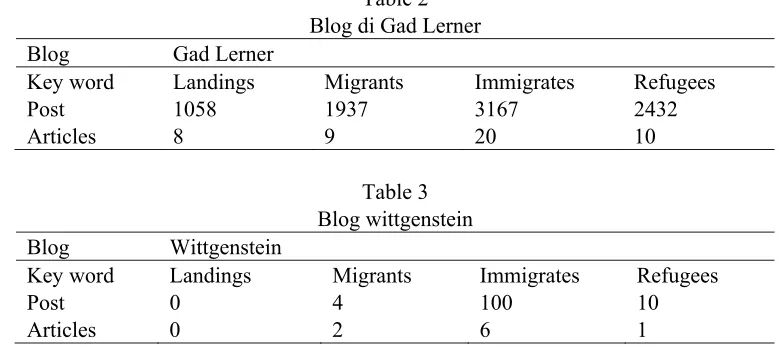
To reach our goal we chose two journalistic blogs kept by two well known pressmen (Luca Sofri and Gad Lerner). The choice of the two blogs was founded on a classification of fruition which puts them in the first two positions. The relevance of co-constructing and spreading the information by means of internet results being a practice which in the post-modernity made individuals not only spectators, but also actors in the public life. We analyzed, with a textual analysis program (SPAD), the corpus obtained from the posts about the refugees’ landings. From the results we expect that the readers’ answers be so pre-fixed by attributions and confirmed by society, that their posts confirm and not oppose the pressmen’s opinions. This means that a silent dynamic exists among people even if there is not explicitly a conversation among them21.
The proposed inquiry forms an explorative study on the construction of the theme of immigration. In an historical moment in which the migratory flow changes its paths and modifies the geopolitical assets of not only the hosting countries but also of the entire planet, it seems interesting to try to understand how pressmen and citizens perceive this phenomenon.
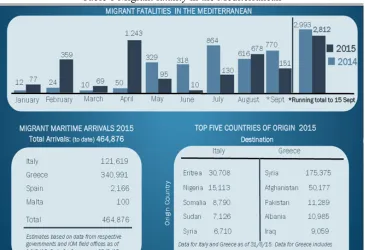
Table 1 Migrant fatality in the Mediterranean
19 IJCCSEC
V
ol
ume 4
, Issue 2
, 2015
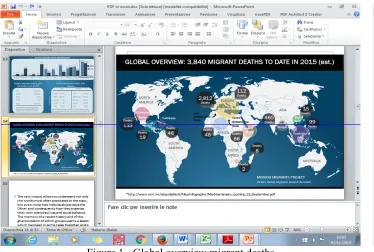
Figure 1 - Global overview migrant deaths
The text inquiry allows us to understand not only the words most often associated to the topic, but even more how individuals perceive the Other and consequently how they organize their own everyday lives and social behavior. The memory of a recent history and of the ghettoizzation of ethnic groups seems a lesson which in some cases has been forgotten and is partially replicated. To analyze the texts we took advantage of Spad-T, a software for the qualitative/quantitative analysis of documents. This tool allowed us to extrapolate the dictionary and observe the frequencies of terms and their relation by means of the factorial analysis. The specificity of the telling is calculated through the application of the test value in the Vospec process.
The sample
In this preliminary study 56 articles taken from the blogs: - www.gadlerner.it
- www.wittgenstein.it/
The articles of the last three years have been selected from those blogs and they contained the
20
IJCCSEC
V
ol
ume 4
, Issue 2
, 2015
Table 2 Blog di Gad Lerner
Blog Gad Lerner
Key word Landings Migrants Immigrates Refugees
Post 1058 1937 3167 2432
Articles 8 9 20 10
Table 3 Blog wittgenstein
Blog Wittgenstein
Key word Landings Migrants Immigrates Refugees
Post 0 4 100 10
Articles 0 2 6 1
Results
From the analysis of the headlines and of the articles emerged that the dictionary is composed by:
TOTAL NUMBER OF ANSWERS 22 TOTAL NUMBER OF WORDS 27427 NUMBER OF DISTINCT WORDS 5937 PERCENTAGE OF DISTINCT WORDS 21.6
Table 4
List words by counts order
Used words Counts Used words Counts
Italy 55 Migrants 49
Them 55 Others 45
Refugees 54 Left party 40
Europe 52 Country 40
People 50 Sea 39
From the frequencies in the articles emerges with higher relevance the distinction between «us» and «them» in addition to the representations of geopolitical character. The human social dimension is almost entirely disregarded leaving more room to reflections of political kind.
21 IJCCSEC
V
ol
ume 4
, Issue 2
, 2015
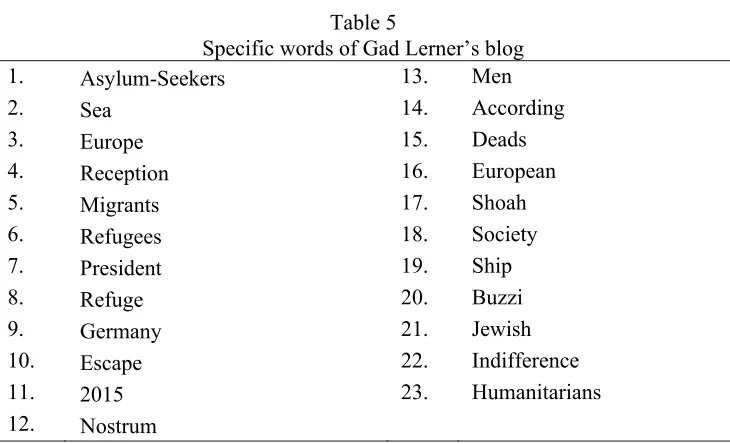
Table 5
Specific words of Gad Lerner’s blog
1. Asylum-Seekers 13. Men
2. Sea 14. According
3. Europe 15. Deads
4. Reception 16. European
5. Migrants 17. Shoah
6. Refugees 18. Society
7. President 19. Ship
8. Refuge 20. Buzzi
9. Germany 21. Jewish
10. Escape 22. Indifference
11. 2015 23. Humanitarians
12. Nostrum
While Wittgenstein uses in a statistically different way the terms in table 6
Table 6
Specific words in Wittgenstein’s blog
1. Right party 10. World
2. Berlusconi 11. To vote
3. Thoughts 12. Better
4. Center-left party 13. Continuous
5. Isis 14. Matter
6. Idea 15. Right
7. Real 16. Money
8. Ugly 17. Xenophobia
9. Terrorists
22
IJCCSEC
V
ol
ume 4
, Issue 2
, 2015
From the analysis of the posts’ content one can find the data relative to the dictionary which is composed by 32.298 distinct words and that among the first 15 ones we find with greater frequency terms linked to the space-time context (table 7). Terms like «Italy, country, now, today» etc. score the greatest presence in the text. Nonetheless it appears interesting to notice that in this list also the term «home» appears. It is about a dimension that is not only logistic, but also social and sentimental which widens the reflection on the theme.
Table 7
List of words by counts order
the specificities we see that the themes treated by the bloggers, i.e. by those who answer to Gad Lerner’s blog, are reported in table 8
Table 8
Topics treated by Gad Learner’s bloggers
1. 2015 9. Europe
2. Syria 10. Always
3. Pm 11. Big
4. Salvini 12. God
5. September 13. Israel
6. Russia 14. Usa
7. All 15. Power
8. 2014 16. Job
For what concerns Wittgenstein’s blog regular clients, the results are reported in table 9.
Used words Counts Used words Counts
Italy 582 War 422
Fact 575 Where 422
Years 488 Country 405
Side 484 Home 393
Others 477 Refugees 384
Europe 472 After 383
His 441 Now 382
23 IJCCSEC
V
ol
ume 4
, Issue 2
, 2015
Table 9
Topics treated by Wittgenstein’s bloggers
1. Primary elections 13. My
2. To vote 14. I take
3. Right party 15. Motivated
4. Bersani 16. Rome
5. Elector 17. Berlusconi
6. Left party 18. Generally
7. Intellectual 19. Articulated
8. Rules 20. Change
9. Registration 21. Real
10. Populists 22. Reasoning
11. Voter 23. Turn
12. Vote 24. Sense
Though there is a meaningful difference between the reports of the audience of the two blogs, it must be stressed that the scarce wealth of posts in Wittgenstein’s blog acquires all but negligible weight in the understanding of the phenomenon. The different narrative matrix of the audience, mainly bound to the politics and apparently not much representative of the theme observed among Wittgenstein’s audience, seems to be representative of a scarce interest in taking a stance on the phenomenon.
Conclusions
A plurality of public spheres by itself does not guarantee democracy. Dahlgren22
claims that structural connections and decisional processes are necessary because they may lead to participation, but also to disengagement. It has been often observed that the apparent political apathy and the lack of interest in the established political system for many citizens cannot necessarily signal a lack of interest for politics itself. Many citizens, instead, reoriented their political attention towards outside the parliamentary system, or are going to redefine just what constitutes politics, often in the context of social movements. Politics not only becomes an instrumental activity for reaching specific goals, but also an expressive activity, a way of affirming, in the public sphere, the group values and the ideals of belonging. The discussion is not always so rational, it does not always foster
22 Dahlgren, P. The internet, public spheres and political Communication: dispersion and
24
IJCCSEC
V
ol
ume 4
, Issue 2
, 2015
tolerance towards those who support visions antithetical to ours and the forms of interaction are not always civilized.
Dahlgren23 sees democracy as being actuated by means of “material and
recurrent practices” which include both the routine of the elections and the spontaneous acts of protest. Such an activity is often accomplished by online “audiences” having in their hands the “modest potential” to favor the shared cultures among the disengaged citizens. The term “discussion” can or cannot assume the form of Habermasian deliberation, but what matters is the dynamic of reciprocity which can be generated by strengthening the parameters of the civic culture and with the impact which can be realized on the wider political situation.
The phenomenon of the blogs, mostly in the beginning, has been defined “autonomous” and “heretic” compared to the logics of the traditional information. But thanks to personalization, passion, trust, transparency and ability to open towards the outside world by means of links a widening in journalistic field was produced through journalistic formats more or less hybrid and frequented as the spread journalism (in situations of emergency), the residual journalism, and the cooperative deepening process. These broadenings, though, do not mean the “end” of traditional journalism, on the contrary just because of this amplification journalism has a real possibility of reclaiming that social and interpretative centrality which it seemed to have lost a little during the years; where the informative complexity grows, at the same time grows the need of expert systems providing orientation maps gifted with meaning.
The diversity is preferable to uniformity, even though there is a unique thought proceeding. “Bringing attention to the discursive dimension (used words, attributed meanings, associated metaphors, etc.) is a tool useful both to probe, inquire, understand the trends and the social transformations that are going on (because to discussion changes correspond changes in the society) and to weigh on reality and transform the ongoing trends”24.
Many are the inquiries which could be made on the selected text, but in this short space it seemed interesting to remain more pertinent to the text and to observe the dynamics of pressmen and civil society while co-participating in the building of an interpretative repertoire of the migrations’ phenomenon. It is interesting to notice the substantial difference in the production of texts by the two pressmen and the consequent difference of participation by their readers. A more stimulated audience tends to answer with greater participation and constancy exposing itself publicly. It appears nonetheless evident that both the pressmen and the civil society intervening in these virtual spaces tend not to fully probe the theme and to further a superficial reflection a little pertinent to the faced problem. One tends to shift the
23 Dahlgren, P. The internet, public spheres and political Communication: dispersion and
deliberation. Political Communication, 22 (2005): 147-161.
24 Boniburini, I. (2008), Linguaggio, discorso, potere. Perché le parole non sono solo
25 IJCCSEC
V
ol
ume 4
, Issue 2
, 2015
reflection to the political dimension and to the State managing augmenting the dual construction between «us» and «them».
It is therefore a matter of building an information which only in few cases would take the responsibility of a through reflection and which would contemplate also the human, social and sentimental implications of the theme. Thus it appears evident that this way of doing journalism favors disinformation and reduces the individual’s ability of shaping a critical thought.
The analysis of the results of the two journalistic blogs shows that those who write posts express a feeling oriented toward sharing what the pressman and the other bloggers are saying in relation to the humanitarian emergency. In particular, the people who post their opinion on the blog remain very adherent to what is happening (or better to what is said to have happened) in the national politic life and they don’t behave as “voices outside the choir”, as the blog could allow them. The results of the present study seem to line up with those emerged in a previous research on the construction of the “natural catastrophe” theme and journalistic blog25. Also in that context it has been found that the main
argumentation of the common people is concentrated on what is known of the national politics and of the discussion on it. Such a result seems to suggest that the “common sense” orients in a stereotyped and homogeneous manner towards the social phenomena and the group dynamics which allow to realize what the politologist Quincy Wright already in 1984 called ‘bandwagoning’ (jumping on the winner’s wagon) because anyone of us wants to belong to that majority of people who regard themselves as winners. We consider it important, in this case, to use the concept of frame in the field of information: the frame opened by this metaphor becomes an interpretative frame both of the message in itself and of the modality in which it is expressed. In other words the frame is an invitation, but also an incentive to read a news in a certain manner26. Pressmen prepare the frames (meant
as a frame of a window); the news is a window on the word. The media and the pressmen working inside them allow us to see a certain reality, selecting for us what we ourselves can see. Obviously, what we can see depends by the opening of the window27, but also by the point of view and by other details.
But our relationship with the reality given by the “news photogram” is more wide and fluid. The process of framing itself is made of references among the different rhetorical, visual and lexical devices which are activated in the map deriving from the frame itself and which is the result of the encounter between different sources: media, experience, good sense. It is not sufficient to emphasize
25 Tessarolo, M. and Bordon, E. L’informazione sulle calamità naturali nei blog
giornalistici. Il caso di wittgenstein.it e di gadlerner.it”. Problemi dell’informazione. 39 (2014): 219-242.
26 Van Gorp, B. The constructionist approach to framing: bringin culture back. Journal of
Communication 57 (2007): 60-78. Bruno, M. Cornici di realtà. Il frame e l’analisi dell’informazione. Milano: Guerini. 2014.
27 Tuchman, G. Making news. A study of the construction of reality. New York: Free Press,
26
IJCCSEC
V
ol
ume 4
, Issue 2
, 2015
the so called frame devices, that is to say the linguistic and representative choices or the rhetorical structures because among these elements realizes a “connectivity principle” consisting in a “set of references which a frame automatically activates among ideas culturally linked among themselves”28.
The landscape appearing from the discussion inside these two blogs does not put one individual and his/her social relationships at the center of the world, but raises a hiding (or a homologation) in a convenient context. It seems that the political debate weakened more and more the ability of shaping the world and of building a critical conscience in the citizens. The discussion inside the two journalistic blogs shows that also the theme of the humanitarian emergency exhibits a scarce cooperation in the audience; it promotes a self-referential subject who lost the interest in expressing, in a public arena, his opinion. It seems we are witnessing a sort of loss of the hope of being active subjects able of changing the world, just when the information technologies offer us the faculty and the possibility too.
WORKS CITED
Bachtin, Mikhail. Estetica e romanzo, Torino, Einaudi, Torino, 1979.
Bachtin, Mikhail and Volosinov Valentin, Il linguaggio come pratica sociale. Bari: Dedalo, 1980.
Barisione, Mauro, Comunicazione e società. Teorie e processi, pratiche e politiche del framing, Bologna: Il Mulino. 2009. Print.
Bateson, Gregory. Verso un’ecologia della mente. Milano: Adelphi. 1977. Beck, Ulrich. Che cos’è la globalizzazione, Roma: Carocci, 1999. Print.
Boniburini Ilaria, Linguaggio, discorso e potere. Perché le parole non sono solo parole. https://eugeniopari.files.wordpress.com/2008/10/ linguaggio-discorso-potere_160.2008. Online.
Bourdieu, Pierre. La parola e il potere. L'economia degli scambi linguistici. Napoli:Guida, 1988. Print.
Bruno, Marco. Cornici di realtà. Il frame e l’analisi dell’informazione. Milano: Guerini. 2014. Print.
Couldry, Nick. Dare voce, Brescia: La scuola. 2012. Print.
Dahlgren, Peter. The internet, public spheres and political Communication: dispersion and deliberation. Political Communication, 22 (2005): 147-161. Print.
Fairclough, Norman. Language and power. London: Longman. 2014(3rd). Print.
Fairclough, Norman. Discourse and Social change, Cambridge, UK: Polity Press,1992. Print.
27 IJCCSEC
V
ol
ume 4
, Issue 2
, 2015
Goffman, Erving. Strategic Interaction. Philadelphia: University of Pennsylvania Press. 1969. Print.
Lakoff, George. The Political Mind: Why You Can't Understand 21st-Century American Politics with an 18th-Century Brain. New York: Viking Penguin. 2008. Print
Luhmann, Niklas. La fiducia. Bologna: Il Mulino, 2002. Print.
Lyotard, Jean-François. La condizione postmoderna. Milano: Feltrinelli, 1981. Print.
Mizzau, Marina. Prospettive della comunicazione interpersonale. Bologna: Il Mulino, 1974. Print.
Pellizzoni, Luigi and Osti Giorgio. Sociologia dell’ambiente. Bologna: Il Mulino.2003. Print.
Tessarolo, Mariselda. Social Change: How tradition renews itself in the Experience of Public Sphere. International Journal of Cross-cultural Studies and Environmental Communication. 1 (2014): 30-40. Online.
Tessarolo Mariselda and Bordon Eleonora. L’informazione sulle calamità naturali nei blog giornalistici. Il caso di wittgenstein.it e di gadlerner.it”. Problemi dell’informazione. 39 (2014): 219-242. Print.
Tuchman, Gaye. Making news. A study of the construction of reality. New York: Free Press, 1978. Print.
Vigotskij Lev S. Pensiero e linguaggio. Firenze, Giunti. 1966. Print.
Volosinov, Valentin. Il linguaggio come pratica sociale (saggi 1926-1930). Bari: Dedalo. 1980. Print.
Van Gorp, Baldwin. The constructionist approach to framing: bringin culture back. Journal of Communication. 57 (2007): 60-78. Print.
28
IJCCSEC
V
ol
ume 4
, Issue 2
29 IJCCSEC
V
ol
ume 4
, Issue 2
, 2015
IMAGES PUBLIQUES ET VIES PRIVEES SUR FACEBOOK
ETUDE DE CAS: FEMMES POLITIQUES ROUMAINES
Daniela Roventa-Frumusani1
Résumé : A la suite des changements paradigmatiques des deux dernières décennies, décelables au niveau de la théorie ainsi que de l’empirie, nous nous proposons de voir comment la multimodalité (ressources sémiotiques iconiques et ressources textuelles) s’articule aux nouvelles pratiques digitales (facebook en l’occurrence) dans l’espace public politique roumain.
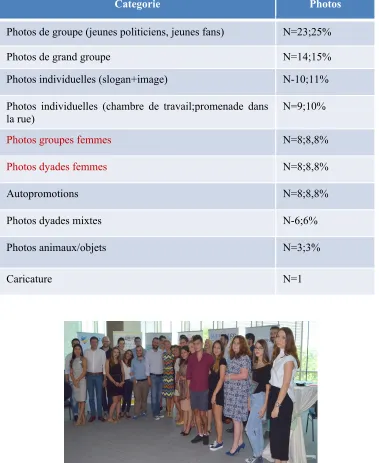
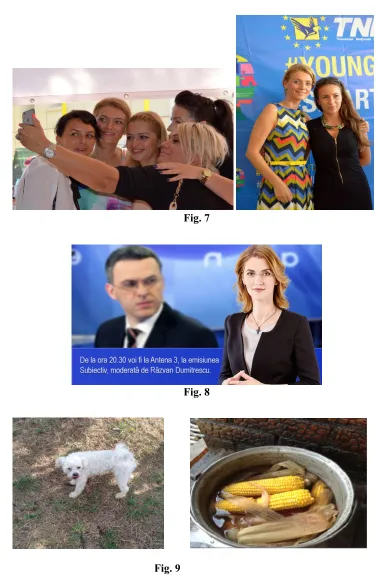
Dans un premier temps nous essaierons de mettre en évidence l’articulation des principales tendances déterminées par l’hégémonie du visuel et la « tyrannie de la visibilité » pour nous arrêter à la manière dont les politiciennes roumaines communiquent sur facebook par leurs images (professionnelles/vs/personnelles), en cernant les changements (?!) que facebook a apportés.
L’un des principaux objectifs sera d’acquérir une réflexivité nouvelle dans la déconstruction de la dynamique du visuel et de la culture visuelle ainsi que dans l’approfondissement des fonctions existentielles et stratégiques politiques de la “vie visuelle”.
Mots clés: Facebook, visuel, visibilité, femmes et politique, espace public/espace privé
1. Web 2.0 Ici Et Maintenant
La plus importante mutation qui marque le passage au troisième millénaire est représentée par la digitalisation de la communication qui a massivement transformée la sphère publique ainsi que la vie individuelle des citoyens ordinaires et des acteurs politiques. L’information, la mobilisation et la participation des individus et des groupes par l’intermédiaire des sites web, de la presse en ligne et surtout des réseaux sociaux semble changer la démocratie. Il est vrai que le technoscape évolue, mais le problème qui se pose pourrait être formulé ainsi : dans un nouveau cadre (recontextualisation du politique) la démocratie change de manière significative ou la même histoire des gagnants se répercute sur des nouveaux supports?
La grande majorité des pratiques d’information et de communication passent aujourd’hui par l’intermédiaire des plateformes numériques en configurant ce que les chercheurs appellent « le capitalisme informationnel » (Proulx et alii 2014) On envoie des photos ou SMS de son téléphone portable, on consulte les journaux en ligne, on partage ses émotions, expériences, commentaires sur Facebook, on rend public son profil professionnel sur LinkedIn ,on publie des photos sur Flickr ou des videos sur YouTube ,on envoie des messages sur Twitter,
30
IJCCSEC
V
ol
ume 4
, Issue 2
, 2015
toutes ces pratiques devenues des gestes quotidiens passent par les plateformes numériques et constituent la culture du sharing (du partage) à l’ère du « capitalisme informationnel »(Proulx, 2014). En utilisant le mot « bricolage » lancé par Claude Levi Strauss pour définir l’assemblage, l’intertextualité et la reconfiguration de l’activité de recherche, les analystes de la culture contributive parlent de « bricolage coopératif » (accumulation, réutilisation et détournement), d’économie de la contribution (Stiegler 2009).
Cette nouvelle forme d’économie et de culture se fonde sur des notions enchevêtrées telles la culture participative promue par Jenkins (2009), la nouvelle figure du producteur/usager (produser), l’intervention de l’amateur dans la constitution des corpus de connaissances sur internet et sur la culture (culte ?) du partage- soubassement idéologique de la nouvelle culture en ligne (John 2013). La notion de partage concerne non seulement des objets concrets tels les photos ou commentaires mais aussi des objets « plus flous - partager sa vie, son monde « (S Proulx (2014 :5). C’est dans ce sens de partage implicite ou explicite de repères et modèles que nous allons analyser les photos sur Facebook des politiciens/politiciennes roumaines dans des situations extraordinaires (campagne présidentielle) et ordinaires (le facebook vécu et « vu » au quotidien).
Ce qui caractérise la nouvelle socialité c’est la fluidité des frontières entre la sphère publique et celle privée, entre le temps et l’activité professionnels et ceux personnels, autrement dit la publicisation de la vie privée et la privatisation (personnalisation) de la vie publique. « Comment sur un forum ou un blogue, passe-t-on d’une atmosphère plutôt privée de badinage à une discussion semi-publique de nature citoyenne ? Des recherches sur le rôle subtil des médias sociaux au moment du printemps arabe ont mis en évidence ces va-et-vient du « parler privé-public » (Cardon, 2012), où des thématiques personnelles se transforment en problématiques à caractère public » (S Proulx, 2014 :6).
La digitalisation n’est pas reliée uniquement à l’effacement des frontières expert/amateur, global/local, commercial/non commercial etc., mais aussi à la suprématie du visible (et de la visibilité) qui remplace ou diminue le scriptible des siècles passés.
31 IJCCSEC
V
ol
ume 4
, Issue 2
, 2015
La seconde lecture du rôle de l’Internet (outre celui du stockage de l’information- big data) met en avant la capacité d’Internet de mobilisation de nouveaux publics et d’inclusion de plus de citoyens dans la politique (C Mabi et A Theviot, 2014 :8).
Selon bon nombre de chercheurs le principal intérêt des réseaux socio-numériques vient de ce qu’ils favorisent l’interactivité, le rassemblement autour d’évènements chauds imposant le partage et une réaction émotionnelle (sport, élections) mais aussi et surtout autour de valeurs communes.
Il est évident que le support technologique impose/suggère certaines réactions et interdit d’autres. Liker sur la page facebook d’une vedette de la chanson n’a pas la même signification et même « engagement » que liker une proposition politique ou la création d’une plateforme, parti etc.
Le support numérique a des caractéristiques particulières qui lui permettent de produire des contenus, les dupliquer et les faire circuler à grande échelle. Sur le plan méthodologique c’est évidemment une entrée pour le chercheur qui peut capter ce que le dispositif nous montre et nous « fait dire » (Monnoyer-Smith, 2013) mais il doit également être considéré comme un espace d’actualisation, le support des interactions entre acteurs, afin de le considérer dans son contexte sociopolitique de conception et d’usage. (C Mabi et A Theviot,2014 :17).
La mise en visibilité de la vie personnelle (sur Facebook par exemple) jouit des caractéristiques du “new journalism” avec ses nouvelles techniques et temps de production/réception: publics fragmentés, microsphères publiques, décontextualisations et recontextualisations.
”This new journalism is open to novices, lacks editorial control, can stem from anywhere (not just the newsroom), involves new writing techniques, functions in a network with fragmented audiences, is delivered at great speed, and is open and iterative. In this manner the technology of the internet is said to have reinvigorated democracy”(Fenton 2010: 6).
Si l’ image hégémonique se substitue à mille mots, très souvent un mot ou syntagme fonctionne à la manière des images, schématisant une expérience ou événement (les 140 caractères des messages Twitter, la fonction ouverture des breaking news à la télé, les mots clés d’un article scientifique etc.).
Ce qui arrive dans la culture journalistique ainsi que dans les pratiques sur Facebook c’est la connectivité avec des publics multiples, hétérogènes ainsi qu’une permanente recontextualisation des messages (reprises des commentaires, feed back des récepteurs)
32
IJCCSEC
V
ol
ume 4
, Issue 2
, 2015
2.Espace(s) Public(s) Et Medias Sociaux
Le repère fondamental dans la définition de l’espace public reste le modèle normatif de Jurgen Habermas proposé à travers plusieurs étapes de l’évolution de sa pensée.Le travail fondateur habermassien (1962) élabore la notion d’espace public comme action de communication basée sur le dialogue critique, le débat des problèmes essentiels de la communauté/société et la critique/interpellation des instances du pouvoir. “En perspective historique ces pratiques communicatio-nnelles allaient contribuer à la transparence de la gouvernance, à l’émancipation politique des gouvernés et aussi à l’apparition de formes de sociabilité entre les citoyens” (C Beciu,2011:714).
Il est utile de rappeler la distinction de la litterature anglo- saxonne entre public sphere visant la déliberation et public space plus englobant, comportant aussi l’espace physique du domaine public (espaces urbains, espaces institutionnels); dans la littérature francophone on emploie surtout le syntagme espace public et “espaces publics” au pluriel :
“L’espace public se décline aujourd’hui d’une double manière, au singulier et au pluriel. Cette distinction renvoie à deux conceptions qui ne sont pas divergentes mais parallèles : le pluriel correspond à l’espace public qui offre au public une « commune visibilité »,celle des rues, des places, des lieux et des monuments qui font émerger un espace commun ; le singulier renvoie à l’« espace public politique » qui est indissociable de dispositifs, de procédures ou de lieux tangibles favorisant le débat public. Si le singulier d’espace public évoque le débat politique et la pratique démocratique, les espaces publics désignent pour leur part des lieux considérés comme publics car accessibles à tous” (O.Mongin ,2012:73).
Selon Dahlgren aussi l’espace public politique est “l’espace discursif, institutionnel, topographique– où les gens dans leur rôle de citoyens ont accès à ce qui peut être nommé métaphoriquement dialogues sociétaux qui s’occupent des problèmes d’intérêt commun, autrement dit de la politique dans le sens le plus large du mot ” (Dahlgren, 1995: 9).
33 IJCCSEC
V
ol
ume 4
, Issue 2
, 2015
de la sphère publique avec de profondes et durables conséquences politiques” (Pierre Levy 2012 : 204).
Et ce médium numérique élargit et démocratise la liberté d’expression pour des raisons économiques, techniques et institutionnelles qui expliquent en grande partie la révolution digitale et la reconstruction des identités, des sociabilités et de l’espace public.
New media et social media facilitent l’agentivité des audiences (agency) et la dissémination des idées contre hégémoniques (Ritzer 2012) ainsi que la reconfiguration des audiences en tant que prosumers ou produsers .
Zizi Papacharissi décrit l’émergence d’une “virtual sphere 2.0”, dans laquelle les citoyens participent en exprimant le désaccord avec l’agenda publique à travers des blogues, des posts sur youTube ou des commentaires dans des groupes de discussion en ligne. (Papacharissi 2010, 244).Et ce nouvel espace public virtuel est basé sur l’explosion du « networked self » (Papacharissi 2011) visant les opportunités sociales pour « expression et connexion » (Papacharissi 2011 :317).
Dans ce contexte de liquéfaction des frontières, amalgame des rôles, identités et espaces nous essayons de voir non seulement comment la vie publique est privatisée et la vie privée publicisée à partir des medias sociaux, mais aussi comment se déconstruit et reconstruit l’espace public virtuel.
3. En Ligne et Hors Ligne
L’analyse des pratiques en ligne permet paradoxalement de sortir de l’hégémonie de « l’ère de l’individu » pour analyser l’engagement citoyen, la dimension collective des pratiques politiques en ligne, la constitution des collectivités parfois malgré l’intention des individus.
Mais ce qui a été valable dans la succession des périodes/courants culturels et des supports (la photographie n’a pas tué la peinture- cf le syndrome évoqué par V Hugo : « ceci ne tuera pas cela ») semble conforter la conclusion de bon nombre d’études empiriques, à savoir que le en ligne s’ajoute à un hors ligne déjà actif (le bon citoyen de Coleman 2005 se manifeste aussi bien ici que là).
« C’est la pluralité des expériences des publics en démocratie qui est ainsi interrogée, créant des ponts avec l’étude des mouvements sociaux plus traditionnels (Neveu, 2011) afin de poser la problématique des effets sociaux du numérique dans une démarche d’articulation entre les espaces « en ligne » et « hors ligne » (Mabi et Theviot, 2014 :19).
34
IJCCSEC
V
ol
ume 4
, Issue 2
, 2015
force présents hors ligne perdurent sur Internet (les géants de l’économie ou de la politique continuent de surveiller et de contrôler). En définitive, Internet n’a pas en lui-même d’effet direct (positif ou négatif) sur la délibération démocratique. Il s’est en partie moulé sur les caractéristiques de notre société, mais il offre aussi de réelles opportunités pour de nouvelles formes démocratiques multiples où le citoyen ne se contente pas d’élire ses représentants, mais où il peut faire connaître son opinion, débattre, surveiller et évaluer les actions de ceux qu’il a élus.
Ce qui nous intéresse dans cette analyse ce n’est pas de voir comment des individus des groupes minoritaires trouvent un espace de manifestation en ligne, mais de voir si certains représentants de ces groupes minoritaires (sexuels, ethniques, religieux) trouvent leur espace et voix de manifestation pour le « grand public ».
Si la politique traditionnelle est prête à utiliser les innovations pour les « normaliser », il n’est pas dépourvu d’intérêt de voir si les individus de leur côté ne tentent pas de refaire à travers des parcours individuels des trajectoires de normalisation (les femmes dans une campagne électorale présidentielle et même dans les pratiques quotidiennes d’usage du numérique se comportant comme des hommes).
4. La « Tyrannie de la Visibilite »
L’ensemble des pratiques sociales connaissent aujourd’hui l’injonction paradoxale de la “mise en visibilité”. Au XIXème siècle on prônait la discrétion sur l’intimité. Aujourd’hui l’invisible signifie l’insignifiant et par conséquent l’inexistant.
L’exigence de visibilité s’est exponentiellement développée avec les nouvelles technologies qui interpellent l’individu à une production continue de soi. La visibilité répond à une exigence (imaginaire aussi bien que réelle) de légitimité et de reconnaissance. L’individu est évalué à partir de la quantité de signes, textes, images qu’il produit et ceci de façon ininterrompue. Par la multiplicité de supports et personnes susceptibles d’avoir accès à notre self (visible), l’individu semble exister plus intensément “comme si la quantité remplaçait la qualité” (Serge Tisseron à propos des réseaux et de l’invisibilité et de la visibilité sur le Net) et vivre plusieurs existences/identités à la fois.
35 IJCCSEC
V
ol
ume 4
, Issue 2
, 2015
5. Facebook et Genre en Roumanie
Facebook le premier réseau de socialisation du monde avec 1,49 de miliards d’utilisateurs actifs au niveau international connait depuis cinq ans en Roumanie une croissance aussi spectaculaire qu’au monde entier. Facebrands.ro et Facebrands PRO, services de monitorisation de l’activité Facebook en Roumanie ont enregistré à la mi novembre 2015 le chiffre de 8.200.000 comptes Facebook en Roumanie. Le nombre d’utilisateurs roumains d’Internet ayant un compte Facebook s’est accru dans les 10 premiers mois de l’année 2015 avec 7,9%, après 8,57% en 2014, (année qui comptait en janvier 2014 -7 millions d’utilisateurs) ; à la mi mars 2015 il y avait déjà 8 millions et à la mi novembre 8.200.000. « Les réseaux sociaux et les blogs continuent de rester les medias les plus dynamiques et interactifs et on s’attend à ce que cette position soit consolidée en 2016 » , selon Ionuţ Oprea, manager des services analytics Facebrands et de l’agence marketing et communication des medias sociaux STANDOUT. Les comptes Facebook des utilisateurs roumains ont évolué ainsi: janvier 2011 - 2.405.920 de comptes, janvier 2012 - 4.406.580 de comptes, janvier 2013 - 5.593.480 de comptes, janvier 2014 - 7.000.000 de comptes, janvier 2015 - 7.600.000 comptes, mars 2015 - 8.000.000 de comptes, novembre 2015 - 8.200.000 de comptes.
Interpellés par cette explosion des plateformes numériques, les institutions, les partis politiques, les leaders mais aussi les gens ordinaires font constamment appel aux posts sur Facebook (largement dominant dans le paysage socio numérique roumain).Lors de la dernière campagne électorale présidentielle les politiciens connus (et soutenus par la formation politique), de même que les candidats indépendants (challengers) ont largement utilisé Facebook. Et la victoire du candidat challenger lors des dernières élections présidentielles a été interprétée comme résultat i) d’une excellente mobilisation sur les réseaux sociaux, a travers des mythes pertinents pour les Roumains (Badau et Eyries 2015) ainsi que de ii) l’interpellation et activation de la diaspora.
36
IJCCSEC
V
ol
ume 4
, Issue 2
, 2015
Fig. 1
Les hommes déjà bien connus et individualisés sont inclus dans le « peuple », les femmes, « pas à leur place » en tant que leader doivent réaffirmer leur statut de leader devant le symbole du pays - le drapeau ou à partir d’un slogan polysémantique sujet à interprétation (Udrea présidente/la Roumanie belle- jeu ambigu de consolidation ou de subversion de l’être/paraître féminin).
Les hommes se présentent comme déjà votés (infra fig. 2)
Fig. 2