Tuning of a PID Controller for use with Second-order-like
Processes having Small Natural Frequency
Galal Ali Hassaan
(Department of Mechanical Design & Production, Faculty of Engineering, Cairo University, Egypt)
---
************************
---Abstract:
This paper presents an effective tuning approach for PID controllers used with second-order-like processes having small natural frequency. The MATLAB program is used through its optimization toolbox to tune the controller using the ISE error-based criterion subjected to three functional constraints. The functional constraints are selected to produce exceptionally good performance of the control system regarding its transient characteristics. The tuning technique used is compared with another technique and the effectiveness of the controller is investigated through comparison with using the ITAE standard forms technique. The effectiveness of the used optimization technique is outlined considering the possibility of kick elimination associated with PID controllers.
Keywords — PID controller, controller tuning, second-order processes with small natural frequency, control system performance.
---
************************
---I. INTRODUCTION
This is work completes the research work published by the author to tune PID controllers used with second-order-like processes with outstanding tuning results and enhancing the elimination of the step time response kick practiced when using the PID controller.
Jalilvand, Vahedi and Bayat (2010) studied the optimal tuning of a PID controller for a buck converter using a Bacterial Foraging Algorithm (BFA). They used an ISE error criterion associated with the optimal technique they used using the BFA method. They showed that their results using the PID controller was more satisfactory than the results of other tuning methods [1]. Nagaraj and Vijayakumar (2011) used a soft computing
approach involving Genetic Algorithms,
Evolutionary Programming, Particle Swarm
Optimization and Bacterial Foraging Optimization to tune the PID controller. They applied the proposed technique to tune a PI controller for a pulp and paper industrial process and compared with other PI tuning methods [2]. Bansal, Sharma and
Shreeraman (2012) presented a review for the PID controller tuning techniques. They reviewed the
Ziegler-Nichols method, the Ant Colony
Optimization, the Bacteria Forage Technique, the Genetic Algorithm, the Differential Evolution, the Evolutionary Programming, the Artificial Neural Networks, the Simulated Annealing, the Support Vector Machine, the Particle Swarm Optimization, the Fuzzy Logic and the Response Surface method [3]. Rao, Subramanyam and Satyaprasad (2013) used a PID controller with Integral Model Control for robust operation. They compared with Cohen-Coon and Hrones-Reswjcle tuning methods in terms of the error criteria: ISE, IAE and ITAE. They used the superheated steam temperature system of a 100 MW boiler as a case study [4].
Chopra, Singla and Dewan (2014) presented the use of intelligent methods based on Fuzzy Logic, Artificial Neural Network, Adaptive Neuro Fuzzy Inferrence and Genetic Algorithms for tuning of a PID controller. They applied the studied tuning techniques to a PID controller used to control a second order process. They obtained a control system maximum overshoot between 0 and 20 %,
maximum undershoot between 7.29 and 44.46 % and settling time between 3.4 and 7.1 seconds [5]. Hassaan (2014) presented a simple tuning approach for PID controllers used with second-order-like processes . He tuned the controller parameters for second order processes having damping ratio between 0.05 and 0.9 and damping ratio between 2.5 and 15 rad/s. He simplified the tuning process to one set of controller parameters. He could obtain control system performance with maximum overshoot between zero and 4.38 % and settling time between 0.23 and 0.93 seconds [6]. Sariyildiz, Yu and Ohnishi (2015) proposed a practical tuning method for robust PID controller with velocity feedback for motion control systems. They verified the validity of their proposal through simulation and experimental results [7].
Abdulameer, Sulaiman, Aras and Saleem (2016) discussed using the tuning methods: Ziegler-Nichols, Chen-Hrones-Reswick and explained the advantages and disadvantages of each formula of the two methods. The DC motor they used as a plant had a second order transfer function with 0.897 damping ratio and 3.89 rad/s natural frequency. The maximum percentage overshoot they got using the studied techniques was 13.1 to 26.3 % while the settling time was between 0.378 and 1.35 seconds [8]. Issa, Hassanien and Abdelbaset (2017) used the Egyptian Vulture Optimization Algorithm to tune PID controllers by minimizing the ISE error function. They showed that using their proposed approach enhanced the performance of the controlled process than the Ziegler-Nichols method [9]. Alzuabi (2018) studied
the application of the Bacterial Foraging
optimization method to tune a PID controller used with a DC motor. His simulation results illustrated the enhancement of the control system response. He didn't compare with other tuning techniques used in the literature to control the PID controller [10]. Zhang, Zhang and Dong (2019) presented a tuning technique for the PID controller based on the Mind Evolutionary Algorithm. They applied their tuning technique to control five different processes using an ITAE error criterion and compared their results with two other tuning techniques [11].
II.PROCESS
The controlled process is second-order-like process having the transfer function, Gp(s):
Gp(s) = ωn2 / (s2 + 2ζωns + ωn2) (1)
Where:
ωn = process natural frequency ζ = process damping ratio
III. THEPIDCONTROLLER
The structure of a conventional parallel PID controller for the control of a linear process is set in the forward path with the process as shown in Fig.1. This structure is for set-point tracking.
The PID controller has a transfer function Gc(s)
given by:
Gc(s) = Kpc + (Ki/s) + Kds (2)
Where:
- Kpc is the proportional gains
- Ki is the integral gain
- Kd is the derivative gain
IV. CONTROLSYTEMTRANSFER
FUNCTION
The closed loop transfer function of the control system is obtained using the block diagram of Fig.1 with unit feedback elements and Eqs.1and 2 and given by:
M(s) = (b0s2+b1s+b2) /(a0s3+a1s2+a2s+a3) (3)
Where:
b0 = ωn2 Kd
b1 = ωn2 Kpc
b2 = ωn 2
Ki
a0 = 1
a1 = 2ζωn + ωn2 Kd
a2 = ωn2 (1 + Kpc)
V.CONTROLLERTUNINGANDSYTEM
TIMERESPONSE
The controller parameters are tuned as
follows:
- The control and optimization toolboxes of MATLAB are used to assign the three parameters of the controller [12].
- The integral of the square of the control system error (ISE) is chosen as an objective function for the optimization process. - Three functional constraints are set for the
closed-loop control system: maximum percentage overshoot, settling time and a stability constraint derived from the Routh-Hurwitz criterion for control system stability.
- The step response of the closed-loop control
system is plotted using the command 'step' of MATLAB [13].
- The controller is tuned using the above
approach for a second order-like process with assigned equivalent damping ratio and equivalent natural frequency.
- The time-based specifications of the closed-
loop control system are extracted using the
MATLAB command 'stepinfo' [14].
- The tuned parameters of the PID controller depend on the process parameters.
- Process parameters covered in the present analysis:
• Damping ratio: 0.05 ≤ ζ≤ 0.90
• Natural frequency: 0.25 ≤ ωn≤ 2.25 rad/s
- The tuned parameters of the controller are
given in Table 1 through Table 5 depending on the range of the process natural
frequency.
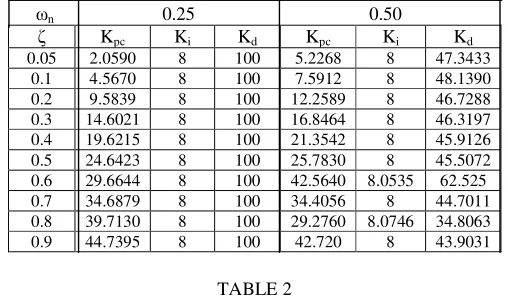
TABLE 1
TUNED CONTROLLER PARAMETERS FOR 0.25 and 0.5 rad/s NATURAL FREQUENCY
ωn 0.25 0.50
ζ Kpc Ki Kd Kpc Ki Kd
0.05 2.0590 8 100 5.2268 8 47.3433 0.1 4.5670 8 100 7.5912 8 48.1390 0.2 9.5839 8 100 12.2589 8 46.7288 0.3 14.6021 8 100 16.8464 8 46.3197 0.4 19.6215 8 100 21.3542 8 45.9126 0.5 24.6423 8 100 25.7830 8 45.5072 0.6 29.6644 8 100 42.5640 8.0535 62.525 0.7 34.6879 8 100 34.4056 8 44.7011 0.8 39.7130 8 100 29.2760 8.0746 34.8063 0.9 44.7395 8 100 42.720 8 43.9031
TABLE 2
TUNED CONTROLLER PARAMETERS FOR 0.75 and 1 rad/s NATURAL FREQUENCY
ωn 0.75 1.00
ζ Kpc Ki Kd Kpc Ki Kd
0.05 3.7981 8 20.926 3.119 8 11.704 0.1 5.3747 8 20.827 4.299 8 11.638 0.2 8.4846 8 20.628 11.704 11.7132 20.87 0.3 11.536 8 20.428 8.893 8 11.374 0.4 34.777 8.077 47.261 19.387 8.084 19.072 0.5 27.720 8.023 31.072 16.493 8.040 13.537 0.6 49.901 12.107 51.837 15.749 8.048 11.215 0.7 30.567 8.042 25.510 17.439 8 10.825 0.8 28.4539 9.372 21.681 18.808 8.014 10.386 0.9 28.5873 8 19.203 21.392 8 10.548
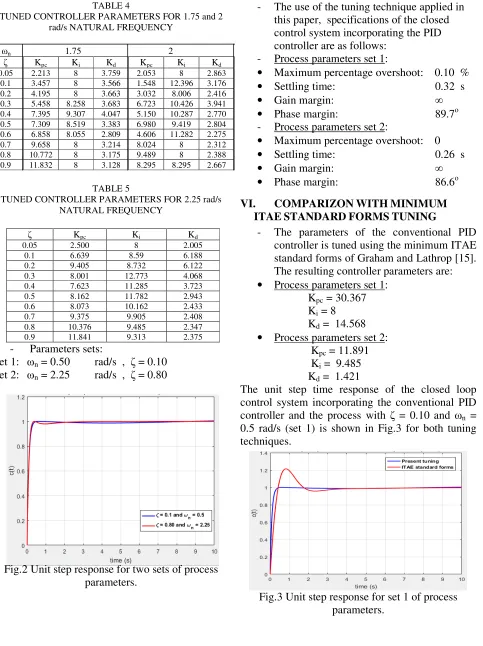
- The unit step response of the control system
incorporating the tuned PID controller and a second-order-like process with two sets of process parameters is shown in Fig.2 using the tuning parameters of the PID controller as given in Tables 1 and 5.
TABLE 3
TUNED CONTROLLER PARAMETERS FOR 1.25 and 1.5 rad/s NATURAL FREQUENCY
ωn 1.25 1.50
ζ Kpc Ki Kd Kpc Ki Kd
TABLE 4
TUNED CONTROLLER PARAMETERS FOR 1.75 and 2 rad/s NATURAL FREQUENCY
ωn 1.75 2
ζ Kpc Ki Kd Kpc Ki Kd
0.05 2.213 8 3.759 2.053 8 2.863 0.1 3.457 8 3.566 1.548 12.396 3.176 0.2 4.195 8 3.663 3.032 8.006 2.416 0.3 5.458 8.258 3.683 6.723 10.426 3.941 0.4 7.395 9.307 4.047 5.150 10.287 2.770 0.5 7.309 8.519 3.383 6.980 9.419 2.804 0.6 6.858 8.055 2.809 4.606 11.282 2.275 0.7 9.658 8 3.214 8.024 8 2.312 0.8 10.772 8 3.175 9.489 8 2.388 0.9 11.832 8 3.128 8.295 8.295 2.667
TABLE 5
TUNED CONTROLLER PARAMETERS FOR 2.25 rad/s NATURAL FREQUENCY
ζ Kpc Ki Kd
0.05 2.500 8 2.005
0.1 6.639 8.59 6.188
0.2 9.405 8.732 6.122 0.3 8.001 12.773 4.068 0.4 7.623 11.285 3.723 0.5 8.162 11.782 2.943 0.6 8.073 10.162 2.433 0.7 9.375 9.905 2.408 0.8 10.376 9.485 2.347 0.9 11.841 9.313 2.375
- Parameters sets:
Set 1: ωn = 0.50 rad/s , ζ = 0.10 Set 2: ωn = 2.25 rad/s , ζ = 0.80
Fig.2 Unit step response for two sets of process parameters.
- The use of the tuning technique applied in
this paper, specifications of the closed control system incorporating the PID controller are as follows:
- Process parameters set 1:
• Maximum percentage overshoot: 0.10 %
• Settling time: 0.32 s
• Gain margin: ∞
• Phase margin: 89.7o
- Process parameters set 2:
• Maximum percentage overshoot: 0
• Settling time: 0.26 s
• Gain margin: ∞
• Phase margin: 86.6o
VI. COMPARIZONWITHMINIMUM
ITAESTANDARDFORMSTUNING
- The parameters of the conventional PID
controller is tuned using the minimum ITAE standard forms of Graham and Lathrop [15]. The resulting controller parameters are:
• Process parameters set 1:
Kpc = 30.367
Ki = 8
Kd = 14.568
• Process parameters set 2:
Kpc = 11.891
Ki = 9.485
Kd = 1.421
The unit step time response of the closed loop control system incorporating the conventional PID controller and the process with ζ = 0.10 and ωn =
0.5 rad/s (set 1) is shown in Fig.3 for both tuning techniques.
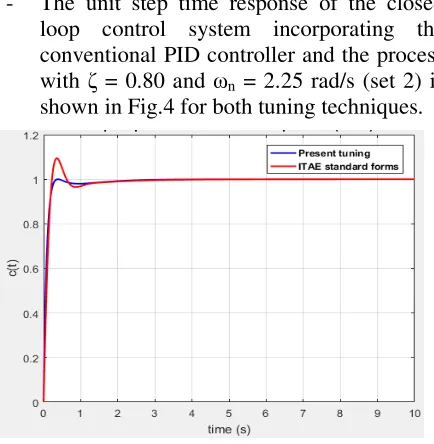
- The unit step time response of the closed loop control system incorporating the conventional PID controller and the process with ζ = 0.80 and ωn = 2.25 rad/s (set 2) is shown in Fig.4 for both tuning techniques.
Fig.4 Unit step response for set 2 of process parameters.
The characteristics of the control system using the two tuning techniques are compared in Tables 6 and 7.
TABLE 6
CHARACTERISTICS COMPARISON USING TWO TUNING TECHNIQUES
(Set 1 Parameters) Tuning
technique
Present tuning ITAE Standard Forms
OSmax (%) 0.10 21.468
Ts (s) 0.318 3.437
GM (dB) ∞ ∞
PM (degrees)
89.70 63.40
TABLE 7
CHARACTERISTICS COMPARISON USING TWO TUNING TECHNIQUES
(Set 2 Parameters) Tuning
technique
Present tuning ITAE Standard
Forms
OSmax (%) 0 9.444
Ts (s) 0.262 1.252
GM (dB) ∞ ∞
PM (degrees)
86.60 67.90
VII. CONCLUSIONS
- The Conventional PID controller was tuned
for use with second-order-like processes with relatively small natural frequencies and damping ratio between 0.05 and 0.9
(underdamped second order processes).
- It was tuned using the MATLAB
optimization toolbox.
- Three constraint functions were used to
provide good performance for the closed loop control system.
- The ISE error criterion was used as an
objective function for the constrained optimization problem of the controller tuning.
- The tuning technique used was compared
with another one using the minimum ITAE standard forms.
- The time response kick was almost
eliminated using the proposed tuning technique.
- The tuned PID controller was superior
compared with the used tuning technique producing a very fast step time response with very low maximum percentage overshoot with kick elimination.
REFERENCES
[1] A. Jalilvand, H. Vahedi and A. Bayat, "Tuning of the PID controller for a buck converter using bacterial foraging algorithm", IEEE-ICIAS2010, 15-17 June, Kualalumpurm Malaysia, 5 pages, 2010. [2] B. Nagaraj and P. Vijayakumar, "Soft computing based PID controller
tuning and application to the pulp and paper industry", Sensors and Transducers Journal, vol.133, issue 10, pp.30-43, 2011.
[3] H. Bansal, R. Sharma and P. Shreeraman, "PID controller tuning techniques: A review", Journal of Control Engineering and Technology, vol.2, issue 4, pp.168-176, 2012.
[4] P. Rao, M. Subramanyam and K. Satyaprasad, "Model based tuning of PID controller", Journal of Control and Instrumentation, vol.4, issue 1, pp.16-22, 2013.
[5] V. Chopra, S. Singla and L. Dewan, "Comparative analysis of tuning a PID controller using intelligent methods", Acta Polytechnica Hungarica, vol.11, issue 8, pp.235-249, 2014.
[6] G. A. Hassaan, "On simple tuning of PID controllers for underdamped second order processes", International Journal of Mechanical and Production Engineering Research and Development, vol.4, issue 3, pp.61-68, 2014.
[7] E. Sarlyildiz, H. Yu and K. Ohnishi, "A practical tuning method for the robust PID controller with velocity feedback", Machines, vol.3, pp.208-222, 2015.
Journal of Electrical Engineering and Computers Science 2, pp.343-349, 2016.
[9] M. Issa, A. Hassanien and A. Abdelbaset, "PID-EVOA: Tuning PID controller parameter optimization based on the habits of the Egyptian vulture", arXiv1710.03594, 6 pages, 2017.
[10] R. Alzuabi, "Optimally tuned PID controller of a DC motor system using Bacterial Foraging Algorithm", International Journal of Current Engineering and Technology, vol.8, issue 2,
pp.294-[11] Y. Zhang, L. Zhang and Z. Dong, "An MEA-Tuning method for design of the PID controller", Mathematical Problems in Engineering, vol.2019, Aticle 1378783, 11 pages, 2019.
[12] C. Lopez, "MATLAB optimization techniques", Springer, 2014. [13] L. Moysis and T. Azar, "Introduction to control system design using
MATLAB", International Journal of System Dynamics Applications, vol.6, issue 3, pp.130-170, 2017
[14] Mathworks, "stepinfo",
https://www.mathworks.com/help/control/ref/stepinfo.html
[15] D. Graham and R. Lathrop, "The synthesis of optimal response, criteria and standard forms", Transactions AIEE, vol.72, issue 5, pp.273 1953.
DEDICATION
I have the honour to dedicate this research work to Prof. Laila Bayyiomi, Chairman of the
Department of Mechanical Design and
Production of the Faculty of Engineering, Cairo University. This is because of her continuous support of providing control simulators required to enhance the capability of the Automatic Control Laboratory in the MDP to support teaching Automatic Control to the department students.
gineering and Computers Science, vol.3, issue
EVOA: Tuning PID controller parameter optimization based on the habits of the Egyptian
Optimally tuned PID controller of a DC motor system International Journal of Current
-297, 2018. Tuning method for design PID controller", Mathematical Problems in Engineering,
C. Lopez, "MATLAB optimization techniques", Springer, 2014. L. Moysis and T. Azar, "Introduction to control system design using
of System Dynamics Applications,
https://www.mathworks.com/help/control/ref/stepinfo.html , 2019. "The synthesis of optimal response, criteria and standard forms", Transactions AIEE, vol.72, issue 5, pp.273-288 ,
I have the honour to dedicate this research work rman of the
ical Design and
Production of the Faculty of Engineering, Cairo University. This is because of her continuous support of providing control simulators required to enhance the capability of the Automatic Control Laboratory in the MDP to support omatic Control to the department
BIOGRAPHY
Galal Ali Hassaan
• Emeritus Professor of System Dynamics
and Automatic Control.
• Has got his B.Sc. and M.Sc. from Cairo
University in 1970 and 1974.
• Has got his Ph.D. in 1979 from Bradford
University, UK under the supervision of Late Prof. John Parnaby.
• Now with the Faculty of Engineering, Cairo
University, EGYPT.
• Research on Automatic Control, Mechanical
Vibrations , Mechanism
History of Mechanical Engineering.
• Published 255 research papers in
international journals and
• Author of books on Experimental Systems
Control, Experimental Vibrations and
Evolution of Mechanical Engineering.
• Chief Justice of the International Journal of
Computer Techniques.
• Member of the Editorial Board of
International Journals including the
International Journal of Computer
Techniques.
• Reviewer in some international journals.
• Scholars interested in the author
publications can visit:
http://scholar.cu.edu.eg/galal BIOGRAPHY
Emeritus Professor of System Dynamics
Has got his B.Sc. and M.Sc. from Cairo University in 1970 and 1974.
Has got his Ph.D. in 1979 from Bradford University, UK under the supervision of Late Prof. John Parnaby.
Now with the Faculty of Engineering, Cairo
Research on Automatic Control, Mechanical Vibrations , Mechanism Synthesis and History of Mechanical Engineering.
research papers in
international journals and conferences. Author of books on Experimental Systems
Control, Experimental Vibrations and
Evolution of Mechanical Engineering. International Journal of
Editorial Board of some
s including the
International Journal of Computer
Reviewer in some international journals.
Scholars interested in the author’s