1-Professor, Mechanical Engineering Department, 3.Ph.D. Student Automotive Engineering Department Iran University of Science and Technology,2.Associate Professor, Malek-e-Ashtar University.
Abstract
New product development (NPD) is described in the literature as the transformation of a market opportunity into a product available for sale. In the automotive industry, within the context of ISO/TS16949:2002 (the automotive quality management system international standard), these related to the product realization process (PRP) which consists of Three main phases such as planning, Implementation and sales, and five sub-phases called “Planning”, “Product Design”, “Process Design and Development”, “Product and Process Verification and Validation”, and “Production”. These phases could be done concurrently and have correlated activities.
There has been a wide range of working in new product development but in automotive section no contributes has been done before. The paper proposes a contribution between the new product development performance factors of a same project in a developed country and developing country. It shows the differences of employee and systems ways of thinking in two above mentioned categories. The main factors were extracted from literatures which are Goal clarity; Process formalization, Process Concurrency, Iteration, Learning, Team Leadership, Team Experience, Team Dedication, Internal Integration, External integration, Empowerment and Architecture. Having differences of people and systems thinking of new product development process of automotive engineering in two different working stations will be helpful in developing a complete model for performance measurement of a new product development in automotive industry. The questionnaires were made to analyze the value of each factor via employee view and system view and distribute in two different bases. The differences are illustrated in the paper.
Keywords: Automotive, NPD, Performance Indicators
.
Introduction
Today, due to the rapid growth of production and competitiveness of the market, the need for products and services is increasing dramatically. Population increase and diversification of needs are the encouraging factors of achieving product and more new goods by organizations.
Therefore, it is obvious that organizations and companies tend to maintain their benefits at this stage. The fundamental solution is the preservation of life and survival of companies in today's competitive market, innovation and development of new products, and replacement which researchers consider the new product development concept (NPD). GA Athaide, RL Stump (2015). Changes in business in some years ago are impact of solutions in NPD process, which are done and managed. TJ Marion, KA Eddleston (2015) noted that, the
competitive advantage of a company can be linked into two key factors.1. The ability to generate new intellectual property that offers superior value to customers and 2.the ability to capitalize on it.
It is possible to list the main driving forces that determine the concentration on product development activity.
1-Increasing level of competition (more firms competition for similar markets) H Gmelin, S Seuring (2014) 2.Rapidly changing market environment 3. Shorter product life cycle W Chang, SA Taylor (2016)
A primary effect of environmental factors on the company is to have some changes that lead to the overall efficiency and effectiveness of the NPD process. Since last decade, many of new techniques and tools has been proposed in order to improve product development
Downloaded from www.iust.ac.ir at 17:38 IRST on Friday March 3rd 2017
* Corresponding Author
A key element is to focus on the consumer who is always available. All activities must be worth something to a customer. All the work that is done onto a product and does not add any value is regarded; hence the pure model is in contact.
The matter in automotive section is that the new product development normally will take up to three years; the process consists of several gates. To control each gate it is interesting to understand if the measuring performance indicators which are mentioned in literature, are sensing in reality and what could be their value weight according to industrial managers and scientific workers in a developed country, developing country and University based project. This contribute could be a base of developing a model to performance measurement of a new product development project in Auto motive industry.
Methodology
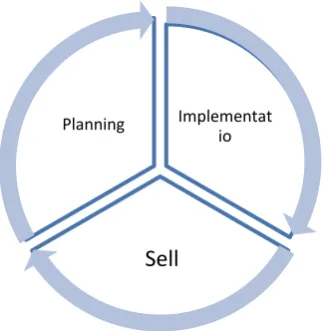
To start, the Indicators in three main phases of new product development which are planning, Implementation and Sell were extracted. (Fig 1)
The framework promotes a holistic view of performance by considering three categories of activities: Planning, Implementation, and Sales and Delivery. Successful performance evaluation comes from acknowledging the fact that there are different objectives for each of the three activity categories.
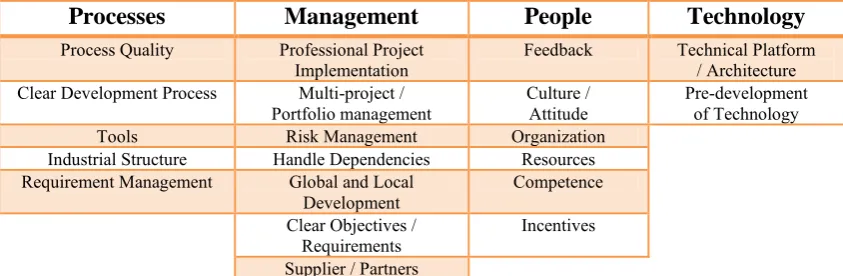
Moreover, performance may be expressed as a function of the performance of the Planning, the Implementation, and the Sales and Delivery activities. The planning activities have been concluded, based on the identified success factors, to be categorized into why, what, how, and when something is to be developed. The implementation activities on the other hand are more operational in character. The categorization of success factors related to the implementation activities includes management, technology, people, and processes. When comparing the framework of success factors, as identified in this research, with the literature it is especially the explicit focus on the planning activities and the focus on technology including for example the product architecture that differs. This may be the result of this research’s explicit focus on the development of Complex products while other studies e.g. (Ernst 2012; Tang, Liu et al. 2055) are covering a more general context. (Table 1)
Factors underlying product development
The idea of having a limited set of factors that affect the performance of the development of new products is appealing for both practitioners and researchers. As a result, a considerable amount of empirical research on the determinants of new product-development performance is reported in the literature (Ernst, 2002; Montoya-Weiss and Calantone, 1994). Prescribed common criterion can, however, explain how successful new products are Created (Poolton and Barclay, 2015).Tang et al. (2005) identified a distinct set of success factors for product development: Leadership, Organizational culture, Human resources, Information, Product strategy, Project execution, Product delivery, and Results.
In a thorough review of critical success factors by Ernst (2002), the following categorization, as previously developed by Cooper and Kleinschmidt (2014), was adopted: Customer integration,Organization, Culture, Role and commitment of senior management and Strategy. Adams et al. (2006) present another review drawing on a wide body of the product innovation literature, and identified the following seven categories as Important in the product innovation process: Inputs management, Knowledge management, Innovation strategy, Organizational culture and structure, Portfolio management, Project management, and Commercialization. Further, Bessant and Tidd (2012) argue for the following success factors in product innovation: Market knowledge, Clear product definition, Product advantage, Project organization, Top management support, Risk assessment, Proficiency in execution, and Project resources. Product advantage involves product superiority in the eyes of the customer e.g. delivering unique benefits to the user and a high performance-to-cost ratio. Chen et al. (2015) further argue, on the basis of their findings, that process and team characteristics are more generalizable and cross-situational consistent determinants of product-development speed than strategy and project characteristics.
In the review by Henard and Szymanski (2014) they conclude that out of the 24 determinants of product-development performance only five, i.e. product advantage, market potential, meeting customer needs, predevelopment task proficiencies and dedicated resources, are salient determinants of product development performance.
Downloaded from www.iust.ac.ir at 17:38 IRST on Friday March 3rd 2017
Fig1. Three main phases in automotive new product development
Table 1. Main categories of factors
Factors underlying product development
The idea of having a limited set of factors that affect the performance of the development of new products is appealing for both practitioners and researchers. As a result, a considerable amount of empirical research on the determinants of new product-development performance is reported in the literature (Ernst, 2002; Montoya-Weiss and Calantone, 1994). Prescribed common criterion can, however, explain how successful new products are Created (Poolton and Barclay, 2015).Tang et al. (2005) identified a distinct set of success factors for product development: Leadership, Organizational culture, Human resources, Information, Product strategy, Project execution, Product delivery, and Results.
In a thorough review of critical success factors by Ernst (2002), the following
categorization, as previously developed by Cooper and Kleinschmidt (2014), was adopted: Customer integration, Organization, Culture, Role and commitment of senior management and Strategy. Adams et al. (2006) present another review drawing on a wide body of the product innovation literature, and identified the following seven categories as Important in the product innovation process: Inputs management, Knowledge management, Innovation strategy, Organizational culture and structure, Portfolio management, Project management, and Commercialization. Further, Bessant and Tidd (2012) argue for the following success factors in product innovation: Market knowledge, Clear product definition, Product advantage, Project organization, Top management support, Risk assessment, Proficiency in execution, and Project resources. Product advantage involves product superiority in the eyes of the customer e.g. delivering unique benefits to the user and a high Implementat
io
Sell
Planning
plan Implementation
Sell
What
Process
Cost
Why
Management
Time
How
People
Quality
When
Technology
Downloaded from www.iust.ac.ir at 17:38 IRST on Friday March 3rd 2017
performance-to-cost ratio. Chen et al. (2015) further argue, on the basis of their findings, that process and team characteristics are more generalizable and cross-situational consistent determinants of product-development speed than strategy and project characteristics.
In the review by Henard and Szymanski (2014) they conclude that out of the 24 determinants of product-development performance only five, i.e. product advantage, market potential, meeting customer needs, predevelopment task proficiencies and dedicated resources, are salient determinants of product development performance.
Conceptual framework
Having literature review the success factor develops in the all three main phases which is illustrated in tables. (2 to 4) then A questionnaire
were develop and accepted by specialist to understand these success factors weighted from all three systems experts and contribution was made.The questionnaire has got three main questions as bellows:
1. How important is Success Factor X for successful product development in your organization according to your opinion?
[1= Not at all - 7 = Most important]
2. How important is Success Factor X for successful product development in your organization according to the organizations opinion?
[1= Not at all - 7 = Most important]
3. To what extent does your organization systematically evaluate Success Factor X through a measurement system?
[1 = Not at all - 7 = fully]
Table 2. Important factors for success planning
What and why
How and When
Market environment analysis Technology Road map
Customer Needs and Wants Metrics
Business Case Organization
Risk Management Ownership from Top Management
Planning Competence
Table3. Important factors for successful implementation activities
Processes
Management
People
Technology
Process Quality Professional Project
Implementation Feedback
Technical Platform / Architecture Clear Development Process Multi-project /
Portfolio management Culture / Attitude Pre-development of Technology
Tools Risk Management Organization
Industrial Structure Handle Dependencies Resources Requirement Management Global and Local
Development Competence Clear Objectives /
Requirements Incentives Supplier / Partners
Table 4. Important factors for successful sell activities
Cost
Time
Quality
Downloaded from www.iust.ac.ir at 17:38 IRST on Friday March 3rd 2017
Combination results
The result was different between the develop and developing county automotive industries and academia.
Here at below figures the contribution is shown.
Figure 2 shows that in employee view management support has more value in a developed country and it has the least value in
the developing country and in organization view it is vice versa.
Figure 3 shows that in employee view goal clarify factors has more value in a developing country and in organization view it has more value in developing country and least value in the develop country.
Figure 4 shows that in employee view and organization view process formalization factors have more value in a developing country than developed country.
Fig2. Management support factors
Fig3.Goal clarity factors
Downloaded from www.iust.ac.ir at 17:38 IRST on Friday March 3rd 2017
Fig4.Process formalization factors.
Fig5.Process Concurrency support factors
Fig6.Iteration support factor
0 10 20 30 40 50 60 70 80 90
Value from the Emp
Value From Org
Sys Measurement
Non-Sys Measurement
local
abroad
Ave
Downloaded from www.iust.ac.ir at 17:38 IRST on Friday March 3rd 2017
Fig7.Learning support factors
Fig8.. Team Leadership factors
Fig9.Team Experience factor
Downloaded from www.iust.ac.ir at 17:38 IRST on Friday March 3rd 2017
Figure 5 shows that in employee view and organization view Process Concurrency factors has more value in a developing country than developed country.
Figure 6 shows that in employee view Iteration factors has more value in a developed country and in organization view it has least value in the developing country.
Figure 7 shows that in employee and organizational view learning factors have more value in a developed country rather than developing country.
Figure 8 shows that in employee and organizational view Team Leadership factors has more value in a developed country rather than developing country.
Figure 9 shows that in employee view and organization view Team Experience factors has more value in a developed country than in the developing country.
Figure 10 shows that in employee view and organization view Team dedication factors has more value in a developed rather than developing country
Figure 11 shows that in employee view internal integration factors have more value in developed country and in organization view it has more value in developing country.
Figure 12 shows that in employee view and organization view external integration factors has more value developing country rather than developed country.
Figure 13 shows that in employee view Empowerment factors has more value in developing country and in organization view it has more value in developed country.
Figure 14 shows that in employee view and organization view architecture factors has more value in development country than in developing country.
Fig10. Team Dedication factor
Fig11. Internal integration factor
Downloaded from www.iust.ac.ir at 17:38 IRST on Friday March 3rd 2017
Fig12. .External Integration Factor
Fig13. Empowerment factors
Fig14. Architecture factor
Downloaded from www.iust.ac.ir at 17:38 IRST on Friday March 3rd 2017
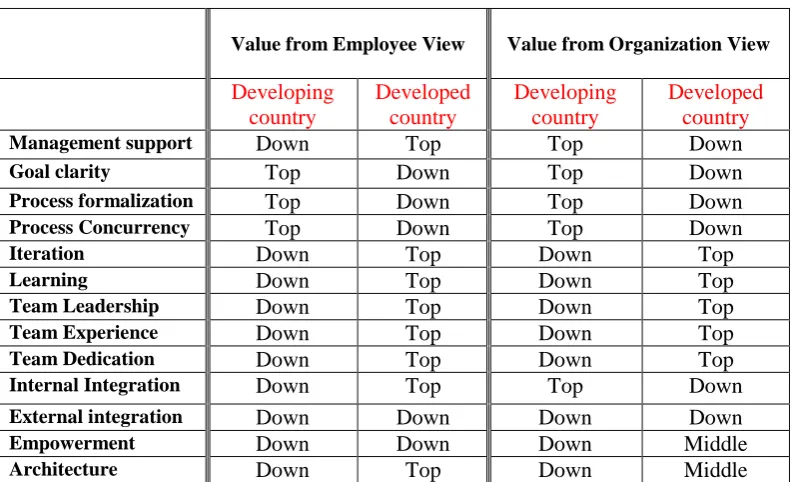
Table 5. Contribution of the success factor
Value from Employee View Value from Organization View
Developing
country
Developed
country
Developing
country
Developed
country
Management support
Down
Top
Top
Down
Goal clarity
Top
Down
Top
Down
Process formalization
Top
Down
Top
Down
Process Concurrency
Top
Down
Top
Down
Iteration
Down
Top
Down
Top
Learning
Down
Top
Down
Top
Team Leadership
Down
Top
Down
Top
Team Experience
Down
Top
Down
Top
Team Dedication
Down
Top
Down
Top
Internal Integration
Down
Top
Top
Down
External integration
Down
Down
Down
Down
Empowerment
Down
Down
Down
Middle
Architecture
Down
Top
Down
Middle
Conclusion
The research was done between same projects of automotive new product development in two base. 1. developing country based project and 2.developed country based projects.
In the literature many success factors as performance indicators of new product development has been introduced.
In the paper some of these factors have been chosen and contributed in these two different sections of automotive new product development to have their value weighted according to employee and system behaviors. The work was done to gather data for developing a model in automotive new product development.
As it is illustrated in table 5, via both employee and organization opinion factors such as Iteration, Learning, team leadership, team experience and team dedications have more value in the industry of development country rather than those in developing countries. We can conclude that in developed country the value of Iteration, Learning, team leadership, team experience and team dedications is more than other factors.
Also it is shown that factors such as goal clarity, process formalization and process
Concurrencies have more value in industry of developing country rather than the industry of developed countries. We can conclude that in developing country there the factors of goal clarity, process formalization and process concurrency have more value rather than others.
So it is considerable that in developing countries’ there are still having a gap of goal clarity, formalization and work concurrencies while in developed countries this issues has been solved and they are working on team cooperation and learning.
It is to conclude that in modern industry they are focusing on using the best Iteration, Learning, team leadership, team experience and team dedications.
In developing country the need focus is on goal clarity, process formalization and process concurrencies and in university the problem is on external integration and empowerment.
The result shows a complete overview and perceived the real situations also it could be useful as a base of a model to control the new product development of automotive industry
Downloaded from www.iust.ac.ir at 17:38 IRST on Friday March 3rd 2017
References
[1]. "Utilizing the balanced scorecard for R&D performance measurement." R & D Management 34(3): 229-238. Chiesa, V., F. Frattini, et al. (2009).
[2]. "Performance measurement in R&D: exploring the interplay between measurement objectives, dimensions of performance and contextual factors." R&D Management 39: 487-519.Clark, K. B. and T. Fujimoto (1991).
[3]. Product Development Performance: Strategy, Organization, and Management in the World Auto Industry, Harvard Business School Press.Clark, K. B. and S. C. Wheelright (1993).
[4]. Managing new product development and process development. New York, USA, The Free Press.Colquhoun, G. J., R. W. Baines, et al. (1993). "A State of the Art Review of IDEF0." International Journal of Computer Integrated Manufacturing6 (4): 252-264.
[5]. Cooper, R. G. (2009). "How companies are reinventing their idea-to-launch methodologies." Research Technology Management 52(2): 47-57.Davila, T., M. J. Epstein, et al. (2006).
[6]. Making innovation work - How to manage it, measure it and profit from it. New Jersey, Wharton School Publishing. Driva, H., K. S. Pawar, et al. (2001).
[7]. "Performance evaluation of new product development from a company perspective." Integrated Manufacturing Systems 12(5): 368-378.
[8]. Ernst, H. (2002). "Success Factors of New Product Development: A Review of the Empirical Literature." International Journal of Management Reviews 4(1): 1-40. [9]. Gharajedaghi, J. (2006). Systems Thinking:
Managing Chaos and Complexity - A Platform forDesigning Business Architecture. San Diego, Elsevier Inc. Goffin, K. and R. Mitchell (2005).
[10]. Innovation Management: Strategy and Implementation Using thePentathlon Framework. London, Palgrave MacMillan.Jiménez-Zarco, A. I., M. P. Martínez-Ruiz, et al. (2006).
[11].12- "Performance measurement system (PMS) integration into new product innovation: A literature review and conceptual framework ."Academy of
Marketing Science Review 10(7).Kaplan, R. S. and D. P. Norton (1992).
[12]."The Balanced Scorecard measures that drive performance ."Harvard Business Review 70(1): 71-80.Katz, D. and R. L. Kahn (1978). The Social Psychology of Organizations New York, John-Wiley & [13].project management competence of
individuals. In J. R. Turner (Ed.), People in Project Management. AldershotUK: Gower.Dulewicz, V. (1995).
[14]. A validation of Belbin’steam rolesfrom 16PF & OPQ using bosses’ ratings of competence.Journal of Occupational & Organizational Psychology, 68(2).Dulewicz, V., & Higgs, M. J. (2000). Emotional intelligence:
[15].A review and evaluation study. Journal of Managerial Psychology, 15(4), 341– 368.Dulewicz, V., & Higgs, M. J. (2003). [16].Design of a new instrument to assess
leadership dimensions and styles.
[17].Henley Working Paper Series HWP 0311. Henley-on-Thames,UK: Henley Management College.Dulewizcz, V., & Higgs, M. J. (2004).
[18].Leadership dimensions questionnaire: Organisation context, leader performance& follower commitment. Henley Working Paper Note. Henley-on-Thames, UK: Henley Management College.
[19].Fiedler, F. E. (1967). A theory of leadership effectiveness. New York: McGraw-Hill. Frame, J. D. (1987). [20].Managing projects in organizations. San
Francisco: Jossey Bass. Goffee, R., & Jones, G. (2000).
[21].Why should anyone be led by you? Harvard Business Review, Sept-Oct, 63– 70. Goleman, D., Boyatzis, R., & McKee, A. (2002).
[22].The New Leaders. Boston: Harvard Business School Press. Handy, C. B. (1982).
[23].Understanding organizations. London: Penguin Hartman, F., & Ashrafi, R. A. (2002).
[24].Project management in the information systems and information technologies industries. Project Management Journal, 33(3), 5-15. Hastings, C., & Briner, W. (1996).
[25].Coping with cultural differences. In J. R. Turner, K. V. Grude, & L. Thurloway (Eds.),
Downloaded from www.iust.ac.ir at 17:38 IRST on Friday March 3rd 2017
[26]. The project manager as change agent. London: McGraw-Hill. Hershey, P., & Blanchard, K. H. (1988).
[27].Management of organizational behavior (5th ed.). Englewood Cliffs, NJ: Prentice Hall. Hobbs, J. B., Pettersen, N., & Guérette, H. (2001).
[28].Building, validating and implementing a PM competency model: The experience of one aerospace company. In Proceedings of the PMI Annual Symposium, Nashville, November 2001. Newtown Square,PA: Project Management Institute. Hofstede, G. (1991).
[29]. Cultures and organziations: Software of the mind, London: McGraw-Hill, R. J. (1971).
[30].Project success: A retrospective look at project success and our evolving understanding of the concept. Project Management Journal. Keegan, A. E., & Den Hartog, D. N. (2004).
[31]. Transformational leadership in a project-based environment: A comparative study of the leadership styles of project managers and line managers. International Journal of Project Management, 22(8), 609-618. Kendra, K., & Taplin, L. J. (2004).
[32].Project success: A cultural framework. Project Management Journal, 35(1), 30-45. [33].Kets De Vries, M. F. R., & Florent-Treacy,
E. (2002).
[34].Global leadership from A to Z: Creating high commitment organisations. Organisations Dynamics, Spring, 295–309. Kirkpatrick, S. A., & Locke, E. A. (1991). [35]. Leadership traits do matter. Academy of
Management Executive, March, 44-60. [36].Kloppenborg T. J., & Petrick, J. A. (1999). [37].The effect of cost goal specificity and new product development process on cost reduction performance M Gopalakrishnan, T Libby, JA Samuels… - Accounting, …, 2015
[38].33-Quality Function Deployment and New Product Development with a focus on Marketing Mix 4P model K Rahmani, K Emamisaleh… - Asian Journal of …, 2015 \
[39].34-Communication intensity, goal congruence, and uncertainty in buyer– supplier new product development T Yan, KJ Dooley - Journal of Operations Management, 2013
Downloaded from www.iust.ac.ir at 17:38 IRST on Friday March 3rd 2017