Cognitive performance of patients with Multiple Sclerosis (MS) in
autobiographical, working and prospective memory in comparison
with normal people
Alireza Moradi
1, Bita Afsardeir
2, Hadi Parhoon
1, Haleh Sanaei
31Department of Clinical Psychology, Faculty of Psychology and Educational Sciences, University of Kharazmi, Tehran, Iran
2Department of Clinical Psychology, Faculty of Psychology and Educational Sciences, University of Science and Culture, Tehran, Iran
3Department of Clinical Psychology, Faculty of Psychology and Educational Sciences University of Shiraz (International Division), Shiraz, Iran
Submitted: 23 January 2016
Accepted: 15 April 2016
Int J Behav Sci. 2016; 10(1): 1-6
Corresponding Author:
Hadi Parhoon, MSc
Department of Clinical Psychology Faculty of Psychology and Educational Sciences,
University of Kharazmi, Tehran,
Iran
E-mail: [email protected]
Abstract
Introduction: This study aims to compare the cognitive performance of patients with Multiple Sclerosis
(MS) in the field of autobiographical, prospective and working memory compared to normal people.
Methods: In a causal-comparative study using convenience sampling 200 patients with MS (100 were
affected less and 100 were affected more than 2 years(and 100 healthy individuals were matched regarding their age, sex, education level and economic conditions. Research tools included Autobiographical Memory Interviews (AMI), Autobiographical Memory Test (AMT), questionnaire of Prospective Oriented Memory (POM) and the information processing index. The obtained data were analyzed using MANOVAand Bonferroni post hoc test.
Results: The results showed that in all three areas of working, autobiographical and prospective
memory there is a significant difference between MS patients (groups affected more and less than 2 years) and the normal group. This reflects the poor performance of MS patients in the three working, autobiographical and prospective memory compared to the normal group.
Conclusion: According to the findings, it seems that the MS disease can damage cognitive
performance. Providing cognitive rehabilitation exercises in order to improve cognitive performance and processing speed in these patients is debatable.
Keywords: Multiple Sclerosis, Autobiographical Memory, Working Memory, Prospective Memory
Introduction
with is the harm in cognitive performance, such as attention and memory that will affect their daily functions [9, 10]. Researches show that the most common clinical signs of cognitive impairment in MS is the cognitive disorder. The prevalence rate among these patients has been reported to be 40 to 65% [11, 12]. MS patients complain about cognitive problems, such as performing simultaneous tasks, complex attention, organizing daily activities on a daily basis, rapid processing of complex information, executive functioning and memory [11]. Most of the cognitive impairment is in the memory. This harm occurs in the main cortical part which is associated with reduced information processing speed and defects in the working and episodic memory [11-13]. In fact, in these patients, problems are observed in short-term, long term, autobiographical, prospective and working memory [13, 14]. Mueller and colleagues showed that patient’s autobiographical memory gets badly damaged [13]. Autobiographical memory damage causes difficulty in making decisions and interactions and the quality of life of MS patients and even patients encounter problems in their social relations with others [15]. Part of this memory is affected more than the other parts, such as episodic memory which gets damaged more than semantic memory in patients [13]. Another section of memory that can be damaged in these patients is the prospective memory [16]. Prospective memory is the aspect of memory which refers to recall or remembrance in doing an action that is planned for the future. This section of memory plays an important role in our social and professional lives and daily activities [17]. Research shows that one-fifth of MS patients have problems with prospective memory and activities of daily living [18], since this part of the memory is associated with social activities such as occupation [19], independence in life [20] and social relations. As a result, people with MS have problems in their daily activities. Moreover, another aspect of that memory which gets impaired in patients with MS is the working memory [21]. This is while reduced information processing speed and memory impairment is observed in most patients [22-24]. The working memory is a part of the human memory system which gets help from cognition in order to hold information temporarily in an active state, so that they can do other operations. It also provides a work area for mental arithmetic, and it acts as a waypoint for long-term memory [25]. Working memory impairment in MS patients decreases speed information processing, attention and learning [23, 26]. Due to the fact that people are in need of attention in order to learn from their environment, and attention is regarded as the basic element of learning, with impairment in working memory in MS patients, the rate of psychomotor part in patients, gets reduced [27]. Therefore due to reduction of learning ability in MS patients, their self-esteem and self-efficacy are reduced and symptoms of depression become more pronounced. Given the presented material, what doubles the importance of paying attention to MS patients, especially in our country is the growing prevalence of the disease in recent years, which women between 20 and 40 years
make up the majority of it. This age is the peak point of their physical activity, mental health and job. So, since the extent of cognitive impairment among MS patients is high, paying attention to the cognitive component of these patients is essential for the design of appropriate rehabilitation interventions and based on local culture which can lead to greater compatibility of them with physical and mental conditions. So given the fact that little research has been done, in the field of dimensions of cognitive impairment in MS patients, in Iran, it is essential to further address this issue. The purpose of the current study was to evaluate cognitive performance in MS patients in autobiographical, prospective and the working memory compared to normal individuals.
Method
The present study is considered a part of a fundamental
research in terms of its purpose and a descriptive study (causal-comparative) in terms of its data collection method. The study sample included all patients which are a member of the MS Society of Iran in 2013, in Tehran city. After examining the records of these patients, they were invited by appointment to the MS Society and they were given adequate explanations about the research project. They were examined, in terms of agreement. After the necessary studies, all the three groups which consisted of 100 patients with MS groups with a history of less than two years of disease, 100 patients with a history of more than two years of disease and 100 normal subjects were selected. They were then matched in terms of age, sex and education level and had the same social and economic conditions. The age range of people who were selected was 22-53 and the average age was 37.96 years, with standard deviation of (SD=9.12).
Autobiographical memory interview: This test is appropriate for the age range of above 18 years and it is administered in the form of a structured interview which consists of two parts[28]. The first part considering the semantic autobiographical memory is paid to evaluation of recalling past events in people's personal lives. In this section, subjects are required to recall the past life facts of childhood, early adulthood and events of recent times. The second part is recalling episodic autobiographical memory, the same three time periods. This test is simple and has quite rapid executive ability, and is interesting and amusing for the patients. AMI offers an assessment of the remote personal memory. Subject’s performance in this test can be compared to the tasks related to the remote common memory which assesses common events knowledge. The test identified damage or subject’s remote memory health, which includes patterns of any impairment and its time slope [29].
short-term prospective memory, long-short-term, short-short-term retrospective memory, and long term, respectively. Each of them has been studied, according to the type of environmental or internal reminder clue [31].
Autobiographical memory test: One task is related to
episodic memory in which the subjects in response to cue words, emotionally charged words, looks into the production of specific episodic autobiographical memory. This test has been designed and developed by Williams and Broadbent [32]. This method includes providing an indication of different emotionally charged words. The participants were asked to response to each word, with the memory which is recalled due to response[33]. Intra-class correlation (raters’ agreement) scoring for specific
memories varied among 0.87 to 0.96.In a study which was
conducted by Moradi and colleagues on the Iranian
population, theKappa coefficient agreement between the
raters was believed to be 82.0 [34].
Working memory test: Information processing index
test was used, for the assessment of working memory. This test is used to measure the visual working memory. This test is done by the computer. Trains with different color wagons enter the station from the left side. The trains are invisible for a moment and then exits from the right side while the color of some wagons change. After the entrance of the train at the station and the disappearance of it, the subjects had to remember the colors of the wagon, in its correct order. In this task, both
accumulation and data processing is needed. The quantity of processing and amount of needed information for retention increases due to the train’s length [35].
Results
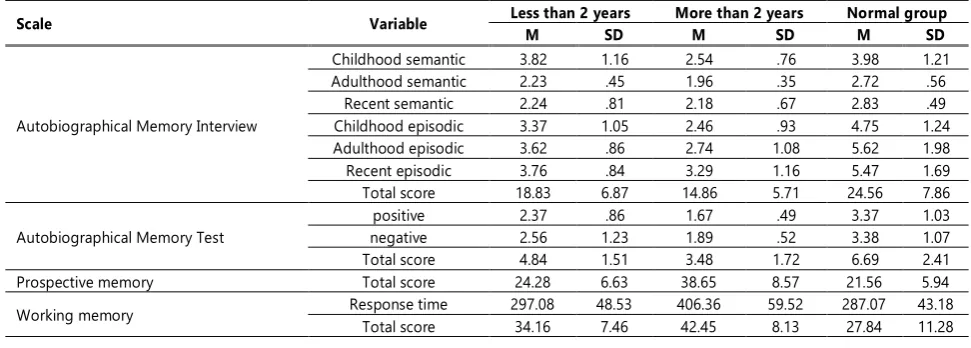
In Table 1, by using the descriptive statistics index, the three groups subject’s performance are shown in autobiographical memory, prospective memory and working memory.
As Table 1 shows, the mean scores show differences in terms of their appearance. In order to evaluate significant differences in the subjects’ mean scores in the three groups of autobiographical, prospective and working memory, multivariate analysis of variance was used. Preliminary assumption testing was conducted to check for normality, linearity, homogeneity of variance covariance matrices, and multicollinearity, with no serious violations noted In order to understanding which of these groups have a significant difference in terms of these variables, theBonferronipost hoc test was used.
The results in Table 2 indicate that there is a significant difference in all the subscales and the total score of autobiographical memory interview, autobiographical memory test, prospective memory and working memory between the groups. In order to determine the detail differences and comparison of groups in pairs, the
Bonferroni post hoc test was used.
Table 1. Mean and standard deviation of autobiographical memory, prospective memory and working memory
Scale Variable Less than 2 years More than 2 years Normal group
M SD M SD M SD
Autobiographical Memory Interview
Childhood semantic 3.82 1.16 2.54 .76 3.98 1.21
Adulthood semantic 2.23 .45 1.96 .35 2.72 .56
Recent semantic 2.24 .81 2.18 .67 2.83 .49
Childhood episodic 3.37 1.05 2.46 .93 4.75 1.24
Adulthood episodic 3.62 .86 2.74 1.08 5.62 1.98
Recent episodic 3.76 .84 3.29 1.16 5.47 1.69
Total score 18.83 6.87 14.86 5.71 24.56 7.86
Autobiographical Memory Test
positive 2.37 .86 1.67 .49 3.37 1.03
negative 2.56 1.23 1.89 .52 3.38 1.07
Total score 4.84 1.51 3.48 1.72 6.69 2.41
Prospective memory Total score 24.28 6.63 38.65 8.57 21.56 5.94
Working memory Response time 297.08 48.53 406.36 59.52 287.07 43.18
Total score 34.16 7.46 42.45 8.13 27.84 11.28
Table 2. Results of multivariate analysis between three groups
Scale Dependent Variable F DF sig Partial Eta
Autobiographical Memory Interview
Childhood semantic 14.27 2 0.01 .09
Adulthood semantic 16.95 2 0.01 .11
Recent semantic 10.67 2 0.05 .07
Childhood episodic 13.80 2 0.05 .09
Adulthood episodic 22.52 2 0.001 .13
Recent episodic 105.58 2 0.001 .42
Autobiographical Memory Test
positive 42.31 2 0.001 .22
negative 23.24 2 0.01 .14
Total score 52.11 2 0.001 .26
Prospective memory Total score 51.31 2 0.001 .24
Working memory Response timeTotal score 26.14 57.55 2 2 0.001 0.001 .16 .28
The results of this test in autobiographical memory part indicated that the mean of the control group in all
patients affected less than 2 years, except the adulthood semantic and recent subscales are higher than the group affected more than 2 years. The autobiographical memory test part, the comparison of paired groups indicated that the mean of the normal group in all subscales of autobiographical memory test is significantly (P<0.01) higher than the other two groups. Moreover, the mean group of patients who are affected with MS less than two years, in all the subscales of the autobiographical test is significantly (P<0.01) higher than the group that is affected more than two years. The mean of patients affected less than 2 years in the subscales of self- long-term prospective, environmental long-long-term-prospective, self- short-term prospective and total test scores is significantly higher than the normal group. Moreover, in the working memory of the Bonferroni test for the comparison of the paired groups indicated that the mean groups of patients affected more than 2 years is lower than the other two groups. The mean group of patients affected less than two years is higher than the normal group. In terms of the response time, both groups of healthy and patients affected less than two years are significantly (P<0.01) lower than the group affected more than 2 years. However, a significant difference (P>0.05) was not seen between the normal group and those affected less than 2 years.
Discussion
MS with debilitating, chronic and unpredictable features creates many challenges in the patients’ life. The current study was carried out with the aim of comparing cognitive performance of patients with MS in autobiographical, prospective and working memory with the normal group. As the findings indicated, people with MS encounter problems in their cognitive performance, compared to healthy individuals. The results of the researches on autobiographical memory area, indicated that there is a significant difference between the 3 groups of patients, the newly diagnosed with multiple sclerosis, chronic MS patients and the control group, in a two-part autobiographical memory interview and the total score of the autobiographical memory test scores. These results are in consistent with the findings of the other studies which indicated that the cognitive performance of MS patients has shown impairment in the autobiographical memory [13, 14, 36, 37]. To explain these findings, we can say that people with multiple sclerosis that use drugs and have physical disabilities, show higher rates of depression. This can affect the retrieval of their past memories and it can also cause impairment in their autobiographical memory. On the other hand, we can say that given the fact that the autobiographical memory plays an important role in the self-endorsement of an individual, the inability to retrieve memories, causes feelings of failure and frustration and decreases the self-efficacy of these patients, As a result, more cognitive performance of these patients gets damaged. Thus, the inability to retrieve autobiographical memories gets higher. Although there is no consensus among experts regarding the main damage in MS patient’s memory, but according to multiple studies
probably the retrieval process gets more affected by multiple sclerosis than the encoding and consolidation process [14]. Research has shown that autobiographical memory is more vulnerable than the other parts of 1 remote memory parts, compared to brain injury. Given that areas of brain responsible for autobiographical memory are precisely the areas that suffer from multiple sclerosis, therefore, it can be predicted that after a while, the autobiographical memory of MS patients gets damaged. A witness to this case is when someone is affected by the MS disease; a person can experience difficulties in their social situations (where autobiographical memory function is felt). In addition, in clinical practice, many MS patients have difficulty in recalling their own personal experiences, accurately [14]. As it was mentioned before, one of the most important in MS patients is the process of retrieving information from long term memory.
Since the information retrieving process is an essential part of the autobiographical memory, autobiographical memory impairment in MS patients is explainable. On the other hand, since the researchers [38] have emphasized on the main role of the prefrontal part in retrieving information and since the prefrontal part of MS patients causes lesions, having problem in retrieving information and damage in autobiographical memory is an expectable consequence. These finding are in consistent with the research findings which indicated that patients with MS have deficiency in their prospective memory [16, 39]. These results are explainable in this sense that MS patients have a reduction in the quality of retrieving information, because of the impact of disabilities due to disease, lack of adequate support from the family and not having enough concentration. They lose their prospective performance ability, to a large extent. The findings also indicated that in working memory index, there is significant difference between the three groups, so the mean of the patient’s groups more than 2 years were more than the two other groups and the mean of newly affected groups were more than the normal group. These findings are in line with the carried out researches in this context that MS patients and healthy individuals differ in working memory index [21, 40]. In fact, the working memory is the result of the ability to control attention and keep focus on a specific mental activity. These findings can be explained in the sense that considering the fact that attention is the important and infrastructure elements of learning and the environment in which people live, is a complex environment that requires attention to multiple parts of the environment. Since the patient’s attention in doing daily activities is solely focused on the primary stimulant, and they are not able to focus on several parts of the stimuli, therefore, the damage in visual memory, decreases learning efficiency in patients with MS.
Conclusion
autobiographical and prospective memory. This reflects the poor performance of MS patients in all the three working, autobiographical and prospective memory
compared to the normal group.According to the findings,
it seems that the MS disease can damage cognitive performance. Providing cognitive rehabilitation exercises in order to improve cognitive performance and processing speed in these patients is debatable.
Acknowledgments
We would like to have the greatest appreciation and gratitude from all the MS society's staff and all those patients who helped us in this study.
References
1. Cohen JA, Rae-Grant A. Handbook of Multiple Sclerosis. Tarporley: Springer Healthcare Ltd; 2010.
2. Iaffaldano P, Viterbo RG, Goretti B, Portaccio E, Amato MP, Trojano M. Emotional and neutral verbal memory impairment in Multiple Sclerosis. J Neurol Sci. 2014;341(1–2):28-31. 3. Milo R, Kahana E. Multiple sclerosis: geoepidemiology,
genetics and the environment. Autoimmun Rev. 2010;9(5):A387-94. Epub 2009/11/26.
4. Alonso A, Hernan MA. Temporal trends in the incidence of multiple sclerosis: a systematic review. Neurol. 2008;71(2):129-35. Epub 2008/07/09.
5. Loma I, Heyman R. Multiple sclerosis: pathogenesis and treatment. Curr Neuropharmacol. 2011;9(3):409-16. Epub 2012/03/02.
6. O’Gorman C, Lucas R, Taylor B. Environmental Risk Factors for Multiple Sclerosis: A Review with a Focus on Molecular Mechanisms. Int J Molecular Sci. 2012;13(9):11718-52. 7. Weiner HL, JM S. Multiple Sclerosis Diagnosis and Therapy.
Blackwell: John Wiley & Sons; 2012.
8. Ogden J. Health Psychology: A Textbook. Edition F, editor: McGraw-Hill Education; 2012.
9. Kollndorfer K, Krajnik J, Woitek R, Freiherr J, Prayer D, Schöpf V. Altered likelihood of brain activation in attention and working memory networks in patients with multiple sclerosis: An ALE meta-analysis. Neurosci Biobehav Rev. 2013;37(10, Part 2):2699-708.
10. Rosti-Otajarvi EM, Hamalainen PI. Neuropsychological rehabilitation for multiple sclerosis. Cochrane Database Syst Rev. 2014;2:CD009131. Epub 2014/02/12.
11. Jongen PJ, Ter Horst AT, Brands AM. Cognitive impairment in multiple sclerosis. Minerva Med. 2012;103(2):73-96. Epub 2012/04/20.
12. Hulst HE, Schoonheim MM, Van Geest Q, Uitdehaag BM, Barkhof F, Geurts JJ. Memory impairment in multiple sclerosis: Relevance of hippocampal activation and hippocampal connectivity. Mult Scler. 2015. Epub 2015/02/15.
13. Muller S, Saur R, Greve B, Melms A, Hautzinger M, Fallgatter AJ, et al. Similar autobiographical memory impairment in long-term secondary progressive multiple sclerosis and Alzheimer's disease. Mult Scler. 2013;19(2):225-32. Epub 2012/06/12.
14. Ernst A, Blanc F, Voltzenlogel V, de Seze J, Chauvin B, Manning L. Autobiographical memory in multiple sclerosis patients: assessment and cognitive facilitation. Neuropsychol Rehabil. 2013;23(2):161-81. Epub 2012/09/18.
15. Kenealy PM, Beaumont GJ, Lintern T, Murrell R. Autobiographical memory, depression and quality of life in multiple sclerosis. J Clin Exp Neuropsychol. 2000;22(1):125-31. Epub 2000/01/29.
16. Rendell PG, Henry JD, Phillips LH, de la Piedad Garcia X, Booth P, Phillips P, et al. Prospective memory, emotional valence, and
multiple sclerosis. J Clin Exp Neuropsychol. 2012;34(7):738-49. Epub 2012/04/05.
17. Kardiasmenos KS, Clawson DM, Wilken JA, Wallin MT. Prospective memory and the efficacy of a memory strategy in multiple sclerosis. Neuropsychol. 2008;22(6):746-54. Epub 2008/11/13.
18. Bravin JH, Kinsella GJ, Ong B, Vowels L. A study of performance of delayed intentions in multiple sclerosis. J Clin Exp Neuropsychol. 2000;22(3):418-29. Epub 2000/06/16. 19. Dismukes R, K,. Prospective Memory in Aviation and Everyday
Settings, In Kliegel, M., McDaniel, M.A. & Einstein, G.O. (Eds.), Prospective memory: Cognitive, neuroscience, developmental, and applied perspectives. Mahwah: Erlbaum; 2007.
20. Woods SP, Iudicello JE, Moran LM, Carey CL, Dawson MS, Grant I. HIV-associated prospective memory impairment increases risk of dependence in everyday functioning. Neuropsychol. 2008;22(1):110-7. Epub 2008/01/24.
21. Parmenter BA, Shucard JL, Benedict RH, Shucard DW. Working memory deficits in multiple sclerosis: comparison between the n-back task and the Paced Auditory Serial Addition Test. J Int Neuropsychol Soc. 2006;12(5):677-87. Epub 2006/09/12. 22. Genova HM, Lengenfelder J, Chiaravalloti ND, Moore NB,
DeLuca J. Processing speed versus working memory: contributions to an information-processing task in multiple sclerosis. Appl Neuropsychol Adult. 2012;19(2):132-40. Epub 2013/02/05.
23. Ruet A, Hamel D, Deloire MS, Charre-Morin J, Saubusse A, Brochet B. Information processing speed impairment and cerebellar dysfunction in relapsing-remitting multiple sclerosis. J Neurol Sci. 2014;347(1-2):246-50. Epub 2014/12/03.
24. Ochi H. [Cognitive impairment in multiple sclerosis]. Brain Nerve. 2014;66(10):1201-9. Epub 2014/10/10.
25. Sperling RA, Guttmann CR, Hohol MJ, Warfield SK, Jakab M, Parente M, et al. Regional magnetic resonance imaging lesion burden and cognitive function in multiple sclerosis: a longitudinal study. Arch Neurol. 2001;58(1):115-21. Epub 2001/02/15.
26. Sweet LH, Rao SM, Primeau M, Mayer AR, Cohen RA. Functional magnetic resonance imaging of working memory among multiple sclerosis patients. J Neuroimaging. 2004;14(2):150-7. Epub 2004/04/21.
27. Denney DR, Lynch SG, Parmenter BA, Horne N. Cognitive impairment in relapsing and primary progressive multiple sclerosis: mostly a matter of speed. J Int Neuropsychol Soc. 2004;10(7):948-56. Epub 2005/04/02.
28. golaij s, moradi a, parhoon h. Comparing the performance of the people suffering from washing compulsion, checking compulsion and generalized anxiety disorders in the realm of autobiographical memory. J Behav Sci. 2014;8(3):1-2. [Persian] 29. Baddeley AD. Working Memory. Oxford: Clarendon Press;
1987.
30. Smith RE. The cost of remembering to remember in event-based prospective memory: investigating the capacity demands of delayed intention performance. J Exp Psychol Learn Mem Cogn. 2003;29(3):347-61. Epub 2003/06/05. 31. Crawford JR, Henry JD, Ward AL, Blake J. The Prospective and
Retrospective Memory Questionnaire (PRMQ): latent structure, normative data and discrepancy analysis for proxy-ratings. Br J Clin Psychol. 2006;45(Pt 1):83-104. Epub 2006/02/17.
32. Williams JM, Broadbent K. Autobiographical memory in suicide attempters. J Abnorm Psychol. 1986;95(2):144-9. Epub 1986/05/01.
33. Moradi A, Salimi M, Fathi- Ashtiani A. Memory performance of war veterans with PTSD. J Behav Sci. 2011;4(4):269-76. [Persian]
Autobiographical memory performance in cancer survivors with PTSD. J Behav Sci. 2012;6(1):17-8. [Persian].
35. Grimley M, Dahraei H, Riding RJ. The relationship between anxiety-stability, working memory and cognitive style. Educ Stud. 2008;34(3):213-23.
36. Ernst A, Botzung A, Gounot D, Sellal F, Blanc F, de Seze J, et al. Induced brain plasticity after a facilitation programme for autobiographical memory in multiple sclerosis: a preliminary study. Mult Scler Int. 2012;2012:820240. Epub 2012/11/06. 37. Ernst A, Noblet V, Denkova E, Blanc F, de Seze J, Gounot D, et
al. Functional cerebral changes in multiple sclerosis patients during an autobiographical memory test. Memory. 2014:1-17. Epub 2014/09/23.
38. Botzung A, Denkova E, Ciuciu P, Scheiber C, Manning L. The neural bases of the constructive nature of autobiographical memories studied with a self-paced fMRI design. Memory. 2008;16(4):351-63. Epub 2008/04/25.
39. Rendell PG, Jensen F, Henry JD. Prospective memory in multiple sclerosis. J Int Neuropsychol Soc. 2007;13(3):410-6. Epub 2007/04/21.