DEMOGRAPHIC RESEARCH
VOLUME 32, ARTICLE 7, PAGES 219
−
250
PUBLISHED 27 JANUARY 2015
http://www.demographic-research.org/Volumes/Vol32/7/ DOI: 10.4054/DemRes.2015.32.7
Research Article
Unemployment and the timing of parenthood:
Implications of partnership status and partner’s
employment
Hande Inanc
©2015 Hande Inanc.
This open-access work is published under the terms of the Creative Commons Attribution NonCommercial License 2.0 Germany, which permits use, reproduction & distribution in any medium for non-commercial purposes, provided the original author(s) and source are given credit.
1 Introduction 220
2 Key theoretical issues 222
3 Previous empirical studies 225
4 Data and methods 226
4.1 Model specification 226
4.2 Work and family histories 228
4.3 Description of covariates 230
5 Results 231
5.1 Unemployment and partnership status 231
5.2 Unemployment within the couple context 234
5.3 Unobserved heterogeneity 241
6 Discussion 243
7 Acknowledgements 244
Unemployment and the timing of parenthood:
Implications of partnership status and partner’s employment
Hande Inanc1
Abstract
BACKGROUND
In many countries, including the UK, unemployment is associated with earlier entries into motherhood. However, the implications of male unemployment are not straightforward.
OBJECTIVE
The paper addresses this issue by investigating transition to first births in relation to unemployment experience as moderated by partnership status. It also examines the effects of both partners‟ employment statuses on transition into parenthood, focusing on the joint labour market status of cohabiting and married couples.
METHODS
The impact of unemployment experience on the timing of parenthood is predicted using discrete time event history analysis. Data from the British Household Panel Study provide complete family and work histories. Unobserved heterogeneity is controlled for.
RESULTS
Unemployment leads to earlier entries into parenthood for both men and women. However, its impact differs according to the relationship status in which it is experienced. Unemployed men who cohabit and unemployed women who are single have a higher probability of becoming parents. Among married individuals the timing of parenthood is determined largely by the labour market status of the female partner. Irrespective of the male‟s employment status, couples with employed female spouses have a substantially lower probability of becoming parents. Yet among women who are not in employment there is a delaying effect of unemployment compared to being economically inactive.
CONCLUSIONS
Different mechanisms explain the relationship between unemployment and fertility timing for non-married and married individuals. Neoclassical family models seem to determine parenthood timing among married individuals, whereas early parenthood among non-married individuals can be explained by an uncertainty reduction strategy or discouragement from marriage.
1. Introduction
Witnessing a period of rapid increase in female labour force participation, post-war research on fertility has almost exclusively focused on women‟s economic activity. It has been assumed that employment and family life are incompatible, since it is difficult to combine the roles of paid worker and mother: women engaged in paid work postpone childbearing and stay out of the labour force while child-rearing. Indeed, apart from a few exceptions, empirical studies have shown that unemployment has an accelerating effect on women‟s parenthood timing. For men, unemployment could also be a crucial factor for timing of parenthood. The economic consequences of unemployment are obvious: loss of current income, potential loss in future wages (Arulampalam 2001), and risk of subsequent unemployment spells (Arulampalam 2002; Arulampalam et al. 2001; Gregory and Jukes 2001). Also widely documented in the literature is the fact that unemployment has an immense deteriorating impact on men‟s physical and psychological well-being (see for example Clark 2003; Clark et al. 2001; Clark and Oswald 1994; Frey and Stutzer 2002; McKee-Ryan et al. 2005; Murphy and Athanasau 1999; Nordenmark 1999, Nordenmark and Strandh, 1999; Whelan et al. 1998). When economic insecurity and illness result from unemployment, men may be discouraged from fatherhood. That being said, empirical studies investigating the relationship between unemployment experience and men‟s timing of parenthood are not only scarce but also provide contradictory findings. Some indicate a negative association between unemployment and parenthood timing, and others point to early fatherhood. Other studies still argue that unemployment has no impact on the timing of fatherhood. Only a few of these studies focus on Britain and they present inconclusive findings.
employment status in fertility decisions, those falling into the latter category usually suffer from left censoring by failing to consider individuals‟ complete work histories.
This paper argues that unemployment is an important determinant of the timing of transition into parenthood for both men and women. However, the partnership status during which it takes place matters, as well as the unemployment experience itself, moderating the initial effect. Such labour market insecurity may influence the fertility decisions of single or cohabiting individuals in a different way to married individuals. Therefore, the core argument of the paper is that unemployment has a differential impact on fertility depending on the relationship status during which it is experienced, and consequently it seeks to disentangle the impact of unemployment by partnership status. Another equally crucial issue is the role of the partner‟s employment status, which may aggravate or alleviate the impact of unemployment on family formation. The second argument of this paper, then, is that a partner‟s employment status is at least as important in this regard as an individual‟s own employment status.
Fertility behaviour in the UK differs from many Western societies on a number of grounds, which could be linked to the particular policy setting in the UK. As a (mostly) means-tested welfare system, a rather heterogeneous picture emerges in the British fertility and family formation processes. The fertility rate in the UK exceeded the OECD average between 1970 and 2012. In 2012 it was 1.92 in the UK whereas the OECD average was 1.72. However, this relatively high fertility rate conceals important diverging trends. The mean age at first birth in 2011 was 30 among British women, this being the highest age at first birth, together with Germany, in the OECD area. Similarly, according to 2011 data, the rate of definitive childlessness at age 45 among British women was also one of the highest (20.5%), this being in sharp contrast to Spain (13.1%) and Sweden (12.9%) as well as to other liberal economies such as the US (14.4%). In contrast to a tendency for late fertility and a high childlessness rate, the proportion of non-marital births and teenage pregnancy in the UK are also among the highest: 45.5% of all births took place outside marital unions in 2010 (OECD average 36.3%) while 23.6 out of a thousand children were born to women aged 1519 (the corresponding figure is 5.9 in Sweden, 13.7 in Spain, 17.5 in Ireland, and 9.8 in Germany)2.
This polarised reproductive behaviour can be explained by family policies. Lack of universal subsidized childcare and generous maternity provisions hinders employment continuity after child-birth: therefore women with better earnings prospects who are not eligible for childcare subsidies have a greater incentive to delay motherhood until they can afford to purchase childcare at the market rate (Ermisch 1989). A recent study comparing the UK and France (which has universalistic family policies) showed that in the lower-skilled occupations British women had first children earlier than French
women, but in medium and higher-skilled occupations British women had later births (Rendall et al. 2009). Additionally, means-tested benefits to families with children contribute to these divergent fertility patterns, particularly between single and married parents. Throughout the 1980s and 1990s single mothers received cash benefits and rent subsidies in public housing and were exempt from local taxes contingent on their unpartnered status (Bradshaw et al. 1996), which can explain the high rates of single parenthood in the UK. Finally, disincentives set by higher marginal tax rates on second earners, most of whom are women, as well as a means-tested child tax benefit that is assessed on joint income can explain the relatively higher fertility rates among couples with non-working female spouses, as well as non-working couples.
With respect to women‟s labour market participation, a lack of extensive family policies encourages women to take part in the market economy, and dual-earner family formation works as a preventive measure against labour market insecurity. However, women's greater participation in the labour market does not result in a gender-egalitarian system. In the UK women hold the majority of non-standard work contracts such as part-time or temporary jobs, and in most cases women‟s income is merely a contribution to the family income. Therefore, it is mostly women who reduce their working hours or withdraw from the labour market for child-rearing.
In the light of this setting, this paper reassesses the relationship between unemployment experience and timing of first births by using longitudinal micro-level data and by analysing individuals‟ complete work and fertility histories in the UK. It distinguishes the implications of unemployment experienced at different life stages, i.e., in singlehood, in cohabiting unions, and in marriages. Since individuals‟ detailed unemployment histories as well as the implications of joint insecurity at the couple level are of interest to this paper, it matches partner‟s work and fertility histories with those of the respondent to assess the impact of partner‟s employment status on the fertility decisions of couples.
2. Key theoretical issues
female-homemaker household, neoclassical models expect male unemployment to be dominated by the income effect, hence correlating with the postponement of parenthood. Conversely, it is expected that female unemployment will be dominated by the price-of-time effect, which leads to earlier entry into motherhood.
Unemployment, by nature, induces uncertainties concerning the future: the length of unemployment spell, the total income loss, or the characteristics of a future job are all unknown to potential parents. Taking rational decisions on long-term binding life-course events under uncertainty becomes particularly tricky, as individuals are not able to assign probabilities to the outcomes of their actions. Friedman et al.‟s (1994) „uncertainty reduction theory‟ suggests two alternative behavioural mechanisms that young adults can use to cope with uncertainty. First, they can transform the problem of uncertainty into risk by gathering information. Individuals adopting this strategy delay parenthood until they have gathered sufficient information about their uncertain employment situation, i.e., until they exit from unemployment. Alternatively, they pursue „global strategies‟ to reduce uncertainty in entire paths of future courses of action. Marriage and bearing a child, along with a stable career, are the main forms of global strategy available to individuals in western societies. Unemployed individuals using global strategies are expected to become parents sooner because of their inability to use stable careers as an uncertainty reduction strategy. This may be expected especially from women with lower human capital, as an alternative to a career.
Neoclassical models of family have been applied to fertility behaviour mainly within the context of marital unions. Nevertheless, individuals facing uncertainty may prefer forming more flexible partnerships instead of marriages as a mechanism to reduce uncertainty (Mills 2005, pp. 285). These individuals may self-select into cohabiting partnerships, since cohabitation might function as an adaptive strategy to overcome uncertainty in the labour market (Oppenheimer 1994). Even if income and price-of-time effects determine the fertility decisions of married individuals they may have little influence on cohabiting couples, who differ from married couples with respect to attitudes, values, and fertility behaviour. Indeed, studies show that cohabiting couples hold less traditional values as regards gender roles and family values (Rindfuss and van den Heuvel 1990), are more likely to have an egalitarian distribution of household tasks (South and Spitze 1994), and desire fewer children (Manning and Landale 1996). Therefore, these two frameworks could be useful to examine unemployment and fertility behaviour across different forms of partnership.
for one‟s own failure. For example, the consequences of joblessness are not going to be as detrimental for an unemployed man (woman) who has a partner with secure employment as for an unemployed man (woman) who has a partner with low-earnings potential. Alternatively, role reversal within a couple could cause a remarkable delay in parenthood transition. Non-employed men partnered with women in employment may be less likely to become parents compared to their counterparts who are partnered with women who are inactive in the labour market, even though in the former case the couple has financial resources for such a transition while in the latter case they do not. Additionally, whether or not a man is partnered with an unemployed woman also affects how much time the couple has for childbearing. Availability of women‟s time may offset the insecurity effect, thereby eliminating the differences between employed and unemployed men‟s transition rates into fatherhood. These decision-making processes also vary depending on the family benefit and tax systems, i.e., individual-based vs. couple-individual-based.
What is more, transition into parenthood does not always take place within partnerships, let alone within marital unions. The impact of unemployment on single people is also likely to differ from its impact on partnered people. While single people do not have the support of a partner during unemployment, neither do they have responsibilities towards a partner in terms of providing economic security or time for domestic tasks. Studies show that poor employment opportunities for young men may discourage them from marriage (Wilson 1987). This in turn increases the population of young women at risk of giving birth outside of marriage along with pregnant women not willing to marry the father of the child. Willis' theory of out-of-wedlock childbearing (1999) argues that a man may prefer to remain single and father children out of wedlock if he can attract a sufficient number of partners who are willing to bear his children with little or no support from him. He shows that men are more likely to father children out of wedlock when the absolute level of male income is lower and relative female income is higher.
3. Previous empirical studies
Empirical research has consistently found a positive relationship between female unemployment and entry into motherhood (see, for example, Liefbroer and Corijn 1999 for the Netherlands and Flanders; Andersson 2000 and Hoem, 2000 for Sweden; Adsera 2004 for EU15 countries; Gonzalez and Jurado 2006 for Spain, Italy, Germany and France; Özcan et al. 2010 for East Germany), although some find the opposite (see, for example, Witte and Wagner 1995 for East Germany). There is also substantive evidence for an educational gradient in transition into motherhood. For example, Kreyenfeld (2010) reported an increased risk of first births among unemployed women with lower educational attainment in Germany. Similarly, low education was found to have an accelerating impact on entry into motherhood among cohabiting women. Studies showed that childbearing within cohabitation was associated with a stronger negative educational gradient than childbearing within marital unions (Hobcraft and Kiernan (2001) for Britain, Perelli-Harris and Gerber (2011) for Russia and Perelli-Harris et al (2010) for eight Western countries). These studies provide support for both neoclassical models of fertility – unemployment as a time resource and uncertainty reduction theory fertility as a mechanism for coping with unemployment, especially by women with weak employment opportunities.
There are fewer studies on male unemployment and parenthood timing, and those studies that do exist have produced contradictory findings. For example, among Dutch men unemployment is found to be associated with delayed entry into fatherhood (Liefbroer and Corjin 1999). Kravdal (2002) also found a negative association between unemployment episodes and fatherhood among Norwegian men. However, there was no relationship between unemployment and timing of parenthood among German men (Özcan et al. 2010).
taken into consideration. In the latter study the accelerating effect of male unemployment was significant when income and transfer of receipt are controlled for, but insignificant when partner‟s education and income are included in the model. The only exception is Francesconi and Golsch (2008), who found no effect of unemployment on timing of entry into fatherhood. Using the first nine waves of the British Household Panel Study, they concluded that male transition into parenthood was not associated with unemployment experience. These empirical findings seem to be at odds with the neoclassical model that associates male income with family provision.
4. Data and methods
4.1 Model specification
Discrete-time event history analysis and discrete-time frailty models were used in order to predict the effect of unemployment experience on the timing of parenthood. With a monthly record for each individual, various individual time-varying characteristics and spousal information were included in models, enabling a dynamic modelling strategy.
Failing to control for unobserved heterogeneity may introduce serious bias in event history analysis. Unemployment may not be exogenous to decisions on becoming a parent. There may be some unobserved individual characteristics which correlate with both unemployment experience and fertility timing. For example, a strong desire to have many children could reduce women‟s work performance and weaken their labour market attachment. Ignoring such individual-specific factors affecting timing of parenthood leads to over-estimation of the degree of negative duration dependence, as individuals with higher levels of the unobservable effect will „fail‟ faster. Similarly, the degree of positive duration dependence would be under-estimated, since individuals with a low level of the unobservable effect would „fail‟ more slowly. If potential unobserved characteristics relating to both the dependent and independent variables are not controlled for the estimates suffer from omitted variable bias. The models that account for the unobserved heterogeneity are called „frailty‟ models.3 This paper uses both „no-frailty‟ and „frailty‟ models to test whether there is unobserved heterogeneity, and discusses its implications.
In discrete-time logit models, the response variable is a binary indicator of the event. In our case, the person-months with no event are recorded as „0‟ and the ones when the conception of the first child occurs as „1‟. The hazard function in logit models is written as:
3
( ) ( ( ) | ( ) ) (1)
where ( ) is the probability of the event occurring during the interval t, on the condition that it did not occur beforehand, and represents the binary response corresponding to the occurrence of the event (conception) in each ( ) where t is the value of the month for each individual, indicated with j. The formal no-frailty discrete-time models can be written as follows:
[ ( )] [ ( )( )] ( ) ( ) (2)
Here, [ ( )( )] refers to the conditional probability of the event occurring in period t for
individual j. The hazard of the „success‟ of an event for individual j in period t is denoted by ( ) and the „failure‟ by 1- ( ). We introduce the random effect in frailty models with a term, which has a normal (Gaussian) distribution. The frailty discrete-time event history models can be written formally as:
[ ( )] [ ( )( )] ( ) ( ) (3)
where ( ), and is the unobserved heterogeneity or „frailty‟ term. In no-frailty models (2), the coefficient ( ) compares the odds of an event for two randomly selected individuals with x values 1 unit apart, and ( ) is the population averaged effect of x. By contrast, in frailty models (3) ( ) is the odds ratio of when the random effect is held constant, as in comparing two individuals with the same random effect value. In these models, ( ) is the individual-specific effect of x.
The logit of the baseline hazard function is represented by ( ). Here, hazard rate function is specified with age and the product of age and education level in order to capture the differentiating effect of skills level on age in timing of parenthood discussed above (Rendall et al. 2009).
I report the results from the „no-frailty‟ models where the standard errors are clustered by individuals. I also report whether or not the likelihood ratio test suggests statistically significant unobserved heterogeneity and discuss its implications on estimates separately.4 Odds ratios are presented throughout the paper.
4.2 Work and family histories
The data come from the British Household Panel Study (BHPS). The BHPS is a yearly longitudinal survey that was begun in 1991 with 10,300 individuals from 5,500 households, and now has 18 waves available.5 Among other issues, each wave contains information on employment status and family events that occurred in the last year, and this information is recorded on a monthly basis. In the second, third, tenth, and eleventh waves, retrospective surveys were introduced to collect entire family and employment histories. A family file and a work-life history file6 were synthesised based on these waves and retrospective surveys. The analysis sample of this paper was prepared mainly using the synthesised files. In order to limit the analysis sample to those with complete family and work histories, I selected individuals who were included in at least one of the retrospective surveys. I then used the family file to determine the end of the observation period for each individual, this end coinciding with the month of birth of the first child, or the last month observed for those who did not yet have a child. However, I subtracted nine months from the birth of the first child in order to minimize the problem of reverse causation, and censored the months falling ahead of the conception date. Individuals are likely to change their employment status and/or occupational commitments upon expecting a baby. The time of conception, however, could reveal rational decisions on family formation.7 After this I combined the work-history information with family data until the end of the observation period, in which employment status is lagged by one month. I excluded respondents who were born before 1940 or after 19858. This process yielded a sample of 6,541 individuals with complete work and family histories, of whom 3,061 are men and 3,480 are women (see Table 1). On average, men are observed for 177.3 months (14.8 years) and women for 153 months (12.8 years), as women become parents earlier than men. 57.6% of men became fathers over the period at an average age of 27.4 years. 68.5% of women became mothers at an average age of 24.8 years. 49% of men and 54.4% of women had
5 The BHPS sample can be followed within the Understanding Society sample, which has extensive continuity in variables.
6 The Family File has been prepared by Chiara Pronzato (2010) and is available via the UK Data Archive. The Work-History File has been prepared by David Máre (2006) and is available via the UK Data Archive. 7 Going backwards from the date of birth of the child to the conception period still has certain limitations. By using this method, I am not able to capture conceptions which resulted in still births or abortion. Between 1998 and 2008 in England and Wales, 91%-93% of conceptions led to maternities (ONS Conception Statistics, 2008). Maternity rates after conception among women over 40 are the lowest (ranging between 66% and 76%). If abortions and miscarriages are associated with employment status, then the analyses provide downwardly biased estimates.
at least one episode of marriage, whereas only 33.4% of men and 32% of women had been in a cohabiting relationship.
Partnership status is unevenly distributed between employment and unemployment spells, and there are notable gender differences. A majority of employed men (98%) spent at least one month in singlehood, which is followed by marital and cohabiting spells. By contrast, a majority of inactive and unemployed men have been in cohabitation, and a minority of them in marital unions. For women the most common partnership status is cohabitation, irrespective of their employment status. This is followed by marital spells. 2,057 individuals were also matched with their partners for whom complete work histories were available.
Note that relationship status is determined based on whether or not individuals have a co-residing partner in a specific month. Married and cohabiting spells may include widows and divorcees as long as respondents are in a partnership in that specific month. Single individuals are those who report not currently having a living-in partner. Hence, this group may also include widows and divorcees in addition to individuals who have never married. Information on non-residing partners is unavailable.
Table 1: A snapshot of the BHPS work-life family history sample
Men Women All
Total number of individuals 3,061 3,480 6,541
Share of first births (%) 57.6 68.5 63.4
Total number of person-months 542,701 532,068 1,074,769
Total observation period in months 177.3 152.9 164.3
Age at first birth 27.4 24.8 25.9
Married Cohabiting All
Total number of matched couples 1,422 653 2,075
Total number of couple-months 77,257 21,373 98,630
% of months spent as
Married Cohabiting Single
Employed men 54.37 31.39 98.32
Employed women 60.26 97.6 30.61
Unemployed men 14 88.38 15.05
Unemployed women 21.99 78.9 19.12
Inactive men 3.19 99.79 4.57
4.3 Description of covariates
Employment status is derived from self-reports of current and historical labour force statuses since it is only possible with self-reports to construct complete work histories.9 Respondents were shown an exhaustive list of labour market statuses: self-employed, employed, unemployed, retired, family care, full-time student, long-term sick/disabled, on maternity leave,10and government training scheme participation. This variable was recoded so that self-employed and employed are combined together for employment, unemployed for unemployment, and the remaining categories coded as inactive in the labour market.11 The three employment groups thus contain all possible activities experienced throughout the observation period. Employment status is measured on a monthly basis and lagged one month. Self-reported partnership status is used to identify married, cohabiting, and single spells.
Other factors that are related to parenthood timing are introduced as control variables. First, individuals with a higher level of human capital stay in the education system longer; hence, they are more likely to delay family formation. Studies also point to a differential effect of education with respect to conception depending on labour market and partnership statuses. Education level in BHPS is measured yearly as the highest academic qualification acquired by the time of the interview. In this paper the highest qualification is aggregated into two broad groups distinguishing those with at least Advanced Levels (A levels), a qualification acquired at age 18 which is used to gain entrance to university, and those who have not. Second, average age of parenthood is expected to increase for each consecutive cohort that is captured with birth-cohorts grouped into four. Finally, bad economic cycles in a country could discourage young individuals from forming families, as they create feelings of uncertainty. Economic climate is controlled for with yearly national-level unemployment rate.
Monthly age is grouped into three: 1424, 2529, and 30 and over, where the reference category is set to 2529. Together with age, an interaction term of age and education is also introduced into the model to estimate the hazard rate function.
9 Relying on self-reported employment data rather than official records has obvious drawbacks. For example, women are more likely to under-report unemployment in interviews. There may be discrepancies in self-reported and official unemployment rates for those who are no longer eligible for unemployment benefits but still in need of employment, or those discouraged individuals failing to re-enter the labour market repeatedly who self-report to be out of labour market but are still officially unemployed.
10 There are no observations of maternity leave since this dataset is right-censored with conception of first child.
5. Results
5.1 Unemployment and partnership status
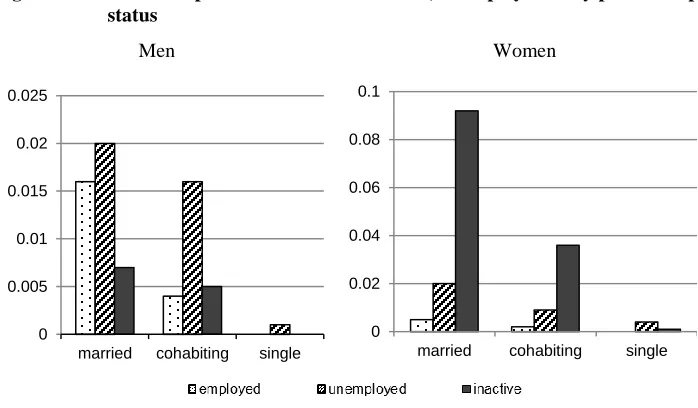
To what extent does unemployment affect the timing of transition into parenthood in Britain? Is its impact similar when individuals experience it in singlehood, in cohabiting partnerships, and in marriage, or is there rather a differential impact? This paper begins by investigating the predicted probabilities of transition into parenthood for married, cohabiting, and single individuals, disaggregated by employment status (Figure 1). Note that these probabilities do not take into account any covariates. Unemployment has the largest predicted probabilities for men irrespective of their partnership status, with the difference between employment and unemployment being more accentuated among cohabiting males. Women have the largest probability when they are inactive in the labour market. This is followed by unemployment spells. The predicted probability of becoming a mother for unemployed women is larger than for employed women, and this is observed for all, irrespective of partnership status.
Figure 1: Predicted probabilities for first births, unemployment by partnership status
Men Women
Note: Unconditional models. Single category includes individuals who are neither married nor cohabiting.
Next, Table 2 presents results from discrete-time event history models with main effects (1a and 1b) and interaction effects (1c and 1d) of employment and partnership
0 0.005 0.01 0.015 0.02 0.025
married cohabiting single
0 0.02 0.04 0.06 0.08 0.1
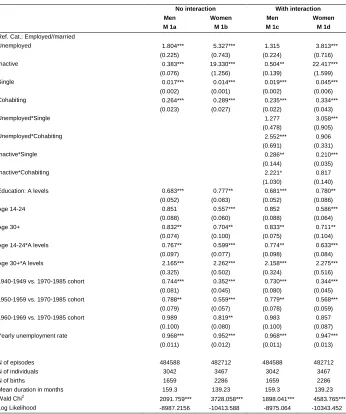
statuses. The models include a baseline hazard function (presented with age dummies and the product of age and education), and, as controls, education level, cohort and aggregate unemployment level. Beginning with the simple models with no interaction terms (1a and 1b), the results indicate that unemployment accelerates men‟s and women‟s transition into parenthood. Unemployed men are almost twice as likely to become parents compared to when they are in employment, and unemployed women are over five times more likely. This is broadly in line with earlier findings. Being inactive is associated with late transition into fatherhood, but with a strong probability of motherhood. This not only reflects women‟s main caregiver role in Britain but also the differences in reasons for inactivity between man and women. Male inactivity is mostly driven by full-time studentship, long-term sickness, and, to a smaller extent, retirement, whereas female inactive spells are mostly comprised of home-making activities. Additionally, the eligibility period for unemployment benefits are particularly short in the UK, as well as being means-tested on partner‟s income. Many women, therefore, underreport unemployment and perceive themselves as inactive, which boosts the impact of inactivity on fertility. Married individuals have the highest probability of parenthood, followed by cohabiters and single individuals.
Models 1c and 1d explore this further with an interaction term showing how the effect of unemployment on the timing of parenthood differs as a function of partnership status. The main effect of unemployment is still positive for both men and women but is not statistically significant for men. However, the interaction term shows that unemployment has a differential effect for both, depending on partnership status. The accelerating effect of unemployment on timing of parenthood is larger for cohabiting men and single women.
In Model 1c, the odds ratio for “Unemployed*Cohabiting” reflects the odds ratio for unemployment for cohabiting men divided by the odds ratio for unemployment for married men, which is equal to 2.55. In other words, unemployed men are two and a half times more likely to become fathers when they are cohabiting compared to when they are married, and this is statistically significant at the 1% level. As for women, in Model 1d the odds ratio for “Unemployed*Single” indicates that unemployed women are three times more likely to enter into motherhood when they are single compared to when they are married.
Table 2: Transition into parenthood – unemployment and relationship status
No interaction With interaction
Men Women Men Women
M 1a M 1b M 1c M 1d
Ref. Cat.: Employed//married
Unemployed 1.804*** 5.327*** 1.315 3.813***
(0.225) (0.743) (0.224) (0.716)
Inactive 0.383*** 19.330*** 0.504** 22.417***
(0.076) (1.256) (0.139) (1.599)
Single 0.017*** 0.014*** 0.019*** 0.045***
(0.002) (0.001) (0.002) (0.006)
Cohabiting 0.264*** 0.289*** 0.235*** 0.334***
(0.023) (0.027) (0.022) (0.043)
Unemployed*Single 1.277 3.058***
(0.478) (0.905)
Unemployed*Cohabiting 2.552*** 0.906
(0.691) (0.331)
Inactive*Single 0.286** 0.210***
(0.144) (0.035)
Inactive*Cohabiting 2.221* 0.817
(1.030) (0.140)
Education: A levels 0.683*** 0.777** 0.681*** 0.780**
(0.052) (0.083) (0.052) (0.086)
Age 14-24 0.851 0.557*** 0.852 0.586***
(0.088) (0.060) (0.088) (0.064)
Age 30+ 0.832** 0.704** 0.833** 0.711**
(0.074) (0.100) (0.075) (0.104)
Age 14-24*A levels 0.767** 0.599*** 0.774** 0.633***
(0.097) (0.077) (0.098) (0.084)
Age 30+*A levels 2.165*** 2.262*** 2.158*** 2.275***
(0.325) (0.502) (0.324) (0.516)
1940-1949 vs. 1970-1985 cohort 0.744*** 0.352*** 0.730*** 0.344***
(0.081) (0.045) (0.080) (0.045)
1950-1959 vs. 1970-1985 cohort 0.788** 0.559*** 0.779** 0.568***
(0.079) (0.057) (0.078) (0.059)
1960-1969 vs. 1970-1985 cohort 0.989 0.819** 0.983 0.857
(0.100) (0.080) (0.100) (0.087)
Yearly unemployment rate 0.968*** 0.952*** 0.968*** 0.947***
(0.011) (0.012) (0.011) (0.013)
N of episodes 484588 482712 484588 482712
N of individuals 3042 3467 3042 3467
N of births 1659 2286 1659 2286
Mean duration in months 159.3 139.23 159.3 139.23
Wald Chi2 2091.759*** 3728.058*** 1898.041*** 4583.765***
Log Likelihood -8987.2156 -10413.588 -8975.064 -10343.452
Odds ratios from discrete-time event history models. Standard errors in parentheses.
Education has a negative effect on timing of parenthood: those with A levels are around 30% less likely to have their first child. The main effect of age indicates an inversed U-shaped transition rate for women; likelihood of motherhood is the highest between ages 24 and 29. For men, there is a declining probability of transition after age 30. The interaction of education and age shows that fertility behaviour varies by educational attainment. There is a negative effect of having A levels at younger ages but a positive effect after age 30, those A levels holders catching up in family formation in their 30s.
Coefficients for other covariates suggest that in gross models with only cohort dummies (not presented) there is a clear cohort effect for women, with younger cohorts postponing entry into motherhood. However, in the full models presented in Table 2 there is an increased risk of motherhood with each consecutive cohort. This arises partly due to late entries in the youngest cohort being right-censored which introduces an upward bias in the transition rates of this group into motherhood, and partly due to controlling for education and age at birth. Furthermore, findings suggest that individuals tend to postpone family formation when economic circumstances in the country are uncertain. A 1% increase in the aggregate unemployment rate decreases the probability of fatherhood by 4% and the probability of entering into motherhood by 6%.
5.2 Unemployment within the couple context
The paper has so far shown that the experience of unemployment has an accelerating effect on individuals‟ transition into parenthood, but that it also has a differential impact based on the relationship status during which it is experienced. The focus now shifts to couples only, and the role of partner‟s employment status in how unemployment affects the timing of having a first child is investigated.
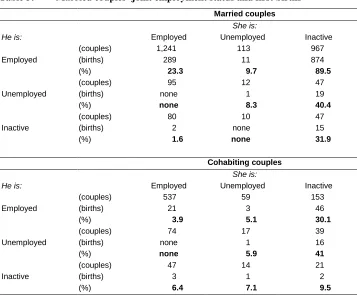
90% of those in which the husband is in paid employment experience transition into parenthood. What is striking is that unemployed and inactive men also experience a large number of transitions into parenthood as long as they are married to wives who are inactive. The picture is somewhat different for cohabiting couples. Similar to in marriage contexts, employment spells in which the female partner is inactive are more likely to result in parenthood. However, the share of transitions into parenthood is the highest (41%) among cohabiters with an unemployed male partner and an inactive female partner.
Table 3: Married couples’ joint employment status and first births
Married couples
She is:
He is: Employed Unemployed Inactive
Employed
(couples) 1,241 113 967
(births) 289 11 874
(%) 23.3 9.7 89.5
Unemployed
(couples) 95 12 47
(births) none 1 19
(%) none 8.3 40.4
Inactive
(couples) 80 10 47
(births) 2 none 15
(%) 1.6 none 31.9
Cohabiting couples
She is:
He is: Employed Unemployed Inactive
Employed
(couples) 537 59 153
(births) 21 3 46
(%) 3.9 5.1 30.1
Unemployed
(couples) 74 17 39
(births) none 1 16
(%) none 5.9 41
Inactive
(couples) 47 14 21
(births) 3 1 2
(%) 6.4 7.1 9.5
couples is 8%. This suggests that employment insecurity is more prevalent among cohabiters.
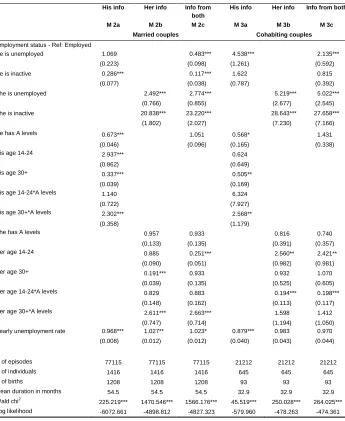
The estimates from the discrete-time event history models for married and cohabiting couples‟ transition into parenthood are reported in Table 4, where the reference category is employment. Models 2a and 3a predict the timing of entry into parenthood among married couples using the employment history of male partners only, whereas 2b and 3b do so using the employment history of female partners only. Models 2c and 3c include information from both partners. These models control for the education level of each partner, the yearly unemployment rate, and the baseline hazard function, which is specified by age dummies and the product of age and education.
Table 4: Transition into parenthood among couples
His info Her info Info from both
His info Her info Info from both
M 2a M 2b M 2c M 3a M 3b M 3c
Married couples Cohabiting couples
Employment status - Ref: Employed
He is unemployed 1.069 0.483*** 4.538*** 2.135***
(0.223) (0.098) (1.261) (0.592)
He is inactive 0.286*** 0.117*** 1.622 0.815
(0.077) (0.038) (0.787) (0.392)
She is unemployed 2.492*** 2.774*** 5.219*** 5.022***
(0.766) (0.855) (2.677) (2.545)
She is inactive 20.838*** 23.220*** 28.643*** 27.658***
(1.802) (2.027) (7.230) (7.166)
He has A levels 0.673*** 1.051 0.568* 1.431
(0.046) (0.096) (0.165) (0.338)
His age 14-24 2.937*** 0.624
(0.862) (0.649)
His age 30+ 0.337*** 0.505**
(0.039) (0.169)
His age 14-24*A levels 1.140 6.324
(0.722) (7.927)
His age 30+*A levels 2.302*** 2.568**
(0.358) (1.179)
She has A levels 0.957 0.933 0.816 0.740
(0.133) (0.135) (0.391) (0.357)
Her age 14-24 0.885 0.251*** 2.560** 2.421**
(0.090) (0.051) (0.982) (0.981)
Her age 30+ 0.191*** 0.933 0.932 1.070
(0.039) (0.135) (0.525) (0.605)
Her age 14-24*A levels 0.829 0.883 0.194*** 0.198***
(0.148) (0.162) (0.113) (0.117)
Her age 30+*A levels 2.611*** 2.663*** 1.598 1.412
(0.747) (0.714) (1.194) (1.050)
Yearly unemployment rate 0.968*** 1.027** 1.023* 0.879*** 0.983 0.970
(0.008) (0.012) (0.012) (0.040) (0.043) (0.044)
N of episodes 77115 77115 77115 21212 21212 21212
N of individuals 1416 1416 1416 645 645 645
N of births 1208 1208 1208 93 93 93
Mean duration in months 54.5 54.5 54.5 32.9 32.9 32.9
Wald chi2
225.219*** 1470.546*** 1566.176*** 45.519*** 250.028*** 264.025***
Log likelihood -6072.661 -4898.812 -4827.323 -579.960 -478.263 -474.361
Odds ratios from discrete-time event history models. Standard errors in parentheses.
There are remarkable differences between married and cohabiting couples in terms of how unemployment relates to timing of parenthood, especially for men. While married couples with an unemployed male partner postpone parenthood, their cohabiting counterparts become parents sooner than couples when the man is employed. Model 3a shows that, in line with the results in section 5.1, unemployed cohabiting men are four and a half times more likely to become fathers. Moreover, the accelerating effect of unemployment still remains when female partners‟ employment status is controlled for (3c). Female unemployment and inactivity produce high odds of motherhood, as was the case for married women. The accelerating impact of unemployment is higher for cohabiting women than for married women. Cohabiting couples experiencing unemployment seem to be using global strategies, i.e., adopting parental roles in order to resolve uncertainty in the employment domain.
We now investigate the issue of gender roles within households, using joint employment status of couples. The neoclassical framework suggests that in a traditional household the male partner is the income provider and the female partner is the caregiver. From the neoclassical point of view, traditional couples in which „he is employed‟ and „she is inactive‟ would be the most likely to have a child since they have both financial resources and time availability for family formation. „Non-traditional‟ couples in which the man is unemployed would lack the resources necessary for childbearing, whereas couples where the woman is employed would lack the time. Note that here we use the notion of the traditional couple with respect to employment status of spouses, not in relation to individuals‟ family values or gender role preferences.
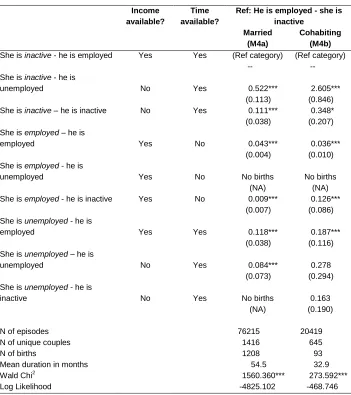
Table 5 presents the odds ratios for parenthood for combinations of joint employment statuses, which are based on discrete-time event history analyses.12 The probability of entering into parenthood is estimated in reference to traditional couples where „he is employed, she is inactive‟. The results are presented to indicate the impact of the changes in his employment status while she is inactive, employed, and unemployed, respectively. The general picture is that, among married couples, all couple combinations have a lower probability of parenthood transition than the traditional couple. This is not the case for cohabiters. Those in which the male partner is unemployed and the female partner is inactive have a higher probability of parenthood.
Now, we examine joint couple employment in detail and start with the implications of changes in the man‟s employment status when the woman is inactive. The top section of Table 5 shows that married couples with an unemployed male partner are 47% and those with an inactive male partner are 90% less likely to become parents than traditional couples. This again provides support for the income effect
among married couples. However, consistent with previous findings, in cohabiting couples male unemployment is associated with earlier entry into parenthood. Compared to the traditional couple in terms of employment status, cohabiting couples with an inactive female partner and an unemployed male partner are around two and a half times more likely to become parents. This confirms that male unemployment has a differential effect depending on the relationship status in which it takes place. Also, there are shown to be behavioural differences between married and cohabiting couples. As a response to uncertainty arising from unemployment, married couples tend to delay family formation, whereas cohabiting couples adopt the parenthood role.
The middle section of the table presents the probability of parenthood for couples with an employed female partner in comparison to traditional couples. Both cohabiting and married dual earner couples postpone transition into parenthood, which is in line with the price-of-time effect. Moreover, the changes in his employment status do not matter as long as she is employed. There are no births taking place when he is unemployed, while the probability of parenthood when he is inactive is very low. This suggests that a woman‟s lack of time is a more important factor than availability of resources, indicating that the price-of-time effect is stronger than the income effect.
Table 5: Transition into parenthood by couples’ joint employment status
Income available?
Time available?
Ref: He is employed - she is inactive
Married Cohabiting
(M4a) (M4b)
She is inactive - he is employed Yes Yes (Ref category) (Ref category)
-- --
She is inactive - he is
unemployed No Yes 0.522*** 2.605***
(0.113) (0.846)
She is inactive – he is inactive No Yes 0.111*** 0.348*
(0.038) (0.207)
She is employed – he is
employed Yes No 0.043*** 0.036***
(0.004) (0.010)
She is employed - he is
unemployed Yes No No births No births
(NA) (NA)
She is employed - he is inactive Yes No 0.009*** 0.126***
(0.007) (0.086)
She is unemployed - he is
employed Yes Yes 0.118*** 0.187***
(0.038) (0.116)
She is unemployed – he is
unemployed No Yes 0.084*** 0.278
(0.073) (0.294)
She is unemployed - he is
inactive No Yes No births 0.163
(NA) (0.190)
N of episodes 76215 20419
N of unique couples 1416 645
N of births 1208 93
Mean duration in months 54.5 32.9
Wald Chi2 1560.360*** 273.592***
Log Likelihood -4825.102 -468.746
Odds ratios from discrete-time event history models. Standard errors in parentheses.
Legend: * p<0.05; ** p<0.01; *** p<0.001.
5.3 Unobserved heterogeneity
So far we have found that unemployment has a significant impact on the timing of entry into parenthood, an effect that is moderated by partnership status. However, is it the experience of unemployment itself that causes earlier entries into parenthood, or could there be other factors that lead to both unemployment and early parenthood transitions? Decisions regarding employment and family life are often interrelated. When individuals face insecurity in the labour market they may either postpone transition in the family domain until they secure a job, or alternatively focus on the family domain and form families. The factors determining whether individuals choose the first or the second strategy, such as personality traits, preferences, or presence of perceived or real economic constraints, often cannot be captured by survey data. The omission of such unobserved individual-specific factors could produce biased estimates. Similarly, there are individual-specific unobservables affecting who is partnered with whom; for example, physical attractiveness, compatibility, or ambition. Accounting for such person-specific traits enables us to measure couples‟ joint employment status net of the effects of assortative mating.
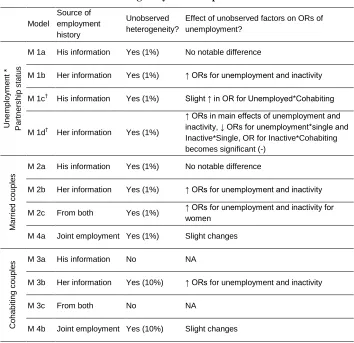
„Frailty models‟, which control for time-invariant factors with the use of a random component, seek to capture such unobserved characteristics. For each model discussed in this paper a frailty model is estimated where the likelihood ratio test indicates whether or not there is unobserved heterogeneity.13 These frailty models show that there are some unobserved individual characteristics which affect the timing of parenthood that are not captured by the covariates used. For men, these individual characteristics captured by the random component do not change the impact of unemployment on transition into fatherhood. Note that for cohabiting men no unobserved heterogeneity was detected.
Table 6: Unobserved heterogeneity and its impact on estimates Model Source of employment history Unobserved heterogeneity?
Effect of unobserved factors on ORs of unemployment? U n e mploy men t * P a rt n e rs h ip s ta tu s
M 1a His information Yes (1%) No notable difference
M 1b Her information Yes (1%) ↑ ORs for unemployment and inactivity
M 1c† His information Yes (1%) Slight ↑ in OR for Unemployed*Cohabiting
M 1d† Her information Yes (1%)
↑ ORs in main effects of unemployment and inactivity, ↓ ORs for unemployment*single and Inactive*Single, OR for Inactive*Cohabiting becomes significant (-)
Mar ried c o u p le s
M 2a His information Yes (1%) No notable difference
M 2b Her information Yes (1%) ↑ ORs for unemployment and inactivity
M 2c From both Yes (1%) ↑ ORs for unemployment and inactivity for women
M 4a Joint employment Yes (1%) Slight changes
C o h a b it ing c o u p le
s M 3a His information No NA
M 3b Her information Yes (10%) ↑ ORs for unemployment and inactivity
M 3c From both No NA
M 4b Joint employment Yes (10%) Slight changes
†Indicates models with an interaction term.
Percentages refer to the significance level at which unobserved heterogeneity is significant.
captured in this study. Furthermore, decisions regarding family and working are often interrelated, particularly for women. Women experiencing insecurity in the labour market may choose to become a mother in order to reduce uncertainty in one life domain with a transition in another.
6. Discussion
Previous studies have shown that in the UK, especially among young individuals, unemployment has a positive impact on fertility decisions, and that there is an educational gradient to parenthood behaviour. There has also been evidence showing that single parenthood is associated with the means-tested family benefits that were effective during the observation period of this study. Contributing to this literature, this paper shows that unemployment is associated with earlier entry into parenthood in Britain but its impact varies significantly depending on partnership status and partner‟s labour market status. Cohabiting men and single women are disproportionately more likely to become parents as a result of unemployment. Married couples‟ parenthood transition is in line with the predictions of neoclassical family models. Male unemployment had a negative effect on the probability of having a first child, whereas female unemployment had a positive effect. Moreover, any couple combination other than an employed male and an inactive female spouse resulted in a delay in childbirth. Cohabiting couples‟ fertility behaviour was markedly different. Both male and female unemployment were associated with earlier entry into parenthood, which is at odds with the income-effect predictions of neoclassical family models.
There are various factors that could explain the differences between fertility behaviours in marital and cohabiting unions. As previous studies have pointed out, there could be some attitudinal differences between individuals who cohabit and who marry. For example, it is striking that there is a similarity between cohabiting men and women in terms of how unemployment affects their fertility outcomes, which is not the case for married individuals. Cohabiting couples may indeed have more egalitarian gender attitudes and their fertility decision is not bound to male breadwinning capabilities. Since private childcare in the UK is very expensive, cohabiting couples with an unemployed father or mother could be pooling their time resources for childcare activities.
cohabiters (as well as among unemployed single mothers) could also result from a lack of the resources needed in order to marry before deciding on having a child. For these individuals in disadvantaged circumstances, parenthood could be just a way of gaining the self-esteem that it is impossible to gain through employment. In this regard, cohabiting couples could be consolidating their parental role first. The fact that unemployed single women are more likely to become parents supports the idea of the adoption of a parental role when a stable career is not possible.
These are in part related to the benefits system in the UK. Eligibility duration for unemployment benefits is relatively short, after which some individuals become inactive, and increasingly less attached to the labour market. For these individuals child-rearing could depend heavily on social benefits received, which are relatively less generous in the UK. The means-tested benefit system targeting un-partnered individuals and low-income families on the one hand and the expensive private childcare for those who do not qualify on the other hand could contribute to a polarisation of parenting age. While unemployed individuals relying on welfare benefits may become parents quicker, those who have to accumulate sufficient earnings to purchase private childcare postpone parenthood. These dual processes are likely to have put pressure on the fertility choices of both groups.
This study has some limitations. Even though the data has been constructed in the richest way possible in order to cover the work and partnership histories of individuals for their entire reproductive age, it lacks important variables such as part-time work, income, receipt of welfare benefits, housing tenure, and values and attitudes towards family and gender relations: variables which may all play a role in decisions relating to parenthood. The criteria of avoiding left censoring and covering entire work histories resulted in a reduced sample, leaving fewer cases where the respondents are disaggregated by a combination of respondents‟ own and partner‟s information. Another limitation is that partner‟s complete work history is available only for those who joined the panel in the first two waves, but not in the retrospective interviews conducted throughout the eleventh and twelfth waves. Since I restrict the sample to only those whose complete work histories are available, the sample dataset is biased towards the initial sample, which is also older on average. Older respondents are more likely to have traditional values towards gender roles. Therefore this restriction possibly causes an overestimation of gender asymmetry, while underestimating the impact of egalitarian roles among younger couples regarding the timing of parenthood.
7. Acknowledgements
References
Adsera, A. (2004). Changing fertility rates in developed countries: The impact of labour market institutions. Journal of Population Economics 17(1): 17–43. doi:10.1007/ s00148-003-0166-x.
Andersson, G. (2000). The impact of labour-force participation on childbearing behaviour: Pro-cyclical fertility in Sweden during the 1980s and 1990s. European Journal of Population 16(4): 292–333. doi:10.1023/A: 1006454909642.
Arulampalam, W. (2001). Is unemployment really scarring? Effects of unemployment experiences on wages. Economic Journal 111(475): 585–606. doi:10.1111/1468-0297.00664.
Arulampalam, W. (2002). State Dependence in Unemployment Incidence: Evidence for British Men Revisited. Bonn: The Institute for the Study of Labor (IZA) (Discussion paper, No.630).
Arulampalam, W., Gregg, P., and Gregory, M. (2001). Unemployment scarring. Economic Journal 111(475): 577–584. doi:10.1111/1468-0297.00663.
Becker, G.S. (1981). A treatise on the family. Cambridge: Harvard University Press.
Bradshaw, J., Kennedy, S., Kikley, M., Hutton, S., Corden, A., Eardley, T., Holmes, H., and Neale, J. (1996). The Employment of Lone Parents: A Comparison of Policy in 20 Countries. London: Family Policy Studies Center.
Clark, A.E. (2003). Unemployment as a social norm: Psychological evidence from panel data. Journal of Labor Economics 21(2): 323–351. doi:10.1086/345560. Clark, A.E., Georgellis, Y., and Sanfey, P. (2001). Scarring: The psychological impact
of past unemployment. Economica 68(270): 221–241. doi:10.1111/1468-0335. 00243.
Clark, A.E. and Oswald, A.J. (1994). Unhappiness and unemployment. Economic Journal 104(424): 648–659. doi:10.2307/2234639.
Francesconi, M. and Golsch, K. (2008). The process of globalization and transitions to adulthood in Britain. In: Blossfeld, H-P., Klijzing, E., Mills, M., and Kurz, K. (Eds.) Globalization, uncertainty and youth in society. Abington: Routledge: 249–267.
Frey, B.S. and Stutzer, A. (2002). What can economists learn from happiness research. Journal of Economic Literature 40(2): 402–35. doi:10.1257/jel.40.2.402. Friedman, D., Hechter, M. and Kanazawa, S. (1994). A theory of the value of children.
Demography 31(3): 375–401. doi:10.2307/2061749.
Gonzalez, M.J. and Jurado-Guerro, T. (2006). Remaining childless in affluent economies. A comparison of France, West Germany, Italy and Spain, 1994-2001. European Journal of Population 22(4): 317–352. doi:10.1007/s10680-006-9000-y.
Gregory, M. and Jukes, R. (2001). Unemployment and subsequent earnings: Estimating scarring among British Men 1984–94. Economic Journal 111(475): 607–625.
doi:10.1111/1468-0297.00665.
Hobcraft, J. and Kiernan, K. (2001). Childhood poverty, early motherhood and adult social exclusion. British Journal of Sociology 52(3): 495–517. doi:10.1080/ 00071310120071151.
Hoem, B. (2000). Entry into motherhood in Sweden: the influence of economic factors on the rise and fall in fertility, 1986–1997. Demographic Research 2(4).
doi:10.4054/DemRes.2000.2.4
Jenkins, S. (2005). Survival Analysis. [Unpublished manuscript]. Colchester: Institute for Social and Economic Research, University of Essex.
Kravdal, Ø. (2002). The impact of individual and aggregate unemployment on fertility in Norway. Demographic Research 6(10): 263–294. doi:10.4054/DemRes. 2002.6.10.
Kreyenfeld, M. (2010). Uncertainties in female employment careers and the postponement of parenthood in Germany. European Sociological Review 26(3): 351–366. doi:10.1093/esr/jcp026.
Manning, W. and Landale, N. (1996). Racial and ethnic differences in the role of cohabitation in permanent childbearing. Journal of Marriage and the Family 58(1): 63–77. doi:10.2307/353377.
Máre, D. (2006). Constructing consistent work-life histories: A guide for users of the British Household Panel Survey. Colchester: Institute for Social and Economic Research (ISER Working Paper Series, No. 2006-39).
McKee-Ryan, F.M., Song, Z., Wanberg, C.R., and Kinicki, A.J. (2005). Psychological and physical well-being during unemployment: A meta-analytic study. Journal of Applied Psychology 90(1): 53–76. doi:10.1037/0021-9010.90.1.53.
Mills, M. (2005). The transition to adulthood in Canada. The impact of irregular work shifts in a 24-hour economy. In, Blossfeld, H-P., Klijzing, E., Mills, M., and Kurz, K. (Eds.) Globalization, uncertainty and youth in society. Oxford: Routledge: 277–304.
Murphy, G.C. and Athanasou, J.A. (1999). The effect of unemployment on mental health. Journal of Occupational and Organizational Psychology 72(1): 83–99.
doi:10.1348/096317999166518.
Nordenmark, M. (1999). Employment commitment and psychological well-being among unemployed men and women. Acta Sociologica 42(135): 135–146.
doi:10.1177/000169939904200203.
Nordenmark, M. and Strandh, M. (1999). Towards a sociological understanding of mental well-being among the unemployed: The role of economic and psychosocial factors. Sociology 33(3): 577–597. doi.10.1177/ s003803859900036x.
OECD (2014). OECD Family Database, Paris: OECD www.oecd.org/social/family/ database
Office for National Statistics (ONS) (2008). Conception statistics: Conceptions for women resident in England and Wales. Oxford: University of Oxford
http://www.ons.gov.uk/ons/rel/ vsob1/conception-statistics-england-and-wales/ 2008/index.html
Oppenheimer, V.K. (1994). Women's rising employment and the future of the family in industrial societies. Population and Development Review 20(2): 293–342.
Özcan, B., Mayer, K.U., and Luedicke, J. (2010). The impact of unemployment on the transition to parenthood. Demographic Research 23(29): 807–846.
doi:10.4054/DemRes.2010.23.29.
Payne, J. (1989). Unemployment and family formation among young men. Sociology 23(2): 171–191. doi:10.1177/0038038589023002002.
Perelli-Harris, B. and Gerber, T.P. (2011). Nonmarital childbearing in Russia: Second demographic transition or pattern of disadvantage? Demography 48(1): 317– 342. doi:10.1007/s13524-010-0001-4.
Perelli-Harris, B., Sigle-Rushton, W., Kreyenfeld, M., Lappegård, T., Keizer, R., and Berghammer, C. (2010). The educational gradient of childbearing within cohabitation in Europe. Population and Development Research 36(4): 775–801.
doi:10.1111/j.1728-4457.2010.00357.x.
Pronzato, C. (2010). British Household Panel Study consolidated marital, cohabitation and fertility histories. Colchester: UK Data Archive (Study number 5629).
Rendall, M.S., Ekert-Jaffé, O., Joshi, H., Lynch, K., and Mougin, R. (2009). Universal versus economically polarized change in age at first birth: A French-British comparison Population and Development Review 35(1): 89–115. doi:10.1111/ j.1728-4457.2009.00262.x.
Rindfuss, R.R. and Van den Heuvel. A. (1990). Cohabitation: A precursor to marriage or an alternative to being single. Population and Development Review 16(4): 703–726. doi:10.2307/1972963.
Schmitt, C. (2012). Labour market integration, occupational uncertainties, and fertility choices in Germany and the UK. Demographic Research 26(12): 253–292.
doi:10.4054/DemRes.2012.26.12.
Schmitt, C. (2008). Gender-specific effects of unemployment on family formation: A cross-national perspective. Berlin: German Institute for Economic Research (DIW). (Discussion paper No. 841)
South, S.J. and Spitze, G. (1994). Housework in marital and nonmarital households. American Sociological Review 59(3): 327–347. doi:10.2307/2095937.
Whelan, C., Gallie, D., and McGinnity, F. (1998). Unemployment and psychological distress: a comparison of Britain and Ireland. Dublin: Mimeo, Economic and Social Research Institute.
Willis, R.J. (1999). A theory of out-of-wedlock childbearing. Journal of Political Economy 107(6): 33–64. doi:10.1086/250103.
Wilson, W.J. (1987). The Truly Disadvantaged. Chicago: University of Chicago Press.