ORIGINAL
ARTICLE Veterinary Research Forum. 2014; 5 (2) 107 - 114
Journal Homepage: vrf.iranjournals.ir
Modeling the growth of
Staphylococcus aureus
as affected by black zira
(
Bunium persicum
) essential oil, temperature, pH and inoculum levels
Abdollah Jamshidi1*, Saeid Khanzadi1, Majid Azizi2, Mohammad Azizzadeh3, Mohammad Hashemi4
1 Department of Food Hygiene and Aquaculture, Faculty of Veterinary Medicine, Ferdowsi University of Mashhad, Mashhad, Iran; 2 Department of
Horticulture, Faculty of Agriculture, Ferdowsi University of Mashhad, Mashhad, Iran; 3 Department of Clinical Sciences, Faculty of Veterinary Medicine,
Ferdowsi University of Mashhad, Mashhad, Iran; 4 Health Science Research Center, Department of Occupational Health Engineering, School of Health,
Mashhad University of Medical Science, Mashhad, Iran.
Article Info Abstract
Article history:
Received: 20 February 2013 Accepted: 16 September 2013 Available online: 15 June 2014
Black zira (Bunium persicum) is a medicinal plant and spice, naturally grows in Iran. The aim of this study was to investigate the combined effects of different concentrations of Bunium persicum essential oil (EO; including 0, 0.08, 0.16 and 0.24%), three incubation temperatures (15, 25 and 35˚C), three levels of pH (5, 6 and 7 adjusted by hydrochloric acid), and three inoculum size (102, 103 and 104 CFU mL-1) on the growth of Staphylococcus aureus in the brain heart infusion
broth. Black zira EO was extracted and its component was identified using gas chromatography-mass spectrometry (GC-MS) analyses.The experiment was carried out in triplicate. Growth was monitored by visible turbidity during a 30-day period. To evaluate effects of explanatory variable on time to detection (TTD) of bacterial growth, parametric survival models based on Log-normal distribution was used. All explanatory variables had significant association with time to detection (p < 0.05). The final model accurately predicted the growth initiation and inhibition of S. aureus.
© 2014 Urmia University. All rights reserved. Key words:
Black zira Essential oil Predictive modeling
Staphylococcus growth
دشر یزاس لدم
سوکوکولیفاتسا سوئرا
هایس هریز سناسا ریثأت تحت (
موكیسرپ موینوب
) ،امد ،
pH
حیقلت زود و
هدیكچ
( هايس هريز موكيسرپ موينوب .ديور يم ناريا رد يعيبط تروصب هك تسا يا هيودا و يئوراد يهايگ )
دشر رب رثوم لماوع رثا يسررب تهج هعلاطم نيا يرتكاب
سوكوكوليفاتسا سوئرا
، لماش راهچ
( هايس هريز سناسا تظلغ 0
، 00 / 0 ، 61 / 0 و 42 / 0 دصرد يامد هس ،) نويسابوكنا ( 61 ، 41 و 1 3 حطس هس ،)دارگيتناس هجرد pH
( 1 ، 1 و 7 ( حيقلت زود هس و )كيرديرلك ديسا زا هدافتسا اب 4
60 ، 3 60 و 2 60
دحاو ليكشت هدنهد ينولك رد يليم رتيل يرتكاب دشر رب ) سوئرا سوكوكوليفاتسا
عيام تشك طيحم رد BHI
شور زا هدافتسا اب نآ هدنهد ليكشت ءازجا نييعت ،هايس هريز سناسا جارختسا زا سپ .دوب
يفارگوتامورك يزاگ
-يمرج يط رد تشك طيحم ترودك ساسا رب يرتكاب دشر و دش ماجنا راركت هس رد هعلاطم نيا .ديدرگ نييعت 30
زور عيزوت اب كيرتماراپ ياقب لدم .تفرگ رارق يبايزرا دروم
گل ارط ياه ريغتم رثا يسررب تهج لامرن يرتكاب دشر عورش نامز رب هدش يح
رب راد ينعم رثا هدش يحارط ياه ريغتم زا كي ره هك دهد يم ناشن هعلاطم نيا زا لصاح جياتن .تفرگ رارق هدافتسا دروم
يرتكاب دشر سوئرا سوكوكوليفاتسا دراد
( 01 / 0
>
p
) شيپ هب رداق بسانم تقد اب يئاهن لدم و يرتكاب دشر زا تعنامم طيارش اي و دشر عورش نامز ينيب
سوئرا سوكوكوليفاتسا .دشاب يم
:یدیلک یاه هژاو دشر ،سناسا
سوكوكوليفاتسا وگشيپ يزاس لدم ،هايس هريز ،
*Correspondence:
Abdollah Jamshidi. DVM, DVSc
Department of Food Hygiene and Aquaculture, Faculty of Veterinary Medicine, Ferdowsi University of Mashhad, Mashhad, Iran.
E-mail: [email protected]
Veterinary Research
Introduction
Staphylococcus aureus is the most common
entero-toxigenic staphylococcal species causing foodborne disease.1
Amongst the reported foodborne illnesses, S. aureus is
considered the third most important cause of disease in the
world.2 This gram-positive bacterium has no particular
nutritional and environmental requirement for its growth
and it can grow at aw of 0.86, pH above 4.80 and its minimum
growth temperature is 8.9 ˚C. Most strains are capable of
producing one or more enterotoxins which are the cause of
gastrointestinal symptoms observed during intoxications.3
As food safety is of major concern in modern society, the scientific discipline of predictive microbiology gains more and more interest worldwide. An important research topic in this field is the development of mathematical models able to predict the growth of pathogenic micro-organisms in foods. Such models present a valuable tool in risk
assessment and HACCP studies.4
Predictive microbiology is a young discipline that has developed most of its terminology and methodology in the last two decades. It is based on the premise that the response of microorganisms (e.g., germination, growth and thermal inactivation kinetics) is reproducible, so the results from past observations can be used to predict the response
of the same organism at similar environmental conditions.5
Essential oils (EOs) are aromatic oily liquids obtained from plant material. Terpenoids and phenolic compounds such as thymol, carvacrol and eugenol are responsible for
their antimicrobial activity.6Essential oils can be obtained
by expression, fermentation, enfleurage or extraction, but the method of steam distillation is most commonly used for
commercial production of EOs.6
There is considerable interest in the possible use of these compounds as food additives, to delay the onset of food spoilage or to prevent the growth of foodborne
pathogens. Among these pathogens Salmonella enteritidis
and S. aureus are of great importance.7
Bunium persicum [Boiss.] B. Fedtsch is an important
medicinal plant and spice belonging to the Apiaceae
family.The plant is growing wild in the dry temperature
regions of Jammu and Kashmir, Himachal Pradesh, Afghanistan, and Iran. It is a small, grassy and perennial plant which produces white or pink flowers on the terminal
and lateral stems during the third year of its life.8
The seeds, rich in essential oil (EO), are consumed widely as condiment. In the indigenous system of medicines, seeds are regarded as stimulants and carminatives and found to
be useful in diarrhea and dyspepsia.9 The extracts of B.
persicum have hypoglycemic activity and can prevent
diabetes and obesity.10 Also, this plant is used for culinary
purposes and for flavoring foods and beverages.10-12
This study was designed to model the combined effects
of different levels of B. persicum EO, temperature, pH and
inoculum levels on the growth of S. aureus.
Materials and Methods
Plant material. The air-dried seeds of B. persicum
[Boiss.] Fedtsch, were supplied from agricultural research fields of Ferdowsi University of Mashhad (FUM), Mashhad, Iran. The plant materials were authenticated in FUM herbarium and voucher specimens (No. 36267) deposited in the herbarium.
Essential oil extraction. Amount of 100 g of dried material were finely ground in a blender and submitted to FUM hydrodistillation facility. Hydrodistillation was done in 4 hr, using a clevenger-type apparatus. The EOs obtained were separated from water and dried over anhydrous
Na2SO4, and stored in dark glass bottles at 4 ˚C prior to use.
Gas chromatography and GC-MS analysis. The
components of the EO sample were identified by GC and GC-MS analyses. The GC-GC-MS apparatus was a Varian GC-GC-MS spectrometer consisting of a Varian Star 3400 GC equipped with a fused-silica column (DB-5, 30 m length × 0.25 mm inner diameter, 0.25 μm film thickness; J and W Scientific Inc., Folsom, USA), interfaced with a mass spectrometric detector (Model Varian Saturn 3; Agilent Technology Inc., Santa Clara, USA). The operating conditions were as follows: oven temperature 60-240 ˚C with a rate of 3 ˚C per min, injector temperature 280 ˚C, injector mode: split
injection, with carrier gas, Helium, flow rate 2 mL min-1,
mass spectra: electronic impact, ionization potential 70 eV, ion source temperature 250 ˚C, ionization current 1000 μA, resolution 1000 and mass range 40-300 unit. The GC was a Shimadzu GC-17 equipped with a FID detector, fused silica column (BP-5, 25 m length × 0.22 mm inner diameter, 0.25 μm film thickness). The operating conditions were: oven temperature 60-280 ˚C with a rate of 8 ˚C per min, injector temperature 280 ˚C, split ratio 1:10, with carrier gas, nitrogen, and detector temperature 300 ˚C.
Identification of components. The oil components were identified from their retention indices (RI) obtained with reference to the n-alkane series (Sigma, Gillingham, UK) on the DB-5 column, mass spectra with those of authentic samples, composition of their mass spectra and fragmentation patterns reported in the literature, and computer matching with MS-data bank (Saturn version 4;
Agilent Technology Inc., Santa Clara, USA).13 Quantification
of the relative amount of the individual components was performed according to the area percentage method.
Test organism. Staphylococcus aureus ATCC 25923 (Mast International Inc., Merseyside, UK) was used as the test organism in this study.
Experimental design. To assess the effects of B.
persicum EO, pH, temperature, and inoculum level on
growth initiation of S. aureus, the experiment was arranged
in a factorial design in brain heart infusion broth (BHI; Merck, Darmstadt, Germany). This design (4 × 3 × 3 × 3 × 3
equal to 324 combinations) included fourconcentrations
and 7) adjusted by hydrochloric acid, three incubation
temperatures (15, 25 and 35 ˚C), three inoculums size (102,
103 and 104 CFU mL-1), three replicate of all combinations
and repeated observations (daily) for growth in BHI broth for up to 30 days.
Preparation of inoculum. The reference bacterium was plated on Baired Parker agar (Merck, Darmstadt, Germany) agar medium and incubated at 37 ˚C for 24 hr.
After confirmation typical colonies as S. aureus by
bio-chemical tests, inoculums were prepared by transferring a loop full of the bacterial colonies to isotonic saline solution in a sterile cuvette to adjust the absorbance of 0.02 at 600 nm using a spectrophotometer (Model 6105; Jenway, Essex,
UK). This adjustment gave a cell concentration of 1.2 × 10⁹
CFU mL-1. The numbers of cells in the suspension were
estimated by duplicate plating from 10-fold serial dilutions on BHI agar and counting the colonies after 24 hr incubation at 37 ˚C.
Performing the experiment. Amount of 3.7 g BHI broth powder (Merck, Darmstadt, Germany) was dissolved in 90 mL distilled water in a 250 mL flask by mild heating. In order to produce and maintain a stable oil-water emulsion in broth substrate during the period of study (30 days), the
method explained by Mann and Markham were used,14 with
some modifications. Briefly, we added 5% (v/v) dimethyl-sulfoxide (Merck, Darmstadt, Germany) as an emulsifier and 0.05% (w/v) agar (Merck, Darmstadt, Germany) as a stabilizer to the broth substrate. The pH was adjusted using hydrochloric acid to designate pH values. The values of pH were adjusted using a pH meter (Jenway, Staffordshire, UK). The final volume of broth substrate was brought to 100 mL with additional distilled water. The content of each flask was autoclaved at 121 ˚C for 15 min. After cooling, the pH of each combination in broth medium was measured and adjusted again to the considered pH using 1M filter sterilized HCl (or NaOH). Then filter sterilized EO was added in different amounts to satisfy the experimental design. The content of flask containing sterile BHI broth was dispensed in portions of 3 mL into 16 × 100 mm sterile caped tubes (Becton Dickinson, San Jose, USA). The tubes
were inoculated with S. aureus culture (102, 103 and 104 CFU
mL-1). For each combination the inoculated tubes were
stored at 15, 25 and 35 ˚C for up to 30 days. During these periods all the tubes were observed for visible growth (turbidity) daily up to 30-days. The number of tubes (combinations) showing growth at a particular observation were recorded. For each combination a negative control (un-inoculated tube) was used. All experiments were conducted in independent triplicate.
Statistical Analysis. The time to visible growth (TTD: time-to-detection or time to the nearest visible growth detection) considered as outcome variable in the present study. Since some combinations did not grow until the end of the study (30 days), event-time (survival) analysis was employed.
Kaplan-Meier survival curves for each level of an explanatory variable were plotted and the homogeneity of the curves between levels tested using the log rank statistic. Explanatory variables that showed a significant association with TTD were selected for inclusion in the multivariate analysis.
Parametric survival model based on accelerated failure
time (AFT) approach15 was used to quantify the effect of
each of the prescribed explanatory variables on time to detection of bacterial growth. The general form of the accelerated failure time model is:
log(t) = (α + β1x1i + … + βmxmi) + log(τ)
where log(t) is the natural logarithm of the time to ‘failure’
(growth), α an intercept term, β1x1i + … + βmxmi is a linear
combination of the m explanatory variables and their
regression coefficients, and log(τ) is an error term. Using
this approach the accelerated failure time coefficients
represent the expected change in log(t) for changes in the
predictor levels.
In the present study the fit of the exponential, weibull, log-normal and log-logistic distribution to the current data was evaluated using mean square error (MSE) values as below. The smaller MSE value indicates a better fit.
MSE = Σ(predicted – observed)2
n – p
where n is the number of observations and p is the number
of parameters to be estimated.
To select those explanatory variables that best explained time to detection a backward stepwise approach was used. Explanatory variables that were not statistically significant were removed from the model one at a time, beginning with the least significant, until the estimated regression coefficients for all retained variables were
significant at p < 0.05. All analyses were carried out using
Stata Statistical Software, version 10 (Stata-Corp, College Station, Texas, USA).
Results
Chemical composition of B. Persicum Boiss. EO. The components of essential are presented in Table 1. The
yield of oil from B. persicum was 9.10% (v/w). GC/MS
identified 35 compounds, representing 95.50% of the oil content. γ-terpinene was the main monoterpene hydrocarbon, with a content of 44.20%. The cumin-aldehyde and ρ-cymene contents determined as 16.90 and 8.00%, respectively.
Description of growth and no growth. About
84.75% of combinations (270 out of 324) showed growth
during the study period and 15.25% of combinations
Evaluation of time to detection of bacterial growth.
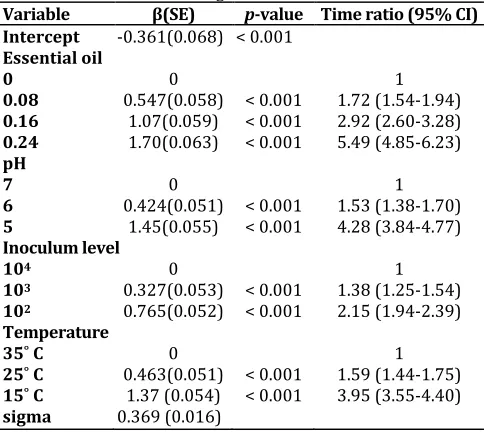
Median time to detection of bacterial growth was 7 days. Kaplan-Meier survival curve for different levels of explanatory variables are presented in Figure 1.
On the basis of MSE value the log normal model provided the best fit to the data. The MSE value of the log normal model was 207.97. While the MSE values were 211.27, 250.10 and 584.70 for log-logistic, Weibull and exponential models, respectively. The final model showed
that all explanatory variables had significant (p < 0.001)
association with time to detection, (Table 2).
On average, time to detection for combinations with
0.08%, 0.16% and 0.24% of B. persicum essential oil was
1.72, 2.92 and 5.49 times greater than those without it, respectively. Time to detection (TTD) for those combinations with pH levels of 6 and 5 was 1.53, and 4.28 times greater
than those with pH level of 7.Also, this time for combinations
Fig. 1. Kaplan-Meier survival curves showing the proportion of no growth combinations for different levels of essential oil, inoculum size, temperature and pH.
Table 1. Phytochemical composition of B. persicum essential oil.
Phytochemicals RIa Percentage
α-Thujene 925 0.4
α-Pinene 932 1.0
Camphene 946 0.1
Sabinene 970 1.2
ß-Pinene 975 1.6
Myrcene 990 1.0
δ-2-Carene 1002 trb
Isosylvestrene 1013 0.3
ρ-Cymene 1019 8.0
Limonene 1025 2.0
1,8-Cineole 1032 2.9
Z-ß-Ocimene 1037 0.1
γ-Terpinene 1055 44.2
3-methylbenzaldehyde 1059 tr
cis-Sabinene hydrate 1061 tr
Terpinolene 1085 0.7
Linalool 1093 0.1
trans-Sabinene hydrate 1095 0.1
Borneol 1162 0.1
Terpinen-4-ol 1170 0.4
α-Terpineol 1189 tr
meta-Cuminol 1217 tr
p-Cuminaldehyde 1231 16.9
trans-p-Menth-2-en-7-ol 1261 0.2
Perillaldehyde 1265 0.2
Bornyl acetate 1280 2.9
α-Terpinen-7-al 1281 0.4
γ-Terpinen-7-al 1287 10.5
Thymol 1289 0.1
9-epi-ß-Caryophyllene 1413 tr
ar-Curcumene 1474 tr
Germacrene D 1476 0.1
α-Zingiberene 1490 tr
EE-α-Farnesene 1503 tr
ß-Sesquiphellandrene 1518 0.1
Total identified 95.5
a Retention index relative to n-alkane series on the DB-5 column. b Trace (< 0.0 5%)
0.0 0 0 .25 0.5 0 0 .75 1.0 0 P rop ort
ion of no growt
h
combi
n
at
ion
0 10 20 30
Time to detection of bacterial growth (days)
pH = 5 pH = 6
pH = 7
Survival function
0 10 20 30
Temperature = 15 Temperature = 25 Temperature = 35
Survival function
Time to detection of bacterial growth (days)
P
rop
ort
ion of no growt
h combi n at ion 0.0 0 0 .25 0.5 0 0.7 5 1.0 0
0 10 20 30
Time to detection of bacterial growth (days)
Inoculum size = 100 Inoculum size = 1000 Inoculum size = 10000
Survival function
P
rop
ort
ion of no growt
h combi n at ion 0.0 0 0. 2 5 0 .50 0 .7 5 1 .00
0 10 20 30
Time to detection of bacterial growth (days)
Essential oil = 0 Essential oil = 0.08 Essential oil = 0.16
Survival function
P
rop
ort
ion of no growt
h
combi
n
at
ion
Essential oil = 0.24
with inoculum level of 103 and 102 was 1.38 and 2.15 times
greater than combinations with inoculum level of 104.
Furthermore, this period for combinations with incubation temperature of 25 ˚C and 15 ˚C was 1.59 and 3.95 times greater than combinations with those by incubation temperature of 35 ˚C.
The final model equation is shown below:
TTD = e
where TTD is time to detection, e is a mathematical
constant approximately equal to 2.718281828, T is
temperature, IL is inoculums size, and EO is essential oil.
Fig. 2. Observed and predicted days needed for growth
initiation of S. aureus (TTD) according to log normal model.
Discussion
Predictive microbiology combines mathematical modeling with experimental data on combinations of factors that influence the growth of food spoilage and/or food-borne pathogenic microorganisms. The developed models are
intended to predict the fate of micro-organisms in foods.16
In this study the effect of B. persicum EO, pH,
temperature and inoculum level have been evaluated on
the growth responses of S. aureus in BHI broth and the log
normal model proposed to predict these growth responses. Plant EOs are potentially useful sources of antimicrobial
compounds.17 In vitro studies have demonstrated
antibacterial activity of EOs against different bacteria at
levels between 0.2-10 µL mL-1. Essential oils containing
phenolic compounds, e.g. thymol, carvacrol, terpinene and p-cymene, are widely reported to possess high levels of antibacterial activity and may have applications in
controlling pathogens in food.6,18,21
Despite the strong antimicrobial activity of EOs, their practical application is currently limited due to their
undesirable flavor changes they cause in food products.22,23
The results of the present study showed that the major
compound of B. persicum EO was phenolic monoterpene γ-
terpinene (44.20%). Other important compounds were cuminaldehyde (16.90%) and ρ-cymene (8.00%).
The model predicts the value of TTD describing the
growth of S. aureus, as environmental factors change.
From these models the values of predicted TTD can be calculated from any combination of EO, T, pH and IL with the limits studied. Observed and predicted time to detection of bacterial growth for each combination presented in Figure 2.
Several researchers have investigated antibacterial and
antifungal effect of B. persicum EO.20,24,27 It has been
proposed that the antifungal activity of B. persicum EO is
due to cuminaldehade.25 Previous studies have shown that
B. persicum essential oil had strong activity against S.
aureus.24,26,27
In the present study on the basis of MSE value, the log normal model provided the best fit to the data. We used the concepts of the TTD in a factorial design study to quantify
the effect of B. persicum EO, pH, and temperature and
inoculum level on the growth responses of S. aureus in BHI
broth medium. Our results indicated that in the final model
all explanatory variables had significant (p < 0.05)
association with time to detection.
To sum up, evidence provided in this study showed that the values of TTD were higher at low levels of temperature, pH, and inoculums but high level of EO. The
same results have been reported by Valero et al. and
Jamshidi et al.28,29 In agreement to results of Goudarzi et al.
and Barros et al., the present study showed that the
anti-microbial properties of plant EO are dose-dependent.30,31
According to our results, increasing the B. persicum EO
concentration had a significant effect (p < 0.001) on time to
detection of S. aureus. Byincreasing theconcentrationof
–
0.361 + 1.37T15 0.463T25 + 0.765IL102 + 0.327IL103 + 1.45pH5 + 0.424pH6 + 1.7 EO0.24 + 1.07 EO0.16 + 0.547 EO0.08Table 2. Accelerated failure time model of factors influencing time to detection of bacterial growth.
Variable β(SE) p-value Time ratio (95% CI) Intercept -0.361(0.068) < 0.001
Essential oil
0 0 1
0.08 0.547(0.058) < 0.001 1.72 (1.54-1.94) 0.16 1.07(0.059) < 0.001 2.92 (2.60-3.28) 0.24 1.70(0.063) < 0.001 5.49 (4.85-6.23) pH
7 0 1
6 0.424(0.051) < 0.001 1.53 (1.38-1.70) 5 1.45(0.055) < 0.001 4.28 (3.84-4.77) Inoculum level
104 0 1
103 0.327(0.053) < 0.001 1.38 (1.25-1.54) 102 0.765(0.052) < 0.001 2.15 (1.94-2.39) Temperature
35˚ C 0 1
25˚ C 0.463(0.051) < 0.001 1.59 (1.44-1.75)
15˚ C 1.37 (0.054) < 0.001 3.95 (3.55-4.40)
sigma 0.369 (0.016)
Day
EO, the growth initiation of organism and also proportion of no growth combinations increased.
Temperature is the most common hurdles used to control microbial growth. According to our results, decreasing the incubation temperature had a significant effect on growth initiation of inoculated bacteria. Probably the most important effect of temperature on growth of a micro-organism is on the shape of enzymes required for metabolism and they will have the proper shape only within a relatively narrow range of temperatures or it may be due to the lower metabolic activity at the lower temperature.
Tassou et al. showed the effect of temperature and
different concentrations (1.2% v/v) of mint EO on the
growth/survival of S. aureus in nutrient broth. Their
results showed that both factors significantly affected the
detection time.7
Basti et al. studied the effects of Zataria multiflora Boiss.
EO, pH and temperature on S. Typhimurium and S. aureus.19
They showed that TTD of both organisms were significantly
affected by temperature, EO and pH, (p < 0.01).
The growth and metabolism of microorganisms are influenced by pH, because acidity or alkalinity of an environment has a profound effect on the activity and
stability of macromolecules.32
According to our results the growth of S. aureus was
significantly affected by pH. When the pH was decreased,
the growth initiation of S. aureus and proportion of no
growth combinations were increased. This can be attributed either the direct effect of pH or to the better dissolving of the EO in the lipid phase of the bacterial
membrane at the low pH.33 In agreement to these results
Basti et al. have shown the inhibitory action of Zataria
multiflora Boiss. EO on the growth initiation of S.
Typhimurium and S. aureus was enhanced by decreasing the
pH value at each defined temperature.19
In this study we used three levels of inoculation.
According to our results the growth of S. aureus was
affected significantly by the inoculum size. Our results showed that the TTD for combinations with inoculum level
of 103 and 102 was 1.38 and 2.15 times greater than
combinations with inoculum level of 104. Several studies
have indicated the importance of inoculum size on the
ability of a microbial population to initiate growth.34-37
Skandamis et al. have modeled the effect of inoculum
size and acid adaptation on growth/no growth interface of
E. coli O157:H7.38 They found that regarding the effect of
inoculum concentration, the lower was the initial population, the higher were the pH levels allowing growth, especially at low temperatures (i.e., 10 and 15 ˚C).
Zhao et al. developed linear regression model with
polynomial terms for analyzing the effect of environmental
factors on time to detection. Their results showed when
temperature was increased, the TTD was increased and
whenthepH andinoculumssizewereincreased,the TTD
was decreased. They also described a very good correlation
of predicted and observed values of TTD.39 This was in
agreement with our results were obtained for the effects of
the designated factors on the TTD of S. aureus within the
studied limits.
The results showed the observed time to detection of bacterial growth and value that predicted by log normal
model equation for TTD of S. aureus in designated
combinations. The graph demonstrated good agreement between predicted and observed values. So our model adequately predicted the growth initiation, and inhibition
conditions of S. aureus as affected by EO, pH, temperature,
and inoculum level.
The predicted values may not match with whatever would occur in any special food system. This means that before the models could be used in such a manner, the user would have to validate the models for each specific food of interest.
Acknowledgements
The authors express their sincere appreciation and thanks for the financial support received from Faculty of Veterinary Medicine, FUM for conducting this research (Grant no: 1240). We also thank Mrs. Samira Khajenasiri for her technical assistance.
References
1. Desmarchelier MP, Higgs GM, Mills L, et al. Incidence of
coagulase positive Staphylococcus on beef carcasses in
three Australian abattoirs. Int J Food Microbiol 1999; 47(3): 221-229.
2. Zhang S, Iandolo J, Stewart C. The enterotoxin D plasmid
of Staphylococcus aureus encodes a second enterotoxin
determinant (sej). FEMS Microbiol Lett 1998; 168(2):
227-233.
3. Normanno G, Firinu A, Virgilio S, et al.
Coagulase-positive Staphylococci and Staphylococcus aureus in
food products marketed in Italy. Int J Food Microbiol 2005; 98(1):73-79.
4. Vereecken KM, Dens EJ, Van Imp JF. Predictive modeling
of mixed microbial populations in food products: Evaluation of two-species models. J Theor Biol 2000; 205(1): 53-72.
5. Roos T, McMeekin TA. Predictive microbiology. Int J
Food Microbiol 1994; 23(3): 241-264.
6. Burt S. Essential oils: Their antibacterial properties and
potential applications in foods - A review. Int J Food Microbiol 2004; 94(3): 223-253.
7. Tassou C, Koutsoumanis K, Nychas GJE. Inhibition of
Salmonella enteritidis and Staphylococcus aureus in
nutrient broth by mint essential oil. Food Res Int 2000; 33(3): 273-280.
of medicinal plants [Farsi]. 1st ed. Tehran, Iran:
Tarrahan-e-Nashr 1998; 424.
9. Abduganiew BE, Abdullaev UA, Aripov KN, et al.
Composition of the essential oil of Bunium persicum
(Boiss.) B. Fedtsch. from Tajikistan. J Essent Oil Res 1997; 9(5): 597-598.
10.Sofi PA, Zeerak NA, Singh P. Kala zeera (Bunium
persicum Bioss.): A Kashmirian high value crop. Turk J
Biol 2009; 33(3): 249-258.
11.Pourmortazavia SM, Ghadiri M, Hajimirsadeghi SS.
Supercritical fluid extraction of volatile components
from Bunium persicum Boiss. (Black cumin) and
Mespilus germanica L. (medlar) seeds. J Food Composit
and Anal 2005; 18(5): 439-446.
12.Thappa RK, Ghosh S, Agarwal SG. Comparative studies
on the major volatiles of Kalazira (Bunium persicum)
seed of wild and cultivated sources. Food Chem 1991; 41(2): 129-134.
13.Adams RP. Identification of essential oil components by
gas chromatography and mass spectrometry. 3rd ed.
Carol Stream, USA: Allured Publishing Corporation 2001;455.
14.Mann CM, Markham JL. A new method for determining
the minimum inhibitory concentration of essential oils. J Appl Microbiol 1998; 84(4): 538-544.
15.Kleinbaum D, Klein M. Survival analysis: A self-learning
text. 2nd ed. New York, USA: Springer 2005;266-286.
16.Tienungoon S, Ratkowsky DA, Mcmeekin TA, et al.
Growth limits of Listeria monocytogenes as a function of
temperature, pH, NaCl, and lactic acid. Appl Environ Microb 2000; 66(11): 4979-4987.
17.Bagamboula CF, Uyttendaele M, Debevere J. Inhibitory
effect of thyme and basil essential oils, carvacrol, thymol,
estragole, linalool, and p-cymene towards Shigella
sonnei and S. flexneri. Food Microbiol 2004; 21(1): 33-42.
18.Khanzadi S, Gharibzadeh S, Raoufy M, et al. Application
of artificial neural networks to predict clostridium
botulinum growth as a function of Zataria multiflora
essential oil, pH, NaCl and temperature. J Food Safety 2010; 30(2): 490-505.
19.Basti, AA, Misaghi A, Khaschabi,D. Growth response and
modelling of the effects of Zataria multiflora Boiss.
essential oil, pH and temperature on Salmonella
Typhimurium and Staphylococcus aureus. LWT Food Sci
Technol 2007; 40(6): 973-981.
20.Oroojalian F, Kasra-Kermanshahi R, Azizi M.
Phyto-chemical composition of the essential oils from three Apiaceae family and their antibacterial effects on food-borne pathogens. Food Chem 2010; 120(3): 765-770.
21.Valero M, Salmeron MC. Antibacterial activity of 11
essential oils against Bacillus cereus in tyndallized carrot broth. Int J Food Microbiol 2003; 85(1): 73-81.
22.Palmer AS, Steward J, Fyfe L. The potential application
of plant essential oils as natural preservatives in soft cheese. Food Microbiol 2001; 18(4): 463-470.
23.Yamazaki K, Yamamoto T, Kawai Y, et al. Enhancement
of anti-listerial activity of essential oil constituents by nisin and diglycerol fatty acid ester. Food Microbiol 2004; 21(3):283-289.
24.Moghtader M, Mansori AI, Salari A, et al. Chemical
composition and antimicrobial activity of the essential
oil of Bunium persicum Boiss. Seed. Iranian J Med
Aromatic Plants 2009; 25(1): 20-28.
25.Sekine T, Sugano M, Azizi M, et al. Antifungal effects of
volatile compounds from Black Zira (Bunium persicum)
and other spices and herbs. J Chem Ecol 2007; 33(11): 2123-2132.
26.Syed M, Hanif M. Antimicrobial activity of the essential
oil of the umbelliferae family. Part 1. Cuminum cyminum,
Coriandrum sativum, Foeniculum vulgare and Bunium
persicum oils. Pakistan J Sci Ind Res 1985; 55: 116-120.
27.Syed MM, Khalid R, Chaudhary FM, et al. Antimicrobial
activity of essential oils of the Umbelliferae family, Part
V: Carum carvi, Petroselinum crispum and Dorema
ammoniacum oils. Pakistan J Sci Ind Res 1987; 30 (2):
106-110.
28.Valero A, Rodríguez M, Carrasco E, et al. Studying the
growth boundary and subsequent time to growth of
pathogenic Escherichia coli serotypes by turbidity
measurements. Food Microbiol. 2010; 27(6): 819-828.
29.Jamshidi A, Kazerani HR, Seifi HA, et al. Growth limits of
Staphylococcus aureus as a function of temperature,
acetic acid, NaCl, and inoculum level. Iranian J Vet Res. 2008; 9(4):353-359.
30.Goudarzi GHR, Saharkhiz MJ, Sattari M, et al.
Antibacterial activity and chemical composition of
Ajowan (Carum copticum Benth. & Hook) essential oil. J
Agr Sci Technol. 2011; 13: 203-208.
31.Barros JC, Conceicao ML, Neto NJG, et al. Interference of
Origanum vulgare L. essential oil on the growth and
some physiological characteristics of Staphylococcus
aureus strains isolated from foods. LWT Food Sci
Technol 2009; 42(6): 1139-1143.
32.Adams MR, Moss MO. Food Microbiology. 3rd ed.
Cambridge, UK: RSC Company 2008;115-167.
33.Koutsoumanis K, Lambropoulou K, Nychas GJE. A
predictive model for the non-thermal inactivation of
Salmonella entritidis in a food model system
supplemented with a natural antimicrobial. Int J Food Microbiol 1999; 49(1): 63-74.
34.Razavilar V, Genigeorgis C. Prediction of Listeria spp.
growth as affected by various levels of chemicals, pH, temperature and storage time in model broth. Int J Food Microbiol 1998; 40(3): 149-157.
35.Masana MO, Baranyi J. Growth/no growth interface of
Brochothrix thermosphacta as a function of pH and
water activity. Food Microbiol 2000; 17(5): 485-493.
36.Robinson TP, Aboaba OO, Kaloti A, et al. The effect of
inoculum size on the lag phase of Listeria
37.Pascual C, Robinson TP, Ocio MJ. The effect of inoculum
size and sublethal injury on the ability of Listeria
monocytogenes to initiate growth under suboptimal
conditions. Lett Appl Microbiol 2001; 33(5): 357-361.
38.Skandamis PN, Stopforth JD, Kendall PA, et al. Modeling
theeffectofinoculumsize andacidadaptation ongrowth
/no growth interface of Escherichia coli O157:H7. Int J
Food Microbiol 2007;120(3): 237-249.
39.Zhao L, Montville TJ, Shaffner DW. Time-to-detection,
percent growth-positive and maximum growth rate
models for Clostridium botulinum 56A at multiple