The objectives of present investigations were to enhance dissolution rate of irbesartan by using chitosan and chitosan chlorhydrate and optimize an effective concentrations of both.
Cocrystals of irbesartan (IB) were prepared by solvent change technique.Chitosan solution was prepared by soaking chitosan and chitosan chlorhydrate in glacial acetic acid. A weighed amount of drug was dispersed in chitosan solution by stirring. The dispersion was added to sodium citrate solution to precipitate
0
chitosan on drug crystals. The precipitate obtained was filtered through Whatmann No. 1 filter paper using vacuum filtration unit and dried at 45 C for 24 h. The prepared cocrystals were characterized in terms of saturation solubility, drug content, infrared spectroscopy (FTIR), differential scanning calorimetry (DSC), powder X-ray diffraction (PXRD), scanning electron microscopy (SEM), in vitro dissolution studies and stability studies. The considerable improvement in the dissolution rate of drug from optimized co-crystal formulation was attributed to the decreased drug crystallinity, altered surface morphology and reduction in particle size. The 0.2% chitosan and 0.4% chitosan chlorhydrate were found to be optimized concentrations for enhancement of dissolution rate of irbesartan. The technique is scalable and may prove valuable in manufacturing process in future for enhancement of dissolution of poorly water soluble drugs.
ABSTRACT
Submitted: 29/11/2011 Revised:09/05/2012 Accepted: 03/08/2012INTRODUCTION
The rate of absorption and bioavailability of poorly water soluble drugs is often controlled by the rate of dissolution of the drug in gastrointestinal tract. Many technological methods of enhancing the dissolution characteristics of slightly water soluble drugs have been reported in literature. These include reducing particle size to increase the surface area, solublization in surfactant system, formation of water soluble complexes, use of prodrug, drug derivatization and manupliation of solid state of drug substance to improve drug dissolution i.e. by decreasing drug crystallanity or crystal
1-2 engineering .
Crystal engineering is generally considered to be the design and growth of crystalline molecular solids with the aim of impacting material properties. A principal tool is the hydrogen bond, which is responsible for the majority of directed intermolecular interactions in molecular solids. Co-crystals are multi-component Co-crystals based on hydrogen bonding interactions without the transfer of hydrogen ions to form salts – this is an important feature, since Bronsted acid-base chemistry is not a requirement for the formation of a co-crystal. Co-crystallization is a manifestation of directed
self-Enhancement of Dissolution Rate of Irbesartan by Chitosan based Crystal
Engineering Technique
1 2 3
Shete A.S* , Yadav A.V and Murthy M.S
1
Department of Pharmaceutics, Shree Santkrupa College of pharmacy, Ghogoan, Karad-415111, India
2
Gourishankar Institute of Pharmaceutical Education and Research, Limb, Satara- 415002, India
3
Vignan Institute of pharmaceutical sciences, Deshmukhi – 508284 Nalgonda Dist. India
*Address for Correspondence:
Shete Amol Somanath, Assistant Professor, Dept. of Pharmaceutics, Shree Santkrupa College of Pharmacy, Ghogoan, Tal. Karad Dist. Satara. M.S (INDIA) E-mail: [email protected]
assembly of different components. Co-crystals have been described of various organic substances over the years, and given various names, such as addition compounds, molecular complexes and heteromolecular co-crystals. Regardless of naming convention, the essential meaning is that of a multi-component crystal where no covalent chemical modification of the constituents occurs as a result of the crystal formation.
Pharmaceutical co-crystals can be defined as crystalline materials comprised of an active pharmaceutical ingredient (API) and one or more unique co-crystal formers, which are solids at room temperature. Co-crystals can be constructed through several types of interaction, including hydrogen bonding, p stacking, and Vander Waals forces. Solvates and hydrates of the API are not considered to be co-crystals by this definition. However, co-crystals may include one or more solvent/water molecules in the crystal lattice.
Co-crystals often rely on hydrogen-bonded assemblies between neutral molecules of API and other component. For nonionizable compounds co-crystals enhance pharmaceutical properties by modification of chemical stability, moisture uptake, mechanical behaviour, solubility, dissolution rate and
3, 4 bioavailability .
distributed in nature. In recent year's chitosan and chitosan derivatives have gained increasing interest in the pharmaceutical field due to its favorable biological properties such as biocompatibility, biodegradability, and lack of toxicity, together with its wide availability, low cost and high
5-8
versatility of use . Previously chitosan was largely used as an excipient for oral drug solid dosage forms, due to its binder,
9-11 anti-adherent and disintegrant properties .
Chitosan, being cationic polysaccharide in neutral or basic pH conditions, contains free amino group and hence insoluble in water. In acidic ph, amino group can undergo protonations thus making it soluble in water. It breaks down slowly to amino sugars harmless products, which are completely
12
absorbed by the human body . Moreover, its ability in improving the dissolution properties and bioavailability of
13-16 poorly-soluble drugs has been proved .
Irbesartan 2-butyl-3-[p-(o-1H-tetrazol-5-ylphenyl) benzyl]-1, 3-diazaspiro [4.4] non-1-en-4-one, is slightly soluble in alcohol and methylene chloride and practically insoluble in water. Compounds with aqueous solubilities lower than 0.1 14 mg/ ml often represents dissolution rate limited absorption . The irbesartan is available in three dose strengths 75, 150 and 300 mg tablets. The estimated bioavailability is greater than 60%, however plasma levels do not increase proportionally with dose. The calculated biopharmaceutical parameters suggested that IBS has absorbable dose of 26 mg, which is far low than lowest dose of the drug. Also the volume of aqueous medium required to dissolve the highest dose, calculated using the ratio of dose/ solubility was 20 L. Thus theoretically IB exhibits a solubility limited bioavailability and would be advantageous to enhance the solubility and dissolution rate of IBS. The solid systems for several drugs using chitosan have been reported with solid dispersions, co-ground mixtures and solid complexes, physical mixture and co- ground products and spray dried products at different ratios. There are hardly any reports on the improvement of dissolution rate and bioavailability of poorly water soluble drugs by precipitation of chitosan using solvent change method. Hence objectives of present study were (i) to assess the feasibility of chitosan and chitosan chlorhydrate in enhancing dissolution rate of irbesartan by preparing co-crystals using solvent change method. (ii) To compare efficacy of low molecular weight chitosan (chitosan chlorhydrate) and chitosan in enhancement of dissolution rate of irbesartan.
MATERIALS AND METHODS
Irbesartan was obtained as gift sample from Alembic Pharma. Pvt. Ltd. Vododra. India. Chitosan (85% deacetylated), chitosan chlorhydrate obtained from mehtani chitosan India. Hydrochloric acid (35-38%), glacial acetic acid (99.5%),
sodium citrate (99.5%) was purchased from Loba chemicals, Mumbai, India. All other chemicals were of analytical grade.
Preparation of Co-crystals:
The composition of different formulations is given in table 1. Chitosan solution was prepared by soaking chitosan and chitosan chlorhydrate in 1% glacial acetic acid for 3 h. A weighed amount of drug was dispersed in chitosan solution by stirring at 4000 rpm for 25 min. The dispersion was added to sodium citrate solution to precipitate chitosan on drug crystals. The precipitate obtained was filtered through Whatmann No. 1 filter paper using vacuum filtration unit and
0
dried at 45 C for 24 h. The dried product then passed through sieve No. 60 to obtain uniform size distribution. A control crystal formulation without chitosan was also prepared (C12). The practical yield of prepared crystals was calculated.
Solubility, Drug Content Determination:
An excess amount of irbesartan or prepared cocrystals was placed in the vials containing 10 ml of different solvents (water and 0.1 N HCl) the vials were agitated in an incubator shaker (100 rpm/ min) for 24 hrs at room temperature. The solution was filtered through a membrane (0.45 μm) the a m o u n t o f d r u g s o l u b l i z e d w a s a n a l y z e d spectrophotometrically (SHIMADZU, 1700, Japan) at 244 nm. This study was carried to determine the saturation solubility of irbesartan in water and 0.1 N HCL.
For determination of drug content, prepared cocrystals (10mg) were triturated with 0.1 N HCL and finally volume was made upto 100 ml with the same. The solution was filtered through a membrane (0.45 μm) the amount of drug
Batch Irbesartan Chitosan Chitosan Glacial Sodium code (mg) (%) chlorhydrate acetic acid citrate
(%) (ml) (2%)
C1 500 0.05 - 20 100
C2 500 0.2 - 20 100
C3 500 0.4 - 20 100
C4 500 0.6 - 20 100
C5 500 0.8 - 20 100
C6 500 - 0.05 20 100
C7 500 - 0.2 20 100
C8 500 - 0.4 20 100
C9 500 - 0.6 20 100
C10 500 - 0.8 20 100
C11 500 - 1 20 100
C12 500 - 20 100
solublized was analyzed spectrophotometrically (SHIMADZU, 1700, Japan) at 244 nm after sufficient dilutions with 0.1 N HCL.
Infrared (IR) Spectroscopy:
IR spectroscopy was conducted using a Shimadzu FTIR 8300S Spectrophotometer (Shimadzu, Tokyo, Japan) and the spectrum was recorded in the wavelength region of 4000–400
−1
cm . The procedure consisted of dispersing a sample (drug alone, mixture of drug and polymer or prepared co-crystals) in KBr and compressing into discs by applying a pressure of 5 t for 5 min in a hydraulic press. The pellet was placed in the light path and the spectrum was recorded. All spectra were −1 collected as an average of three scans at a resolution of 2 cm .
Differential Scanning Colorimetry:
DSC was performed using DSC - SDT Q 600 V20.9 Build 20 (Shimadzu, Tokyo, Japan) calorimeter to study the thermal behavior of drug alone and prepared co-crystals. The samples were heated in hermetically sealed aluminum pans under nitrogen flow (30 ml/min) at a scanning rate of 10 ◦C/min
0 0
from 50 C to 300 C. Empty aluminum pan was used as a reference. The physical mixture of drug with excipients for compatibility studies was prepared by triturating the drug with excipeints in a dried mortar for 5 min.
Powder X- Ray Diffraction (XRD):
The X-ray diffraction patterns of pure drug and the optimized crystals formulation were recorded using Philips analytical X-ray diffractometer (Model: PW 3710) (Philips, Almelo, The Netherlands) with a copper target over the interval of
5--1
70 ° 2θ . The conditions were: voltage 40 kV; current 30 mA; scanning speed 2◦/min; temperature of acquisition: room temperature; detector: scintillation counter detector; sample holder: non-rotating holder.
Scanning Electron Microscopy (SEM):
The surface characteristics of the pure drug and prepared crystals were studied by SEM (JEOL, JSM 50A, Tokyo, Japan) at 1600×. The samples were mounted on double-sided adhesive tape that has previously been secured on copper stubs and then analyzed. The accelerating voltage was 10 kV.
In Vitro Dissolution study:
The dissolution rate of irbesartan alone and prepared cocrystals were measured in triplicate in a dissolution apparatus (Lab India, Model Disso 2000 Tablet dissolution test apparatus, Mumbai, India) using apparatus USP Type II. Dissolution studies were carried out using 900mL 0.1 N HCl at 37 ± 0.5°C at 50rpm. 100 mg irbesartan or its equivalent amount cocrystals were added to 900 mL 0.1N HCl. 5 mL samples were withdrawn after 15, 30, 45, 60 and 90min and
replaced each time with 5mL fresh 0.1 N HCl. The solutions were immediately filtered through 0.45 mm membrane filter, diluted and the concentration of irbesartan was determined spectrophotometrically at 244 nm.
Stability study:
After determining the drug content, the optimized crystals were charged for accelerated stability studies as per ICH guidelines. The samples (each 100mg, n=3) were kept for
0
stability studies at 40 ± 2 C and 75 ± 5% RH for a period of 6 months in environmental test chamber (HMG INDIA, Mumbai). The samples were kept in glass vials sealed with rubber plugs. 10 mg of stored crystals were taken out at 15, 30, 60, 90 and 180 days and analyzed for drug content and physical change.
RESULTS AND DISCUSSION
Practical yield, drug content and solubility:
The solubility, dissolution behavior and permeability of a drug are the key determinants of its oral bioavailability. The solubility data of Irbesartan reveals that it is poorly soluble in water. Therefore, the improvement of irbesartan dissolution from its oral solid dosage forms is of great concern.
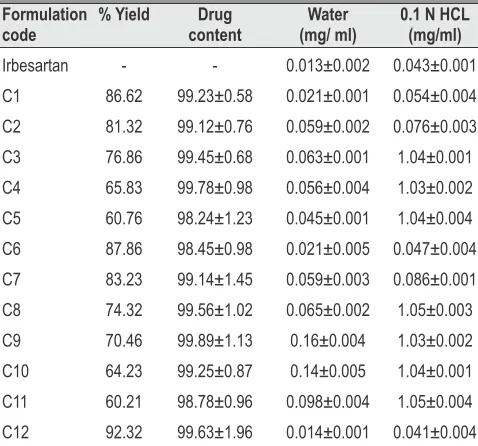
The practical yield was ranged from 60.21 to 92.32% (Table 2). The practical yield was found to be decreased with the increase in polymer concentration due to the formation of a thick viscous chitosan solution from which separation of the drug crystals was difficult. The drug content was found to be good and uniform among the different batches of crystals prepared and ranged from 98.24 to 99.89 % (Table 2).
Formulation % Yield Drug Water 0.1 N HCL
code content (mg/ ml) (mg/ml)
Irbesartan - - 0.013±0.002 0.043±0.001
C1 86.62 99.23±0.58 0.021±0.001 0.054±0.004 C2 81.32 99.12±0.76 0.059±0.002 0.076±0.003 C3 76.86 99.45±0.68 0.063±0.001 1.04±0.001 C4 65.83 99.78±0.98 0.056±0.004 1.03±0.002 C5 60.76 98.24±1.23 0.045±0.001 1.04±0.004 C6 87.86 98.45±0.98 0.021±0.005 0.047±0.004 C7 83.23 99.14±1.45 0.059±0.003 0.086±0.001 C8 74.32 99.56±1.02 0.065±0.002 1.05±0.003 C9 70.46 99.89±1.13 0.16±0.004 1.03±0.002 C10 64.23 99.25±0.87 0.14±0.005 1.04±0.001 C11 60.21 98.78±0.96 0.098±0.004 1.05±0.004 C12 92.32 99.63±1.96 0.014±0.001 0.041±0.004
In the solubility studies of the prepared crystals from chitosan , formulation batch C-3 showed highest solubility of drug in both water (0.063 mg/ml) and 0.1N HCl (1.04 mg/ml) in comparison with pure drug (water: 0.013 mg/ml; 0.1N HCl: 0.043 mg/ml). If we compare solubility data of chitosan and chitosan chlorhydrate batch C9 showed better aqueous solubility (0.16 mg/ml). No difference was observed in case of solubility in o.1 N HCL. The difference in aqueous solubility of chitosan and chitosan chlorhydrate may be due to better wetting property and low molecular weight of chitosan chlorhydrate. In addition, as the concentration of chitosan or chitosan chlorhydrate increased in the formulation, the solubility gradually increased up to a certain concentration followed by decrease in the solubility.
Infrared (IR) Spectroscopy:
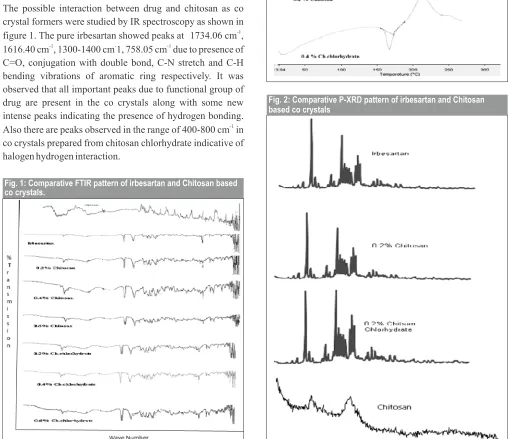
The possible interaction between drug and chitosan as co crystal formers were studied by IR spectroscopy as shown in -1 figure 1. The pure irbesartan showed peaks at 1734.06 cm ,
-1 - -1
1616.40 cm , 1300-1400 cm 1, 758.05 cm due to presence of C=O, conjugation with double bond, C-N stretch and C-H bending vibrations of aromatic ring respectively. It was observed that all important peaks due to functional group of drug are present in the co crystals along with some new intense peaks indicating the presence of hydrogen bonding.
-1 Also there are peaks observed in the range of 400-800 cm in co crystals prepared from chitosan chlorhydrate indicative of halogen hydrogen interaction.
PXRD:
The XRD patterns of the pure drug and the co crystals are shown in figure 2. The PXRD scan of plain irbesartan showed
0
intense peak of cystallanity at 12.4 (2Ө) with peak intensity of 21123 indicating its crystalline nature. The relative degree
Fig. 1: Comparative FTIR pattern of irbesartan and Chitosan based co crystals.
Fig. 2: Comparative P-XRD pattern of irbesartan and Chitosan based co crystals
of crystllanity values of irbesartan co crystals at specific angle are 0.729, 0.514 for 0.2% chitosan and 0.2% chitosan chlorhydrate co crystals respectively. It indicates decrease in crystallinity of irbesartan in co crystals.
Differential Scanning Colorimetry:
The results of DSC studies are shown in figure 3. IB showed 0
an endothermic peak at 190.58 C corresponding to its melting point followed by an exothermic peak at 244 °C. This exothermic peak might convert the drug into more stable but less soluble form. The peaks of chitosan and chitosan based co-crystals were broad, less sharp than drug, cocrystals also showed exothermic peaks nearer to 244°C. The endothermic peaks of co-crystals were found to be same as that of drug confirming that the resultant co-crystals were in the crystalline state. This was also confirmed from P-XRD and SEM analysis.
Scanning Electron Microscopy (SEM):
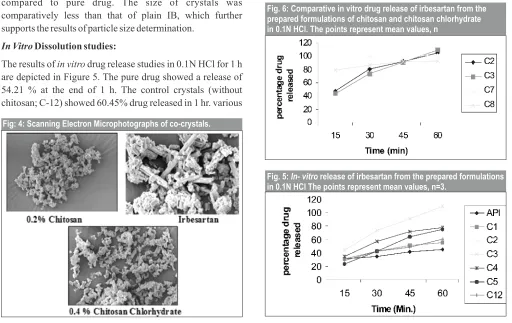
The SEM photomicrographs of pure irbesartan and the selected crystal formulations are given in Figure 4. The pure Irbesartan was characterized by crystals of bigger size and regular shape with an apparently smooth surface. In contrast crystals were present in the form of fine powder. Additionally, crystals were fluffy and possess porous and rough surface which might have resulted in the enhanced dissolution rate as compared to pure drug. The size of crystals was comparatively less than that of plain IB, which further supports the results of particle size determination.
In Vitro Dissolution studies:
The results of in vitro drug release studies in 0.1N HCl for 1 h are depicted in Figure 5. The pure drug showed a release of 54.21 % at the end of 1 h. The control crystals (without chitosan; C-12) showed 60.45% drug released in 1 hr. various
crystals (C1 to C5) were prepared using increasing concentrations of chitosan using sodium citrate (2%) as dispersion medium. The chitosan salted-out with the sodium salts of citric, tartaric, malic and malonic acids was in general more soluble in dilute aqueous HCl or dilute aqueous acetic
17,18
acid The C-1 crystals containing 0.05% chitosan showed a drug release of 55.14% in 1 h. Crystals C-2 to C-5 was again prepared by increasing the chitosan concentrations. Highest drug release was observed with C-2, C3 crystals with 0.2% and 0.4% chitosan (105.44% and 109.4% in 1 h). Further with increase in concentration of chitosan C4, C5 decrease in drug release was observed compare to C2. It was interesting to note that chitosan was able to increase the dissolution rate at lower concentrations when associated with sodium citrate. This could be due to efficient adsorption of chitosan on drug particles in the presence of sodium citrate. It has been reported that polymers with positively or negatively charged groups interact with molecules of opposite charges to form three dimensional networks. The reaction of chitosan with multivalent anions like sodium citrate (anion cross-linker) allows the formation of bridges between the polymeric chains and results in cross-linking (by electrostatic interaction) between the chitosan molecules, which might have eventually resulted in efficient adsorption of chitosan on drug particles
Fig: 4: Scanning Electron Microphotographs of co-crystals.
Fig. 6: Comparative in vitro drug release of irbesartan from the prepared formulations of chitosan and chitosan chlorhydrate in 0.1N HCl. The points represent mean values, n
17
.Cocrystals prepared by using chitosan chlorhydrate showed better drug release than chitosan this might be due to the water soluble nature of chitosan chlorhydrate (figure 6). The crystals prepared by chitosan showed release (C2 and C3) 47.88. % and 43.82% at the end of 15 min. The crystals (C7 and C8) showed 100.1% and 78.72% drug release in 15min.
The increase in the irbesartan solubility, although little, and significant increase in its dissolution rate from prepared crystals can be explained as following: Chitosan has been proposed as a useful excipient for enhancing the 18 bioavailability of poorly water-soluble compounds. Chitosan and its derivatives have been reported as a good vehicle for enhancing the solubility and dissolution of poorly
,21-23
water-soluble . Chitosan dissolves readily in most of the acid solutions and upon dissolution, amine groups of the polymer become protonated, resulting in a positively charged polysaccharide (RNH3+) and chitosan salts (chloride,
24
glutamate, etc.) that are soluble in water .The earlier literature reveals that dissolution rate not only depends on the surface area and particle size of the processed powder, but is
25 greatly affected by crystal morphology and wettability . So increased wettability of the drug by the adsorption of chitosan and chitosan chlorhydrate onto the hydrophobic surface of the drug is the first reason. In a previous study also, chitosan showed increased solubility and dissolution rate of naproxen
22
due to adsorption on its surface . As the concentration of polymer is increased dissolution rate was decreased (4, C-5, and C7). This could be due to the formation of thick gel layer of the chitosan on the surface of the crystals.
The difference in dissolution rate enhancement by chitosan and chitosan chlorhydrate can be explained as, the trend found was that for the two types of chitosan (base and salt), the lower the Mw, the faster was the drug dissolution. This behavior was predictable taking into account the relationship between Mw
26
and viscosity of polymer solution . Upon contact with the acidic medium; chitosan swells and forms a gel. The diffusion of the drug through the gel into the release medium would be retarded by increasing the viscosity of the polymer, and hence
27
of the gel . On the other hand, the chitosan chlorhydrate led to faster drug dissolution than chitosan. The explanation to this behavior was found in the differences in the wetting rate, solubilities and swelling capacity of the chitosan and chitosan salts, chitosan chlorhydrate rapidly wet and dissolve upon its incorporation into the dissolution medium, whereas the chitosan base being less water soluble, would take more time to dissolve.
In order to clarify the causes of significant difference in the dissolution rate, the surface morphology of the crystals was examined by SEM. Thus the fine and fluffy physical state of
crystals along with their porous and rough surface as supported by SEM photomicrographs might also have contributed to the enhanced solubility and dissolution rate of irbesartan from these crystals.
Stability studies:
The physical stability of co-crystals was compared with the drug. The co-crystals were found to be stable during the study period as no any change in color was found. The drug content in all the co-crystals was found to be within the limit. The drug content within the formulations is shown in the table 3.
CONCLUSIONS
The present study investigated a successful and simple method to prepare irbesartan-chitosan and irbesartan – chitosan chlorhydrate crystals to enhance its dissolution rate. The prepared crystals also exhibited exceptional stability. If this process can be scaled-up to manufacturing level, this technique has the potential to develop into valuable technology in future.
REFERENCES
1. Nokhodchi A. The effect of type and concentration of vehicle on dissolution rate of poorly water soluble drug (indomethacin) from liquid solid compacts. J Pharm Pharmaceut Sci 2005; 8: 18-25.
2. Blagden N, de Matas M, Gavan PT, York P. Crystal engineering of active pharmaceutical ingredients to improve solubility and dissolution rates. Adv Drug Deli Rev 2007; 59: 617–30.
3. Yadav AV, Shete A S, Dabake AP, Kulkarni PV, Sakhare SS. Co-Crystals: A Novel Approach to Modify Physicochemical Properties of Active Pharmaceutical Ingredients. Indian J Pharm Sci 2009; 71: 359-70.
4. 32. Yadav AV, Shete AS, Dabake AP. Crystal engineering an approach to modify physicochemical characteristics of Mefloquine Hydrochloride. Drug Dev Ind Pharm 2010; 36 (09): 1036- 45.
5. Felt O, Buri P, Gurny R. Chitosan: a unique polysaccharide for drug delivery. Drug Dev Ind Pharm 1998; 24: 979–93.
6. Dodane V, Vilivalam VD. Pharmaceutical applications of chitosan. Pharm Sci Technol Today 1998; 1: 246–53.
7. Illum L. Chitosan and its use as a pharmaceutical excipient. Pharm Res 1998; 15: 1326–31.
th
8. Paul W, Sharma CP. Chitosan, a drug carrier for the 21 century, STP Pharma Sci 2000; 10: 5–22.
Storage condition Drug Content (%) of formulations
o
30 ± 2 C /65±5% RH Irbesartan 0.2% Chitosan 0.4% Chitosan chlorhydrate Time 0 days 99.56 ± 1.14 98.77 ± 1.34 98.19 ± 2.13 Time 90 days 99.46 ± 1.34 98.67 ± 1.44 98.09 ± 2.34 Time 180 days 99.26 ± 1.14 98.47 ± 1.23 97.69 ± 2.01
9. Nagai T, Sawayanagi Y, Nambu N. Applications of chitin and chitosan to pharmaceutical preparations, in: J.P. Zizakis editor. Chitin, Chitosan and Related Enzymes. Orlando: Academic Press; 1984. 21–39. 10. Ritthidej GC, Chomto P, Pummangura S, Menasveta P. Chitin and
Chitosan as disintegrants in paracetamol tablets. Drug Dev Ind Pharm 1994; 20: 2109–34.
11. Upadrashta SM, Katikaneni PR, Nuessle NO. Chitosan as a tablet binder. Drug Dev Ind Pharm 1992; 18: 1701-8.
12. Sawayanagi Y, Nambu N, Nagai T. Dissolution properties and bioavailability of phenytoin from ground mixtures with chitin or chitosan. Chem Pharm Bull 1983;31: 2062–8.
13. Shiraishi S, Arahira M, Imai T, Otagiri M. Enhancement of dissolution rates of several drugs by low molecular chitosan and alginate. Chem Pharm Bull 1990; 38:185–7.
14. Acarturk F, Sencan A, Celebi N. Evaluation of the effect of low molecular weight chitosan on the solubility and dissolution characteristics of spironolactone. Die Pharmazie 1993;48: 605–7. 15. Portero A, Remun˜an-Lopez C, Vila-Jato JL. Effect of chitosan and
chitosan glutamate enhancing the dissolution properties of the poorly water soluble drug nifedipine. Int J Pharm 1998; 175: 75–84.
16. Horter D, Dressman JB. Influence of physicochemical properties on dissolution of drugs in the gastrointestinal tract. Adv Drug Deli Rev 2001; 46: 75–87.
17. Shu XZ, Zhu KJ. Controlled drug release properties of ionically crosslinked chitosan beads: the influence of anion structure. Int J Pharm 2002; 233:217–25.
18. Dupuis G, LeHoux J. Recovery of chitosan from aqueous acidic solutions by salting-out. Part 2. Use of salts of organic acids. Carbohydrate Polym 2007; 68: 287–94.
19. Lu Z, Steenekamp JH, Hamman JH. Cross-linked cationic polymer microparticles: effect of n-trimethyl chitosan chloride on the release and permeation of ibuprofen. Drug Dev Ind Pharm 2005; 31: 311–7. 20. Anal AK, Stevens WF. Chitosan–alginate multilayer beads for
controlled release of ampicillin. Int J Pharm 2005; 290: 45–54. 21. Mura P, Zerrouk N, Mennini N, Maestrelli F, Chemtob C. Development
and characterization of naproxen-chitosan solid systems with improved drug dissolution properties. Eur J Pharm Sci 2003; 19: 67–75.
22. Maestrelli F, Zerrouk N, Chemtob C, Mura P. Influence of chitosan and its glutamate and hydrochloride salts on naproxen dissolution rate and permeation across Caco-2 cells. Int J Pharm 2004; 271: 257–67. 23. Kumar VSG, Mishra DN, Preparation, characterization and in vitro
dissolution studies of solid systems of valdecoxib with chitosan. Chem Pharm Bull 2006; 54: 2–12.
24. Rowe RC, Sheskey PJ, Owen SC. Handbook of Pharmaceutical Excipients. London, United Kingdom; Pharmaceutical Press: 2006. 25. Perrut M, Jung J, Leboeuf F. Enhancement of dissolution rate of
poorly-soluble active ingredients by supercritical fluid processes. Part I. Micronization of neat particles. Int J Pharm 2005; 288: 3–10. 26. Adusumilli PS, Bolton SM. Evaluation of chitosan citrate complexes as
2
matrices for controlled release formulations using a 3 full factoral design. Drug Dev Ind Pharm 1991; 17:1931–45.
27. Imai T, Shiraishi S, Saito H, Otagiri M. Interaction of indomethacin with low-molecular weight chitosan and improvement of some pharmaceutical properties of indomethacinby low-molecular weight chitosans. Int J Pharm 1991. 67: 11–20.