RESEARCH ARTICLE
The sensitivity and specificity of automated auditory brainstem
response and otoacoustic emission in neonatal hearing
screening: a systematic review
Saeed Heidari1, Alireza Olyaee Manesh2*, Fatemeh Rajabi3
1
- Health Sciences Education Development Department, School of Public Health, Tehran University of Medical Sciences, Tehran, Iran
2
- Health Financing System, National Institute for Health Research, Tehran University of Medical Sciences,Tehran, Iran
3
- Center for Academic and Health Policy, Tehran University of Medical Sciences,Tehran, Iran
Received: 17 Feb 2015, Revised: 14 Mar 2015, Accepted: 15 Mar 2015, Published: 22 Jun 2015
Abstract
Background and Aim: Otoacoustic emissions
(OAE) and automated auditory brainstem response (AABR) are the most commonly-used
methods for universal neonatal hearing
screening (UNHS). Various sensitivity and spe-cificity rates have been reported for the OAE and AABR tests as tools for screening newborn hearing. The main objective of this review was to determine the pooled sensitivity and pooled specificity of each of the two devices in com-parison with ABR as the gold standard.
Methods: A systematic review was performed
to evaluate the diagnostic accuracy of the OAE and AABR tests. Research was conducted in the relevant domestic and international databases. There were no time restrictions. The quality of included studies was evaluated with Quality Assessment of Diagnostic Accuracy Study (QUADAS) checklist using the software RevMan 5.1 and results were extracted. After organizing and extracting data, the pooled sensi-tivity and specificity of OAE and AABR tests were calculated with Meta-Disc software.
Results: A total of 5154 articles were found; 57
articles were investigated in full and 17 articles possessed the inclusion criteria. Analysis was performed on the basis of these results. the quality of the studies was weak (7 cases) to moderate (10 cases). Results of the meta-analysis showed that the pooled sensitivity and specificity of the OAE were 0.77 and 0.93 respectively, and for AABR they were 0.93 and 0.97 respectively.
Conclusion: The single stage screening
pro-tocol using AABR is an effective alternative to the single stage screening protocol using OAE, which is less accurate.
Keywords: Newborn hearing screening;
otoacoustic emissions; automated auditory brainstem response; sensitivity; specificity
Introduction
Hearing impairment is one of the most common congenital abnormalities in newborns [1]. Based on the World Health Organization’s report, 0.5-5 in 1000 newborns are affected with congenital or early onset hearing loss or severe to profound hearing impairment [2]. The prevalence of permanent congenital hearing loss –which is bilateral- in infants without risk factors is approximately 1 in 1000 live births. This rate is 3-4 in 1000 live births for mild cases [3]. In Iran, the prevalence of hearing loss is an *
average of 5 in 1000 live births [4].
Owing to the relatively high prevalence of hearing loss, its side-effects and economic burden on the individual, family and comm-unity, the use of neonatal screening programs to detect hearing loss at an early stage has risen considerably in the past two decades. The most important reason that has garnered continued support for such programs is the belief that the early detection and subsequent intervention undertaken to treat and control hearing loss can lead to improved speech and lingual outcomes in the future [5].
Among the components that determine the efficiency and appropriateness of a screening program are the sensitivity and specificity of the test used. Generally speaking, the higher the sensitivity of a test the lower the false-negative cases and subsequently the lower socio-eco-nomic side-effects and burden of disease. Fur-thermore, the higher the specificity of a test the lower the false-positive cases, and thus, the lower its financial burden and resultant stress [6]. Therefore, being aware of a test’s sensitivity and specificity is crucial in decision-making and policy-making aimed at controlling a congenital health issue through universal neonatal scree-ning programs. The otoacoustic emission (OAE) and automated auditory brainstem response (AABR) tests are the most common tests em-ployed in universal neonatal hearing screening (UNHS) [6]. OAEs are in fact the waves recorded in the cochlea when naturally function-ing. These waves do not directly measure hear-ing sensitivity, but are directly associated with natural cochlear performance. The AABR device can show hearing sensitivity through examining the performance of the 8th central nerve and/or the brainstem auditory pathway [6].
Different studies have reported different values for the diagnostic accuracy of OAE and AABR in neonatal hearing screening programs [3]. However, no single value has been reported for either sensitivity or specificity of these devices on the basis of acceptable scientific methods. The objective of this study was to systematically review the existing scientific evidence on the
sensitivity and specificity of OAE and AABR devices as opposed to a gold standard i.e. the ABR, to achieve a pooled value for sensitivity and specificity of the devices that are most widely used to screen hearing in neonates in most countries around the world. Eventually, the results may be used as a criteria for decision-making and policy-making in neonatal hearing screening programs.
Methods
This systematic review was based on Cochrane Institute’s standard method for diagnostic accuracy studies. Existing scientific evidence was used to determine the sensitivity and specificity of OAE and AABR vs. ABR –as a gold standard. To this end, the most important and appropriate electronic medical databases including MEDLINE, PubMed, Cochrane, Sci-ence Direct, Trip and Google Scholar as well as relevant websites were searched without time limit up to August 2014. The MeSH system was used, as well as ‘and’ and ‘or’ between words of the same meaning and concept i.e. otoacoustic emission, auditory brainstem response, Infant, hearing screening, sensitivity and specificity. The appropriate search strategy was applied to each database. Appendix 1 shows the search strategy used for the Cochrane database. The extracted articles were organized in Endnote software. After deleting the duplicate articles the titles and abstracts of the articles were revi-ewed. The articles that were deemed to be irrelevant to the research objectives were excluded. Then, the full texts of the selected articles were gathered. Those articles that did not possess the inclusion criteria were excluded. The inclusion and exclusion criteria of the study were determined as follows:
Inclusion criteria of the study: population: infants aged under 12 months; diagnostic test: OAE and AABR devices (alone or together) as hearing screening tools; gold standard: ABR device; outcome: sensitivity, specificity; type of studies: diagnostic accuracy studies; time: without restriction.
that have used a gold standard other than the ABR device, articles that have reported the sensitivity and specificity of the devices without mentioning the gold standard, articles of studies that have performed hearing screening in infants older than 1 year, and languages other than Persian and English.
The quality of studies was assessed with the Quality Assessment of Diagnostic Accuracy Study (QUADAS) and the RevMan 5.1 soft-wares [7].
A structured form that was designed to extract data was used to collect the required data. Eventually, Meta-Disc software (a software used to statistically meta-analyze diagnostic ac-curacy studies) was used to analyze the data.
Results
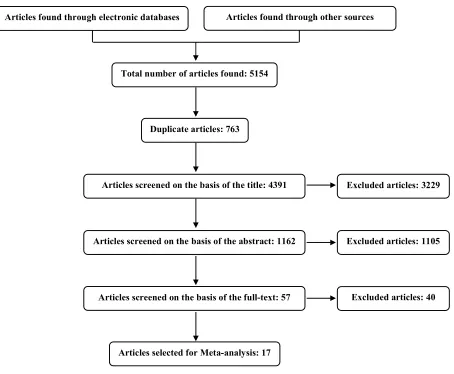
On the whole 5154 articles were found, out of which 763 duplicate articles were excluded. Then their titles were reviewed. At this stage, 1162 articles were selected. In the next step, the abstracts were reviewed, in which 57 articles were selected. The full texts of these 57 articles were collected and examined. Then, upon app-lying the inclusion and exclusion criteria 17 articles remained (Fig. 1). Appendices 2-a and 2-b illustrate the reasons behind excluding the articles at each stage.
Out of these 17 articles, 6 had examined the sensitivity and specificity of the AABR device and 9 articles had examined the sensitivity and specificity of the OAE device. All 17 had compared the devices with the gold standard
Total number of articles found: 5154
Articles selected for Meta-analysis: 17
Articles found through electronic databases Articles found through other sources
Articles screened on the basis of the title: 4391
Articles screened on the basis of the abstract: 1162
Articles screened on the basis of the full-text: 57 Duplicate articles: 763
Excluded articles: 3229
Excluded articles: 1105
Excluded articles: 40
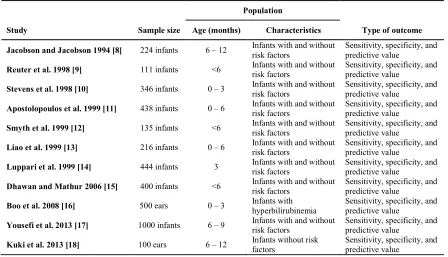
(ABR). Two articles had simultaneously exa-mined the sensitivity and specificity of both devices and had compared them with the gold standard. The general features of the 17 articles have been presented in Tables 1 and 2.
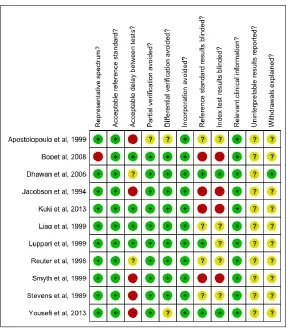
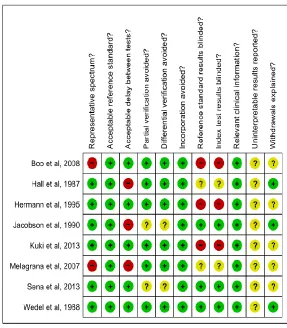
Quality assessment of the articles –which was done with QUADAS and RevMan 5.1- showed that out of 17 articles 10 had an acceptable quality, and 7 (Kuki et al., Boo et al., Apostolopoulos et al., Jacobson and Jacobson, Table 1. Characteristics of the articles included for evaluating the sensitivity and specificity of otoacoustic
emission device
Population
Study Sample size Age (months) Characteristics Type of outcome
Jacobson and Jacobson 1994 [8] 224 infants 6 – 12 Infants with and without risk factors
Sensitivity, specificity, and predictive value
Reuter et al. 1998 [9] 111 infants <6 Infants with and without
risk factors
Sensitivity, specificity, and predictive value
Stevens et al. 1998 [10] 346 infants 0 – 3 Infants with and without
risk factors
Sensitivity, specificity, and predictive value
Apostolopoulos et al. 1999 [11] 438 infants 0 – 6 Infants with and without risk factors
Sensitivity, specificity, and predictive value
Smyth et al. 1999 [12] 135 infants <6 Infants with and without
risk factors
Sensitivity, specificity, and predictive value
Liao et al. 1999 [13] 216 infants 0 – 6 Infants with and without
risk factors
Sensitivity, specificity, and predictive value
Luppari et al. 1999 [14] 444 infants 3 Infants with and without
risk factors
Sensitivity, specificity, and predictive value
Dhawan and Mathur 2006 [15] 400 infants <6 Infants with and without risk factors
Sensitivity, specificity, and predictive value
Boo et al. 2008 [16] 500 ears 0 – 3 Infants with
hyperbilirubinemia
Sensitivity, specificity, and predictive value
Yousefi et al. 2013 [17] 1000 infants 6 – 9 Infants with and without
risk factors
Sensitivity, specificity, and predictive value
Kuki et al. 2013 [18] 100 ears 6 – 12 Infants without risk
factors
Sensitivity, specificity, and predictive value
Table 2. Characteristics of the articles included for evaluating the sensitivity and specificity of the automated auditory brainstem response device
Population
Study Sample size Age (months) Characteristics Type of outcome
Boo et al. 2008 [16] 500 ears 0 – 3 Infants with
hyperbilirubinemia
Sensitivity, specificity, and predictive value
Kuki et al. 2013 [18] 100 ears 6 – 12 Infants without risk
factors
Sensitivity, specificity, and predictive value
Hall et al. 1987 [19] 336 infants 6 Infants with and without
risk factors
Sensitivity, specificity, and predictive value
Schauseil-Zipf and von Wedel 1988 [20] 100 infants 0 – 3 Infants with and without risk factors
Sensitivity, specificity, and predictive value
Jacobson et al. 1990 [21] 447 infants <3 Infants with and without
risk factors
Sensitivity, specificity, and predictive value
Hermann et al. 1995 [22] 304 infants 3 Infants with and without
risk factors
Sensitivity, specificity, and predictive value
Melagrana et al. 2007 [23] 388 infants 1 – 2 Infants with and without
risk factors
Sensitivity, specificity, and predictive value
Sena et al. 2013 [24] 400 infants 3 Infants with and without
risk factors
Smyth et al., Hermann et al, and Melagrana et al.) had low quality (Figures 2 and 3).
The sensitivity of the OAE was compared to that of the ABR (as the gold standard) using the Mantel-Haenszel method in a sample of 3914 newborns with and without risk factors. Based on the meta-analysis, the pooled sensitivity of the OAE device was estimated at 0.75 (95% CI: 0.694 to 0.804; Fig. 4). Since there was a high level of heterogeneity (91.2%) in the estimated sensitivity the source of the heterogeneity was investigated and eventually traced back to the studies by Kuki et al., Boo et al. and Apostolopoulos et al. from then on, these stud-ies were excluded from the analysis in a step-wise fashion and heterogeneity was re-tested. Eventually, after excluding all three articles an acceptable heterogeneity (35.1%) was achieved.
Under these circumstances the pooled sensi-tivity of the OAE device was estimated at 0.77 (95% CI: 0.65 to 0.86; Fig. 5).
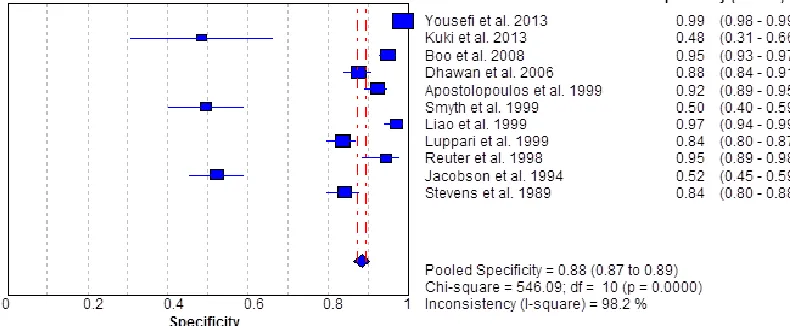
The specificity of the OAE was compared to that of the ABR (as the gold standard) using the Mantel-Haenszel method in a sample of 3914 newborns with and without risk factors. Based on the meta-analysis, the pooled specificity of the OAE device was estimated at 0.88 (95% CI: 0.873 to 0.894; Fig. 6). Since there was a high level of heterogeneity (98.2%) in the estimated specificity the source of the heterogeneity was investigated and eventually traced back to the studies by Kuki et al., Jacobson and Jacobson, and Smyth et al. Hence, these studies were excluded from the analysis in a step-wise fashion and heterogeneity was re-tested. Eventually, after excluding all three articles Fig. 2. Results of quality assessment of articles included in the evaluation of sensitivity and specificty of
heterogeneity did become less but was still not acceptable (96%). Under these circumstances the pooled specificity of the OAE device was estimated at 0.93 (95% CI: 0.92 to 0.93; Fig. 7). The sensitivity of the AABR was compared to that of the ABR (as the gold standard) using the Mantel-Haenszel method in a sample of 2575 newborns with and without risk factors. Based on the meta-analysis, the pooled sensitivity of the AABR device was estimated at 0.88 (95% CI: 0.836 to 0.913; Fig. 8). Since there was a high level of heterogeneity (92.5%) in the estimated sensitivity the source of the heterogeneity was investigated and eventually traced back to the studies by Boo et al., Hermann et al. and Melagrana et al. thereafter, these studies were excluded from the analysis in a step-wise fashion and heterogeneity was
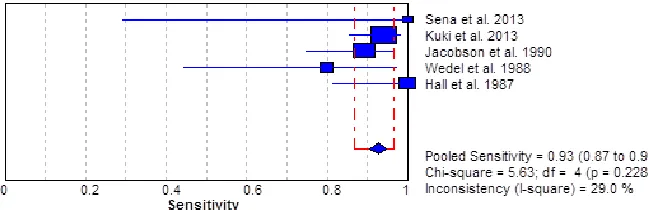
re-tested. Eventually, after excluding all three articles an acceptable heterogeneity (29%) was achieved. Under these circumstances the pooled sensitivity of the AABR device was estimated at 0.93 (95% CI: 0.87 to 0.96; Fig. 9).
The specificity of the AABR was compared to that of the ABR (as the gold standard) using the Mantel-Haenszel method in a sample of 2575 newborns with and without risk factors. Based on the meta-analysis, the pooled specificity of the AABR device was estimated at 0.90 (95% CI: 0.886 to 0.912; Fig. 10). Since there was a high level of heterogeneity (98.4%) in the estimated specificity the source of the hetero-geneity was investigated and eventually traced back to the studies by Boo et al. and Kuki et al. Hence, these studies were excluded from the analysis in a step-wise fashion and Fig. 3. Results of quality assessment of articles included in the evaluation of sensitivity and specificty of
Fig. 4. Pooled sensitivity of OAE vs ABR as the gold standard.
Fig. 5. Pooled sensitivity of OAE vs ABR as the gold standard –after heterogeneity testing.
Fig. 7. Pooled specificity of OAE vs ABR as the gold standard –after heterogeneity testing.
Fig. 8. Pooled sensitivity of AABR vs ABR as the gold standard.
Fig. 9. Pooled sensitivity of AABR vs ABR as the gold standard –after heterogeneity testing.
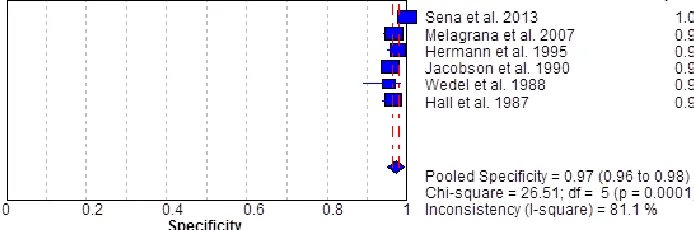
heterogeneity was re-tested. Eventually, after excluding both articles heterogeneity did be-come less but was still not acceptable (81.1%). Under these circumstances the pooled specifi-city of the AABR device was estimated at 0.97 (95% CI: 0.96 to 0.98; Fig. 11).
Discussion
Among the elements that determine the effi-ciency and appropriateness of a screening
Fig. 10. Pooled specificity of AABR vs ABR as the gold standard.
Fig. 11. Pooled specificity of AABR vs ABR as the gold standard –after heterogeneity testing.
similar disorders then that tool is said to have high sensitivity. If the same tool is used among a vast population of healthy individuals and the healthy ones are correctly detected then that tool is said to have high specificity.
In a systematic review conducted by Wolff et al. in Germany the diagnostic accuracy of the OAE device was investigated [25]. Eight articles were reviewed in a comparison between the OAE device and the AABR –as the gold standard- for their sensitivity and specificity. Since AABR itself is used as a screening test so considering it as the gold standard will cause bias and hetero-geneity in the sensitivity and specificity. Hence, the results of this study have been reported without a meta-analysis. Generally speaking, in this study the sensitivity of the OAE was bet-ween 0.5-1 and the specificity was betbet-ween 0.49-0.97 [25]. White et al. examined the sensi-tivity and specificity of the AABR device and compared it with the ABR device (as the gold
standard) in 1997. They reviewed 4 articles, regardless of their quality and the statistical methods applied. The pooled sensitivity and specificity of these articles were reported at 96% and 98% [26].
excluded from the study step-by-step. The remaining articles were meta-analyzed again until an acceptable heterogeneity was achieved. The causes of heterogeneity were interpreted as follows:
Jacobson and Jacobson and Smyth et al. studies lacked adequate accuracy and quality as they had not blinded the results of the screening test and gold standard. Moreover, there was a large time gap between the screening test and the gold standard [8,12]. Boo et al.’s study samples included premature babies and those with hyper bilirubinemia, so the samples were not truly representative of the community. Again, there was a large time gap between the screening test and gold standard, resulting in bias and inconsistency with other study results [16]. The studies conducted by Melagrana et al. [22] and Apostolopoulos et al. [11] too had large time gaps between their screening test and gold standard results, thereby resulting in bias and inconsistency with other study results. Kuki et al. and Hermann et al.’s studies had not blinded the results of their screening test and gold standards either, thereby lacking adequate accuracy and quality [18,22].
Overall, the sensitivity of the OAE device was between 0.5-1 in the studies examined. Based on the meta-analysis and heterogeneity testing, the pooled sensitivity was estimated at 0.77. The pooled specificity of this device was 0.48-0.99 among the articles examined. Eventually, the meta-analysis revealed a pooled specificity of 0.93. Similarly, the sensitivity of the AABR was between 0.8-1. Following meta-analysis and heterogeneity testing the pooled sensitivity of the study was estimated at 0.93. The pooled specificity of this device was 0.9-2 in the articles under study. Eventually, this value was estimated at 0.97.
It should be mentioned that a number
of relevant articles have been missed
due to lack of access to certain important elec-tronic databases (such as Embase) and in-accessibility to certain English full-texts. This inaccessibility may have caused bias in the meta-analysis results on the devices’ diagnostic accuracy.
Conclusions
On the whole, there was no big difference between the pooled specificity of the two devices (OAE: 0.93; AABR: 0.97). Both devices had high accuracy in detecting infants with normal hearing. However, there was a significant difference between the sensitivity of the two devices and their abilities to detect infants with hearing impairment (OAE: 0.77; AABR: 0.93). Annually, there are approxi-mately one million births in Iran. And the prevalence of hearing impairment is roughly five in 1000 live births. So on average, 5000 babies are born with hearing loss. Taking into account the achieved sensitivity and specificity values, the OAE and AABR devices would be able to detect 3850 and 4650 cases respectively (i.e. 800 more cases for AABR). Considering the significance of early detection of hearing loss and the complications and socio-economic burden of delayed detection of this defect, it seems that the AABR would be a more efficient substitute as opposed to the OAE in single-stage newborn hearing screening protocols.
Acknowledgements
This article is the result of S. Heidari MSc. diss-ertation in the Health Technology Assessment (HTA) discipline titled “HTA of AABR vs. OAE in Neonatal Hearing Screening”. This study was supported by grant No. 241/m/93124 from I.R.Iran’s National Institute of Health Research, Tehran University of Medical Sciences.
REFERENCES
1. Farhadi M, Mahmoudian S, Mohammad K, Daneshi A. The pilot study of a nationwide neonatal hearing screening in Iran: Akbarabadi and Mirzakouchak-Khan hospitals in Tehran (June 2003-October 2004). Hakim Health Sys Res. 2006;9(3):65-75. Persian.
2. World Health Organization. Newborn and infant hearing screening: Current issues and guiding principles for action. 2010; [7] available from: www.who.int/blindness/publications/Newborn and Infant Hearing Screening Report.pdf. Mar:15.2015. 3. Akinpelu OV, Peleva E, Funnell WR, Daniel SJ.
Otoacoustic emissions in newborn hearing screening: a systematic review of the effects of different protocols on test outcomes. Int J Pediatr Otorhinolaryngol. 2014;78(5):711-7.
A, Ansari Dezfooli M, Esmailzadeh M. Prevalence of neonatal hearing impairment in province capitals. Journal of the School of Public Health and Institute of Public Health Research. 2008;5(4):1-9. Persian. 5. Callow-Heusser CA. The effects of early identification
and intervention on language outcomes of children born with hearing loss. [Dissertation]. Utah State University. 2011.
6. Corabian P, Harstall C, Yan C, Chuck A, Chojecki D. The safety and efficacy/effectiveness of using automated testing devices for universal newborn hearing screening: an update. IHE2012.; [5] available from: www.ihe.ca/publications?date=2012&topic=1043. Mar:15.2015
7. The Cochrane Collaboration. Review Manager (RevMan). Version 5.0. 2008. Copenhagen: The Nordic Cochrane Centre.
8. Jacobson JT, Jacobson CA. The effects of noise in transient EOAE newborn hearing screening. Int J Pediatr Otorhinolaryngol. 1994;29(3):235-48.
9. Reuter G, Bördgen F, Dressler F, Schäfer S, Hemmanouil I, Schönweiler R, et al. Neonatal hearing screening with the Echosensor automated device for otoacoustic emissions. A comparative study. HNO. 1998;46(11):932-41. German.
10. Stevens JC, Webb HD, Hutchinson J, Connell J, Smith MF, Buffin JT. Click evoked otoacoustic emissions compared with brain stem electric response. Arch Dis Child. 1989;64(8):1105-11.
11. Apostolopoulos NK, Psarommatis IM, Tsakanikos MD, Dellagrammatikas HD, Douniadakis DE. Otoacoustic emission-based hearing screening of a Greek NICU population. Int J Pediatr Otorhinolaryngol. 1999;47(1):41-8.
12. Smyth V, McPherson B, Kei J, Young J, Tudehope D, Maurer M, et al. Otoacoustic emission criteria for neonatal hearing screening. Int J Pediatr Otorhinolaryngol. 1999;48(1):9-15.
13. Liao H, Wu Z, Zhou T. Otoacoustic emissions for newborn hearing screening. Zhonghua Er Bi Yan Hou Ke Za Zhi. 1999;34(1):21-4. Chinese.
14. Luppari R, Orzan E, Arslan E. Acoustic distortion products otoacoustic emissions (DPOAE) in neonatal screening. Acta Otorhinolaryngol Ital. 1999;19(2):57-63. Italian.
15. Dhawan R, Mathur NN. Comparative evaluation of transient evoked oto-acoustic emissions and brainstem evoked response audiometry as screening modality for hearing impairment in neonates. Indian J Otolaryngol
Head Neck Surg. 2007;59(1):15-8.
16. Boo NY, Rohani AJ, Asma A. Detection of sensorineural hearing loss using automated auditory brainstem-evoked response and transient-evoked otoacoustic emission in term neonates with severe hyperbilirubinaemia. Singapore Med J. 2008;49(3):209-14.
17. Yousefi J, Ajalloueyan M, Amirsalari S, Hassanali Fard M. The specificity and sensitivity of transient otoacustic emission in neonatal hearing screening compared with diagnostic test of auditory brainstem response in Tehran hospitals. Iran J Pediatr. 2013;23(2):199-204.
18. Kuki S, Chadha S, Dhingra S, Gulati A. The role of current audiological tests in the early diagnosis of hearing impairment in infant. Indian J Otolaryngol Head Neck Surg. 2013;65(3):244-50.
19. Hall J, Kileny P, Ruth R, Kripal JP. Newborn auditory screening with ALGO-1 vs. conventional ABR. ASHA. 1987;29:120.
20. Schauseil-Zipf U, von Wedel H. Hearing screening using acoustically evoked brainstem potentials in newborn infants and infants. Klin Padiatr. 1988;200(4):324-9. German.
21. Jacobson JT, Jacobson CA, Spahr RC. Automated and conventional ABR screening techniques in high-risk infants. J Am Acad Audiol. 1990;1(4):187-95.
22. Herrmann BS, Thornton AR, Joseph JM. Automated infant hearing screening using the abr: development and validation. Am J Audiol. 1995;4(2):6-14.
23. Melagrana A, Casale S, Calevo MG, Tarantino V. MB11 BERAphone and auditory brainstem response in newborns at audiologic risk: comparison of results. Int J Pediatr Otorhinolaryngol. 2007;71(8):1175-80.
24. Sena-Yoshinaga TA, Almeida MG, Côrtes-Andrade IF, Lewis DR. Neonatal hearing screening with automated auditory brainstem response: using different technologies. Audiol Commun Res. 2014;19(1):19-24. 25. Wolff R, Hommerich J, Riemsma R, Antes G, Lange S,
Kleijnen J. Hearing screening in newborns: systematic review of accuracy, effectiveness, and effects of interventions after screening. Arch Dis Child. 2010;95(2):130-5.
26. White KR. Universal newborn hearing screening: Issues and evidence. Atlanta, GA: Workshop on Early Hearing Detection and Intervention (EHDI). 1997; [5] available from: