University of South Carolina
Scholar Commons
Theses and Dissertations
12-15-2014
Practical Concurrency Support for Web Service
Transactions
Emad Alsuwat
University of South Carolina - Columbia
Follow this and additional works at:https://scholarcommons.sc.edu/etd Part of theComputer Engineering Commons
This Open Access Thesis is brought to you by Scholar Commons. It has been accepted for inclusion in Theses and Dissertations by an authorized administrator of Scholar Commons. For more information, please [email protected].
Recommended Citation
P
RACTICALC
ONCURRENCYS
UPPORT FORW
EBS
ERVICET
RANSACTIONSby
Emad Alsuwat
Bachelor of Computer Science Taif University, 2008
Submitted in Partial Fulfillment of the Requirements
For the Degree of Master of Science in
Computer Science and Engineering
College of Engineering and Computing
University of South Carolina
2014
Accepted by:
Csilla Farkas, Director of Thesis
Marco Valtorta, Reader
Manton M Matthews, Reader
A
CKNOWLEDGEMENTSFirst and foremost I express my sincere gratitude for my advisor Prof. Csilla
Farkas. It has been an honor to be her master student. I am very thankful for her
motivation, immense knowledge, and continuous support. I appreciate all her
contributions of time, and ideas to make my master experience productive and
stimulating.
Besides my advisor, I would like to thank the rest of my thesis committee, Prof.
Manton M Matthews, and Prof. Marco Valtorta, for their insightful comments and
encouragement.
I would like to thank my family for all their unlimited encouragement and love. I
would like to sincerely thank my parents who raised me with a love of science and for
providing me the support I need. I also would like to thank my brothers and sisters for
supporting me spiritually throughout my life.
Last but not the least, I would like to thank my friends for all their love and true
friendship. My time at the University of South Carolina was made enjoyable in large part
due to the many friends that became a part of my life. I am grateful for time spent with
A
BSTRACTTraditional database concurrency control methods use locking,
timestamp-ordering, and optimistic-ordering to achieve DB consistency. However, these approaches
are not suitable for long-running Web Service Compositions (WSCs) due to associated
performance degradation. Our hypothesis asserts that, using transactional semantic and
ordering information, the execution time of a WSC can be reduced, thus allowing the use
of traditional database concurrency control methods while avoiding unacceptable
performance degradation. Our solution is based on the following approaches:
§ We model a WSC as WS-BPEL specification, i.e., a partial order of WS transactions.
§ We allow some of the WS transactions in the WSC to execute in parallel.
§ We use traditional locking mechanism for WSC to guarantee database consistency.
To identify WS transactions that can execute parallel, we analyzed the WS-BPEL
specification of the WSCs. The research tasks follow:
§ Task 1: Identify WS transaction precedence relations
§ Task 2: Build Parallel Execution Scenarios (PES)
§ Task 3: Investigate possible further improvement of WSC execution schedule. For
Task 3, we propose the following sub-tasks:
o Increase the number of WSs executing in parallel, and
o Execute concurrently those WSs that have similar execution time
T
ABLE OFC
ONTENTSACKNOWLEDGEMENTS ... iii
ABSTRACT ... iv
LIST OF FIGURES ... vi
LIST OF ABBREVIATIONS ... vii
CHAPTER 1INTRODUCTION ...1
CHAPTER 2RELATED WORK ...5
2.1CONCURRENCY CONTROL MECHANISMS ...5
2.2WEB SERVICE COMPOSITION AND TRANSACTIONS ...8
2.3WEB SERVICE SERIALIZABILITY ...10
CHAPTER 3MOTIVATED EXAMPLE ...12
CHAPTER 4PERFORMANCE IMPROVEMENT:PAIR-WISE PARALLEL EXECUTION ...14
4.1TASK 1:IDENTIFY WS TRANSACTIONS THAT CAN EXECUTE CONCURRENTLY ...15
4.2TASK 2:BUILD ALL PARALLEL EXECUTION SCENARIOS (PES) ...18
CHAPTER 5PERFORMANCE IMPROVEMENT:MULTIPLE PARALLEL EXECUTION ...27
5.1INCREASING THE NUMBER OF WSS EXECUTING PARALLEL ...27
5.2EXECUTE CONCURRENTLY WSS THAT HAVE SIMILAR EXECUTION TIME ...33
CHAPTER 6CONCLUSION ...36
L
IST OFF
IGURESL
IST OFA
BBREVIATIONSACID ... Atomicity, Consistency, Isolation, Durability
DB ... Database
PES ... Parallel Execution Scenario
TO ... Topological Order
WS... Web Service
WSC ... Web Service Compositions
WSP ... WS-Pairs
WSS ... Web Service Set
CHAPTER
1
I
NTRODUCTIONWithin the field of information technology and computer science, concurrency
controls play a vital role in triggering concurrent operations at the quickest speeds
possible based on hardware and software system compilations defined by specified
consistency rules. During interactivity, problems may arise. The general basis for these
controls is to safeguard system integrity. Database systems are essential for a wealth of
applications. A database state defines the value of the database objects and this state is
changed when a user executes a transaction; individual transactions are assumed to be
correct in that they are running in isolation but this assumption changes when multiple
users access multiple database objects on multiple sites within the context of a distributed
database system (Bhargava, 1999). At this point, problems arise.
In traditional database management systems, concurrency controls are used to
ensure that executed transactions on the database system are running concurrently
without causing any violation to the consistency of the database; to ensure the correctness
of concurrency control mechanisms, the database management system must meet two
criteria for correctness: 1) database integrity and 2) serializability (Bhargava, 1999).
Simply stated, concurrency controls protect data simultaneous data modification from
impeding on changes made by another user. Simultaneous transaction executions over a
lost updates, uncommitted data, and inconsistent retrievals (Kung & Robinson, 1981).
Techniques are needed to mitigate these risks through improved data management. Many
concurrency control algorithms can be leveraged to validate serializability, including
using mechanisms such as locking, timestamp ordering, or optimistic ordering.
Serializability architects sequential database transitions from one state to the next, based
on the blueprinted serial execution of all transactions (Bhargava, 1999).
The idea of concurrency control mechanisms is to guarantee database consistency
while improve the performance of the database systems. In this process, serializability is
the universally accepted correctness criterion for processing multiple transactions within
centralized high-performance multiple transaction processing systems (Thomasian,
1998). Concurrency control mechanisms confirm serializability in centralized and
distributed within traditional database management systems (DBMS) and this is achieved
by verifying the reliability of database transactions by assuming that each transaction is
ACID - that is, atomicity, consistency, isolation, and durability properties hold.
Two-Phase Locking (2PL) is the most widely used concurrency control mechanism
(Al-Jumaha et al., 2002). Yet these mechanisms are not suitable for long-running WSCs
(Web Service Cluster) due to the associated performance degradation. That is,
transactions in the service-oriented architecture are not ACID transactions due to the
heterogeneous nature of the execution environment. The lack of concurrency control
mechanisms in WSC causes a problem of WS-serializability (Web Service), which occurs
when multiple transactions read and write the same data through independent services at
the same time (i.e. allowing for dirty read and dirty write). The dirty reads and writes
be aborted, it will affect the consistency of other concurrent transactions due to the lack
of isolation levels (Gao et al., 2011).
In this thesis, the problem of concurrency control for WSCs is the target focal point.
The study prioritizes the problem of WS-serializability given that current web service
transactions do not ensure concurrency control due to the heterogeneous nature of the
execution environment. In addition, the research proposes a concurrency control method
that is suitable for WS-transactions. The research hypothesis predicts that, by reducing
the execution time of WSCs, the applicability of concurrency control for WSCs can be
improved, therefore enhancing both transaction correctness (i.e., serializability) and
efficiency.
Our proposed solution is based on the following claims:
§ We model a WSC as WS-BPEL (Web Services Business Process Execution
Language) specification, i.e., a partial order of WS transactions.
§ We allow some of the WS transactions in the WSC to execute in parallel.
§ We use traditional locking mechanism for WSC to guarantee database consistency.
To identify WS transactions that can achieve parallel execution, we analyzed the
WS-BPEL specification of the WSCs. The research tasks follow:
§ Task1: identify WS transaction precedence relations
§ Task 2: build Parallel Execution Scenarios (PES) that do not violate the precedence
relations identified in Task 1.
§ Task 3: Investigate possible further improvement of WSC execution schedule. For
o Increase the number of WSs executing in parallel, and
o Execute concurrently those WSs that have similar execution time.
This thesis is organized as follows: Section 2 presents an overview of the related
work and limitations of current research. A Motivated Example is presented in Section 3.
Sections 4 and 5 provide the research problem and the proposed solution. Finally, our
CHAPTER 2
RELATED
WORK
2.1CONCURRENCYCONTROLMECHANISMS
The problem of violating the consistency in database systems appears within the
context of executing multiple concurrent transactions in the same database. Concurrency
control algorithms are introduced to solve the problem of inconsistency and to guarantee
the correctness and integrity of the execution of concurrent transactions within these
database systems. Three generic approaches are used when designing concurrency
control algorithms to achieve synchronization: 1) Wait - If and when two transactions
conflict, one must wait until the actions of the other have been completed; 2) Timestamp
- Transaction selection order is determined by unique timestamps and processing is based
on these rankings; and 3) Rollback - If two transactions conflict, some actions are undone
or rolled back or one of the transactions is restarted (deemed optimistic due to
expectations that conflicts require only a few transactions would require rollback)
(Bhargava, 1999). In other words, concurrency control mechanisms are used to ensure
serializability in database systems (Sheikhan et al., 2013).
Standard locking or two-phase locking (2PL) is the primary concurrency control
method utilized in centralized databases; this method mandate lock release only when the
transaction is committed or aborted, as this prevents cascading aborts that occur when a
transaction accesses modified object initiated by an uncommitted transaction (Thomasian,
that conflicts are assumed and common techniques involve detecting and resolving
conflicts via blocking and as quickly as possible (Kung & Robinson, 1981). Waiting
times can be reduced by employing readlocks or writelocks, each of which limits the
entity’s actions until the competing transaction has completed the operation and the
unlock is triggered, thus rendering these entities readily available for access. Lock and
unlock operations may be embedded within the transaction by the user or may be
transparent to the transaction; in the later method, the system is accountable for
appropriately granting and enforcing lock/unlock activity for each transaction (Bhargava,
1999). However, locking may create problems, including livelock and deadlock. In both
instances, the lock mechanism fails in its function, resulting in either repeated failure to
obtain a lock (livelock) or multiple, simultaneous locking on entities (deadlock)
(Bhargava, 1999).
Timestamp ordering differs in that is based on the premise that the read set and
write set of each transaction is known, thus allowing group transactions to be categorized.
In this method, transaction execution is bound to timestamp ordering and clock
synchronization safeguards system integrity. When transaction conflict arises, processing
defaults to timestamp ordering (TSO), which produces serialization histories (Bhargava,
1999). Finally, optimistic-ordering methods or rollback mechanisms is based on
validation mechanisms, employing conflicts and timestamp data to guide validation.
According to Bhargava (1999), “The optimistic approach maximizes the utilization of
syntactic information and attempts to make use of some semantic information about each
transaction;” the four phases of transaction execution within this optimistic concurrency
6). Optimistic methods are grounded in the perspective that locking results in
disadvantages and potential costs that are unnecessary given the supposed rarity of
conflict, thus contending that better performance may be achieved by instead managing
conflicts at the commit time (Kung & Robinson, 1981). As such, optimistic concurrency
controls allow transactions to be executed without restrictions and check for conflict just
prior to occurrence.
Our proposed approach is closely related to lock-based concurrency control. As
previously stated, 2PL is the most widely lock-based mechanism that can ensure
serializability in traditional database systems. A transaction in 2PL needs to make a lock
request to obtain a lock (Read or write) on any data item that this transaction needs to
access (Al-Jumaha et al., 2002). 2PL has two kinds of locks: shared locks and exclusive
locks. Shared locks are not typically the source of problems since many transactions can
obtain shared locks without affecting the system performance; however, two-phase
locking may be subjected to deadlocks when two or more transactions are waiting for
each other to release the exclusive lock on a data item since no two transactions can
obtain exclusive locks on the same data item according to the rules of 2PL (Thomasian,
1998). Two-Phase Commit (2PC) is another protocol that is used to ensure serializability
in distributed database systems. The goal of this protocol is to ensure the consistency of a
transaction that executes in a distributed database. Therefore, all sites have the right to
decide and reach the same final decision, whether committing the transition (if all sites
say yes) or aborting the transaction (if there is a no vote or a failure in one site)
concurrency control mechanisms used. Extensive research has been used to substantiate
advantages and disadvantages of each method.
2.2WEBSERVICECOMPOSITIONANDTRANSACTIONS
The aim of services oriented architecture (SOA) is the integration of Web services
(WS) over the Web. In the article, “Composing aggregate web services in BPEL,”
Ezenwoye and Sadjadi describe Web services (WS) as a software system that is designed
with the purpose of simplifying machine-to-machine interaction over the Web. The
service of each WS is described in the Web Service Description Language (WSDL), and
the interaction with other WSs is through Simple Object Access Protocol (SOAP)
messages (Ezenwoye and Sadjadi, 2006). Web Service Composition (WSC) is defined in
the article, “Semantic Web Service Composition Approaches: Overview and
Limitations,” as the process of composing available Web services (WS) in order to get
new functionality that has to meet the description a technical process in business areas
(Zeshan and Mohamad, 2011).
There are fundamental requirements related to the process of defining web
services (WS) in the services-oriented architecture (SOA) framework. For instance, a
major requirement in the process of defining a Web service in a services-oriented
architecture (SOA) framework is composition of services into business processes.
Composition of services into business processes provides benefits, including: the ability
to provide flexible support for business process; increased ease of modification of
business processes; ability to efficiently change costumers’ requirements (i.e., the
and use of Business Process Execution Language (BPEL), defined as an executable
language that has the ability to work as an engine for action specification inside business
processes (Juric, 2006). In total, the idea of web service composition is based on the
understanding that web service composition aims to build a new composition that has
specific goals set under specific constraints.
In “Transaction Compensation in Web Services,” Strandenaes and Karlsen (2003)
describe transactions in web service composition as transactions that enable each web
service to effectively interact with other web services within a shared business domain.
These transactions are also known as conversational transactions since each transaction
typically consists of multiple sub transactions. Conversational transactions do not enforce
ACID properties due to the loosely coupled and heterogeneous nature of web service
environment. Therefore, if anyone of the sub transactions within a conversational
transaction aborted, every transaction inside this conversational transaction must be
aborted as a result, thus enforcing the all-or-nothing property on which the transaction is
contingent (Strandenaes and Karlsen, 2003).
Similarly, compensation transaction support is an important requirement in the
composition of business processes. Strandenaes and Karlsen (2003) define the
compensation transaction as a transaction that “semantically undoes the partial effect of a
[conversional] transaction … without performing cascading aborts of dependent
transactions, restoring the system to a consistent state.” Therefore, when aborting a
conversational transaction, the compensation transaction can be used in the recovery of
the committed sub transactions and thus assist in maintaining the total consistency of the
Web Service Business Process Execution Language (WS-BPEL) is an additional,
critical requirement in the composition of business processes. In “Composing aggregate
web services in BPEL,” researchers Ezenwoye and Sadjadi define WS-BPEL as a
standard language that can be used to describing actions for web services within business
processes. WS-BPEL must be able to meet stated standards such as supporting long
running transactions, facilitating recovery after aborting conversational transactions, and
managing various failures arising within the business process (Ezenwoye and Sadjadi,
2006). In conjunction, long-running processes support is another vital component.
Long-running transactions are those transactions capable of Long-running for a long period of time,
varying from hours to days in duration. Wang et al. define long running processes as
transactions that avoid obtaining locks on non-local resources and use compensation in
order to handle failure and enforce all-or-nothing (ACID) properties. Therefore, long
running processes must meet fundamental requirements to foster endurance, including
possessing short running processes properties (i.e. all-or-nothing properties), the ability to
rollback long running processes automatically without human participation, and actively
aborting short running processes if there is a conflict with long running processes since
long running processes have higher priority over short running processes (Wang et al.,
2004).
2.3WEBSERVICESERIALIZABILITY
In a service-oriented architecture (SOA), there is no support for serializability
because of the inefficiency of traditional database concurrency support. As a result, we
can conclude the limitations of the current research in service-oriented architectures,
no serializability and therefore no consistency in business processes due to the
heterogeneous nature on the Web service environment. In addition, feasibly, the use of
traditional database concurrency control algorithms such two-phase locking (2PL) to
enforce ACID properties in long running processes is undesirable given that the
performance level is deemed unacceptable. Therefore, the proposed solution presented in
this study is different from pervious research as it is based on the claim that we can
reduce the Web Service Compositions (WSCs) execution time by allowing some of the
WS transactions in the WSC to execute on parallel paths; we also use a traditional
locking mechanism in partnership with the parallel WSs to guarantee database
CHAPTER
3
MOTIVATED
EXAMPLE
Consider a retailer X offering Web services with a service provider SPX, allowing
for order placement (OP) and order cancellation (OC). Each one of these services is a
compensation service of the other one. Suppose that two business processes (A and B)
are invoked via these web services due to price differentiation: Process A – cancelled
order in retailer X and placed order in retailer Y. Process A aims to avoid dual order
placement completion; this action seeks to preserve scope atomicity, meaning that
compensate actions are able to run smoothly in that a block of actions can be completed
and therefore compensated. As such, the process designer creates a transaction process
that maintains the atomicity property. The scenario is:
1. Process A releases initial order by invoking OC in SPX.
2. Process B reserves released by process A order by invoking OP in SPX.
3. Process A is trying to place order at a retailor Y. It invokes the web service OP in the
service provider of retailor Y, SPY. It can be assumed that this effort fails due to fact that
Y is out of requested item stock.
4. In the meantime, the process B, through payment, commits placing order at X.
5. The lack of supply stock in Y leads to the fact that the process A wants to make Web
There are limitations of the applicability of the proposed solution:
• If we are dealing with fully automated WSC our pre-processing will reduce
execution time; however,
• If we are dealing with WSC that requires manual interaction our pre-processing
CHAPTER 4
PERFORMANCE
IMPROVEMENT:
PAIR-WISE
PARALLEL
EXECUTION
The hypothesis of this research is that the execution time of WSC can be reduced
and the efficiency of WS-concurrency control can be improved; thus enabling the use of
locks based concurrency controls for WSCs.
The proposed solution is based on the observation that we can model a WSC as
WS-BPEL specification (i.e., a partial order of WS transactions). This representation will
allow us to identify WS transactions in the WSC that can be executed in parallel, and,
therefore, reduce transaction execution time. Our expectation is that the reduced
execution time will allow us to use traditional locking mechanism to guarantee database
consistency. Furthermore, we are aiming to reduce the overhead created by data item
locking by proposing semantically enhanced locks types.
The research problem is:
1. Identifying subgroups of WSs that can run concurrently without potential
violation of consistency of the database.
To identify WS transactions that can execute parallel, we analyzed the WS-BPEL
4.1TASK1:IDENTIFYWSTRANSACTIONSTHATCANEXECUTE CONCURRENTLY
Let a WS composition be a directed acyclic graph (DAG), where the vertices are
the WSs, and the links represent service request between the WSs, i.e., if WSi requests
service from WSj, there is a directed edge from WSi to WSj. We evaluate each
WS-composition from the perspective of:
• Precedence relation between WSs, and • Conflicting operations between WSs.
First: for the identification of the WS subgroups, we use the precedence relation
among WS in a composition.
Algorithm 1 finds all set of WS-pairs (WSP) that are not ordered by precedence
and do not conflict.
Algorithm 1: Finding-WSP(WSC)
Input: WSC (WS-BPEL specification).
Output: WSP= {(WS1, WS2), … , (WSi, WSj)}, such that there is no path between the
WSs of any of the pairs.
1. // Subroutine to insert all possible pairs of WSC into WSP
2. Inserting-all-possible-pairs(WSC)
3. WSP ← Empty set that will contain all possible set of pairs
4. WS ← Set of all nodes (Web services) in WSC
5. WSC’← WSC
6. while WS is non-empty do
7. choose WSa∈ WS such that WSa has no incoming edge in WSC’
8. remove WSa from WS and WSC’
9. if WS is non-empty then
10. for each WSb in WS do
11. insert(WSa, WSb)into WSP
12. endfor
13. endif
14. endwhile
15. return WSP (all possible set of pairs)
17. Dropping ordered pairs from WSP (DAG, WSP) 18. for each pair (WSa, WSb) ∈ WSP do
19. if there is a path from WSa to WSb then
20. remove(WSa, WSb)from WSP
21. endif
22. endfor
23. // we will return WSP 24. return WSP
25. // Subroutine Drop-conflicting-pairs 26. Drop-conflicting-pairs-from-WSP (WSP) 27. for all WSi in WSC do
28. Write_set(WSi) = {A1, A2, …, Ak} such that WSi writes items
A1, A2, …, Ak
29. Read_set(WSi) = {A1, A2, …, Al} such that WSi reads items A1, A2, …, Al
30. endfor
31. For each pair (WSa, WSb) ∈ WSP do
32. if write set(WSa) ∩ write set(WSb) ≠ Φ
33. or write set(WSa) ∩ read set(WSb) ≠ Φ
34. or read set(WSa) ∩ write set(WSb) ≠ Φ then
35. WSa and WSb are conflicting
36. remove (WSa, WSb) from WSP
37. endif
38. endfor
39. return WSP
THEOREM 1:ALGORITHM 1 GENERATES
1) (Completeness) all pairs of WSs that do not have precedence relation with each other
and do not conflict; and
2) (Soundness) only those pairs of WSs that meet the above characteristics.
PROOF OF THEOREM 1:
(Completeness) Assume, by contradiction, that there is a pair (WSi, WSj) such
that
ii. WSi and WSj have no conflicting operations, and
iii. (WSi, WSj) is not in WSP.
If WSi and WSj are in WSC, then by lines (6-14) there must be a pair (WSi, WSj)
(or an equivalent pair (WSj, WSi)) in WSP. But then, by assumption iii (WSi, WSj) must
have been removed from WSP if it is not in the final set. (WSi, WSj) could have been
removed either during the process of dropping pairs that have 1) precedence relations in
lines (18-22) or when 2) removing conflicting pairs in lines (27-38).
In the drop-order-subroutine, in lines (18-22), we only remove pairs from WSP if
they have a precedence ordering. But then by assumption i, the pair (WSi, WSj) cannot be
removed by this subroutine.
But then, the pairs (WSi, WSj) could have been removed only by the
drop-conflicting-pairs subroutine, in lines (27-38). However, this subroutine removes a pair
from WSP only if WSi and WSj have conflicting operations. By assumption ii, WSi and
WSj have no conflicting operation; therefore, the pair (WSi, WSj) cannot be removed
from WSP.
This illustrates that (WSi, WSj) must be in the final set WSP. This is a
contradiction to our original assumption.
(Soundness) Assume, by contradiction, that the pair (WSi, WSj) is in WSP but
either
i. there is a precedence relation between WSi and WSj.
ii. there is a conflicting operation between WSi and WSj.
In lines (6-14), Algorithm 1 creates a pair (WSi, WSj) (or (WSj, WSi)) only if
both WSi and WSj are in WSC. The pair (WSi, WSj) has not been removed from WSP
since it is in the final set. (WSi, WSj) must be removed from WSP either during the
process of dropping pairs that have 1) precedence relations in lines (18-22) or when 2)
removing conflicting pairs in lines (27-38). In the drop-order-subroutine, in lines (16-24),
we remove pairs if they have a precedence ordering. If WSi and WSj have precedence
relation by assumption i, then the pair (WSi, WSj) must be removed by this subroutine,
therefore, cannot be present in the final set WSP. This is a contradiction of our
assumption. If (WSi, WSj) has conflicting operation (assumption ii), then the pair should
have been removed by the drop-conflicting-pairs subroutine in lines (25-38), therefore,
cannot be present in the final set WSP. This is a contradiction of our assumption.
This illustrates that (WSi, WSj) must not be in the final set WSP. This is a
contradiction to our original assumption.
TASK 1OUTCOME: Set of WS-pairs (WSP) that are not ordered by precedence and do not
conflict.
4.2TASK2:BUILDALLPARALLELEXECUTIONSCENARIOS(PES)
Given a web service composition (WSC) as a partial order over web services
{WS1, …, WSk}, and WSP as a set of web service pairs (WSi, WSj) such that WSi and
WSj can execute concurrently. In this task we perform two subtasks. First, we generate a
of TO with pairs of concurrently executing services. For the second subtask, we aim to
maximize the number of parallel executing services.
4.2.1TOPOLOGICALORDER
In this section, we present algorithm 2 to find a topological order using Breadth
First Search.
Algorithm 2: Find-Topological-Order(WSC)
Input: WSC (WS-BPEL specification).
Output: TO = {WS1, WS2, … , WSk)}, which is the BFS topological ordering of web
services in WSC such that for any edge from WSi to WSj in WSC, WSi must precedes
WSj in the total ordering TO.
1. // Find-topological-order(WSC)
2. WS ← Set of all nodes (Web services) in WSC
3. E ← Set of all edges in the WSC represented as (WSa, WSb)
4.//indicating that there is a directed edge from WSa to WSb, i.e., WSa must preceed WSb
5. TO ← Empty list that will contain the topological order of WSC
6. while WS is not empty do
7. for each WSi in WS do
8. if WSi has no incoming edges do
9. remove WSi from WS
10. append WSi to TO
11. for each edge e originating from WSi do
12. remove e from E
13. endfor
14. endif
15. endfor
16. endwhile
4.2.2OPTIMALWEBSERVICEREPLACEMENT
In this section we develop Algorithm 3 to find the optimal set of WS-Pairs
(WSPoptimal) that can be substituted in the topological order TO.
Algorithm 3: Optimal-Pairs(WSP)
Input: WSP
Output: The optimal set of WS-Pairs (WSPoptimal) that that can be substituted in the
topological order TO.
1. Optimal-Pairs(WSP)
2. L ← Empty set that will contain already used WSs while
processing
3. PAIRS ← Empty set that will contain the current calculated
4. // set of pairs that might be WSPoptimal
5. WSPoptimal ← An empty set that will contain the optimal set of
pairs
6. WEIGHT ← 0 // The corresponding weight for each set in Pairs
7. MAX_WEIGHT ← 0 // the weight of the current maximum set of
pairs
8. for each pair (WSi, WSj) in WSP do
9. WSPWorking ← WSP
10. add WSi and WSj to L
11. add (WSi, WSj) to PAIRS
12. increase WEIGHT by one
13. drop (WSi, WSj) from WSPWorking
14. for each pair (WSa, WSb) in WSPWorking do
15. if WSa or WSb in L then
16. Drop (WSa, WSb) from WSPWorking
17. else
18. (WSi, WSj) ← (WSa, WSb)
19. goto line 11
20. endif
21. endfor
22. if WEIGHT is greater than MAX_WEIGHT then
23. WSPoptimal ← PAIRS
24. MAX_WEIGHT ← WEIGHT
25. endif
26. set PAIRS ← empty
27. set L ← empty
28. set WEIGHT ← 0
29. endfor
DEFINITION 1:CORRECTNESS CRITERIA:
Given a WS-pair, (WSi, WSj) in TO, we can rewrite TO denoted as 𝑇𝑂→ by
replacing (WSi, WSj) with WSi à WSj , where à indicate a precedence in the
topological order.
We say that TO is correct if there exists a topological order, 𝑇𝑂→, of
WS-composition, such that
to = 𝑇𝑂→
DEFINITION 2:OPTIMALITY:
Given a WS-composition, WSP, and a TO, we say that TO is optimal if there is
no other correct topological orders to, such that
𝑡𝑜 # !" !"#$%&"' !"# > 𝑇𝑂 # !" !"#$%&"' !"#
• Generate a topological order • Select optimal replacement • Show properties
THEOREM 2:ALGORITHM 3 GENERATES
1) Correct WS-Pairs (WSPoptimal) as (Definition 1)
2) The optimal set of WS-Pairs (WSPoptimal) that can be substituted in the topological
PROOF OF THEOREM 2:
To prove correctness and optimality of algorithm 3, we need to show the
following properties of the loop invariant: 1) initialization, where we have to show that
the algorithm is true prior to the first iteration of the loop, 2) maintenance, where we have
to show that if our algorithm is true before an iteration of the loop, then it remains true
before the next iteration, and 3) termination, which means that when the loop terminates,
the invariant gives a useful information that allows to show that the algorithm is correct
and optimal, i.e., we have to show that the resulted pairs of this algorithm are the correct
and optimal pairs that can be substituted in the topological order TO.
Loop invariant: At the start of each iteration of the for loop of lines (8-29), the list
WSPoptimal consists of the current optimal pairs of web services that might be substituted
in the topological order TO. By the end of the last iteration, the list WSPoptimal will
contain the optimal pairs of web services that will be substituted in the topological order
TO.
Initialization: Prior to the first iteration of the for loop in lines (8-29), the list
WSPoptimal will be empty; therefore, we can say that the loop invariant holds prior to the
first iteration.
Maintenance:The body of the for loop works by picking up the first pair (WSi,
WSj) from WSP, then adding the pair (WSi, WSj) to the list PAIRS, and the services WSi
and WSj to the list L. The inner for loop in lines (14-21) will delete any pair from
WSPworking that has either WSi or WSj (lines 14-16). In the inner for loop, if the current
to (WSi, WSj), and restart the inner for loop until WSPworking is empty (lines 11-19). By
the end of the inner for loop, if the current weight is higher than the current maximum
weight, then that means we find a new optimal set of pairs; therefore, we need to 1)
assign the pairs in PAIRS to WSPoptimal (line 23), 2) assign the value of the variable
WEIGHT to the variable MAX_ WEIGHT (line 24), and 3) reset the variables PAIRS, L,
WEIGHT getting ready for the next iteration (lines 26-28). Hence, we can say the loop
invariant is true before the next iteration the for loop.
Termination:When the for loop terminates (lines 8-29), the list WSPoptimal has the
correct and optimal pairs of WSP that can be substituted in the topological order TO.
Hence, we can say that algorithm 3 is correct and optimal.
COMPLEXITY:
Let n denote the number of times the for loop iterates (lines 8-29) (the number of times
this loop iterates is equal to the number of pairs in WSP). Also, the inner for loop (lines
14-21) will iterate n-1 times in the worst case scenario since WSPworking may have all the
pairs of WSP except the one dropped by line 13; therefore, the running time of algorithm
3 in the worst case scenario is
T(n) = n(n-1) = Θ(n2).
4.2.3TOPOLOGICALORDERWITHWEBSERVICEPAIRS
In this section we present Algorithm 4 that is based on the following claim.
CLAIM 1:Given a topological order of the WSC (DAG), TO = {WS1, …, WSa, …, WSb,
WSb forward to immediately follow WSa or to move WSa backward to immediately
proceed WSb in TO as follows:
FORWARD MOVE:We can move WSb forward to immediately follow WSa in TO if and
only if there is no WSi in TO such that
• WSa proceeds WSi in TO
• WSi proceeds WSb in TO, and
• there is no path in WSC from in WSC from WSi to WSb.
BACKWARD MOVE: We can move WSa backward to immediately proceed WSb in TO if
and only if there is no WSi in TO such that
• WSa proceeds WSi in TO
• WSi proceeds WSb in TO, and
• there is no path in WSC from in WSC from WSa to WSi.
Algorithm 4 generates Parallel Execution Scenarios (PES) that do not violate the
precedence relations in WSC.
Algorithm 4: Optimal-Topological-Order(WSC,TO,WSPoptimal)
Input:
• TO, a topological ordering of web services in WSC
• WSPoptimal, all set of parallel optimized pairs
Output:
• Calculating the optimal topological order TOoptimal
1. Optimal-Topological-Order(WSC,TO,WSPoptimal)
2. TOoptimal ← TO
3. for each pair (WSi, WSj) in WSPoptimal do
4. if WSi can be moved forward in TOoptimal then
5. // according to forward move definition in claim 1
6. move WSi forward to immediately follow WSj
9. // according to backward move definition in claim 1
10. move WSj backward to immediately proceed WSi
11. substitute “WSi, WSj” in TO with the pair (WSi, WSj)
12. endif
13.endfor
14.return TOoptimal
PROOF OF ALGORITHM 4: The proof is trivial according to claim 1.
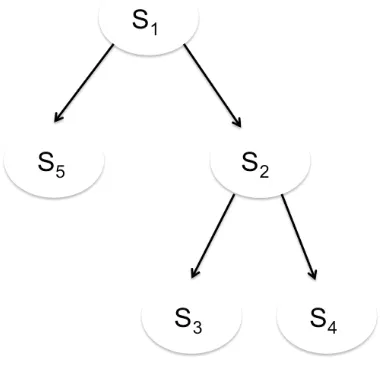
EXAMPLE 1: Assume that we have the following WSC represented as a DAG in figure
4.1, the corresponding topological order TO = {WS1 , WS5 , WS2 , WS3 , WS4 }, and the
execution time of each web service, Execution time = {10,100,20,100 ,100}, then the
execution time of the WSC can be calculated as follow:
Figure 4.1 DAG Graph of Example 1
The execution time of the topological TO without any enhancements is 10+100 +
20 + 100 + 100 = 330 units. After applying the concepts of Task 2, the optimal web
service replacement (WSPoptimal) is { (S5 , S2), (S3 , S4)}; therefore, the topological order
with web service pairsis { S1 , (S5 , S2), (S3 , S4)}, and the improved running time will be
IMPROVEMENT OF WSCEXECUTION SCHEDULE AFTER USING THE PAIR-WISE PARALLEL
EXECUTION:
In the above example (figure 4.1),the execution time of the web service schedule
without any enhancements is 10+100 + 20 + 100 + 100 = 330 units. The running time
after using the WS-pairs approach is { S1 , (S5 , S2), (S3 , S4)} = 10 + 100 +100 = 210
units.
Therefore, Speed upoverall = !"#$%&'() !"#$%&'() !"#$!"#$ !"#!"#
Speed upoverall = !!"!"#
Speed upoverall = 1.57143
Therefore, the execution time of web service schedule has improved after using the
CHAPTER 5
PERFORMANCE
IMPROVEMENT:
MULTIPLE
PARALLEL
EXECUTION
In this chapter, we present Task 3 that investigates possible further improvement
of WSC execution schedule. In this Task, we improve the execution performance of
WSC of Task 2 by applying the following approaches:
5.1INCREASING THE NUMBER OF WSS EXECUTING IN PARALLEL.
5.2EXECUTE CONCURRENTLY THOSE WSS THAT HAVE SIMILAR EXECUTION TIME.
5.1 INCREASING THE NUMBER OF WSS EXECUTING PARALLEL
Given a WS-composition and the corresponding WSP, find all arrangements of
parallel WS execution WSS = {WSS1, … , WSSn} such that WSS contains all possible
execution schedules, where each WSSi ( i = 1, … , n) contains sets of concurrent
executing services that are not ordered by precedence and do not conflict.
DEFINITION 3:OPTIMAL WEB SERVICE SET (WSS)
Given a set WSS= {WSS1, … , WSSn}, and k number of parallel processors, we
say that WSSi = {WS1, … , WSl} is optimal if the following conditions hold:
1.) |WSj| ≤ k, that is the number of web services in each set is less than or equal to k,
2.) there is no other WSSm (where, m = 1, … , n) that satisfies the first condition and has
DEFINITION 4:CORRECTNESS CRITERIA
Given a WS-set, (WSi, … , WSj) in TO, we can rewrite TO denoted as TO’ by
replacing (WSi, … ,WSj) with WSi à…à WSj , where à indicate a precedence in the
topological order.
We say that TO is correct if there exists a topological order, TO’, of
WS-composition, such that
to = TO’
DEFINITION 5:
Let WSP contains all pairs of web services that can execute parallel we say that if
there are pairs (WSi,WSj), (WSj,WSk), and (WSi,WSk), then (WSi,WSj, WSk) can execute
concurrently.
Algorithm 5 generates the optimal WSS that has WS-sets that can be substitute in
the topological order TO.
Algorithm 5: Building WSS
Input:
• TO, the BFS topological ordering of web services in WSC • WSP, all possible Web service pairs
Output:
• Generation the optimal (WSS) 1. Given WSC, WSP
2. WSSi = Φ ( i= 1, … , n)
3. for each web service (Si) in WSC (i.e. each node in WSC) do
4. WSSi = WSSi ∪ {(Si, Sj) | (Sj, Si) ∈ WSP}
5. end for
6. set extension function // final parallel sets
9. DS := Sj – Si
10. then for any services sd ∈ DS,
11. Si := Si ∪ {d} if and only if for all services si in Si
there is a
12. pair (si,d) or (d, si) in WSP.
13. Use the new set and repeat until no more changes
14. end for
15. Drop any WSSi that has no sets
16. for each WSSi // limited k number of processors
17. Drop all sets that have more than K elements where K is the
18. number of available processors
19. For each set in each WSSi, set the weight equal to
execution time 20. of the longest web service in that set 21. end for
22. Merge all WSSi sets into a new set denoted as WSSall
23. set optimal_set ← empty // optimality part
24. set optimal_weight ← 0
25. set current_optimal_set ← empty
26. set current_optimal_weight ← 0
27. set WSSall’ ← WSSall
28. tested_sets ← empty
29. for each set { Si, …, Sk} in WSSall’
30. Drop all other sets that have Si, …, or Sk from
WSSall’
31. Find all possible combinations between { Si, …, Sk}
and the 32. remaining sets in WSSall’ such that this
combination is
33. feasible to be substituted in the topological order
34. Calculate the weight of each combination 35. if the least weight is less than
current_optimal_weight then
36. Set current_optimal_weight equal to weight of this
37. combination
38. Set current_optimal_set equal to this combination
39. end if
40. if current_optimal_weight is less than optimal_weight then
41. set optimal_set = current_optimal_set
42. set optimal_weight = current_optimal_weight 43. end if
44. add { Si, …, Sk} to tested_sets
45. set current_optimal_set ← empty
47. WSSall’ ← WSSall – sets that have been tested already 48. end for
49. set weight = optimal_weight 50. set WSS = optimal_set
THEOREM 3:Algorithm 5 generates
1) (Completeness) all sets of WSs that do not have precedence relation with each other
and do not conflict, i.e., generate all parallel execution schedules; and
2) (Soundness) only those sets of WSs are generated that meet the above characteristics,
i.e., each set of parallel execution i ≤ k.
PROOF OF THEOREM 3:
(Completeness) Assume, by contradiction, that there is a set S’ of parallel
execution services such that S’ is sound but not in WSSall. Assume that S’ contains {(si,
…, sj, …)}. Service sj can run parallel with any other services in S’. But then, for any
other service, si, there must be a pair (Si, Sj) (or the equivalent pair (sj, si) in WSP.
Therefore, in our initial set WSSi, (line 6), there must be a pair (si,sj), WSSi = { … , (si,sj),
… }. Since sj must be able to run concurrently with all other services in S’, and by the set
extension function, our algorithm must produce S’ (lines 6-14). Therefore, if S’ is
produced, then it must be removed from the final set. However, our algorithm allows the
removal of a set only if its size is lager than k (lines 17-18) which is a contradiction of
our assumption that S’ is a valid and sound selection.
(Soundness)Assume, by contradiction, that there is a set of sets S’ contains { …,
si, …, sj,…} in WSSi, such that either
or
ii. there is a conflicting operation between si and sj.
PROOF OF SOUNDNESS: trivially follows from the algorithm of WSP and set extension
function.
Algorithm 6 generates Parallel Execution Scenarios (PES) that do not violate the
precedence relations in WSC by increasing the number of WSs executing concurrently.
Algorithm 6: Optimal-Topological-Order-With-Sets (WSC, TO, WSS)
Input:
• TO, a topological ordering of web services in WSC • WSS, set of optimal WSS
Output:
• Calculating the optimal topological order TOc
1. TOc ← TO
2. for each set WSq in WSS do
3. if WSq has only two elements {WSi, WSj} then 4. if WSi can be moved forward in TOc then
5. // according to forward move definition in claim 1
6. move WSi forward to immediately follow WSj
7. substitute “WSi, WSj” in TOc with the set {WSi, WSj}
8. else
9. // according to backward move definition in claim 1
10. move WSj backward to immediately proceed WSi
11. substitute “WSi, WSj” in TOc with the set {WSi, WSj}
12. endif
13. elseif WSq has more than two elements {WSi, WSj, WSt, …} then 14. if WSj can be moved forward to immediately follow WSi in TOc
then
15. if WSt can be moved forward to immediately follow
WSj then
16. // according to forward move definition in
claim 1
17. move WSj forward to immediately follow WSi
18. move WSt forward to immediately follow WSj
19. substitute “WSi, WSj, WSt,…” in TOc with the set {WSi, WSj, WSt, …}
20. else
21. // according to backward move definition
in claim 1
22. move WSi backward to immediately proceed
WSj
then
24. move WSi backward to immediately proceed WSj
25. move WSt forward to immediately follow WSj
26. substitute “WSi, WSj, WSt,…” in TOc with the set {WSi, WSj, WSt, …}
27. else
28. move WSj backward to immediately proceed WSt
29. move WSi backward to immediately proceed WSj
30. substitute “WSi, WSj, WSt,…” in TOc with the set {WSi, WSj, WSt, …}
31. endif
32. endif
33. endif
34. else // WSS is empty
35. return TOc
36. endif
37. endfor
38. return TOc
PROOF OF ALGORITHM 6: The proof is trivial according to claim 1 (Chapter 4).
EXAMPLE 2: Given the WSC and the corresponding topological order (TO) in figure 4.1,
the execution time of Task 2 can be improved by applying the concepts of Task 3 as
follows:
The optimal Web Service Set (WSS) ={(S5 , S3 , S4)}. Therefore, the topological
order with web service sets (WSS) is ={ S1, S2, (S5 , S3 , S4) } and the improved running
time will be = 10 + 20 + 100 = 130 units.
IMPROVEMENT OF WSCEXECUTION SCHEDULE AFTER INCREASING THE NUMBER OF WSS
THAT EXECUTE CONCURRENTLY:
Using the approach of WS-sets, the running time of the web service schedule can
be improved since the new execution time = 10 + 20 + 100 = 130 units. Therefore, we
can compare the execution time after using the WSS approach to the execution time
Speed upoverall = !"#$%&'() !"#$%&'() !"#$!"#$ !"! !"#
Speed upoverall = !!"!"#
Speed upoverall = 2.5385
Therefore, the execution time of web service schedule has improved 153% after using the
WS-sets approach.
5.2EXECUTE CONCURRENTLY THOSE WSS THAT HAVE SIMILAR EXECUTION TIME
Given a WSC, the corresponding WSS, and the execution time for each WS, i.e.,
(WSi, ti), where ti is the execution time of web service WSi, find all arrangements of
parallel WS execution WSS = {WSS1, … , WSSn} such that WSS contains all possible
execution schedules, where each WSSi ( i = 1, … , n) contains sets of concurrent
executing services that are not ordered by precedence, do not conflict, and have similar
execution time.
DEFINITION 6:OPTIMAL WEB SERVICE SET (WSS) WITH SIMILAR EXECUTION TIME
Given a set WSS = {WSS1, … , WSSn}, and k number of parallel processors, we
say that WSSi = {WS1, … , WSl} is optimal if the following conditions hold:
1.) |WSj| ≤ k, that is the number of web services in each set is less than or equal to k,
2.) there is no other WSSm (where, m = 1, … , n) that satisfies the first condition and has
Algorithm 5 can be extended to generate the Optimal Web Service Set (WSS)
with similar execution time that can be substitute in the topological order TO as follows:
We define a threshold value, optimal_threshold, and require that the optimal WSS is the
one with the least total threshold values.
Extension of Algorithm 5
23. set optimal_set ← empty 24. set optimal_ threshold ← 0 25. set current_optimal_set ← empty 26. set current_optimal_ threshold ← 0 27. set WSSall’ ← WSSall
28. set tested_sets ← empty
29. for each set { Si, …, Sk} in WSSall’
30. set threshold of this set equal to the difference 31. between the execution times of the largest and 32. smallest WSs
33. Drop all other sets that have Si, …, or Sk from WSSall’
34. Find all possible combinations between { Si, …, Sk} and the 35. remaining sets in WSSall’ such that this combination is
36. feasible to be substituted in the topological order 37. Calculate the weight of each combination
38. if the least threshold is less than current_optimal_threshold then
39. Set current_optimal_threshold equal to threshold of this
40. combination
41. Set current_optimal_set equal to this combination 42. end if
43. if current_optimal_threshold is less than optimal_threshold then
44. set optimal_set = current_optimal_set
45. set optimal_threshold = current_optimal_threshold 46. end if
47. add { Si, …, Sk} to tested_sets 48. set current_optimal_set ← empty 49. set current_optimal_ threshold ← 0
50. WSSall’ ← WSSall – sets that have been tested already
51. end for
52. set threshold = optimal_threshold 53. set WSS = optimal_set
EXAMPLE 3: In the above example, WS5 , WS3 , and WS4 have similar execution times,
100 units; therefore, this will give us the least possible threshold when executing those
WSs together, the total execution time = 10 + 20 + 100 = 130 units.
IMPROVEMENT OF WSC EXECUTION SCHEDULE AFTER EXECUTING CONCURRENTLY THOSE
WSS THAT HAVE SIMILAR EXECUTION TIME:
Using the approach of executing concurrently WSs that have similar execution
time, the running time of the web service schedule can be improved since the new
execution time = 10 + 20 + 100 = 130 units. Therefore,
Speed upoverall = !"#$%&'() !"#$%&'() !"#$!"#$ !"#!"#
Speed upoverall = !!"!"#
Speed upoverall = 2.5385
The execution time of web service schedule has improved 153% after using the approach
of executing concurrently those WSs that have similar execution time.
CHAPTER 6
CONCLUSION
In this thesis we have presented improvement of web service composition (WSC)
execution time using pair-wise and multiple parallel execution schedules. We modeled a
WSC as WS-BPEL specification, i.e., a partial order of WS transactions, thus allowing
some of the WS transactions in the WSC to execute concurrently. We analyzed the
WS-BPEL specification of the WSCs to identify WS transactions that can execute parallel.
In chapter 4, we identified subgroups of WSs that can run concurrently without
potential violation of consistency of the database. Our algorithm generated an optimal set
of WS-Pairs (WSPoptimal) and substituted web services with concurrently executing web
services pairs in the Parallel Execution Scenarios (PES), thus reducing the total execution
time of the WSC.
In chapter 5, we investigated possible further improvement of WSC execution
schedule. We increased the number of WSs that could execute concurrently, and we
provided further improvement by scheduling services with similar execution time to run
concurrently. In each case we generated optimal web service schedules, called Parallel
For future work, we will study possible further improvement of WSC execution
schedule by balancing the workload of concurrent services over available processors. In
addition, we will investigate the possibility of improving upon traditional locking
mechanism for WSC to guarantee database consistency while avoiding unacceptable
BIBLIOGRAPHY
Al-Jumaha, N.B., Hassaneinb, H.S., & El-Sharkawia M. (2002). Implementation and
modeling of two-phase locking concurrency control—a performance study.
Information and Software Technology, 42 (2000), 257–273.
Bhargava, B. (1999, Jan/Feb). Concurrency control in database systems. IEEE
Transactions on Knowledge and Data Engineering, 11(1), 3-16.
Ezenwoye, O. and S.M. Sadjadi, Composing aggregate web services in BPEL, Proc. 44th
ACM Southeast Conference (ACMSE), March 2006, Melbourne, FL.
Juric, M. B., Business Process Execution Language for Web Services. 2nd Edition. Packt
Publishing, 2006.
Kung, H. T., & Robinson, J. T. (1981, June). On optimistic methods for concurrency
control. ACM Transactions on Database Systems, 6(2), 213-226.
Le, Gao, Susan Darling Urban, Janani Ramachandran: A survey of transactional issues
for Web Service composition and recovery. IJWGS 7(4): 331-356 (2011).
Lechtenbörger, Jens: Two-Phase Commit Protocol. Encyclopedia of Database Systems
Sheikhan, Mansour, Mohsen Rohani, and Saeed Ahmadluei: A neural-based concurrency
control algorithm for database systems. Neural Computing and Applications
22(1): 161-174 (2013).
Strandenaes, Thomas, and Randi Karlsen, Transaction Compensation in Web Services,
IEEE 2003.
Thomasian, A. (1998). Concurrency Control: Methods, Performance, and Analysis. ACM
Computing Surveys, 30(1), 70-119.
Wang, Jinling, Beihong Jin, and Jing Li: A Transaction Model for Long Running
Business Processes. ICEIS (1) 2004: 267-274.
Zeshan Furkh and Radziah Mohamad, “ Semantic Web Service Composition
Approaches: Overview and Limitations”, International Journal on New Computer
Architectures and Their Applications (IJNCAA) 1(3): 64The Society of Digital
Information and Wireless Communications, 2011 (ISSN: 2220-9085), pp