A new method based on fourth kind Chebyshev wavelets to a fractional–
order model of HIV infection of CD4
+T cells
Haman Deilami Azodi∗ Faculty of Mathematical Sciences, University of Guilan, Rasht, Iran. E-mail: [email protected]
Mohammad Reza Yaghouti Faculty of Mathematical Sciences, University of Guilan, Rasht, Iran. E-mail: [email protected]
Abstract This paper deals with the application of fourth kind Chebyshev wavelets (FKCW) in solving numerically a model of HIV infection of CD4+T cells involving Caputo
fractional derivative. The present problem is a system of nonlinear fractional differential equations. The goal is to approximate the solution in the form of FKCW truncated series. To do this, an operational matrix of fractional integration is constructed for these wavelets. This matrix transforms the problem to a nonlinear system of algebraic equations. Solving the new system, enables one to identify the unknown coefficients of expansion. Numerical results are compared with other existing methods to illustrate the applicability of the method.
Keywords. Fourth kind Chebyshev wavelets, HIV model, Caputo derivative.
2010 Mathematics Subject Classification. 65T60, 34A08.
1. Introduction
The human immunodeficiency virus (HIV) is a virus that attacks the immune system which is our body’s natural defense against the diseases. This virus destroys a type of white blood cells in the immune system called CD4+T and makes copies of itself inside these cells. AIDS is a status which the immune system is too weak to fight off infection.
The dynamics of CD4+T cells and HIV interaction are formulated by the following
system of ordinary differential equations [27]
dT
dt =p−αT+rT (
1−TT+I
max
)
−kV T,
dI
dt =kV T −βI, dV
dt =N βI−γV,
(1.1)
Received: 11 July 2017 ; Accepted: 9 May 2018.
∗Corresponding author.
with the initial conditions
T(0) =T0, I(0) =I0, V(0) =V0. (1.2)
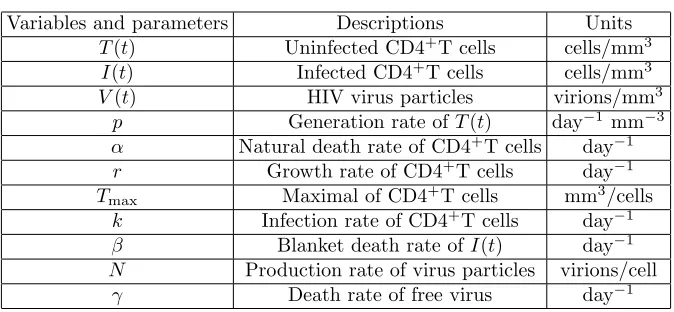
The descriptions of variables and parameters of (1.1) are listed in Table1.
Table 1. Variables and Parameters
Variables and parameters Descriptions Units
T(t) Uninfected CD4+T cells cells/mm3
I(t) Infected CD4+T cells cells/mm3 V(t) HIV virus particles virions/mm3
p Generation rate ofT(t) day−1 mm−3 α Natural death rate of CD4+T cells day−1
r Growth rate of CD4+T cells day−1 Tmax Maximal of CD4+T cells mm3/cells
k Infection rate of CD4+T cells day−1 β Blanket death rate ofI(t) day−1
N Production rate of virus particles virions/cell
γ Death rate of free virus day−1
The mathematical model (1.1) represents the changes of infected CD4+T cells,
uninfected CD4+T cells and virus particles numbers in a period of time. In medical
sciences, the computation of these variables are vital to measure the progression of disease and to get a better cure. Accordingly, the numerical solution of the HIV model is a considerable task of mathematicians. The methods existing in the literature to solve (1.1) with the initial conditions (1.2) include as follows: Laplace Adomian decomposition method [20], Multi –step Laplace Adomian decomposition method [5], Variational iteration method [16], Differential transform method [25], Homotopy perturbation method [17], Bessel collocation method [31], Legendre wavelets method [26] and Taylor’s series method [11].
The important point to note here is that biological systems have memory and aftereffects. In the models interpreted by ordinary differential equations with integer-order, such effects are neglected. Because of the relation of fractional calculus to the systems with memory, fractional models are more suitable for biological systems. Thus, by replacing the integer-order derivative in (1.1) with Caputo fractional derivative, the following model is established
Dν1
∗ T =p−αT +rT (
1− T+I Tmax
)
−kV T, Dν2
∗ I=kV T −βI,
Dν3
∗ V =N βI−γV,
(1.3)
with the same initial conditions (1.2), where 0< ν1, ν2, ν3≤1 andD∗ denotes the
Caputo fractional derivative. For ν1 = ν2 = ν3 = 1, (1.3) reduces to the classical
See [4,21].
For solving the fractional model (1.3), G¨okdogan et al. have presented a multi– step differential transform method [7], Haq et al. have used Adomian decomposition method [8] and also Gandomani et al. have proposed M¨untz–Legendre polynomials collocation method [6].
From recent decades up to now, wavelet methods have been accounted as powerfool tools with diverse applications in science and technology. Especially, wavelets generated by the dilation and translation of orthogonal polynomials have been considered more than other ones in finding the solution of various types of differential and integral equations. The useful characteristics of wavelets can be summarized as follows: (a) Wavelet methods are appropriate for the computer programming. (b) The operational matrix achieved by wavelets exhibits sparsity which is computationally very fast. (c) By applying wavelets, it is possible to obtain a good approximation of a function by using only a few coefficients. (d) For a large number of the basis functions, most of the wavelet coefficients vanish. (e) The solution is multi–resolution [2,3].
As we know, there are four kinds of Chebyshev polynomials. All of them are used widely in approximation theory. They are orthogonal on [−1,1] with respect to different weight functions [15]. The operational matrices of the fractional integration related to first and second kind Chebyshev wavelets have been constructed to the numerical solution of fractional differential equations in [13] and [28], respectively. Recently, Zhou et al. have been gained an operational matrix of fractional integration of third kind Chebyshev wavelets for solving fractional convection–diffusion equation [32]. FKCW have been paid less attention by authors and no serious attempt has been made to extend FKCW for solving fractional problems. Motivated by the mentioned works, our main aim is to develope the applications of FKCW in approximation of the solution of (1.3). For this purpose, using collocation method, an operational matrix of fractional integration for FKCW is first fabricated. This matrix converts (1.3) to a nonlinear system of algebraic equations. After solving the new system by any standard iterative scheme, the solution of problem is acquired in terms of FKCW. Numerical results of the method are compared with some recent methods. Since the exact solution of (1.3) is unknown, residual errors of (1.3) are evaluated to indicate the efficiency of method.
The remainder of this paper proceeds as follows: In section2, FKCW and some properties of them are described. Uniform convergence and error estimation of FKCW expansion are also investigated. Section 3 implements the numerical method for solving (1.3). In section 4, numerical and graphical results of applying the present method are announced. Finally, concluding remarks are drawn in section5.
2. Some properties of FKCW
2.1. Wavelets and FKCW. Wavelets are a class of functions used to localize a given
parameterb of a mother waveletψdefine the following continuous wavelets
ψa,b(x) =√1
aψ
(
x−b a
)
, a∈R+, b∈R. (2.1)
Now, supposea0>1 andb0>0 are fixed and takea=a−0k andb=na−
k
0 b0 such
that k, n ∈ N. Instead of using the family of wavelets (2.1), we use the family of wavelets indexed byN, named the discrete wavelets,
ψk,n(x) =a k
2
0ψ
(
ak0x−nb0
)
, k, n∈N. (2.2)
The family of (2.2) constitutes an orthogonal basis onL2(R) and by choosinga 0= 2
andb0= 1,this basis will be an orthonormal basis on L2(R) [14,18].
FKCW are defined on [0,1] forn= 1, ...,2k−1, k∈N,m= 0, ..., M −1,M ∈Nas
ψn,m(t) = { √
1
π2
k
2Wm(2kt−2n+ 1), n−1
2k−1 ≤t <
n
2k−1,
0, otherwise, (2.3)
in whichWm are Chebyshev polynomials of fourth kind of degreem= 0,1, . . . that
are orthogonal with respect to the weight function ω(t) = √
1−t
1+t on [−1,1] and for
m∈Ncan be determined by the following recurrence formula [15]
W0(t) = 1, W1(t) = 2t+ 1, Wm+1(t) = 2tWm(t)−Wm−1(t).
The coefficient √
1
π in (2.3) is for normality. The dilation and translation parameters are a = 2−k and b = (2n−1)2−k, respectively. Also, k ∈ N denotes the level of resolution.
It is worth mentioning that FKCW defined in (2.3) constitute an orthonormal basis onL2[0,1] with respect to the weight functionω
n(t) =ω (
2kt−2n+ 1).
2.2. Function approximation. Any function f(t) ∈ L2
ω[0,1] can be expanded at the levelk∈Nas
f(t) =
2k−1
∑
n=1
∞ ∑
m=0
fn,mψn,m(t), (2.4)
where
fn,m=⟨f(t), ψn,m(t)⟩L2
ω[0,1] =
∫ 1
0
f(t)ψn,m(t)ωn(t)dt,
in which⟨., .⟩L2
ω[0,1] denotes the inner product inL 2
ω[0,1].
Usually, the infinite series in (2.4) is truncated and written in the following
f(t)≈
2k−1
∑
n=1
M∑−1
m=0
which approximates f(t) as a finite linear combination of FKCW. In (2.5), F and
Ψ(t) are column vectors with ˆm= 2k−1M entries given by
F=[f1,0, . . . , f1,M−1, . . . , f2k−1,0, . . . , f2k−1,M−1
]T
,
Ψ(t) =[ψ1,0(t), . . . , ψ1,M−1(t), . . . , ψ2k−1,0(t), . . . , ψ2k−1,M−1(t)
]T
.
The following proposition ensures the uniform convergence of FKCW expansion.
Proposition 2.1. Assume f(t) be a continuous function and R = sup|f′′(t)| on
[0,1].Then, it can be expanded as an infinite sum of FKCW and the series converges uniformly tof(t), that is
f(t) =
2k−1
∑
n=1
∞ ∑
m=0
fn,mψn,m(t).
Moreover, form >1,
|fn,m|< 1 2 √ π 2 R
n52(m−1)2
.
Proof. The coefficients of FKCW expansion off(t) are defined as
fn,m=⟨f(t), ψn,m(t)⟩L2
ω[0,1]
= ∫ 1
0
f(t)ψn,m(t)ωn(t)dt
= √ 1 π2 k 2 ∫ n
2k−1
n−1 2k−1
f(t)Wm (
2kt−2n+ 1)ω(2kt−2n+ 1)dt.
Letx= 2kt−2n+ 1. Thus,
fn,m= √ 1 π2 −k 2 ∫ 1 −1 f (
x+ 2n−1 2k
)
Wm(x)ω(x)dx.
Puttingx= cosθentails
fn,m= √ 1 π2 −k 2 ∫ π 0 f (
cosθ+ 2n−1 2k
)
sin(m+12)θ
sin12θ
√
1−cosθ
1 + cosθsinθdθ.
Knowing √
1−cosθ
1+cosθsinθ= 2 sin
2θ
2 yields
fn,m= 2 √ 1 π2 −k 2 ∫ π 0 f (
cosθ+ 2n−1 2k
) sin
(
m+1 2
)
θsin1 2θdθ = √ 1 π2 −k 2 ∫ π 0 f (
cosθ+ 2n−1 2k
)
(cosmθ−cos(m+ 1)θ)dθ.
With the aid of integration by parts technique, it follows
fn,m= √
1
π2
−3k
2 1 m ∫ π 0 f′ (
cosθ+ 2n−1 2k
)
sinmθsinθdθ
−
√ 1
π2
−3k
2 1
m+ 1 ∫ π
0 f′
(
cosθ+ 2n−1 2k
)
sin(m+ 1)θsinθdθ.
Letζ1=m1
∫π
0 f′
(cosθ+2n−1
2k
)
sinmθsinθdθ.Then,
ζ1=
1 2m ∫ π 0 f′ (
cosθ+ 2n−1 2k
)
(cos(m−1)θ−cos(m+ 1)θ)dθ
= 2 −k 2m ∫ π 0 f′′ (
cosθ+ 2n−1 2k
) (
sin(m−1)θ m−1 −
sin(m+ 1)θ m+ 1
) sinθdθ.
Obviously,
|ζ1| ≤
1 2m2
−kR ∫ π
0
sin(m−1)θ m−1 −
sin(m+ 1)θ m+ 1
|sinθ|dθ
≤ 1
2m2
−k(πR) (
1
m−1+ 1
m+ 1 )
< 2
−kRπ
(m−1)2.
Letζ2=m1+1
∫π
0 f′
(cosθ+2n−1
2k
)
sin(m+ 1)θsinθdθ.In a similar way,
|ζ2| ≤
2−kRπ
m(m+ 1) <
2−kRπ (m−1)2.
Now, form >1,
|fn,m| ≤ √
1
π2
−3k
2 (|ζ1|+|ζ2|)<
√ 1
π2
−3k
2 2×2
−kRπ
(m−1)2 =
2R√π
(m−1)22
−5k
2 .
Sincen≤2k−1, it is clear that 2−5k
2 ≤(2n)−
5
2. Hence,
|fn,m|< 1 2 √ π 2 R
n52(m−1)2
.
Ifm= 1, according to (2.6),
|fn,1| ≤
√ 1
π2
−3k
2
(
π+π 2 )
sup|f′(t)| ≤ 3 4
√
π
2
sup|f′(t)|
n32
.
So,∑2nk−=11∑∞m=0fn,mis absolutely convergent and the infinite sum of FKCW converges
tof(t) uniformly.
The proposition below seeks an upper bound for the error estimation of FKCW expansion.
Proposition 2.2. Under the assumptions of Proposition (2.1), assume the truncated
seriesfk,M(t) = ∑2nk−=11∑Mm=0−1fn,mψn,m be the FKCW approach of f(t)at the level
kfor a given M. Then,
∥f(t)−fk,M(t)∥< π
8R
2 2∑k−1
n=1
∞ ∑
m=M 1
n5(m−1)4
1 2
Proof. Using the orthonormality ofψn,m and Proposition2.1, the following relations are held.
∥f(t)−fk,M(t)∥
2
= ∫ 1
0
2
k−1
∑
n=1
∞ ∑
m=M
fn,mψn,m(t)
2ωn(t)dt
=
2k−1
∑
n=1
∞ ∑
m=M
|fn,m|
2
< π
8R
2 2k−1
∑
n=1
∞ ∑
m=M 1
n5(m−1)4.
Intuitively, iff(t) = 1
π2sin(πt) thenR= 1 and Proposition2.2reveals
∥f(t)−f1,3(t)∥<0.1798, ∥f(t)−f1,7(t)∥<0.0278, ∥f(t)−f1,13(t)∥<0.0093.
Thus, we deduce at the levelk for large enough value ofM, fk,M→f(t). For a fixedM,we affirm
f(t) = ∞ ∑
n=1
M∑−1
m=0
fn,mψn,m(t).
Likely, one can prove for a givenM by increasingkthe accuracy of the approximation ∑2k−1
n=1
∑M−1
m=0fn,mψn,m(t) is improvable.
2.3. Operational matrix of fractional integration (OMFI). OMFI of a family
of wavelets can be obtained with or without Block-Pulse functions (BPF). For obtaining OMFI of Bernoulli wavelets, Keshavarz et al. expanded these wavelets into Bernoulli polynomials [10]. Then, the authors specified a relation for OMFI of Bernoulli wavelets fork = 2 and arbitraryM. Moreover, Rong et al. formed Jacobi wavelets based on the explicit formula of Jacobi polynomials [24]. Then, they found an OMFI for Jacobi wavelets. In both of these works, the designed operational matrices contain many entries in the form of summation. Thus, although OMFI works efficiently but for not so small values ofkandM, it has large computational effort.
In [1,13,19,22,23,28–30,32], OMFI has been constructed for Haar, first kind Chebyshev, Shannon, Legendre, Gegenbauer, second kind Chebyshev, Euler, CAS and third kind Chebyshev wavelets, respectively by using BPF. The main idea in all of these references is that the corresponding wavelets family is first expanded into BPF. Then, OMFI of BPF is used for calculating the OMFI of the wavelet. The resulting OMFI has a simple formula and is easy to perform for every k and M.
Motivated by the works mentioned above, we intend to determine OMFI of FKCW using BPF.
2.3.1. BPF.
Definition 2.3. The ˆm-set of BPF on [0,1] is defined in the following
bi(t) = {
1, i−mˆ1 ≤t < mˆi,
0, otherwise,
wherei= 1, . . . ,m.ˆ
Remark 2.4. BPF are disjoint and orthogonal, namely
• bi(t)bj(t) = {
0, i̸=j,
bi(t), i=j,
• ∫1
0 bi(t)bj(t)dt=
{
0, i̸=j, 1
ˆ
m, i=j.
The functionf(t)∈L2[0,1] can be written as
f(t)≈
ˆ
m ∑
i=1
fibi(t) =fTBm(ˆ t),
wheref = [f1, f2, . . . , fmˆ]
T
, Bmˆ(t) = [b1(t), b2(t), . . . , bmˆ(t)]
T
,fori= 1, . . . ,mˆ
fi = ˆm ∫ 1
0
f(t)bi(t)dt.
Definition 2.5. The tensor product of two vectorsfmˆ = [fi] andgmˆ = [gi] is defined
as
f⊗g= (fi×gi)mˆ .
Similarly, for two matricesA= [ai,j] andB= [bi,j] of ˆm×mˆ
A⊗B= (ai,j×bi,j)mˆ×mˆ .
The Lemma below will be needed in the next section.
Lemma 2.6. Let the functions f(t), g(t)∈ L2[0,1] be expanded into BPF, that is
f(t) =fTBm(ˆ t)andg(t) =gTBm(ˆ t). Then
f(t)g(t) =(fT ⊗gT)Bm(ˆ t).
Proof.
f(t)g(t) =fTBm(ˆ t)BTmˆ(t)g=f1g1b1(t) +f2g2b2(t) +. . .+fmˆgmˆbm(ˆ t)
=(fT ⊗gT)Bmˆ(t).
For the sake of simplicity, we rewrite (2.5) as
f(t)≈
ˆ
m ∑
i=1
where fi =fn,m, ψi =ψn,m. The indexi is determined by i = (n−1)M +m+ 1, and ˆm= 2k−1M.By this notation, we get
Fmˆ =
[
f1, . . . , fM|, fM+1, . . . , f2M|, . . . ,|f(2k−1−1)M+1, . . . , fmˆ
]T
,
Ψmˆ(t) =
[
ψ1, . . . , ψM|, ψM+1, . . . , ψ2M|, . . . ,|ψ(2k−1−1)M+1, . . . , ψmˆ
]T
.
Taking the collocation points ti = 22 ˆi−m1, i= 1, . . . ,mˆ, we define the ˆm×mˆ FKCW matrixΦmˆ×mˆ as
Φmˆ×mˆ = [Ψm(ˆ t1),Ψm(ˆ t2), . . . ,Ψm(ˆ tm)]ˆ . (2.7)
2.3.2. Operational matrix. From [12], OMFI of order ν of the BPF vectorBm(ˆ t) is
offered as
IνBm(ˆ t)≈Fmνˆ×mˆBm(ˆ t), (2.8)
where
Fν
ˆ
m×mˆ =
1 ˆ
mν 1 Γ(ν+ 2)
1 ξ1 ξ2 . . . ξmˆ−1
0 1 ξ1 . . . ξmˆ−2
0 0 1 . . . ξmˆ−3
..
. ... ... . .. ... 0 0 0 . . . 1
,
in whichξi= (i+ 1)ν+1−2iν+1+ (i−1)ν+1,i= 1, . . . ,mˆ −1. LetPνmˆ×mˆ be the OMFI of FKCW, that is
IνΨm(ˆ t)≈Pmνˆ×mˆΨm(ˆ t), (2.9)
Now, fort∈{22 ˆi−m1|i= 1, . . . ,mˆ}, using (2.7) implies that
Ψm(ˆ t) =Φmˆ×mˆBm(ˆ t). (2.10)
By (2.8) and (2.10), one can write
IνΨmˆ(t) =IνΦmˆ×mˆBmˆ(t) =Φmˆ×mˆIνBmˆ(t)≈Φmˆ×mˆFmνˆ×mˆBmˆ(t). (2.11)
Also, with the aid of (2.10), we get
Bmˆ(t) =Φ−mˆ1×mˆΨmˆ(t). (2.12)
Consequently, from (2.11) and (2.12), it follows
IνΨm(ˆ t)≈Φmˆ×mˆFνmˆ×mˆΦ− 1 ˆ
m×mˆΨm(ˆ t). (2.13)
Comparison (2.13) with (2.9) results in
Pνmˆ×mˆ ≈Φmˆ×mˆFνmˆ×mˆΦ− 1 ˆ
Figure 1. 13 order integration oft 2
t
0 0.1 0.2 0.3 0.4 0.5 0.6 0.7 0.8 0.9 1 0
0.1 0.2 0.3 0.4 0.5 0.6 0.7
exact integral numerical integral
which is independent ofBm(ˆ t).
Particularly, fork= 2, M = 3, ν= 0.7,OMFI of FKCW is computed as
P06.×76=
0.2329 0.1683 −0.0142 0.5558 −0.0602 0.0116 0.0416 0.1574 0.0913 0.6457 −0.0943 0.0211
−0.0460 −0.1031 0.1638 0.2089 −0.0537 0.0145
0 0 0 0.2329 0.1683 −0.0142 0 0 0 0.0416 0.1574 0.0913 0 0 0 −0.0460 −0.1031 0.1638
.
One should mention that CPU time of MATLAB software to calculateP0.7 ˆ
m×mˆ for the
values (k= 4, M = 5ormˆ = 40), (k= 6, M = 7ormˆ = 224), (k= 8, M = 9ormˆ = 1152) and (k= 10, M = 11ormˆ = 5632) is 0.0042s, 0.1170s, 3.2529s and 152.1935s, respectively. This means that OMFI of FKCW is computationally fast.
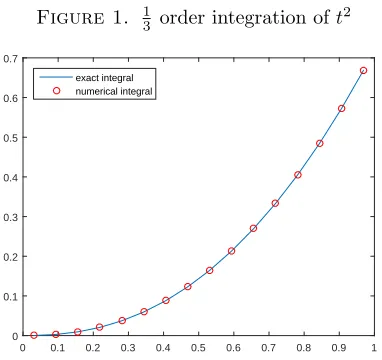
For example, considerf(t) =t2.The fractional integration of orderν off is given
by
Iνf(t) = Γ(3) Γ(ν+ 3)t
ν+2.
The correctness of OMFI are shown in Figure1forν =1
3, k= 3, M= 4 or ˆm= 16.
3. Implementation of numerical method
First, let us rewrite the fractional–order model of HIV infection (1.3) as
Dν1
∗ T =p+ (r−α)T−Tmaxr T
2− r
TmaxT I−kV T,
Dν2
∗ I=kV T −βI,
Dν3
∗ V =N βI−γV.
Put
Dν1
∗ T(t)≈CTΨm(ˆ t), Dν2
∗ I(t)≈DTΨm(ˆ t), Dν3
∗ V(t)≈KTΨmˆ(t),
(3.2)
in which C = [c1, . . . , cm]ˆ
T
,D = [d1, . . . , dm]ˆ
T
, K = [k1, . . . , km]ˆ
T
. Integrating of fractional–order, we obtain
T(t) =Iν1Dν1
∗ T(t) +T0≈CTPνmˆ1×mˆΨm(ˆ t) +T0, I(t) =Iν2Dν2
∗ I(t) +I0≈DTPνmˆ2×mˆΨm(ˆ t) +I0, V(t) =Iν3Dν3
∗ V(t) +V0≈KTPνmˆ3×mˆΨmˆ(t) +V0,
(3.3)
whereI(.)is the Riemann–Liouville fractional integral operator. Collocating (3.3) at the pointst∈{22 ˆi−m1|i= 1, . . . ,mˆ}and using (2.10) lead to
T(t)≈CTPν1
ˆ
m×mˆΦmˆ×mˆBm(ˆ t) + [T0, . . . , T0]1×mˆBm(ˆ t), I(t)≈DTPν2
ˆ
m×mˆΦmˆ×mˆBm(ˆ t) + [I0, . . . , I0]1×mˆBm(ˆ t), V(t)≈KTPν3
ˆ
m×mˆΦmˆ×mˆBmˆ(t) + [V0, . . . , V0]1×mˆBmˆ(t).
(3.4)
Let CTPν1
ˆ
m×mˆΦmˆ×mˆ = [a1, . . . , am]ˆ . Then, the nonlinear terms of (3.1) can be
expressed as
T2(t) =[a21, . . . , a2mˆ]Bmˆ(t) + 2 [T0a1, . . . , T0amˆ]Bmˆ(t)
+[T02, . . . , T02]1
×mˆBmˆ(t),
(3.5)
T(t)I(t) =([a1, . . . , am]ˆ ⊗DTPνmˆ2×mˆΦmˆ×mˆ
)
Bm(ˆ t)
+([T0, . . . , T0]1×mˆ ⊗D
TPν2
ˆ
m×mˆΦmˆ×mˆ
)
Bmˆ(t)
+ [T0I0, . . . , T0I0]1×mˆ Bm(ˆ t) + [I0a1, . . . , I0am]ˆ Bm(ˆ t),
(3.6)
V(t)T(t) =([a1, . . . , amˆ]⊗KTPνmˆ3×mˆΦmˆ×mˆ
)
Bmˆ(t)
+([T0, . . . , T0]1×mˆ ⊗K
TPν3
ˆ
m×mˆΦmˆ×mˆ
)
Bm(ˆ t)
+ [T0V0, . . . , T0V0]1×mˆBm(ˆ t) + [V0a1, . . . , V0am]ˆ Bm(ˆ t).
(3.7)
unknowns is achieved
CTΦmˆ×mˆ = [p, . . . , p]1×mˆ + (r−α) [a1+T0, . . . , amˆ +T0]
− r
Tmax
[
a2
1+ 2T0a1+T02, . . . , am2ˆ + 2T0amˆ +T02
]
− r
Tmax
(
[a1, . . . , am]ˆ ⊗DTPνmˆ2×mˆΦmˆ×mˆ + [I0a1, . . . , I0am]ˆ
)
− r
Tmax
(
[T0, . . . , T0]1×mˆ ⊗D
TPν2
ˆ
m×mˆΦmˆ×mˆ + [T0I0, . . . , T0I0]1×mˆ
)
−k([a1, . . . , am]ˆ ⊗KTPνmˆ3×mˆΦmˆ×mˆ + [V0a1, . . . , V0am]ˆ
)
−k([T0, . . . , T0]1×mˆ ⊗K
TPν3
ˆ
m×mˆΦmˆ×mˆ + [T0V0, . . . , T0V0]1×mˆ
)
,
DTΦ
ˆ
m×mˆ =k
(
[a1, . . . , am]ˆ ⊗KTPνmˆ3×mˆΦmˆ×mˆ + [V0a1, . . . , V0am]ˆ
)
+k([T0, . . . , T0]1×mˆ ⊗K
TPν3
ˆ
m×mˆΦmˆ×mˆ + [T0V0, . . . , T0V0]1×mˆ
)
−β(DTPν2
ˆ
m×mˆΦmˆ×mˆ + [I0, . . . , I0]1×mˆ
)
,
KTΦ
ˆ
m×mˆ =
(
N βDTPν2
ˆ
m×mˆ −γKTP
ν3
ˆ
m×mˆ
)
Φmˆ×mˆ
+ [N βI0−γV0, . . . , N βI0−γV0]1×mˆ ,
(3.8)
which is solved by Newton-Raphson method or fsolve function of MATLAB and MAPLE softwares. Substituting ci, di and ki, i = 1, . . . ,mˆ into (3.3), T(t), I(t) andV(t) are obtained.
4. Numerical example
Firstly, it is notable that we perform all of the computations by MATLAB R2015a software on a 64-bit PC with 2.20 GHz processor and 8 GB memory.
Consider thatν1=ν2=ν3=ν.Also, the initial values and parameters of the system
(1.3) explained in Table1are given as follows
T0= 0.1, I0= 0, V0= 0.1, p= 0.1, α= 0.02, β= 0.3,
r= 3, γ= 2.4, k= 0.00027, Tmax= 1500, N= 10.
Letk= 3, M = 4.After solving the nonlinear system (3.8) and substituting the obtained coefficients, ci, di and ki, i = 1, . . . ,mˆ into (3.3), the solution of (1.3) is specified.
Tables2,3 and4 compare the numerical results of FKCW in the caseν = 1 with those results of [17,20,31] and fourth–order Runge–Kutta (RK4) method.
Table5is devoted to the maximum differences of RK4 method from FKCW method (fork = 3, M = 4 or ˆm = 16) and Variational iteration method (16 terms) in the caseν = 1.
These amounts for Variational iteration method are as follows
L∞(TV IM) = max|TRK−TV IM|,
L∞(IV IM) = max|IRK−IV IM|,
and for the present wavelet method are defined in the following
L∞(TW M) = max|TRK−TW M|,
L∞(IW M) = max|IRK−IW M|,
L∞(VW M) = max|VRK−VW M|.
The results of Table5 expose that in comparison with VIM the present method is in a better agreement with RK4 method.
Figures2(A),3(A)and4(A)demonstrate the behaviour of solution for some values ofν.It is understandable that whenνtends to 1 the solution of fractional model (1.3) approaches to the solution of classical model (1.1). Figures2(B),3(B)and4(B)also conclude the present method forν = 1 is well adapted to RK4 method.
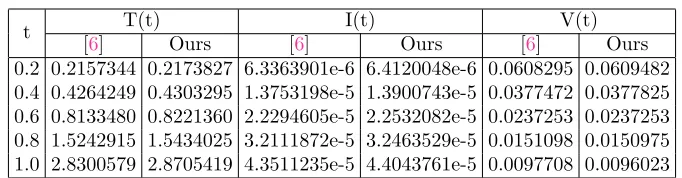
Tables 6, 7 and 8 analogy the present method to the method of [6] for ν = 0.90, 0.95, 0.98.It is visible that the results of two methods are close to each other. We can test the accuracy of FKCW method easily by using the residual errors of
T(t),I(t) and V(t) for the system (1.3). For eacht ∈[0,1], these errors are defined as
E(T(t)) =Dν1
∗ T−p+αT −rT (
1−TT+I
max
)
+kV T ≈0,
E(I(t)) =Dν2
∗ I−kV T+βI≈0,
E(V(t)) =Dν3
∗ V −N βI+γV ≈0.
Table9calculates absolute residual errors for ν= 0.75,k= 2 andM = 6, 9.
Figures 5, 6 and 7 portray E(T(t)), E(I(t)) and E(V(t)), respectively for k = 3, M = 4 or ( ˆm= 16) in the caseν= 0.98 by means of present method.
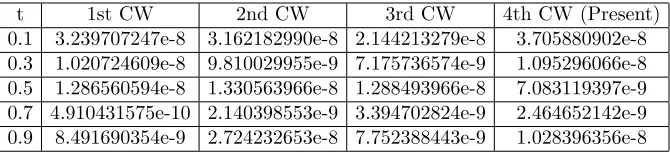
Tables 10, 11 and 12 compare absolute residual errors of 1st, 2nd and 3rd kind Chebyshev wavelets with present method for ˆm= 16 andν = 0.98.
Table 2. T(t) solutions forν= 1
t Method of [20] Method of [31] VIM [17] RK4 Present method 0.2 0.2088072731 0.2038616561 0.2088073214 0.2088080833 0.2102858565 0.4 0.4061052625 0.3803309335 0.4061346587 0.4062405393 0.4096883861 0.6 0.7611467713 0.6954623767 0.7624530350 0.7644238890 0.7720687308 0.8 1.3773198590 1.2759624442 1.3978805880 1.4140468310 1.4304307811 1.0 2.3291697610 2.3832277428 2.5067466690 2.5915948020 2.6253702046
Table 3. I(t) solutions forν = 1
Figure 2. The numerical behaviour ofT(t)
t
0 0.1 0.2 0.3 0.4 0.5 0.6 0.7 0.8 0.9 1
T(t)
0 1 2 3 4 5 6 7 8 9
ν=0.8
ν=0.85
ν=0.9
ν=0.95
ν=1
(a)Solutions ofT(t)
t
0 0.1 0.2 0.3 0.4 0.5 0.6 0.7 0.8 0.9 1
T(t)
0 0.5 1 1.5 2 2.5 3
Present method RK4 method
(b)T(t) forν= 1
Figure 3. The numerical behaviour ofI(t)
t
0 0.1 0.2 0.3 0.4 0.5 0.6 0.7 0.8 0.9 1
I(t)
×10-5
-2 0 2 4 6 8 10 12 14
ν=0.8
ν=0.85
ν=0.9
ν=0.95
ν=1
(a)Solutions ofI(t)
t
0 0.1 0.2 0.3 0.4 0.5 0.6 0.7 0.8 0.9 1
I(t)
×10-5
0 0.5 1 1.5 2 2.5 3 3.5 4 4.5
Present method RK4 method
(b) I(t) forν= 1
Figure 4. The numerical behaviour ofV(t)
t
0 0.1 0.2 0.3 0.4 0.5 0.6 0.7 0.8 0.9 1
V(t)
0 0.02 0.04 0.06 0.08 0.1 0.12
ν=0.8
ν=0.85
ν=0.9
ν=0.95
ν=1
(a)Solutions ofV(t)
t
0 0.1 0.2 0.3 0.4 0.5 0.6 0.7 0.8 0.9 1
V(t)
0 0.02 0.04 0.06 0.08 0.1 0.12
Present method RK4 method
Figure 5. Residual error ofT(t) for ˆm= 16, ν= 0.98
t
0 0.1 0.2 0.3 0.4 0.5 0.6 0.7 0.8 0.9 1
E(T(t))
×10-5
-1 -0.5 0 0.5 1 1.5 2 2.5 3
Figure 6. Residual error ofI(t) for ˆm= 16, ν = 0.98
t
0 0.1 0.2 0.3 0.4 0.5 0.6 0.7 0.8 0.9 1
E(I(t))
×10-5
2 2.5 3 3.5 4 4.5 5 5.5 6 6.5 7
Figure 7. Residual error ofV(t) for ˆm= 16, ν= 0.98
t
0 0.1 0.2 0.3 0.4 0.5 0.6 0.7 0.8 0.9 1
E(V(t))
×10-8
Table 4. V(t) solutions forν = 1
t Method of [20] Method of [31] VIM [17] RK4 Present method 0.2 0.0618799603 0.0618799186 0.0618799531 0.0618798433 0.0619988576 0.4 0.0383132488 0.0382949349 0.0383082013 0.0382948879 0.0383340405 0.6 0.0243917435 0.0237043186 0.0239202926 0.0237045501 0.0237076863 0.8 0.0099672189 0.0146795698 0.0162170455 0.0146803638 0.0146692185 1.0 0.0033050764 0.0237043186 0.0160841871 0.0091008450 0.0091033490
Table 5. Maximum differences of RK4 method from VIM and
present wavelet method for ν= 1
L∞(TV IM) L∞(TW M) L∞(IV IM) L∞(IW M) L∞(VV IM) L∞(VW M) 8.48e-2 3.34e-2 1.60e-5 1.03e-7 7.00e-3 2.50e-6
Table 6. Solution forν = 0.90
t T(t) I(t) V(t)
[6] Ours [6] Ours [6] Ours
0.2 0.2501158 0.2527680 7.7692349e-6 7.8959056e-6 0.0567019 0.0568077 0.4 0.5309877 0.5377599 1.6753726e-5 1.6999140e-5 0.0358789 0.0358936 0.6 1.0784967 1.0948600 2.8164952e-5 2.8582639e-5 0.0240146 0.0240055 0.8 2.1489168 2.1869990 4.3464569e-5 4.4150437e-5 0.0168397 0.0168260 1.0 4.2409152 4.3272263 6.5030221e-5 6.6704335e-5 0.0123158 0.0124822
Table 7. Solution forν = 0.95
t T(t) I(t) V(t)
[6] Ours [6] Ours [6] Ours
0.2 0.2272514 0.2292073 6.8290042e-6 6.9203613e-6 0.0592643 0.0593793 0.4 0.4606339 0.4653858 1.4746964e-5 1.4924381e-5 0.0369869 0.0370138 0.6 0.8979687 0.9089264 2.4155672e-5 2.4445824e-5 0.0237983 0.0237942 0.8 1.8178109 1.7431956 3.5585428e-5 3.6030591e-5 0.0157587 0.0157459 1.0 3.2590105 3.3131521 4.9905893e-5 5.0489617e-5 0.0107509 0.0106363
5. Concluding remarks
Table 8. Solution forν = 0.98
t T(t) I(t) V(t)
[6] Ours [6] Ours [6] Ours
0.2 0.2157344 0.2173827 6.3363901e-6 6.4120048e-6 0.0608295 0.0609482 0.4 0.4264249 0.4303295 1.3753198e-5 1.3900743e-5 0.0377472 0.0377825 0.6 0.8133480 0.8221360 2.2294605e-5 2.2532082e-5 0.0237253 0.0237253 0.8 1.5242915 1.5434025 3.2111872e-5 3.2463529e-5 0.0151098 0.0150975 1.0 2.8300579 2.8705419 4.3511235e-5 4.4043761e-5 0.0097708 0.0096023
Table 9. Absolute residual errors forν = 0.75 andk= 2
t |E(T(t))| |E(I(t))| |E(V(t))|
M = 6 M = 9 M = 6 M = 9 M = 6 M = 9 0.2 1.78e-7 1.89e-8 4.60e-5 4.50e-5 4.70e-8 2.95e-8 0.4 1.29e-6 1.01e-7 8.06e-5 7.85e-5 8.60e-9 1.41e-8 0.6 6.60e-5 1.82e-7 1.48e-4 1.43e-4 1.12e-7 3.23e-8 0.8 1.09e-5 4.62e-8 2.82e-4 2.71e-4 3.40e-8 1.65e-8 1.0 1.83e-3 8.28e-6 5.56e-4 5.32e-4 5.61e-7 7.33e-7
Table 10. |E(T(t))|for ˆm= 16 andν = 0.98
t 1st CW 2nd CW 3rd CW 4th CW (Present) 0.1 1.394145363e-7 2.853561788e-9 1.483582065e-7 1.173094767e-7 0.3 2.125257259e-7 3.386933558e-7 2.179188310e-7 2.162348578e-7 0.5 2.110107749e-6 2.065419183e-6 1.935604056e-6 2.334686191e-6 0.7 1.614663088e-6 1.159239888e-6 1.623875887e-6 1.405070119e-6 0.9 1.972559666e-6 1.630945443e-6 2.145168218e-6 1.920314006e-6
Table 11. |E(I(t))|for ˆm= 16 andν= 0.98
t 1st CW 2nd CW 3rd CW 4th CW (Present) 0.1 2.849599731e-5 2.849598901e-5 2.849599720e-5 2.849599563e-5 0.3 3.582931357e-5 3.582930290e-5 3.582931139e-5 3.582931343e-5 0.5 4.333970193e-5 4.333967383e-5 4.333969282e-5 4.333969529e-5 0.7 5.179770982e-5 5.179773022e-5 5.179770952e-5 5.179770946e-5 0.9 6.200333814e-5 6.200332757e-5 6.200333231e-5 6.200334232e-5
• The calculations are in the matrix form. This manner of representation makes the computer programming simple and convenient. In the other word, this method is computer–oriented.
Table 12. |E(V(t))|for ˆm= 16 andν= 0.98
t 1st CW 2nd CW 3rd CW 4th CW (Present) 0.1 3.239707247e-8 3.162182990e-8 2.144213279e-8 3.705880902e-8 0.3 1.020724609e-8 9.810029955e-9 7.175736574e-9 1.095296066e-8 0.5 1.286560594e-8 1.330563966e-8 1.288493966e-8 7.083119397e-9 0.7 4.910431575e-10 2.140398553e-9 3.394702824e-9 2.464652142e-9 0.9 8.491690354e-9 2.724232653e-8 7.752388443e-9 1.028396356e-8
• Due to the operational matrix is detected after discretization, the computation of it is done once and is used to solve fractional–order system of ordinary differential equations as well as integer–order one.
• The operational matrix simplifies the problem to a solvable system of algebraic equations.
Acknowledgment
We would like to show our gratitude to the editor of journal and anonymous reviewers for their comments that greatly improved the quality of manuscript.
References
[1] Y. Chen, M. Yi., and C. Yu, Error analysis for numerical solution of fractional differential equation by Haar wavelets method, J. Comput. Sci.,3(5) (2012), 367–373.
[2] C. K. Chui,An Introduction to Wavelets, Academic Press, 1992. [3] I. Daubechies,Ten Lectures on Wavelets, SIAM, 1992.
[4] K. Diethelm,The analysis of Fractional Differential Equations, Springer–Verlag, 2010. [5] N. Dogan, Numerical treatment of the model for HIV infection of CD4+T cells by using
multistep Laplace adomian decomposition method, Discrete Dyn. Nat. Soc., Article ID 976352 (2012), 11 pages.
[6] M. R. Gandomani and M. T. Kajani,Numerical solution of a fractional order model of HIV infection of CD4+T cells using M¨untz-Legendre polynomials, Int. J. Bioautomation, 20(2)
(2016), 193–204.
[7] A. G¨okdogan, A. Yildirim, and M. Merdan,Solving a fractional-order model of HIV infection of CD4+T cells, Math. Comput. Model.,54(9–10) (2011), 2132–2138.
[8] F. Haq, K. Shah, G. U. Rahman, and M. Shahzad, Numerical analysis of fractional order model of HIV-1 infection of CD4+T-cells, Comput. Methods Differ. Equ.,5(1) (2017), 1–11.
[9] Z. Jiang and W. Schaufelberger, Block Pulse Functions and Their Applications in Control Systems, Springer-Verlag, 1992.
[10] E. Keshavarz, Y. Ordokhani, and M. Razzaghi, Bernoulli wavelet operational matrix of fractional order integration and its applications in solving the fractional order differential equations, Appl. Math. Model.,38(24) (2014), 6038–6051.
[11] M. Khalid, M. Sultana, F. Zaidi, and F. S. Khan,A Numerical Solution of a Model for HIV Infection CD4+T cells, Int. J. Inno. Sci. Res.,16(1) (2015), 79–85.
[12] A. Kilicman and Z. A. A. Al Zhour,Kronecker operational matrices for fractional calculus and some applications, Appl. Math. Comp.,187(1) (2007), 250–265.
[13] Y. Li,Solving a nonlinear fractional differential equation using Chebyshev wavelets, Commun. Nonlinear Sci. Numer. Simul.,15(9) (2010), 2284–2292.
[16] M. Merdan,Homotopy perturbation method for solving a model for hiv infection of CD4+T cells, Istanb. Commerce Uni. J. Sci.,12(6) (2007), 39–52.
[17] M. Merdan, A. G¨okdogan, and A. Yildirim,On the numerical solution of the model for HIV infection of CD4+T cells, Comput. Math. Appl.,62(1) (2011), 118-123.
[18] M. Misiti, Y. Misiti, G. Oppenheim, and J. M. Poggi,Wavelets and their Applications, Wiley Press, 2007.
[19] K. Nouri and N. B. Siavashani, Application of Shannon wavelet for solving boundary value problems of fractional differential equations, Wavelets linear algebr.,1(1) (2014), 33–42. [20] M. Y. Ongun, The Laplace Adomian Decomposition Method for solving a model for HIV
infection of CD4+T cells, Math. Comput. Model.,53(5–6) (2011), 597–603.
[21] I. Podlubny,Fractional Differential Equations, Academic Press, 1999.
[22] M. U. Rehman and R. A. Khan,The Legendre wavelet method for solving fractional differential equations, Commun Nonlinear Sci Numer Simulat,16(11) (2011), 4163–4173.
[23] M. U. Rehman and U. Saeed, Gegenbauer wavelets operational matrix method for fractional differential equations, J. Korean Math. Soc.,52(5) (2015), 1069–1096.
[24] L. J. Rong and P. Chang,Jacobi wavelet operational matrix of fractional integration for solving fractional integro-differential equation, J. Phys. Conf. Ser, (2016), 14 pages. DOI 10.1088/1742-6596/693/1/012002.
[25] V. K. Srivastava, M. K. Awasthi, and S. Kumar,Numerical approximation for HIV infection of CD4+T cells mathematical model, Ain Shams Eng. J.,5(2) (2014), 625–629.
[26] S. G. Venkatesh, S. R. Balachandar, S. K. Ayyaswamy, and K. Balasubramanian, A new approach for solving a model for HIV infection of CD4+T cells arising in mathematical chemistry using wavelets, J. Math. Chem.,54(5) (2016), 1072–1082.
[27] L. Wang and M. Y. Li, Mathematical analysis of the global dynamics of a model for HIV infection of CD4+ T cells, Math. Biosci.,200(1) (2006), 44–57.
[28] Y. Wang and Q. Fan, The second kind Chebyshev wavelet method for solving fractional differential equations, Appl. Math. Comput.,218(17) (2012), 8592–8601.
[29] Y. Wang and L. Zhu,Solving nonlinear Volterra integro-differential equations of fractional order by using Euler wavelet method, Adv. Differ. Equ., (2017), 16 pages. DOI 10.1186/s13662-017-1085-6.
[30] M. Yi and J. Huang,CAS wavelet method for solving the fractional integro-differential equation with a weakly singular kernel, Int. J. Comput. Math.,92(8) (2015), 1715–1728.
[31] S. Y¨uzbasi,A numerical approach to solve the model for HIV infection of CD4+T cells, Appl.
Math. Model.,36(12) (2012), 5876–5890.
[32] F. Zhou and X. Xu, The third kind Chebyshev wavelets collocation method for solving the time-fractional convection diffusion equations with variable coefficients, Appl. Math. Comput.,