University of New Orleans Theses and
Dissertations Dissertations and Theses
5-20-2011
Dual Tense
Dual Tense
Robyn M. Denny
University of New Orleans
Follow this and additional works at: https://scholarworks.uno.edu/td
Recommended Citation Recommended Citation
Denny, Robyn M., "Dual Tense" (2011). University of New Orleans Theses and Dissertations. 1302.
https://scholarworks.uno.edu/td/1302
This Thesis is protected by copyright and/or related rights. It has been brought to you by ScholarWorks@UNO with permission from the rights-holder(s). You are free to use this Thesis in any way that is permitted by the copyright and related rights legislation that applies to your use. For other uses you need to obtain permission from the rights-holder(s) directly, unless additional rights are indicated by a Creative Commons license in the record and/or on the work itself.
A Thesis
Submitted to the Graduate Faculty of the University of New Orleans
in partial fulfillment of the requirements for the degree of
Master in Fine Arts in
Fine Arts by
Robyn Michelle Denny
B.F.A. Louisiana State University, 2008
TABLE OF CONTENTS
List of Illustrations……….ii
Abstract………...iii
Introduction………...1
Early Work………..6
Eat series………..7
Teeth series……….8
Feet Eaters series……….11
Wrapping series………...12
Conculsion………14
Bibliography………15
Vita………...17
Figure 1: Eat series, 2009………..8
Figure 2: Teeth series, 2010………..10
Figure 3: Feet Eaters series 2010………...12
Figure 4: Wrapping series, 2011………13
ABSTRACT
This thesis is a description and analysis of work I produced at the University of New
Orleans during my Graduate studies. My work centers on the theme of tension, human
interaction, and the vulnerability and dominance of those interactions. I create paintings,
drawings, and prints to articulate my theme of tension. These works of art are meant to
describe the feeling of tension through my mark making.
INTRODUCTION
My work intents so show an element of fear by isolating figures on empty
backgrounds. I want to express the feeling of human interaction and friction through a
visual language of figures pushing, pulling and fighting within a landscape of aloneness. I
have shown “tension” through the use of non-‐touching of figures, overlapping fighting
figures, constriction of movement, eating or consuming, visual spikes protruding from
bodies, and finally wrapping of figures. The line moves around the figures and entraps
them. The figures become one with the space around them. Each form takes on its own
meaning but they all have the idea of tension in mind. I also want to convey an idea of
trapped suspension, the idea that the figures were always in this painting. Their lives are
the painting and nothing else. They exist only for the viewer.
I paint people for the emotional response it forces the viewer to bring to the
painting. The viewer is a person looking at a painting of figures and therefore brings
personal history to the work. The viewer comes to the work with their own responses but
also understands my intent. I respond emotionally to paintings by Balthus, Francis Bacon,
Dana Schutz, Kathe Kolowitz, and Laylah Ali. These artists use figures in many different
ways, some to act out an action or interaction, some to comment on society, and others to
make a statement about the physicality of the paint. Each allows the viewer to connect with
the subject and wants that connection between viewer and subject.
Most of my most important influences are figural artists. I find that I respond
younger, my main influences were Pablo Picasso, William DeKooning, and Egon
Scheile. These artists will always be a huge part of why I want to make art, but the
drawings I have discovered by these artists are now more influential to me as I produce art.
I have begun to draw as my main form of art making. The drawings are the end, not a
sketch for an end. I have always kept a sketchbook and drawing has always been a huge
part of my art making process. The more I “found” printmaking and saw the use of line, the
more I began to think about drawings as an objective, this has heavily impacted me.
Picasso’s The Bull. State I-‐IV 1945, led me into printmaking. His different use of texture and
the line in those prints is beautiful. Kathe Kolowitz was the next big influence as far as
printmaking. Her use of narrative and ability to show pain through line and the use of
heavy darkness influenced me greatly. Printmaking had a major role in my ideas about
drawing. Once I made the discovery of drawing I began looking at artists like Julie Mehretu.
Her work is a mixture of landscape painting, diagram drawing, and gesture drawing.
Although her work is not figurative, I pull a lot of influence from her because she has so
much energy and clarity to her abstract drawings. The lines and gestural elements in her
work feel like a storm or cloud that the catches the viewer off guard, while still allowing it
to feel like a cityscape or other developed urban landscape. Her use of line has greatly
affected me in my current body of work. The different sizes and textures of her lines
influenced me to explore my own line quality. She mainly uses white space in her work and
her cityscapes sit on top of that space. The pieces float on the background but still feel like a
place the viewer could visit. My choice for making drawings instead of paintings is very
intentional. My development into drawing began with me working on intaglios while doing
paintings that were unsuccessful, I then started working with screenprint monotypes to
combine my love of color and line. By using graphite powder, painting has really informed
my drawings. The lines are now painted, the drawings begin with a brush or rag and I draw
or erase into them. My paintings in my first year of graduate school were too concentrated
in the history of painting; my influences were not contemporary and my work suffered for
it. My intentions were getting lost in my inability articulate my subject. I have since
developed my ideas and developed my line quality so that it better serves my intentions.
Drawing has helped me move into a new and exciting place where my intentions match my
art making.
INTENT
My intent is often to communicate a narrative of a violent nature which can
be interpreted through the marks I use, and the body language of the figures. The body
language has an aggressive choreography of the figures in a fighting type of dance. The
bodies are very lyrically painted but have an abruptness about their gestures. The lines I
use in the bodies of the figures that form the gesture are very curvy and full of movement.
The movement itself is the abrupt part of the gesture. The people look trapped in an
uncomfortable moment. The intention is that the figures look beautiful at first glance but
the more time the viewer spends with the piece the more pain they see in the action. The
A contemporary artist who has influence on my current body of work is Dana
Schutz. I was drawn to her because of her color palette and use of figures, but I discovered
her work has the violent references as well as comedy that I appreciate. Her series the Self
Eaters has impacted the way I make art the most. Her ideas on consumption are critically
important sources of inspiration and validation. Her subjects consume everything in their
midst and, finally, themselves. I find the pieces in the Self Eaters series to be signifiers or
metaphors for the end of time, or at least the violent conclusion of their time. I have used
the similar ideas but have taken my work in a somewhat different tangent. I use the end of
time aspect in my work as well, although I intend it more as a reference to an unreadable or
suspended time or space. My figures are dealing with not only tension and social
interaction, but also eating each other. My ideas with the Eat series were more about a
physical manifestation of social hierarchy and how the figures in the painting rank
themselves. Most of the figures were both eating and being eaten. My intent is for the work
to be seen as a visual commentary on family psychology and groups. This body of work is
utilized a way of restating the manner in which humans fall into catergories. Schutz makes
her figures recognizable as different sexes but the viewer is able to indentify with her work.
The commentary is not on the sex of the figures, but rather its action. I brought this to my
work through the use of ambiguous figures. I use ambiguous figures and want the viewer to
understand my purpose because he or she identifies with the subject of the painting. We
are all human and therefore are able to indentify with a painting of a figure because instant
identifiable nature.
My work centers on visual tension illustrating the struggle with the self and the self
versus others. How we as people function in the world. How we deal with everyday
activities and personal struggles. My work asks questions about interactions between
people: family, friends, work relationships, the human challenges, and rewards of being
social creatures. I evoke that imposition, and put that feeling into the work. The art I have
produced in my time at UNO has all had the same underlying theme of tension, aggression,
and hostility, pent up anger invasive, or intruding behavior. I present the situations, as
they are happening and just about to happen. I have developed different visual vocabulary
to describe friction. I began with trying to capture the moment in between action, and then
moved on to people eating each other, spikes, and figures wrapped in binding. Each one
represents tension and yet is different. I want to show the feeling of anticipation through
the use of different marks on the paper. I have shown “tension” through the use of non-‐
touching of figures, overlapping fighting figures, constriction of movement of certain
figures, eating or consuming, visual spikes protruding from the figures’ bodies, and finally
binding of figures. Each visual form of this aggressive teasing took on its own meaning but
they all had the intention in mind. Eating figures take on ideas of cannibalism, which is not
the only intention of the piece but it is a fine addition to the work. The first paintings were
of figures running through fields about to be attacked by each other or an outside source,
which one of these things might happen is not clear. The figures were painted with the idea
that they existed in our world. And therefore functioned with the same pain and fear.
figures to be in their own world. The bodies of the figures were painted overlapping each
other. The intent was to communicate a non-‐verbal dialogue of tension through dominance
and submissiveness of the respective figures in the painting. The new use of outline of each
figure and the gesture of their action was supposed to emphasize, while at the same time
reinforcing intensity. The figures are overlapping and intersecting but share the same color
of outline, and therefore are one being in the end. The majority of the bodies shared the
same structural lines. One figure was beginning to consume the other.
EARLY WORK
The paintings in my first year of graduate school were of two figures running in a
barren landscape. The idea behind these works was to showcase tension and trust, or the
lack thereof. The barren landscape was supposed to imply vulnerability and danger. The
landscapes were also intended to give the idea of a post-‐apocalyptic world. The figures
were trapped there, in time, suspended in their anticipation. I really wanted to get across
an idea of trapped suspension. I wanted the idea that the figures were always in this
painting. Their lives are the painting and nothing else. They exist only for the viewer.
In the earlier work the figures in my paintings were running from each other or an
antagonistic source that was unknown to the viewer. In those first paintings it was very
important to me that the viewer not be able to fully define the source of the conflict. The
idea that the figures were trapped inside the painting, within that moment forever, was
very important to the iconography of that series. The feeling of suspension was what I was
figure. This marks the beginning of struggle between two figures, which is now a common
manifestation, and a common theme throughout my work. I am engaged by the pursuit of
trying to capture tension as an anticipated moment is about to happen. The suspense in the
work, at this point was an absence of action. The anticipation of the action of the figures is
the tension. Element of fear, two figures in total isolation. Alone.
EAT SERIES
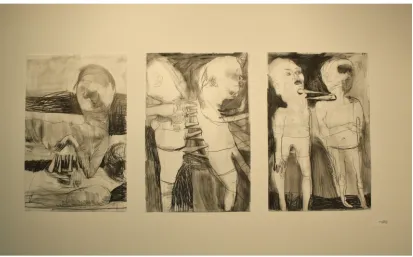
The next series, the Eat series, were of figures consuming each other, these pieces
were sketchbook size, which made the viewer walk up to them, stand close and explore the
texture of the piece. The figures were consuming or eating the other figures on an
imposing and light consuming black background. The black signified space but also allowed
the figures to remain on a shallow plane. By getting rid of the backgrounds I had been
working with in previous series, the idea of the work became more about the interaction
between the figures. The viewer is forced to deal with the action of the figures consuming
the other figures, and then ease into the nuances of the piece and explore the tactile
qualities. The shallow space was created by the integration of each screen print beneath
the ink. The inks reacted in such a way that the screen print shows through the ink, limiting
the amount the viewer falls into the space. The black india ink cracked enough to show the
color through the ink in some places. It allows the viewer to see the screen print under the
black ink. The sheen of the ink contrasts with the screen printing ink, and makes the black
seem not so empty, which helps put the figures in a space. These layers allow the viewer to
narrative is human interaction, group psychology and everyday emotional dominance.
The combination of painting and drawing in these pieces was very important to how the
piece worked as a whole. The effect of the ink cracking was something I did not intend to
happen, but it made the piece successful.
FIGURE 1: Eat series, 2009
TEETH SERIES
After the success of the Eat series, I began experimenting with plastic Yupo paper
and different Japanese papers, both of which have translucent qualities to them, yet they
are totally different in the paper spectrum. The synthetic quality of Yupo paper has become
a great aspect of my process. Initially, I used it only with intaglio ink, which was repelled by
the plasticity of the paper, and I did not feel like this was something I needed to explore.
began the semester after the Eat series with ideas that the figures eating each other felt a
little too violent, so I began making prints on plastic with figures biting or eating their
hands. The series that followed was a brief encounter with abstraction in nonobjective
monotypes. I used Japanese rice paper and the plastic paper but used the same themes in
both sets of monotypes. The figures are virtually unrecognizable. I was trying to gauge the
degree to which my ideas required the faces of bodies in order for the audience to
understand my intent or for the viewer to become engaged with the image. I started taping
off different parts of the plate before I printed on the paper, which had found its way back
into my current work. These prints were unsuccessful in terms of my intention; the
response was not what I had in mind, and they were read in a different way than I
intended. I continued with the Yupo paper and started experimenting with pencil, which
led to powered graphite, watercolor, tape, and gouache. Although these particular pieces
were unsuccessful, I think the current body of work was very much influenced by the
experimentation in this period. I am currently still working with the same materials but
reworking the subject matter.
The drawings on Yupo began after the monotypes of the previous semester. I
thought that the eating of food and hands was, again, no longer working, so I began to
reconsider my imagery and intent and switched gears. The Teeth series came next. I used
spikes coming out of bodies in this series. Two figures were in the drawing with spikes
coming out of their backs. The spikes are impaling each figure, however much the one
injury. They are enduring and imposing the same amount of pain. Both figures in these
works are equal. Before this series the figures had been either good or evil, or dominant
and subordinate, only now I was exploring the equal ability to administer and endure pain
of two beings. I wanted to show a different side of relationships between people that I had
not explored in my previous work. By letting the figures hurt and be hurt I was engaging
and considering the idea that the world was only theirs. It was meant to be the end for this
series and the physical end for those figures. The spikes represent teeth, canine or shark
type teeth, to me; the teeth are on the outside of the bodies, as though part of an
exoskeleton. The figures live inside the painting as a symbiotic set but would eventually
die. I direct the narrative and subsequent action to that the figures in my work all meet
their end. The violent dances or battles never have survivors. The idea is that the work is
the last stand or the last lesson before the end.
The figures in the Teeth series only exist in the space of the painting. They only
function together. I was working on the same ideas of aggressive human interaction, but
trying to come up with new possibilities of how to illustrate it. This led to my Feet Eaters
series. These figures have something binding their bodies to another figure. The binding
can function as yarn or intestinal shapes wrapping the figures. I want to keep the
possibilities of what the binding is open. I don’t want the view to feel as though it is one
particular type of string or yarn. I want the binding to be able to be many different things.
The intention of the wrapping was to completely consume the other figure. In some of
these pieces there is only one figure because the other one has been swallowed. These are
pieces about the aftermath of the action. The Feet Eaters series was all done on pre-‐cut, no
explored the size of my work.
Figure 3: Feet Eaters series, 2010
WRAPPING SERIES
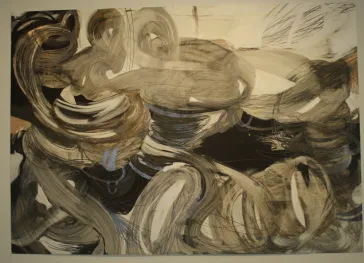
The Wrapping series followed the Feet Eaters; it followed the same intent and
explored new ways of how to visually show tension through mark making. The size
difference made an impact on my subject matter. The figures went between the binding or
wrapping. I felt that I did not need to articulate the figures’ bodies any longer. I allowed the
binding to describe the bodies, without having a hand or foot out for the viewer. I feel that
these pieces still have the emotion that the other pieces have, even though the figures are
more hidden between the engulfing marks. With the pieces of work being so much bigger,
5’X7’, I was able to really explore the different ways to make marks on the plastic paper. I
erased and wiped the graphite powder and water mixture, and with the new size the wiped
marks became completely different than they had been before I changed sizes. The new
size also engages the viewer in a new way. The piece was all encompassing for the viewer.
The intent became more about the viewer’s reaction to the piece and not so much the
narrative style with which I had worked initially. I do not feel like the narrative of the
previous work is over-‐bearing or a complete story, but figures interacting always implies a
narrative. The narrative in both the Eat and Teeth series is a vague narrative but still
understandable from the viewer’s standpoint.
CONCLUSION
The idea of visually describing human interaction has been my main theme in my
current body of work. Working with different visual versions of friction or anticipation, I
developed a vocabulary of marks that visually describe vulnerability and dominance. Each
series I created has a different version of aggressive interaction behind it. The first few
series dealt with figural based moments about to occur and the absence of action, the pause
is the suspense. The next series explored figures interacting and eating each other in a
hierarchal order: Figures eating smaller children, figures eating while being eaten. And the
last set of series deals with figures being binded in a type of string or thick cylindrical form.
These pieces explore control and human interaction. The viewer should take away from
these works the idea that one the figure has dominated the other figure to oblivion or non-‐
existence. My work has gone through a great transformation during my time at the
University of New Orleans. My work started off completely figural and now, after three
years, has changed in many ways. The figures are now behind the marks. They are implied
by shapes of lines, not drawn out and completely recognizable. The figures will always be in
my work in some way but for right now in my current series of work they are engulfed by
line and not articulated. The theme remains the same but the work has gone through many
different versions where I try to visually describe aggressive human interaction.
Ali, Laylah, Alex Baker, and Kara Elizabeth Walker. Laylah Ali: Typology. Philadelphia,
PA: Pennsylvania Academy of the Fine Arts, 2007.
Calvocoressi, Richard, and Martin Hammer. Francis Bacon: Portraits and Heads. Edinburgh:
National Galleries of Scotland, 2005.
Doucet, Julie. Long Time Relationship. Montreal, Quebec: Drawn & Quarterly, 2001.
Gravett, Paul. Cult Fiction: Art and Comics [on the Occasion of the Exhibition Cult Fiction: Art
and Comics, a Hayward Gallery Touring Exhibition ... ; 4 May - 1 July 2007, New Art Gallery,
Walsall ... 19 January - 16 March 2008, Tullie House, Carlisle]. London: Hayward Gallery
Publ., 2007.
Grosenick, Uta, and Ilka Becker. Women Artists in the 20th and 21st Century. Koln: Taschen,
2001.
Kallir, Jane. Egon Schiele. New York: Harry N. Abrams, 1990.
Raphaela Platow, Katy Siegel, and Jorg Heiser. Dana Schutz: Paintings, 2002-2005. Waltham,
Reynolds, April. "Eat the Top Lip First." Modern Painters 2004: 58-‐61.
Schwabsky, Barry. Vitamin P: New Perspectives in Painting. London U.a.: Phaidon, 2007.
Schwabsky, Barry, Dana Schutz, and Jonathan Safran Foer. Dana Schutz. New York [u.a.:
Rizzoli, 2010.
Robyn Denny was born in Louisiana and grew up in St. Amant, Louisiana. She
attended the Louisiana State University and graduated in 2008. She moved to New Olreans
in 2008 to study at the University of New Orleans. She currently lives in New Orleans.