DOI: 10.7508/pj.2017.01.014
Print ISSN 2383-451X Online ISSN: 2383-4501 Web Page: https://jpoll.ut.ac.ir, Email: [email protected]
A review on enhancement techniques of electrokinetic soil
remediation
Jamshidi-Zanjani, A.* and Khodadadi, A.
Department of Mining, Faculty of Engineering, Tarbiat Modares University, 14115-143 Tehran, Iran
Received: 3 Aug. 2016 Accepted: 11 Sep. 2016
ABSTRACT: During the last decade, the expansion of urbanization and industrial activities caused serious environmental problems such as soil pollution. Novel technologies are required to remediate soil contamination with toxic contaminants, including heavy metals and organic pollutants. In recent years, there have been increasing attempts to improve soil remediation efficiency. Electrokinetic (EK) is an emerging remediation technology for mixed contaminants, especially in low hydraulic conductivity soils. During EK remediation process, an electric field is applied to the specimen to remove the contaminants from soil by means of electro-osmotic (EO), electro-migration (EM), and electrophoresis (EP) processes. The usual EK technique may have no suitable removal efficiency or contaminants migration. Thus, enhancement techniques or their combination with other technologies are required to overcome EK limitations, increasing its efficiency. The present study reviews seven main enhancement techniques combined with EK; they include using surfactant, chelants, complexing agents, soil pH control, bioremediation, permeable reactive barriers, and ultrasonication. It should be mentioned that, selecting the suitable combination technique highly depends on the soil type and the kind of contaminant.
Keywords: electrokinetic, enhancement techniques, soil remediation, Zeta potential.
INTRODUCTION
Soil contamination is an important environmental issue due to anthropogenic activities and inefficient waste handling techniques (Virkutyte et al., 2002; Gomes et al., 2012; Pedersen et al., 2016; Habibul et al., 2016). Organic and inorganic contaminants such as heavy metals and Organochlorines, present in the soil matrix, which are migrated to the groundwater may lead to harmful negative impacts (Gomes et al., 2012; Yeung et al., 2011; Valdovinos et al., 2016; Mena et al., 2016).
Corresponding author E-mail: [email protected],
Tel.: +98 21 82884956, Fax: +98 21 82884324
2009; Saeedi et al., 2009; Chen et al., 2013; Guedes et al., 2014; Annamalai et al., 2015). Electrokinetic (EK) remediation is considered an emerging technology that has already proven its value, especially in low permeability contaminated soils (Gomes et al., 2012; Darban et al., 2009; Saeedi et al., 2009; Zanjani et al., 2012; Bahemmat et al., 2016; Ji et al., 2016; Ramírez et al., 2015a; Chirakkara et al., 2015; Mohamed Johar and Embong, 2015; Kim et al., 2015; Shin et al., 2016).
Basically, EK is based on the application of an electric field to the contaminated soil, either by conducting a constant voltage or a direct current (Virkutyte et al., 2002; Amrate et al., 2005; Akretche, 2002; Saeedi et al., 2009; Zanjani et al., 2012; Hassan et al., 2015;
Cameselle, 2015; Ng et al., 2014; Zhou et al., 2014; Zou et al., 2016).
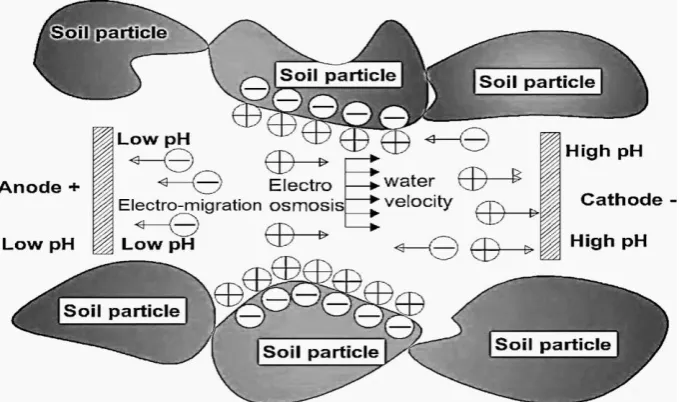
The contaminants migrate through three main phenomena, namely Electro-osmotic (EO), Electro-migration (EM), and Electrophoresis (EP). In an electrolytic cell, EO is the movement of soil moisture from the anode to the cathode. The transportation of ion complexes towards the opposite charge is called EM that usually occurs when ionic inorganic species, such as heavy metal cations, exist. Moreover, charged particles or colloids transport via a phenomenon named EP. Figure 1 depicts mentioned contaminant migration (Virkutyte et al., 2002; Saeedi et al., 2009; Fan et al., 2014; Zhou et al., 2014; Ren et al., 2014).
Fig. 1. Electro-osmosis and electro-migration of ions (Moghadam et al., 2016; Acar et al., 1994)
The surface charge of water-saturated clays is typically negative, causing the direction of EO flow from anode to cathode (Virkutyt et al, 2002; Vane and Zang, 1997; Lynch et al, 2007; Alshawabkeh and Acar, 1992; Suzuki et al., 2014). Water electrolysis is considered the dominant electron transfer that affects the EK process significantly (Virkutyt et al, 2002; Amrate and Akretche, 2005; Saeedi et al., 2009; Zanjani et al., 2012; Ramírez et al., 2015b).
Anode : H O2 2H 1/2 O (g) 2e2
Cathode : 2H O 2e2 2OH H (g)2
and Hicks, 1993; Saeedi et al., 2009; Zanjani et al., 2012).
Zeta potential (ζ) is the potential difference between the shearing surface and the bulk fluid (Page and Page, 2002; Moghadam et al., 2016). As the zeta potential (ζ) of soil particle surfaces is lowered, the positive EO volume flow rate increases and advective transport of the organic contaminants happen towards the cathode (Yeung and Gu, 2011). It should be noted that, the more negative the zeta potential (ζ) of the soil surface, the greater the EO flow rate (Kim et al., 2009; Moghadam et al., 2016).
According to Vane and Zang (1997), zeta potential depends on ionic species and strength, pH, type of clay minerals, and temperature. It should be noted that zeta potential is usually negative for water-saturated clays and silts (Virkutyte et al., 2002); however, water electrolysis in EK propagates acid and base front from the anode and cathode, probably affecting the soil zeta potential to a large extent (Yeung et al., 1997). Polarity of zeta potential is a crucial issue in soil remediation by means of EK. Once it becomes positive, reverse EO happens that has serious effects on the efficiency of contaminants’ removal (Yeung et al., 1997; Virkutyte et al., 2002; Saeedi et al., 2009; Zanjani et al., 2012). For example, during metal remediation from clays, soil pH should be maintained low enough to ensure that most of the contaminants exist in the dissolved phase. On the other hand, pH should be high enough to maintain negative zeta potential (Yeung et al., 1997; Virkutyte et al., 2002). The simultaneous need for remaining dissolved metal contaminants and maintaining a negative zeta potential is considered the main obstacle in soil remediation, by means of EK process (Virkutyt et al., 2002; Yeung et al., 1997; Saeedi et al., 2009; Zanjani et al., 2012).
In general, EK is considered a green remediation technology, used for remediation of soils contaminated by various
types of contaminants such as heavy metals and organic pollutants (Huang et al., 2012; Saichek et al., 2005). The capability of EK to remediate low permeability soil, in situ remediation, and short remediation time are believed to be the main advantages of EK process; however, poor solubility, weak desorption capacity, and low removal efficiency of non-polar contaminants comprise its main disadvantages (Huang et al., 2012). Thus, some enhancement techniques or combined technologies should be applied to overcome these limitations and increase EK remediation efficiency.
The enhancement techniques are applied to EK: in order to:
1. Solubilize or mobilize the contaminants;
2. Control or adjust soil pH in the suitable range for EK;
3. Transform, breakdown, or destroy the contaminants (Yeung et al., 2011). Thus, to overcome EK limitations and its disadvantages some enhancement techniques such as surfactant, chelants, complexing agents, soil pH control, bioremediation, permeable reactive barriers, and ultrasonication have been provided for combination with EK so that soil remediation efficiency is increased (Yeung et al., 2011; Gomes et al., 2012; Virkutyte et al., 2002; Saeedi et al., 2009; Zanjani et al., 2012; Moghadam et al., 2016).
ENHANCED EK
Surfactants and Cosolvents
1.Cationic surfactants, such as CTAC; 2. Anionic surfactants, such as sodium dodecyl sulfonate (SDS);
3. Non-ionic surfactants, such as Tween 80 (Huang et al., 2012; Yeung et al., 2011). Moreover, biological surfactants (biosurfactants) such as β-cyclodextrin are categorized as natural surfactants.
It should be noted that water hardness, sorption of surfactants onto solid phase, inactivation of surfactants, and difficulties in recovering the surfactants are considered to be main limitations of using surfactants in order to enhance EK remediation (Harwell et al., 1992; Yeung et al., 2011). Thus, to overcome these limitations, such factors as effectiveness of surfactants in EK process,
toxicity and biodegradability of the surfactant and its byproducts, ability to be recovered and recycled, and functionality of the surfactant at different pHs should be taken into consideration (Yeung et al., 2011; Park et al., 2007; Yuan and Weng, 2004).
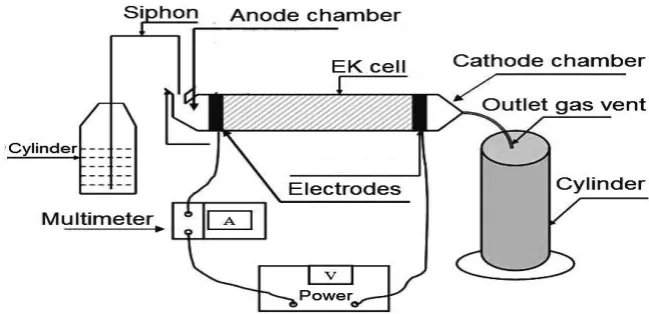
Usually, due to high toxicity of the cationic surfactants and opposite migration direction of the anionic ones, compared to EO in EK process, they are selected as surfactant to enhance EK remediation less frequently. However, nonionic or biological surfactants are often selected due to their less toxicity and environmental-friendliness (Yeung et al., 2011; Huang et al., 2012). Figure 2 demonstrates the schematic diagram of EK, enhanced by surfactant.
Fig. 2. EK remediation enhanced by surfactant (Yuan et al., 2006; Huang et al., 2012)
Cosolvent such as methanol, ethanol, propanol, acetone, tetrahydrofuran, and butylamine are used to enhance aqueous solubility of organic pollutants including alkanes, halogenated hydrocarbons, benzenes, phenols, polychlorinated biphenyl, and Polycyclic Aromatic Hydrocarbons (PAH), better transporting them with EO flows (Yeung et al., 2011; Huang et al., 2012; Li et al., 2000; Maturi and Reddy, 2008; Saichek and Reddy, 2003; Wan et al., 2009; Yuan et al., 2007).
Chelants
The formation of more than two separate bonds between a bi-dental or multi-dental ligand, and an individual ion or metal atom
is known as chelation (Yeung et al., 2011). Therefore, chelation can desorb toxic metals from soil surface, using formation of strong water-soluble complexes (Yeung et al., 2011). Chelating agents such as ethylenediaminetetraacetic acid (EDTA), (diethylenetriamine) pentaacetic acid (DTPA), and citric acid have been frequently used in EK processes (Virkutyt et al., 2002; Yeung et al., 2011; Darban et al., 2009; Kiyaee et al., 2013).
increase, facilitating the advective transportation of the contaminants (Yeung et al., 2011; Virkutyt et al., 2002).
Remediation of contaminated gold mining sediment by mercury was studied by Darban et al. (2009), using EK enhanced by EDTA as chelate. The removal efficiency from using this technique turned out to be up to 70% (Darban et al., 2009).
Complexing agents
Complexing agents are chemicals which form only a single bond between the ion or metal atom (coordination complexes) that differs from complexing agents (Yeung et al., 2011). Complexing agents such as I−, Cl−, NH3−, and OH− are used in the EK process to
form soluble metal complexes (Yeung et al., 2011). For example, many researchers believe that mercury could be efficiently
extracted by iodide-enhanced EK
remediation as soluble complex HgI42− (Shen
et al., 2009; Reddy et al., 2003; Cox et al., 1996). Acetic acid (CH3COOH) is another
complexing agent, used to enhance EK remediation of Cu-contaminated soil (Zhou et al., 2006). Moreover, Cyclodextrins, which is nontoxic and biodegradable, is frequently used to enhance the EK process to remediate contaminated soil (Maturi and Reddy, 2006; Wan et al., 2011; Li et al., 2010).
Soil pH control
Water Electrolysis generates H+ and O2 at
the anode and OH- and H2 gas at the
cathode. The migration of H+ and OH- lead to acidic and basic condition in the soil, near the anode and cathode. The adverse impacts of the development of acid/base front may be controlled through two main methods, namely electrode conditioning and ion exchange membrane (Yeung et al., 2011; Virkutyt et al., 2002).
In electrode conditioning, weak acids such as CH3COOH (Genc et al., 2009) and
citric acid (Gidarakos and Giannis, 2006) may be used to neutralize the generated hydroxyl ions during EK remediation. It should be mentioned that improper use of
some acids such as HCl may lead to the presence of toxic byproducts, posing a health hazard (Yeung et al., 2011).
Ion exchange membrane is the other enhancement technique of reservoir conditioning (Yeung et al., 2011). Cation and anion exchange membrane allow only cations and anions to pass through. Thus, installation of cation exchange membrane between the cathode and specimen can hinder the migration of the generated OH -ions as well as metal hydroxides precipitation (Yeung et al., 2011). In this technique the precipitation of metal contaminants occur on the surface of the membrane or into the catholyte, leading to the membrane fouling and the increase in flow resistance (Yeung et al., 2011; Shen et al., 2007; Lee et al., 2002).
EK combined with bioremediation (Bio-EK)
Bioremediation uses microorganisms to degrade hazardous contaminants (especially organic pollutants) under a suitable condition (Yeung et al., 2011). However, in cases such as low hydraulic conductivity soils, it is difficult to supply microorganism and the required electron acceptors or nutrients to the hazardous contaminants (Yeung et al., 2011). Thus, EK combined with bioremediation is
designed to activate or supply
microorganisms and electron acceptors, providing nutrients for the contaminants through EO flow to promote the reproduction, growth, and metabolism of the microorganisms (van Cauwenberghe, 1997; Virkutyt et al., 2002; Yeung et al., 2011).
Some examples of combination of EK
and bioremediation to remediate
EK combined with Permeable Reactive Barriers (PRB)
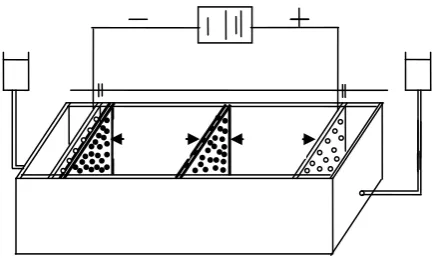
A Permeable Reactive Barrier (PRB) is an innovative technology, made of reactive material placed across the flow path of a dissolved phase contaminant plume, to degrade or remove contaminants (Saeedi et al., 2009; Palmer, 2001; Yeung et al., 2011). When EK is combined with PRB, the EO
flow plays an important role to remove or degrade dissolved contaminants (Fig. 3). It should be noted that the sorption of contaminants on surface of PRBs material or degradation of contaminants largely depend on the pH. Thus, the pH gradient during EK process may affect removal efficiency of contaminants, using this combination technique (Yeung et al., 2011).
Fig. 3. Electrokinetic coupled with PRB (Saeedi et al., 2009)
The zero-valent iron (ZVI) is frequently used as a reactive material in PRB, combined with EK. The feasibility of EK remediation coupled with ZVI PRB to remediate nitrate-contaminated soil was investigated by Chew and Zhang (1998). TCE Degradation by means of EK, coupled with ZVI PRB was investigated by Moon et al. (2005). They found that the rate of reductive dechlorination of TCE improved up to six times more than ZVI PRB alone. The removal mechanism of Cr+6, using EK combined with ZVI PRB, was studied by Cang et al. (2009), who obtained a removal efficiency up to 72% when they placed ZVI PRB between the electrodes and contaminated soils. In addition to ZVI and atomizing slag (Chung and Lee, 2007), carbon active (Saeedi et al., 2009) was used as reactive material, combined with EK, to remediate contaminated soils.
EK combined with ultrasonication Ultrasonication is based on the cavitation (bubble formation) to increase kinetic energy, temperature, volume, and pressure
of soil pore water (Gomes et al., 2012; Yeung et al., 2011; Chung and Kamon, 2005). It can destroy organic pollutants such as PCBs and PAH by increasing molecular motion of the contaminants, inducing mobilization, and disintegrating sorbed contaminants on soil surfaces (Gomes et al., 2012; Yeung et al., 2011).
Remediation of contaminated clayey soil by Pb and phenanthrene, using EK combined with ultrasonication, was studied by Chung and Kamon (2005). They found that the combination of EK and ultrasonication improved remediation efficiency, compared to EK only. Remediation of spiked kaolin by HCB, phenanthrene, and fluoranthene was investigated by Pham et al. (2009) who used EK coupled with ultrasonication. Their results revealed higher EO flow, current and efficiency, in comparison with EK only.
CONCLUSION
EK remediation is an innovative and promising remediation technology especially in fine-grained contaminated soils. However, due to some of its limitations and
Cathod e
Barrie r
Anode Power
supply
disadvantages, several enhancement techniques are provided to overcome the limitations and increase EK remediation efficiency. Thus, this paper has reviewed some of the main enhancement techniques to improve EK remediation effectiveness. Overall, it can be concluded that surfactants, chelates, and complexing agents can enhance the solubility of contaminants using different functions to improve removal efficiency in EK process. Moreover, soil pH and zeta potential can control the EO direction flow and removal efficiency. The combination of EK with bioremediation can specifically enhance degradation of organic pollutants in fine-grained soils. For EK, coupled with PRB, it could be a very effective technique, when contaminants are soluble and transported through the EO flow. Moreover, the degradation of ionic and nonionic contaminants, using EK combined with ultrasonication has promising efficiency and research prospects. In general, selecting the best combination technique to increase EK efficiency depends on the contaminant types (OP, Heavy metals, etc.) and soil type. For
example, combination of EK and
bioremediation can be very effective for the soil, contaminated with PAH. EK combined with surfactant, chelant, and complexing agents can be very effective to remediate soil contaminated with heavy metals. Moreover, EK combined with ultrasonication is considered a suitable remediation technique for both ionic and nonionic contaminants. Moreover, it should be noted that controlling the soil pH in EK, combined with other techniques, may increase removal efficiency. In some cases, soil pretreatment by means of weak acids may increase the EK efficiency. Moreover, EK, combined with other
techniques including fenton and
phytoremediation, may be effective tools to improve EK efficiency.
REFERENCE
Acar, Y.B., Hamed, J.T. and Gale, R.J. (1994). Removal of cadmium (II) From saturated kaolinite by
the application of electrical current. Geotechniques. 44(2), 239-254.
Acar, Y.B., Gale, R.J., Putnam, G.A., Hamed, J. and Wong, R.L. (1990). Electrochemical processing of soils: Theory of pH gradient development by diffusion, migration, and linear convection. J. Environ. Sci. Heal. 25, 687-714.
Akretche, D.E. (2002). Influence of the solid nature in the efficiency of an electrokinetic process. Desalination. 147, 381-85.
Alshawabkeh, A.N. and Acar, Y.B. (1992). Removal of Contaminants from Soils by Electrokinetics: A Theoretical Treatise. J. Environ. Sci. Heal. 27, 1835-1861.
Amrate, S., Akretche, D.E., Innocent, C. and Seta, P. (2005). Removal of Pb from a calcareous soil during EDTA-enhanced electrokinetic extraction. Sci. Total. Environ. 349, 56-66.
Annamalai, S., Selvaraj, S., Selvaraj, H., Santhanam, M. and Pazos, M. (2015). Electrokinetic remediation: Challenging and optimization of electrolyte for sulfate removal in textile effluent-contaminated farming soil. RSC Adv., 5(99), 81052-81058.
Bahemmat, M., Farahbakhsh, M. and Kianirad, M. (2016). Humic substances-enhanced electroremediation of heavy metals contaminated soil. J. Hazard. Mater., 312, 307-318.
Cameselle, C. (2015). Enhancement of Electro-Osmotic Flow during the Electrokinetic Treatment of A Contaminated Soil. Electrochim. Acta., 181, 31-38.
Cang, L., Zhou, D.M., Wu, D.Y. and Alshawabkeh, A.N. (2009). Coupling electrokinetics with permeable reactive barriers of zero-valent iron for treating a chromium contaminated soil. Sep. Sci. Technol., 44, 2188-2202.
Chen, F., Xing, J.H. and Cao, Z.W. (2013). Study on the electrokinetic remediation technology of Cr(IV) polluted soil. Adv. Mater. Res., 726-731, 1751-1754.
Chew, C.F. and Zhang, T.C. (1998). In-situ remediation of nitrate contaminated groundwater by electrokinetics iron wall processes. Water. Sci. Technol., 38, 135-142.
Chirakkara, R.A., Reddy, K.R. and Cameselle, C. (2015). Electrokinetic Amendment in Phytoremediation of Mixed Contaminated Soil. Electrochim. Acta., 181, 179-191.
Chung, H.I. and Kamon, M. (2005). Ultrasonically enhanced electrokinetic remediation for removal of Pb and phenanthrene in contaminated soils. Eng. Geol., 77, 233-242.
Cox, C.D., Shoesmith, M.A. and Ghosh, M.M. (1996). Electrokinetic remediation of mercury contaminated soils using iodine/iodide lixiviant. Environ. Sci. Technol., 30, 1933-1938.
Darban, A.K., Ayati, B., Yong, R.N., Khodadadi, A. and Kiayee, A. (2009). Enhanced Electrokinetic Remediation of Mercury-Contaminated Tailing Dam Sediments. J. ASTM Int., 6(5), 1-11.
Estabragh, A.R., Bordbar, A.T., Ghaziani, F. and Javadi, A.A. (2016). Removal of MTBE from a clay soil using electrokinetic technique. Environ. Technol., 37, 1745-1756.
Fan, G., Cang, L., Fang, G. and Zhou, D. (2014). Surfactant and oxidant enhanced electrokinetic remediation of a PCBs polluted soil. Sep. Purif. Technol., 123, 106-113.
Figueroa, A., Cameselle, C., Gouveia, S. and Hansen, H.K. (2016). Electrokinetic treatment of an agricultural soil contaminated with heavy metals. J. Environ. Sci. Health. A. Tox. Hazard. Subst. Environ. Eng., 51, 691-700.
Genc, A., Chase, G. and Foos, A. (2009). Electrokinetic removal of manganese from river sediment. Water. Air. Soil. Pollut., 197, 131-141.
Gidarakos, E. and Giannis, A. (2006). Chelate agents enhanced electrokinetic remediation for removal cadmium and zinc by conditioning catholyte pH. Water. Air. Soil. Pollut., 172, 295-312.
Gomes, H.I., Dias-Ferreira, C. and Ribeiro, A.B. (2012). Electrokinetic remediation of organochlorines in soil: enhancement techniques and integration with other remediation technologies. Chemosphere., 87, 1077-1090.
Gu, Y.Y., Yeung, A.T., Koenig, A. and Li, H.J. (2009). Effects of chelating agents on zeta potential of cadmium-contaminated natural clay. Sep. Sci. Technol., 44, 2203-2222.
Guedes, P., Mateus, E.P., Couto, N., Rodríguez, Y. and Ribeiro, A.B. (2014). Electrokinetic remediation of six emerging organic contaminants from soil. Chemosphere. 117(1), 124-131.
Habibul, N., Hu, Y., Sheng, G.P. (2016). Microbial fuel cell driving electrokinetic remediation of toxic metal contaminated soils, J. Hazard. Mater. 318, 9-14.
Harwell, J.H. (1992). Factors affecting surfactant performance in groundwater remediation applications, in: D.A. Sabitini, R.C. Knox (Eds.), Transport and Remediation of Subsurface Contaminants: Colloidal,
Interfacial, and Surfactant Phenomena, ACS Symposium Series 491, American Chemical Society, (pp. 124-132). Washington, DC.
Hassan, I., Mohamedelhassan, E. and Yanful, E.K. (2015). Solar powered electrokinetic remediation of Cu polluted soil using a novel anode configuration. Electrochim. Acta., 181, 58-67.
Huang, D., Xu, Q., Cheng, J., Lu, X. and Zhang, H. (2012). Electrokinetic Remediation and Its Combined Technologies for Removal of Organic Pollutants from Contaminated Soils. Int. J. Electrochem. Sci., 7, 4528-4544.
Jeon, E.K., Jung, J.M., Kim, W.S., Ko, S.H. and Baek, K. (2014). In situ electrokinetic remediation of as-, cu-, and pb-contaminated paddy soil using hexagonal electrode configuration: A full scale study. Environ. Sci. Pollut. Res., 22 (1), 711-720.
Ji, M., Zou, H., Du, W., Gao, K. and Liu, C. (2016). Surfactant enhanced electrokinetic remediation of polycyclic aromatic hydrocarbons contaminated soil. Chin. J. Environ. Eng., 10(7), 3871-3876.
Kim, G.N., Kim, S.S., Park, U.R. and Moon, J.K. (2015). Decontamination of Soil Contaminated with Cesium using Electrokinetic-electrodialytic Method. Electrochim. Acta., 181, 233-237.
Kim, D.H., Ryu, B.G., Park, S.W., Seo, C.I. and Baek, K. (2009). Electrokinetic remediation of Zn and Ni-contaminated soil. J. Hazard. Mater., 165(1), 501-505.
Kiyaee, A., Tavakoli, M.R. and Khodadadi, A. (2013). Investigation of Electrokinetic for the Removal of Mercury from Contaminated Soil and Sediment. J. Tethys., 1(4), 266-281.
Lee, K.Y., Kim, H.A., Lee, B.T., Kim, S.O., Kwon, Y.H. Kim, K.W. (2011). A feasibility study on bioelectrokinetics for the removal of heavy metals from tailing soil. Environ. Geochem. Health., 33, 3-11.
Lee, H.J., Choi, J.M., Cho, J.W. and Moon, S.H. (2002). Characterization of anion exchange membranes fouled with humate during electrodialysis. J. Membr. Sci. 203, 115-126.
Lee, H.S. and Lee, K. (2001). Bioremediation of diesel-contaminated soil by bacterial cells transported by electrokinetics. J. Microbiol. Biotechnol. 11, 1038-1045.
Li, D., Tan, X.Y., Wu, X.D., Pan, C. and Xu, P. (2014). Effects of electrolyte characteristics on soil conductivity and current in electrokinetic remediation of lead-contaminated soil. Sep. Purif. Technol., 135, 14-21.
electrokinetic remediation of sediment contaminated with HCB and heavy metals. J. Hazard. Mater., 176, 306-312.
Li, A., Cheung, K.A. and Reddy, K.R. (2000). Cosolvent-enhanced electrokinetic remediation of soils contaminated with phenanthrene, J. Environ. Eng. ASCE. 126, 527-533.
Lynch, R.J., Muntoni, A., Ruggeri, R. and Winfield, K.C. (2007). Preliminary tests of an electrokinetic barrier to prevent heavy metal pollution of soils. Electrochim. Acta., 52, 3432-3440.
Masi, M. and Losito, G. (2015). Spectral induced polarization for monitoring electrokinetic remediation processes. J. Appl. Geophys., 123, 284-294.
Maturi, K. and Reddy, K.R. (2008). Cosolvent-enhanced desorption and transport of heavy metals and organic contaminants in soils during electrokinetic remediation. Water. Air. Soil. Pollut., 189, 199-211.
Maturi, K. and Reddy K.R. (2006). Simultaneous removal of organic compounds and heavy metals from soils by electrokinetic remediation with a modified cyclodextrin. Chemosphere., 63, 1022-1031.
Mena, E., Villaseñor, J., Rodrigo, M.A. and Cañizares, P. (2016). Electrokinetic remediation of soil polluted with insoluble organics using biological permeable reactive barriers: Effect of periodic polarity reversal and voltage gradient. Chem. Eng. J., 299, 30-36.
Moghadam, M.J., Moayedi, H., Sadeghi, M.M., and Hajiannia, A. (2016). A review of combinations of electrokinetic applications, Environ. Geochem. Health., DOI: 10.1007/s10653-016-9795-3
Mohamed Johar, S. and Embong, Z. (2015). The optimisation of electrokinetic remediation for heavy metals and radioactivity contamination on Holyrood-Lunas soil (acrisol species) in Sri Gading Industrial Area, Batu Pahat, Johor, Malaysia. Radiat. Prot. Dosim., 167(1-3), 160-164.
Moon, J.W., Moon, H.S., Kim, H. and Roh, Y. (2005). Remediation of TCE-contaminated groundwater using zero valent iron and direct current: experimental results and electron competition model. Environ. Geol., 48, 805-817.
Mulligan, C.N., Yong, R.N. and Gibbs, B.F. (2001). Surfactant-enhanced remediation of contaminated soil: a review. Eng. Geol., 60, 371-380.
Naidu, R., Sreedaran, B.R. and Smith, E. (2013). Electroremediation of lead-contaminated kaolinite using cation selective membrane and different electrolyte solutions topical collection on remediation of site contamination. Water. Air. Soil. Pollut., 224(12), 1708-1716.
Ng, Y.S., Sen Gupta, B. and Hashim, M.A. (2015). Effects of operating parameters on the performance of washing-electrokinetic two stage process as soil remediation method for lead removal. Sep. Purif. Technol., 156, 403-413.
Ng, Y.S., Sen Gupta, B. and Hashim, M.A. (2014). Performance Evaluation of Two-Stage Electrokinetic Washing as Soil Remediation Method for Lead Removal using Different Wash Solutions. Electrochim. Acta., 147, 9-18.
Page, M.M. and Page, C.L. (2002). Electroremediation of contaminated soils. J. Environ. Eng. 128(3), 208-219.
Palmer, P.L. (2001). Permeable treatment barriers, in: In situ Treatment Technology, 2nd ed., (Lewis Publishers, Boca Raton).
Park, J.Y., Lee, H.H., Kim, S.J., Lee, Y.J. and Yang, J.W. (2007). Surfactant-enhanced electrokinetic removal of phenanthrene from kaolinite. J. Hazard. Mater., 140, 230-236.
Pedersen, K.B., Lejon, T., Jensen, P.E., Ottosen, L.M. (2016). Degradation of oil products in a soil from a Russian Barents hot-spot during electrodialytic remediation. SpringerPlus., 5, (1), 1-10.
Pham, T.D., Shrestha, R.A., Virkutyte, J. and Sillanpää, M. (2009). Combined ultrasonication and electrokinetic remediation for persistent organic removal from contaminated kaolin. Electrochim. Acta., 54, 1403-1407.
Probstein, R.F. and Hicks, R.E. (1993). Removal of Contaminants from Soils by Electric Fields. Science., 260, 498-504.
Ramírez, E.M., Camacho, J.V., Rodrigo, M.A. and Cañizares, P. (2015a). Combination of bioremediation and electrokinetics for the in-situ treatment of diesel polluted soil: A comparison of strategies. Sci. Total. Environ., 533, 307-316.
Ramírez, E.M., Jiménez, C.S., Camacho, J.V., Rodrigo, M.A.R. and Cañizares, P., (2015b), Feasibility of Coupling Permeable Bio-Barriers and Electrokinetics for the Treatment of Diesel Hydrocarbons Polluted Soils. Electrochim. Acta., 181, 192-199.
Reddy, K.R., Chaparro, C., and Saichek, R.E. (2003). Removal of mercury from clayey soils using electrokinetics, J. Environ. Sci. Health A-Tox. Hazard. Subst. Environ. Eng. 38, 307-338.
Saeedi, M., Jamshidi, A., Shariatmadri, N. and Falamaki, A. (2009). An investigation on the efficiency of electro kinetic coupled with carbon active barrier to remediate nickel contaminated Clay, Int. J. Environ. Res., 3(4), 629-636.
Saichek, R.E. and Reddy, K.R. (2005). Electrokinetically enhanced remediation of hydrophobic organic compounds in soils: A review. Crit. Rev. Env. Sci. Tec., 35, 115-192.
Saichek, R.E. and Reddy, K.R. (2003). Effects of system variables on surfactant enhanced electrokinetic removal of polycyclic aromatic hydrocarbons from clayey soils. Environ. Technol. 24, 503-515.
Shen, Z.M., Zhang, J.D., Qu, L.Y., Dong, Z.Q., Zheng, S.S. and Wang, W.H. (2009). A modified EK method with an I−/I2 lixiviant assisted and approaching cathodes to remedy mercury contaminated field soils. Environ. Geol. 57, 1399-1407.
Shen, Z.M., Chen, X.J., Jia, J.P., Qu, L. and Wang, W.H. (2007). Comparison of electrokinetic soil remediation methods using one fixed anode and approaching anodes. Environ. Pollut., 150, 193-199.
Shin, S.-Y., Park, S.-M. and Baek, K. (2016). Electrokinetic Removal of As from Soil Washing Residue. Water. Air. Soil. Pollut., 227(7), 223-231.
Suzuki, T., Kawai, K., Moribe, M. and Niinae, M. (2014). Recovery of Cr as Cr(III) from Cr(VI)-contaminated kaolinite clay by electrokinetics coupled with a permeable reactive barrier. J. Hazard. Mater., 278, 297-303.
Valdovinos, V., Monroy-Guzmán, F. and Bustos, E. (2016). Electrokinetic removal of radionuclides contained in scintillation liquids absorbed in soil type Phaeozem. J. Environ. Radioact., 162-163, 80-86.
van Cauwenberghe, L. (1997). Electrokinetics: Technology Overview Report. Groundwater Remediation Technologies Analysis Centre., 1-17.
Vane, L.M. and Zang, G.M. (1997). Effect of aqueous phase properties on clay particle zeta potential and electro-osmotic permeability: implications for electrokinetic soil remediation processes. J. Hazard. Mater., 55, 1-22.
Virkutyte, J., Sillanpa, M., and Latostenmaa, P. (2002). Electrokinetic soil remediation- critical overview.Sci. Total. Environ., 289, 97-121.
Wan, C.L., Du, M.A., Lee, D.J., Yang, X., Ma, W.C. and Zheng, L.N. (2011). Electrokinetic remediation and microbial community shift of
_-cyclodextrin-dissolved petroleum hydrocarbon-contaminated soil. Appl. Microbiol. Biotechnol., 89, 2019-2025.
Wan, J.Z., Yuan, S.H., Chen, J., Li, T.P., Lin, L. and Lu, X.H. (2009). Solubility-enhanced electrokinetic movement of hexachlorobenzene in sediments: a comparison of cosolvent and cyclodextrin. J. Hazard. Mater. 166, 221-226.
Wick, L.Y., Mattle, P.A., Wattiau, P. and Harms, H. (2004). Electrokinetic transport of PAH degrading bacteria in model aquifers and soil. Environ. Sci. Technol., 38, 4596-4602.
Yeung, A.T. and Gu, Y.Y. (2011). A review on techniques to enhance electrochemical remediation of contaminated soils, J. Hazard. Mater., 195, 11-29.
Yeung, A., Hhsu, C. and Menon, R.M. (1997). Physicochemical soil _ contaminant interactions during electrokinetic extraction. J. Hazard. Mater., 55, 221-237.
Yuan, S.H., Wan, J.Z. and Lu, X.H. (2007). Electrokinetic movement of multiple chlorobenzenes in contaminated soils in the presence of β-cyclodextrin. J. Environ. Sci., 19, 968-976.
Yuan, S., Tian, M. and Lu, X. (2006). Electrokinetic movement of hexachlorobenzene in clayed soils enhanced by Tween 80 and β-cyclodextrin. J. Hazard. Mater., 137(2), 1218-1225.
Yuan, C. and Weng, C.H. (2004). Remediating ethylbenzene-contaminated clayey soil by a surfactant-aided electrokinetic (SAEK) process. Chemosphere., 57, 225-232.
Zanjani, A.J., Saeedi, M. and Weng, C.H. (2012). An electrokinetic process coupled activated carbon barrier for nickel removal from kaolinite. EnvironmentAsia., 5(2), 28-35.
Zhou, D.M., Cang, L., Alshawabkeh, A.N., Wang, Y.J. and Hao, X.Z. (2006). Pilot-scale electrokinetic treatment of a Cu contaminated red soil, Chemosphere., 63, 964-971.
Zhou, M., Tang, H., Zhu, S., Ge, B., and Hu, J. (2014). EDTA-enhanced electrokinetic remediation of heavy metals co-contaminated soil. Chin. J. Environ. Eng., 8(3), 1197-1202.