Journal of Humanities Insights 1(3): 134-140, 2017
Research Paper
A Comparative Study of Performance Evaluation
System of Teachers
Shahram Shafiee1, Amir Rezaee2*, Morteza Akbar2, Laleh Kayvani2
1Assistant Prof., University of Guilan, Rasht, Iran 2University of Guilan, Rasht, Iran
Received: 04 July 2017 Accepted: 13 August 2017 Published: 01 September 2017
Abstract
Designing and performing a sound system of evaluating the teachers’ performance considering their occupational nature, accounts as one of the very important responsibilities of human resources in education and training. The nature of carrier performance of P.E. Teachers is somehow different from other teachers. Therefore, on this study, system of performance assessment of P.E. and non-P.E. teachers was compared. Methodology was descriptive and by using random clustered sampling method. According statistical population and Morgan Schedule 310 P.E. teachers and 480 non-P.E. teachers were selected as statistical samples of study, and their performance assessment questionnaire were analyzed. The data were analyzed via Mann-Whitney U; One Sample Kolmogorov-Smirnov tests; and Pearson correlation on P≤0.05 level. The results of this study indicated that no significant difference existed between assessment scores and level of encouragement (p=0.389) and improvement (p=0.557) of P.E, and non-P.E. teachers. It was also indicated that the correlation between the assessment (r=0.103 & p=0.024) score and the level of encouragement and improvement was significant only for non-P.E. teachers and non-P.E teachers (p=0.021). The difference between assessment scores (p=0.028) and encouragement factor (p=0.005) of male and female teachers was significant . The difference between assessment scores of junior high and high school P.E. teachers was significant (p=0.038); however, no significant difference was indicated between two factors of encouragement and improvement in this group of teachers (p=0.213 & p=0.35). Even though no significant difference existed in assessment scores of non-P.E. teachers of junior high and high schools (p=0.171), however a significant difference existed in factor of improvement in this group of teachers (p=0.004). A significant difference also existed in errors of softness (p=0.001) and leniency (p=0.001) in assessment system of P.E. and non-P.E. teachers. Generally, the performance assessment of P.E. and non-P.E. teachers is not being done accurately. The individuals who perform the assessment, evaluate the teachers more than what they deserve, and they are negligent in suggesting improvement method. It also seems that the teachers are not being encouraged and improved regardless of their assessment results. This kind of assessment could be a strong reason for lowering the teachers’ occupational motivation.
Keywords: Assessment Score; Performance; Level of Encouragement; Improvement How to cite the article:
S. Shafiee, A. Rezaee, M. Akbar, L. Kayvani, A Comparative Study of Performance Evaluation System of Teachers, J. Hum. Ins. 2017; 1(3): 134-140, DOI: 10.22034/jhi.2017.86963
©2017 The Authors. This is an open access article under the CC By license
1. Introduction
The subject of evaluation has been considered as one of the important successful factors in academic and educational environment for a long time. The experts have always tried to use the instruments of
* Corresponding Author Email: [email protected]
essential and unavoidable factor that is necessary for a sound and dynamic management in any departments. Therefore, developing programs regarding education and its future changes is one of the most important responsibilities of the educational planners and policy-makers, all over the world. This growing process of thinking and responsibility is arising from this reality that the most valuable asset and the main source that any society needs to fulfill its future goals and objectives, its their intellectual manufacturer force [1] and the bureau of education and training is the organization that could train this building forces. Without any doubt, the human sources in any organization could not ever attain the necessary quality and feedback without education and improvements. One of the main problems in education and training departments, considering the vastness of human resources, especially the teachers, is the reinforcement of human resources. By reinforcing the human resources we mean enhancing the knowledge, skills, abilities and motivations of the workers especially teachers employed in this organization. This progress is not possible, without attainment of evaluation. Raymond (2006) studied the teacher evaluation principles within two years and found out that teacher evaluation is the effective factor for creating competition within them, and it’s a powerful method for learning and improving their programs [2]. Poorsamad (1977) studied the job motivation of the "Kuhkilooyeh" province and found out that the most important factors for the lack of satisfaction of teachers, are the low salaries, lack of sound evaluation, and their social status [3]. Raoofi (1991) performed a study on the aspect of reaction of the workers to evaluation and concluded that performance evaluation is an effective factor on appearing individual talents and comprehension of suitability, and enhancement of efficiency in organizations, and performance evaluation has tremendous effects on motivation and efficiency of the workers [4].
Several researchers studied the point of views of the evaluators around the effect of the new method of evaluation on improvement of the government employees performance. They concluded that, this new method ended to a better performance, coordination, discipline, and more motivation to work. The most important factor on reaching for goals of any organization is its human resources. In education and training for the moralistic and educational purposes, teachers account as the most important effective factors in education and training [5]. If we invest more on educational human sources meaning the teachers, this in fact means we are enhancing the knowledge and empowering the basis of the society. The physical education teachers as a part of these human
resources in education and training have serious responsibilities such as developing physical fitness, developing sound moral and social attributes, creating recreational activities, and teaching adequate ways of life to the students. Beside these responsibilities there are also other important factors which if those are not being considered, both teachers and students are wrongly affected. One of these important factors is the method of evaluation of the teacher's performance. For this reason in order to enhance the quality level of the teachers performance and adequate benefiting from this human resources, the bureau of education and training should pay more attention to the teachers performance evaluation, and apply it more accurately. On this regard Ramazani-nezhad indicated that performance evaluation is one of the effective factors on organizational health and job satisfaction [6].
Since the efficiency of the organizations is related to the performance evaluation of its employees, therefore all organizations especially the education and training bureau could prepare an official design for careful and adequate evaluation of the performance of its employees. This in turn causes the teachers after beginning to work in school in order to reach the determined objectives, and improving their performance, become more aware about the quality of their performance. This awareness causes them to be informed more about the weaknesses and strengths of their performance and attitudes, and apply better, arrangements to promote their performance effectiveness.
endeavour in workplace; 4. having creativity and originativity; 5. Enhancing occupational knowledge and skills; 6. Transferring knowledge and informations; 7. Having flexibility; and following Islamic morals and behaviors.
Considering the existence of errors in evaluation discipline of the teachers, the bureau of education and training, should try to perform this discipline appropriately. Since this careful assessment, could provide enormous feedbacks for the organization and the teachers therefore they could take stronger steps for the improvement and development of their programs. Performing the present study, makes it possible to acquire the necessary in formations from this specific population; and by analyzing the acquired data we could determine few of deficiencies of the evaluation principles between two groups of P.E. and Non P.E. teachers. Even though few studies were performed in this regard in the country; however those studies indicated that the evaluation principles of the P.E. teachers are not done properly [1,7]. The investigator tried to clear this subject by comparing it to non-P.E. teachers, so that possibly the results of this study could help the officials and administrators in bureau of education and training in order to apply appropriate performance evaluation programs.
2. Methodology
This is a descriptive-comparative study. The subjects of this study were consisted of 310 physical education teachers and 480 non-physical education teachers who were selected from sixteen city in province of Guilan (Langrood, Fuman, Rasht, Roodsar, Astaneh, Talesh, Anzali, and Soomehsara) in Iran. These subjects were selected as statistical samples through random cluster sampling. The measuring instrument of the study was the teachers' performance assessment forms that education and training organization use those for teacher evaluation. These forms have 30 points which 20 points are given to performance factors (including five valued questions from the least 0.5 grade to highest of 2.5 grade). Ten points are given to processing factors, which 7 points is given to job behavior criterion (including five valued questions from the least of zero grade to highest grade of 1). Three points are also given to moral behavior including one 3 valued questions from least grade of 1 to highest grade of 3. Acquiring better grades is an indicator of a better performance by the teachers. In order to have access to these forms and points inserted in these forms; a coded questionnaire was provided in this study. These questionnaires were provided for the assessing officials of the education and training departments in the selected cities, so that the assessment forms are transferred it these questionnaires without
stating the biography of the teachers. This was done in order to keep the information confidential and we could not have a direct access to assessment scores available. In these questionnaires, performance factors of the teachers (8 factors) and processing factors (including 7 job behavior criterion and one moral behavior criterion), including other information such as gender, organizational unit, group, number of encouragement suggestions and number of correction suggestions were inserted. The information regarding to filling up the questionnaires were provided for the experts in the selected cities so that the information of the assessment forms are transferred to the questionnaires. After collection of the questionnaires, the inserted data in assessment forms were analyzed by using SPSS and the descriptive statistical methods (abundance, percent, and average); and summarized and classified in a forms of tables. In order to study the hypothesis related to correlation between teacher assessment grades and their level of encouragement and correction and assessment errors, Pearson correlation coefficient test in P≤0.05 level and kolmogorov-smirnov tests were used. Because the distribution of variables was not normal, therefore in order to compare the different groups, the non-parametric test (U-man Whitney) was used.
3. Results
From the total of 790 subjects, 310 were P.E. teachers (150 males &160 females), and 480 non-P.E. teachers (237 males & 243 females), who accordingly consisted 39.24% and 60.76% of the study samples. From 310 non-P.E. teachers, 161 were employed in junior-highs, and 146 in high schools; and from 480 non-P.E. teachers, 171 were employed in junior-highs and 330 in high-schools. The results of this study indicated that, the mean performance assessment of P.E. teachers (29.91) is higher than non-P.E. teachers (29.89). However considering the Z score and significance level of U-man Whitney test; no significant difference existed between the performance assessment scores of P.E. and non-P.E. teachers (Table1).
The information on table 2 indicated that the non-P.E. teachers were encouraged and corrected more than the P.E teachers. However considering the Z score and significance level of U-man Whitney test, no significant difference was indicated between P.E. and non-P.E. teachers on factors of encouragement and correction.
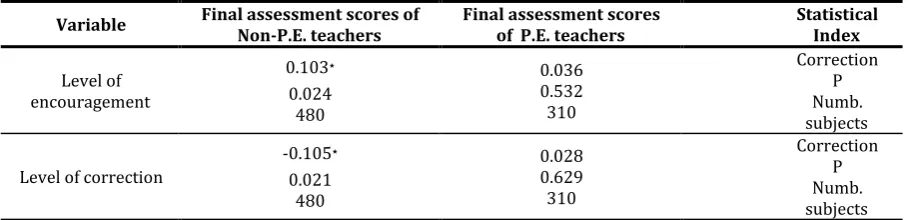
significant relationship between the level of correction and encouragement and the final score of performance assessment of P.E. teachers. However a significant relationship existed between the level of correction and encouragement of assessment scores of non-P.E. teachers (Table3).
The difference between assessment scores of males & females P.E. and non-P.E. teachers were also studied. The results indicated that there was no significant difference in the assessment scores of females (29.95) and male (29.88) P.E. teachers (Z=1.628, p=0.105). However the difference between assessment score of female (24.44), and male (29.85), non-P.E. teachers was significant (Z=-2.199, P=0.028). According to the information on table (4) and considering the Z score and the significance level of U-man Whitney test; no significant difference existed, between male and female P.E. teachers in factors of encouragement and correction. Between male and female non-P.E. teachers in factor of correction, no significant difference existed; however in factor of encouragement the difference was significant.
The results of this study also indicated that the difference between the assessment score of the P.E.
teachers in junior-high schools (29.96); and high schools (29.86) is significant (Z=-2.078; P =0.038). However this difference in non-P.E. teachers of junior-high schools (29.91) and high school (29.88) is not significant (Z=-1.324, P=0.171). According to table (5) and considering the Z score and the significance level in U-man Whitney test between junior highs and high school P.E. teachers a significant difference existed in factors of encouragement and correction .However between non-P.E. teachers in junior highs and high-schools in factor of correction, the difference is significant. In other words the non-P.E. teachers in junior- highs were corrected more than the high-school teachers.
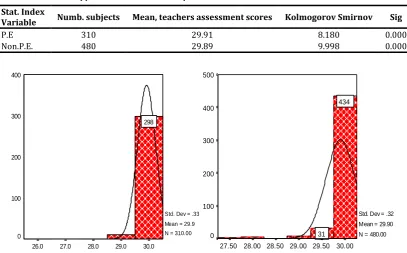
According to the information in table (6) and Fig (1) the significance level of Kolmogorov-Smirnov test, with the existence of errors of suppleness; and assistance in assessment scores of P.E. and non-P.E. teachers was significant. The scales 1 & 2 also indicates that, the distribution curve in assessment scores of P.E. and non- P.E. teachers is inclined towards the right and the assessors made suppleness and assistance errors in performance assessment of P.E. and non-P.E. teachers.
Table 1. Statistical results of comparison between assessment scores of P.E. and Non-P.E. teachers.
P Z
U-Man Whitney Mean
Numb.subjects Field of teaching
State Index Variable
0.202 -1.276
71879 29.91
310 P.E.
Total Assessment score Non.P.Ed. 480 29.89
Table 2. Sttistical results of comparison between P. E. & Non-P.E teachers in factors of encouragement and correction.
p Z U. Man Whitney Numb. of encouragement
& correction Numb.subjects
Field of
teaching State Index
Variable
0.389
-0.861 1887.5
48 310
P.E. Encouragement
86 480
Non- P.E
0.557
-0.807 30
4 310
P.E Correction
19 480
Non-P.E
Table 3. Correlation between level of encouragement and correction and final performance assessment scores of P.E & Non-P.E teachers.
Correlation is significant in 0.05 levels. ٭
Statistical Index Final assessment scores
of P.E. teachers Final assessment scores of
Non-P.E. teachers Variable
Correction P Numb. subjects 0.036
0.532 310 0.103٭
0.024 480 Level of
encouragement
Correction P Numb. subjects 0.028
0.629 310 -0.105٭
Table 4. Comparison of difference between P.E. and Non-P.E. male and female teachers in factors of encouragement and correction. P Z U .Man Whitney Numb. of encouragement &
correction Numb. subjects Gender Stat. Index Variable 0.109 -1.625 11193.5 28 150 male Encouragement 20 160 female 0.286 -1.064 11836 3 150 male Correction 1 160 female 0.005٭ -2.787 25466 31 237 male Encouragement 55 243 female 0.230 -1.201 28179 12 237 male Correction 7 243 female
Table 5. Comparison of difference of junior high and high school P.E. & Non.P.E. Teachers in factors of encouragement and correction
Table 6. Errors of suppleness and assistance in performance assessment scores of P.E.& Non-P.E. teachers.
Sig Kolmogorov Smirnov Mean, teachers assessment scores
Numb. subjects Stat. Index Variable 0.000 8.180 29.91 310 P.E 0.000 9.998 29.89 480 Non.P.E. 30.0 29.0 28.0 27.0 26.0 400 300 200 100 0
Std. Dev = .33
Mean = 29.9
N = 310.00
298 30.00 29.50 29.00 28.50 28.00 27.50 500 400 300 200 100 0
Std. Dev = .32 Mean = 29.90 N = 480.00 434
31
Figure 1. Errors of suppleness and assistance in performance assessment scores of P.E. & Non-P.E. teachers.
4. Discussion and conclusion
The result of this study indicated that there is no difference between the assessment scores of P.E. teachers (29.91) and non-P.E. teachers (29.89), and according to the assessment officials, the degree
and the quality of the efforts and efficiency of P.E. and non-P.E. teachers for fulfillment of the job objectives, and their given responsibilities, were almost in the same level (table 1). These results don't agree with Silverman's and Tyson's results (1994) who concluded that the assessment scores of non-P.E. teachers were higher than P.E. teachers
P Z U-man Whitney Mean encouragement & correction Numb. subjects School period Stat. Index Variable 0.213 -1.245 11377 21 161 Jun-high Encouragement
P.E. high 149 27
0.350 -0.934 11850.5 3 161 Jun-high Correction 1 149 high 0.143 -1.466 25379.5 37 171 Jun-high Encouragement
Non.P.E. high 309 49
[8]. The difference between the results could be the inequality of process of performance assessment of the teachers. That is because, in some other countries, besides assessment by the principles and direct manager, the assessment is also done by the students and the teacher himself. Thornton (1980), Campbel (1988) and Sharp (1990), also performed studies on the aspect of assessment and concluded that for the performance evaluation of the teachers we have to emphasize on the assessment itself [9-11]. No significant difference was indicated between the levels of encouragement of correction in these two groups of teachers (table 2). Considering the assessment scores of P.E. and non-P.E. teachers we expected that these two groups of teachers are encouraged and corrected to the same degree. The results also indicated that there is a significant relationship between the assessment scores of non-P.E.
teachers and their level of encouragement and correction. Which means that these teachers' level of encouragement and correction is relative to their assessment scores (table 3). However, considering the significance of difference between the assessment scores of P.E. and non-P.E. teachers, and lack of difference between the level of encouragement and correction in this group of teachers, no significant correlation indicated between the assessment scores of P.E. teachers and their level of encouragement and correction, and P.E. teachers are not encouraged and corrected relative to their assessment scores (table 3). This could happen because of lack of importance of assessment from the assessors' point of views, and errors of suppleness and assistance, and the highness of the assessment scores of most of the teachers. Therefore, by these kinds of assessment, difference between the strong and weak teachers cannot be very much observed and the job motivation of the teachers will lower down.
These results agree with Salehi's (1991), and Mehdizadeh (1997) founding's who concluded that it is not paid so much attention to performance assessment of the teachers, and they are not very much encouraged and not promoted [1,7]. The results of this study also indicated that there was no significant difference between the assessment scores of females P.E. teachers (29.95) and male ones (29.88); and between their factors of encouragement and correction. From the assessor's point of views, the performance of these groups of teachers (Male & Females) was almost in the same level and they are encouraged and corrected to the same degree (Table 4). However the difference between assessments scores of female non-P.E. teachers (29.94) and male ones (29.85) was significant. According to that, the female non-P.E. teachers were more encouraged. However, in the factor of correction, the difference between these
two groups was not significant (Table 4). Even though it was expected that male non-P.E. teachers should be corrected more than the female ones due to their lower scores. By studying the assessment scores of the teachers according to junior-high and high school, it was indicated that there was a significant difference between the assessment scores of the P.E. teachers in junior-high school (29.96) and high schools (29.86), and the junior-high teachers received a junior-higher grade. However, considering the difference between their performance, and higher grades of junior-high teachers, not only no significant difference was indicated between these two groups of teachers on factors of encouragement and correction, but also the high school teachers were more encouraged and less corrected. This clearly shows that the assessors are more on the side of the high-school P.E. teachers, and the scores that the teachers received do not have much effect on their working fate. By studying the assessment scores of junior-high non-P.E. teachers, it was indicated that the scores of junior-high teachers (29.91) was higher than high-school teachers (29.88), but the difference was not significant. The results related to factors of encouragement and correction, are similar to the P.E. teachers' results (Table 5). This also shows that the assessors neglect in offering correction recommendation, especially for male and high school teachers. The results of this study also agree with the founding by Tyson who also concluded that the assessment scores of the junior-high teachers was junior-higher than junior-high-school ones.
These scholars also studied the assessment scores of P.E. and non-P.E. teachers, who concluded that the scores of non-P.E. teachers were higher than P.E. teachers, and the scores the second year high-school P.E. teachers were much higher than first year ones. The reason for that was because of performing instructional programs in order to correct and improves the teacher performance and presenting adequate feed back to the teachers [12,13]. The results of the studies of Jalali (1997), Asadi (1995) and Smith (1988) also indicated that the stages of assessing employees' performance (beginning interview; assessment during the course; testing period; and final interview) are not performed properly; and no steps were taken in order to improve the quality level of the employees' performance [5,14,15].
concluded that a significant difference existed between the managers' and teachers' satisfaction regarding to the assessment and proper use of the results at assessment [12]. The results of this study also indicated that the assessors encountered with errors of suppleness and assistance in assessing P.E. and non-P.E. teachers and assessed the teacher performance in a high level. In other words, few of the teachers are assessed more than their competence (Table 6). This could be because of the lack of sound instruction and explanation to assessors or high performance of all the teachers; which is somehow unlikely. The results of this study agrees with founding by Jalali (1997) on this basis that the assessors encountered with errors of suppleness and assistance while assessing the workers, and the instruction and explanation of the assessors are not done properly [5,12].
References
1.Mehdi-Zadeh, T. R. 1997. "Description of school P.E. teachers, views in city of Isfahan related to few effective factors on enhancing their efficiency". Ms Thesis, University of Tarbiat-Moallem, Tehran. 2.Pecheone, R. L., R. R. Chung. 2006. Evidence in
teacher education: performance assessment for California teachers (PACT). Journal of teacher education 57(1): 22-36.
3.Poorsamad, H. 1993. "A study of job motivation of Kuhkiluieh Teachers". Ms Thesis, Tarbiat Muallem University, Tehran.
4.Raoofi, S. 1991. Employee's reaction to assessment. Ms Thesis, University of Tehran. 5.Jalali, A. 1997. "A study of performance
assessment of employees in Jehad office of Khurasan". Ms Thesis, College of accoumting and management, Allameh Tabatabaii University, Tehran.
6.Ramazani-Nezhad, R. 2002. "A comparative study of dean's supportive behavior, job keeping factors, and job stress factors in P.E. and sport instructors in state universities in the country". Ms Thesis, University of Tehran.
7.Salehi, I. 1990. "A study of education training students views related to causes and factors of
their lower attention span and lack of interests on studying education courses". Ms Thesis, Isfahan University.
8.Tyson, L. A., S. Silverman. 1994. An analysis of physical education and non-physical education teachers at elementary and secondary levels on state wide teacher assessment. Journal of teaching in physical education 14: 85-98.
9.Thornton, G. C. 1980. Psychometric of self-appraisals of performance. Personal psychology
33: 263-27.
10.Campbel, D. E. and C. Lee. 1988. Self-appraisal in performance evaluation: development versus education. Academy of management review 13: 302-314.
11.Sharp, T., R. spies, D. Newman and D. Spickelmier. 1996. Assessing and improving the accuracy of in-service teacher. Perceptions of daily practice. Journal of teaching in physical education
15: 297-318.
12.Gharib, A. 1999. "Evaluation of performance assessment criterion of education and training teachers". Ms Thesis, Tarbiat Moddarres University, humanity college, Tehran.
13.Bakhtiari, M. 1996. "A study and comparison of managers' and teachers' point of views in Toiserkan high-schools regarding to performance assessment of managers and teachers of education and training beaureau". Ms Thesis, Allameh Tababaii University, Education college, Tehran. 14.Asadi, M. J. 1995. "Assessment of official
activities in center of research and natural resource in domestic animal institutions and their financial affairs in Lorestan". Ms Thesis, Accounting and management college, Allameh Tabatabaii University, Tehran.
15.Smith, D. E. 1986. Training programs for performance Appraisal: A review. Academy of management Review 11: 22-40.