Journal of Industrial Engineering and Management Studies Vol. 4, No. 2, 2017, pp. 64-84
DOI: 10.22116/JIEMS.2017.54607
www.jiems.icms.ac.ir
A discrete-event optimization framework for mixed-speed train
timetabling problem
Seyyed Akbar Gholamian1,*
Abstaract
Railway scheduling is a complex task of rail operators that involves the generation of a conflict-free train timetable. This paper presents a discrete-event simulation-based optimization approach for solving the train timetabling problem to minimize total weighted unplanned stop time in a hybrid single and double track railway networks. The designed simulation model is used as a platform for generating feasible conflict-free train timetables. It includes detailed infrastructure information, such as station characteristics, trains running time and praying intervals. The proposed approach has the capability of scheduling trains in large-scale networks subject to the capacity constraints and infrastructure characteristics. In optimization procedure, a path relinking meta-heuristic algorithm is utilized to generate near-optimal train timetables. A case study of Iran railway network is selected for examining the efficiency of the meta-heuristic algorithm. The computational result shows that the proposed approach has the capability of generating near-optimal timetable in real-sized train scheduling problems.
Keywords: Train scheduling; Simulation-based optimization; Object oriented model; evolutionary path re-linking
Received: August 2017-28
Revised: September 2017-13
Accepted: October 2017-23
1. Introduction
Railway optimization problems and especially train timetabling are complex and data-intensive applications of large-scale transportation networks. The quality of a published train timetable directly impacts the service cost and quality. Train scheduling involves sequencing of trains over the railway network and this problem belongs to the class of NP-complete problems (Caprara et al., 2002, Garey and Johnson, 1979). Railway operations including arrival and departure of trains are exposing to stochastic disturbances. Evaluation of timetable stability and punctuality in a large scale railway network is highly cost and time-consuming procedure. Railway timetable planning is extremely complex, mainly because it is a decision problem under many uncertainties. Several uncertain factors may eventually result in railway operations and create some minor or major deviations from the pre-planned timetable. These major disruptions may cause schedule deviation from the planned schedule and make the
* corresponding Author; [email protected]
current solution infeasible. In Iranian railway system, the main sources of delays are capacity degrade due to accident or engine breakdown, and severe weather condition (Hassannayebi et al., 2017). Designing an optimal train timetable in the rail network is one of the most difficult activities in the railway companies. In Iranian railway company, the train schedules are produced manually by rail experts that ensure high cost and time. The generated timetable must include the detail departure/arrival times at stations as well as the stop time and location for pray services of the passengers. According to the Islamic regulation, trains have to stop in the religious horizon intervals at stations for prayer services. This makes the distinction between the Iranian rail and the railways in the other countries.
Mathematical modeling approaches, analytical models, and the simulation models are alternative methods used to evaluate the impact of timetabling procedure on reliability (Hajian-Heidary and Aghaie, 2015). In this regard, simulation models are flexible tools and can be used to create the disruptions and to study how the delays spread on the whole network (Vromans, 2005). In the absence of tractable mathematical models for this complex combinatorial problem, simulation-based optimization is a flexible and powerful approach to tackling with challenges. The capability of simulation models is to increase the reliability of the train timetable by decreasing the average traveling time of passenger trains (Azadeh et al., 2008). This study aims to provide a practical simulation-optimization approach to train timetabling problem on rail networks. More specifically, the scope of this research includes the optimization train services in a rail network subject to the capacity constraints. This paper deals with an investigation of stochastic simulation models to evaluate and optimize railway timetables. In this study, the advantages of applying a simulation-based optimization approach are demonstrated for the railway industry. The contributions of the article are twofold: (1) designing an effective simulation-based optimization framework for timetable assessment of rail operations, and (2) an efficient meta-heuristic algorithm is proposed to minimize the total excessive stop time of the trains.
The remaining of the article is structured as follows. The literature review is provided in Section 2. The problem statement along with the assumptions are given in Section 3. The developed simulation-optimization approach is described in section 4. Numerical results of a case study are presented in section 5. The simulation outputs will be validated by comparing to the solutions that determined by the human dispatcher or generated by standard simulation-based optimization software packages. Finally, the conclusion and recommendations for further research are summarized in Section 6.
2. Literature review
the development of the software application PETER (Performance Evaluation of Timed Events in Railways). Mattsson (2007) studied the joint relationships between the capacity consumption and train delay using simulation and statistical approaches. Dingler et al. (2009) examined the influence of train heterogeneity on the accessible capacity of the single-track railway systems. A simulation-based train dispatching method was established to study the effect of heterogeneity on capacity and train delays of a North American railway. (Khan and Zhou, 2010) develop a stochastic optimization formulation to incorporate segment travel time uncertainty and dispatching policies into a medium-term train timetabling process. They proposed a sequential decomposition solution approach that aims to minimize both the total trip times and the expected schedule delay. Medeossi et al. (2011) presented an approach for using stochastic blocking times to support precise conflict resolution in timetable planning. The proposed approach describes train conflicts by assigning a probability with each conflict predicted as a function of process time variability.
Simulation techniques are the most practical approaches for analysis of the complex transport problems; see e.g. (Dessouky and Leachman, 1995), (Confessore et al., 2009), (Motraghi and Marinov, 2012), Sajedinejad et al. (2011), Eskandari et al. (2013), Hassannayebi et al. (2014), (Ilati et al., 2014), (Pouryousef et al., 2015), and (Keiji et al., 2015). Fröidh et al. (2014) proposed a simulation model for capacity assessment in a mixed traffic railway. The model adopts skip-stop services for local trains with the purpose of increasing the running speed for rapid trains. The result of case studies proves that the optimized train formation can improve the capacity consumption and at the same time decrease the undesirable effects of disturbances. Warg and Bohlin (2016) addressed the assessment of capacity and economic aspects for railways by simulation approaches. The validation process was performed using the historical delay data of rapid trains on a double-track corridor with highly dense and mixed traffic in Sweden railway. The simulation model was utilized to quantify the delay parameters of train timetables. The result of the capacity assessment model supports the rail planner to test scenarios in economic view. Xu et al. (2016) proposed a discrete-event model for rescheduling of subway trains in the case of an incident on a track of a double-track segment. The discrete-event simulation model accounts for the train position where the state variables are considered as a sequence of discrete events. The simulation model was enhanced with an optimization module that includes a rescheduling strategy. In addition, to avoid deadlocks, a capacity check procedure was designed. The optimization model is capable of obtaining a near-to-optimal disposition timetable with the least total delay time. The model was tested in a real-world case study of Beijing Yi Zhuang subway line of China to prove the efficiency of the proposed simulation-based optimization algorithm. Hassannayebi et al. (2016) presented an integrated simulation and optimization for railway systems under capacity degraded modes. The model is capable of adjusting the train stop plan and short turn services to minimize the total delay caused by a blockage. The successful application of the proposed simulation model was confirmed using a real case study of Tehran metropolitan network.
calibrated using the collected data of the Automatic Vehicle Location (AVL) and Automatic Fare Collection (AFC) systems. The result of experiment demonstrates that the tuned transfer strategies can significantly decrease the transfer waiting time and the probability of missing a transfer. Stankaitis et al. (2017) designed an advanced railway simulation model for train operating systems. The simulation platform was developed on the basis of innovative verification procedures to support mixed traffic condition and different signaling and driving systems.
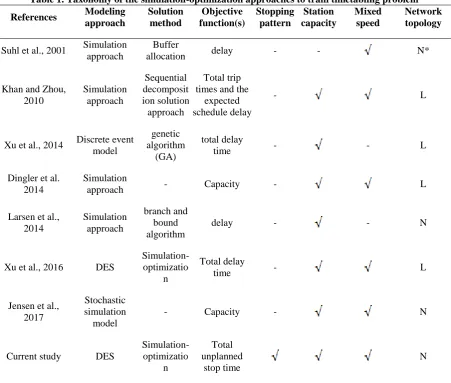
Taxonomy of the related studies has been provided in
Table 1. As can be seen, the majority of the existing approaches ignored the combined optimization of train schedule, sequence, and stopping patterns. The main research questions are (1) how to schedule the train stopping pattern and the timetable, (2) how the traffic can be handled by the available capacity and (3) how much extra stop time will be incurred for the designed timetable.
Table 1. Taxonomy of the simulation-optimization approaches to train timetabling problem
References Modeling
approach Solution method Objective function(s) Stopping pattern Station capacity Mixed speed Network topology
Suhl et al., 2001 Simulation approach
Buffer
allocation delay - - N*
Khan and Zhou, 2010 Simulation approach Sequential decomposit ion solution approach Total trip times and the
expected schedule delay
- L
Xu et al., 2014 Discrete event model
genetic algorithm
(GA)
total delay
time - - L
Dingler et al. 2014
Simulation
approach - Capacity - L
Larsen et al., 2014 Simulation approach branch and bound algorithm
delay - - N
Xu et al., 2016 DES
Simulation-optimizatio
n
Total delay
time - L
Jensen et al., 2017
Stochastic simulation model
- Capacity - N
Current study DES
Simulation-optimizatio n Total unplanned stop time N
* N: Network, L: Line
and stopping plans where the minimization of the total unplanned stop time is of interest. For this purpose, this paper proposes a discrete-event simulation modeling framework for mixed-speed train scheduling problems.
This study has several contributions to the field of train scheduling problem in railway networks. First, it provides an integrated simulation-optimization model to generate train plans under capacity constraints. Second, the constraints associated with train stops within the praying intervals are practically handled. In addition, the designed simulation model can generate a valid timetable under different scenarios. Third, the proposed approach has the capability of generating near-optimal solutions for real-world instances of the train scheduling problems.
2. Problem definition
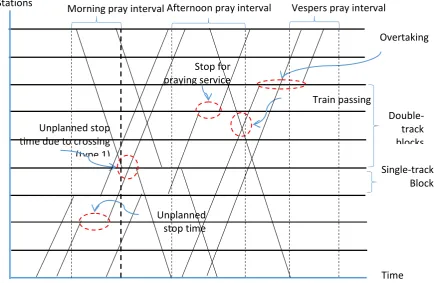
In this section, the formal definition of the train timetabling problem along with the representation of the input parameters, and model’s constraints are described in details. The rail network includes a set of stations and block sections and a set of operating trains (Fig. 1). Every line between two adjacent stations consists of a single or double block section. This follows the principle of absolute fixed block operations between two stations. In this case, every track between two stations corresponds to a single block section. Each train has a predefined route in the network. The signaling system controls the train traffic by imposing a minimum headway time.
Figure 1. The time-station graph of train movements
3.1. Notations
Symbols used in the train timetabling model are summarized in Table 2. In order to accurately formulate the meet and crossing conditions of the trains in blocks and station lines, parameter vij is used to determine the direction of movement in any part of the rail network. Without loss of the generality of modeling, two directions (+1 for inbound, -1 for outbound) redefined for each segment. If the train does not pass block, the corresponding vij is equal to zero.
Table 2. The notation of the parameters and sets
Symbol Definition
Index of train service
Block-station index
Index of track segment
k Counter of train operations (running on the rail segments or dwelling at stations)
p Index of praying services
Set of blocks/stations on the network
I The set of scheduled trains that has not been dispatched at the moment of disruption
P The set of religious services (morning, evening and Vesper)
The set of stations/blocks that ith train passes it ( )
Time Stations
Double-track blocks Single-track
Block
Unplanned stop time (type 2) Morning pray interval
Train passing Unplanned stop
time due to crossing (type 1)
Overtaking Afternoon pray interval Vespers pray interval
Set of stations for passenger stop ( )
The total number of trains in rail network
The minimum headway between the arrival/departure of trains at the station j
The kth operation of the train i
The direction of movement of train i on section j {1,-1,0}
The total number of operations for ith train
The number of block section at the jth station
The minimum and maximum travel time or stop time of train i at jth block
Earliest and latest scheduled departure time of origin for ith train
Stop time of trains at station j for prayer service within the pth religious horizon
=1 If there is a mosque at station j, and 0 otherwise
The lower and upper bounds for performing pth religious services
A large positive number
Table 3. The definition of decision variables
Definition
Arrival time of train i to block/station j Departure time of train i from block/station j Running time or stop time of train i in block/station j
If the train i1 enters the block/station j before the train i2 is equal to 1 and 0 otherwise. If the train i1 enters the block/station j after the train i2 is equal to 1, and 0 otherwise. If train i assigned to track number u in block/station j equals to 1, and 0 otherwise.
If train i stops at the station j within the pth religious horizon is equal to 1, and 0 otherwise. If train i have to stop within the pth religious horizon is equal to 1, and 0 otherwise.
If train i departs before the start time of pth religious horizon is equal to 1, and 0 otherwise. If train i arrives at the destination after the end time of pth religious horizon is equal to 1, and 0 otherwise.
The objective function of the integrated train timetabling and stop planning model is the total travel time of trains which is calculated by Equation (1). The represents the time of
optimization model determines the best stopping pattern for praying services. Equation (11) ensures that, in case of planned stop for praying, a specific station is assigned to each train to perform religious service. Constraints (12) imply that train can only stop at eligible stations for performing praying services. Constraints (13) define the conditions corresponding to the stopping pattern for pray services. Constraints (14) and (15) define the logical relationship that corresponds to the overlap between the train timetable and the praying interval. Constraints (16) define the lower and upper bounds for the time of praying services.
(1)
(2) (3) (4) (5) (6) (7)
(8)
(9) (10)
(11)
(12) (13)
(14)
(15) (16)
(17)
The model is formulated as an extended flexible job shop scheduling problem. It has been shown that the classic job shop scheduling problem belongs to the category of NP-Hard (Pinedo, 2015). Thus, the investigated problem belongs to the class of NP-Hard. Due to the computational complexity, the integrated simulation and optimization methods is proposed to solve the real-world instances of the train timetabling problems.
4. Simulation modeling approach
The railway network simulated in this paper consists of stations and links. The number of tracks and platforms inside the station modeled implicitly. The railway network topology is similar to a tree. Hence the routing of trains on the network is not really challenging part of modeling. Only just some bypass routes and limited connecting stations exist.
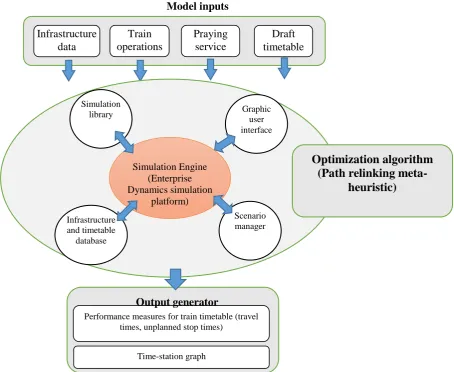
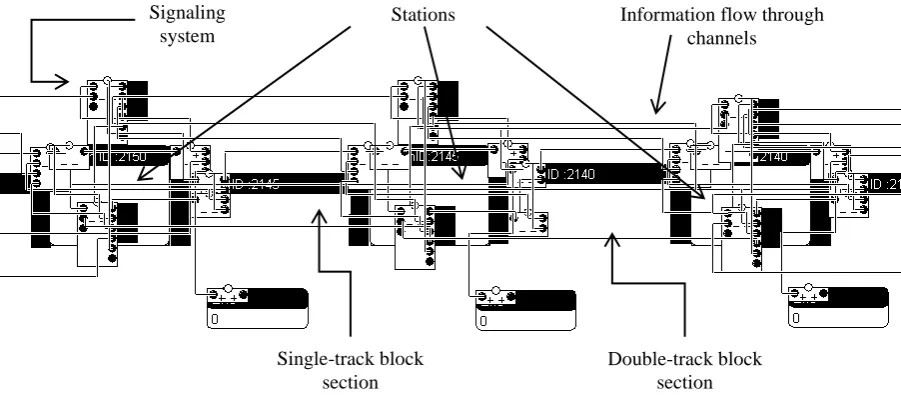
The architecture of the simulation-based decision support system is illustrated in Fig. 2. Briefly, the system is designed for infrastructure modeling layout, a simulation module, optimization module, a schedule evaluation module, and a graphical user interface (GUI). The proposed simulation-based decision support system has the capability of generating a conflict-free train schedule through a fast simulation engine. The model developers can access standard libraries of atoms to build simulation models. ED’s object-oriented architecture enhances the functionality of the simulation system. In addition to standard libraries, the modeler can design a customized library of objects (atoms) for modeling purposes. Successful applications of the Enterprise Dynamics in railway context can be found by (Hassannayebi et al., 2014, Hassannayebi et al., 2016, Middelkoop and Bouwman, 2001). In the language of ED, an atom is a multi-dimensional object. Each atom has different attributes e.g. size, location, speed, and dynamic behavior over time. Atoms can correspond to a resource, an entity, a data set, or a specific report (e.g. table or graph). As illustrated in Fig. 3, the developed simulation model of rail operations is composed of atoms that can be categorized as moving entities (vehicles), servers (rail segments), and queues (depots). Simulation engine implements an event handler that defines the behavior of an object. For example, when a train enters a station, the On-Entering event handler of the train is executed. The On-Entered event handler is executed when another moving object (e.g. a train) enters the container object (e.g. a block segment). Likewise, the On-Exiting and On-Exited event handlers are utilized to trigger the exit (or departure) events.
Figure 2. The architecture of the designed decision support system for train scheduling Infrastructure
data
Train operations
Praying service
Draft timetable
Performance measures for train timetable (travel times, unplanned stop times)
Time-station graph
Outputgenerator Simulation Engine
(Enterprise Dynamics simulation
platform)
Scenario manager Infrastructure
and timetable database
Graphic user interface Simulation
library
Model inputs
Optimization algorithm (Path relinking
Figure 3. A partial view of the designed simulation model in two-dimensional layout of ED
5. Solution method: path relinking algorithm
This article presents a Path relinking meta-heuristic algorithm for designing a conflict free train timetable. Path relinking algorithm was first presented by Glover and Laguna (1993) as a search strategy of exploring solution space between references solutions (Laguna and Glover, 1993). Path relinking algorithm is based on the process of generating a series of reference solutions. The process of creating a path of solutions leads to the set of combined solutions which may have better quality compared with elite solutions. The reader is referred to (Lai et al., 2016) for a recent review of path relinking algorithm and its extensions. Path relinking uses logical rules for linking solutions by combining promising elements of elite solutions. Each path of solutions can be constructed by using a starting solution and a directorial solution (selected from the reference set of elite solutions). The idea of generating path is to gradually introduce the promising attributes of the elite solution into the intermediate solutions. The moving direction of the generated paths can be forward, backward or hybrid.
The decision variables in the optimization model are defined as dispatch times of trains at the origin. The dispatching time takes places within a specified interval (usually an hour) in 5-minute slots ( ), e.g. 8:00, 8:05, 8:10, etc. For solution representation, a series of departure time are selected. One potential solution to the problem is represented by a sequence of integers Si = [d1, d2, d3, ..., dn]. The initial departure time of jth train is denoted by and allowed time interval is defined within the range [ , ]. The fitness function (F) is obtained by equation (18), where Cij and Tij are the non-planned stop time of types I and II at station , respectively.
(18 ) Scaling factor ( ) determines the relative importance of the two delay types. According to Iranian railway preferences, the second delay type is of more importance as against the first one. In addition, the penalty coefficient ( ) calculates the amount of infeasibility regarding the non-regular stop time for praying services. The penalty coefficient,
determines the feasibility of stopping pattern for jth during the pth praying interval.
Suppose two solutions x and y. The set Δ(x, y) is constructed by including non-common elements of these solutions. In the path generated from to , their shared characteristics remain unchanged. The algorithm starts from an initial solution and the best move of set
Stations
Single-track block section
Double-track block section Signaling
system
that has not been used, is performed. This process continues until we reach to the solution . The best intermediate solution is regarded as the output solution. The strategy of moving between initial solution and the guiding solution include forward, reverse, mix, and random. These differences rely on the selection of the initial and guiding solutions, the objective value as well as the moving direction between the two solutions.
The general framework of the integrated simulation-optimization method is illustrated in Fig. 4. In the proposed algorithm, a forward path relinking strategy is used. In this way, starting from the initial solution x, the target solution (y) is constructed progressively while keeping the common features of these two solutions. Featured from evolutionary optimization algorithms such as genetic algorithms and scatter search, path relinking can explore the problem space and generate a population of solutions. The population evolves by producing solutions that combine the solutions of the previous population. Thus, during the evolving process, a series of population P0, P1, P2 are constructed. The best-obtained solutions are defined as the reference population. The evolution of solution population is performed based on the criteria of quality and a variety of search tricks. The proposed algorithm starts by generating random initial solutions. The solutions are evaluated within the simulation model to determine the average value of the fitness function. The solution population evolves until stop criteria have been met.
Figure 4. The general framework of the integrated simulation-optimization method
If one of the following conditions is satisfied, a candidate solution enters to the reference set: The solution is better than all the solutions in the reference set.
Discrete event simulation Path relinking algorithm
Determine the level of confidence% 1-α, and the number
of simulation iterations (M)
Estimate the expected value of the fitness function • initialize the system state and the input variables and
attributes • Prepareevent list
Execution of the simulation model for current solution
Fitness function calculation Initial solution generation
(Building the reference set)
یراکتبا شور اب
Solution evaluation
Output generation
Compute the dissimilarity index (distance) between
solutions
Forward path relinking to generate intermediate solutions
Update the reference set
Average fitness value Encoded solution
Yes
Yes No No
Stop criteria satisfied?
The objective function value of the candidate solution is within the range of the best and worst objective values of the solutions in the reference set as well as the distance between this solution and the solutions in the reference set is larger than a specified amount.
The candidate solution should be replaced by one of the solutions of the reference set, as . The solution is not better than the candidate solution. In addition, it should be the closest (most similar) one compared with other solutions in the reference set. To determine the similarity between the two solutions, one must measure the distance between two defined solutions. The distance between solutions x1 and x2 is defined by the symbol d(x1,x2) that is obtained by equation (19). In this equation, the departure time of jth train for solution x is denoted by .
(19)
6. Result and discussion
6.1. Numerical example
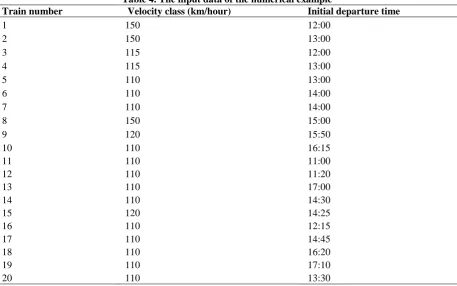
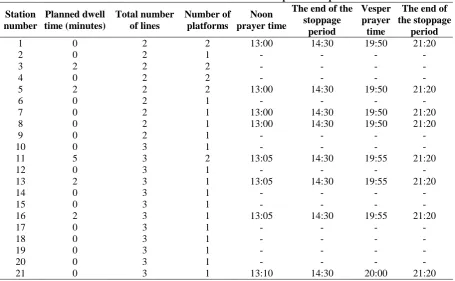
A numerical example is provided to verify the performance of the simulation model and the optimization algorithm. In this example, the 10 inbound and 10 outbound trains are scheduled on a partially single and double-track line with 21 stations. Two out of track segments are double track. The velocity class of the train is given which specify the running time on the sections. The stations with mosque belong to the set . The input data of the numerical example is given in Table 4.
Table 4. The input data of the numerical example
Train number Velocity class (km/hour) Initial departure time
1 150 12:00
2 150 13:00
3 115 12:00
4 115 13:00
5 110 13:00
6 110 14:00
7 110 14:00
8 150 15:00
9 120 15:50
10 110 16:15
11 110 11:00
12 110 11:20
13 110 17:00
14 110 14:30
15 120 14:25
16 110 12:15
17 110 14:45
18 110 16:20
19 110 17:10
20 110 13:30
3.3 GHz and 4 GB of RAM. The optimization algorithm was coded with a built-in scripting language (4DScript programming language) of ED software.
Table 5. The data of the rail infrastructure and operational parameters
Station number
Planned dwell time (minutes)
Total number of lines
Number of platforms
Noon prayer time
The end of the stoppage
period
Vesper prayer time
The end of the stoppage
period
1 0 2 2 13:00 14:30 19:50 21:20
2 0 2 1 - - - -
3 2 2 2 - - - -
4 0 2 2 - - - -
5 2 2 2 13:00 14:30 19:50 21:20
6 0 2 1 - - - -
7 0 2 1 13:00 14:30 19:50 21:20
8 0 2 1 13:00 14:30 19:50 21:20
9 0 2 1 - - - -
10 0 3 1 - - - -
11 5 3 2 13:05 14:30 19:55 21:20
12 0 3 1 - - - -
13 2 3 1 13:05 14:30 19:55 21:20
14 0 3 1 - - - -
15 0 3 1 - - - -
16 2 3 1 13:05 14:30 19:55 21:20
17 0 3 1 - - - -
18 0 3 1 - - - -
19 0 3 1 - - - -
20 0 3 1 - - - -
21 0 3 1 13:10 14:30 20:00 21:20
In what follows, the performance of the meta-heuristic algorithm for various parameters is tested. For this purpose, 9 scenarios were designed in accordance with the data given in Table 7. In each scenario, the algorithm run for 30 minutes and the best-found solutions are reported. Furthermore, the initial population and the pop-size are selected in accordance with increased departure tolerance. In the problem instances, the number of possible choices for
departure time of train j is . As a result, the total number of potential solution
to train dispatching problem is .
The total number of eligible stations to stop for praying services is denoted by L. In addition, the pray services are performed at intervals over the planning horizon. Thus, the maximum number of stops during the praying interval equals to LH.n. Accordingly, the maximum number of feasible schedule based on the model parameters is denoted by . It can be seen that by increasing the number of trains, the computational complexity is growing exponentially and thus the problem belongs to a class of NP-Hard
Table 6. The sensitivity of the optimization model against algorithm’s parameters
Scenario Departure tolerance K Pop-Size
F(xbest)
(minute)
Total unplanned stop time (hours)
first type second type
1 ±30 9 300 10 62 10.03 2
2 ±30 0.7 300 20 190 10.01 14
3 ±30 0.5 300 30 291 9.11 35
4 ±60 9 500 10 60 9.7 2
5 ±60 0.7 500 20 144 7.84 4
6 ±60 0.5 500 30 276 8.68 31
7 ±120 9 1000 10 51 8.5 0
8 ±120 0.7 1000 20 124 6.77 3
9 ±120 0.5 1000 30 216 7.1 6
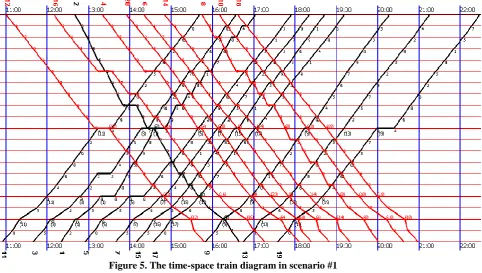
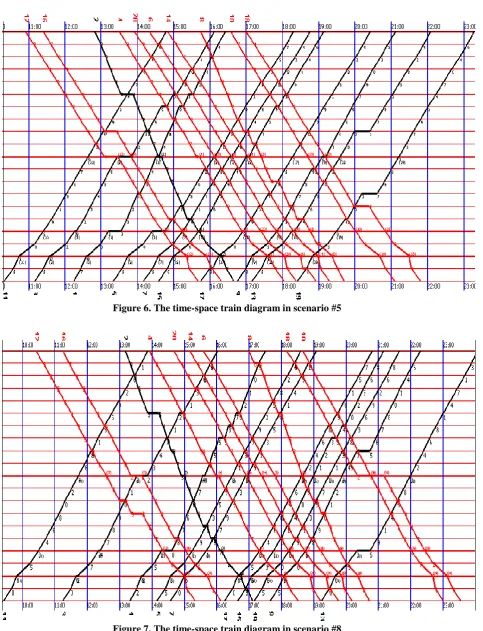
According to the obtained result, the performance of the algorithm has been improved by increasing the departure time tolerance. In addition, the choice of has a positive impact on the convergence of the algorithm. The result indicates that the scenarios 1,5, 8 are in high desirability due to the lowest unplanned stoppage time of trains. The time-space train diagram in scenarios #1, #5, and #8 are given in Figure 5 to Figure 7, respectively. As can be seen, in scenario 1, due to the compressed schedule, as anticipated, an overtaking has occurred between the train 2 and 16. But in scenarios 5 and 8, because of the increased range of traveling, there is no overtaking there.
Figure 6. The time-space train diagram in scenario #5
Figure 7. The time-space train diagram in scenario #8
6.2. Case study
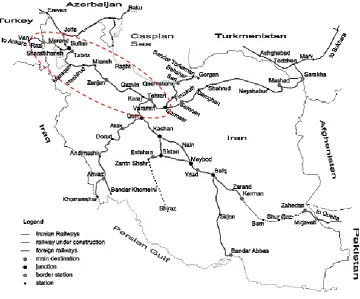
In this study, Tehran-Razi corridor is selected as a case study to assess the performance of the simulation-based optimization algorithm. This corridor is one of the most important East-West corridors. It connects the capital to the Turkish at the Razi border. The corridor includes 56 stations, 55 blocks, and 46 trains. All stations with praying zones have been implemented in the simulation application. All trains depart with a tolerance interval of ±60 minutes. All problems solved with penalty coefficient minutes. The optimization algorithm has been programmed with the 4DScript programming language of ED.
The result of the train scheduling model in Tehran-Razi route for various parameters is summarized in Table 7. The maximum execution time is set to 2 hours for all considered scenarios. In the best-found solution that has been manually generated by Railroad Company, the unplanned stop time of trains of type I and type II are 1030 and 30 minutes, respectively.
Figure 8. Iran railway network (Tehran-Razi corridor)
Table 7. The result of the train scheduling model in Tehran-Razi route
Scenario K
Pop-Size
F(xbest)
(minutes)
Total unplanned stop time of
first type (hours)
Total unplanned stop
time of second type (hours)
Reduction% of the total unplanned stop time of the
first type
Reduction% of the total unplanned stop time of the
second type
1 0.9 2000 30 107 1052 2 -2.14% 93.33%
2 0.9 2000 20 119 1100 10 -6.80% 66.67%
3 0.9 2000 10 97 970 0 5.83% 100.00%
4 0.8 1000 10 194 950 5 7.77% 83.33%
5 0.8 3000 30 225 1089 9 -5.73% 70.00%
6 0.7 2000 20 288 911 21 11.55% 30.00%
7 0.7 100 10 378 1148 48 -11.46% -60.00%
8 0.5 2000 20 471 900 42 12.62% -40.00%
9 0.6 1000 30 475 1123 43 -9.03% -43.33%
Figure 10. The convergence graph of Path-relinking algorithm
As a general rule, a faster convergence rate results in an improved and more realistic solution for the train scheduling model. A plot of solution quality progress against computational time is provided in Figure 10, which accounts for the convergence analysis of the proposed meta-heuristic algorithm. The search profiles are illustrated in Figure 10 in terms of different weight parameter. It should be noted that the computation time is essentially corresponding to the algorithm iterations, as each replication has an approximately constant time. The convergence graph of Path-relinking algorithm indicates diverse rates of convergence to the optimal solution in different scenarios. In all scenarios, the Path-relinking algorithm could converge to the near-optimal solution within the maximum execution time of two hours. As a conclusion, the computational results of the simulation-optimization method on a real case illustrate that the proposed approach is capable of finding an improved train timetable in reasonable computation times. The results highlight the importance of accounting for optimized stopping pattern in train schedules.
7. Conclusion
system is able to produce the desired train schedule in large-scale railway systems is in a reasonable time. Our findings will significantly contribute to the rail service planning as the simulation-optimization approach greatly supports timetabling process and allows moving from the theoretical experience to an applied one. This will benefit the rail companies by increasing efficiency and decreasing operational costs.
The combinatorial nature of the problem addressed in this study shows the difficulty of solving with exact methods. It is mainly because of the complexity and the large size of the train scheduling problem and the specific constraints in Iranian railway systems. Due to time constraint, the application of exact methods is limited. Correspondingly, we remark that no exact methods exist in the literature, dealing with stochastic factors and disruptions. The possibility to use exact methods for train scheduling problem in the network is left for future research.
Further research is required into integrated simulation-optimization approaches providing decision support for rail capacity planning procedures. In addition, the model can be extended by providing fast algorithms in the simulation model to reschedule trains in case of a disruption. Another area for future research is considering multi-objectives e.g. energy consumption, delay cost and the total traveling time in the optimization model.
References
Azadeh, A., GHaderi, S. and Izadbakhsh, H., (2008). "Integration of DEA and AHP with computer simulation for railway system improvement and optimization", Applied Mathematics and
Computation, Vol. 195, pp. 775-785.
Bhaskar, A., Cools, M. and Chung, E., (2017). "An investigation of timed transfer coordination using event-based multi agent simulation", Transportation Research Part C: Emerging Technologies. Cappara, A., Fischetti, M. and Toth, P., (2002). "Modeling and solving the train timetabling problem",
Operations Research, Vol. 50, pp. 851-861.
Carey, M. and Carville, S., (2003). "Scheduling and platforming trains at busy complex stations",Transportation Research Part A: Policy and Practice, Vol. 37, pp. 195-224.
Confessore, G., Liotta, G., Cicini, P., Rondione, F. and De luca, P., (2009). "A simulation-based approach for estimating the commercial capacity of railways", Simulation Conference (WSC), Proceedings of the 2009 Winter, IEEE, pp. 2542-2552.
Dessouky, M. M. and Leachman, R. C., (1995). "A simulation modeling methodology for analyzing large complex rail networks", Simulation, Vol. 65, pp. 131-142.
Dingler, M., Lai, Y.-C. and Barkan, C., (2009). "Impact of train type heterogeneity on single-track railway capacity", Transportation Research Record: Journal of the Transportation Research Board, pp. 41-49.
Dingler, M. H., Lai, Y.-C. and Barkan, C. P., (2014). "Effect of train-type heterogeneity on single-track heavy haul railway line capacity", Proceedings of the Institution of Mechanical Engineers, Part F: Journal of Rail and Rapid Transit, Vol. 228, pp. 845-856.
Eskandari, H., Rahaee, M. A., Memarpour ,M., Nayebi, E. H. and Malek, S., (2013). "A. Evaluation of different berthing scenarios in Shahid Rajaee container terminal using discrete-event simulation", Proceedings of the 2013 Winter Simulation Conference: Simulation: Making Decisions in a Complex World, 2013 .IEEE Press, pp. 3462-3474.
Froid, O., Sipila, H. and Warg, J., (2014). "Capacity for express trains on mixed traffic lines",
International Journal of Rail Transportation, Vol. 2, pp. 17-27.
Goverde, R. M., (2005). "Punctuality of railway operations and timetable stability analysis",
Netherlands TRAIL Research School.
Hajian-Heidary, M. and Aghaei, A., (2015). "Risk measurement in the global supply chain using monte-carlo simulation", Journal of Industrial Engineering and Management Studies, Vol. 2, pp. 1-12.
Hassannayebi, E., Sajedinejad, A. and Mardani, S., (2014). "Urban rail transit planning using a two-stage simulation-based optimization approach", Simulation Modelling Practice and Theory, Vol. 49, pp. 151-166.
Hassannayebi, E., Sajedinejad, A. and Mardani, S., (2016). Disruption Management in Urban Rail
Transit System: A Simulation Based Optimization Approach, Handbook of Research on Emerging
Innovations in Rail Transportation Engineering. IGI Global.
Hassannayebi E., Zegordi, S. H., Yaghini, M. and Amin naseri, M. R., (2017). "Timetable optimization models and methods for minimizing passenger waiting time at public transit terminals",
Transportation Planning and Technology, Vol. 40, pp. 278-304.
Hullinger, D. R., (1999). "Taylor enterprise dynamics", Simulation Conference Proceedings, Winter, 1999. IEEE, 227-229.
Ilati, G., Sheikholeslami, A. and Hassannayebi, E., (2014). "A Simulation-Based Optimization Approach for Integrated Port Resource Allocation Problem", PROMET-Traffic&Transportation, Vol. 26, pp.243-255.
Jensen, L. W., Landex, A., Nielsen, O. A., Kroon, L. G. and Schmidt, M., (2017). "Strategic assessment of capacity consumption in railway networks: Framework and model", Transportation
Research Part C: Emerging Technologies, Vol. 74, pp. 126-149.
Keiji, K., Naohiko ,H. and Shigeru, M., (2015). "Simulation analysis of train operation to recover knock-on delay under high-frequency intervals", Case Studies on Transport Policy, Vol. 3, pp. 92-98. Khan, M. B. and Zhou, X., (2010). "Stochastic optimization model and solution algorithm for robust double-track train-timetabling problem", Intelligent Transportation Systems, IEEE Transactions on, Vol. 11, pp. 81-89.
Laguna, M. and Glover, F., (1993). "Bandwidth packing: a tabu search approach", Management
science, Vol. 39, pp. 492-500.
Lia, X., Hao, J.-K., LÜ, Z. and Glover, F., (2016). "A learning-based path relinking algorithm for the bandwidth coloring problem", Engineering Applications of Artificial Intelligence, Vol. 52, pp. 81-91. Larsen, R., Pranzo, M., D’ariano, A., Corman, F. and Pacciarelli, D., (2014). "Susceptibility of optimal train schedules to stochastic disturbances of process times", Flexible Services and
Manufacturing Journal, Vol. 26, pp. 466-489.
Mattson, L.-G., (2007). "Railway capacity and train delay relationships", Critical Infrastructure, Springer.
Medeossi, G., Longo, G. and De Fabris ,S., (2011). "A method for using stochastic blocking times to improve timetable planning", Journal of Rail Transport Planning & Management, Vol. 1, pp. 1-13. Middelkoop, D. and Bouwman, M. Simone, (2001). "large scale train network simulations", Proceedings of the 33nd conference on Winter simulation, 2001. IEEE Computer Society, 1042-1047. Motraghi, A. and Marinov, M. V., (2012). "Analysis of urban freight by rail using event based simulation", Simulation Modelling Practice and Theory, Vol. 25, pp. 73-89.
Noordeen, M., (1996). "Stability analysis of cyclic timetables for a highly interconnected rail network", PhD thesis.
Pouryousef, H., Lautala, P. and White, T., (2015). "Railroad capacity tools and methodologies in the US and Europe", Journal of Modern Transportation, Vol. 23, pp. 30-42.
Rudolph, R. and Demitz, J., (2003). "Simulation of large railway networks", Robustness test for the timetable 2003 in North Rhine Westphalia, Germany. Proceedings of the World Congress on Railway Research, 2003. 644-652.
Sajedinejad, A., Mardani, S., Hassannayebi, E., Mir Mohammadi K, S. and Kabirian, A. Simarail, (2001). "simulation based optimization software for scheduling railway network", Simulation Conference (WSC), Proceedings of the 2011 Winter, 2011, IEEE, pp. 3730-3741.
Stankaitis, P., Iliasov, A. and Romanovsky, A., (2017). "A Railway Simulation Suite For Modelling Advanced Railway Control Systems", International Journal of Transport Development and
Integration, Vol. 1, pp. 558-567.
Suhl, L., Mellouli, T., Biederbick, C. and Geocke, J., (2001). "Managing and preventing delays in railway traffic by simulation and optimization", Mathematical methods on optimization in
transportation systems. Springer.
Vromans, M. J. C. M., (2005). "Reliability of railway systems", Erasmus University Rotterdam. Warg, J. and Bohlin, M., (2016). "The use of railway simulation as an input to economic assessment of timetables", Journal of Rail Transport Planning & Management, Vol. 6, pp. 255-270.
Xu, X., LI, K. and Yang, L., (2016). "Rescheduling subway trains by a discrete event model considering service balance performance", Applied Mathematical Modelling, Vol. 40, pp. 1446-1466. Xu, X., LI, K., Yang, L. and Ye, J., (2014). "Balanced train timetabling on a single-line railway with optimized velocity", Applied Mathematical Modelling, Vol. 38, pp. 894-909.
Zhou, L., Tong, L. C., Chen, J., Tang, J. and Zhou ,X., (2017). "Joint optimization of high-speed train timetables and speed profiles: A unified modeling approach using space-time-speed grid networks",