An Analysis of Active Learning Strategies for Sequence Labeling Tasks
Burr Settles∗† ∗
Dept. of Computer Sciences University of Wisconsin Madison, WI 53706, USA [email protected]
Mark Craven†∗ †
Dept. of Biostatistics & Medical Informatics University of Wisconsin
Madison, WI 53706, USA [email protected]
Abstract
Active learning is well-suited to many prob-lems in natural language processing, where unlabeled data may be abundant but annota-tion is slow and expensive. This paper aims to shed light on the best active learning ap-proaches for sequence labeling tasks such as information extraction and document segmen-tation. We survey previously used query selec-tion strategies for sequence models, and pro-pose several novel algorithms to address their shortcomings. We also conduct a large-scale empirical comparison using multiple corpora, which demonstrates that our proposed meth-ods advance the state of the art.
1 Introduction
Traditional supervised learning algorithms use whatever labeled data is provided to induce a model. By contrast, active learninggives the learner a de-gree of control by allowing it to select which in-stances are labeled and added to the training set. A typical active learner begins with a small labeled set L, selects one or more informativequery instances from a large unlabeled poolU, learns from these la-beled queries (which are then added toL), and re-peats. In this way, the learner aims to achieve high accuracy with as little labeling effort as possible. Thus, active learning can be valuable in domains where unlabeled data are readily available, but ob-taining training labels is expensive.
Such is the case with many sequence labeling
tasks in natural language domains. For example, part-of-speech tagging (Seung et al., 1992; Lafferty
et al., 2001), information extraction (Scheffer et al., 2001; Sang and DeMeulder, 2003; Kim et al., 2004), and document segmentation (Carvalho and Cohen, 2004) are all typically treated as sequence labeling problems. The source data for these tasks (i.e., text documents in electronic form) are often easily ob-tained. However, due to the nature of sequence la-beling tasks, annotating these texts can be rather te-dious and time-consuming, making active learning an attractive technique.
While there has been much work on active learn-ing for classification (Cohn et al., 1994; McCallum and Nigam, 1998; Zhang and Oles, 2000; Zhu et al., 2003), active learning for sequence labeling has received considerably less attention. A few meth-ods have been proposed, based mostly on the con-ventions ofuncertainty sampling, where the learner queries the instance about which it has the least cer-tainty (Scheffer et al., 2001; Culotta and McCallum, 2005; Kim et al., 2006), or query-by-committee, where a “committee” of models selects the instance about which its members most disagree (Dagan and Engelson, 1995). We provide more detail on these and the new strategies we propose in Section 3.
The comparative effectiveness of these ap-proaches, however, has not been studied. Further-more, it has been suggested that uncertainty sam-pling and query-by-committee fail on occasion (Roy and McCallum, 2001; Zhu et al., 2003) by query-ing outliers, e.g., instances considered informative in isolation by the learner, but containing little infor-mation about therestof the distribution of instances. Proposed methods for dealing with these shortcom-ings have so far only considered classification tasks.
This paper presents two major contributions for active learning and sequence labeling tasks. First, we motivate and introduce several new query strate-gies for probabilistic sequence models. Second, we conduct a thorough empirical analysis of previously proposed methods with our algorithms on a variety of benchmark corpora. The remainder of this pa-per is organized as follows. Section 2 provides a brief introduction to sequence labeling and condi-tional random fields (the sequence model used in our experiments). Section 3 describes in detail all the query selection strategies we consider. Section 4 presents the results of our empirical study. Section 5 concludes with a summary of our findings.
2 Sequence Labeling and CRFs
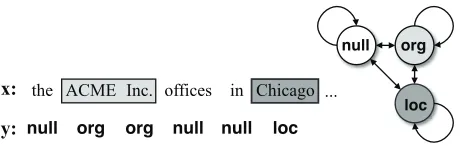
In this paper, we are concerned with active learn-ing for sequence labellearn-ing. Figure 1 illustrates how, for example, an information extraction prob-lem can be viewed as a sequence labeling task. Letx = hx1, . . . , xTi be an observation sequence of length T with a corresponding label sequence y = hy1, . . . , yTi. Words in a sentence corre-spond to tokens in the input sequencex, which are mapped to labels iny. These labels indicate whether the word belongs to a particular entity class of inter-est (in this case, organdloc) or not (null). These labels can be assigned by a sequence model based on a finite state machine, such as the one shown to the right in Figure 1.
We focus our discussion of active learning for sequence labeling onconditional random fields, or CRFs (Lafferty et al., 2001). The rest of this sec-tion serves as a brief introducsec-tion. CRFs are sta-tistical graphical models which have demonstrated state-of-the-art accuracy on virtually all of the se-quence labeling tasks mentioned in Section 1. We use linear-chain CRFs, which correspond to condi-tionally trained probabilistic finite state machines.
A linear-chain CRF model with parametersθ de-fines the posterior probability ofygivenxto be1:
P(y|x;θ) = 1 Z(x)exp
T
X
t=1
K
X
k=1
θkfk(yt−1, yt,xt)
!
.
(1)
1
Our discussion assumes, without loss of generality, that each label is uniquely represented by one state, thus each label sequenceycorresponds to exactly one path through the model.
loc org null
x: y:
... the
null
ACME
org
Inc.
org
offices
null
in
null
Chicago
loc
Figure 1: An information extraction example treated as a sequence labeling task. Also shown is a corresponding sequence model represented as a finite state machine.
Here Z(x) is a normalization factor over all pos-sible labelings of x, and θk is one of K model parameter weights corresponding to some feature fk(yt−1, yt,xt). Each feature fk describes the se-quencexat positiontwith labelyt, observed along a transition from label statesyt−1 toyt in the finite state machine. Consider the example text from Fig-ure 1. Here,fkmight be the feature WORD=ACME and have the valuefk =1 along a transition from the null state to the org state (and 0 elsewhere). Other features set to 1 here might be ALLCAPSand NEXTWORD=Inc. The weights inθare set to max-imize the conditional log likelihood`of training se-quences in the labeled data setL:
`(L;θ) = L X
l=1
logP(y(l)|x(l);θ)−
K X
k=1
θk2 2σ2,
whereLis the size of the labeled setL, and the sec-ond term is a Gaussian regularization penalty onkθk to prevent over-fitting. After training, labels can be predicted for new sequences using the Viterbi algo-rithm. For more details on CRFs and their training procedures, see Sutton and McCallum (2006).
Note that, while we describe the active learning algorithms in the next section in terms of linear-chain CRFs, they have analogs for other kinds of sequence models, such as hidden Markov models, or HMMs (Rabiner, 1989), probabilistic context-free grammars (Lari and Young, 1990), and general CRFs (Sutton and McCallum, 2006).
3 Active Learning with Sequence Models
[image:2.612.310.540.55.128.2]Given: Labeled setL, unlabeled poolU, query strategyφ(·), query batch sizeB
repeat
// learn a model using the currentL θ= train(L);
forb= 1toBdo
// query the most informative instance
x∗b = arg maxx∈Uφ(x);
// move the labeled query fromU toL L=L ∪ hx∗b,label(x∗b)i;
U =U −x∗b ; end
untilsome stopping criterion;
Algorithm 1: Pool-based active learning.
Algorithm 1 provides a sketch of the generic pool-based active learning scenario.
In the remainder of this section, we describe var-ious query strategy formulations of φ(·) that have been used for active learning with sequence mod-els. We also point out where we think these ap-proaches may be flawed, and propose several novel query strategies to address these issues.
3.1 Uncertainty Sampling
One of the most common general frameworks for measuring informativeness is uncertainty sampling
(Lewis and Catlett, 1994), where a learner queries the instance that it is most uncertain how to la-bel. Culotta and McCallum (2005) employ a sim-ple uncertainty-based strategy for sequence models calledleast confidence (LC):
φLC(x) = 1−P(y∗|x;θ).
Here,y∗ is the most likely label sequence, i.e., the Viterbi parse. This approach queries the instance for which the current model has the least confidence in its most likely labeling. For CRFs, this confi-dence can be calculated using the posterior proba-bility given by Equation (1).
Scheffer et al. (2001) propose another uncertainty strategy, which queries the instance with the smallest margin between the posteriors for its two most likely labelings. We call this approachmargin (M):
φM(x) =− P(y∗1|x;θ)−P(y∗2|x;θ)
.
Here, y∗1 and y∗2 are the first and second best la-bel sequences, respectively. These can be efficiently computed using the N-best algorithm (Schwartz and Chow, 1990), a beam-search generalization of Viterbi, withN =2. The minus sign in front is sim-ply to ensure that φM acts as a maximizer for use with Algorithm 1.
Another uncertainty-based measure of informa-tiveness is entropy (Shannon, 1948). For a dis-crete random variable Y, the entropy is given by H(Y) = −P
iP(yi) logP(yi), and represents the information needed to “encode” the distribution of outcomes forY. As such, is it often thought of as a measure of uncertainty in machine learning. In active learning, we wish to use the entropy of our model’s posteriors over its labelings. One way this has been done with probabilistic sequence models is by computing what we calltoken entropy (TE):
φT E(x) =−1
T
T
X
t=1
M
X
m=1
Pθ(yt=m) logPθ(yt=m),
(2) whereT is the length of x,m ranges over all pos-sible token labels, and Pθ(yt = m) is shorthand for the marginal probability that m is the label at positiontin the sequence, according to the model. For CRFs and HMMs, these marginals can be effi-ciently computed using the forward andbackward
algorithms (Rabiner, 1989). The summed token en-tropies have typically been normalized by sequence lengthT, to avoid simply querying longer sequences (Baldridge and Osborne, 2004; Hwa, 2004). How-ever, we argue that querying long sequences should not be explicitly discouraged, if in fact they contain more information. Thus, we also propose thetotal token entropy (TTE)measure:
φT T E(x) =T×φT E(x).
For most sequence labeling tasks, however, it is more appropriate to consider the entropy of the la-bel sequenceyas a whole, rather than some aggre-gate of individual token entropies. Thus an alternate query strategy issequence entropy (SE):
φSE(x) =−X
ˆ y
P(ˆy|x;θ) logP(ˆy|x;θ), (3)
of possible labelings grows exponentially with the length of x. To make this feasible, previous work (Kim et al., 2006) has employed an approximation we callN-best sequence entropy (NSE):
φN SE(x) =−X
ˆ
y∈N
P(ˆy|x;θ) logP(ˆy|x;θ),
where N = {y∗1, . . . ,yN∗ }, the set of theN most likely parses, and the posteriors are re-normalized (i.e.,Z(x)in Equation (1) only ranges overN). For N =2, this approximation is equivalent toφM, thus N-best sequence entropy can be thought of as a gen-eralization of the margin approach.
Recently, an efficient entropy calculation via dy-namic programming was proposed for CRFs in the context of semi-supervised learning (Mann and Mc-Callum, 2007). We use this algorithm to compute the true sequence entropy (3) for active learning in a constant-time factor of Viterbi’s complexity. Hwa (2004) employed a similar approach for active learn-ing with probabilistic context-free grammars.
3.2 Query-By-Committee
Another general active learning framework is the
query-by-committee(QBC) approach (Seung et al., 1992). In this setting, we use a committee of models C = {θ(1), . . . , θ(C)} to represent C different hy-potheses that are consistent with the labeled set L. The most informative query, then, is the instance over which the committee is in most disagreement about how to label.
In particular, we use the query-by-bagging ap-proach (Abe and Mamitsuka, 1998) to learn a com-mittee of CRFs. In each round of active learning, L is sampled (with replacement) Ltimes to create a unique, modified labeled set L(c). Each model
θ(c) ∈ Cis then trained using its own corresponding labeled set L(c). To measure disagreement among
committee members, we consider two alternatives. Dagan and Engelson (1995) introduced QBC with HMMs for part-of-speech tagging using a measure calledvote entropy (VE):
φV E(x) =−1
T
T
X
t=1
M
X
m=1
V(yt, m)
C log
V(yt, m)
C ,
whereV(yt, m)is the number of “votes” labelm re-ceives from all the committee member’s Viterbi la-belings at sequence positiont.
McCallum and Nigam (1998) propose a QBC strategy for classification based onKullback-Leibler (KL) divergence, an information-theoretic measure of the difference between two probability distribu-tions. The most informative query is considered to be the one with the largest average KL divergence between a committee member’s posterior label dis-tribution and the consensus. We modify this ap-proach for sequence models by summing the average KL scores using the marginals at each token position and, as with vote entropy, normalizing for length. We call this approachKullback-Leibler (KL):
φKL(x) = 1 T
T X
t=1
1 C
C X
c=1
D(θ(c)kC),
where (using shorthand again):
D(θ(c)kC) =
M
X
m=1
Pθ(c)(yt=m) log
Pθ(c)(yt=m)
PC(yt=m)
.
HerePC(yt=m) = C1 PcC=1Pθ(c)(yt=m), or the
“consensus” marginal probability thatmis the label at positiontin the sequence.
Both of these disagreement measures are normal-ized for sequence length T. As with token en-tropy (2), this may bias the learner toward query-ing shorter sequences. To study the effects of nor-malization, we also conduct experiments with non-normalized variantsφT V EandφT KL.
Additionally, we argue that these token-level dis-agreement measures may be less appropriate for most tasks than measuring the committee’s disagree-ment about the label sequenceyas a whole. There-fore, we proposesequence vote entropy (SVE):
φSV E(x) =− X
ˆ
y∈NC
P(ˆy|x;C) logP(ˆy|x;C),
where NC is the union of the N-best parses from all models in the committee C, and P(ˆy|x;C) =
1
C PC
c=1P(ˆy|x;θ(c)), or the “consensus” posterior
probability for some label sequenceyˆ. This can be thought of as a QBC generalization ofN-best en-tropy, where each committee member casts a vote for the posterior label distribution. We also explore asequence Kullback-Leibler (SKL)variant:
φSKL(x) = 1 C
C
X
c=1 X
ˆ
y∈NC
P(ˆy|x;θ(c)) logP(ˆy|x;θ (c))
3.3 Expected Gradient Length
A third general active learning framework we con-sider is to query the instance that would impart the greatest change to the current modelif we knew its label. Since we train discriminative models like CRFs using gradient-based optimization, this in-volves querying the instance which, if labeled and added to the training set, would create the greatest change in the gradient of the objective function (i.e., the largest gradient vector used to re-estimate pa-rameter values).
Let ∇`(L;θ) be the gradient of the log-likelihood`with respect to the model parametersθ, as given by Sutton and McCallum (2006). Now let ∇`(L+hx,yi;θ) be the new gradient that would be
obtained by adding the training tuple hx,yi to L. Since the query algorithm does not know the true la-bel sequenceyin advance, we instead calculate the expected gradient length (EGL):
φEGL(x) = X
ˆ
y∈N
P(ˆy|x;θ)
∇`(L
+hx,yˆi;θ) ,
approximated as an expectation over theN-best la-belings, wherek · k is the Euclidean norm of each resulting gradient vector. We first introduced this ap-proach in previous work on multiple-instance active learning (Settles et al., 2008), and adapt it to query selection with sequences here. Note that, at query time, ∇`(L;θ) should be nearly zero since ` con-verged at the previous round of training. Thus, we can approximate ∇`(L+hx,yˆi;θ) ≈ ∇`(hx,yiˆ ;θ)
for computational efficiency, because the training in-stances are assumed to be independent.
3.4 Information Density
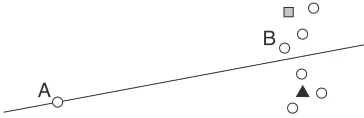
It has been suggested that uncertainty sampling and QBC are prone to querying outliers (Roy and Mc-Callum, 2001; Zhu et al., 2003). Figure 2 illtrates this problem for a binary linear classifier us-ing uncertainty samplus-ing. The least certain instance lies on the classification boundary, but is not “rep-resentative” of other instances in the distribution, so knowing its label is unlikely to improve accuracy on the data as a whole. QBC and EGL exhibit similar behavior, by spending time querying possible out-liers simply because they are controversial, or are expected to impart significant change in the model.
A
[image:5.612.331.513.57.116.2]B
Figure 2: An illustration of when uncertainty sampling can be a poor strategy for classification. Shaded poly-gons represent labeled instances (L), and circles repre-sent unlabeled instances (U). SinceAis on the decision boundary, it will be queried as the most uncertain. How-ever, queryingB is likely to result in more information about the data as a whole.
We argue that this phenomenon can occur with se-quence labeling tasks as well as with classification. To address this, we propose a new active learning approach calledinformation density (ID):
φID(x) =φSE(x)× 1 U
U X
u=1
sim(x,x(u))
!β
.
That is, the informativeness ofxis weighted by its average similarity to all other sequences inU, sub-ject to a parameterβ that controls the relative im-portance of the density term. In the formulation pre-sented above, sequence entropyφSE measures the “base” informativeness, but we could just as easily use any of the instance-level strategies presented in the previous sections.
This density measure requires us to compute the similarity of two sequences. To do this, we first transform each x, which is a sequence of feature vectors (tokens), into a single kernel vector~x:
~x=
" T X
t=1
f1(xt), . . . , T X
t=1
fJ(xt) #
,
wherefj(xt)is the value of featurefj for tokenxt, andJis the number of features in the input represen-tation2. In other words, sequencexis compressed into a fixed-length feature vector~x, for which each element is the sum of the corresponding feature’s values across all tokens. We can then use cosine
2
Note thatJ6=K, andfj(xt)here differs slightly from the feature definition given in Section 2. Since the labelsyt−1and
similarity on this simplified representation:
simcos(x,x(u)) = ~ x·~x(u)
k~xk × k~x(u)k.
We have also investigated similarity functions based on exponentiated Euclidean distance and KL-divergence, the latter of which was also employed by McCallum and Nigam (1998) for density-weighting QBC in text classification. However, these measures show no improvement over cosine similarity, and re-quire setting additional hyper-parameters.
One potential drawback of information density is that the number of required similarity calculations grows quadratically with the number of instances inU. For pool-based active learning, we often as-sume that the size of U is very large. However, these densities only need to be computed once, and are independent of the base information measure. Thus, when employing information density in a real-world interactive learning setting, the density scores can simply be pre-computed and cached for efficient lookup during the actual active learning process.
3.5 Fisher Information
We also introduce a query selection strategy for se-quence models based onFisher information, build-ing on the theoretical framework of Zhang and Oles (2000). Fisher informationI(θ)represents the over-all uncertainty about the estimated model parame-tersθ, as given by:
I(θ) =−
Z
x
P(x)
Z
y
P(y|x;θ) ∂
2
∂θ2 logP(y|x;θ).
For a model with K parameters, the Fisher infor-mation takes the form of aK ×K covariance ma-trix. Our goal in active learning is to select the query that most efficiently minimizes the model variance reflected inI(θ). This can be accomplished by op-timizing theFisher information ratio (FIR):
φF IR(x) =−tr Ix(θ)−1IU(θ), (4)
whereIx(θ)andIU(θ)are Fisher information
ma-trices for sequencexand the unlabeled pool U, re-spectively. The leading minus sign again ensures thatφF IRis a maximizer for use with Algorithm 1.
Previously, Fisher information for active learning has only been investigated in the context of simple binary classification. When employing FIR with se-quence models like CRFs, there are two additional computational challenges. First, we must integrate over all possible labelingsy, which can, as we have seen, be approximated as an expectation over theN -best labelings. Second, the inner product in the ratio calculation (4) requires inverting aK ×K matrix for eachx. In most interesting natural language ap-plications, K is very large, making this algorithm intractable. However, it is common in similar situ-ations to approximate the Fisher information matrix with its diagonal (Nyffenegger et al., 2006). Thus we estimateIx(θ)using:
Ix(θ) = X
ˆ
y∈N
P(ˆy|x;θ) "
∂logP(ˆy|x;θ) ∂θ1
2
+δ, . . . ,
∂logP(ˆy|x;θ)
∂θK
2 +δ
#
,
andIU(θ)using:
IU(θ) =
1 U
U X
u=1
Ix(u)(θ).
For CRFs, the partial derivative at the root of each element in the diagonal vector is given by:
∂logP(ˆy|x;θ) ∂θk
=
T
X
t=1
fk(ˆyt−1,yˆt,xt)
−
T
X
t=1 X
y,y0
P(y, y0|x)fk(y, y0,xt),
which is similar to the equation used to compute the training gradient, but without a regularization term. A smoothing parameterδ 1 is added to prevent division by zero when computing the ratio.
Notice that this method implicitly selects repre-sentative instances by favoring queries with Fisher informationIx(θ)that is not only high, but similar to that of the overall data distributionIU(θ). This
Corpus Entities Features Instances
CoNLL-03 4 78,644 19,959
NLPBA 5 128,401 18,854
BioCreative 1 175,331 10,000
FlySlip 1 31,353 1,220
CORA:Headers 15 22,077 935
CORA:References 13 4,208 500
Sig+Reply 2 25 617
[image:7.612.85.282.57.159.2]SigIE 12 10,600 250
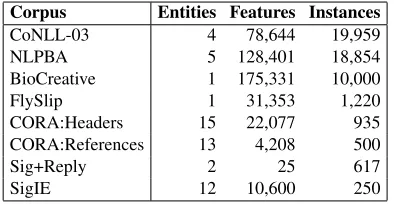
Table 1: Properties of the different evaluation corpora.
4 Empirical Evaluation
In this section we present a large-scale empirical analysis of the query strategies described in Sec-tion 3 on eight benchmark informaSec-tion extracSec-tion and document segmentation corpora. The data sets are summarized in Table 1.
4.1 Data and Methodology
CoNLL-03 (Sang and DeMeulder, 2003) is a col-lection of newswire articles annotated with four en-tities: person, organization, location, and misc. NLPBA (Kim et al., 2004) is a large collection of biomedical abstracts annotated with five entities of interest, such as protein, RNA, and cell-type. BioCreative (Yeh et al., 2005) and FlySlip (Vla-chos, 2007) also comprise texts in the biomedical domain, annotated forgeneentity mentions in arti-cles from the human and fruit fly literature, respec-tively. CORA (Peng and McCallum, 2004) consists of two collections: a set of research paper headers annotated for entities such astitle,author, and insti-tution; and a collection of references annotated with BibTeX fields such asjournal,year, andpublisher. The Sig+Reply corpus (Carvalho and Cohen, 2004) is a set of email messages annotated forsignature and quotedreplyline segments. SigIE is a subset of the signature blocks from Sig+Reply which we have enhanced with several address book fields such as name,email, andphone. All corpora are format-ted in the “IOB” sequence representation (Ramshaw and Marcus, 1995).
We implement all fifteen query selection strate-gies described in Section 3 for use with CRFs, and evaluate them on all eight data sets. We also com-pare against two baseline strategies: random in-stance selection (i.e., passive learning), and na¨ıvely querying the longest sequence in terms of tokens.
We use a typical feature set for each corpus based on the cited literature (including words, orthographic patterns, part-of-speech, lexicons, etc.). Where the N-best approximation is used N =15, and for all QBC methodsC=3; these figures exhibited a good balance of accuracy and training speed in prelimi-nary work. For information density, we arbitrarily set β = 1 (i.e., the information and density terms have equal weight). In each experiment, L is ini-tialized with five random labeled instances, and up to 150 queries are subsequently selected fromU in batches of size B = 5. All results are averaged across five folds using cross-validation.
We evaluate each query strategy by constructing learning curves that plot the overallF1 measure (for
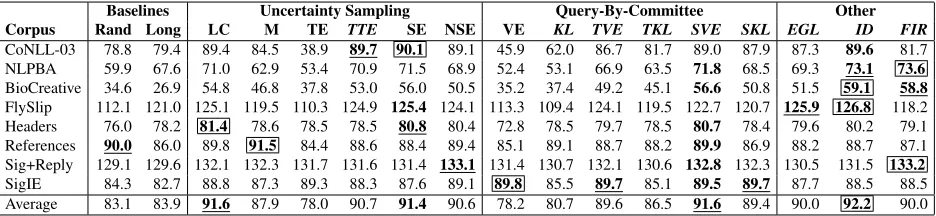
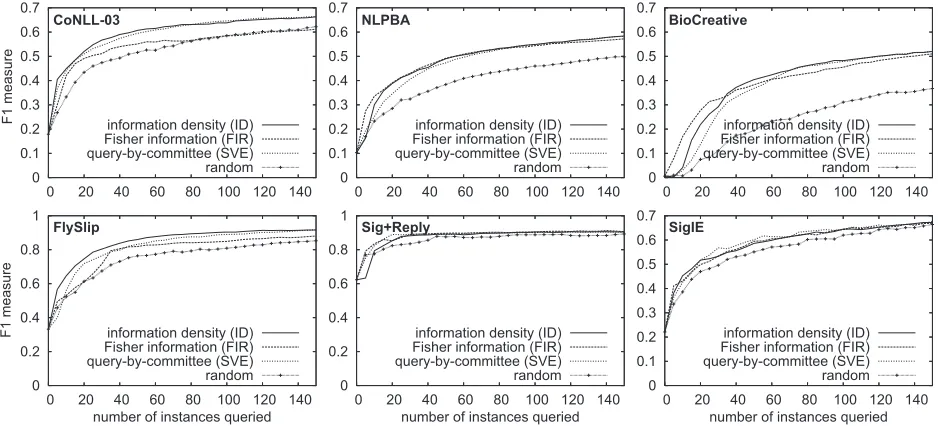
all entities or segments) as a function of the num-ber of instances queried. Due to lack of space, we cannot show learning curves for every experiment. Instead, Table 2 summarizes our results by reporting the area under the learning curve for all strategies on all data. Figure 3 presents a few representative learning curves for six of the corpora.
4.2 Discussion of Learning Curves
The first conclusion we can draw from these results is that there is no single clear winner. However, in-formation density (ID), which we introduce in this paper, stands out. It usually improves upon the base sequence entropy measure, never performs poorly, and has the highest average area under the learning curve across all tasks. It seems particularly effective on large corpora, which is a typical assumption for the active learning setting. Sequence vote entropy (SVE), a QBC method we propose here, is also note-worthy in that it is fairly consistently among the top three strategies, although never the best.
Second, the top uncertainty sampling strategies are least confidence (LC) and sequence entropy (SE), the latter being the dominant entropy-based method. Among the QBC strategies, sequence vote entropy (SVE) is the clear winner. We conclude that these three methods are the best base information measures for use with information density.
length-Baselines Uncertainty Sampling Query-By-Committee Other Corpus Rand Long LC M TE TTE SE NSE VE KL TVE TKL SVE SKL EGL ID FIR
[image:8.612.70.538.57.165.2]CoNLL-03 78.8 79.4 89.4 84.5 38.9 89.7 90.1 89.1 45.9 62.0 86.7 81.7 89.0 87.9 87.3 89.6 81.7 NLPBA 59.9 67.6 71.0 62.9 53.4 70.9 71.5 68.9 52.4 53.1 66.9 63.5 71.8 68.5 69.3 73.1 73.6 BioCreative 34.6 26.9 54.8 46.8 37.8 53.0 56.0 50.5 35.2 37.4 49.2 45.1 56.6 50.8 51.5 59.1 58.8 FlySlip 112.1 121.0 125.1 119.5 110.3 124.9 125.4 124.1 113.3 109.4 124.1 119.5 122.7 120.7 125.9 126.8 118.2 Headers 76.0 78.2 81.4 78.6 78.5 78.5 80.8 80.4 72.8 78.5 79.7 78.5 80.7 78.4 79.6 80.2 79.1 References 90.0 86.0 89.8 91.5 84.4 88.6 88.4 89.4 85.1 89.1 88.7 88.2 89.9 86.9 88.2 88.7 87.1 Sig+Reply 129.1 129.6 132.1 132.3 131.7 131.6 131.4 133.1 131.4 130.7 132.1 130.6 132.8 132.3 130.5 131.5 133.2 SigIE 84.3 82.7 88.8 87.3 89.3 88.3 87.6 89.1 89.8 85.5 89.7 85.1 89.5 89.7 87.7 88.5 88.5 Average 83.1 83.9 91.6 87.9 78.0 90.7 91.4 90.6 78.2 80.7 89.6 86.5 91.6 89.4 90.0 92.2 90.0
Table 2: Detailed results for all query strategies on all evaluation corpora. Reported is the area under theF1learning
curve for each strategy after 150 queries (maximum possible score is 150). For each row, thebest method is shown boxed in bold, thesecond bestis shown underlined in bold, and thethird bestis shown in bold. The last row summa-rizes the results across all eight tasks by reporting the average area for each strategy. Query strategy formulations for sequence models introduced in this paper are indicated with italics along the top.
normalizedcounterparts (TE, VE, KL) in nearly all cases. In fact, the normalized variants are often in-ferior even to the baselines. While an argument can be made that these shorter sequences might be eas-ier to label from a human annotator’s perspective, our ongoing work indicates that the relationship be-tween instance length and actual labeling costs (e.g., elapsed annotation time) is not a simple one. Anal-ysis of our experiment logs also shows that length-normalized methods are occasionally biased toward short sequences with little intuitive value (e.g., sen-tences with few or no entities to label). In addition, vote entropy appears to be a better disagreement measure for QBC strategies than KL divergence.
Finally, Fisher information (FIR), while theoreti-cally sound, exhibits behavior that is difficult to in-terpret. It is sometimes the winning strategy, but oc-casionally only on par with the baselines. When it does show significant gains over the other strategies, these gains appear to be only for the first several queries (e.g., NLPBA and BioCreative in Figure 3). This inconsistent performance may be a result of the approximations made for computational efficiency. Expected gradient length (EGL) also appears to ex-hibit mediocre performance, and is likely not worth its additional computational expense.
4.3 Discussion of Run Times
Here we discuss the execution times for each query strategy using current hardware. The uncertainty sampling methods are roughly comparable in run time (token-based methods run slightly faster), each routinely evaluating tens of thousands of sequences
in under a minute. The QBC methods, on the other hand, must re-train multiple models with each query, resulting in a lag of three to four minutes per query batch (and up to 20 minutes for corpora with more entity labels).
The expected gradient length and Fisher informa-tion methods are the most computainforma-tionally expen-sive, because they must first perform inference over the possible labelings and then calculate gradients for each candidate label sequence. As a result, they take eight to ten minutes (upwards of a half hour on the larger corpora) for each query. Unlike the other strategies, their time complexities also scale linearly with the number of model parametersK which, in turn, increases as new sequences are added toL.
As noted in Section 3.4, information density in-curs a large computational cost to estimate the den-sity weights, but these can be pre-computed and cached for efficient lookup. In our experiments, this pre-processing step takes less than a minute for the smaller corpora, about a half hour for CoNLL-03 and BioCreative, and under two hours for NLPBA. The density lookup causes no significant change in the run time of the base information measure. Given these results, we advocate information density with an uncertainty sampling base measure in practice, particularly for active learning with large corpora.
5 Conclusion
se-F1 measure
F1 measure
0 0.1 0.2 0.3 0.4 0.5 0.6 0.7
0 20 40 60 80 100 120 140 information density (ID) Fisher information (FIR) query-by-committee (SVE) random
CoNLL-03
0 0.1 0.2 0.3 0.4 0.5 0.6 0.7
0 20 40 60 80 100 120 140 information density (ID) Fisher information (FIR) query-by-committee (SVE) random
NLPBA
0 0.1 0.2 0.3 0.4 0.5 0.6 0.7
0 20 40 60 80 100 120 140 information density (ID) Fisher information (FIR) query-by-committee (SVE) random
BioCreative
number of instances queried 0
0.2 0.4 0.6 0.8 1
0 20 40 60 80 100 120 140 information density (ID) Fisher information (FIR) query-by-committee (SVE) random
FlySlip
number of instances queried 0
0.2 0.4 0.6 0.8 1
0 20 40 60 80 100 120 140 information density (ID) Fisher information (FIR) query-by-committee (SVE) random
Sig+Reply
number of instances queried 0
0.1 0.2 0.3 0.4 0.5 0.6 0.7
0 20 40 60 80 100 120 140 information density (ID) Fisher information (FIR) query-by-committee (SVE) random
[image:9.612.70.539.58.271.2]SigIE
Figure 3: Learning curves for selected query strategies on six of the evaluation corpora.
quence models to date, and proposed several novel strategies to address some of their shortcomings. Our large-scale empirical evaluation demonstrates that some of these newly proposed methods advance the state of the art in active learning with sequence models. These methods include information density (which we recommend in practice), sequence vote entropy, and sometimes Fisher information.
Acknowledgments
We would like to thank the anonymous reviewers for their helpful feedback. This work was supported by NIH grants T15-LM07359 and R01-LM07050.
References
N. Abe and H. Mamitsuka. 1998. Query learning strate-gies using boosting and bagging. In Proceedings of the International Conference on Machine Learning (ICML), pages 1–9. Morgan Kaufmann.
J. Baldridge and M. Osborne. 2004. Active learning and the total cost of annotation. InProceedings of the Con-ference on Empirical Methods in Natural Language Processing (EMNLP), pages 9–16. ACL Press. V.R. Carvalho and W. Cohen. 2004. Learning to extract
signature and reply lines from email. InProceedings of the Conference on Email and Anti-Spam (CEAS). D. Cohn, L. Atlas, and R. Ladner. 1994. Improving
gen-eralization with active learning. Machine Learning, 15(2):201–221.
A. Culotta and A. McCallum. 2005. Reducing labeling effort for stuctured prediction tasks. In Proceedings of the National Conference on Artificial Intelligence (AAAI), pages 746–751. AAAI Press.
I. Dagan and S. Engelson. 1995. Committee-based sampling for training probabilistic classifiers. In Pro-ceedings of the International Conference on Machine Learning (ICML), pages 150–157. Morgan Kaufmann. R. Hwa. 2004. Sample selection for statistical parsing.
Computational Linguistics, 30(3):73–77.
J. Kim, T. Ohta, Y. Tsuruoka, Y. Tateisi, and N. Col-lier. 2004. Introduction to the bio-entity recognition task at JNLPBA. InProceedings of the International Joint Workshop on Natural Language Processing in Biomedicine and its Applications (NLPBA), pages 70– 75.
S. Kim, Y. Song, K. Kim, J.W. Cha, and G.G. Lee. 2006. MMR-based active machine learning for bio named entity recognition. InProceedings of Human Language Technology and the North American Asso-ciation for Computational Linguistics (HLT-NAACL), pages 69–72. ACL Press.
J. Lafferty, A. McCallum, and F. Pereira. 2001. Con-ditional random fields: Probabilistic models for seg-menting and labeling sequence data. InProceedings of the International Conference on Machine Learning (ICML), pages 282–289. Morgan Kaufmann.
K. Lari and S. J. Young. 1990. The estimation of stochas-tic context-free grammars using the inside-outside al-gorithm.Computer Speech and Language, 4:35–56. D. Lewis and J. Catlett. 1994. Heterogeneous
Pro-ceedings of the International Conference on Machine Learning (ICML), pages 148–156. Morgan Kaufmann. G. Mann and A. McCallum. 2007. Efficient computation of entropy gradient for semi-supervised conditional random fields. InProceedings of the North American Association for Computational Linguistics (NAACL), pages 109–112. ACL Press.
A. McCallum and K. Nigam. 1998. Employing EM in pool-based active learning for text classification. In Proceedings of the International Conference on Machine Learning (ICML), pages 359–367. Morgan Kaufmann.
M. Nyffenegger, J.C. Chappelier, and E. Gaussier. 2006. Revisiting Fisher kernels for document similarities. In
Proceedings of the European Conference on Machine Learning (ECML), pages 727–734. Springer.
F. Peng and A. McCallum. 2004. Accurate information extraction from research papers using conditional ran-dom fields. InProceedings of Human Language Tech-nology and the North American Association for Com-putational Linguistics (HLT-NAACL). ACL Press. L. R. Rabiner. 1989. A tutorial on hidden Markov
mod-els and selected applications in speech recognition.
Proceedings of the IEEE, 77(2):257–286.
L.A. Ramshaw and M.P. Marcus. 1995. Text chunking using transformation-based learning. InProceedings of the ACL Workshop on Very Large Corpora. N. Roy and A. McCallum. 2001. Toward optimal active
learning through sampling estimation of error reduc-tion. InProceedings of the International Conference on Machine Learning (ICML), pages 441–448. Mor-gan Kaufmann.
E.F.T.K. Sang and F. DeMeulder. 2003. Introduction to the CoNLL-2003 shared task: Language-independent named entity recognition. In Proceedings of the Conference on Natural Language Learning (CoNLL), pages 142–147.
T. Scheffer, C. Decomain, and S. Wrobel. 2001. Ac-tive hidden Markov models for information extraction. InProceedings of the International Conference on Ad-vances in Intelligent Data Analysis (CAIDA), pages 309–318. Springer-Verlag.
R. Schwartz and Y.-L. Chow. 1990. TheN-best algo-rithm: an efficient and exact procedure for finding the
N most likely sentence hypotheses. In Proceedings of the International Conference on Acoustics, Speech, and Signal Processing (ICASSP), pages 81–83. IEEE Press.
B. Settles, M. Craven, and S. Ray. 2008. Multiple-instance active learning. InAdvances in Neural Infor-mation Processing Systems (NIPS), volume 20, pages 1289–1296. MIT Press.
H.S. Seung, M. Opper, and H. Sompolinsky. 1992. Query by committee. In Proceedings of the ACM
Workshop on Computational Learning Theory, pages 287–294.
C. E. Shannon. 1948. A mathematical theory of com-munication. Bell System Technical Journal, 27:379– 423,623–656.
C. Sutton and A. McCallum. 2006. An introduction to conditional random fields for relational learning. In L. Getoor and B. Taskar, editors,Introduction to Sta-tistical Relational Learning. MIT Press.
A. Vlachos. 2007. Evaluating and combining biomedical named entity recognition systems. InBioNLP 2007: Biological, translational, and clinical language pro-cessing, pages 199–206.
A. Yeh, A. Morgan, M. Colosimo, and L. Hirschman. 2005. Biocreative task 1a: gene mention finding eval-uation.BMC Bioinformatics, 6(Suppl 1):S2.
T. Zhang and F.J. Oles. 2000. A probability analysis on the value of unlabeled data for classification prob-lems. InProceedings of the International Conference on Machine Learning (ICML), pages 1191–1198. Mor-gan Kaufmann.