UDK 620.92:697.7
Uporaba fazno spremenljivih materialov v steni s TIM
Use of Phase Change Materials In the Wall with TIM
UROŠ STRITIH - SAŠO MEDVED
V prispevku so navedeni podatki o PCM (fazno spremenljivi materiali) za hranjenje sončne energije in navedene njihove fizikalne karakteristike. Opisana je stenska konstrukcija z vsemi elementi, izdelana v Laboratoriju za ogrevalno, sanitarno in solarno tehniko na Fakulteti za strojništvo v Ljubljani. Podan je matematični model taljenja parafina kot materiala PCM, segrevanja zraka za simuliranje delovanja stene in podprogram TYPE 58 kot modul za programski paket TRNSYS. Opisana je meritev stenskega elementa in primerjava izmerjenih rezultatov z rezultati simuliranja. S simuliranjem so dobljene tudi optimalne karakteristike parafina.
In this paper we present data on phase change materials (PCM) for the storage o f solar energy and list their physical characteristics. A wall section with all elements was developed in the Laboratory for Heating, Sanitary and Solar Technology at the Faculty of Mechanical Engineering in Ljubljana. A mathematical model of paraffin wax melting as an example of a PCM material, heating of air for the simulation of wall functioning as well as a TYPE 58 subprogram as a module for the program package TRNSYS are given. A measurement of the wall element and a comparison of measured results with the results of simulation are des cribed. Optimal characteristics of paraffin were also obtained by simulation.
0 UVOD 0 INTRODUCTION
V današnjem času se za shranjevanje toplotne energije vse pogosteje uporabljajo materiali z la tentno toploto, ki spreminjajo svoje agregatno sta nje in s tem sprejemajo in oddajajo toploto (PCM) 111. Izkoriščanje latentne toplote je eno najbolj učinkovitih, saj ima veliko zmožnost hranjenja toplote pri konstantni temperaturi hranilnega me dija, kar prikazuje slika 1.
Te materiale so začeli raziskovati in uporab ljati pred več ko tridesetimi leti. Izbor uporabnih materialov je zasnovan na lastnostih in zahtevah. Za solarno ogrevanje poslopij to pomeni, naj bi bila temperatura tališča nekaj stopinj nad temperaturo zraka v prostoru, kar omogoča optimalno izrabo sončne energije.
The use of latent heat materials, i.e. mate rials which change their aggregate state and thus receive and emit heat, (PCM) 11), for the storage of heat has been increasing lately. Utilization of latent heat is one of the most efficient means of heating due to a high capacity of heat storage at a constant temperature of the storage medium, as it is shown in Figure 1.
The use and the research of the PCM mate rials began more than 30 years ago. The choice of materials is based on their properties on one hand and the requirements on the other. In the case of solar heating of buildings this means that the melting-point temperature should be a few degrees above the ambient temperature, which would enable optimum use of solar energy.
Sl. 1. Temperaturne karakteristike hranilne naprave
Parafini kot materiali PCM so pri sobni tem peraturi v obliki voskov. Kemijsko sestavljajo ravno verigo ogljikovodikov z majhno razvejanost jo. V našem preizkusu smo uporabili črno obarvan parafin s tališčem 52°C.
1 PREIZKUS
Paraffins as the phase change materials exist in the form of waxes at ambient tempera ture. Their chemical structure is a straight chain of hydrocarbons with little branching. Black paraffin with a melting-point of 52°C was used in the experiment.
1 EXPERIMENT V Laboratoriju za ogrevalno, sanitarno in so
larno tehniko smo razvili fasadno konstrukcijo, namenjeno zbiranju toplote sončnega sevanja, ki pada na absorber s PCM. Shranjena toplota se uporablja za ogrevanje zraka za prezračevanje prostora.
Stena je sestavljena iz štirih glavnih elemen tov, prikazanih na sliki 2.
A facade construction designed for storage of the heat of solar radiation falling on a absorber plate with PCM was developed in the Laboratory for Heating, Sanitary and Solar Technology. The heat stored is used for preheating of air for ventilation.
The wall consists of four main elements presented in Figure 2.
T IM
ž a l u z i j e b l i n d s
SI. 2. Sestavni deli stene za akumulacijo sončne energije v PCM
Fig. 2. Components of wail for storing solar energy in PCM
— Element z žaluzijami z odbojnim nanosom usmerja sončne žarke pravokotno skozi TIM pozimi in odbija sončne žarke poleti 121.
— Naloga prosojne toplotne izolacije (TIM) je prepustiti čim več kratkovalovnega sončnega se vanja do PCM, hkrati pa preprečiti konvektivni in dolgovalovni sevalni prehod toplote [31.
— Material PCM, shranjen v prozornem pla stičnem okrovu iz po li karbonata, je absorber in hranilnik toplote obenem.
— Zračni kanal, sestavljen iz okvira in izola cije, pa je namenjen za usmerjanje zraka.
Meritve smo opravili na poligonu, ki ga upo rabljata Fakulteta za strojništvo in Fakulteta za arhitekturo, gradbeništvo in geodezijo v Ljubljani. Sončno sevanje in temperature smo zapisovali na avtomatski bralnik. Rezultati preizkusa so prika zani v poglavju 2, primerjani z rezultati simulira nja.
— The element with blinds with reflective transparent cover directs solar rays perpendi cularly through TIM in winter and reflects them completely in summer 121.
— The purpose of the transparent heat insu lation (TIM) is to allow as much as possible of the short-wave solar radiation to pass through the PCM and at the same time prevent convecti ve and long-wave radiation transfer 131.
— The PCM in a transparent plastic casing made of polycarbonate absorbs and stores heat.
— The air channel between the frame and the insulation material is intended for directing air flow.
The measurements were carried out on a test-rig used by the Faculty of Mechanical Engineering and the Faculty of Civil Engineering. Solar radiation and temperatures were recorded by automatic data reader. The results of the experiment are presented in Chapter 2 and compared with the results cf simulation.
2 SIMULIRANJE 2 SIMULATION
Matematični model taljenja parafina in segre- The mathematical model of paraffin melting vanja zraka je zasnovan na metodi končnih eie- and heating of air is based on the finite element
Zaradi neenakomernega odvzema toplote po višini absorberja smo razdelili element s PCM na
m enakih delov, zaradi prevajanja toplote vodorav no po parafinu pa na n delov. Pri modeliranju smo opazovali dinamično spreminjanje temperatur v posameznih celicah, kar prikazuje slika 3.
Due to non-uniformity of heat loss along the absorber plate vertically, the element with PCM was divided to m equal parts, while due to hori zontal heat transfer it was divided to n equal parts. In modelling, a dynamic variation in tem perature In individual cells was observed, as shown in Figure 3.
K
SI. 3. Segmentna razdelitev hranilnika toplote s PCM
Fig. 3. Segmental division of heat storage unit with PCM
Za vsako celico velja prvi glavni zakon termo dinamike, ki ima ob upoštevanju tehničnega dela naslednjo obliko:
Z odvajanjem po času in ob upoštevanju, da je tehnično delo enako nič, dobimo:
Taking into account technical work, the first law of thermodynamics applies to every cell and has the following form:
AWj., (1) .
After derivation by time and taking into ac count that technical work vanishes, we obtain:
«j..
Toplotni tok sončnega sevanja na celice z označbo c, , je enak celotnemu sevanju na navpič no ploskev, ki je zmanjšan za izgube:
A H,J.i
A t (2) .
The heat flux of solar radiation falling on cells designated c, , equals global radiation on the vertical plane, reduced by heat losses:
0.s o n , i ' g l o b , ßL X oc (3).
Prepustnost TIM je odvisna od vpadnega kota sončnih žarkov 131.
Absorptivnost črnega parafina smo pomerili v tovarni Saturnus in znaša v trdnem stanju
oc = 0,93 in v tekočem stanju oc = 0,97.
Toplota se v parafinu prenaša s prevodom toplote, zato med posameznimi celicami upošteva mo enačbo za prevod toplote:
A
■"prev, i j
The transmissivity of TIM depends on the inclination of solar rays 131.
The absorptivity of black paraffin was mea sured in the Sturnus firm and amounts to oc = 0.93 in the solid state and oc = 0.97 in the liquid state.
In paraffin, heat is transferred by heat con duction, therefore the equation for heat conduction is considered:
0 , .1 ■ i k t l - . , . - t u ) (4).
Toplota se iz absorberja s PCM prenaša na zračni tok. Gre za značilni prenosnik toplote, zato toplotni tok ob /-ti celici izračunamo po enačbi:
From the absorber plate, heat is transferred by air flow. Since this is a typical heat exchanger, the side heat flux for the i- cell can be calculated from the equation:
Hkrati velja:
S p re ti, I '» z ^ pz ( '/zi '/'zi )
At the same time: Spreti, i = k A A7jn ,
S kombinacijo enačb (5) in (6) dobimo: Combining eq. (5) and (6), we obtain:
k A
S p r e t i, I C p z ( 7’n , l " ^ z . i ) ! 1 - e ' ” zCpZ (7).
Funkcija predstavlja enačbo za prenosnik to- The function is the equation for the heat piote, ki je prikazana na sliki 4. exchanger presented in Figure 4.
SI. 4. Odvisnost toplotnega toka od masnega toka zraka
Fig. 4. Dependence of heat flux on air mass flow
Koristni toploti določimo tako. da od toplote. The useful heat is determined by subtracting ki prestopi na zračni tok. odštejemo izgube skozi heat loss through insulation from heat transferred
izolacijo: to the air flux:
^kor.l Spreti, I 0I z g 1 , 1 (8) .
Toplotne izgube skozi izolacijo določimo po Heat loss through insulation is determined
enačbi: by the equation:
0I z g l. 1 ^'iz^i(^z,l Ts) (9).
Toplotne izgube skozi TIM izračunamo po Heat loss though TIM can be calculated by the
naslednji enačbi 151: following equation 151:
^ l z g 2 , l ^ T z g , t i m ^ I ( ^1. i T0) (10) .
Iz enačbe (2) je razvidno, da je vsota vstopa- It follows from equation (2) that the sum of jočih in izstopajočih toplotnih tokov v celico enaka incoming and outgoing heat flux to the cell equals spremembi entalpije parafina v času. Diferenciale the change in enthalpy of paraffin over time. The zamenjamo s spremembami obeh veličin po nasled- differentials are replaced by changes in both quan-
nji enačbi: titles according to the following equation:
A^j.i i ~ H j,i ~ fy.i) A i sp { hi.\ - ^j.i)
At At At A t
(11) .
Zaradi stabilnosti izračuna mora biti časovni interval krajši 161:
• At ^
Matematični model je napisan v programskem jeziku FORTRAN in pomeni nov modul TYPE 58 za simuliranje v sklopu programskega paketa TRNSYS 161.
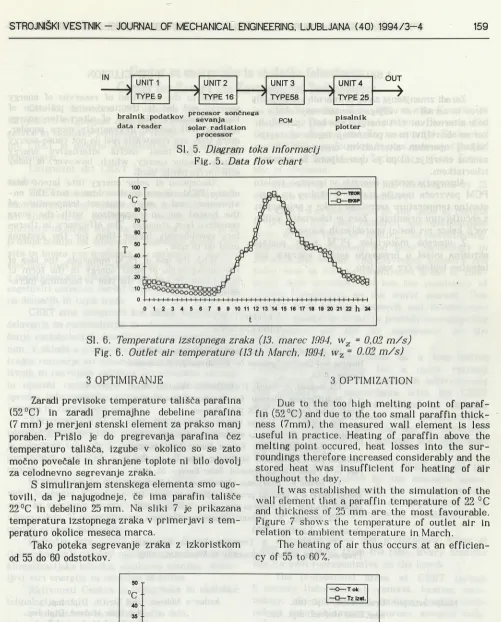
Vstopna datoteka za simuliranje stenskega elementa je prikazana na sliki 5.
Primerjava rezultatov preizkusa in simulira nja je prikazana na sliki 6.
For the stability of calculation, the time interval has to be shorter 161:
p S 'c .p s
2A (12) .
The mathematical model is written in the FORTRAN program language and represents a new module TYPE 58 for simulation within the TRNSYS program package 161.
The input datafile for the simulation of the wall element is shown in Figure 5.
b r a l n i k p o d a t k o v «“ ^ a " o n B n e “ a p c M r i s a l n i k d a t a r e a d e r s o l a r r a d i a t i o n p l o t t e r
p r o c e s s o r
SI. 5. Diagram toka informacij
Fig. 5. Data flow chart
SI. 6. Temperatura izstopnega zraka (13. marec 1994, wz = 0,02 m /s )
Fig. 6. Outlet air temperature (13 th March. 1994, wz = 0.02 m /s )
3 OPTIMIRANJE
Zaradi previsoke temperature tališča parafina (52 °C) in zaradi premajhne debeline parafina (7 mm) je merjeni stenski element za prakso manj poraben. Prišlo je do pregrevanja parafina čez temperaturo tališča, izgube v okolico so se zato močno povečale in shranjene toplote ni bilo dovolj za celodnevno segrevanje zraka.
S simuliranjem stenskega elementa smo ugo tovili, da je najugodneje, če ima parafin tališče 22 °C in debelino 25 mm. Na sliki 7 je prikazana temperatura izstopnega zraka v primerjavi s tem peraturo okolice meseca marca.
Tako poteka segrevanje zraka z izkoristkom od 55 do 60 odstotkov.
3 OPTIMIZATION
Due to the too high melting point of paraf fin (52 °C) and due to the too small paraffin thick ness (7mm), the measured wall element is less useful in practice. Heating of paraffin above the melting point occured, heat losses into the su r roundings therefore increased considerably and the stored heat was insufficient for heating of air thoughout the day.
It was established with the simulation of the wall element that a paraffin temperature of 22 °C and thickness of 25 mm are the most favourable. Figure 7 shows the temperature of outlet air in relation to ambient temperature in March.
The heating of air thus occurs at an efficien cy of 55 to 60%.
SI. 7. Temperatura okolice in izstopna temperatura zraka meseca marca
4 SKLEP
Zaradi zmanjšanja zalog primarnih energijskih virov in zaradi vse večjega onesnaževanja okolja se bodo alternativni viri energije vse bolj uporabljali, ker so obnovljivi in ne povzročajo izgube eksergije. Najbolj uporaben alternativni energetski vir je sončna energija, ki pa jo uporabljamo še s slabim izkoristkom.
Absorpcija sončne energije v latentno toploto PCM povzroča manjše izgube v okolico in kon stantno temperaturo segretega zraka v primerjavi z občutljivimi hranilniki. Zato je izkoristek veliko večji kakor pri doslej uporabljanih sistemih.
Z uporabo materialov PCM zopet postaja aktualna misel o hranjenju sončne energije kot latentne toplote čez vse leto.
4 CONCLUSION
Due to the reduction of reserves of energy sources and due to the increasing pollution of the environment, the use of alternative energy sources will become increasingly more popular, since they are renewable and do not cause exergy losses. The most useful alternative energy source is solar energy, which, however, is today still inefficiently used.
Absorption of solar energy into latent heat of the PCM causes smaller losses into the en vironment and a more constant temperature of the heated air in comparison with the more sensitive heat storages. The efficiency is there fore considerably higher than for the systems used up to now.
With the use of PCM materials, the idea of the conservation of solar energy in the form of latent heat throughout the year is becoming incre asingly popular.
5 L I T E R A T U R A 5 R E F E R E N C E S
( l i A r a n o v i t c h . E.: D e s i g n a n d T e c h n o l o g y of S o l a r H e a t i n g a n d C o o l i n g S y s t e m s f o r B u i l d i n g s . J o i n t R e s e a r c h C e n t r e . 1979.
[21 M e d v e d . S . - N o v a k . P . : R e f l e c t i v e V e n e t i a n B l i n d - a M u l t i p u r p o s e E l e m e n t f o r P a s s i v e S o l a r H e a t i n g .
W o r l d S o l a r C o n g r e s s . I S E S 1991. D e n v e r ,
(3! H a f n e r . T .: P r e n o s t o p l o t e v z i d u s T I M . D i p l o m s k a nalo ga , F a k u l t e t a z a s t r o j n i š t v o . L j u b l j a n a . 1993. [41 S o m a D a s - T a p a s K u m a r D u t t a : M a t h e m a t i c a l M o d e l i n g a n d E x p e r i m e n t a l S t u d i e s o n S o l a r E n e r g y S t o r a g e i n a P h a s e C h a n g e M a t e r i a l . S o l a r E n e r g y . 51. 1993. [51 J e r š i n , K.: I z b o l j š a n j e u č i n k o v i t o s t i s p r e j e m n i k o v
s o n č n e e n e r g i j e z u p o r a b o p r o s o j n e t o p l o t n e i z o l a c i j e . D i p l o m s k i s e m i n a r . F a k u l t e t a z a s t r o j n i š t v o . L j u b l j a n a 1993. 161 M e d v e d , S.: S o l a r n i i n ž e n i r i n g . F a k u l t e t a za s t r o j n i š t v o . L j u b l j a n a . 1993.
171 T R N S Y S - A T r a n s i e n t S y s t e m S i m u l a t i o n P r o g r a m . U s e r M a n u a l. U n i v e r s i t y of W i s c o n s i n . 1992.
N a s l o v a v t o r j e v : U r o š S t r i t i h , d i p l . in ž. .
m a g . S a š o M e d v e d , d i p l . in ž. .
F a k u l t e t a z a s t r o j n i š t v o U n i v e r z e v L j u b l j a n i A š k e r č e v a 6. L j u b l j a n a
A u t h o r ' s A d d r e s s : U r o š S t r i t i h . D i p l . Ing., Mag. S a š o M e d v e d . D i p l . Ing., F a c u l t y of M e c h a n i c a l E n g i n e e r i n g U n i v e r s i t y of L j u b l j a n a
A š k e r č e v a 6. L j u b l j a n a , S l o v e n i a
P r e j e t o :
R e c e i v e d : 1 5 .4 .1 9 9 4
S p r e j e t o :