Published with Creative Commons licence: Attribution–Noncommercial–No Derivatives
Putting Rooted Networks into Practice
Alida Cantor
Assistant Professor, Department of Geography Portland State University, Portland, OR, USA
Elisabeth Stoddard
Assistant Teaching Professor, Undergraduate Studies Social Science and Policy Studies
Director, Center for Sustainable Food Systems Worcester Polytechnic Institute, Worcester, MA, USA
Dianne Rocheleau
Professor, Graduate School of Geography Clark University, Worcester, MA, USA
Jennifer F. Brewer
Associate Professor, Department of Geography University of New Hampshire, Durham, NH, USA
Robin Roth
Associate Professor, Department of Geography University of Guelph, Guelph, Ontario, Canada
Trevor Birkenholtz
Associate Professor
Department of Geography and Geographic Information Science University of Illinois at Urbana-Champaign, Champaign, IL, USA
Katherine Foo
Assistant Teaching Professor, Interdisciplinary and Global Studies Worcester Polytechnic Institute, Worcester, MA, USA
Padini Nirmal
Lecturer, Graduate School of Geography Clark University, Worcester, MA, USA
Abstract
Rooted networks provide a conceptual framework that embeds network thinking in nature-society geography in order to investigate socio-ecological relations, while emphasizing the place-specific materiality of these relations. This progress report examines how geographers have put the framework into scholarly practice. The conceptual approach has enabled researchers to: 1) articulate the territoriality and materiality of networks as assemblages, which may be simultaneously rooted and mobile; 2) discern diverse types of power that flow through network connections; and 3) conduct analyses that unearth multiply-situated knowledges within
analyze; and illustrating networks for effective communication. We describe the ways in which rooted networks can be used as a tool for action, as a pedagogical guide, and to strengthen collective capacity to imagine and negotiate alternative futures based on ‘seeing multiple.’ Finally, we call for geographers and other scholars, researchers and activists to build upon a rooted networks framework as a tool for design, analysis, understanding and communication in the search for more socially just and ecologically viable futures.
Keywords
Rooted networks; political ecology; social movements; power; territory; naturecultures; decolonization
Introduction
Rooted networks, a conceptual framework first published by Rocheleau and Roth in 2007, embeds network thinking in nature-society geography to investigate socio-ecological relations, while emphasizing the place-specific materiality of these relations. The rooted networks framework seeks to “make the most of what
network thinking has to offer and bring the best of nature-society geography and ecology to bear on networks in order to investigate changing [socio-ecological] formations” (Rocheleau and Roth 2007, p. 433). This article offers a progress report on the concept of rooted networks since its inception a decade ago. We trace the development of the rooted network concept and examine how geographers and others have put it to work in multiple contexts, revealing unique insights and broaching new challenges for theory and practice. Given the resurgence of dialogue among critical human geographers around questions of praxis and engagement (for example, Hawkins et al. 2011; Blaikie 2012; Dwyer and Baird 2014; Asher 2014; Lave 2014), it seems appropriate that political ecologists reflect on how our own related and parallel conversations have evolved, as filtered through our particular human-environment lens.
Rooted networks (Rocheleau and Roth 2007; Rocheleau 2008, 2015a, 2015b, 2015c) stresses the ways in which socio-ecological relations exist in
material places, expanding definitions of 'territory' beyond abstractions of Cartesian polygons to embrace the praxis of social movements. Developed alongside and building upon Escobar’s work on place and territory (Escobar 2008), rooted networks applies metaphors of networks to socio-ecological connections and formations. It is a framework that is less a predictive theory than a metaphor, model, and set of principles to guide our explanatory efforts.
perspectives of human and nonhuman actors (Rocheleau, 2011). Second, the dimension of ‘rootedness’ acknowledges that networks are connected to territories. Third, the approach involves a critical and relational vision of naturecultures.1 Fourth, the rooted networks approach necessitates a close and nuanced examination of the multiple nodes and types of power, and the materiality of that power, that can exist within these relational, territorialized webs.
The rooted networks framework is explicitly based on the integration of scholarly inquiry and practice. Rooted networks knit together aspects of several bodies of scholarly theory to make them more available for human-environment geography, including actor-network theory, feminist and cultural studies of science and technology, complexity theory, poststructuralism, posthumanism, critical indigenous theory and systems ecology (e.g. Escobar 2001, 2008; Haraway 1991; Latour 2005; LaDuke 2002; Smith 1999; Law 1992; Whatmore 2006; Robbins 2011; Ingold 2000; Braun 2015). In terms of practice, the approach is intended to foster an “epistemology of allies”2 and “working coalitions” to expand and deepen our understandings of power, place, and material relations. It is a way of rigorously considering what questions we ask, and how, where, and with whom we seek answers (Nirmal 2017).
The rooted networks approach is a persistent reminder of best practices as we design research, assess theories, and enact professional identities. The goals are to 1) cross ontological divides between social and natural science, 2) respond to polarized debates about power, scale and territory, 3) infuse static and abstract notions of network structure with dynamic systems activity, material ecologies and political ontologies, 4) analyze phenomena from multiple situated positions, and 5) reveal the contingent and complex nature of power(s) in place.
This paper first describes the history of the rooted networks concept, then discusses how scholars in a variety of contexts are putting three key aspects of rooted networks into practice: naturecultures, rootedness, and place; typologies of power; and methodologies of seeing multiple. We then examine some challenges and limitations of using the rooted networks framework, and end with an updated call to action signaling new directions and potentials. The paper originated as a panel session at the 2014 meeting of the American Association of Geographers in Tampa, Florida, and we include quotations from this and other conversations between authors throughout the paper.
1 “The term “naturecultures” challenges the dichotomous formulation of nature and culture and
…evoke[s] the relational logic and complexities of the living worlds we inhabit, including relations of power within and between places, people, [beings] and ‘things’ “ (Rocheleau 2015c; see also Rocheleau and Nirmal 2015; Rocheleau and Nirmal 2016; Haraway 1991).
2 This phrase was introduced by Biology Professor, Marxist analyst and activist Richard Levins as part of a conversation with Sandra Harding after her talk at the 1989 Rethinking Marxism
Development of the concept: It takes a network
The rooted networks approach is itself informed by a diffuse array of actors across multiple times and places. The conceptual origins of the framework owe much to Rocheleau’s collaborative thinking with anthropologist Arturo Escobar on networks and complexity, inspired by several other authors on nature and culture (Haraway 1991, 2004; Ingold 2000, 2011; Latour 2005; Law 1992; Whatmore 2006), combined with complexity theory (Law and Mol 2002; Mitchell 2009). Escobar, Wendy Harcourt, J.K. Gibson-Graham, Rocheleau and others in the Women and the Politics of Place project (Harcourt and Escobar 2002, 2005), brought together network approaches in social movement scholarship with feminist theories of naturecultures (Haraway 2004) and social movement thought on
networked organization and alternatives to “sustainable development” (Escobar 2001, 2008; Harcourt and Nelson 2015; Harcourt 2016).
Rooted networks is also informed directly by social movements. These range from land-based movements of the Via Campesina global network of peasant farmers to a resurgence of indigenous and forest peoples’ movements for land, territory, autonomy and ecological integrity in diverse places across the planet. Women’s movements played a particularly important role, including explicit women’s movements, as well as women working within environmental,
indigenous, race, class, ethnic, and place-based environmental justice movements spanning urban and rural contexts. These mobilizations have all brought social movement networks “down to earth,” making claims in terms of (networked) territories rather than polygons of property. They make common cause in regionally and globally networked campaigns for access, use and protection of particular commons and territories. Their logics are networked in method and content; their politics are simultaneously based in ecology and place as well as identities and affinities. The words and practices of all these movements, directly and through the writing of others, contributed to the formulation of rooted networks and continue to inform its evolution.
People in several very specific places in processes of landscape and livelihood transitions provided key reflections and observations, including the following selected examples. Kenyan Akamba farmers’ discussions of historical and contemporary circulations and entangled rooting patterns in a patchwork landscape of forest, range and farm ecologies in the 1980’s and 90’s contributed to Rocheleau’s (2015a, 2015b) ongoing work on gendered landscapes, complex commons and multiply-rooted networks from the 1980’s to the present.
claims legible and defensible in legal and administrative terms. The members of the Rural Federation of Zambrana-Chacuey in the Dominican Republic brought their complex commons and emergent, networked agroforestry ecologies into focus for Rocheleau and Ross (1995; Rocheleau 2011). They, along with rural people in each location, influenced Susannah McCandless’ understanding of complex commons in forest and farming communities in Costa Rica and Vermont (McCandless 2010). Fishing communities in Maine (Brewer 2013) and Long Island (Hamm 2011) brought Jennifer Brewer and Christina Hamm into deliberations among fishers, researchers, and regulators, providing new windows on complex commons, networks and fluid territories (see also St Martin 2001). Indigenous peoples of the Amazon basin shared the mixed results of network strategies and alliances with national and global environmental organizations to protect Amazonian worlds (Pieck 2006). Analyses from members of several Adivasi (indigenous)
communities of their own networked roots and circulation pathways in Attapaddy, Kerala State, India, informed and inspired Padini Nirmal’s (2016) recent
elaboration of rooted networks in a decolonial feminist political ecology framework.
For these aforementioned scholars, and for their colleagues, mentees, and readers, the network metaphor became a salient descriptor for dynamic, multivalent relations among living things, blurring boundaries between individual and
collective agencies. Used as such, the term ‘network’ only distantly resembled earlier usage by computer scientists who popularized it to model technological relationships in mechanical terms. The assemblage network metaphors of actor-network theory (ANT; see Latour 2005; Law 1992) and the
social/political/economic power networks of the conceptual artist Lombardi
(Lombardi and Hobbs 2003) came together with ecological and evolutionary theory (Botkin 1990; Margulis 2008), as well as complexity theory across disciplines (Mitchell 2009), to inform rooted networks and related concepts, including emergent ecologies and complex commons (Escobar 2008; Rocheleau 2011; Rocheleau et al. 2001; Roth 2004).
These intellectual collaborations, along with networks of social
movements, marginalized groups fighting for access to land and resources, and burgeoning art and theory on politics, nature, culture, and power, were the foundation and inspiration for the conceptual framework of rooted networks. In their initial article Rocheleau and Roth (2007) made a call to action:
A decade later, we now consider how geographers and others have taken up this call, putting the concept into practice in their own work, and examining its utility and challenges. In the following sections, we examine three key aspects of the rooted networks framework—naturecultures, rootedness and place; typologies of power and terms of rooting; and seeing multiple. For each, we discuss specific examples of how geographers are currently using these concepts. We use examples drawn from our own work, which addresses a diverse range of topics including virus flows in agricultural spaces (Lisa Stoddard), the power dynamics of water systems (Trevor Birkenholtz, Alida Cantor), livelihoods in governmentally-protected park areas (Robin Roth), mobilization of some fishery groups to amass capital and marginalization of others (Jennifer Brewer), environmental governance of urban forestry (Katherine Foo), and the emergence of new agrarian territorial ecologies and the incursion of land grabs under environmental and development pretexts (Dianne Rocheleau, Padini Nirmal). We go on to discuss challenges, limitations, and next steps for the application of rooted networks in scholarly practice.
Naturecultures, rootedness and place
The concept of rooted networks differs from most network-focused theories in that it is explicitly place-based, emphasizing the ways in which particular
territories situate and ground socio-ecological relations. It recognizes apparently discrete territories as emergent from, and produced by, networked relations between complex assemblages of disparate things and beings. The idea of ‘rootedness’ draws from Deleuze and Guatarri’s ‘rhizome’ (1988) echoed by Latour in his ‘actant-rhizome ontology’ as an alternative term for his assemblage-based ‘actor-network theory’ (Latour 1999). But, as a geographic concept, rooted networks emphasizes particularities of place and territory more strongly than either of these antecedents. The concept asserts that human and non-human interactions transpire in material dimensions in specific places. At the same time, territories are conceptualized as more than discrete spatial polygons. They are relational,
particular, material, and manifest across multiple scales.
Drawing attention to the relationship between territory, place and networks, the concept of a rooted network closely resembles and gains inspiration from the relational ontologies many of us witnessed while working with indigenous
communities around the world.3 We see this as one of the most distinctive aspects of the rooted networks conceptual framework. For example, Padini Nirmal
discusses the ways in which she sees the framework as both concept and method for bring actually existing naturecultures into focus:
3For more on indigenous ontologies, see, for example, Ingold 2001, Berkes 1999, Blaser 2014,
My continually growing understanding of rooted networks has taken shape over the years through multiple conversations with Dianne Rocheleau, and through lived and research experiences of worlding through networks. I see my (hopefully decolonial) work on
contemporary indigenous land politics in southern India as being nested among those engaging with ‘naturecultures, rootedness and place’ when thinking with and through rooted networks. I see rooted networks as design and method, integrating place, power, material AND ontological relations, in its shaping of territories (over space and time). In my work, I have come to understand indigenous territories as ‘living worlds’ of related beings. Living worlds are dynamic spaces structured by rooted networks. Hence, rooted networks as design and method animate the living world through an ecological framework in relational, rather than mechanistic, terms.
Human and nonhuman actors move through these ‘living worlds’ and take root in multiple ways. In the rest of this section, we focus on ways in which networks are fixed in place and territory, and also on mobility and circulation within and between networks (Rocheleau 2015a). For example, Lisa Stoddard’s research on livestock production networks in North Carolina shows how place-specific social conditions facilitated the establishment and intensification of a particular bio-physical hazard beyond the limits of social control (Stoddard 2015; Stoddard and Cantor 2017). The global pork production network is rooted in particular territories, with consequences for those places. Stoddard explains:
A key element of a rooted networks framework that I found valuable is the importance of connecting networks to territories. Across the US, pork production networks are very similar in their ownership and operating structures. But these networks are rooted in place, with different histories, politics, and ecologies that impact the capacity of the network to cope with and recover from a disaster, like the
outbreak of a contagious disease. For example, North Carolina’s floodplain was targeted by the hog industry because of the concentration of low-income, minority communities with limited livelihood opportunities. This same political-economic-ecological landscape that drew corporations to place 10 million hogs on a floodplain is also what makes it almost impossible for the network to cope with and recover from a potential disease outbreak. In the event of an outbreak, the concentration of millions of hogs on the
Robin Roth describes her research with conservation territories, long understood and problematized as discrete polygons. She explains how social dynamics enable or prevent certain land use designations, and how those categories in turn transform socio-ecological relations and possible futures inside and outside designated boundaries.
Political ecologists, myself included, have spent a lot of energy demonstrating how National Parks and other forms of protected areas replicate problematic and harmful dichotomous nature/culture
thinking through their spatial form. And yet we can garner still more insight into conservation practice by understanding these territories as produced through networks and relying on networks for their continual maintenance. Their establishment also gives rise to new and novel network assemblages of place, territory, ecology and culture. For instance, in the hills of Northern Thailand, there is a network of state agencies, people, social movements,
non-government organizations and particular ideas about nature and the indigenous people who inhabit the hills, that has enabled the creation of National Parks in some places and resistance to them in others. The territory of the National Park, once established, reflects the relations of power in that network. And similarly, the territory of the National Park inspires the restructuring of socio-ecological networks as indigenous residents try to survive in new conditions. They seek out opportunities to sell new crops such as corn, coffee and potatoes, they seek employers in the city to help meet a need for more seasonal work and they seek to market themselves in ways that might attract tourists to their communities. These changing networks have direct influence on the ecology and territory of the National Park.
Understanding territories as produced from networks has allowed me to ask new questions, to try and trace these networks and the ways they articulate with conservation territories.
The rooted networks framework supports analytical examination of mobility and circulation as well as stability, and metaphors of roots and rhizomes can describe multiple ways in which networks can become fixed in place or
Up until the 1970s farmers in the community rotated at multiple scales in time and space to get their livestock to the best grazing lands, across seasons and years. They were forced into sedentary villages through colonization and later land privatization, which reduced their ability to circulate seasonally in local and regional space. Many farmers migrated to dry agricultural frontiers to form new villages, choosing to stay within Ukambani, even when better and cheaper lands might be available elsewhere. So people circulated under new terms between distinct locations in a home place that was regional, and later as those movements were blocked, they moved to another part of the same region, or kept their home in the same place and worked outside (in the military, plantations, cities and towns). Yet they were still at home, on the move, over a vast region, and then contingently home together in particular villages with “outposts” in cities, plantations, military bases and new rural villages. This was the first prompt for me to think in terms of rooted networks, with the metaphor of the spider plant, to understand how people networked across time and space in the fields, forests and rangelands of Ukambani (as of 1990 Machakos and Kitui Districts in Kenya).
This example illustrates how rooted networks may be characterized simultaneously by an ever-mobile rhizome, a deep stable taproot, and many other structures of connection to the earth at multiple scales and space-time
configurations (Rocheleau 2015a). It is important to keep in mind the potential for problematic applications of biological metaphors to explain social phenomena. For example, Sayre’s (2007) analysis discusses how ‘carrying capacity’ was
problematically translated into support for neo-Malthusian arguments of global overpopulation. However, in practice, given the multitude of types of roots,
rhizomes, and other physical connections to resources, the metaphors of rootedness and circulation—combined with a nuanced understanding of power typologies, discussed in the following section—have provided a useful tool for considering a variety of different types of connections to territory. These metaphors continue to evolve: Rocheleau notes that since the framework was developed, many authors have elaborated more on concepts such as fungal mycelium4 as better metaphors for flexible and multidirectional patterns of connection to resources (Ingold 2011; Tsing 2012). For example, while a root or rhizome may imply a single-species organism, even the tap-rooted pine tree shares nutrients carried by fungal mycelia to tree roots throughout the larger forest. Likewise, a rooted network takes into account the relationality between many human and nonhuman actors.
4The vegetative body of fungi: a mass of branching filaments (hyphae) that spread throughout the
The notion of circulation is also an important aspect of rooted networks, one that provides a conceptual complement to rootedness. For example, in Trevor Birkenholtz’s investigation of irrigation systems in India (Birkenholtz 2009, 2012), circulation of water, a material resource, has in turn led to new knowledge
circulation and has allowed new socio-ecological scenarios to emerge, including possibilities for economic transformation. He explains:
Putting water into circulation creates particular demands, such as irrigation timing, new forms of labor, and new unknowns and problems such as salinization. It also creates opportunities, such as new crops, new markets, and new labor opportunities. It also sets in motion, or redirects, the flow of capital and power between adopters and users of new ecological technologies.
Rootedness and circulation work in tandem in many cases. For example, Padini Nirmal describes how concepts of both movement and rootedness emerge as central and interconnected themes in her work on Indigenous land relations in India:
In Attappady, where I work, the Irular (a previously ‘semi-nomadic’ indigenous community) are seen as a settling population, with contentious claims to land as indigenous others themselves (unlike the ‘original’ indigenous inhabitants of the region, the Mudugar). However, a rooted networks lens, by illuminating terms of movement and circulation, along with revealing the terms of rootedness of the Irular, makes it possible to see longer histories of circulation and
their terms of relations. This identifies a networked connection to Attappady previously rendered invisible through colonial tellings and retellings of a skewed ecological, indigenous history of Attappady.
Alida Cantor also examines both circulation and rootedness in her
examinations of rural-to-urban water transfers in California (Cantor 2016, 2017), demonstrating that the concept of rooted networks is not only applicable in agrarian contexts, it is also useful in understanding urban and urbanization processes. She combines the rooted networks framework with concepts of urban metabolism (Gandy 2004; Newell and Cousins 2015) to understand and compare urban and rural areas connected via water transfers:
significant say in land development activities in seemingly rural areas from which LA sources its water supply. These relationships are not unidirectional or homogenous; they are mediated by situated human and nonhuman actors particular to each place, leading to diverse social and ecological outcomes.
As these examples illustrate, scholars have used the rooted networks
framework to emphasize how human and non-human actors are interconnected and situated in particular places and territories, and also how human and nonhuman actors are mobile and circulate. This addresses the question of ‘scale of analysis’ by reframing scale as an outcome of particular forms of rootedness and territorial production from networked processes (see also Escobar 2008, 2016, 2018).
Typologies of power and terms of rooting
The articulation of a power typology—a careful, empirical consideration of the “terms of connection” – offers broad analytical leverage not found elsewhere (Hovorka 2012). The typology supports close examination of socio-ecological relationships to determine the type of power deployed, expanding traditional definitions of power that emphasize power over (control), power against (resistance), and occasionally power with (solidarity). Instead, the framework incorporates a wider, more nuanced “range of more entangled and embedded relationships, including power alongside, power from beneath, and power-in-spite-of” (Rocheleau and Roth 2007, p. 434; Rocheleau 2015a, 2015b, 2015c). As Trevor Birkenholtz explains:
I have a particular interest in power, which is exercised relationally, of course, and so I was initially led to relational network ontologies, specifically actor-network theory (ANT). But as many have argued, ANT has historically been more concerned with the heterogeneous associations between actors, which can be an apolitical method, rather than the process of assembly, which is power charged. So, following Latour – nothing just sits there. But why, in what ways, under what conditions and to whose loss and benefit? These are questions that the rooted networks framing demands. This is why I have found inspiration in it for examining the political ecology of irrigation networks.
government, and politically and financially sponsored armed bands that force local people from their land (Figure 1).
Figure 1: Illustration of networked land grabbing. Published in Rocheleau 2015c.
In this way, evidence of a rooted, networked relationship is not an analytical end goal, but an incremental step inviting further explication and theorization (Rocheleau 2015a, Hovorka, 2012).
By focusing explicitly on the kinds of power involved in a relationship, power becomes a more nuanced and analytically useful concept. Scholars using rooted networks ask about the terms of connection, about why actors make particular decisions, and why events unfold in particular ways. As Robin Roth details in her examination of livelihood change in Thailand, the rooted network approach helped her to question not only to whom a farmer might sell her/his product and at what price, but pushed her to dig deeper, seeking out how these relationships play out across multiple concurrent dimensions:
exclusive? Under what terms can the connection be broken? And so on…
In conversation with Robin Roth, Jennifer Brewer agreed that the rooted network approach engenders more thorough and contextual understandings of power that are not easily found elsewhere:
I've had a similar experience, but frankly I don’t use the word power much, because I find it to be a black box. It is often used in ways that are seriously under-theorized. In reality, some choice virtually always exists, even if it might be between death and some other decision. So we are more often assessing trade-offs, and the ability to imagine alternate futures. Constraints can come from many different directions, so it is helpful to think about different trajectories of power: over, under, beneath, between, around.
Dianne Rocheleau further elaborated on how she thinks about power as relational in her work on land grabs, and how power can manifest at the interface of different systems of knowledge and socio-ecological organization:
The terms of connection have become primary for me. When I talk about land grabbing, whether about networks coming from above, and from big power, to take land, or about people being on land and resisting land grabs, – it is about the termsof rooting. For example, we can talk about the difference between legal rights to property and legitimate claims5 to be in and protect a territory without exclusive rights of use or ownership. This is part of an ongoing decolonial discussion on knowledge, power, and cognitive justice.
The approach of analyzing terms of connection and relationships of power from the multiple positions of humans and nonhumans is writ large when the rooted networks framework is applied methodologically. As an example of how this power typology is put into practice, Hovorka (2012) analyzes the multiple positionalities of men, women, cattle, and chickens on commercial farms in Botswana. She explores how their terms of connection “are the means through which men, women, chickens and cattle become privileged and/or othered within dominant gender–species hierarchical arrangements” (Hovorka, 2012, p. 875). Moreover, developing this more nuanced understanding of power holds potential to be useful in identifying interventions of a practical nature. For example, Trevor Birkenholtz explains that tracing networks makes it easier to see clearly how they might be reconfigured and by whom:
5An indigenous activist made this point about “legality and legitimacy” during the course of the
Once we understand the precise character of the [irrigation] network -- the type, terms and strength of the connections within it -- we can identify the disparate actors and their respective positions and ways they might be willing to reconfigure the networks to reduce
vulnerability, without exacerbating it and undermining the adaptive potential for some groups.
As the next section describes, this emphasis on multiplicity extends beyond the characterization of power per se. The rooted networks approach leverages the plurality of standpoint feminism to gain analytical purchase in our understanding of livelihoods, identities, and coalition-building.
Seeing multiple
Applying the rooted networks framework underscores the nature of networks as polycentric rather than monocentric. It facilitates multi-dimensional analysis, overcoming the limitations of a unitary (and perhaps hegemonic)
viewpoint. Not only are the people and places multiple, but causal flows are multi-dimensional. In this way, “seeing multiple” (Rocheleau 2011) can lead to novel insights, and greater appreciation for possibilities of change through collective action.
For example, Robin Roth’s work on conflicts around national parks in Thailand, and the ensuing livelihood changes that emerge out of spatial struggles over territory, considers rooted networks from multiple nodes:
For me, the farmer is the primary node that I try to understand these things from. However, the rooted networks approach pushes me to understand livelihood issues from other nodes as well, particularly the non-human nature nodes. For example, when I start to see through the lens of the coffee plants, I start to see the connections to pollinators…and ask questions about those connections. I see the connections to other species, and I also see the connections to cow dung and buffalo dung. The persistence of the coffee plant and the people connected to it depends on a whole set of networked relations. That is really important because in the context of a park I work in, some park staff and conservationist advocates would like to ban domestic buffalo and cattle. However, newly reconfigured
livelihoods are dependent on the coffee market. If farmers were no longer able to keep buffalo and cattle, and thus have access to their dung for fertilizer, the quality and quantity of their coffee might suffer, negatively impacting their livelihoods.
insight into the potential impact of certain park conflicts (e.g., whether or not to rid the park of buffalo and cattle).
In another case, Jennifer Brewer saw how a rooted networks strategy supported a capacity-building program to foster deliberative democracy through decentralized leadership and community organizing (Brewer 2013). Her work focuses on fisheries -- how harvesters construct and navigate multiple, intersecting networks in their livelihoods and associated governance strategies; and how they leverage political resources across these to consolidate or distribute benefits. Recalling a case in the rural, northeast corner of the US, she elaborates:
With facilitation by a convening NGO, a diverse group of marine resource harvesters met for the first time, pointed to their home harbors and fishing areas on a map, and promptly began questioning one another about how those biophysical locales affect their harvest practices and resource management concerns. Most harvesters immediately gained a new appreciation of the contingency and relationality of their livelihoods, knowledge, loyalties, and political power. They were able to suspend assumptions, abandon barriers, and demonstrate previously elusive capacities for listening, respect, leadership, cooperation, and collective problem-solving. In
subsequent workshops, most extended these same principles to conversations with scientists and managers, and a few began sharing the new approach with skeptical harvesters back home. They have never heard the term rooted networks, but they are in fact building and mobilizing them.
The insights these fishers gained about coalition building at the facilitated meeting transferred readily to new venues because they were collaboratively and viscerally ground-truthed. Recognition of shared and divergent goals as bound to place-specific materialities provided an immediate lesson in the realistic
articulation of common cause. A rooted networks approach thereby helped transform the dynamics of marine governance – bringing a new sense of mutual accountability and solidarity to a process that is otherwise prone to confrontation and impasse. Rather than struggling to articulate individual interests in opposition to some vaguely perceived oppressor, participants labored collectively to identify new prospects for mutual cooperation (Brewer 2013).
As we see multiple, we also understand ourselves as active nodes in the networks we seek to understand. In this way, we work to radically advance the claim by feminist and indigenous scholars that there is no one subject position, no innocent observer position, but we are all situated within multiple knowledges and multiple worlds, what Escobar (2018) and others call the pluriverse. This
Bringing rooted networks to bear has allowed scholars, resource users, policy makers, people-in-place and others to better understand a range of issues from diverse standpoints: indigenous farmers and their nomadic neighbors, peasant farmers, landowners, investors, farmers, public officials, civil society groups, mountains, forests, floodplains, fish, coffee, buffalo, disease, hogs, and water. This willingness to see multiple enables us to ask more thoughtful questions, reveal unexpected outcomes, develop solidarities and nurture alternative futures.
Additionally, researchers and practitioners themselves become part of the network through their work. Jennifer Brewer notes that she has had to recognize how her own presence and interaction with families in a community in which she was conducting research has enabled and constrained various sorts of connections for them. Seeing ourselves as part of the network in question is a way of practicing reflexivity, a theme we revisit in the conclusion.
Challenges and limitations
While we find the rooted networks concept to be productive in many ways, it also comes with challenges and limitations. A primary limitation is that while the concept can increase rigor by tightening the coupling between method and theory, and it can inform social change by tightening the coupling between analysis and action, rooted network models do not alone comprise fully articulated theory or action plans. The conceptual approach draws on transdisciplinary complexity theory and network theories in social and ecological sciences (Mitchell, 2009) as well as feminist, post-structural and decolonial social theories, as an emerging theoretical frame in development. The concept as currently articulated provides models and metaphors to guide inquiry which may take a more critical or
qualitative turn, or may follow a logical positivist path. For positivist research this open-ended framework, like political ecology, may be more useful as way of seeing and a mode of analysis than as an explanation per se, and may require additional theoretical and quantitative elements to meet expectations of proof and replicability. The rooted networks framework as is can provide analytical rigor and novel insights from which more robust theory can and should be developed.
Concurrently, the awareness of complexity and preference for analyses that bridge pre-existing categories may make the process of theory-building more strenuous-- even as they make resulting theory more robust. The framework demands that we recognize and parse complexity thoroughly; whereas theory is often assessed by its elegance, rooted networks preclude explanatory shortcuts. For example, the framework instigates a cascade of associated questions of method and research design: who decides which actors or actants6 are important to the story and which are not, and how are these decisions made? As we uncover added layers
6While Latour and other ANT theorists distinguish between human actors and other actants, some
of empirical complexity, how and by whom is the central narrative established for reporting out to interested audiences? How do we organize duly revealed complex relationships and flows in a way that satisfies prevailing conventions of academic discourse? Does this conflict with ways of reporting that might be more
accountable to the communities within which we work? The answers to these questions are not always obvious.
Tensions can arise when our explanatory frameworks place data in newly devised or re-typologized categories that challenge traditional disciplines and associated writing conventions. Navigating interdisciplinarity has long been a conversation in political ecology (Robbins 2011; Zimmerer and Bassett 2003); this issue is certainly present when putting rooted networks into practice. Dianne Rocheleau notes that disciplinary journals tend to prefer either physical science data (e.g., species names and quantitative measures) or social science data (e.g. power relationships and environmental governance) in her articles on rural land use change. However, her data includes tracing relationships from soil, grazing land, and biodiversity to weddings, cattle dowries, national militaries, land tenure and international development policies—a range of topics that do not fit neatly into “social” or “physical” science categories. A rooted networks approach encourages the researcher to wade through the depths of complexity and work from its
strengths; while unleashing this complexity can yield substantial benefits, it can also come with limitations. Robin Roth recounts:
When I started to use the concept of rooted networks -- what I could see in terms of complexity…I loved it. Things got bigger, more expansive, my view got wider. But my attempt to tame all of that complexity into anything resembling a traditional academic article, that didn’t work so well.
Dilemmas thus arise between elegant theory and messy empiricism, but rooted networks compel us to think more reflexively about that balance, and about how we cope with complexity. Rooted networks demand greater rapprochement between the legacies of biophysical and social scholarship without shortchanging either one. Even as academia rallies for more interdisciplinarity in research and pedagogy, many scholars are hesitant to embrace a research agenda that raises professional hurdles. We argue that this dilemma exposes longstanding institutional problems.
experiment, but these research designs have procedural implications for the utility of rooted networks at different stages of project development. To explore these implications, the rooted networks approach would need to be recognized,
documented, and disseminated more widely by those using it in specific contexts, so that other scholars and various actors can cite, adapt and use it. Like any living concept, its utility and limitations become clearest when it is applied and adapted to new circumstances.
Ultimately, the utility of a rooted networks model will be shaped by the intensity of its relationship to more explicitly theoretical efforts. Like any conceptual model, it does not provide answers, it only facilitates them. Dianne Rocheleau discusses these concerns about research method, design, and rationale:
The element of choice and discretion, in the selection of categories and process of simplification, is an issue in any model or method. It is true of systems models and statistical models across social and biophysical applications. You have to carefully think through, define and defend your choices. It is complicated by combining human and non-human elements and refusing to recognize “social” versus “natural” categories. But that complex mix is part of everyday life and rooted networks helps us to articulate it. We just choose to simplify differently, crossing categories not usually blurred.
In other words, it seems that some simplification is inevitable as we
selectively translate our observations in our scholarly communications. The ability of rooted networks to embrace complexity has the potential to fundamentally reorganize our thinking and thereby produce new theoretical insights. The value of rooted networks is not in providing a singular course of action or predictive theory to resolve all uncertainties. Rather, like any useful model, it grants us greater traction with which to ask new questions of ourselves and others. Like the most honest and profound scholarly contributions, it comes with limitations, but it opens more doors than it closes.
Conclusions
The discussion above demonstrates how diverse implementations of the rooted networks concept continue to reach outward to new audiences. The
New directions
Recent theoretical and practical innovations by numerous scholars have opened up additional possibilities for thinking about rhizomatic and relational approaches to territory, place, networks, assemblages and living worlds. Works on relational ontologies, the pluriverse, and world anthropologies (Escobar 2018; Nirmal 2016; Escobar and Rebeiro 2006; Blaser 2014; De la Cadena 2010) bring decolonial and indigenous anthropology into conversation with networks,
territories, and natureculture assemblages as living worlds. Meanwhile, scholars of settler colonialism critically examine and problematize rooted territorial
connections that have been established in the interests of racism and white supremacy (Bonds and Inwood 2016). Tim Ingold’s writing on dwelling,
meshworks, and his tongue-in-cheek essay on ANT and SPIDER in his book Being Alive (2011) illuminate multiple pathways into future thinking on naturecultures in places and rooted assemblages in living worlds. Likewise, recent work on feminist materialism and vitalism (Bennett 2009; Alaimo & Hekman 2009) stretches the bounds of political ecology and science and technology studies to explore how we know things, beings, their connections, and life in general. Political ecologists have drawn from and contributed to these debates on materiality and feminist
materialism (see, for example, Bakker and Bridge 2006; Lawhon 2013; Rioux 2015). New waves of intersectional, indigenous and decolonial feminist political ecology also provide salient examples of intersectional and situated knowledges and experience relevant to rooted network thinking in policy, practice and theory (Harcourt 2016; Harcourt and Nelson 2015; Nirmal 2016; Mollett 2010;
Nightingale 2011; Resurreccion and Elmhirst 2012). Indigenous scholars, writers and activists Winson Laduke (1999, 2002) and Leanne Simpson (2014, 2017a,b) explicitly invoke the relationality and living worlds of North American indigenous peoples rooted in complex territories beyond the reach of “indigenous knowledge” and similar paradigms, while Linda T. Smith (1999) explores the decolonization of research methodologies. Scholars drawing from this array of theoretical approaches contribute to the broader goals of rooted network thinking (although they may or may not explicitly use the term to describe their work).
Among those explicitly using a rooted network framing, new generations of political ecologists have expanded the application of rooted networks to address a variety of issues and contexts. In addition to the examples described throughout this paper, these include the role of social movements in creating agrofuel territories from peasant landscapes in Northeastern Brazil (Manzi 2013), to the military and gendered reassembly of “nature” in the image of the state through green land grabs and ecotourism in Colombia (Ojeda 2012), to place-based actor networks in the Panhandle of Oklahoma (Sheehan and Vadjunec 2012). Padini Nirmal’s research on indigenous naturecultures (Nirmal 2016) and resistance to modernist development brings relational ontologies into discussions of rooted networks from southern India to the lands of Canadian First Nations. Mara
rooted networks into the framing of their collection on political ecology and science and technology studies.
Inspired by both early and newer works, we launch a renewed call to
scholars in human and political ecology and ecological sciences, their students, and community-based researchers and practitioners to build upon a rooted networks framework as a tool for communication and an instrument to pursue social justice and ecological viability.
Using rooted network illustrations to communicate across different communities
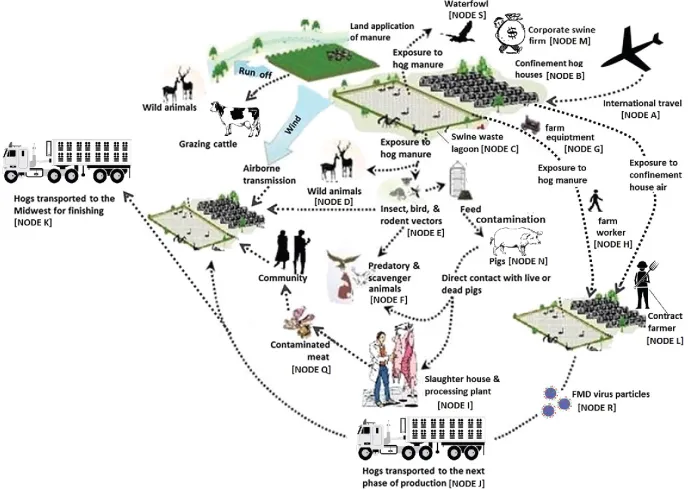
Network thinking, in particular concepts of positionality and situated power, can be a useful tool in navigating the complex relationships between science, policy, and society (Chilvers and Evans 2009). Visually depicting rooted networks can allow for effective communication among different epistemic communities, including academics, social movements, and policy makers. For example, Lisa Stoddard found that visual illustrations were a useful way to communicate across distinct communities. While researching the susceptibility of North Carolina’s hog industry to an outbreak of foot-and-mouth disease, she created network illustrations and used these illustrations to facilitate conversations with farmers, environmental organizations, public health experts, and others (Figure 2). These conversations improved the specificity and accuracy of the analysis by filling in details of power relations and circulation patterns at and between each node and connection.
Stoddard brought the completed rooted network analysis and illustration to the North Carolina Environmental Justice Network Summit to discuss the
susceptibility of the industry to a disease outbreak, as well as potential impacts on the communities who live near the hog facilities. She discusses the response to the network illustration:
At the conference, there was a diverse set of stakeholders. My goal was to use the rooted networks illustration to facilitate a conversation amongst these groups about the potential impact of a disease
outbreak, like foot-and-mouth disease, and about how we might reduce the susceptibility of the local communities to associated harms. Multiple stakeholders noted that they had never seen such an accurate depiction of the relationships involved in the industry. I credit this to the fact that the map was made with the input of people
within the network. The epidemiologists at the conference appreciated that the rooted networks approach and illustration allowed us to map and discuss how politics and virology interact with one another through different relationships, as well as the associated impacts. One environmental organization asked to use the illustration to talk with stakeholders at another meeting. Others pointed at areas of the network to highlight relationships they saw as problematic or to engage in debates. So, overall, I was happy. It was a successful way to facilitate conversation among all of these
stakeholders.
However, it can be difficult to translate complexity visually. For example, even with a background in landscape architecture and design, Katherine Foo notes that she still struggles with effective visualization:
For me, a key feature of rooted networks is the way it renders visible what the social and material influences over a particular landscape or territory are. Visualizing these relationships is a way to clarify and to communicate what the linkages are, where they are, and how they function in relation to each other. Visualizations, even very simple ones like diagrams, can function as boundary products that can communicate among different epistemic communities. I continue to struggle with how to effectively illustrate a rooted networks analysis to make that communication among different communities easy.
Foo has explored the potential of rooted network illustrations by using illustration as a pedagogical tool in the classroom to encourage systems thinking and awareness of complexity. For example, she asked the students in her urban ecology course to illustrate resource flows through urban agricultural systems. She explains:
organizations, businesses, and also people. Graphically, I asked them to use rectangles to indicate nouns, which could be people,
organizations, or even concepts, and arrows to indicate verbs. For example, one student started with a parcel of cultivated land and traced it back to a grassroots program funded by Boston city government, which makes vacant land available to people living in the neighborhood. As a result of turning this vacant land into cultivated land, the student argued that the effect was to strengthen the community and to create a synergy with existing non-profit organizations, which would have the result of strengthening
organizing power in the neighborhood to make demands or claims on the city government.
Several lessons for those seeking to create effective visualizations emerged from this work:
Based on experimenting with different visual techniques in work with community organizations and undergraduate students, I have learned that, first, a rooted networks illustration needs a good legend. Second, scale is difficult to communicate effectively. Third, I learned that analyzing rooted networks through participatory mapping or illustrating is possible, and that practice with students and
communities can help to highlight and work out some of the kinks.
Ample room remains for others to use rooted networks illustrations to expand and improve upon our own initial efforts, and to foster communication and debate in an effort to facilitate progress and change on important
human-environment issues.
Using a rooted networks approach to strengthen collective capacity and processes of change
Finally, we call on scholars, practitioners and networked communities of various kinds to use rooted networks as a strategy to facilitate community
engagement and to contribute to ongoing processes of change across scales. We see rooted networks and the theories and practices of the global movement for
decolonization as co-conspirators in the decentering, destabilizing and demystifying of concentrations of power. As Padini Nirmal elaborates:
I see the value of rooted networks as a tool of decolonization (which is arguably a key function of the original framework). Through my research, I came to understand indigenous land relations as both a form of embodiment (that is, capturing the myriad ways in which many of Attappady’s indigenous peoples see themselves as
relational worlds). As such, embodiment and worlding happens through and within rooted networks, so that the rooted networks structure and shape the living world itself, including its material and ontological relations. The task of seeing embodiment and worlding come alive, as active, dynamic manifestations of relations within the living world, is, in itself, an act of decolonization when working from and within colonial institutions, epistemologies, ontologies and methods.
An effective engaged political ecology must include an understanding of the connections and power relations between different actors, including
relationships amongst researchers and scholars as well as between researchers and communities (Blaikie 2012; Dwyer and Baird 2014; Lave 2014). Jennifer Brewer argues for a stronger recognition of the researcher’s own connections and urges us to deliberately tend to networks in order to make them visible, to strengthen certain strategic linkages, and build capacity to act collectively. She urges:
I’ve undertaken a number of projects to increase the role of science in policy, and in each instance, I have rediscovered the acute need for largely distinct networks of academia and social action to
assiduously cultivate shared nodes, and to attend to any number of associated implications vis a vis territory and power. Easier said than done. Our panel organizers asked us to point out challenges, and I see this as a persistent one. The marine harvesters and resource professionals I mentioned earlier only overcame barriers to coalition-building and collective problem-solving after focused consideration of their own roots, including spaces of work and home, and various inequities that impede productive collaborations. Academics wishing to conduct interdisciplinary, problem-driven work would be advised to do the same. Those rooted networks I’ve pointed to as success stories flourish because they are intentionally seeded and cultivated. They are given social space and material resources to establish and grow.
academic-territorial roots as researchers, teachers, and public servants, attenuating older networks to form new nodes (Bebbington 2012). Some connections may emerge spontaneously, but others require concerted effort, recognizing our own rooted locations within fields of active and latent power, and eliciting reciprocally situated perspectives from co-researchers and the broader communities we seek to serve.
References
Alaimo, Stacy and Susan Hekman (eds). 2008. Material feminisms. Indiana University Press.
Asher, Kiran. 2014. The Doers and the Done For: Interrogating the Subjects and Objects of Engaged Political Ecology. ACME: An International E-Journal for Critical Geographies 13 (4):489-496.
Bakker, Karen and Gavin Bridge. 2006. Material worlds? Resource geographies and the matter of nature'. Progress in human geography, 30(1), pp.5-27.
Bebbington, Anthony. 2012. Underground political ecologies. Geoforum 43 (6):1152-1162.
Bennett, Jane. 2009. Vibrant matter: A political ecology of things: Duke University Press.
Birkenholtz, Trevor. 2009. Irrigated Landscapes, Produced Scarcity, and Adaptive Social Institutions in Rajasthan, India. Annals of the Association of American Geographers 99 (1):118-137.
———. 2012. Network political ecology: Method and theory in climate change vulnerability and adaptation research. Progress in Human Geography 36 (3):295-315.
Blaikie, Piers. 2012. Should some political ecology be useful? The Inaugural Lecture for the Cultural and Political Ecology Specialty Group, Annual Meeting of the Association of American Geographers, April 2010. Geoforum
43 (2):231-239.
Blaser, Mario. 2014. Ontology and indigeneity: on the political ontology of heterogeneous assemblages. Cultural geographies 21 (1):49-58.
Bonds, Anne and Joshua Inwood. 2016. Beyond white privilege: Geographies of white supremacy and settler colonialism. Progress in Human
Geography, 40(6), pp.715-733.
Botkin, Daniel. 1990. Discordant harmonies: a new ecology for the twenty-first century: Oxford University Press.
Brewer, Jennifer F. 2013. From personal experience to public participation: social learning at the community fisheries action roundtable. Environmental
Management 52 (2):321–334.
Brewer, Jennifer F., Natalie Springuel, James Wilson, Robin Alden, Dana Morse, Catherine Schmitt, Chris Bartlett, Teresa Johnson, Carla Guenther, and Damian Brady.2017. Engagement in a Public Forum: Knowledge, Action, and
Cosmopolitanism. Antipode 49 (2): 273–293.
Cantor, Alida. 2016. Dust storms and dying lakes: Wastefulness, reasonable and beneficial use, and water transfers in California. (Doctoral dissertation, Clark University).
———. 2017. Material, Political, and Biopolitical Dimensions of “Waste” in California Water Law. Antipode 49 (5):1204-1222.
Chilvers, Jason and James Evans. 2009. Understanding networks at the science-policy interface. Geoforum 40 (3):355-362.
De la Cadena, Marisol. 2010. Indigenous cosmopolitics in the Andes: Conceptual reflections beyond “politics”. Cultural anthropology 25 (2):334-370.
Deleuze, Gilles and Felix Guattari. 1988. A thousand plateaus: Capitalism and schizophrenia. London: Continuum.
Dwyer, Michael B. and Ian G. Baird. 2014. Principled Engagement: Political Ecologists and Their Interactions Outside the Academy Introduction to a Set of Short Interventions. ACME: An International E-Journal for Critical
Geographies 13 (4):473-477.
Escobar, Arturo. 2001. Culture sits in places: reflections on globalism and subaltern strategies of localization. Political Geography 20 (2):139-174.
———. 2008. Territories of difference: place, movements, life, redes. Duke University Press.
———. 2018. Designs for the Pluriverse: Radical Interdependence, Autonomy, and the Making of Worlds. Durham and London: Duke University Press.
Escobar, Arturo and Gustavo Lins Rebeiro (eds). 2006. World anthropologies: disciplinary transformations within systems of power: New York: Berg publishers.
Gandy, Matthew. 2004. Rethinking urban metabolism: water, space and the modern city. City, 8(3), pp.363-379.
Hamm, Christina. 2011. The Complex Institutional Seascape of the Long Island Sound Lobster Fishery. Dissertation, Geography, Clark University, Worcester MA.
Haraway, Donna J. 1991. A Cyborg Manifesto: Science, Technology, and Socialist-Feminism in the Late Twentieth Century. In Simians, Cyborgs, and
Women: The Reinvention of Nature, 149-181. New York, NY: Routledge.
———. 2004. The Haraway Reader. New York: Routledge.
Harcourt, Wendy. 2016. The Palgrave handbook of gender and development. Critical engagements in feminist theory and practice. New York: Palgrave Macmillan.
Harcourt, Wendy and Arturo Escobar. 2002. Women and the Politics of Place.
Development, 45(1), 7-14.
———. 2005. Women and the Politics of Place. Bloomfield, CT: Kumarian Press.
Harcourt, Wendy and Ingrid Nelson (eds). 2015. Practicing Feminist Political
Ecologies: Moving Beyond the Green Economy. London: Zed Books.
Hawkins, Harriet, Shelley Sacks, Ian Cook, Eleanor Rawling, Helen Griffiths, Di Swift, James Evans, Gail Rothnie, Jacky Wilson, Alice Williams, Katie Feenay, Linzi Gordon, Heather Prescott, Claire Murphy, Daniel Allen, Tyler Mitchell, Rachel Wheeldon, Margaret Roberts, Guy Robinson, Pete Flaxman, Duncan Fuller, Tom Lovell, and Kye Askins. 2011. Organic Public Geographies: “Making the Connection”. Antipode 43 (4):909-926.
Hovorka, Alice. 2012. Women/chickens vs. men/cattle: Insights on gender-species intersectionality. Geoforum 43 (4):875-884.
Ingold, Tim. 2000. The Perception of the Environment: Essays on Livelihood, Dwelling and Skill. New York: Routledge.
———. 2011. Being alive: Essays on movement, knowledge and description: Taylor & Francis.
LaDuke, Winona. 2002. The Winona LaDuke Reader: A Collection of Essential Writings. Stillwater: Voyageur Press Inc.
———. 1999. All Our Relations: Native Struggles for Land and Life. Cambridge MA: South End Press.
Latour, Bruno. 1999. On recalling ANT. The Sociological Review 47 (S1):15-25.
———. 2005. Reassembling the social-an introduction to actor-network-theory: Oxford University Press.
Law, John. 1992. Notes on the theory of the actor-network: ordering, strategy, and heterogeneity. Systems practice 5 (4):379-393.
Law, John and Annemarie Mol. 2002. Complexities: Social Studies of Knowledge Practices. Durham NC: Duke University Press.
Lawhon, Mary. 2013. Flows, friction and the sociomaterial metabolization of alcohol. Antipode, 45(3), pp.681-701.
Lombardi, Mark and Robert Hobbs. 2003. Global Networks. New York: Independent Curators Inc.
Manzi, Maya. 2013. Agrarian Social Movements and the Making of Agrodiesel Moral Territories in Northeast Brazil. Dissertation, Geography, Clark University, Worcester MA.
Margulis, Lynn. 2008. Symbiotic planet: a new look at evolution: Basic Books. McCandless, Susannah. 2010. Conserving the Landscapes of Vermont: Shifting
Terms of Access and Visibility. Dissertation, Geography, Clark University, Worcester MA.
Mitchell, Melanie. 2009. Complexity: A guided tour: Oxford University Press. Mollett, Sharlene. 2010. Está listo (are you ready?) Gender, race and land
registration in the Río Plátano Biosphere Reserve. Gender, Place and Culture
17 (3), 357–375.
Newell, Joshua and Joshua Cousins. 2015. The boundaries of urban metabolism: Towards a political–industrial ecology. Progress in Human Geography, 39(6), pp.702-728.
Nightingale, Andrea. 2011. Bounding difference. intersectionality and the material production of gender, caste, class and environment in Nepal. Geoforum 42 (2), 153–162.
Nirmal, Padini. 2016. Being and Knowing Differently In Living Worlds: Rooted Networks and Relational Webs in Indigenous Geographies. In The Palgrave Handbook on Gender and Development: Critical engagements in feminist theory and practice, ed. W. Harcourt. New York: Palgrave.
———. 2017. Disembodiment and Deworlding: Taking Decolonial Feminist Political Ecology to ground in Attappady, Kerala (Doctoral dissertation, Clark University).
Ojeda, Diana. 2012. Green pretexts: Ecotourism, neoliberal conservation and land grabbing in Tayrona National Natural Park, Colombia. Journal of Peasant Studies 39 (2):357-375.
Resurrección, Bernadette and Rebecca Elmhirst (eds). 2012. Gender and Natural Resource Management: Livelihoods, Mobility and Interventions. New York and Oxon. Earthscan/IDRC.
Rioux, Sebastien. 2015. Capitalism and the production of uneven bodies: women, motherhood and food distribution in Britain c. 1850–1914. Transactions of the Institute of British Geographers, 40(1), pp.1-13.
Robbins, Paul. 2011. Political ecology: A critical introduction. 2nd ed. Wiley-Blackwell.
Rocheleau, Dianne. 2008. Political ecology in the key of policy: From chains of explanation to webs of relation. Geoforum 39 (2):716-727.
———. 2011. Rooted networks, webs of relation, and the power of situated science: Bringing the models back down to Earth in Zambrana. In Knowing nature: Conversations at the intersection of political ecology and science studies, eds. M. J. Goldman, P. Nadasdy and M. D. Turner, 209-226. Chicago: University of Chicago Press.
———. 2015a. Roots, rhizomes, networks and territories: reimagining pattern and power in political ecologies. In International handbook of political ecology, ed. R. L. Bryant. Cheltenham, UK: Edward Elgar.
———. 2015b. A situated view of feminist political ecology from my networks, roots and territories. In Practicing Feminist Political Ecologies, eds. W. Harcourt and I. L. Nelson. London: Zed Books.
———. 2015c. Networked, rooted and territorial: green grabbing and resistance in Chiapas. The Journal of Peasant Studies 42 (3-4):695-723.
Rocheleau, Dianne and Padini Nirmal. 2015. Feminist political ecologies: grounded, networked and rooted on earth. In Oxford Handbook of
Transnational Feminist Movements, eds. R. Baksh and W. Harcourt. Oxford: Oxford University Press.
———. 2016. Culture. In Keywords for Environmental Studies, eds. J. Adamson, W. Gleason and D. N. Pellow. New York: New York University Press.
Rocheleau, Dianne and Laurie Ross. 1995. Trees as tools, trees as text: struggles over resources in Zambrana-Chacuey, Dominican Republic. Antipode 27 (4):407-428.
Rocheleau, Dianne, Laurie Ross, Julio Morrobel, Luis Malaret, Ricardo Hernandez, and Tara Kominiak. 2001. Complex communities and emergent ecologies in the regional agroforest of Zambrana-Chacuey, Dominican Republic. Cultural geographies 8 (4):465-492.
Roth, Robin. 2004. Spatial organization of environmental knowledge: conservation conflicts in the inhabited forest of northern Thailand. Ecology and Society 9 (3):5.
———. 2009. The challenges of mapping complex indigenous spatiality: from abstract space to dwelling space. Cultural Geographies 16 (2):207-227.
Sheehan, Rebecca and Jacqueline Vadjunec. 2012. Placing community through actor-network theory in Oklahoma's ‘No Man's Land’. Social & Cultural Geography 13 (8):915-936.
Simpson, Leanne. 2014. Land as Pedagogy: Nishnaabeg Intelligence and Rebellious Transformation. Decolonization: Indigeneity, Education and Society. 3 (3): 1-25.
———. 2017a. This Accident of Being Lost: Songs and Stories. Toronto. House of Anansi Press.
———. 2017b. As We Have Always Done: Indian Freedom as Radical Resistance. Minneapolis and London: University of Minnesota Press.
Smith, Linda. 1999. Decolonizing methodologies: Research and Indigenous Peoples. London: Zed Books.
St Martin, Kevin. 2001. Making space for community resource management in fisheries. Annals of the Association of American Geographers 91 (1):122-142.
Stoddard, Elisabeth. 2015. Neoliberal Governance and Environmental Risk: 'Normal Accidents' in North Carolina's Hog Industry. In Political Ecologies of Meat, ed. J. a. N. Emel, Harvey, 137-158. New York, New York: Routledge.
Stoddard, Elisabeth and Alida Cantor. 2017. A Relational Network Vulnerability Assessment of the North Carolina Hog Industry. Annals of the American Association of Geographers, 107(3), pp.682-699.
Tsing, Anna. 2012. Unruly edges: mushrooms as companion species.
Environmental Humanities 1:141-154.
Whatmore, Sarah. 2006. Materialist returns: practising cultural geography in and for a more-than-human world. Cultural geographies 13 (4):600-609.