A
AL
LG
GO
O
RI
R
IT
TH
H
M
M
DE
D
EV
VE
EL
LO
OP
PM
ME
EN
NT
T
F
FO
OR
R
M
MI
IX
XT
TU
UR
RE
E
O
OF
F
T
TW
WO
O
C
CO
OL
LO
O
RS
R
S
F
FO
OR
R
E
EN
NH
HA
AN
NC
CE
EM
ME
EN
NT
T
O
O
F
F
NE
N
EW
W
C
CO
O
LO
L
OR
R
D
DE
EV
VE
EL
LO
OP
PM
ME
EN
NT
T
1 1
M
M
u
u
k
k
a
a
i
i
l
l
a
a
O
O
l
l
a
a
g
g
u
u
n
n
j
j
u
u
,
,
22A
A
.
.
E
E
.
.
A
A
d
d
e
e
n
n
i
i
y
y
i
i
,
,
33S
S
.
.
E
E
.
.
A
A
d
d
e
e
w
w
u
u
m
m
i
i
,
,
11U
U
.
.
S
S
.
.
O
O
n
n
y
y
e
e
a
a
b
b
o
o
r
r
1
Department of Computer Science, Federal University Oye-Ekiti, Nigeria
2
Department of Computer Science, Landmark University, Omu-Aran, Nigeria
3
Department Computer Science, Federal University Lokoja, Nigeria
Corresponding author: Mukaila Olagunju, [email protected],
ABSTRACT: Due to the problem that normally occur when colors are needed to be chosen for industrial uses, color are needed to be mixed together to generate new difference color. The algorithms were developed in two phases which consist of illustration algorithm and the other aspect which is the working algorithm which focus on the pattern of the mixing of any two colors in order to generated new color. Java programming language is used to develop the color mixture template as a guide for the users in industrial painting in order to know the likely match color, when two colors where to mixed together. This color mixture techniques algorithm will go a long way in generating the new color and will surely eliminate the issue of color riot when trying to use for industrial purpose and also help to showcase the beauty of color mixture.
KEYWORDS: Algorithm, Color, Generated, Light,
Mixture.
1. INTRODUCTION
Color is simply defined as a visual relating property conforming in every respect in humans to the categories called red, green, blue, yellow and so on ([Far16]). Colors are obtained from the distribution of light power and wavelength interacting through human eyes with the spectral sensitivities of the light receptors. Various color categories and its physical specifications are associated with objects and materials based on their physical characteristic such as light absorption, emission spectra or reflection. By definition, color spaces are identified by their numerically coordinates ([Far16]). Color is another form of data representation, so it can represent lots of information and gives several meaning. Color plays a vital role in flow of information dissemination, so person with normal functioning visual system can obtain large amount of information about its environment ([Kue96]). Human eye can perceive more than ten millions different colors and it is really a huge and potential amount of ([Kue96]). The beauty of color comes from differing qualities of light being reflected or emitted by them ([***17]).
For a color to display it true self, light must shine on it. When light shines on object of a colors, some color bounce off the object and others are absorbed by it. Human eye only sees the color that is bounced off.
All the color of the rainbow are contained and mixed together in the ray of sun. This mixture is called while light. White color is formed when white light strikes a white crayon because it absorbs no color and reflects all color equally, while a black crayon cap absorbs all colors equally and reflects none, so it looks black to us. Artists consider black a color, scientists do not because black is the absence of all color ([***17]).
Light is made up of electromagnetic waves which make all light rays to contain color. These waves spread out from any light source, such as the sun. Light waves travel extraordinarily speed of about 186,000miles or 300,000 kilometers per second; each colors have different wavelengths, which is the distance between corresponding parts of two of the waves. Color red is the longest wavelength of light that human being can see while violet is the shortest. Ultraviolet has a shorter wavelength of light but human eye cannot see it, but some birds have the ability to see it. Human being cannot also see infrared light which has longer wavelength but can only feel the heat that it generates ([***17]). The human color stems perception varying from spectral sensitivity of different types of cone cells in the retina to different parts of the spectrum
(
[NJ86]
). Color can be measured by the degree towhich they stimulate these cells. Color appearance cannot be detailed explained by it psychophysical perception. Chromatics or colorimetry which is known as science of color. Light is said to be the origin of color perception through human eye and brain in different color materials, color theory which is the arts and the physics of electromagnetic radiation in the visible range (
[Ohn00])
.growing impact of information technology .Today’s no industry , no business or individual can afford to be color unaware. Hence, industries especially working on product development must have to make a color decision carefully to get benefit. For such wise decision, proper application of color theory and measurement of color is highly essential. In industries, coloring process is quite complex due to non linear and complex nature of colorants, as well as defining color of colored object because it is more than just the property of objects. Color is the vision of the nature of physical world, the brain gives response of eye to light and natural processing of the retinal. ([GM97]). In this sense, color of a particular entity is based on light, size of the entity, background and surrounding colors and much more importantly, the observer ([Ber00]). This important factor makes color a subjective matter. Obviously, doing analysis or dealing with subjective matter is more difficult than other branches of science and engineering which deal pure objective phenomenon such as amplitude of a signal, period and time. However, with the advancement of technology, various color theories, measurement methods and computer have made this subjective matter almost fully understandable [Don97] and without any doubt, it is quite possible to approach with greater precision to judgments taken by an observer on color.
In order to make this research work more meaningful we have to explain what color mixing is, color mixing is the combination of two or more different colors to form or develop new color. Color mixture is divided into two types, which are: Additive mixture and Subtractive mixture.
Both the additive and subtractive color mixture has three primary and secondary colors. A secondary color is the one made created by mixture of two out of the three primary color, the two colors are mixed in equal proportion. When all the three primary colors are mixed together it produces tertiary color. Subtractive color mixture where mimic by programmer in producing computer graphics applications ([Sco15]). A practical example of such mixture is a program of how paints are mix. Other applications, like photo-realistic scene generation and painting program can benefit from being able to model subtractive color mixture. It is still difficult in realizing algorithm for color mixing because of some basic color values which includes: green [010], blue [001], red [100], magenta [101], yellow [110], cyan [011], white [111] and black [000] ([Sco15]).
Yellow, cyan and magenta are used as subtractive primaries color. Note how well the math works when we multiply the Red Green Blue (RGB) value together when mixing them Cyan [011] * Magenta
[101] produce Blue [001], Magenta [101] * Yellow [110] produce Red [100], Cyan [011] * Yellow [110] produce Green [010].
When a subtractive color mix together it gives the above result that was produced in mixing such color together. But was quite unfortunate, the multiplicative mixture model breaks down so quickly for other pairs of colors. For example, yellow and red mixture gives red as the multiplicative result, not orange as we would expect. In the above multiplication, it appears that white mixture with any other color has no effect; therefore there is no way of producing a tint of a color from this type of mixture model.
It has been suggested that converting the Red, Green and Blue to other color spaces, using (L) times (a) times (b) times color space which is a perceptually uniform color space, CYMK color space or HSV color space, before doing the mixture to help with the subtractive mixture computation. The only way of achieving this is to first understand how the brain sees colors and then adapt this process to the subtractive mixture of RGB-based color ([Sco15]).
Additive and Subtractive of Color Mixing
The additive mixing of colors is prompted by a natural tendency which works for mixing of light; this synergy applies to color television, disco light, monitor screen and projector. (
[Bri07])
. The three primary colors Red (R), Green (G) and Blue (B) filter with white light and transmit light of the same colors. These three colors are mix on the white screen and overlap them to obtain almost any colors.The displays on television and computer monitor make use of additive color mixing to produce a wide range of colors with the three primary colors. A pixel is the act of positioning close together of these three primary colors. Television projections have three projectors with one for each primary color (
[Bri07]
).Subtractive color mixing is the mixing of pigments in paints, for color printing and photography and also for overlapping multiple filters in front of projectors. In subtractive mixing, the filter does not absorb fixed light but absorbs fixed fraction of the light incidence upon it. The operation of subtractive mixing of color is not subtraction but multiplication of the incidence intensity by the transmittances of two filters ([Sco15]).
On the basis of these three factors (light, object and observer) color perception process occurs as follows:
A beam of light from the source reaches the surface of the object, then the portion of the light reflected from the surface and triggers light sensitive cell in the retina; the cells of the retina send signal to the brain where the color of the object is perceived ([Man13]). The perceived color of the object will change once the light changes, but the eye-brain system attempts to compensate for the change in lighting. The more pronounced the change in lighting, the more pronounced the change in color ([Man13]).
[Hun98] described that without light there is no color, this implies that Light sources therefore have key role in determining color of an object. Basically, light is a form of energy which is in form of waveform because the energy content of radiation is usually expressed in terms of wavelength. So, light is similar to radio waves and other electromagnetic radiation. It is commonly denoted with the Greek letter λ and measured in metric units. The following figure illustrates this concept.
Discovery of the spectral nature of light by Isaac Newton in the 1600s gives us the modern understanding of origin of color ([Hun98]).
Our eyes are sensitive to a band of wavelengths with the approximate range of 400nm to 700nm which described that light consists of energy of different wavelength. The range of wavelength is described by the visibility of spectrum which represent only a small fraction of the full electromagnetic spectrum. Within the visible spectrum certain wavelengths give rise to certain visual sensations commonly described by hue. For example, the 700 nm end is red. Orange appears between 590 to 630 nm. Yellow falls over the range between 560 to 590 nm. Green light occurs next between 480 and 560 wavelengths. The shortest wavelengths, below about 480nm are perceived to be violet and blue. The following figure illustrates this concept more clearly ([Mul05]).
The Physics of Color
The physics of color related with electromagnetic radiation which is characterized by its wavelength and its intensity ([KB69]). Visible light is when the wavelength is within the range of wavelengths humans can perceive, approximately from 390nm to 700nm.
The Light source emits light from different wavelengths; spectrum source distributes the intensity at each wavelength ([KB69]). Though the spectrum of light entering the eye from a given direction determines the color sensation in such direction, there are more possible spectrum
combinations than the color sensations ([Boh06]). A color can be formally described as a class of spectral which produces the same color sensation, although such classes would differ widely among different species, and to a lesser extent among individuals within the same type in each of the classes, the members were given a name called metamers ([Wal02]).
2. MATERIAL AND METHOD
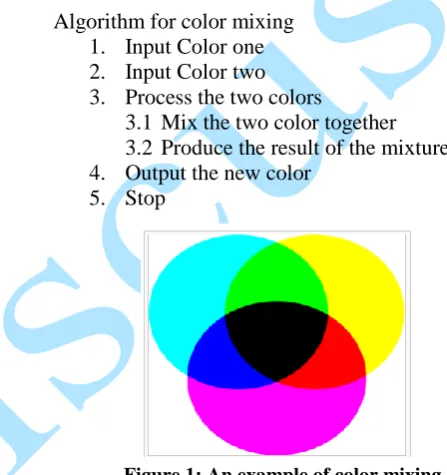
The material used in this research work is based on the algorithm of color mixing from below, this algorithm gives the output of new color when two colors are mix together.
Algorithm for color mixing 1. Input Color one 2. Input Color two 3. Process the two colors
3.1 Mix the two color together 3.2 Produce the result of the mixture 4. Output the new color
5. Stop
Figure 1: An example of color mixing
Working Algorithm for color mixture
UPP = Upper(R,G,B) LOW = Lower(R,G,B) if (UPP = LOW)
High = 0 Slow = 0 Else
Add = (UPP/225)+(LOW/225) Sub = (UPP/225)-(LOW/225) Perc =(UPP + LOW) / 2 if Per < 128
Slow = (Sub / Add) * 255 Else
Slow = (Sub / (2-Sub)) * 255 End
Case UPP of R
High = (((G –B)/255)/Sub) * 60 Case of G
High = (((2+ (B – R)/255)/Sub) * 60 Case B
If High < 0
High + = 255 End
End
RGB to CMY C = 255 – R M = 255 – G Y = 255 – B RGB to CMYK C = 255 – R M = 255 – G Y = 255 – B K = Low(C, M, Y) CMY to CMYK K = Low(C, M, Y) C = (C – K) / (255 – K) M = (M – K) / (255 – K) Y = (Y – K) / (255 – K)
3. DISCUSSION OF RESULT
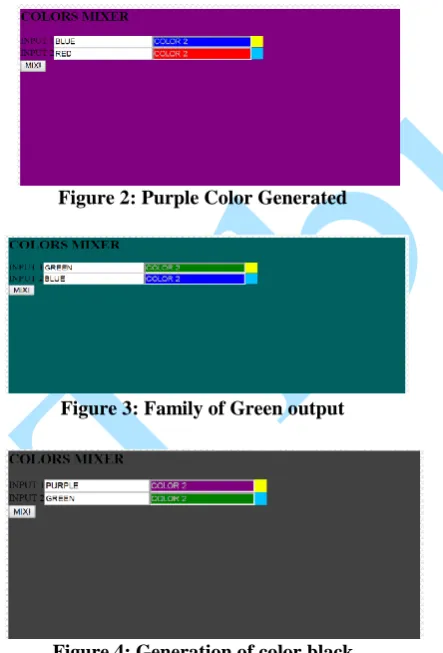
The following are the output generated in mixing of the primary colors.
Figure 2: Purple Color Generated
Figure 3: Family of Green output
Figure 4: Generation of color black
The figure 2 displays the new color generated when color blue and color red are mixed together. This produces purple color.
The figure 3 displays the new color generated when color green and color blue are mixed together. This produces family of green.
In the figure 4, color purple and color green were mixed to generate color black with the algorithm above.
4. CONCLUSION
In color industries, color measurement and color theories are very important to solve coloring process problems as they provide a quantitative evaluation of color. Before applying any theoretical model, it is also necessary to measure the color of objects or colorants with Spectra radiometers and Spectrophotometers in terms of spectral reflectance, transmittance and absorption because all most all color theories use these parameters as the input to do analysis of color or prediction of color of objects. The author also measured spectral reflectance, transmittance and absorption of many samples and materials correctly.
No colors mixture can produce a truly identical to that of a spectral, although one can get close result, especially for the color with longer wavelengths ([CIE32]). A simple illustration is the mixing of light green (530nm) with light blue (460nm) produces light cyan that is slightly de-saturated, because response of the red color receptor would be greater to the green and blue light in the mixture than it would be to a pure cyan light at 485nm that has the same intensity as the mixture of blue and green ([Wri28]).
REFERENCES
[Ber00] R. S. Berns – Billmeyer and
Saltzman’s Principles of Color
Technology, 3rd Edition. Wiley, New York. ISBN 0-471-19459-X.
[Boh06] C. F. Bohren – Fundamental of
Atmospheric Radiation: An
Introduction with 400 problems, 2006
[Bri07] D. Briggs – The dimension of color. Archive from the original. Retrieved 2015.
[CIE32] Commission Internationale de I’Eclairage – Proceedings, 1931. Cambridge: Cambridge University Press.
[Don97] R. McDonald – Color Physics for Industry, 1997.
[Far16] S. Farris – Color: Color Theory,
Mixing and Perception of color.
[GM97] E. J. Giorgianni, T. E. Madden – Digital Color Management: Encoding
Solutions, Addison Wesley Longman,
Massachusetts 1997.
[Hun98] R. W. G. Hunt – Measuring Color, third edition, Fountain Press, England, 1998.
[Kue96] R. G. Kuehni – Color: An
Introduction to Practice and
Principles, Willey & Sons, New York,
1996.
[KB69] P. Kay, B. Berlin – Basic color terms:
their universality and evolution,
Berkeley: University of California Press. 1969.
[Man13] Mani – Author Archive. Retrieved
September, 2013 from
https://manichemist09.wordpress.com/ author/manichemist09/ and http://en.wikipedia.org/wiki/Additive_ color.
[Mul05] B. M. Mulholland – Hoechst
technical Polymers, Florence.
Introduction to Color Theory, 2005.
[NJ86] J. Neitz, G. Jacob – Polymorphism of the long wavelength cone in normal
human color vision. Nature 323(6089):
623-5.
[Ohn00] Y. Ohno – Fundamentals for color measurement (pdf). IS&T NIP16 Intl. Conf. on Digital Printing Technologies, 2000.
[Sco15] A. B. Scott – Subtractive Color
Mixture Computation. University of
Illinois at Urbana-Champaign, 2015.
[Wal02] G. Waldman – Introduction to light: the physics of light, vision, and color (Dovered) Mineola: Dover Publications, 2002.
[Wri28] W. D. Wright – A re-determination of the trichromatic coefficients of the
spectral colors. Transactions of the
Optical Society. 30(4). 141-164. Doi:10.1088/1475/4878/30/4/301.
[***17] *** – Crayola: Learn color,
http://www.crayola.com/for-