O
RIGINAL
A
RTICLES
The death notification form (‘death certificate’) (DNF), the primary source of mortality and disease statistics in South Africa, is essential for planning public health programmes and public spending. Data in the DNF must be accurate and complete, but little or no training and/or supervision is provided to health care providers to ensure their correct completion.
During the apartheid era the BI-12 form was the DNF used for all racial groups, except for black African people, for whom the BA 679 applied. Both these forms were sparse, containing minimal information for statistical use. A joint committee established in 1996 recommended improvements to the death notification system in South Africa. A new DNF (the BI-1663) was designed to ensure registration of death, collect important data for health planning, reduce fraud and achieve compliance with international standards set by the World Health
Organization (WHO).1 The first page collects information
required for registering the death, and the second records socio-demographic and health data of the deceased and details
of the cause of death. The second page is confidential, should be sealed by the person completing the form, and may only be accessed by a Department of Home Affairs official.
The cause of death is entered in two parts. Part 1 records a sequence of conditions beginning with the immediate cause of death (the final disease or condition resulting in death) on line (a) which is dueto the condition recorded on line (b), which is due to the condition in line (c), which is due to the underlying cause of death (the disease or injury that initiated events resulting in death) on line (d). It is not necessary to use all four lines in part 1, but in every case the underlying cause of death should be recorded last in the sequence. In part 2 other significant conditions contributing to death, but not resulting in the underlying cause, must be entered. The underlying cause of death is coded according to the the Manual of the International Statistical Classification of Diseases, Injuries, and Causes of Death, 10th revision (ICD-10) by nosologists from Statistics South Africa (Stats SA) who receive DNFs from the central Home Affairs Office in Pretoria. This information is then used to generate cause-specific mortality statistics in South Africa. Because of the need for monitoring of DNF completion in South Africa, we sought to determine the frequency of errors in the cause of death sequence and the completeness of information on DNFs.
Methods
We evaluated DNFs of all residents of the communities of Bonteheuwel and Langa, Cape Town, who died during the period 1 June 2003 to 31 May 2004. Under apartheid
Errors in the completion of the death notification form
Elsie Helena Burger, Lize van der Merwe, Jimmy VolminkForensic Medicine Division, Faculty of Health Sciences, Stellenbosch University, Tygerberg, W Cape
Elsie Helena Burger, MB ChB, FCForPath (SA), MMed Forens Path
Biostatistics Unit, Medical Research Council, Tygerberg
Lize van der Merwe, BSc, MSc, PhD
Faculty of Health Sciences, Stellenbosch University, Tygerberg
Jimmy Volmink, BSc, MB ChB, DCH (SA), MPH, DPhil
Objectives. To determine the frequency of errors in the cause of death sequence and to assess the completeness of information recorded on death notification forms (DNFs).
Design. A population-based descriptive study.
Setting. All residents of two residential areas in the Cape Town metropole who died during the period 1 June 2003 to 31 May 2004.
Methods. We examined DNFs for pre-specified major and minor
errors, assessed potential predictors of major errors using multivariate analysis, and assessed the DNFs for completeness in terms of particulars of the deceased, the informant and the health professional certifying death.
Results. 844 DNFs were evaluated. Errors were found in 91.7%
(95% CI 89.7 - 93.4%) of DNFs, and 43.4% (95% CI 40.1 - 46.7%) had at least one major error, most commonly an illogical cause of death sequence. Factors that seemed to affect the frequency
of major errors were the number of lines of the cause of death sequence that had been completed, the age, gender and area of residence of the deceased, and the type of facility where the DNF had been completed. Varying levels of completeness were found for different items of information with some questions such as the education, occupation, usual business and smoking history of deceased being largely ignored by health professionals.
Conclusion. An unacceptably high proportion of DNFs in the
greater Cape Town area contain errors sufficiently serious to affect the accuracy of cause of death coding. This has far-reaching implications for the reliability of mortality data in South Africa. Educational, managerial and administrative interventions are urgently needed to improve the standard of DNF completion.
S Afr Med J 2007; 97: 1077-1081.
O
RIGINAL
A
RTICLES
Bonteheuwel was designated a ‘coloured’ area while Langa was a ‘black’ area, and their populations still reflect this. Based on the 2001 census, the populations of Bonteheuwel and Langa are approximately 55 707 and 49 667, respectively.
The Cape Town City Health Department routinely obtains copies of all DNFs from the regional Department of Home Affairs offices for statistical purposes.2 We accessed the relevant
DNFs from the City Health Department records and report the frequency and type of errors made in the completion of DNFs, but did not attempt to validate the cause of death specified.
Our main focus was on the cause-of-death section of the DNF which we evaluated for errors, using categories previously reported, as these seemed relevant, clear and easy to use.3 Major errors were considered to be those that could affect
the accurate coding of the underlying cause of death, including any of the following: (i) no acceptable cause of death in part 1; (ii) competing causes of death in part 1; (iii) immediate, intermediate and underlying causes of death presented in an incorrect order (sequencing error); or (iv) mechanism of death not followed by a proper cause of death.
Minor errors, less likely to lead to misclassification of the underlying cause of death, were any of the following: absence of a time interval between onset of the condition and death, use of abbreviations, illegible writing, and recording of inappropriate information.
We also assessed the DNFs for completeness with respect to socio-demographic details as well as health and administrative information.
EHB assessed all DNFs for errors and missing information, and captured the information electronically using Epidata Version 3.1. Microsoft Excel, NCSS and packages MASS and nlme in the computing environment R were used to analyse the data. The frequency of errors or omissions was calculated as percentages. We initially explored whether certain factors influenced the frequency of major errors by using the
chi-squared test for the comparison of proportions. In our final analysis, we adjusted for non-independence of errors arising from individual doctors completing more than one DNF, by using logistic regression with random effects. We assessed each factor singly and in combination.
The study was approved by the ethics committees of the health sciences faculties of the Universities of Stellenbosch and Cape Town, and the Health Departments of the City of Cape Town and the Provincial Government of the Western Cape.
Results
We obtained a total of 844 DNFs: 331 from Bonteheuwel and 513 from Langa, completed by health care professionals at 33 different public sector health care facilities, including two general tertiary hospitals, one specialist children’s hospital, three medico-legal mortuaries and several secondary and primary health care facilities, and by private practitioners. Only one or two lines of the cause of death sequence were used in part one in 77.3% of DNFs.
Frequency of errors in the cause of death section
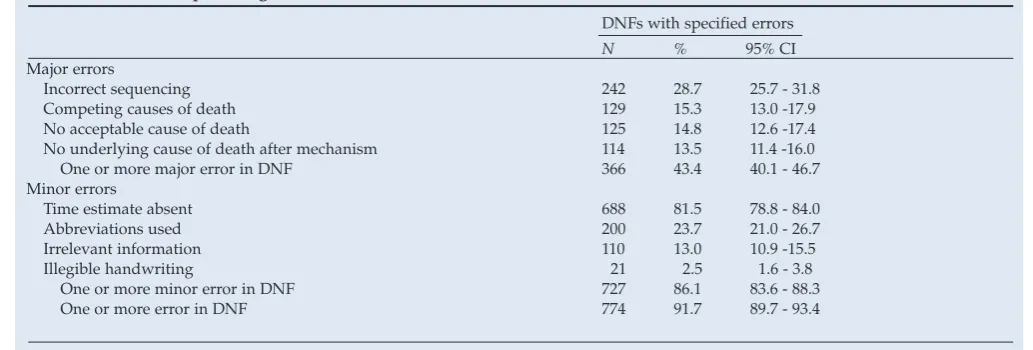
Only 70 DNFs were free of any errors, meaning that 774 (91.7%; 95% CI 89.7 - 93.4%) had at least one major or minor error. Table I shows the frequency of error types.
Major errors occurred in 366 (43.4%; 95% CI 40.1 - 46.7%) of DNFs, most frequently sequencing errors, found in 242 (28.7%; 95% CI 25.7 - 31.8%). This type of error can only occur where two or more lines of the cause of death sequence were completed. Limiting the analysis to these cases only, the prevalence of sequencing errors was 242/449 (53.9%; 95% CI 49.3 - 58.5%).
[image:2.637.56.573.612.787.2]Competing causes of death were found in 129 (15.3%; 95% CI 13.0 - 17.9%) of DNFs. A common example of this category of error is ‘Hypertension’ followed by ‘Diabetes mellitus’, or vice versa. The appropriate place to record competing causes
Table I. Number and percentage of errors found in DNFs, with 95% confidence intervals
DNFs with specified errors
N % 95% CI
Major errors
Incorrect sequencing 242 28.7 25.7 - 31.8
Competing causes of death 129 15.3 13.0 -17.9
No acceptable cause of death 125 14.8 12.6 -17.4
No underlying cause of death after mechanism 114 13.5 11.4 -16.0
One or more major error in DNF 366 43.4 40.1 - 46.7
Minor errors
Time estimate absent 688 81.5 78.8 - 84.0
Abbreviations used 200 23.7 21.0 - 26.7
Irrelevant information 110 13.0 10.9 -15.5
Illegible handwriting 21 2.5 1.6 - 3.8
One or more minor error in DNF 727 86.1 83.6 - 88.3
O
RIGINAL
A
RTICLES
would be in part 2 of the cause of death section, but in our sample part 2 was used in only 72 (8.5%; 95% CI 6.8 - 10.6%) DNFs.
Injudicious use of mechanisms of death was encountered in 114 (13.5%) of DNFs. In some of these cases mechanisms were followed by legitimate causes of death, but no link could be established between the mechanism and the proffered cause of death, e.g. dehydration due to hypertension.
In 125 cases (14.8%; 95% CI 12.6 -17.4%) no acceptable cause of death was given, and of these 79 (9.4% of all DNFs) showed only ‘Natural causes’ or ‘Unnatural causes’. Other examples include signs and symptoms, and ill-defined terms such as ‘Old age’ and ‘Severe headache’.
Minor errors were found in 727 (86.1%; 95% CI 83.6 - 88.3%) DNFs. By far the most common was the absence of a time estimate between the onset of disease and death, which occurred in 688 (81.5%; 95% CI 78.8 - 84.0%) cases.
Abbreviations were used in 200 (23.7%; 95% CI 21.0 - 26.7%) DNFs. While some abbreviations were relatively clear (DM = diabetes mellitus), others were hard to interpret, e.g. ‘HONK’.
One hundred and ten (13.0%; 95% CI 10.9 -15.5%) DNFs contained irrelevant information in the cause of death section, including complete case histories and multiple causes of death written in single lines.
Approximately 2.5% (95% CI 1.6 - 3.8%) of cause of death sequences in DNFs were completely illegible, and many more were very hard to decipher, though this is subjective.
Factors influencing the frequency of major errors
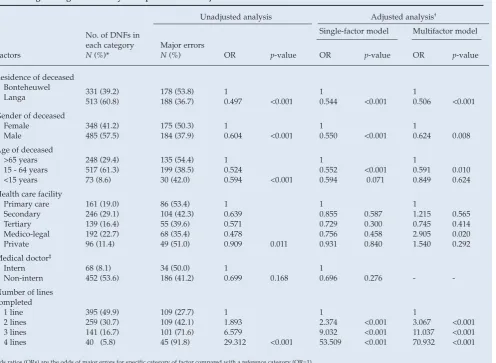
Table II shows the influence of selected factors on the [image:3.637.78.575.389.752.2]prevalence of errors that were chosen based on the availability of data and their potential importance in influencing the frequency of errors. Major errors were found to increase as the number of lines completed in the cause of death
Table II. Logistic regression analysis of predictors of major errors in DNFs
No. of DNFs in each category N (%)*
Unadjusted analysis Adjusted analysis†
Single-factor model Multifactor model
Factors Major errors N (%) OR p-value OR p-value OR p-value
Residence of deceased Bonteheuwel
Langa 331 (39.2)513 (60.8) 178 (53.8)188 (36.7) 10.497 <0.001 10.544 <0.001 10.506 <0.001
Gender of deceased Female
Male 348 (41.2)485 (57.5) 175 (50.3)184 (37.9) 10.604 <0.001 10.550 <0.001 10.624 0.008
Age of deceased >65 years 15 - 64 years <15 years
248 (29.4) 517 (61.3) 73 (8.6)
135 (54.4) 199 (38.5) 30 (42.0)
1 0.524
0.594 <0.001
1 0.552
0.594 <0.001 0.071 1 0.591
0.849 0.0100.624 Health care facility
Primary care Secondary Tertiary Medico-legal Private
161 (19.0) 246 (29.1) 139 (16.4) 192 (22.7) 96 (11.4)
86 (53.4) 104 (42.3) 55 (39.6) 68 (35.4) 49 (51.0)
1 0.639 0.571 0.478
0.909 0.011
1 0.855 0.729 0.756 0.931
0.587 0.300 0.458 0.840
1 1.215 0.745 2.905 1.540
0.565 0.414 0.020 0.292 Medical doctor‡
Intern
Non-intern 68 (8.1)452 (53.6) 34 (50.0) 186 (41.2) 10.699 0.168 10.696 0.276 -
-Number of lines completed
1 line 2 lines 3 lines 4 lines
395 (49.9) 259 (30.7) 141 (16.7) 40 (5.8)
109 (27.7) 109 (42.1) 101 (71.6) 45 (91.8)
1 1.893 6.579
29.312 <0.001
1 2.374 9.032 53.509
<0.001 <0.001 <0.001
1 3.067 11.037 70.932
<0.001 <0.001 <0.001
Odds ratios (ORs) are the odds of major errors for specific category of factor compared with a reference category (OR=1). *Unknown variables were excluded.
O
RIGINAL
A
RTICLES
sequence increased. Higher rates of major errors were found when the deceased was female, aged <15 or >65, or lived in Bonteheuwel. The highest rates of errors were observed at primary care centres and the lowest at medico-legal mortuaries.
This analysis, however, did not take into account the fact that the same doctors may have completed more than one DNF. When adjusted for this (Single factor models, Table II) the results were similar, but the place of completion was no longer important.
We then developed a multivariate model to control for the mutually confounding effects of the potential predictors of error we had assessed in the univariate analysis, and because some doctors completed more than one DNF. More than one line in the cause of death sequence, female sex, age >65 years and residency in Bonteheuwel remained significantly associated with error. Place of completion once again emerged as important, but interestingly the odds of error in mortuary-derived DNFs was significantly higher than that in DNFs completed in primary care (Multivariate model, Table II). Although the error rate at the medico-legal mortuaries was the lowest of all the facilities, the proportion of errors for single-line DNFs was highest at these facilities (31.5% at medico-legal v. 11.4% at primary care). Since 84.3% of DNFs completed at mortuaries contained only one line in the cause of death sequence, as opposed to 21.7% in primary care facilities, the odds of error was significantly higher for medico-legal mortuaries when standardised for the number of lines completed.
Completeness of information
We examined DNFs for completeness of information, comparing the frequency of missing data in the two communities. Age at death, racial group and marital status were completed in less than two-thirds of cases. The smoking history of the deceased was completed in 35% of DNFs, slightly less frequently than the smoking habits of the informant (37%). While the ID number of the deceased and health professional’s details were completed in most cases, contact details of the informant were rarely provided. The questions concerning education, occupation and the industry involved in during life were rarely completed, with the occupation faring best at 27.1%. The poor completion of these questions renders them useless for statistical comparisons by Stats SA. In general, DNFs from Bonteheuwel residents were more complete than those from Langa.
Additional findings
On page 1, the certifying doctor must decide whether the death was due to ‘Natural causes’, or indicate ‘I am not in the position to certify that the deceased died exclusively due to natural causes’. In 41 cases (4.9%) there was a discrepancy between the manner of death option chosen on page 1 and the
cause of death noted on page 2, e.g. a certifying practitioner ticked the second box on page 1 and recorded ‘Asthma’ as the cause of death on page 2. This is indicative of poor DNF completion, and these cases may represent missed forensic cases.
Discussion
Soon after the adoption of the BI-1663, a sample of DNFs obtained from the Cape Town City Health Department in 1999 found that 75% of forms had adequate cause of death information.2 A bleaker picture emerged in a study at a large
hospital in Umtata which revealed that 79% of DNFs had ‘Cardio-respiratory failure’ as cause of death.4 A WHO study
put South Africa in the group of ‘low quality’ death registration data.5
Using identical criteria, we found more major errors (43%) than in a teaching hospital in Canada3 in 1993 (32%), and only
8% of our DNFs were completely free of error, compared with their 45%. Other studies found error rates varying from 6% to 43%,6-9 each using different criteria for assessment.
Our high incidence of minor errors is largely accounted for by the absence of time intervals in 81.5% of cases. This is necessary to clarify the order of events, easing the job of the nosologists, and is requested in most international DNFs. In the Canadian study3 the time interval was not completed in
36% of cases.
As in our study, error rates in Taiwan increased with advancing age of the deceased.10 Since elderly people often
have multiple pathologies, there is a greater likelihood of sequencing errors and recording multiple causes of death. The complexity of certain clinical cases can make it hard to identify a single underlying cause of death.11
Our finding that the error rate rises with the number of lines in the cause of death sequence completed is not surprising given that this increases opportunities for error. It is more difficult to explain the higher rates of major errors in DNFs in women compared with men and in Bonteheuwel residents compared with Langa.
In medico-legal cases a low level of major errors might be anticipated but this was not the case in our study or in a Canadian study.3 Fifty-one DNFs from mortuaries (26.6%)
indicated ‘Natural/Unnatural causes’ as the cause of death on the second page. This could be due to pathologists’ concerns about being questioned in court regarding a specific cause of death stated on the DNF. In South Africa, pathologists are not legally obliged to specify the precise manner of death, e.g. suicide, homicide, or the specific external cause of injury, though this would improve the quality of mortality information.
O
RIGINAL
A
RTICLES
second pages exists, leading to some doctors not recording the true underlying cause of death in sensitive cases (e.g. HIV), or stating ‘Natural causes’. Anonymous completion of page 2, without identifying details of the deceased person, and for the certifier to send this separately to the Department of Home Affairs, have been proposed.15 A similar system has been used
in the Netherlands since 1927, and improved in 1956, so that the first page does not show the cause of death.16 The serial
number contained on both pages of the South African DNF could link information at the central Department of Home Affairs.
To our knowledge this is the first population-based study of errors in the completion of the new South African DNF. It reflects the performance of all health professionals certifying death within a defined geographical population.
A limitation is that the determination of the types of errors was judged by one forensic pathologist (EHB). A cross-check of the findings by a second researcher may have improved the study; however, the use of pre-specified categories of error will have reduced bias. No attempt was made to validate the accuracy of the underlying cause of death, which will be the focus of a follow-up study.
A Canadian study showed that a brief educational intervention can significantly reduce the rates of major errors in the completion of death certificates.17 Targeted educational
interventions should be developed and tested in South Africa as a matter of urgency. Modification of the current DNF by reformatting, rephrasing or removing some questions warrants consideration, with the involvement of all relevant stakeholders.
Health care facilities should also consider introducing strategies, including incentives, to encourage doctors and administrative staff to comply with the rules of DNF completion. Counter-signing of DNFs by senior medical staff, multidisciplinary mortality meetings and querying programmes (as used in parts of the USA and Europe) could also be considered.
The advice by Gear in 1937 remains to be taken seriously: ‘A contribution, by a little time and energy being given to the
accurate registration of deaths, … is but a small effort to make for the common good’.18
We are grateful to Professor Debbie Bradshaw and Drs Pat Yudkin, Pam Groenewald and Danuta Kielkowski for comments on early drafts of the paper, to Dr Gwyneth Arendorf, Ms Sharm Naidoo, Ms Lungiswa Mankayi and Mr David Blease for their help with data collection, and for financial support from the UK Department for International Development (via the Effective Health Care Alliance Programme) and the Department of Primary Health Care, Oxford University.
References
1. National Health Information System of South Africa Technical Committee on Vital Registration. Final report: Evaluation of the new Death Notification Form (BI-1663). January 2001. http://www.doh.gov.za/nhis/vital/docs/evaluation/contents.html/ (last accessed 8 November 2006).
2. Bradshaw D, Groenewald P, Bourne DE, et al. Making COD statistics useful for public health at local level in the city of Cape Town. Bull World Health Organ March 2006; 84(3): 211-217. 3. Jordan JM, Bass MJ. Errors in death certificate completion in a teaching hospital. Clin Invest
Med 1993; 16: 249-255.
4. Meel BL. Certification of deaths at Umtata General Hospital, South Africa. J Clin For Med
2003; 10: 13-15.
5. Mathers CD, Ma Fat D, Inoue M, Rao C, Lopez AD. Counting the dead and what they die from: an assessment of the global status of COD data. Bull World Health Organ 2005; 83: 171-177.
6. Swift B, West K. Death certification: an audit of practice entering the 21st century. J Clin Pathol 2002; 55: 275-279.
7. Slater DN. Certifying the cause of death: an audit of wording inaccuracies. J Clin Pathol 1993; 46: 232-234.
8. Sibai AM, Nuwayhid I, Beydoun M, Chaaya M. Inadequacies of death certification in Beirut: who is responsible? Bull World Health Organ 2002; 80(7): 555-561.
9. Cina SJ, Selby DM, Clark B. Accuracy of death certification in two tertiary care military hospitals. Mil Med 1999; 164(12): 897-899.
10. Lu TH, Shau WY, Shih TP, Lee MC, Chou MC, Lin CK. Factors associated with errors in death certificate completion: A national study in Taiwan. J Clin Epidemiol 2001; 54: 232-238. 11. McAllum C, St George I, White G. Death certification and doctors’ dilemmas: a qualitative
study of GPs’ perspectives. Br J Gen Pract 2005; 5(518): 677-683.
12. Bah S. A note on confidentiality of death notification forms. S Afr Med J 2003; 93(4): 238. 13. Groenewald P, Nannan N, Bourne D, Laubscher R, Bradshaw D. Identifying deaths from
AIDS in South Africa. AIDS 2005; 19:193-201.
14. Dada MA, McQuoid-Mason DJ. Medico-legal aspects of pathology – current dilemmas regarding confidentiality and disclosure. S Afr Med J 2005; 95(11): 875-877.
15. Dhai A, Dada M, Kirk GM, McQuoid-Mason DJ. Confidentiality – a dying wish? S Afr Med J
2001; 91: 123-127.
16. Van Poppel F, Van Dijk J. The development of cause-of-death registration in the Netherlands, 1865-1955. Continuity and Change 1997; 12(2): 265-287.
17. Myers KA, Farquhar DRE. Improving the accuracy of death certification. CMAJ 1998; 158(10): 1317-1323.
18. Gear HS. A plea for improved South African medical and vital Statistics. S Afr Med J 1937; XI(5): 149-154.