
THE UNITED REPUBLIC OF TANZANIA
MINISTRY OF EDUCATION AND VOCATIONAL TRAINING
© Ministry of Education and Vocational Training, 2007
First Reprint, 2010
Second Reprint, 2012
Third Reprint, 2017
ISBN: 978 – 9976 – 61 – 238 – 7
Designed and prepared by:
Tanzania Institute of Education,
P.o.Box 35094, Dar es Salaam,
TANZANIA.
Tel: +255 -022 - 2773005/2774420 /2780891
Fax No: +255 -22-2774420
E-mail: [email protected]
All rights reserved. No part of this publication may be reproduced, reported,
stored in any retrieval system, or transmitted in
TABLE OF CONTENTS
Page
Introduction ...
iii
Aims and Objectives of Education in Tanzania ...
iii
Aims and Objectives of Secondary Education ...
iv
General Competences ...
v
General Objectives ...
v
The Structure of the Syllabus ...
v
Form I ...
1
Form II ...
29
Form III ...
69
1.0
Introduction
This Physics syllabus is a revised version which has been prepared to
replace that of 1996 syllabus which has been phased out. The revision process
focused on change in paradigm from that of content based curriculum to a
competence- based curriculum. Moreover, the revision was inevitable due
to the fact that the 1996 syllabus did not sufficiently consider the current
social, cultural, global, technological, subject biases and cross cutting issues
taking place worldwide but particularly in Tanzanian society.
In addition, the revision has also taken into consideration the requirements
for the Secondary Education Development Plan (SEDP). This syllabus has
been introduced for implementation from January 2007.
2.0
Aims and Objectives of Education in Tanzania
The general aims and objectives of education in Tanzania are to:
a) guide and promote the development and improvement of the
personalities of the citizens of Tanzania, their human resources and
effective utilization of those resources to bringing about individual and
national development;
b) promote the acquisition and appreciation of the culture, customs and
traditions of the people of Tanzania;
c) promote the acquisition and appropriate use of literacy, social,
scientific, vocational, technological, professional and other forms of
knowledge, skills and attitudes for the development and improvement
of the condition of man and society;
d) develop and promote self-confidence and an inquiring mind, an
understanding and respect for human dignity and human rights and
readiness to work hard for self- advancement and national development;
e) promote and expand the scope of acquisition, improvement and
f) enable every citizen to understand and uphold the fundamentals
of the National Constitution as well as the enshrined human and civic
rights, obligations and responsibilities;
g) promote love and respect for work, self and wage employment and
improved performance in the production and service sectors;
h) inculcate principles of national ethic and integrity, national and
international cooperation, peace and justice through the study,
understanding and adherence to provisions of the National Constitution
and other international basic charters;
i) enable a rational use, management and conservation of the environment.
3.0
Aims and Objectives of Secondary Education
The aims and objectives of secondary education are to:
a) consolidate and broaden the scope of baseline ideas, knowledge, skills
and attitudes acquired and developed at the primary education level;
b) enhance further development and appreciation of national unity,
identity and ethic; personal integrity, respect for and readiness to work,
human rights, cultural and moral values, customs, traditions and civic
responsibilities and obligations;
c) promote the development of competency in linguistic ability and
effective use of communication skills in Kiswahili and at least one
foreign language;
d) provide opportunities for the acquisition of knowledge, skills, attitudes
and understanding in prescribed or selected fields of study;
e) prepare students for tertiary and higher education, vocational, technical
and professional training;
f) inculcate a sense and ability for study, confidence and
self-advancement in new frontiers of science and technology, academic and
occupational knowledge and skills.
4.0
General Competences
By the end of the four years course, students should have ability to:
a) use Physics knowledge, principles and concepts in daily life;
b) apply scientific methods in solving problems in daily life;
c) apply technological skills in interacting with the environment;
d) manage simple technological appliances.
e) use the language of Physics in communication .
5.0
General Objectives
By the end of the four years course, students should be able to:
a) develop knowledge on concepts, laws, theories and principles of
Physics;
b) understand procedures of scientific investigation;
c) acquire technological skills to interact with the environment;
d) develop the language of communication in Physics.
6.0
Structure of the Syllabus
This Physics syllabus has a slightly different structure compared to that of
1997. The following changes were added for improvement:
a) General competences for the whole course.
b) Competences for each class.
c) Suggested areas for assessment.
d) Number of periods per sub-topic.
6.1
Class Level Competences
Competences have been stated for each class/level of Physics course. The
class level objectives are derived from the class level competences.
6.2
Class Level Objectives
6.3
Topics
The topics have been derived from the class level competences and objectives.
Some topics in the 1997 and 2005 Physics syllabus have been retained. Also
some content from cross-cutting issues (CCI), have been integrated. Topics
have been rearranged to attain a logical order, starting from the simple to the
most difficult ones. Both block and spiral arrangements of topics have been
adopted.
6.4
Sub – topics
Topics have been divided into sub-topics. Each sub-topic comprises of a
portion of the content of the topic in question. The sub-topics have also been
arranged to attain a logical order.
6.5
Specific Objectives
Each sub-topic has one or more specific objectives. These specific objectives
are the expected outcomes in classroom instructions. They also reflect the
process to attain competences within the cognitive, affective and psychomotor
domains.
6.6
Teaching and Learning Strategies
6.7
Teaching and Learning Resources
Teaching of Physics requires a variety of teaching/learning resources in
quality and quantity. In case the commercial teaching/learning resources are
not available, the teacher should work with students to collect or improvise
alternative resources available in their environment.
6.8
Assessment
• Both formative
(
assessment for learning
)
and summative
(
assessment of
learning
) assessment should be done as to check for understanding of
the stated objectives in particular topic/subtopic. All in turn will reflect
the competences expected to be met at a particular level/class.
• The teacher should use tools of assessment for the teaching and learning
process by the end of each lesson. Examples of these tools are: exercise,
tests, quiz, examinations, role plays, project work, experiments/
practical and portfolio.
Likewise, in the column of assessment in the scheme of work, a teacher
should use these tools of assessment instead of writing the question asked in
the said column.
6.9
Number of Periods
DECLARATION
Ordinary level secondary education is a four years course which has been designed
to prepare students for the advanced level or other tertiary education. A student will
be recognized as a Form Four graduate when he/she successfully complete and pass
secondary education examinations conducted by National Examination Council of
Tanzania.
This document is hereby declared as the Syllabus of Physics for ordinary level
secondary education course.
Commissioner for Education
FORM ONE
CLASS LEVEL COMPETENCES
Student should have the ability to:
-1)
practice safety rules in daily life;
2)
apply laws, principles of Physics in daily life;
3)
make appropriate measurements of physical quantities; and
4)
use scientific skills to identify nature and properties of matter.
CLASS LEVEL OBJECTIVES
By the end of Form One course, the student should be able to:
1)
demonstrate laboratory practice and safety;
2)
demonstrate laws and principles of Physics;
TOPICS/ SUB-T
OPICS
SPECIFIC OBJECTIVES
TEACHING AND
LEARNING
STRA
TEGIES
TEACHING AND LEARNING RESOURCES
ASSESSMENT
NO. OF PERIODS
INTRODUCTION T
O
PHYSICS Concept of Physics The student should be able to: a)
explain the concept of Physics
i)
The teacher to assist students to brainstorm and discuss the concept of Physics
ii)
Students to identify various things related to Physics.
i)
Manila card
ii)
Charts with diagram
Is the student able to explain the concept of Physics?
2
b)
establish the relationship between Physics and other subjects
i)
The teacher to guide students in their small groups to discuss the relationship between Physics with other subjects.
ii)
Students to explain the relationship of Physics with other subjects.
i)
Science kit
ii)
W
all charts
Is the student able to establish the relationship between Physics and other subjects?
c)
state the importance of studying Physics
i)
The teacher to guide students in groups to state the importance of studying Physics.
ii)
Students to discuss and state the importance of studying Physics.
i)
Charts of dif
ferent
machines
ii)
Picture
Is the student able to state the importance of studying Physics?
Applications of Physics in Real Life The student should be able to: a)
explain the applications of Physics in real life
i)
The teacher to guide students to discuss the applications of Physics in real life.
ii)
Students in groups to explain the applications of Physics in real life. Chart with hospital/ industrial machines Is the student able to explain the applications of Physics in real life?
TOPICS/ SUB-T OPICS SPECIFIC OBJECTIVES TEACHING AND LEARNING STRA TEGIES
TEACHING AND LEARNING RESOURCES
ASSESSMENT
NO. OF PERIODS
b)
apply Physics in daily life
i)
The teacher to guide students in groups to describe various applications of Physics in daily life.
ii)
Students use guidelines to perform activities which demonstrate applications of physics.
i)
Apparatus
ii)
Domestic tools
Is the student able to apply Physics in daily life?
INTRODUCTION TO LABORA
TOR
Y
PRACTICE Laboratory Rules and Safety
The student should be able to: a) state Physics laboratory rules
i) The teacher to guide students to discuss the laboratory rules. ii) Students to list the Physics laboratory rules. Chart of Physics laboratory rules. Is the student able to state Physics laboratory rules? 6 b)
explain the safety measures in Physics laboratory
i) The teacher to guide students in groups to discuss important safety measures for the Physics laboratory . ii) Students to explain important safety measures for Physics laboratory . i)
Wall charts and pictures showing safety measures in Physics laboratory
.
ii)
Foam or Carbon dioxide fire extinguisher Is the student able to explain safety measures in Physics laboratory?
c)
use the First
Aid Kit to
TOPICS/ SUB-T OPICS SPECIFIC OBJECTIVES TEACHING AND LEARNING STRA TEGIES
TEACHING AND LEARNING RESOURCES
ASSESSMENT
NO. OF PERIODS
d)
identify warning signs
i) The teacher to guide students through Think-Pair - Share technique to identify warning signs. ii) Students in groups to dif ferentiate warning signs of the objects/wall chart distributed to them by the teacher . i) Wall chart of dif ferent warning signs. ii) Dif ferent objects labelle d with warning Signs. Is the student able to identify warning signs? e)
use warning signs in daily life
i) The teacher to demonstrate to students the uses of warning signs in daily life. ii) The teacher to assist students through role play on how to use the warning signs in dif ferent context. i) Label of dif ferent objects/ containers. ii) Dif ferent objects labeled with warning Signs. Is the student able to use warning signs in daily life?
Basic Principles of Scientific Investigation
TOPICS/ SUB-T OPICS SPECIFIC OBJECTIVES TEACHING AND LEARNING STRA TEGIES
TEACHING AND LEARNING RESOURCES
ASSESSMENT
NO. OF PERIODS
c) use the scientifi c investigation methods in solving problems. i) Teacher to assist students to brainstorm the uses of scientifi c investigation methods in solving problems. ii) Students to apply scientifi c investigation methods in solving problems. i) Physics apparatus ii) Wall charts Is the student able to use the scientifi c investigation methods in solving problems?
MEASUREMENT Concepts of Measurement
The student should be able to: a) explain the concepts of measurement; i) By using YES/NO cards the teacher to lead students in groups to read case study about the concept of measurement. ii) Students in pairs to explain the concept of measurement. i) Metre rule ii) Tape measure iii) Beam balance iv) Stop watch v) Clock Is the student able to explain the concept of measurement? 1 b) state the importance of measurement in real life. i) By using Think-Pair -Share technique, the teacher to guide students to state the importance of measurement in real life. ii) Students in groups to apply measurement in various bodies. i) Solid body ii) Liquid iii) Measurement tools Is the student able to state the importance of measurement? Fundamental Quantities The student should be able to: a) defi ne a fundamental quantity; i) The teacher to assist students to defi ne a fundamental quantity . ii) Students in groups to defi ne fundamental quantity . i) Metre rule ii) Thermometer iii) Stop watch iv) Beam balance
TOPICS/ SUB-T OPICS SPECIFIC OBJECTIVES TEACHING AND LEARNING STRA TEGIES
TEACHING AND LEARNING RESOURCES
ASSESSMENT
NO. OF PERIODS
b) mention three basic fundamental quantities of measurement; i) The teacher to lead students to brainstorm the three basic fundamental quantities. ii) Students in groups to mention the three basic fundamental quantities which are mass, length and time. i) Metre rule ii) Stop watch iii) Beam balance iv) Digital balance Is the student able to mention the three basic fundamental quantities? c) state the S.I. unit of fundamental quantities; and i) The teacher to guide students individually to discuss the S.I. units of the basic fundamental quantities. ii) Students to summarize the S.I unit of basic fundamental quantities i) Books ii) Internet Is the student able to state S.I units of fundamental quantities? d) use appropriate instruments for measuring fundamental quantities. i) The teacher to facilitate students to use the appropriate instruments to measure mass, length and time. ii)
Students in groups to practice on how to measure mass, length and time.
i) Beam balance ii) Meter rule iii) Stop watch iv)
Micrometer screw gauge
TOPICS/ SUB-T OPICS SPECIFIC OBJECTIVES TEACHING AND LEARNING STRA TEGIES
TEACHING AND LEARNING RESOURCES
ASSESSMENT
NO. OF PERIODS
b) state the S.I. units of derived quantities. i) The teacher to guide students in groups to discuss the S.I. units of derived quantities. ii) Students individually to state the S.I. units of derived quantities. i) Books ii) Internet Is the student able to state the SI units of derived quantities?
Basic Apparatus/ Equipments and their Uses The student should be able to: a)
describe basic apparatus/ equipments used for measurement;
i) By using Thumbs up/Thumbs down technique, the teacher to ask questions relating to basic apparatus / equipment used for measurement. ii)
Students in pairs to describe the basic apparatus/equipment used for measurement.
i) Metre rule ii) Spring balance iii) Beam balance iv) Digital balance v) Measuring cylinder
Is the student able to describe apparatus/ equipment used for measurement?
4
b)
identify sources of errors in measurement.
i) The teacher to guide students to investigate the sources of errors in experiments and how to minimize. ii) Students in groups to discuss the concepts of parallax error , zero error and instrumental error . i) Stop watch ii) Solid objects iii) Spring balance iv) Metre rule
Is the student able to identify sources of errors in measurement?
Density and Relative Density The student should be able to: a)
explain the concept of density of a substance and its S.I. unit;
i) The teacher to guide students to brainstorm the concept of density of a substance and its S.I. unit. ii) Students in groups’ to explain the concept of density of a substance and its S.I. unit. i) Beam balance ii) Metre rule iii) Regular solid e.g. Rectangular wooden blocks of dif ferent sizes
Is the student able to explain the concept of density of a substance and its S.I unit?
TOPICS/ SUB-T OPICS SPECIFIC OBJECTIVES TEACHING AND LEARNING STRA TEGIES
TEACHING AND LEARNING RESOURCES
ASSESSMENT
NO. OF PERIODS
b)
determine the density of regular solid , irregular solids and insoluble substance;
i) The teacher to or ganize students in groups to determine the density of regular solid, irregular solids and insoluble substances. ii) Students to perform experiments to determine the density of regular , irregular and insoluble substances. iii) Students to solve problems of density of regular and irregular solids. i) Measuring cylinder ii) Calibrated beaker iii) Eureka can iv) Water v) Regular & irregular solid vi) Insoluble substance
Is the student able to determine the density of regular
, irregular
solids and insoluble substance?
c)
determine the density of a liquid;
i)
The teacher to demonstrate to students on how to determine the density of liquids.
ii)
Students to practice on how to determine the density of oil and kerosene using density bottle, pipette, burette.
i) Density bottle ii) Kerosine iii) Oil iv) Water
Is the student
able
to determine the density of liquids?
d)
define
the relative
density of a substance;
i)
By using
Think-Pair
-Share techniques
the teacher to guide students to describe the concept of the relative density of a substance.
ii)
Students in groups to solve problems on relative density
.
i)
Sand, beads
ii)
Lead shorts
Is the student able to define
the relative
TOPICS/ SUB-T
OPICS
SPECIFIC OBJECTIVES
TEACHING AND
LEARNING
STRA
TEGIES
TEACHING AND LEARNING RESOURCES
ASSESSMENT
NO. OF PERIODS
e)
determine the relative density of a substance;
i)
The teacher to guide students to perform experiments to determine the relative density of solid and a liquid.
ii)
Students to perform experiments to determine the relative density of a solid and liquid body
.
i)
Solid object
ii)
Liquid
iii)
Water
iv)
Beaker
v)
Density bottle
vi)
Measuring
cylinder
Is the student
able
to determine the relative density of a substance?
f)
interpret applications of density and relative density in real life.
i)
The teacher to guide students’ demonstration on application of density and relative density in real life.
ii)
Students in groups to interpret the applications of density and relative density in real life.
i)
A
model of a boat
ii)
Picture showing bodies floating
in water
iii)
Picture of dif
ferent
elements
Is the student able to interpret applications
of
density and relative density in real life?
FORCE Concept of Force
The student should be able to: a) explain the concept of force; and
i)
The teacher to use information from
YES/
NO cards to assess student’
s understanding
on the concept of force.
ii)
Students hold up either
YES or NO card to
respond to the teacher
’s questions on the
concept of force.
iii)
The teacher to assist students to perform demonstration about the concept of force.
i)
Spring balance
i)
Magnets
i)
Rubber band
i)
Block of wood
i)
Iron filings
i)
Weights
Is the student able to explain the concept of force?
TOPICS/ SUB-T
OPICS
SPECIFIC OBJECTIVES
TEACHING AND
LEARNING
STRA
TEGIES
TEACHING AND LEARNING RESOURCES
ASSESSMENT
NO. OF PERIODS
b)
state the S.I. unit of force.
i)
The teacher to guide students through Think-Pair
-Share technique to derive the
S.I. unit of force.
ii)
Students in groups to state the S.I. unit of force.
i)
Books
ii)
Internets
Is the student able to state the SI unit of force?
Types of Forces
The student should be able to: a) identify fundamental types of forces; and
i)
The teacher to assist students to brainstorm the fundamental forces.
ii)
Students in groups to identify the fundamental forces.
i)
Magnets
ii)
Spring balance
iii)
Block of wood
iv)
Stone, ball
Is the student able to identify the types of forces?
2
b)
describe the properties of each type of the fundamental forces.
i)
The
teacher
to guide
students to demonstrate
the properties of fundamental forces.
ii)
Students in groups to describe the properties of fundamental forces.
i)
Magnets
ii)
Spring balance
iii)
Weights
iv)
Rubber
Is the student able to describe the properties of fundamental forces?
Ef
fects of Forces
The
student
should
be
able
to:
a)
identify
ef
fects
of
forces;
and
i)
By using
Think-Pair
-Share technique the
teacher to assist students to discuss the effects of forces.
ii)
The teacher to guide students to identify effects of forces. (Stretching, restoring, attraction, repulsion, compression, torsion, frictional and viscosity).
i)
Magnets
ii)
Iron
filings
iii)
Block
of
wood
iv)
Stone,
ball
Is the
student
able
to
identify
the
ef
fects
of
forces?
TOPICS/ SUB-T OPICS SPECIFIC OBJECTIVES TEACHING AND LEARNING STRA TEGIES
TEACHING AND LEARNING RESOURCES
ASSESSMENT
NO. OF PERIODS
b) justify the ef fects of forces on materials. i)
The teacher to lead students to demonstrate effects of forces on materials.
ii)
The teacher to assist students through question and answer technique to justify the effects of forces on material.
i) Rubber ii) W eight iii) Springs iv) Spongy Is the student able to justify the ef fects of forces on materials?
ARCHIMEDES PRINCIPLE AND LAW
OF
FLOT
ATION
Archimedes Principle
The student should be able to: a) explain the concept of up thrust;
i)
The teacher to guide students through
Think-Pair
-Share technique to discuss
the concept
of upthrust.
ii)
Students in groups to perform an
experiment
to determine the upthrust.
i) Spring balance ii) W ater iii) Thread iv) Measuring cylinder v) Stones
Is the student able to explain the concept of upthrust?
4 b) Verify the Archimedes Principle; and i)
The teacher to lead students to carry
out
experiment to verify
Archimedes
Principle.
ii)
Students in groups to verify
Archimedes Principle experimentally . i) Spring balance ii) W ater iii) Beaker iv) Eureka Can v) Stone vi) Thread vii) Measuring cylinder
Is the student
able
to verify
the
TOPICS/ SUB-T
OPICS
SPECIFIC OBJECTIVES
TEACHING AND
LEARNING
STRA
TEGIES
TEACHING AND LEARNING RESOURCES
ASSESSMENT
NO. OF PERIODS
c)
Apply
the Archimedes
Principle to determine relative density
.
i)
The teacher to facilitate students to
state the
relationship between apparent
loss in weight
(upthrust) and real
weight.
ii)
Students in groups to discuss the
relationship
between apparent loss in
weight (upthrust)
and real weight.
iii)
Students in pairs to determine the
relative
density of a substance by
applying the
Archimedes’
principle.
i)
Kerosene
ii)
Alcohol
iii)
Density bottle
iv)
Sand
v)
W
ater
vi)
Beaker
Is the student able to determine the relative density
of
a substance
by
applying the Archimedes Principle?
Law of Flotation
The student should be able to: a) distinguish floating and sinking of objects;
i)
The teacher to assist students through question and answer to distinguish floating and sinking
ii)
The teacher to demonstrate to students on floating
and sinking
i)
Wood
ii)
Coin/stone
iii)
Fresh egg
iv)
Pure water
v)
Salt and stirrer
Is the student able to distinguish floating
and sinking
objects?
10
b)
explain the conditions for a substance to float in fluids;
i)
The teacher to guide students to brainstorm the conditions for a substance to float
in
fluids.
ii)
Students to perform experiments to verify the conditions for a substance to float
in
fluids.
i)
Test tube
ii)
Lead shots
iii)
Plasticine
iv)
Water
v)
Beaker
Is the student able to explain the conditions to substances to float
TOPICS/ SUB-T
OPICS
SPECIFIC OBJECTIVES
TEACHING AND
LEARNING
STRA
TEGIES
TEACHING AND LEARNING RESOURCES
ASSESSMENT
NO. OF PERIODS
c)
relate upthrust and weight of floating body;
i)
The teacher to guide students through question and answer technique to relate upthrust and weight of floating
body
.
ii)
Students in groups to carry out experiment to relate upthrust and weight of a floating body
.
i)
Spring balance
ii)
W
ater
iii)
Beaker
iv)
Piece of wood
v)
Eureka can
vi)
Measuring cylinder
vii)
Lead shots/sand
Is the student able to relate upthrust and weight of floating
body?
d)
state the law of flotation;
i)
The teacher to guide students to brainstorm the law of flotation.
ii)
Students in groups to state the law of flotation.
i)
To
y
ii)
W
ooden ship
iii)
Container
iv)
Water
Is the student able to state the law of flotation?
e)
apply the law of flotation
in everyday
life;
i)
The teacher to guide students to read case study about various bodies which apply the flotation law
.
ii)
Students in groups to mention bodies which obey the law of flotation.
iii)
The teacher to guide students to discuss the mode of action of a ship (Plimsoll line) and submarine.
i)
Buoyant
ii)
Ships, Canoes, Boats
iii)
Balloons
iv)
Kite
Is the student able to apply the law of flotation
in daily
TOPICS/ SUB-T OPICS SPECIFIC OBJECTIVES TEACHING AND LEARNING STRA TEGIES
TEACHING AND LEARNING RESOURCES
ASSESSMENT
NO. OF PERIODS
f)
describe the mode of action of a hydrometer;
i) The teacher to lead students to demonstrate the mode of action of a hydrometer . ii) Students to practice the mode of action of a hydrometer . i) Hydrometer ii)
Chart of Hydrometer
Is the student able to describe the hydrometer?
g)
construct a simple hydrometer; and
i) The teacher to supervise students in groups to construct simple hydrometer . ii)
Students in their groups to construct a simple hydrometer
. i) Test tube ii) Beaker iii) Lead shots/bearing iv) Salt v)
water and Kerosene
Is the student able to construct a simple hydrometer?
h)
use hydrometer to determine the relative density of dif
ferent
liquids.
i)
The teacher to guide student to discuss
how
a hydrometer is used to measure
the relative
density of liquids.
ii)
Students in groups to perform
experiment
of relative density of
liquids by using a
hydrometer . i) Kerosene ii) W ater iii) Hydrometer iv) Milk
Is the student able to determine the relative density of different liquids by using a hydrometer?
STRUCTURE AND PROPER
TIES OF
MA
TTER
Structure of Matter
The student should be able to: a) explain the concept of matter;
i)
The teacher to use concept map
technique to
discuss with students the
concept of matter
.
ii)
Students in pairs to explain the concept
of matter . i) Various objects ii) Liquids iii) gases
Is the student able to explain the concept of matter?
TOPICS/ SUB-T
OPICS
SPECIFIC OBJECTIVES
TEACHING AND
LEARNING
STRA
TEGIES
TEACHING AND LEARNING RESOURCES
ASSESSMENT
NO. OF PERIODS
b)
justify the particulate nature of matter;
i)
The teacher to guide students to justify
the
particulate nature of matter by
applying
Brownian motion in liquids
and in gases.
ii)
Students to perform experiment to
justify
the particulate nature of matter
by applying
Brownian motion in
liquids and in gases.
i)
Water
ii)
Coloured substances eg KMnO4
iii)
Microscope
iv)
Pollen gains,
v)
Marbles
vi)
Beaker
Is the student able to justify the particulate nature of matter?
c)
explain the kinetic theory of matter; and
i)
The teacher to guide students to
brainstorm
the kinetic theory of matter
.
ii)
Students demonstrate the movement
of
particles in smoke and coloured
substances
using a microscope and a
torch.
i)
Smoke-cell
ii)
Light source (torch)
iii)
Magnifying lens
iv)
Smoke
Is the student able to explain the Kinetic theory of matter?
d)
classify three states of matter
.
i)
The teacher to use
YES/NO cards to lead
students to classify the three states of matter
.
ii)
Students to in groups to categorize the three states of matter
.
i)
Solid: Stone, wood
ii)
Liquid: W
ater
, milk
iii)
TOPICS/ SUB-T
OPICS
SPECIFIC OBJECTIVES
TEACHING AND
LEARNING
STRA
TEGIES
TEACHING AND LEARNING RESOURCES
ASSESSMENT
NO. OF PERIODS
Elasticity
The student should be able to: a) explain the concept of elasticity;
i)
The teacher to assist students to demonstrate the concept of elasticity
.
ii)
Students in groups to explain the concept of elasticity
.
i)
Rubber
ii)
Spiral spring
iii)
Slotted weights
iv)
Rule
v)
Retort stand
vi)
Mass hanger
vii)
Pointer
Is the student able to explain the concept of elasticity?
3
b)
justify the relationship between tension and extension of a loaded elastic material; and
i)
The teacher to lead students to demonstrate the relationship of tension and extension of loaded elastic material.
ii)
Students in groups to justify the relationship between tension and extension of loaded material.
i)
Spring balance
ii)
Rule
iii)
Slotted weights
iv)
Retort stand
v)
Mass hanger
vi)
Pointer
vii)
Rubber band
Is the student able to justify the relationship between tension and extension of a loaded elastic material?
c)
identify the applications of elasticity in real life.
i)
The teacher to assist students to brainstorm the applications of elasticity in real life.
ii)
Students in pairs to identify the applications of elasticity in real life.
i)
Iron rods
ii)
Catapult
iii)
Bow and arrow
TOPICS/ SUB-T
OPICS
SPECIFIC OBJECTIVES
TEACHING AND
LEARNING
STRA
TEGIES
TEACHING
AND LEARNING RESOURCES
ASSESSMENT
NO. OF PERIODS
Adhesion and Cohesion
The student should be able to: a) explain the concept of adhesion and cohesion; and
i)
By using thumb up/thumb down technique the teacher to lead students to answer questions related to adhesion and cohesion.
ii)
Students to explain the concept of adhesion and cohesion.
i)
Test tube
ii)
Sheet of glass
iii)
Water
iv)
Measuring cylinder
v)
Mercury
Is the student able to explain the concept of adhesion and cohesion forces?
3
b)
apply adhesion and cohesion in daily life.
i)
The teacher to guide students through question and answer technique to discuss the applications of adhesion and cohesion in daily life.
ii)
Students to describe the applications of adhesion and cohesion in daily life.
i)
Tape
ii)
Glue
iii)
W
ater
iv)
Needle
v)
Ink
vi)
Paper
Is the student able to apply adhesion and cohesion in daily life?
Surface T
ension
The student should be able to: a) explain the concept of surface tension;
i)
The teacher to assist students to demonstrate the concept of surface tension
ii)
Students to carry out an experiment to verify the concept of surface tension.
i)
Mosquito larva
ii)
Soap
iii)
Needle
iv)
Water
v)
Beaker/trough
vi)
Thread
vii)
Pond skaters
Is the student
able
to explain the concept of surface tension?
TOPICS/ SUB-T
OPICS
SPECIFIC OBJECTIVES
TEACHING AND
LEARNING
STRA
TEGIES
TEACHING
AND LEARNING RESOURCES
ASSESSMENT
NO. OF PERIODS
b)
identify the applications of surface tension in daily life;
i)
By using question and answer technique the teacher to guide students to identify the applications of surface tension.
ii)
Students in groups to explain the applications of surface tension.
i)
Mosquito larva
ii)
Soap
iii)
Needle
iv)
Water
v)
Beaker/trough
vi)
Thread
vii)
Pond skater
Is the student able to identify the applications
of
surface tension in daily life?
Capillarity
The student should be able to: a) explain the concept of capillarity; and
i)
The teacher to guide students to
demonstrate
the concept of capillarity
.
ii)
Students to carry out an experiment to
show
capillarity by rise of water in glass
tubes with
narrow bores of dif
ferent
diameters.
i)
Glass
tubes
with
narrow
bores
of
dif
ferent
diameter
ii)
Kerosene
lamp
with
wick,
iii)
Blotting paper
iv)
Towel
Is the student able to explain the concept of capillarity?
3
b)
identify the applications of capillarity in daily life.
i)
The teacher to guide the students to brainstorm the applications of capillarity
in
daily life.
ii)
Students in groups discuss the
applications
of capillarity in daily life.
Kerosene
lamp
with
wick,
TOPICS/ SUB-T
OPICS
SPECIFIC OBJECTIVES
TEACHING AND
LEARNING
STRA
TEGIES
TEACHING
AND LEARNING RESOURCES
ASSESSMENT
NO. OF PERIODS
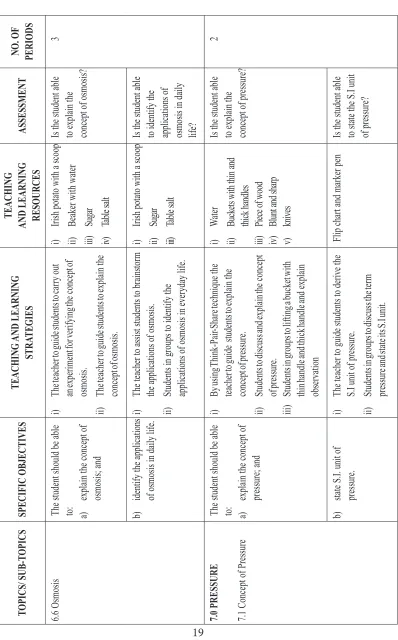
Osmosis
The student should be able to: a) explain the concept of osmosis; and
i)
The teacher to guide students to carry
out
an experiment for verifying the
concept of
osmosis.
ii)
The teacher to guide students to explain
the
concept of osmosis.
i)
Irish potato with a scoop
ii)
Beaker with water
iii)
Sugar
iv)
Table
salt
Is the student able to explain the concept of osmosis?
3
b)
identify the applications of osmosis in daily life.
i)
The teacher to assist students to brainstorm the applications of osmosis.
ii)
Students in groups to identify the applications of osmosis in everyday life.
i)
Irish potato with a scoop
ii)
Sugar
iii)
Table
salt
Is the student able to identify the applications of osmosis in daily life?
PRESSURE Concept of Pressure The student should be able to: a)
explain the concept of pressure; and
i)
By using
Think-Pair
-Share technique
the
teacher to guide
students to explain
the
concept of pressure.
ii)
Students to discuss and explain the
concept
of pressure.
iii)
Students in groups to lifting a bucket with thin handle and thick handle and
explain
observation
i)
Water
ii)
Buckets
with
thin
and
thick
handles
iii)
Piece
of
wood
iv)
Blunt
and
sharp
v)
knives
Is the student able to explain the concept of pressure?
2
b)
state S.I. unit of pressure.
i)
The teacher to guide students to derive the S.I unit of pressure.
ii)
Students in groups to discuss the term pressure and state its S.I unit.
Flip chart and marker pen
TOPICS/ SUB-T
OPICS
SPECIFIC OBJECTIVES
TEACHING AND
LEARNING
STRA
TEGIES
TEACHING
AND LEARNING RESOURCES
ASSESSMENT
NO. OF PERIODS
Pressure due to Solids
The student should be able to: a) explain dependence of pressure on surface of contact; and
i)
The teacher to guide students question and answer technique to explain dependence of pressure on surface of contact.
i)
Students in small groups to cut bars of soap into pieces by using a thin and a thick wire loop and state what they experienced.
i)
Bars of soap
ii)
Thin and thick wire loops Is the student able to explain the dependence of pressure on surface of contact?
3
b)
identify the applications of pressure due to solids.
i)
Students in groups to brainstorm the applications of pressure due to solids.
ii)
The teacher leads students’
discussion on
identifying the applications of pressure due to solids.
i)
Bars of soap
ii)
Thin and thick wire loops Is the student able to identify the applications of pressure due to solids?
Pressure in Liquids
The student should be able to: a) describe the characteristics of pressure in liquids;
i)
The teacher to guide students to brainstorm the characteristics of pressure in liquids.
ii)
The teacher to assist students through question and answer technique to describe the characteristics of pressure in liquids.
i)
Cans with hole punches at dif
ferent depths.
ii)
Cans with holes punched at the same depth
iii)
Glass vessel with tubes of dif
ferent diameters
iv)
Water
.
Is the student able to describe the characteristics of pressure in liquids?
TOPICS/ SUB-T OPICS SPECIFIC OBJECTIVES TEACHING AND LEARNING STRA TEGIES TEACHING
AND LEARNING RESOURCES
ASSESSMENT
NO. OF PERIODS
b)
examine the variation of pressure with depth in liquids;
i) Students in small groups to perform activities on the spurting out of water from the holes of a can which are at dif ferent depths. ii) The teacher to support students to examine the variation of pressure with depth in liquids and derive the iii) formular p = hρ g. i)
Cans with hole punches at dif
ferent depths.
ii)
Water
iii)
Bucket
Is the student able to examine the variation of pressure with depth in liquids?
c)
solve problems involving pressure in liquids;
i) Students in groups to solve problems involving pressure in liquids. ii) The teacher to assist students to solve problems involving pressure in liquids.
Is the student able to solve problems involving pressure in liquids?
d)
explain the principle of a hydraulic press; and
i)
Students in small groups to investigate the actions of an applied force to a load by using a model of hydraulic press.
ii)
The teacher to lead students in deriving the equation
fF
=
aA
For pressure on the
small and lar
ge pistons of hydraulic
pressure (where f and F are forces at small and lar
ge pistons of areas “a” and “A”
respectively).
iii)
The teacher to assist students to explain the principle of a hydraulic press.
i)
Models of hydraulic press
ii)
Hydraulic jack
TOPICS/ SUB-T
OPICS
SPECIFIC OBJECTIVES
TEACHING AND
LEARNING
STRA
TEGIES
TEACHING
AND LEARNING RESOURCES
ASSESSMENT
NO. OF PERIODS
e)
measure pressure of a liquid.
i)
The teacher to assist students to demonstrate the measurement of pressure of a liquid.
ii)
Students to demonstrate how to measure pressure of a liquid.
Manometer
Is the student able to measure pressure of a liquid?
Atmospheric Pressure
The student should be able to: a) describe the existence of atmospheric pressure;
i)
Teacher to assist students to demonstrate the existence of atmospheric pressure.
ii)
Students in groups to demonstrate and describe the existence of atmospheric pressure.
i)
Tumbler with lid,
ii)
empty can
iii)
cold water
iv)
source of heat
Is the student able to describe the existence of atmospheric pressure?
5
b)
identify the applications of atmospheric pressure; and
i)
By using
Think-Pair
-Share technique the
teacher to guide students to identify the applications of atmospheric pressure.
ii)
Students in groups to discuss and identify the applications of atmospheric pressure.
i)
Bicycle pump
ii)
Siphon
iii)
Syringes
iv)
Water
v)
Flushing tanks
Is the student able to identify the applications of atmospheric pressure?
c)
measure atmospheric pressure.
i)
The teacher to lead students to measure the atmospheric pressure.
ii)
Students in small groups to measure atmospheric pressure by using a barometer
.
i)
Fortin barometer
ii)
Aneroid barometer
TOPICS/ SUB-T
OPICS
SPECIFIC OBJECTIVES
TEACHING AND
LEARNING
STRA
TEGIES
TEACHING
AND LEARNING RESOURCES
ASSESSMENT
NO. OF PERIODS
WORK, ENERGY AND POWER Work
The student should be able to: a) explain the concept of work;
i)
The teacher to guide students to brainstorm the concept of work as applied to Physics.
ii)
Students in pairs to explain the concept of work as applied to Physics.
i)
Block of wood
ii)
Thread, Pulley
iii)
Bench
iv)
Spring balance,
v)
Metre rule
vi)
Stop watch/clock
Is the student able to explain the concept of work?
5
b)
state S.I. unit of work; and
i)
The teacher to guide students to derive the S.I unit of work.
ii)
Students in small groups to state the S.I units of force.
i)
Metre rule
ii)
Beam balance
iii)
Spring balance
iv)
Tape measure
Is the student able to state the SI unit of work?
c)
determine the work done by an applied force.
i)
The teacher to lead students to discuss how to determine the work done by an applied force.
ii)
Students in groups to perform an experiment to determine the work done.
i)
Heavy body
ii)
Tape measure
iii)
Long metre Ruler
TOPICS/ SUB-T
OPICS
SPECIFIC OBJECTIVES
TEACHING AND
LEARNING
STRA
TEGIES
TEACHING
AND LEARNING RESOURCES
ASSESSMENT
NO. OF PERIODS
Ener
gy
The student should be able to: a) explain the concept of energy;
i)
The teacher to assist students through question and answer technique to discuss how to determine the work done by an applied force.
ii)
Students in groups to explain the concept of ener
gy
.
Is the student able to explain the concept of ener
gy?
8
b)
state S.I. unit of ener
gy;
i)
The teacher to guide students to derive the S.I. unit of ener
gy
.
ii)
Students in groups to state the S.I unit of energy
.
Is the student able to state the S.I unit of energy?
c)
identify dif
ferent forms
of ener
gy;
i)
The teacher to guide students to brainstorm different forms of ener
gy
.
ii)
Students in groups to identify dif
ferent
forms of ener
gy
.
i)
Helical spring
ii)
Object
iii)
Stone
iv)
Thread
v)
Bob
Can the student identify dif
ferent
forms of ener
gy?
d)
distinguish between potential ener
gy and
kinetic ener
gy;
i)
The teacher to guide students to demonstrate and explain the pushing effect of a compressed spiral spring when released.
ii)
Students to demonstrate the existence of P.E and K.E using a spiral spring.
iii)
Students to compute P
.E and K.E for a
moving body
.
Is the student able to distinguish between potential energy and kinetic ener
TOPICS/ SUB-T
OPICS
SPECIFIC OBJECTIVES
TEACHING AND
LEARNING
STRA
TEGIES
TEACHING
AND LEARNING RESOURCES
ASSESSMENT
NO. OF PERIODS
e)
describe the transformation of energy;
i)
Through question and answer technique, the teacher to facilitate students to discuss the transformation of ener
gy
.
ii)
Students to describe the transformation of energy
.
i)
Tube light/ fluorescent tube
ii)
Motor
iii)
Telephone
iv)
Candle
v)
Electric fan
Is the student able to describe the transformation of energy?
f)
state the principle of conservation of ener
gy;
and
i)
The teacher to assist students to brainstorm the principle of conservation of ener
gy
.
ii)
Students to state the principle of conservation of ener
gy
.
i)
Trolley
ii)
Objects
Is the student able to state the principle of conservation of energy?
g)
explain the uses of mechanical ener
gy
.
i)
The teacher to assist students to discuss the uses of mechanical ener
gy
.
ii)
Students in groups to explain the uses of mechanical ener
gy
.
Is the student able to explain the uses of mechanical energy?
Power
The student should be able to: a) explain the concept of power;
i)
The teacher to use
YES/NO cards to ask
questions related to the concept of power
.
ii)
Students in pairs to explain concept of power
.
i)
Heavy body
ii)
Stop watch/clock
iii)
Metre rule
Is the student able to explain the concept of power?
TOPICS/ SUB-T
OPICS
SPECIFIC OBJECTIVES
TEACHING AND
LEARNING
STRA
TEGIES
TEACHING
AND LEARNING RESOURCES
ASSESSMENT
NO. OF PERIODS
b)
state the S.I. unit of power; and
i)
The teacher to guide students to derive the S.I unit of power
.
ii)
Students in pairs to state the S.I. unit of power by relating work done and time. Is the student able to state the SI unit of power?
c)
determine the rate of doing work.
i)
The teacher assists students to demonstrate how to determine the rate of doing work.
ii)
The teacher to guide students to determine the rate of raising a heavy body through a given vertical distance.
i)
Heavy body
ii)
Metre rule
Is the student able to determine the rate of doing work?
LIGHT Sources of Light
The student should be able to: a) explain the concept of light;
i)
The teacher to guide students through question and answer technique to discuss the concept of light.
ii)
Students in groups to explain the concept of light.
i)
String
ii)
Card board
iii)
Torch
iv)
Box with a hole
Is the student able to explain the concept of light?
5
b)
identify sources of light; and
i)
The teacher to assist students to brainstorm the sources of light.
ii)
Students in small groups to identify sources of light.
i)
Candle
ii)
Kerosene lamp
iii)
Sun
iv)
flame
TOPICS/ SUB-T
OPICS
SPECIFIC OBJECTIVES
TEACHING AND
LEARNING
STRA
TEGIES
TEACHING
AND LEARNING RESOURCES
ASSESSMENT
NO. OF PERIODS
c)
distinguish luminous from non-luminous bodies.
i)
The teacher guide students through concept map to distinguish between luminous and non-luminous bodies.
ii)
Students in groups to distinguish luminous from non-luminous bodies.
i)
Luminous objects
ii)
Candle
iii)
Electric lamp
iv)
Non-luminous
v)
objects
Is the student able to distinguish luminous from non-luminous bodies?
Propagation and Transmission of Light The student should be able to: a) explain the concept of rays and beam of light;
i)
The teacher to supervise students to perform experiment about light rays and beam of light.
ii)
Students in group to perform experiment and explain the concept of rays and beam of light.
i)
Rays box
ii)
Candle
Is the student able to explain the concept of rays and beam of light?
5
b)
verify that light rays travels in straight line; and
i)
The teacher to lead students to discuss how to verify that light travels in a straight line
ii)
Students to perform demonstration to verify that light travels in a straight line.
i)
String
ii)
Card board
iii)
Source of light
Is the student
able
to verify that light travels in a straight line?
c)
identify transparent, translucent and opaque materials.
i)
The teacher to guide students to brainstorm about transparent, translucent and opaque materials.
ii)
Students in groups to identify transparent, translucent and opaque materials.
i)
Oiled paper
ii)
Iron sheet
iii)
Glass
iv)
Paper stained glass
v)
W
alls
TOPICS/ SUB-T
OPICS
SPECIFIC OBJECTIVES
TEACHING AND
LEARNING
STRA
TEGIES
TEACHING
AND LEARNING RESOURCES
ASSESSMENT
NO. OF PERIODS
c)
identify transparent, translucent and opaque materials.
i)
The teacher to guide students to brainstorm about transparent, translucent and opaque materials.
ii)
Students in groups to identify transparent, translucent and opaque materials.
i)
Oiled paper
ii)
Iron sheet
iii)
Glass
iv)
Paper stained glass
v)
W
alls
Is the student able to identify transparent, translucent and of opaque materials?
Reflection of Light
The student should be able to: a) explain the concept of reflection of light;
i)
The teacher to lead students to demonstrate the concept of reflection
of light.
ii)
Students in groups to explain the concept of reflection
of light.
i)
Rays box
ii)
Plane mirror
iii)
Protractor
iv)
Ruler
v)
Soft board
vi)
Optical pins
vii)
Source of light
viii)
Plane paper
Is the student able to explain the concept of reflection of light?
6
b)
distinguish regular from irregular reflection of light.
i)
The teacher to facilitate the students to distinguish regular and irregular reflection of light.
ii)
Students in small groups to distinguish between regular and irregular reflection of light.
i)
Rays box
ii)
Plane mirror
iii)
Protractor
, Ruler
iv)
Soft board,
v)
Optical pins
vi)
Source of light
vii)
Plane paper
TOPICS/ SUB-T
OPICS
SPECIFIC OBJECTIVES
TEACHING AND
LEARNING
STRA
TEGIES
TEACHING
AND LEARNING RESOURCES
ASSESSMENT
NO. OF PERIODS
c)
apply the laws of reflection
of light; and
i)
The students to carry out an experiment to investigate the laws of reflection
of light.
ii)
From the results of experiment the teacher to assist students to state the laws of reflection
of light.
iii)
The teacher and students to apply the laws of reflection
of light to observe the
position of the incident ray
, the reflected
ray and the normal.
i)
Rays box
ii)
Plane mirror
iii)
Protractor
iv)
Ruler
, Soft board
v)
Optical pins
vi)
Source of light
vii)
Plane paper
Is the student able to apply the laws of reflection of light?
d)
describe image formed by a plane mirror
.
i)
Students to perform an experiment to investigate the image formed by a plane mirror
.
ii)
The teacher to assist students to describe the position and size and nature of an image formed by a plane mirror
.
FORM TWO
CLASS LEVEL COMPETENCES
Student should have the ability to:
-1)
apply electricity and magnetism knowledge in daily life;
2)
apply the concepts of turning forces in daily life.
3)
apply laws of motion in dealing with moving objects;
4)
use simple machine to simplify work; and
5)
apply environmental knowledge in interacting with environment.
CLASS LEVEL OBJECTIVES
By the end of Form Two course, the student should be able to:
-1)
understand concepts and principles of magnetism and electricity;
2)
develop a knowledge of force in equilibrium
3)
comprehend the laws of motion;
4)
understand principles of simple machine; and
5)
understand the concept of temperature.
TOPICS/SUB-T
OPICS
SPECIFIC OBJECTIVES
TEACHING AND
LEARNING
STRA
TEGIES
TEACHING
AND LEARNING RESOURCES
ASSESSMENT
NO. OF PERIODS
ST
ATIC
ELECTRICITY Concept of Static Electricity The student should be able to: a)
explain the concept of static electricity;
i)
The teacher to lead students to demonstrate picking up of tiny pieces of paper by plastic pens and other materials rubbed on the hair
.
ii)
Students practicing on picking up of tiny pieces of paper by plastic pens and other materials rubbed on the hair
.
i)
Plastic pen
ii)
Ebonite rod
iii)
Glass rod
iv)
Fur
v)
Perspex comb
vi)
Silk
vii)
Polythene rod
Is the student able to explain the concept of static electricity?
2
b)
explain the origin of charges;
i)
The teacher to or
ganize for read- review-on
origin of char
ges.
ii)
Students to discuss the origin of char
ges.
i)
Reference books
ii)
Internet
Is the student able to explain the origin of char
ges?
c)
identify the two types of charges;
i)
The teacher to or
ganize for discussion on
char
ge movement when two bodies are
rubbed against each other
.
ii)
Students to identify two types of char
ges
on a body
.
i)
Ebonite rod
ii)
Fur
iii)
Polythene rod
iv)
Glass rod
Is the student able to identify two types of char
ges?
d)
state the fundamental law of static electricity; and
i)
Teacher and students to demonstrate on attraction and repulsion between the suspended rod and other bodies.
ii)
Teacher to guide students to state the fundamental law of static electricity
.
i)
Plastic pen
ii)
Piece of papers
iii)
Ebonite rod
iv)
Glass rod
v)
Thread
vi)
Retort stand
TOPICS/SUB-T
OPICS
SPECIFIC OBJECTIVES
TEACHING AND
LEARNING
STRA
TEGIES
TEACHING
AND LEARNING RESOURCES
ASSESSMENT
NO. OF PERIODS
e)
char
ge bodies using
dif
ferent methods.
i)
The teacher to or
ganize an experiment to
show dif
ferent methods of char
ging a body
.
ii)
Students to char
ge bodies by dif
ferent
methods.
i)
Piece of papers
ii)
Plastic pen
iii)
Glass rod
iv)
Ebonite rod
v)
Polythene rod
Is the student able to char
ge bodies
using dif
ferent
methods?
Detection of Char
ges
The student should be able to: a) describe the structure of a gold leaf electroscope;
i)
The teacher to guide students to describe the structure and function of gold leaf electroscope.
ii)
Students to draw and label gold leaf electroscope.
i)
Gold leaf electroscope
ii)
Diagram of leaf electroscope Is the student able to describe the structure of a leaf electroscope?
2
b)
determine the sign of charges; and
i)
The teacher to lead the students to demonstrate the mode of action of electrophorus.
ii)
Students to char
ge an electrophorus by
induction using char
ged polythene base.
iii)
Students to char
ge a gold leaf electroscope
by induction and by contact methods using a positively char
ged electrophorus.
i)
Char
ged polyethylene
base
ii)
Electrophorus
iii)
Gold leaf electroscope
Is the student able to determine the sign of char
TOPICS/SUB-T
OPICS
SPECIFIC OBJECTIVES
TEACHING AND
LEARNING
STRA
TEGIES
TEACHING
AND LEARNING RESOURCES
ASSESSMENT
NO. OF PERIODS
c)
identify steps of charging and dischar
ging
of a gold leaf electroscope.
i)
The teacher to demonstrate to students the steps of char
ging and dischar
ging of a gold
leaf electroscope.
i)
Students to identify steps of char
ging and
dischar
ging of gold leaf electroscope.
i)
Conducting wire
ii)
Gold leaf electroscope
Is the student able to identify steps of char
ging and
dischar
ging of
a gold leaf electroscope?
Conductors and Insulators The student should be able to distinguish between a conductor and insulator
.
i)
The teacher to lead students to distinguish between insulator and conductor
.
ii)
Students to identify conductors and insulators by passing electric current through them.
iii)
The teacher to lead students to explain the dif
ference between electrical
conductivities of conductors and insulators.
i)
Copper wire
ii)
Aluminum rod
iii)
Glass rod
iv)
Ebonite rod
v)
Wood
vi)
Fur
, wax
Is the student able to distinguish between a conductor and insulator?
2
Capacitors
The student should be able to: a) explain the concept of capacitance;
i)
The teacher to lead the students to define the capacitance of a body
.
ii)
Students in groups to give the meaning of capacitance.
i)
Source of char
ge
ii)
Copper electrodes
Is the student able to explain the concept of capacitance?
TOPICS/SUB-T OPICS SPECIFIC OBJECTIVES TEACHING AND LEARNING STRA TEGIES TEACHING
AND LEARNING RESOURCES
ASSESSMENT
NO. OF PERIODS
b)
explain mode of action of a capacitor;
i)
The teacher and students to describe mode of action of capacitor
.
ii)
The teacher to lead students to identify different types of capacitors.
iii)
Students to demonstrate the char
ging and
dischar
ging of a capacitor
. i) Air -filled parallel- plate capacitor ii) Cylindrical capacitor iii) Paper -filled capacitor iv) Variable capacitor v) Battery vi) Resistor voltmeter
Is the student able to explain mode of action of a capacitor?
c)
describe the construction of an air
-filled
capacitor;
and
i)
The teacher to explain the construction of air capacitor
.
ii)
Student to carry out a project to construct an air capacitor
.
Air
-filled capacitor
Can the student describe the construction of an air
-filled capacitor? d) determine equivalence capacitance of a combination of capacitors. i) The teacher to guide students to determine the equivalent capacitance of two or more capacitors connected in series and in parallel by derivation. ii) Students to derive equivalent capacitance of two or more capacitors connected in series and in parallel. i) Two or more capacitors ii) Connecting wires iii) Battery
Figure
Related documents
In response to the increasing malnutrition levels and decreased purchasing power of the drought affected households, nutrition sensitive activities such as, vegetable and
For the group of firms with expected SEOs, larger firms experienced a significant lower negative abnormal return on both the expectation- and announcement date.. This coincides
An analysis of the economic contribution of the software industry examined the effect of software activity on the Lebanese economy by measuring it in terms of output and value
Additionally, the fact that coaching may encourage people to change careers, as seen in one of the quotes above, can provide benefits to the Organisation in that people who
cell type, page size, and block size, on system-level metrics such as performance, cost, and power consumption in various applications with different characteristics, e.g..
For the poorest farmers in eastern India, then, the benefits of groundwater irrigation have come through three routes: in large part, through purchased pump irrigation and, in a
The purpose of this study was to evaluate the diagnostic utility of real-time elastography (RTE) in differentiat- ing between reactive and metastatic cervical lymph nodes (LN)
The Trust is satisfied that the information requested would be likely to prejudice the commercial interests of the company concerned, and in turn the Trust, however the exemption
