R E S E A R C H
Open Access
Load emphasizes muscle effort minimization
during selection of arm movement direction
Wanyue Wang and Natalia Dounskaia
*Abstract
Background:Directional preferences during center-out horizontal shoulder-elbow movements were previously established for both the dominant and non-dominant arm with the use of a free-stroke drawing task that required random selection of movement directions. While the preferred directions were mirror-symmetrical in both arms, they were attributed to a tendency specific for the dominant arm to simplify control of interaction torque by actively accelerating one joint and producing largely passive motion at the other joint. No conclusive evidence has been obtained in support of muscle effort minimization as a contributing factor to the directional preferences. Here, we tested whether distal load changes directional preferences, making the influence of muscle effort minimization on the selection of movement direction more apparent.
Methods:The free-stroke drawing task was performed by the dominant and non-dominant arm with no load and
with 0.454 kg load at the wrist. Motion of each arm was limited to rotation of the shoulder and elbow in the horizontal plane. Directional histograms of strokes produced by the fingertip were calculated to assess directional preferences in each arm and load condition. Possible causes for directional preferences were further investigated by studying optimization across directions of a number of cost functions.
Results:Preferences in both arms to move in the diagonal directions were revealed. The previously suggested tendency to actively accelerate one joint and produce passive motion at the other joint was supported in both arms and load conditions. However, the load increased the tendency to produce strokes in the transverse diagonal directions (perpendicular to the forearm orientation) in both arms. Increases in required muscle effort caused by the load suggested that the higher frequency of movements in the transverse directions represented increased
influence of muscle effort minimization on the selection of movement direction. This interpretation was supported by cost function optimization results.
Conclusions:While without load, the contribution of muscle effort minimization was minor, and therefore, not apparent, the load revealed this contribution by enhancing it. Unlike control of interaction torque, the revealed tendency to minimize muscle effort was independent of arm dominance.
Keywords:Movement cost, Interaction torque, Multi-joint, Dominant arm, Muscle energy
Background
Human movements are often considered to be near-optimal, although the type of minimized movement cost remains under debate [1]. One of the most frequently considered factors is minimization of muscle effort or muscle energy [2-14]. However, a number of studies have questioned the contribution of this factor to move-ment formation. For instance, it was demonstrated that during point-to-point movements, the tendency to
produce straight trajectory dominated the tendency to minimize muscle torque change [15], a cost function minimization of which had been proposed as the organization principle of arm movements [16]. In an-other study, a robotic manipulandum was used to gener-ate a force field in which minimal metabolic energy was achieved on a curved trajectory [17]. Consistent with the finding of [15], adaptation to the force field resulted in straight movement trajectories similar to those in the null field.
* Correspondence:[email protected]
Kinesiology Program, Arizona State University, Tempe, AZ 85287, USA
Directional preferences of arm movements revealed in our group did not provide a support for minimization of muscle effort either [18,19]. In [18], subjects produced series of strokes from a circle center to the perimeter, selecting movement directions in a random order. Al-though instructions encouraged the uniform distribution of stroke directions, consistent directional preferences were observed. Seven cost functions were calculated for each stroke to test whether any of them can account for the observed directional preferences. Three of the cost functions addressed muscle effort for movement produc-tion in different ways. They were the change in muscle torque [16], sum of squared muscle torques across the joints [20], and inertial resistance that represented muscle effort required to generate equal hand acceler-ation in different directions [21,22].
The change in muscle torque and the sum of squared muscle torques did not show any anisotropic behavior. Inertial resistance was anisotropic but the minimal values were observed in directions distinct from the major preferred directions. Thus, none of the three cost functions were minimized in the major preferred direc-tions. Rather, the directional preferences were consistent with a tendency to simplify neural control of interaction torque by actively accelerating one (leading) joint and exploiting interaction torque to produce largely passive motion at the other (subordinate) joint [23,24]. The same conclusion was obtained with the use of an uncon-strained free-stroke drawing task in which strokes were not center-out but they could be initiated anywhere in the horizontal workspace in front of the subject [19].
The findings that subjects prioritize optimization of tra-jectory straightness and exploitation of interaction torque for movement production does not however exclude a possibility that minimization of muscle effort still influ-ences movement formation. It is possible that there are several influential factors, and minimization of muscle ef-fort is only one of them. Using terminology of the optimal control theory, muscle effort may be included in the re-sultant cost function with a certain weight. For instance, minimization of a weighted sum of angular acceleration and work produced by joint muscle torques was proposed in [14]. This composite cost function was distinguished with the use of an inverse optimal control technique that automatically inferred the weighted sum of considered op-timality criteria that best fitted the experimental data.
Here, we employed another method to test the contribu-tion of muscle effort minimizacontribu-tion to movement forma-tion. Namely, we examined whether load attached at the distal portion of the arm changed directional preferences revealed in [18]. Apparently, load would increase muscle effort for movement production in all directions, and therefore, the importance of muscle effort minimization would grow. In other words, load would increase the
weight of muscle effort in the resultant cost function. It can be expected that muscle effort varies across movement directions. For example, inertial resistance of the arm is maximal in the two directions along the forearm longitu-dinal axis (longitudinaldirections) and minimal in the two directions perpendicular to the forearm orientation ( trans-verse directions) [21,25,26]. The anisotropy of inertial re-sistance predicts that load would change directional preferences by increasing the tendency to produce move-ments in the transverse directions and making movemove-ments in the longitudinal directions less attractive.
This hypothesis was tested in the present study through comparison of directional preferences during the center-out free-stroke drawing task [18] performed with and without load attached at the wrist. The task was performed with the dominant and nondominant arm to investigate whether the influence of load on the selection of movement direction depends on arm dom-inance. In addition to the directional biases, the depend-ence on distal load of a number of cost functions that may represent muscle effort was also examined.
Methods Participants
Thirteen neurologically intact right-handed adults (6 males and 7 females, 23 ± 2 years of age) recruited from the university community participated in this study. Par-ticipants signed informed consent prior to participation. The institutional review board (IRB) at Arizona State University approved the experimental protocol.
Procedure and design
The experimental procedure was similar to that described in [18,19]. Participants sat at a table the height of which was adjusted to provide arm movements approximately in the horizontal plane at the shoulder level. Movements were performed unimanually, with the dominant and nondominat arm. Slings suspended from the ceiling sup-ported the upper arm segments to reduce muscle effort for gravity compensation. Subjects produced movements, sliding the tip of the index finger along the table surface. Movements of each arm were performed through flexion/ extension of the elbow and shoulder. Motion at the trunk was prevented by restraining the torso between the table edge and the chair back. The hand was aligned with the forearm by splinting the wrist. The index finger was splinted and immobilized with respect to the hand. The finger tip was wrapped with Micropore™paper tape to re-duce friction with the table.
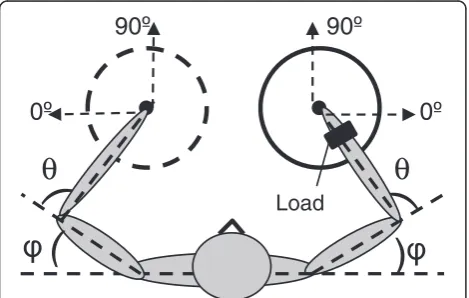
with the initial arm posture determined by the shoulder joint angle of φ = 30° and the elbow joint angle of θ = 100° (Figure 1). The consistency of the initial arm pos-ture decreased differences across subjects in initial inter-segmental dynamics. The initial joint angles were chosen to allow movements from the center to the circle perim-eter in all directions with minimal elastic forces that may arise at the anatomical limits of joint rotations.
A free-stroke drawing task was performed. Participants produced a series of straight center-out strokes, selecting directions of the strokes in a random order. Upon com-pleting each stroke, participants moved the fingertip along the table surface back to the circle center to initi-ate a subsequent stroke. Accuracy of reaching the perim-eter during center-out strokes was de-emphasized. Strokes were produced at 1.5 Hz frequency guided by a metronome. Continuous production of strokes lasted for 15 s within each trial. To encourage the uniform distri-bution of movement directions, participants were instructed to produce strokes in as many different direc-tions as possible, changing direcdirec-tions randomly. Produc-tion of strokes in a specific order, such as around the circle clockwise or counterclockwise, was not allowed. During the experiment, participants could see their arms but fingertip motion did not leave any visible traces on the table. The purpose of the free-stroke drawing task was to reveal consistent deviations from the uniform dis-tribution of movement directions that would be indica-tive of inherent directional preferences.
Performance of the task with the dominant and non-dominant arm was counterbalanced across participants.
Each arm performed the task in two load conditions, first with no load and then with 0.454 kg load distribu-ted evenly around the wrist. Six fifteen-second trials of stroke production were performed by each arm in each load condition. In addition, two practice trials were per-formed prior to data collection in each condition. Prior to performance of the task with each arm, position of the arm while touching the circle center was recorded for 15 s. These data were later used for identification of the circle center location.
Data collection
Arm movements were recorded with an OPTOTRAKW
(Northern Digital Inc., Waterloo, Ontario, Canada) three-dimensional optoelectronic system. Seven infrared emitting diodes (IREDs) were positioned on the trunk and the two shoulders, elbows, and index fingernails. Time-varying position data were recorded at a sampling rate of 200 Hz. The collected data were filtered with a 7 Hz low-pass 4th-order Butterworth digital filter to re-move high-frequency components that were not related to low-frequency arm motion. The data were used to determine motion of the fingertip in the horizontal plane and time-series of the shoulder (φ) and elbow (θ) joint angles.
Analysis of directional preferences
The position of the finger marker on the horizontal table at each moment of time twas described by coordinates x(t), y(t)in the OPTOTRAK-determined coordinate sys-tem. Using these data, minima of fingertip marker vel-ocity were determined and used to identify center-out strokes. Pairs of the consecutive minima were inter-preted as the beginning and the end of a stroke if the first minimum occurred within a 4 cm radius from the circle center and the next minimum took place at least at 12 cm distance from the circle center. The initial and final stroke portions during which velocity was lower than 3% of its peak value were removed from the ana-lyzed trajectories. Inclusion of sharp turns associated with reversals in movement trajectory was prevented ex-cluding trajectory portions with curvature higher than 50 m-1. Curvature was computed as
C¼ jx_⋅y€x€⋅_yj=x_2þy_23=2 ð
1Þ
wherex_,y_ and x€,ÿrepresent the first and second deriva-tives of the (x,y) position data, respectively. Finally, only strokes that contained a minimum of 100 ms of data and a minimum length of 12.5 cm were considered to prevent inclusion in the analysis of shortened and in-complete strokes. 98.1% of all strokes were included in the analysis.
)
θ
θ
0º
0º
90º
90º
Load
Length, curvature, and angular orientation of each stroke were analyzed. Since (1) provides a local charac-teristic of curvature at each point of the stroke, entire stroke curvature was additionally assessed as a ratio in which the denominator was the length of the straight line connecting the initial and final points of the stroke and the numerator was the maximal deviation of the stroke trajectory from this line.
The angular orientation of each stroke was determined as the direction of the line connecting the initial and final point of the stroke. The 0° orientation was assigned to movements performed in the mediolateral direction away from the body midline and 90° to movements in the anterioposterior direction away from the participant (Figure 1). The stroke orientation data obtained in the six trials by each participant in each experimental condi-tion were used to build an individual direccondi-tional histo-gram. Thus, four histograms were built for each participant that characterized distribution of stroke directions in the dominant and nondominant arm in the two load conditions. The histograms were produced by counting strokes within 72 bins, each of 5° width. The results were smoothed using a standard normal kernel smoothing function having a window width of 5°, yielding a probability density estimate for each orientation [27]. For visualization purposes, each individual histogram was normalized to its maximal value, resulting in values between 0 and 1.
Each individual histogram was analyzed to identify statistically significant peaks. These peaks were inter-preted as directional preferences if they exceeded the mean value H of the histogram. The multimodal distri-bution within each individual histogram was analyzed with a mode existence test [28,29]. A detailed descrip-tion of this analysis is presented in [18]. Briefly, this test revealed whether each peak identified in the direc-tional histogram was either an artifact of the sample or a true feature of the population. Due to the conserva-tive nature of tests for multimodality, peaks were
con-sidered significant at p ≤ 0.15 [28,30]. The mode
existence test provided the direction and bounds of each significant peak.
As indicated in the Results section, the majority of produced strokes were fairly straight. Nevertheless, we analyzed whether directional preferences depended on the computation of stroke orientation as (1) the direc-tion of the straight line connecting the initial and final stroke points and as (2) the direction of motion during the first 60 ms of the stroke. This analysis was per-formed in the same way as in our previous studies [18,19]. Like in those studies, directional preferences obtained with the two methods were approximately the same. This result is therefore not reported for the sake of conciseness.
To evaluate the dependence of directional preferences on the arm and load, bias strengthwas assessed in each directional histogram f(x) as the deviation of f(x) from its mean value H. Here x represents movement direc-tion (0° ≤ x< 360°). After applying the smoothing pro-cedure, x varied with an increment of 0.1° across 3601 directions. Since directional preferences were repre-sented by histogram peaks that exceeded H, and values f(x) < H were limited by 0 (which could distort the evaluation of bias strength), only directions xi (i=1, . . ., N) in which f(xi) > H were included in the computa-tion. The bias strength was computed as:
BS¼ 1 N
1 H
XN
i¼0
f xð Þ i H
ð Þ ð2Þ
where the normalization coefficients 1/N and 1/H were used to allow the comparison of bias strength across conditions and subjects. Computed in this way, bias strength is higher for directional histograms character-ized by larger deviation of their peaks from the uniform distribution.
Cost functions
Contribution of a factor to emergence of directional preferences was assessed with the use of a cost func-tion representing influence of this factor on producfunc-tion of each stroke. Preferred directions revealed by peaks of the directional histograms were compared with the directions in which the cost function was maximized. Eight cost functions were computed. Two of them represented a tendency to exploit interaction torque by rotating either the shoulder or elbow actively and allowing predominantly passive motion generated by interaction torque at the other joint. These cost func-tions were included because they accounted for
direc-tional preferences in the dominant arm in our
previous studies [18,19,31]. They were computed as
IINTE ¼
1 T1T0
XT1
t¼T0
INTEt
j j
INTEt
j j þjMUSEtj ð
3Þ
IINTS ¼
1 T1T0
XT1
t¼T0
INTSt
j j
INTSt
j j þjMUSStj ð
4Þ
Here T0 and T1are the time moments of the
begin-ning and the end of the stroke, INTE and INTS are
interaction torques and MUSE and MUSS are muscle
tendency to produce predominantly passive motion at the shoulder. Each cost function varied between 0.0 and 1.0 with 1.0 being the optimal value representing com-pletely passive joint motion performed with zero muscle torque. A movement was considered optimized if the value of the corresponding cost function was greater than 0.6. This threshold distinguished strokes during which motion at the corresponding joint was predomin-antly passive, i.e., it was generated through a larger con-tribution of interaction torque compared with muscle torque.
Interaction torque and muscle torque at the shoulder and elbow were computed with the use of inverse-dynamics equations of two-joint horizontal arm motion. The equations are presented in [32] as torque definition II. These equations allow computation of interaction torque, muscle torque, and net torque at each joint from angular velocity and acceleration time series obtained by differentiation of shoulder (φ) and elbow (θ) joint angles. Interaction torque represents the passive rotational ef-fect attributed to reaction forces at the joints due to mo-tion of the adjacent limb segments. Muscle torque represents the effect of muscle forces on joint rotation. Net torque is the sum effect of both interaction and muscle torque. The influence of gravitation was not con-sidered because arm movements were performed in the horizontal plane. Anthropometric measurements includ-ing limb segment inertia, mass, and center of mass exploited for torque calculations were estimated from regression equations using the height and weight of each subject [33].
In addition to IINTE and IINTS, six other cost func-tions were tested. IIR assessed inertial resistance [21], IJRK assessed jerk [34], IMUSC assessed muscle torque
change [16], ISMUS assessed squared muscle torque
[20], IE assessed mechanical energy represented by
work produced by MUS [12], and IACC assessed
angu-lar acceleration with constraints [35]. IIR, IJRK, IMUSC, and ISMUS were tested in our previous studies [18,19]. No support for the influence of IJRK, IMUSC, and ISMUS on observed directional biases and even no modulation of these costs across movement directions were found. Similar results were obtained for these three cost func-tions in the present study. For this reason, we chose not to present these results and to exclude these cost functions from further consideration.
Although no strong support for explaining
direc-tional biases with IIR was obtained in our previous
studies, this cost function was analyzed because load increased inertial resistance, and thus, it could increase the influence of this cost function on directional pre-ferences. Specifically, load could strengthen preferences for the transverse directions in which IIR was minimal and weaken preferences for the longitudinal directions
in which IIR was maximal [21,22,25]. Following [18], IIR was defined as
IIR ¼1:0
βsEmin;IR
π=2 ð5Þ
where βs is the angular orientation of the stroke, and Emin,IR is the orientation of the minor eigenvector of the matrixTIR= (J')−1MJ−1. Here J is the 2 × 2 Jacobian matrix and M is the 2 × 2 matrix of the limb’s inertial properties.Jand M were computed in the same form as in previous studies with the use of the initial joint angles and individual anthropometric characteristics [36,37]. The minor eigenvector of TIR denotes the directions of the least inertial resistance (the two transverse direc-tions). In these directions, IIRachieves its maximal value of 1.0. Values ofIIR> 0.875 were used to identify strokes during which IIR was optimized. This threshold deter-mined the transverse directions ± 11.25° as the intervals of the directions optimized in terms ofIIR.
IEandIACCwere considered because of the recent sup-port for optimization of a weighted sum of these cost functions during arm movements [14]. Following that study, these two cost functions were computed as
IE¼1:0
Es
maxsð ÞEs ð
6Þ
where
Es¼
XT1
t¼T0
_
ϕt⋅MUSSt
þθ_t⋅MUSEt
ð7Þ
and
IACC¼1:0
ACCs
maxsðACCsÞ ð
8Þ
where
ACCs¼
XT1
t¼T0
ϕ€t
2
þθ€t
2
ð9Þ
Like the other tested cost functions,IEand IACCvaried between 0.0 and 1.0 with 1.0 representing the optimal value. Similar to IIR, the threshold for them was set at 0.875.
Statistical analyses
Statistical analyses were used to study the dependence of directional preferences and factors contributing to them on the arm dominance and load condition. A 2 × 2 (arm × load condition) ANOVA with repeated measures on both variables was applied to data obtained from the dominant and nondominant arm in the two load condi-tions, no load and with load. Characteristics analyzed were the number of produced strokes, rate of stroke pro-duction, stroke length and curvature, bias strength, mean value of each cost function computed across all strokes, and the percentage of strokes optimized in terms of each cost function. The level of significance was set at 0.05.
Results
Stroke characteristics
Table 1 provides mean and SD of the number of pro-duced strokes, rate of stroke production, stroke length and stroke curvature for each arm in the no-load and with-load conditions. The number of strokes and the rate of stroke production were slightly but significantly higher in the dominant arm compared with the nondo-minant arm [F(1, 12) = 14.86, P < 0.01 and F(1, 12) = 14.86, P < 0.01, respectively]. Load significantly increased stroke length [F(1,12) = 5.13, P < 0.05]. Strokes performed with the nondominant arm were more curved compared with strokes performed with the dominant arm [F(1, 12) = 21.62, P < 0.01]. This result was consistent with previous findings that point-to-point movements performed by the nondominant arm were more curved than those of the dominant arm [38,39]. Other main effects and interactions for the stroke char-acteristics were not significant (P > 0.01), except for the load effect on stroke curvature that was marginally significant (P = 0.08).
Directional preferences
A representative example of stroke production by a sin-gle subject with each arm without and with load is given in Figure 2. The top panels show strokes pro-duced in all six trials performed in each load condition by the dominant and nondominant arm. The majority of the strokes were fairly straight, which was typical for all subjects. Also, it is apparent that the distribution of
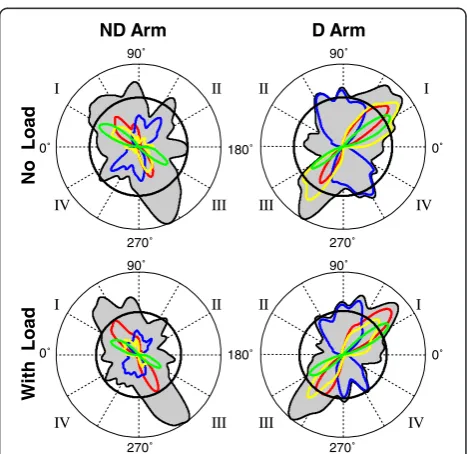
the strokes across directions was not uniform in all four conditions. The corresponding histograms of stroke directions shown at the bottom (Figure 2c, d, g, h) con-firm this observation. Pronounced peaks of each histo-gram reveal directional preferences consistent with those documented in our previous studies. In particular, each histogram contains peaks oriented in the two diag-onal directions, which is similar to the results obtained in previous studies of directional preferences [18,31]. The diagonal peaks of the histograms show that the preferences in both arms were to produce movements approximately in the transverse directions (quadrants I and III) and in the longitudinal directions (quadrants II and IV). Apparently, these directions were symmetrical in the dominant and nondominant arm with respect to the anterior-posterior midline. The color traces in Figure 2 present results for cost function optimization reported further.
The preference of both arms to move in the diagonal directions was common across subjects, as was demon-strated through the analysis of statistically significant peaks. Each individual histogram had 4.2 (SD = 0.9) sta-tistically significant peaks, and this number was not influenced by either arm dominance or the load (P > 0.1). Figure 3 presents directional histograms of the sta-tistically significant peaks detected across all subjects in each arm and load condition. The diagonal orientations of the major peaks of the four histograms confirm that the majority of the individual histogram peaks were di-agonal. The preferences to produce strokes in the diag-onal directions are also apparent in group histograms built for directions of strokes produced by all subjects in each condition (Figure 4).
Visual comparison between the top and bottom group histograms in Figure 4 shows that load caused stretching of the histograms along the transverse diagonal. This load effect was supported by analysis of two characteris-tics, bias strength (Figure 5a) and the percentage of strokes produced in quadrants I and III out of the total number of strokes (Figure 5b). Both characteristics increased with load [F(1, 12) = 7.47, P < 0.05 and F(1,12) = 12.65, P < 0.01, respectively]. These load effects were similar for both arms. Indeed, the arm effect and in-teraction were not significant for both characteristics
Table 1 Mean and (SD) of stroke characteristics
Dominant arm Nondominant arm
No load With load No load With load
Stroke number* 21.2 (2.1) 21.1 (2.3) 19.8 (2.4) 19.7 (1.9)
Stroke rate (s-1)* 1.4 (0.14) 1.4 (0.16) 1.3 (0.16) 1.3 (0.13)
Stroke length (cm) ** 15.2 (0.80) 15.4 (0.83) 15.3 (0.80) 15.5 (0.87)
Stroke curvature* 0.040 (0.008) 0.039 (0.005) 0.049 (0.01) 0.045 (0.007)
With Load No Load
D Arm ND Arm
a
b
e
ND Armf
D Arm180˚ 0˚
0˚
270˚ 270˚
270˚ 270˚
90˚ 90˚ 90˚
180˚ 0˚ 0˚
90˚ II
IV I
III II
III IV
I II
IV I
III II
III IV I
c d
g
h
Figure 2An example of strokes and polar representations of corresponding directional histograms obtained from a representative subject during production of the task with the dominant (D) and nondominant (ND) arm without and with load.The histograms represented by the contours of the grey areas demonstrate the frequency of stroke production in each direction. Peaks of these histograms represent preferred directions. Quadrants I, II, III, and IV of movement directions are denoted mirror-symmetrically for the D and ND arms. The histograms are overlapped with traces representing the directional histograms of strokes optimized according toIINTE(blue),IINTS(red),IIR(green), andIE(yellow). Here and in the other histograms, 0° denotes the lateral direction away from the body midline and 90° denotes the anterior direction away from the body.
0˚
D Arm ND Arm
W
ith
Load
No
Load
270˚ 180˚
90˚
0˚
270˚ 180˚
90˚
0˚ 270˚
90˚
0˚
270˚ 90˚
Figure 3Directional histograms of statistically significant peaks detected in all individual directional histograms of strokes produced with the dominant (D) and nondominant (ND) arm without load and with load.The major peaks of each histogram were oriented in the diagonal directions, demonstrating that statistically significant peaks of individual histograms were also oriented mainly in these directions.
0˚
D Arm ND Arm
W
ith
Load
No
Load
270˚ 180˚
90˚
0˚
270˚ 180˚
90˚
0˚ 270˚
90˚
0˚
270˚ 90˚
II
IV I
III
II
IV I
III II
III
II
III
IV I
IV I
(P > 0.1). These results demonstrate that the load caused increases in the preference to produce strokes in quad-rants I and III, i.e. approximately in the transverse directions.
Cost function optimization
Here, results for optimization of five cost functions, IINTE, IINTS, IIR, IE and IACC, are reported. The color traces in Figure 2 and 4 represent directional histograms of strokes optimized according to four out of the five cost functions, excluding IACC. Optimization of IACC is addressed further. Each color histogram shows the per-cent of strokes performed in each direction during which the corresponding cost function was nearly opti-mal (exceeded its threshold value). In both figures, peaks of the histograms of strokes optimized with each cost function were usually aligned with some peaks of the directional histograms, which is especially apparent for the dominant arm. Peaks of the histograms of
strokes optimized with IINTE were aligned with the
peaks of the preferred directions along the longitudinal diagonal, i.e. the diagonal of quadrants II and IV. Peaks of the histograms of strokes optimized with IINTS, IIR, and IE were aligned with the peaks of the directional histograms oriented along the transverse diagonal, i.e. the diagonal of quadrants I and III. However, it is observed in Figure 4 that the directions in which IIR was optimized (the green peaks) were slightly but con-sistently distinct from the directions of the transverse peaks of the directional histograms. Namely, the IIR op-timal directions were slightly rotated clockwise in the dominant arm and counterclockwise in the nondomi-nant arm relative to the transverse peaks of the direc-tional histograms.
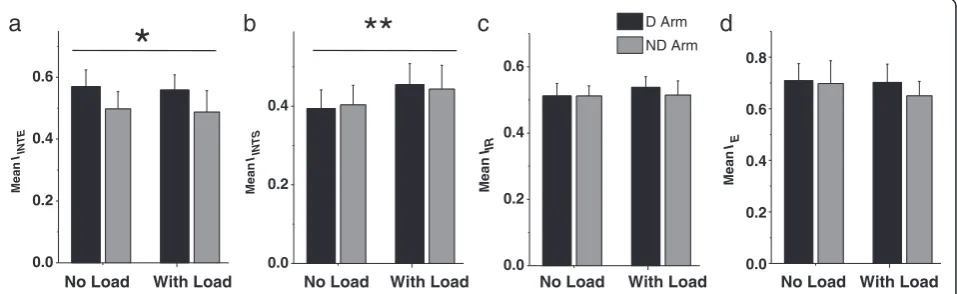
Load did not produce a significant effect on
optimization of IINTE. The main effect of load was not significant for the mean value of this cost function com-puted across all directions for each subject in each con-dition (Figure 6a, P > 0.1). The arm effect was significant with the mean IINTE being larger in the dominant arm
0.0 0.2 0.4 0.6 0.8
D Arm ND Arm
Bias Strength
No Load With Load
**
0.0 0.2 0.4 0.6
Strokes in Quadrants I & III (%)
**
No Load With Load
a
b
Figure 5Effect of arm and load on bias strength (a) and on the percentage of strokes produced total in quadrants I and III (b).The load significantly increased bias strength equally in both arms. The significant main effect of load is indicated by **. The vertical bars on the top of the columns represent SD.
0.0 0.2 0.4 0.6
Mean
IINTE
0.0 0.2 0.4
Mean
IINTS
0.0 0.2 0.4 0.6
Mean
IIR
a
b
**
c
*
No Load With Load No Load With Load No Load With Load
0.0 0.2 0.4 0.6 0.8
Mean
IE
d
No Load With Load D Arm
ND Arm
compared with the nondominant arm [F(1,12) = 9.17, P<0.01]. The interaction was not significant (P > 0.1).
Since IINTS, IIR, and IE were optimized approximately along the transverse directions, the load-related increases in the relative number of strokes produced in quadrants I and III may suggest that the mean values of IINTS, IIR, andIEalso increased with the load. However, this expect-ation was confirmed for IINTS only (Figure 6b-d). Mean IINTS significantly increased with load in both arms [F (1,12) = 51.31, P < 0.01], while the main effect of arm and the interaction were not significant (P > 0.1). The two main effects and the interaction were not significant for both mean IIR and mean IE, although the main effect of load approached significance for IIR [F(1,12) = 4.65, P = 0.052]. Figure 6c shows that this load effect was not con-sistent for both arms, causing slight increases in meanIIR predominantly in the dominant arm.
The results for the mean values of the cost functions were supported by results for the percentage of strokes optimized by each cost function (Table 2). Again, only the arm effect was significant for the percentage of strokes optimized in terms of IINTE that was lower in the nondominant arm, compared with the dominant arm [F(1, 12) = 14.97, P<0.01]. The load effect and the interaction were not significant (P > 0.1). The percent-age of strokes optimized in terms of IINTS increased with load [F(1,12) = 11.58, P < 0.01], while the arm ef-fect and the interaction were not significant (P > 0.1). Both main effects and the interaction were not signifi-cant for the percentage of strokes optimized in terms of IIR (P > 0.1). The percentage of strokes optimized in terms of IE was significantly lower in the nondominant arm compared with the dominant arm [F(1, 12) = 8.35, P<0.05], while the main effect of load and the inter-action were not significant (P > 0.1). Noteworthy, this characteristic had high inter-subject variability, as fol-lows from the high SD in all four conditions (Table 2).
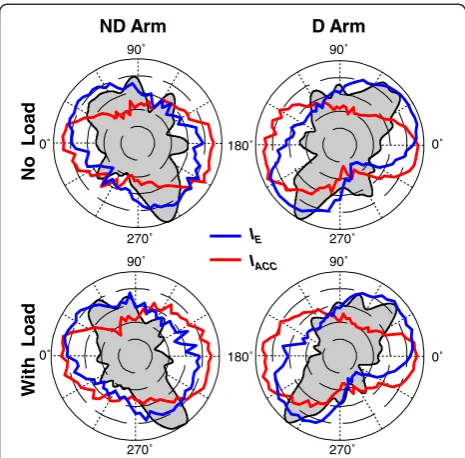
The above analyses were not applied to IACC because peaks of the histograms of strokes optimized by this cost function were not aligned with the preferred directions, as observed in Figure 7. The directions in which mean IACCincreased (the red contours) were not close to any major peaks of the directional histograms. Thus, the
optimization of IACC did not account for any of the
directional preferences. In addition, Figure 7 shows that the association of any directional preferences with the optimization of a weighted sum ofIE and IACC[14] also has to be rejected. This figure shows that the highest values of IE (the blue contours) overlapped the trans-verse peaks of the directional histogram, and therefore, this cost function alone could be a contributor to this directional preference. However, any weighted sum of it with IACCwould have lower explanatory power. Indeed, maximal values of a weighted sum of IE and IACCwould be in between the directions of maximalIEvalues and of maximal IACC values. Since the highest values of IACC were achieved in approximately lateral directions, the maximal values of the composite cost function would be rotated away from the transverse histogram peaks, and thus, would provide lower fit to the histogram peaks compared with maximal values ofIEalone.
Discussion
Effect of load on directional preferences
In our previous studies of directional preferences revealed during the free-stroke drawing task, it was found that movements in the preferred directions were performed by rotating either the shoulder or the elbow actively and by moving the other joint largely passively, by interaction torque [18,19,31,40]. This finding was pre-dicted by the leading joint hypothesis (LJH) that suggests that during shoulder-elbow movements, muscle torque at one (leading) joint serves to generate motion and muscle torque at the other (subordinate) joint serves to control the effect of interaction torque caused by the leading joint motion [23,24]. Since control of interaction torque involves complex feedforward and feedback neural processes [41-44], the LJH predicts a tendency to minimize interaction torque control, i.e. to move the subordinate joint predominantly passively. The associ-ation of the directional preferences with the tendency to minimize active control of interaction torque can be interpreted as a tendency to minimize“neural effort”for control of inter-segmental dynamics. This interpretation was supported by marked strengthening of directional preferences caused by cognitive load [31,40].
Alternative interpretations of the directional biases were examined in the previous studies by testing whether
Table 2 Mean and (SD) of the portion of strokes (%) optimized with respect to each cost function
Cost Function Dominant arm Nondominant arm
No load With load No load With load
IINTE* 49.6 (9.1) 47.3 (9.0) 32.5 (12.3) 29.0 (14.4)
IINTS** 19.0 (5.7) 27.0 (8.9) 18.7 (7.1) 22.9 (11.1)
IIR 12.7 (4.0) 13.8 (4.9) 12.7 (3.6) 10.7 (5.3)
IE* 36.0 (10.8) 25.7 (23.0) 31.1 (18.1) 15.6 (9.9)
various cost functions were optimized in the preferred directions. In particular, a number of cost functions that may represent minimization of muscle effort were tested. No evidence in support for this tendency was obtained. Here, we re-examined the contribution of the muscle effort minimization to the selection of movement direc-tion by studying the effect of distal load on direcdirec-tional preferences. Apparently, distal load increases muscle ef-fort for stroke production. It could therefore be expected that if muscle effort minimization influences selection of movement direction, load would make this influence stronger, causing more frequent selection of the direc-tions in which muscle effort is minimal.
The results demonstrated that the load attached at the wrist caused stretching of the individual directional his-tograms approximately along the transverse directions, as observed in the group histograms (Figure 4). This vis-ual observation was statistically supported by the load-related increases in bias strength and in the percentage of strokes produced in quadrants I and III (Figure 5). These results suggest that muscle effort for stroke pro-duction is minimal in the transverse directions, and the load increased the weight of muscle effort in the com-posite cost function, causing more frequent production of strokes in the directions of minimal muscle effort.
It can be argued that the directional biases changed because the load increased interaction torque, and thus, it enhanced the tendency to produce passive motion at the subordinate joint. However, it is unclear why the load strengthened the preference for the transverse
directions in which the shoulder moved passively and made less preferred the longitudinal directions in which the elbow moved passively. Also, if the load-related changes in the directional preferences were associated with interaction torque control, differences between the dominant and nondominant arm would be observed be-cause of the reduced proficiency of the nondominant arm in interaction torque control [38,39,45]. Such inter-arm differences were not found. First, bias strength and the percentage of strokes produced in quadrants I and III increased with load equally in both arms. Second, no significant arm effect or arm by load interaction were found for optimization ofIINTSthat represented the ten-dency to actively rotate the elbow and passively rotate the shoulder.
The provided considerations show that it is unlikely that the frequency of strokes in the transverse direc-tions increased because the load strengthened the pre-ference to passively rotate the shoulder. Rather, the increased preference to move in the transverse direc-tions caused by the load was associated with the increased preference to minimize muscle effort for stroke production. This preference may be limited with-out load, with other factors being more influential. One such factor may be the tendency to move along a straight trajectory [15,17]. Another such factor may be the tendency to minimize neural effort for interaction torque control by producing movements through active rotation of a single joint and allowing the other joint to be driven by interaction torque [18,19]. The load attached at the distal portion of the arm required larger muscle effort for movement production, and thus, it increased the weight of muscle effort in the resultant cost function, making the contribution of this factor to movement formation more apparent.
Cost function representation of muscle effort
The interpretation that the increased frequency of trans-verse strokes caused by load represented minimization of muscle effort is consistent with the finding that the strokes in the preferred directions were optimized in terms ofIINTS,IIR, andIE, i.e. the cost functions each of which may represent muscle effort in some way. How-ever, only the IINTS optimization was enhanced by the load, as was revealed by the analyses of mean values of the cost functions and of the percentage of strokes opti-mized by each cost function. No apparent effect of the load on optimization of IIR was found. The following considerations show that the preference to minimize muscle effort may be better represented byIINTSthan by IIR. The directions optimal in terms of IIR are perpen-dicular to the forearm [25], and therefore, they are achieved through single-joint elbow movements. These movements require muscle effort for compensation for 0˚
D Arm ND Arm
W
ith
Load
No
Load
270˚ 180˚
90˚
0˚
270˚ 180˚
90˚
0˚ 270˚
90˚
0˚
270˚
90˚ IACC
IE
interaction torque to fixate the shoulder. The directions optimal in terms of IINTSare also achieved through ac-tive elbow motion but they require zero muscle effort for interaction torque control at the shoulder. The direc-tions optimal in terms of IINTShave low inertial resist-ance because they are close to those optimal in terms of IIR. Low inertial resistance and no muscle effort for shoulder control may make the directions in whichIINTS is optimized more economical than the directions in which IIR is optimized. Thus, movements optimized in terms ofIINTSmay have multiple benefits, including low muscle effort and low neural effort for interaction torque control at the shoulder.
No load effect was found for IE either. In contrast to IINTS and IIR, optimization of this cost function depended on the arm. The number of strokes optimized in terms ofIEwas higher in the dominant arm compared with the nondominant arm. Also, inter-subject variability of this characteristic was high (Table 2). These results suggest that in addition to muscle effort, this cost tion may depend on other factors. Indeed, this cost func-tion represents mechanical energy of mofunc-tion [14]. It is possible that the same muscle effort can produce differ-ent mechanical energy, depending on organization of control. For example, efficient exploitation of interaction torque may allow the dominant arm to generate larger mechanical energy through the same muscle effort com-pared with the nondominant arm. This interpretation accounts for the results obtained for IE, suggesting that mechanical energy is minimal in the directions in which muscle effort is minimal and it is lower in the nondomi-nant arm due to inefficient movement control compared with the dominant arm.
The discussed results highlight IINTS as the cost func-tion that represents muscle effort best out of the consid-ered cost functions. However, it should be taken into account that all cost functions used in this study to as-sess muscle effort were computed through muscle torque that may be not an adequate characteristic of muscle effort. For example, muscle torque can be low when antagonistic muscles are activated to a high level. Also, cost functions relying on muscle torque do not take into account many factors that influence muscle en-ergy expenditure, such as muscle contractile dynamics, recruitment of slow vs. fast motor units, elastic proper-ties of tissues surrounding each joint, etc. Taking into account the complexity of factors influencing muscle en-ergy expenditure, any formal cost function would have certain limitations. For this reason, results obtained with the use of cost functions need to be verified through ex-perimental manipulations that directly target the studied phenomenon, like applying the distal load in the present study. Another example is using hypergravity to support muscle torque impulse minimization during upward and
downward arm movements [9]. In particular, experimen-tal verification needs to be performed for the weighted sum of IE and IACCsuggested in [14] as a cost function optimized during arm movements. The lack of support obtained in our study emphasizes the need for further validation of this cost function.
Effect of arm dominance
The tendency to move in the transverse directions was similar in the dominant and nondominant arm. Indeed, the load increased the bias strength and the percentage of strokes in quadrants I and III equally in both arms. In addition, the mean values ofIINTSand the percentage of strokes optimized by IINTS increased with load in both arms. The lack of interlimb differences in all these char-acteristics suggests that the tendency to minimize muscle effort was independent of the arm dominance.
The similarity with which the dominant and nondomi-nant arm responded to the load was in contrast to inter-limb differences in control of interaction torque. Interaction torque emerges at the limb’s joints due to mechanical interactions among limb segments [46]. A decreased ability of the nondominant arm to control interaction torque is well-recognized (for review, see [47]). Consistent with this knowledge, it was demon-strated that during the free-stroke drawing task, the por-tion of strokes optimized byIINTE and IINTS(i.e. strokes during which interaction torque was exploited for rota-tion of the elbow or shoulder, respectively) was substan-tially lower in the nondominant arm compared with the dominant arm [40]. Even though directional preferences of the nondominant arm revealed in that study were mirror-symmetric and optimization of IINTE and IINTS accounted for directional preferences in both arms, the nondominant arm failed to exploit interaction torque for production of subordinate joint motion in the preferred directions.
reason. It may increase due to both minimization of muscle effort and minimization of neural effort for con-trol of interaction torque at the shoulder [18,19,31,40].
The similar effect of load on the directional prefer-ences suggests similarity in planning for the required muscle effort in the dominant and nondominant arm. The generation of muscle effort may also be similar in
both arms, as suggested by approximately equal
increases in the IINTS characteristics caused by load in each arm. However, the nondominant arm may exploit the generated muscle effort during movement execution less effectively compared with the dominant arm. This interpretation is supported by the less proficient inter-action torque control along the longitudinal direction as well as by the lower values of IE in the nondominant arm compared with the dominant arm found in the present study. This interpretation is also consistent with the previously recognized deficiency of the nondominant arm in interaction torque control [38-40].
Conclusions
To summarize, distal load increased the tendency to produce arm movements in the transverse directions. Since the load required higher muscle effort for move-ment production in all directions, the changes in direc-tional preferences suggest that the load enhanced the tendency to minimize muscle effort. Consistent with this interpretation, three cost functions (IINTS,IIRandIE) that may represent muscle effort were optimized in the trans-verse directions. The findings support the contribution of muscle effort minimization to movement planning. This contribution may be relatively small during move-ments without load and it increases with load. This con-clusion is consistent with a theory that the resultant cost function optimized during arm movements is complex and it includes several components weights of which
change depending on movement conditions. The
increases in the preference to produce strokes in the transverse directions caused by load were similar in the dominant and nondominant arm. This finding is import-ant because it reveals differences in control of muscle ef-fort compared with control of interaction torque in which the nondominant arm is deficient.
Competing interests
Both authors declare that they have no competing interests.
Authors' contributions
WW carried out data analysis and was critically involved in the design and conduction of the experiment and, in the manuscript preparation. ND made critical contribution to development of conception and design of the study, data analysis, and manuscript preparation. Both authors read and approved the final manuscript.
Acknowledgements
The study was supported by National Science Foundation (grant BCS0744747 awarded to Natalia Dounskaia).
Received: 18 January 2012 Accepted: 1 October 2012 Published: 4 October 2012
References
1. Todorov E:Optimality principles in sensorimotor control.Nat Neurosci
2004,7:907–915.
2. Alexander RM:A minimum energy cost hypothesis for human arm trajectories.Biol Cybern1997,76:97–105.
3. Cos I, Belanger N, Cisek P:The influence of predicted arm biomechanics on decision making.J Neurophysiol2011,105:3022–3033.
4. Cruse H:Constraints for joint angle control of the human arm.Biol Cybern
1986,54:125–132.
5. Emken JL, Benitez R, Sideris A, Bobrow JE, Reinkensmeyer DJ:Motor adaptation as a greedy optimization of error and effort.J Neurophysiol
2007,97:3997–4006.
6. Engelbrecht SE:Minimum principles in motor control.J Math Psychol2001, 45:497–542.
7. Guigon E, Baraduc P, Desmurget M:Computational motor control: redundancy and invariance.J Neurophysiol2007,97:331–347. 8. Hatze H, Buys JD:Energy-optimal controls in the mammalian
neuromuscular system.Biol Cybern1977,27:9–20.
9. Crevecoeur F, Thonnard J-L, Lefevre P:Optimal Integration of Gravity in Trajectory Planning of Vertical Pointing Movements.J Neurophysiol2009, 102:786–796.
10. Nelson WL:Physical principles for economies of skilled movements.Biol Cybern1983,46:135–147.
11. Prilutsky B, Zatsiorsky VM:Optimization-based models of muscle coordination.Exerc Sport Sci Rev2002,30:32–38.
12. Soechting JF, Buneo CA, Herrmann U, Flanders M:Moving effortlessly in three dimensions: does Donders’law apply to arm movement?J Neurosci
1995,15:6271–6280.
13. Torres EB, Zipser D:Reaching to grasp with a multi-jointed arm. I. Computational model.J Neurophysiol2002,88:2355–2367. 14. Berret B, Chiovetto E, Nori F, Pozzo T:Evidence for Composite Cost
Functions in Arm Movement Planning: An Inverse Optimal Control Approach.PLoS Comput Biol2011,7:e1002183.
15. Wolpert DM, Ghahramani Z, Jordan MI:Are arm trajectories planned in kinematic or dynamic coordinates? An adaptation study.Exp Brain Res
1995,103:460–470.
16. Uno Y, Kawato M, Suzuki R:Formation and control of optimal trajectory in human multijoint arm movement.Biol Cybern1989,61:89–101.
17. Kistemaker DA, Wong JD, Gribble PL:The central nervous system does not minimize energy cost in arm movements.J Neurophysiol2010, 104:2985–2994.
18. Goble JA, Zhang Y, Shimansky Y, Sharma S, Dounskaia NV:Directional biases reveal utilization of arm's biomechanical properties for optimization of motor behavior.J Neurophysiol2007,98:1240–1252. 19. Dounskaia N, Goble J, Wang W:The role of intrinsic factors in control of
arm movement direction: Implications from directional preferences.
J Neurophysiol2011,105:999–1010.
20. Yen V, Nagurka ML:A suboptimal trajectory planning algorithm for robotic manipulators.ISA Trans1988,27:51–59.
21. Hogan N:The mechanics of multi-joint posture and movement control.
Biol Cybern1985,52:315–331.
22. Mussa-Ivaldi FA, Hogan N, Bizzi E:Neural, mechanical, and geometric factors subserving arm posture in humans.J Neurosci1985,5:2732–2743. 23. Dounskaia N:Control of human limb movements: The leading joint
hypothesis and its practical applications.Exerc Sport Sci Rev2010, 4:201–208.
24. Dounskaia N:The internal model and the leading joint hypothesis: Implications for control of multi-joint movements.Exp Brain Res2005, 166:1–16.
25. Gordon J, Ghilardi MF, Cooper SE, Ghez C:Accuracy of planar reaching movements. II. Systematic extent errors resulting from inertial anisotropy.Exp Brain Res1994,99:112–130.
26. Levin O, Ouamer M, Steyvers M, Swinnen SP:Directional tuning effects during cyclical two-joint arm movements in the horizontal plane.Exp Brain Res2001,141:471–484.
28. Minnotte MC:Nonparametric testing of the existence of modes.Ann Statist1997,25:1646–1660.
29. Minnotte MC, Scott DW:The mode tree: A tool for visualization of nonparametric density features.J Comput Graph Statist1993,2:51–68. 30. Izenman AJ, Sommer C:Philatelic mixtures and multimodal densities.
J Am Statist Assoc1988,83:941–953.
31. Dounskaia N, Goble J:The role of vision, speed and attention in overcoming directional biases during arm movements.Exp Brain Res
2011,209:299–309.
32. Dounskaia N, Ketcham CJ, Stelmach:Commonalities and differences in control of various drawing movements.Exp Brain Res2002,146:11–25. 33. Chaffin DB, Andersson GBJ:Occupational biomechanics. New York: John
Wiley & Sons; 1984.
34. Flash T, Hogan N:The coordination of arm movements: an experimentally confirmed mathematical model.J Neurosci1985, 5:1688–1703.
35. Ben-Itzhak S, Karniel A:Minimum acceleration criterion with constraints implies bang-bang control as an underlying principle for optimal trajectories of arm reaching movements.Neural Comput2008,20:779–812. 36. Lacquaniti F, Carrozzo M, Borghese NA:Time-varying mechanical behavior
of multijointed arm in man.J Neurophysiol1993,69:1443–1464. 37. Sabes PN, Jordan MI:Obstacle avoidance and a perturbation sensitivity
model for motor planning.J Neurosci1997,17:7119–7128.
38. Bagesteiro LB, Sainburg RL:Handedness: dominant arm advantages in control of limb dynamics.J Neurophysiol2002,88:2408–2421.
39. Sainburg RL, Kalakanis D:Differences in control of limb dynamics during dominant and nondominant arm reaching.J Neurophysiol2000, 83:2661–2675.
40. Wang W, Johnson T, Sainburg RL, Dounskaia N:Interlimb differences of directional biases for stroke production.Exp Brain Res2012,216:263–274. 41. Gribble PL, Ostry DJ:Compensation for interaction torquesduring
single- and multijoint limb movements.J Neurophysiol1999, 82:2310–2326.
42. Koshland GE, Hasan Z:Selection of muscles for initiation of planar, three-joint arm movements with different final orientations of the hand.
Exp Brain Res1994,98:157–162.
43. Sainburg RL, Poizner H, Ghez C:Loss of proprioception produces deficits in interjoint coordination.J Neurophysiol1993,70:2136–2147.
44. Sainburg RL, Ghilardi MF, Poizner H, Ghez C:Control of limb dynamics in normal subjects and patients without proprioception.J Neurophysiol
1995,73:820–835.
45. Dounskaia N, Nogueira KG, Swinnen SP, Drummond E:Limitations on coupling of bimanual movements caused by arm dominance: When the muscle homology principle fails.J Neurophysiol2010,102:2027–2038. 46. Hollerbach JM:Computers, brains, and the control of movement.Trends
Neurosci1982,6:189–192.
47. Sainburg RL:Evidence for a dynamic-dominance hypothesis of handedness.Exp Brain Res2002,142:241–258.
doi:10.1186/1743-0003-9-70
Cite this article as:Wang and Dounskaia:Load emphasizes muscle effort
minimization during selection of arm movement direction.Journal of NeuroEngineering and Rehabilitation20129:70.
Submit your next manuscript to BioMed Central and take full advantage of:
• Convenient online submission
• Thorough peer review
• No space constraints or color figure charges
• Immediate publication on acceptance
• Inclusion in PubMed, CAS, Scopus and Google Scholar
• Research which is freely available for redistribution