www.geosci-model-dev.net/8/69/2015/ doi:10.5194/gmd-8-69-2015
© Author(s) 2015. CC Attribution 3.0 License.
Modelling turbulent vertical mixing sensitivity using a 1-D version
of NEMO
G. Reffray1, R. Bourdalle-Badie1, and C. Calone2 1Mercator Océan, Toulouse, France
2LGGE, Grenoble, France
Correspondence to: G. Reffray ([email protected])
Received: 2 July 2014 – Published in Geosci. Model Dev. Discuss.: 8 August 2014 Revised: 21 November 2014 – Accepted: 16 December 2014 – Published: 22 January 2015
Abstract. Through two numerical experiments, a 1-D verti-cal model verti-called NEMO1D was used to investigate physiverti-cal and numerical turbulent-mixing behaviour. The results show that all the turbulent closures tested (k+l from Blanke and Delecluse, 1993, and two equation models: generic length scale closures from Umlauf and Burchard, 2003) are able to correctly reproduce the classical test of Kato and Phillips (1969) under favourable numerical conditions while some solutions may diverge depending on the degradation of the spatial and time discretization. The performances of turbu-lence models were then compared with data measured over a 1-year period (mid-2010 to mid-2011) at the PAPA sta-tion, located in the North Pacific Ocean. The modelled tem-perature and salinity were in good agreement with the ob-servations, with a maximum temperature error between −2 and 2◦C during the stratified period (June to October). How-ever, the results also depend on the numerical conditions. The vertical RMSE varied, for different turbulent closures, from 0.1 to 0.3◦C during the stratified period and from 0.03 to 0.15◦C during the homogeneous period. This 1-D configura-tion at the PAPA staconfigura-tion (called PAPA1D) is now available in NEMO as a reference configuration including the input files and atmospheric forcing set described in this paper. Thus, all the results described can be recovered by downloading and launching PAPA1D. The configuration is described on the NEMO site (http://www.nemo-ocean.eu/Using-NEMO/ Configurations/C1D_PAPA). This package is a good starting point for further investigation of vertical processes.
1 Introduction
Copernicus is a multidisciplinary programme of the Euro-pean Union for sustainable services providing information on monitoring of the atmosphere, climate change, and land and marine environments. The services also address the man-agement of emergency and security-related situations (http: //www.copernicus.eu/). The GMES (Global Monitoring for Environment and Security) marine service was the precur-sor of Copernicus and has ensured the systematic monitor-ing and forecastmonitor-ing of the state of oceans at regional and global scales. Within the GMES/MyOcean project, Mercator Océan, one of the French operational oceanography teams, has implemented an operational, global, eddy-resolving sys-tem at 1/12◦ and a regional system at 1/36◦ covering the French and Iberian Peninsula coasts. The NEMO (Nucleus for European Modelling of the Ocean; Madec, 2008) ocean model has been used for both systems.
NEMO is a numerical-modelling tool developed and op-erated within a European consortium. Its code enables in-vestigation of oceanic circulation (OPA) and its interactions with the atmosphere. Ice models (LIM) and biogeochemical models (TOP – PISCES or LOBSTER) could also be cou-pled. This primitive equation model offers a wide range of applications from short-term forecasts (Mercator Océan and MyOcean/Copernicus) and climate projections (Voldoire et al., 2013) to process studies (e.g. Chanut et al., 2008; Bernie et al., 2007).
veloc-ity, the sea surface height and two active tracers (temperature and salinity).
These equations allow description of a wide range of pro-cesses at any spatial and temporal scales. This involves inter-preting complex numerical results, which means that it is dif-ficult to improve the model due to the multiple non-linear in-teractions between the different equation terms. Fortunately, there are a lot of numerical test cases in the literature that make it possible to isolate each term of the equations (advec-tion, diffusion or coordinate systems) and improve it inde-pendently of the others.
Vertical mixing plays an essential role in ocean dynamics and it must therefore be correctly estimated. In particular, it creates the mixed layer, the homogeneous ocean layer that in-teracts directly with the atmosphere, which can then be mod-elled as the mixed layer depth (MLD). The MLD plays a very important role in the energetic exchanges between the ocean and the atmosphere and may have very high spatiotemporal variations (diurnal, seasonal, synoptical). In addition, MLD variability plays a crucial role in biogeochemical processes. The deepening episodes of the MLD during winter inject nu-trients into the euphotic layer, with a strong impact on pri-mary production (Flierl and Davis, 1993). Vertical mixing is also responsible for convection or seasonal stratification. Lastly, vertical mixing must be able to conserve the water masses.
To focus on vertical turbulent mixing, we use NEMO1D, a feature included in NEMO, to consider only one column of water. NEMO1D is a simple, robust, useful and powerful tool that enables quick and easy investigation of the physical processes affecting the vertical component of the ocean state variables: turbulence, surface and bottom boundary condi-tions, penetration radiation schemes, etc.
In this paper, based on the 1-D configuration, we assess the effectiveness of different turbulent schemes available in NEMO. Section 2 describes the equations of motions, the turbulent closures discussed in this paper and the numeri-cal contexts (vertinumeri-cal grids and time steps). Section 3.1 con-tains a discussion of how the turbulence models performed in relation to the empirical law which states that the mixed layer deepens as a function of time, as described by Kato and Phillips 1969) and based on a laboratory experiment. The sensitivity of the spatial and time discretization of each turbu-lent scheme is also discussed. Section 3.2 reports on some ex-periments performed under realistic conditions and these tur-bulent closures are compared with data measurements taken at the PAPA station (http://www.pmel.noaa.gov/OCS/Papa/ index-Papa.shtml). This buoy, located in a region of weak horizontal advection, is commonly used by the community to validate turbulent closures (Burchard and Bolding, 2001). The last section contains the conclusion and perspectives for future investigation.
2 Model description 2.1 Equations of motions
NEMO is based on the 3-D primitive equations resulting from Reynolds averaging of the Navier–Stokes equations and transport equations for temperature and salinity. The set of equations is:
∂ui ∂t +uj
∂ (ui)
∂xj = −
1 ρ0 ∂P ∂xi − ∂ ∂xj
u0ju0 i−υmol
∂ui ∂xj
+fi (1a) ∂T
∂t +uj ∂ (T )
∂xj
= − ∂
∂xj
u0jT0−K mol
∂T ∂xj
+ 1
ρ0Cp
∂I (Fsol, z)
∂z (1b)
∂S ∂t +uj
∂ (S) ∂xj
= − ∂
∂xj
u0jS0−K mol
∂S ∂xj
+Ef−Pf, (1c)
where ui{i=1,2} represents the horizontal components of
the velocity,T the temperature, S the salinity,xj{i=1,3}= (x, y, z)are the horizontal and vertical directions,tthe tem-poral dimension,fi{i=1,2} the components of the Coriolis
term, P the pressure, I the downward irradiance, Fsol the penetrative part of the surface heat flux,ρ0the reference den-sity andCpthe specific heat capacity.EfandPfare respec-tively the evaporation and precipitation fluxes whileυmoland Kmolare respectively the molecular viscosity and molecular diffusivity.
u0ju0
i are the Reynolds stresses,u 0
jT0andu 0
jS0are the
tur-bulent scalar fluxes. After a scaling analysis, only the vertical terms are kept and are parameterized as:
u0iw0= −υ t
∂ui
∂z (2a)
T0w0= −K t
∂T
∂z (2b)
S0w0= −K t
∂S
∂z, (2c)
whereυt andKt are respectively the vertical turbulent vis-cosity and diffusivity.
2.2 Vertical turbulence models
the buoyancy to the shear:
υt= υt0
(1+a Ri)b (3a)
Kt=
Kt0
(1+a0Ri)b0 (3b)
Ri= N 2
M2 withN
2= −g ρ0
∂ρ ∂z
andM2= 2 X i=1 ∂ui ∂z 2 , (3c)
whereN2is the Brunt–Väisälä frequency,ρthe density and
g=9.81 m s−2 the gravitational acceleration. υt0 and Kt0 correspond to background values anda, b, a0andb0are con-stants depending on the selected closure (Munk and Ander-son, 1948; Paconowski and Philander, 1981).
Other more complex methods use the turbulent kinetic en-ergykand the mixing lengthlto estimate the turbulent coef-ficients. Then, in these casesυtandKtare expressed as: υt=Cµ
√
k l (4a)
Kt=Cµ0
√
k l, (4b)
whereCµandC0µcan represent stability functions or
con-stants. The problem becomes to determine the values of k,
l, Cµ and Cµ0. k is usually computed with a differential
equation.lcan be parameterized using an algebraic relation (one-equation model) or computed using a second differen-tial equation (two-equation model).
The main objective of the present paper is to highlight and to understand the performance of a two-equation model com-pared to the standard turbulent model of NEMO referred to as the one-equation model. Simpler models than those de-scribed in Eq. (3a)–(3c) or other kinds of models such as such as K-Profile Parameterization (commonly called KPP suggested by Large et al., 1994) are not considered here, and could be considered in a further study.
The different ways of estimatingk,l,CµandCµ0 are
de-scribed in the following sections. The surface boundary con-ditions are also described and discussed.
2.2.1 Turbulent kinetic energy
For the one-equation as for the two-equation model, the tur-bulent kinetic energy (k) is computed according to the fol-lowing transport equation:
∂k
∂t =Dk+P+G−ε, (5)
where Dk represents the turbulent and viscous transport
terms expressed as:
Dk= ∂ ∂z υt σk ∂k ∂z (6)
withσka constant Schmidt-number.
P andG in Eq. (5) relate to the production of turbulent kinetic energy respectively by shear and buoyancy:
P =υtM2 (7a)
G=KtN2. (7b)
However,Gis a term for production of turbulent kinetic energy only in unstable situations. In stable situations, this term reflects the destruction of the turbulence due to stratifi-cation.
Finally,εin Eq. (5) is the rate of dissipation:
ε=Cµ03k 3/2
l , (8)
whereCµ0denotes a constant of the model. 2.2.2 The mixing length
The mixing lengthl can be either parameterized using an algebraic formulation (Blanke and Delecluse, 1993 or Xing and Davies, 1999) or computed using a second prognostic differential equation (Umlauf and Burchard, 2003). These types of closure are respectively referred to as one- and two-equation models (Burchard et al., 2008).
The turbulent model, most frequently used by the NEMO community and commonly called the TKE model, is a one-equation model suggested by Blanke and Delecluse (1993). The parameterization of the mixing length is a simplification of the formulation of Gaspar et al. (1990) by considering only one mixing length established under the assumption of a lin-ear stratified fluid. This mixing length is then simply com-puted as a ratio between the turbulent velocity fluctuations and the Brunt–Väisälä frequency:
l=(2k) 1/2
N . (9)
In addition, this mixing length is bounded by the dis-tances between the calculation point position and the physi-cal boundaries (surface and bottom).
The two-equation models, most frequently used by the ocean modelling community, are:k-kl(Mellor and Yamada, 1982),k-ε(Rodi, 1987) andk-ω(Wilcox, 1988). According to Umlauf and Burchard (2003), the turbulent quantitieskl,ε
andωcan be expressed using a generic length scale (GLS):
9=Cµ0 p
kmln, (10)
wherep,mandnare real numbers (see Table 1).
The transport equation for the variable9 can be formu-lated as:
∂ψ
∂t =Dψ+ ψ
k Cψ1P+Cψ3G−Cψ2ε
Table 1. Turbulence model constants.
Constants TKE k-kl k-ε k-ω Generic
p – 0 3 −1 0
m – 1 1.5 0.5 1
n – 1 −1 −1 −0.67
Cµ 0.1 Canuto A Canuto A Canuto A Canuto A Cµ0 0.1/P r Canuto A Canuto A Canuto A Canuto A
C0µ3 0.7 (0.5268)3 (0.5268)3 (0.5268)3 (0.5268)3
C91 – 0.9 1.44 0.555 1
C92 – 0.5Fwall 1.92 0.833 1.22
C93(stable) – 2.62 −0.629 −0.64 0.05
C93(unstable) – 1 1 1 1
σκ 1 1.96 1 2 0.8
σ9 – 1.96 1.2 2 1.07
whereC91,C92andC93are constants to be defined andD9
represents the turbulent and viscous terms of9expressed as:
Dψ = ∂ ∂z
υt σψ
∂9
∂z, (12)
whereσ9is a constant Schmidt-number.
2.2.3 Stability functions
The stability functions appear in Eq. (4a) and (4b). For the TKE model, they are:
Cµ=0.1 (13a)
Cµ0 =0.1/P r, (13b)
with P r, the Prandtl number, defined as a function of the Richardson number:
P r=5Ri if Ri≥Ric
P r =1 otherwise , (14)
whereRic=0.2 is the critical Richardson number.
For GLS models, the stability functions are derived from the Reynolds stress equations and depend on the shear and buoyancy numbers, defined in Eq. (3c), called respectively
αM andαNand expressed as:
αM=k 2
ε2M
2 and αN=k2 ε2N
2. (15)
There are several articles on stability functions in the literature. The main functions commonly used by the re-search community are Galperin et al. (1988), Kantha and Clayson (1994), Hossain (1980) and Canuto A and B (Canuto et al., 2001). This study does not discuss any sensitivity tests for these functions. This has in fact been done by Burchard and Bolding (2001), who claim that better results are ob-tained with the Canuto A stability functions. Thus, they were
naturally chosen for the study presented in this paper and are expressed as:
Cµ=
0.731+0.119αN−0.00082αM
1+0.2555αN+0.02872αM+0.008677α2N+0.005222αMαN−0.0000337αM2
(16a)
Cµ0 =
0.766+0.0309αN+0.00602αM
1+0.2555αN+0.02872αM+0.008677α2N+0.005222αMαN−0.0000337αM2 . (16b) P ris then determined as:
P r=υt/Kt=Cµ Cµ0. (17)
For information, the Ric for the stability functions of Canuto A is 0.847.
2.2.4 Surface boundary condition
The ocean surface is subjected to atmospheric forcing and eventually surface wave breaking that could induce signifi-cant mixing.
Logarithmic boundary layer
In the absence of an explicit wave description, the surface turbulent quantities can be described as a logarithmic bound-ary layer with the following properties:
k=λu2∗ if P =ε (18a)
l=κ (z+z0) (18b)
Dk= − υt σk
∂k
∂z =0, (18c)
wherez is the distance from the sea surface,z0is the sur-face roughness,u∗is the friction velocity andλis a constant depending on the turbulence closure.
and 16b) converge to the valueCµ0. The constantsλdepend on the turbulence model and can be expressed as:
λ= 1
q Cµ C0
µ 3
=√ 1 0.1·0.7
=3.75 (19)
for TKE closures and
λ= 1
C0 µ
2
= 1
(0.5268)2
=3.6 (20) for GLS closures using Canuto A.
Both of these values are closed to the typical value of 103 given by Townsend (1976) for a logarithmic boundary layer. Mixing induced by breaking waves
Breaking waves induce significant mixing inside the surface layer through the diffusion term, as proposed by Craig and Banner (1994):
Dk= −υt
σk ∂k ∂z=Cwu
3 ∗
z+z
0 z0
3α/2
, (21)
whereCwis an empirical parameter depending on the wave age, and usually estimated to beCw=100 for a fully devel-oped wave orCw=0 if no surface wave breaking is consid-ered to again fall within Eq. (18c).
For the TKE model, the simplification of Eq. (21) leads to a value of turbulent kinetic energy at the surface (z=0) sim-ilar to that of Eq. (18a) as proposed by Mellor and Blumberg (2004):
k=1
2(15.8CW) 2
3u2∗ (22a)
l=κz0. (22b)
In addition, to enable the mixing induced by breaking waves to penetrate the water column, a percentage of the surface turbulent kinetic energy is injected below the surface. The total turbulent kinetic energy is then determined as follows:
ktot(z)=keq(z)+αbckbc(z=0) e −Hz
p forz6=0, (23) where keq is the turbulent kinetic energy computed with Eq. (5),kbcis the surface turbulent kinetic energy computed with Eq. (22a),αbcis a percentage set to 5 % andHpis the depth of penetration. In most cases,Hpvaries as a function of the latitude (0.5 m at the equator to a maximum of 30 m at the middle latitudes).
In the GLS model, if the surface breaking waves mixing is considered, then shear-free turbulence may be assumed. This special case is characterized by a spatial decay of turbulence away from a source without mean shear. In these conditions,
the turbulence solution can be written as:
k=K(z+z0)α (24a)
l=L(z+z0) (24b)
Dk=ε, (24c)
whereαis the decay exponent for the turbulent kinetic en-ergy expressed as:
α= − 4n(σk)
1/2
(1+4m) (σk)1/2− σk+24σkCψ2
1/2 (25)
andL is a constant of proportionality for the length scale expressed as:
L=C0µ C 0 µ
Csfµ !1/2
1+4m+8m2σk+12σ9Cψ2−(1+4m) σk σk+24σ9Cψ21/2
12n2
1 2
, (26)
where Cµsf is the shear free value of the stability func-tion, estimated to 0.731 for the Canuto A (Eq. 16a with
αM=αN=0). This value is slightly higher than the value
ofCµ0 =0.5268 established inside the logarithmic boundary layer (Eq. 20).
Note that the value ofαin Eq. (25) must be between−2 and −3, and the value of L in Eq. (26) must be slightly smaller than the von Karman constantκ=0.41. The values ofαandLcomputed with thek-εare not correct when the absolute value ofα is too high or the value for Ltoo low (Burchard, 2001b). To overcome this failure, the relation (25) is used to compute the optimalσk obtained withα= −1.5. A transition function is then necessary forσkto tend towards this surface value.
Surface roughness
For the TKE model, the surface roughness is computed using Charnock’s relation (1955):
z0= β gu
2
∗, (27)
whereβ=2×10⁵is an empirical constant (Stacey, 1999). For GLS models,z0is expressed as a function of the sig-nificant wave heightHsexpressed as a function of the wave ageWageas suggested by Rascle et al. (2008):
z0=1.3Hs=1.3 665 0.85gu
2 ∗W
3 2 age
withWage=30 tanh
0.6
28u∗
. (28)
2.2.5 Model constants and calibration
The values of constants are condensed in Table 1 and depend on the selected closure model.
For the TKE model, the constants of Eqs. (13a), (13b) and (8) are similar to that of the model of Gaspar et al. (1990).
The GLS closures are defined by the set of parametersm,
n,σκ, σ9, C91,C92 andC93 but alsoα (Eq. 25) and L (Eq. 26). We note that the parameterp and then the factor
Cµ0p appearing in the definition of9 (Eq. 10) are math-ematically irrelevant and introduced only to allow 9 to be completely identifiable with traditional quantities such askl,
ε and ω. The constant C0µ is already set by the stability function inside the logarithmic boundary layer. Due to the standard turbulent flow test cases (e.g. mixed layer deepen-ing, shear-free turbulence), Umlauf and Burchard (2003) ex-plain the influence of each parameter, how to check its val-ues and how to correct it if necessary. For example, the value of C93, under stable conditions, monitors the mixed layer deepening. Indeed, a Richardson number can be computed in a homogeneous stratified shear-flow in steady state. This number, called Rist, depends on the stability functions (see Sect. 2.2.3) and onC93. The values ofC93shown in Table 1 were computed withRist=0.25 using the Canuto A stability functions. The value of 0.25 was determined by comparison with the measurements of the Kato–Phillips experiment (fur-ther discussed below). Then, the value ofC93 for thek-kl model was adjusted to 2.62 by Burchard (2001a). This value is significantly higher than the initial value of 0.9 suggested by Mellor and Yamada (1982). Some values for the other sta-bility functions can be found in Warner et al. (2004).
The well-known failure of k-kl to respect the law of the wall required the addition of a wall function FWALL to the C92constant. The wall function implemented in NEMO was initially suggested by Mellor and Yamada (1982).
Umlauf and Burchard (2003) also suggested an optimal calibration of the model using the polymorphic nature of the generic model. Thus, the parametersmandnare also con-sidered as model parameters to be set. According to the ob-servations in grid stirring experiments,αandLare primarily set to optimal values. The equations established in shear-free turbulence imply thatndepends only onm, which leads to an infinite number of solutions. For each pair mandn, the other parameters can be easily determined thanks to the other physical constraints. These models are called “generic mod-els”. For the purposes of this paper, only the “generic model” determined by (α= −2;L=0.2;m=1 andp=0 for im-plementation facility) is considered.
The results obtained with the GLS closures (k-kl,k-ε,k-ω
and the generic model) and TKE are presented in this paper.
2.3 The NEMO 1-D framework 2.3.1 Equations system
NEMO is based on the 3-D primitive equations (Eq. 1a–1c) but it offers the possibility of reducing the complexity of the system by limiting the domain to just one water column. This is the 1-D approach (NEMO1D).
The set of equations, after simplification of all horizontal gradients in the primitive equations, then reduces to:
∂ui ∂t = −
∂ ∂zυt
∂ui
∂z +fi (29a)
∂T ∂t =
1
ρ0Cp
∂I (Fsol, z)
∂z −
∂ ∂zKt
∂T
∂z (29b)
∂S ∂t = −
∂ ∂zKt
∂S
∂z+Ef−Pf (29c)
asυmolυt andKmolKt on the vertical, the molecular diffusive terms are dismissed.
The C-grid (Arakawa and Lamb, 1977) is commonly used in NEMO. For purely numerical reasons, the A-grid is hence-forth used by NEMO1D as the velocity components and the scalar values are calculated at the same point.
Due to the equation simplifications and the low computa-tional cost, NEMO1D is an ideal tool for studying the vertical component of NEMO.
2.3.2 Space and time discretization
The choice of the vertical grid is crucial. A compromise should be found between the resolution needed for a good representation of the oceanic processes and the computa-tional cost, linked to the number of cells and the Courant– Friedrichs–Lewy CFL criteria (Courant et al., 1928) which induce the time-step constraint.
Currently, for 3-D realistic applications using NEMO, there are two classes of vertical grids:
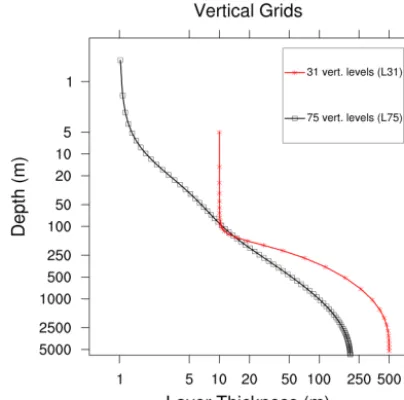
– low-resolution vertical grids with the thickness of first levels between 6 and 10 m. The grid with 31 cells (Fig. 1), used in the standard ORCA2 configuration of NEMO and specifically designed for climate applica-tions (Dufresne et al., 2013), is a good example. This is the first grid selected for this study and will be referred to as L31.
Figure 1. Thickness of vertical levels as a function of depth for two vertical grids: L31 (red) and L75 (black). Each plotting point (squares and stars) corresponds to the depth of levels.
The more interesting aspect, with respect to the test case re-sults presented in the next sections, concerns the resolution of the first 10 m in which the MLD takes place. We note that L75 has more levels than L31 in the first 50 m: 18 to 5. The layer thicknesses are of the order of 1 m in L75 but 10 m for L31.
Several time steps are used in 3-D simulations and these are fixed according to the spatial resolutions and their asso-ciated CFL conditions.
NEMO1D has no restriction on the time step, as there is no vertical advection and hence no CFL condition. However, we have tested the sensitivity of each turbulence model to the following time steps: 360, 1200 and 3600 s. These time steps correspond to those used in the global configurations at Mer-cator Océan and more generally in the research community. So we can easily regroup some pairs [vertical grid, time step] to retrieve some known configurations:
– [L75, 360 s]: Global configurations at 1/12◦(Deshayes et al., 2013; Treguier et al., 2014) used in Mercator Océan forecast system (Drévillon et al., 2008; Dom-browsky et al., 2009)
– [L75, 1200 s]: Global configurations at 1/4◦ used in global Mercator Océan reanalysis (Ferry et al., 2011) and DRAKKAR project (Barnier et al., 2006)
– [L31, 3600 s]: Global configurations at 1◦used for cli-matic studies (Hewitt et al., 2011)
– [L75, 3600 s]: Global configurations at 1◦ used for decadal forecast in the GIEC framework (Voldoire et al., 2013)
Special attention will be paid to these four pairs when we interpret the numerical results.
2.3.3 Numerical implementation
For the TKE model,kis computed first by resolving Eq. (5). The mixing lengthlis computed using Eq. (9) with bounding procedure. The turbulent coefficients are then deduced from Eq. (4a) and (4b) once the stability functions are computed.
For the GLS models, firstly,9 and the dissipation rateε
are reconstructed from the previous state ofk andl. Then the time evolution ofk(Eq. 5) and9 (Eq. 11) but also the stability functions (Eq. 16a and 16b) are computed.εandl
are deduced from the new state of9(Eqs. 10 and 8). Finally, the turbulent coefficients are updated with Eq. (4a) and (4b). To ensure a minimum level of mixing, background values are applied to the following turbulence quanti-ties:υt0=1.2×10⁻⁴m2s−1,Kt0=1.2×10⁻⁵m2s−1,k0= 10−6m2s−2,ε0=10−12m2s−3.
All the terms of the differential equations are solved ex-plicitly except the diffusive terms appearing in Eqs. (5), (11) and (29a)–(29c), which are solved implicitly.
3 Experimental design
It is obvious that the TKE and GLS closures are very differ-ent from a purely physical aspect but also in the way they are implemented. If we were to perform a relevant compari-son of these turbulence models, we should, for example, use the same boundary conditions or the same stability functions. The problem then should simply involve comparing a param-eterization of the mixing length to that obtained with a dif-ferential equation.
But the aim of this paper is to provide feedback to NEMO users on the one- and two-equation turbulent closures avail-able in the model.
3.1 Idealized test case: the Kato–Phillips experiment 3.1.1 Description
The Kato–Phillips (1969) experiment is classically used in the literature to test and calibrate turbulence models (e.g. Burchard, 2001a; Galperin et al., 1988). This laboratory ex-periment deals with the measurement of the mixed layer deepening of an initial, linear, stratified fluid, characterized by the Brunt–Väisälä frequency N2=10−4s−2 and sub-jected to a constant surface friction represented by u∗= 0.01 m s−1.
The model MLDs are then computed with criteria linked to the depth of the maximum ofN2inside the water column and compared with those given by the empirical relation:
MLD(t )= 1.05u∗ √
t
√
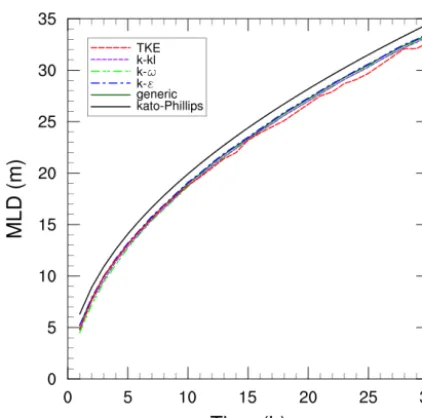
Figure 2. Time evolution of the MLD obtained as a function of the different turbulent closures with the 1000 levels vertical grid and a time step of 36 s.
The MLDs calculated with Eq. (30) are reliable on timescales of the order of 30 h, which determines the sim-ulation duration.
To estimate the performance of each turbulence model, de-pending on the choice of the vertical grid and the time step, the metrics selected are the correlation coefficient, the stan-dard deviation and the root mean square error (RMSE) of the simulated MLD compared to the analytic one given by Eq. (30).
The writing frequency for outputs is set by the highest time step considered in this study, i.e. 3600 s.
The surface boundary conditions are those described in Eqs. (18)–(20). Obviously we did not consider the wave breaking effect on the mixing. Nevertheless, the background value for the surface roughness was retained.
3.1.2 Reference simulation
As NEMO1D has a low computational cost, a new verti-cal grid was adopted and a water column of 100 m consid-ered. This new vertical grid has 1000 levels (hereafter called L1000) at 10 cm intervals. Coupled with a time step of 36 s, this numerical framework is ideal for checking the ability of all the turbulence models considered in this study to repro-duce satisfactorily the empirical time-dependent relation (Eq. 30). Figure 2 shows that all the models gave very similar re-sults close to the empirical solution. However, the numerical MLDs were slightly underestimated by approximately 1 m: the RMSEs were between 0.9 m fork-εand 1.4 m for TKE.
3.1.3 Results
In realistic 3-D global or regional configurations, the numeri-cal framework is less favourable for obvious computing time or storage reasons. The vertical grids are then coarser (typi-cally L31 or L75) with greater time steps. Nevertheless, these time steps are limited by the CFL condition, mainly on the vertical, and thus set by the choice of the grid. This numer-ical restriction does not occur in NEMO1D due to the no-advection assumption. Consequently, we have taken into ac-count the 60 possibilities (5 turbulence models×3 vertical grids×4 time steps). As stated previously, we focused on the four pairs described at the end of Sect. 2. As expected, and as shown in Fig. 3, the deepening of the MLDs cannot be continuous in time but occurs in steps, determined by the vertical resolution. The number of levels near the surface is crucial to this process.
For the pair [L75, 360s] (Fig. 3a), all the models yielded suitable results with associated RMSEs of the order of 3 m. For the pair [L75, 1200s] (Fig. 3b), all the models were close with RMSEs around 4 m, except fork-ω, which exhibited a high RMSE value of 10 m. Concerning the pair [L75, 3600 s] (Fig. 3c), k-ε and TKE exhibited the best results with an RMSE slightly greater than 7 m. The three other models did not provide satisfying results in this numerical context. The RMSEs were higher: 10, 13 and 15 m respectively for the generic,k-klandk-ω.
The numerical context of the pair [L31, 3600 s] (Fig. 3d) is obviously the most difficult. The L31 vertical grid is not well adapted for this test case due to its coarse surface layer resolution with a 10 m separation of the first levels. The thresholds linked to the vertical grid are such that the RMSE should not be compared to those obtained with the L75 grid. It should be noted that (i) all closures represent the deepening of the maximum ofN2(ii) all GLS closures show a quicker deepening of the MLD compared to the TKE solution. The MLD reaches 20 m during the first 10 h and there is no sig-nal with TKE closure. This is due to the implementation of the surface boundary condition on two points in the GLS clo-sures.
To represent synthetically the 60 possibilities of our test cases, the performed statistics (RMSE and correlation) were condensed in a Taylor diagram (Fig. 4). Note that the red and blue cloud points, corresponding to the tests done re-spectively with L1000 and L75 grids, are, for most of them, statistically close to the reference solution with a standard de-viation lower than 25 % and a correlation greater than 95 %. However,k-ωandk-klappear to be very sensitive to the cho-sen time step (numbers 3 and 4 in red and blue on the dia-gram) and have a normalized RMSE weaker than 0.75, even though the correlation is still good (greater than 0.95).
sim-Figure 3. Time evolution of the MLD obtained with the different turbulence models for the pairs [L75, 360 s] (a), [L75, 1200 s] (b), [L75, 3600 s] (c), [L31, 3600 s] (d).
Figure 4. Taylor diagram of the 60 Kato–Phillips experiments.
ilar. This kind of scatter is only influenced by the fact that the solution could be above or below the step of the coarse vertical discretization near the surface (Fig. 3d).
3.2 PAPA station 3.2.1 Description
The PAPA station, located west of Canada in the Pacific Ocean (50◦N, 145◦W), has been intensively studied in the literature (Gaspar et al., 1990; Burchard, 2001a; Mellor and Durbin, 1975). The resulting measurements are particularly well adapted for a study following a 1-D approach, and for validating and calibrating any turbulence model. Indeed, there is no interaction with the coast and the horizontal ad-vections of heat and salt are weak. High-quality measure-ments of ocean properties (temperature, salinity, velocities) and atmospheric conditions (wind, humidity, air temperature, heat fluxes and precipitation rate) are available for this site.
salinity field exhibits a stationary halocline at a depth of around 120 m while the surface variability is strongly cor-related to the temperature field. Indeed, during strong strati-fication events, the MLD of only several tens of metres is iso-lated from the rest of the water column and when subjected to the precipitation rate, the salinity decreases. Next, during water column homogenization events, the salinity increases due to mixing with the deeper saltier waters. Note that the halocline depth can vary significantly during these several years of measurements (between 100 and 150 m in depth). This interannual variability is mostly attributed to variations in horizontal salt advection.
In this section, we compare all the turbulence model re-sults with the data collected at the PAPA station between 15 June 2010 and 15 June 2011. For this period, there is no significant gap in the time series and the halocline depth re-mains stationary (120 m depth), i.e. advection is less influen-tial.
3.2.2 Numerical configuration Input files
A NEMO1D simulation is easily set up. The bathymetry con-sidered is the value of the global bathymetry file at 1/4◦ of resolution (Barnier et al., 2006) at the geographic point (50◦N, 145◦W) and the depth is 4198 m. The climatolog-ical chlorophyll values, required to calculate the light pen-etration, were also deduced from the global 1/4◦ input file built from the monthly SeaWIFS climatological data (Mc-Clain et al., 2004). At the PAPA station location, these values remain weak and range between 0.27 and 0.43 mg Chl m−3. The penetration light scheme used was based on the light de-composition following the red, green and blue wavelengths (Jerlov, 1968).
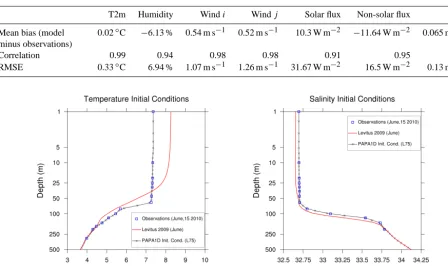
The 3 h atmospheric forcing came from the European Cen-tre for Medium-Range Weather Forecasts (ECMWF) anal-ysis and forecasting operational system. Although atmo-spheric measurements are taken at the PAPA station, they are only available once a day. However, these data are useful for checking that the ECMWF atmospheric fields are relevant enough to be used with confidence. Statistical comparisons (mean of the model minus observations, correlation coeffi-cients and RMSEs) are shown in Table 2. Mean errors for wind velocities and air temperature are very small (respec-tively 1 m s−1and 0.02◦C) and the correlations are greater
than 0.98. The atmospheric model assimilates these data. The radiative fluxes are well correlated contrary to the precipita-tion rate with a correlaprecipita-tion coefficient of only 0.76. There is no marked seasonal cycle concerning the precipitation rate in observed data and ECMWF outputs (not shown in this pa-per). We conclude that the ocean summer stratification is pri-marily due to atmospheric heat fluxes. The relative humidity correlates well but shows a constant bias (RMSE value very close to the mean bias value) of almost 6 %. Globally, these
Figure 5. Temperature (top) and salinity (bottom) measured at the PAPA station covering the period 2009–2013.
statistics show that the atmospheric fields from the ECMWF system can be used for this study.
Regarding initial conditions, it would be ideal to initialize the model with temperature and salinity measurements taken at the PAPA station on 15 June 2010. However, the data cover only the first 200 m for salinity and the first 300 m for tem-perature. Moreover, the salinity and temperature data are not collected on the same vertical grid: 24 levels for the temper-ature as opposed to 18 levels for the salinity. Thus, below a depth of 200 or 300 m, data from the WOD09 climatology (Levitus et al., 2013) were considered. Fortunately, there is a close match between the measurements and the climatology data below a depth of 150 m (Fig. 6).
Model settings
For simulations under realistic conditions, the turbulence models should take into consideration mixing caused by breaking waves. Thus, the surface boundary conditions are those described in Sect. 2.2.4 (Eqs. 24–26 for the GLS mod-els and Eq. 22 for the TKE model). Moreover, the TKE model takes into account the injection of surface energy in-side the water column as described in Eq. (23). This param-eterization depends on the parameters αbc and Hp. In or-der to estimate their impact on the MLD dynamics, three cases are considered, corresponding to the three cases avail-able in NEMO for this latitude: αbc=0 (no_penetration), Hp=10 m andHp=30 m. Thus, three distinct TKE mod-els are defined: TKE_0m, TKE_10m and TKE_30m.
Table 2. Comparisons of ECMWF atmospheric values and measurements at the PAPA station.
T2m Humidity Windi Windj Solar flux Non-solar flux Rain
Mean bias (model minus observations)
0.02◦C −6.13 % 0.54 m s−1 0.52 m s−1 10.3 W m−2 −11.64 W m−2 0.065 m d−1
Correlation 0.99 0.94 0.98 0.98 0.91 0.95 0.76
RMSE 0.33◦C 6.94 % 1.07 m s−1 1.26 m s−1 31.67 W m−2 16.5 W m−2 0.13 m d−1
Figure 6. Initial conditions (black line and star) of temperature (left) and salinity (right) from measurements at the PAPA station (blue square) on 15 June 2010 and Levitus 2009 climatology data (red).
1.22 kg m−3. For this study, the ocean surface velocities are not taken into consideration in the stress computation.
For these experiments, the two vertical grids (L31 and L75) and the three different time steps (360, 1200, 3600 s) described in Sect. 2 have been taken into account. All pos-sible pairs with all closures (four issued from GLS formula-tion and three different TKEs) have been performed. This in-volved 42 simulations. The next section gives the results ob-tained with the pair with the highest resolution [L75, 360 s]. This pair is the selected setting for the standard configura-tion PAPA1D. The last secconfigura-tion discusses the spatio-temporal sensitivity.
3.2.3 Results with the pair [L75, 360 s]
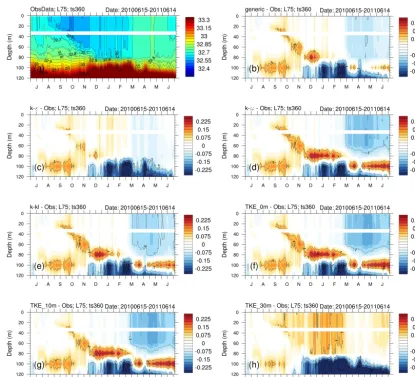
Figures 7 and 8 represent the observed temperature and the observed salinity respectively at the PAPA station and the bi-ases (model minus observation) obtained with different clo-sures.
During the year of simulation, the summer stratification is well represented with an increase of temperature of 6◦C at a depth of 10 m between the initialization (15 June) and the maximum at the beginning of September. The halocline is close to 100 m depth except between November and Febru-ary, when it is located at 80 m depth. This depth variation is probably due to advective effects, which the model can-not reproduce. Above the MLD formed by the stratification,
an increase of freshwater from August to November can be observed with a minimum of 32.4 PSU in October.
In all simulations, this annual cycle is found and the general behaviour is the same, except for the simulation TKE_30m in which the differences between simulated tem-perature and measurements exhibit, during summer, a ver-tical dipole, with a colder temperature than that observed, reaching−2◦C, in the first 40 m and warmer (+2◦C) below 40 m. This dipole is indicative of excessive mixing and the lack of stratification as shown on density profiles in Fig. 9. The vertical temperature gradient for the TKE_30m exper-iment (pink line) is smoother than the observed one (dark line). Consequently, a large amount of heat is introduced into the ocean and leads to a warming of 2◦C in the 40–120 m layer, especially during autumn and winter. As the thermo-cline is not present, the seasonal variability of the salinity cannot be investigated (Fig. 8). During winter (November to March), the excessive turbulent mixing partially destroys the halocline and the biases show the formation of a vertical dipole with water that is too salty (+0.15 PSU) in the up-per 80 m and too fresh below, with respect to the observation data. Consequently, we can conclude that the mixing is too strong in the first 100 m in this experiment.
Figure 7. Observed temperature at PAPA station (a) over the study period (15 June 2010 to 14 June 2011) and the biases (model minus observed data) obtained in the simulations with all closures, with [L75; 360 s]: generic (b),k-ε(c),k-ω(d),k-kl(e), TKE_0m (f), TKE_10m (g) and TKE_30m (h). Iso-lines are plotted every 0.5◦C (except for the iso-0, which has not been plotted).
TKE_30m experiment. On the contrary, the models tend to stratify too much during the summer as shown in Fig. 7, in which the temperatures of all these closures are too warm in the first 20 m (+1◦C for generic, k-ω, k-kl, TKE_0m and +0.5◦C fork-ε, TKE_10m) and too cold in the layer 20– 80 m (−2◦C for generic,k-ω,k-kl, TKE_0m and−1◦C for k-ε, TKE_10m) with respect to the observation data.
As the precipitation rate has little influence on MLD dy-namics (see Sect. 3.2.1), the salinity biases (Fig. 8) are di-rectly linked to the MLD thickness by mixing and by evapo-ration. For the period from June to September, all the models exhibit the same weak salinity biases, as the MLD deepen-ing is similar in each case. In October, for generic,k-ω,k-kl, TKE_0m and TKE_10m closure, significant biases appear at a depth of 40 m (+0.1 PSU) and are trapped between 80 m and 100 m (>0.2 PSU) from December to the end of the simulation. Consequently, these trapped saltier waters mod-ify the halocline structure and are not mixed with the surface
water. This induces a freshwater bias (−0.1 PSU) in the first 80 m during March to June. Such biases are not found in the results obtained withk-ε. The key process seems to occur in October when the atmospheric heat fluxes decrease and lead to the destruction of the stratification, thus generating a sig-nificant mixing. The density profiles of 12 October, plotted in Fig. 9, show that onlyk-εis able to correctly reproduce the MLD deepening. The underlying saltier waters are then cor-rectly injected into the MLD. Due to that,k-εis the only clo-sure that conserves the halocline intact and there is no fresh bias at the end of the simulation.
Figure 8. Observed salinity at PAPA station (a) over the study period (15 June 2010 to 14 June 2011) and the biases (model minus observed data) obtained in the simulations with all closures, with [L75; 360 s]: generic (b),k-ε(c),k-ω(d),k-kl(e), TKE_0m (f), TKE_10m (g) and TKE_30m (h). Iso-lines are plotted every 0.1 PSU (except the iso-0, which has not been plotted).
Figure 10. Evolution of the temperature RMSE computed along the vertical (0–120 m) for the pairs [L75, 360 s] (a), [L31, 360 s] (b), [L75, 1200 s] (c), [L31, 1200 s] (d), [L75, 3600 s] (e), [L31, 3600 s] (f) and different closures.
of 10 m provides more satisfying results but the setting ofHp can be more complex in the case of global ocean simulations. 3.2.4 Spatiotemporal sensitivity
As in Sect. 3.1.3, this section covers the sensitivity of the different closures to the vertical discretization (grid L75 and L31) and to the time step (360, 1200 and 3600 s). Figure 10 shows the evolution of the temperature RMSE for the differ-ent closures, computed for the first 120 m of the water col-umn (depth corresponding to the halocline depth, Fig. 5).
In all cases, two periods can be distinguished: (i) from June to November 2010 corresponding to the stratified pe-riod, for which high variations of the RMSE have been ob-served (between 0.03 to 0.35◦C), (ii) from December 2010 to June 2011, corresponding to the period when no
stratifi-cation takes place, for which the RMSE of all simulations is constant over the period (close to 0.12◦C for TKE_30m and 0.05◦C for other closures).
In both periods, the three TKE closures (red, orange and pink lines) do not show any significant sensitivity to the verti-cal discretization or the time step. This result is in agreement with the Kato–Phillips results presented in Sect. 3.1.
For the GLS closures, the two periods should be studied separately:
– During the first period (June to November 2010), thek
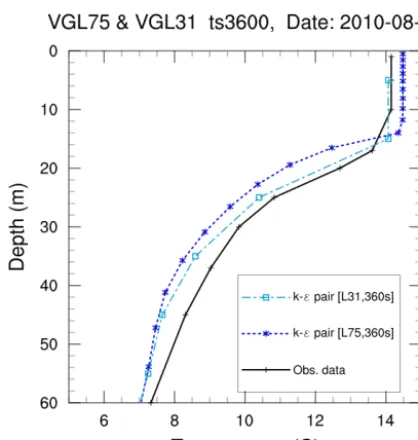
in-Figure 11. Daily vertical profiles of temperature for 20 Au-gust 2010: observed (black), simulated withk-εclosure, a time step of 3600 s, L31 (light blue) and L75 (dark blue). The levels of obser-vations and configurations are marked with squares (L31) or stars (L75).
creases to 0.35◦C with a time step of 3600 s (green line
in Fig. 10). The time-step variations have a weaker im-pact with L31 than with L75. The RMSE withk-ωstays close to 0.3◦C in all L31 experiments. This result means that the time-step sensitivity is directly proportional to the vertical resolution. For a particular grid, the generic andk-εclosures do not show a high sensitivity to the time step (dark and light blue in Fig. 10). Thek-ε clo-sure gives the best results between these two cloclo-sures, exhibiting an RMSE ranging between 0.03 and 0.2◦C. The generic RMSE varies from 0.05 to 0.25◦C. – During the second period (December 2010 to
June 2011), all the RMSEs are similar and weak (0.05◦C). The temporal variations over this period are small. Moreover, the closures have a small sensitivity to the vertical discretization and to the time step. The RMSEs for k-ε closure are better from August to September with L31 compared to those obtained with L75. For example, for 20 August and 360 s, the RMSE of the sim-ulation with L75 is 0.15◦C and decreases to 0.08◦C with
L31 (blue line in Fig. 10).
To focus on this point, vertical temperature profiles for both vertical grids were plotted for this date (Fig. 11). L75 tends to over-stratify and this result is in agreement with the previous section (Fig. 7). The profile obtained with L31 agrees better with the observations (dark blue line). This is due to the numerical dilution effect of the coarse grid in the surface layer. Indeed, this grid has only three levels in the first
30 m and is not able to create a strong stratification. In this case, a low vertical resolution becomes an advantage simply for numerical reasons.
4 Conclusions and perspectives
This paper has described the 1-D model version available in NEMO (NEMO1D). This model is very useful for isolating and studying vertical processes, and for improving their rep-resentation before switching to a 3-D model.
The present study focused on the behaviour of two types of turbulence closures available in NEMO, i.e. TKE and GLS. There are many differences between these two approaches, with respect to both the mixing length estimate and the con-stants used or boundary conditions. For this reason, we did not concentrate on comparing the closures but rather on their different strengths and weakness. Two test cases were se-lected, an “idealized” one, based on the experiment described in Kato–Phillips, and a “realistic” one, reproducing one year of salinity and temperature measured at the PAPA buoy.
The first test case was based on observations performed in a laboratory experiment. This experiment deals with the monitoring of the MLD deepening of an initially linear strat-ified fluid only subjected to a stationary surface stress. Be-cause of its simplicity, this test case offers a perfect context for validating the numerical assumptions and implementa-tions. Simulations were performed under favourable numer-ical conditions (grid with a resolution of 0.1 m and a time step of 36 s). All the turbulence closures correctly reproduced the experimental results described even if the TKE closure slightly underestimates the MLD. This validates their imple-mentation in NEMO. However, we found some dependence on numerical conditions (ratio time step/vertical discretiza-tion) for the GLS closures. This dependence is strong fork
-ωandk-kland a little smaller for generic,k-εand the TKE closure.
The data collected at the PAPA station are typically used to perform studies with 1-D models. This mooring was nat-urally chosen to create a new reference configuration for NEMO. This new configuration was described, and then used to complement our study of TKE and GLS closures. The re-sults show that these closures are largely able to reproduce the stratification/homogenization cycle observed at the sta-tion.
in a realistic 3-D simulation. GLS closures gave good re-sults despite excessive summer stratification. Similar rere-sults to those of the Kato–Phillips experiment have been found for sensitivity to the numerical conditions (time step and vertical discretization): TKE closure does not show any sensitivity, generic and k-εare slightly sensitive and k-ω andk-kl are very sensitive.
A key process has also been highlighted, namely the rep-resentation of salinity, occurring during the homogenization event in mid-October. All the models, exceptk-ε, underesti-mated the mixing and led to significant salinity biases in the vicinity of the halocline. These biases persisted throughout the entire simulation. Nevertheless, we found no signature for the temperature field. Thek-εclosure correctly simulates the homogenization phase. This is the only closure that con-serves the halocline and exhibits the weaker salinity biases. By consequence,k-εis set as the standard turbulent model for PAPA1D even if TKE_10m gives very satisfactory results especially during the stratification phase. Currently, the TKE model is the standard model used by the NEMO community for 3-D model experiments. In light of the results presented in this paper, the standard value of 30 m for Hp seems too
high at the PAPA station location. We think this parameter should be tuned with care or regionalized in the case of global simulations. 3-D sensitivity experiments should also be car-ried out with thek-ε, and interactions with the other vertical physical components should also be studied (solar penetra-tion, bulk formulae, etc.).
The results obtained with NEMO1D were successfully compared with laboratory observations or in-situ measure-ments through a turbulent closure sensitivity study. The 1-D approach, applied at the PAPA station (new NEMO ref-erence configuration PAPA1D) or at another location, could be useful for further investigation of the turbulent mixing or some other physical component affecting vertical processes. Indeed, the MLD is subject to complex interactions between the turbulence, the surface forcing (including atmospheric fluxes and waves) and the boundary treatments.
Some of the following questions could be investigated us-ing this numerical tool.
What is the behaviour of the other turbulence models of NEMO (KPP) (Large et al., 1994) and Paconowski and Phi-lander (1981)? What is a more optimal value of some pa-rameters (Hp, surface roughness, background values, etc.)? What is the sensitivity of the stability function? What would be the impact of another atmospheric data set (observed data or coming from another meteorological centre) or the forcing frequency (1 day, 3 hours, 1 hour, etc.)? What would be the impact of another forcing function (bulk formulae, flux form or atmospheric boundary layer model)? What would be the wave impact characterized for example through the Stokes drift or the Langmuir cells? What would be the impact of the solar flux penetration scheme that could incorporate two aspects: the chlorophyll fields used (temporal variability, ob-served at the surface or 3-D simulated field) or the
penetra-tion radiapenetra-tion schemes (red–green–blue scheme such as the one used in this paper or a two-band scheme depending only on an attenuation depth)?
Finally, this 1-D model could also be useful for studies on coupling with atmospheric, ice or biogeochemical models.
Acknowledgements. This research was supported by the My-Ocean2 European project and Mercator Océan. The authors wish to thank collaborators who have contributed to development of the NEMO ocean code as part of the NEMO consortium. We thank Yann Drillet, Jean-Michel Lellouche and Marie Drévillon for their useful comments and both reviewers for their very constructive suggestions and questions.
Edited by: R. Marsh
References
Arakawa, A. and Lamb, V. R.: Computational design of the basic dynamical processes of the UCLA general circulation model, Meth. Comp. Phys, New York: Academic Press, 17, 173–265, 1977.
Barnier, B., Madec, G., Penduff, T., Molines, J.-M., Treguier, A.-M., le Sommer, J., Beckmann, A., Biastoch, A., Böning, C., Dengg, J., Derval, C., Durand, E., Gulev, S., Remy, E., Talandier, C., Theetten, S., Maltrud, M., Mc Clean, J., and de Cuevas, B.: Impact of partial steps and momentum advection schemes in a global circulation model at eddy permitting resolution, Ocean Dynam., 56, 543–567, doi:10.1007/s10236-006-0082-1, 2006. Bernie, D. J., Guilyardi, E., Madec, G., Slingo, J. M., and
Wool-nough, S. J.: Impact of resolving the diurnal cycle in an ocean-atmosphere GCM. Part 1: a diurnally forced OGCM, Clim. Dy-nam., 29, 575–590, doi:10.1007/s00382-007-0249-6, 2007. Blanke, B. and Delecluse, P.: Variability of the Tropical Atlantic
Ocean Simulated by a General Circulation Model with Two Dif-ferent Mixed-Layer Physics, J. Phys. Ocean., 23, 1363–1388, 1993.
Burchard, H.: On the q2l equation by Mellor and Yamada (1982), J. Phys. Oceanogr., 31, 1377–1387, 2001a.
Burchard, H.: Simulating the Wave-Enhanced Layer under Break-ing Surface Waves with Two-Equation Turbulence Models, J. Phys. Oceanog., 31, 3133–3145, 2001b.
Burchard, H. and Bolding K.: Comparative Analysis of Four Second-Moment Turbulence Closure Models for the Oceanic Mixed Layer, J. Phys. Oceanogr., 31, 1943–1967, 2001. Burchard, H. and Umlauf, L.: A Generic Length-Scale Equation for
Geophysical Turbulence Models, J. Marine Res., 61, 235–265, 2003.
Burchard, H., Craig, P. D., Gemmrich, J. R., van Haren, H., Math-ieu, P. P., Meier, H. E., Smith W., Prandke, H., Rippeth, T. P., Skyllingstad, E. D., Smyth, W. D., Welsh, D., and Wijesekera, H. W.: Observational and numeric al modeling methods for quanti-fying coastal ocean turbulence and mixing, Prog. Oceanogr., 76, 399–442, 2008.
and heat vertical diffusivities, J. Phys. Oceanogr., 31, 1413–1426, 2001.
Chanut, J., Barnier, J., Large, W., Debreu, L., Penduff, T., Molines, J. M., and Mathiot, P.: Mesoscale eddies in the Labrador Sea and their contribution to convection and re-stratification, J. Phys. Oceanogr., 38, 1617–1643, 2008.
Charnock, H.: Wind stress on a water surface, Q. J. Roy. Meteor. Soc., 1, 639–640, 1955.
Courant, R., Friedrichs, K., and Lewy, H.: On the partial difference equations of mathematical physics, IBM J. Res. Dev., 11, 215– 234, 1928.
Craig, P. D. and Banner, M. L.: Modeling wave-enhanced turbu-lence in the ocean surface layer, J. Phys. Oceanogr., 24, 2546– 2559, 1994.
Deshayes, J., Treguier, A., Barnier, B., Lecointre, A., Sommer, J. L., Molines, J.-M., Penduff, T., Bourdalle-Badie, R., Drillet, Y., Garric, G., Benshila, R., Madec, G., Biastoch, A., Boning, C., Scheinert, M., Coward, A. C., and Hirschi, J.: Oceanic hindcast simulations at high resolution suggest that the Atlantic MOC is bistable, Geophys. Res. Lett., 40, 3069–3073, 2013.
Dombrowsky, E., Bertino, L., Bassington, G. B., Chassignet, E. P., Davidson, F., Hurlburt, H. E., Kamachi, M., Lee, T., Martin, M. J., Mei, S., and Tonani, M.: GODAE Systems in Operation, Oceanography, 22, 80–95, 2009.
DRAKKAR Group: Eddy-permitting ocean circulation hindcasts of past decades, CLIVAR Exchanges, 12, 8–10, 2007.
Drévillon, M., Bourdallé-Badie, R., Derval, C., Drillet, Y., Lel-louche, J.-M., Rémy, E., Tranchant, B., Benkiran, M., Greiner, E., Guinehut, S., Verbrugge, N., Garric, G., Testut, C.-E., La-borie, M., Nouel, L., Bahurel, P., Bricaud, C., Crosnier, L., Dombrowsky, E., Durand, E., Ferry, N., Hernandez, F., Le Gal-loudec, O., Messal, F., and Parent, L.: The GODAE/Mercator-Ocean global ocean forecasting system: results, applications and prospects, J. Oper. Oceanog., 1, 51–57, 2008.
Dufresne, J. L., Foujols, M. A., Denvil, S., Caubel, A., Marti, O., Aumont, O., Balkanski, Y., Bekki, S., Bellenger, H., Benshila, R., Bony, S., Bopp, L., Braconnot, P., Brockmann, P., Cadule, P., Cheruy, F., Codron, F., Cozic, A., Cugnet, D., de Noblet, N., Duvel, J. P., Ethé, C., Fairhead, L., Fichefet, T., Flavoni, S., Friedlingstein, P., Grandpeix, J. Y., Guez, L., Guilyardi, E., Hauglustaine, D., Hourdin, F., Idelkadi, A., Ghattas, J., Jous-saume, S., Kageyama, M., Krinner, G., Labetoulle, S., Lahel-lec, A., Lefebvre, M. P., Lefevre, F., Levy, C., Li, Z. X., Lloyd, J., Lott, F., Madec, G., Mancip, M., Marchand, M., Masson, S., Meurdesoif, Y., Mignot, J., Musat, I., Parouty, S., Polcher, J., Rio, C., Schulz, M., Swingedouw, D., Szopa, S., Talandier, C., Terray, P., Viovy, N., and Vuichard, N.: Climate change projections us-ing the IPSL-CM5 Earth System Model: from CMIP3 to CMIP5, Clim. Dynam., 40, 2123–2165, 2013.
Ferry, N., Parent, L., Garric, G., Barnier, B., Jourdain, N. C., and the Mercator Ocean team: Mercator Global Eddy Permitting Ocean Reanalysis GLORYS1V1: Description and Results, Mer-cator Ocean Quarterly Newsletter, 36, 15–28, 2010.
Ferry, N., Parent, L., Masina, S., Storto, A., Haines, K., Val-divieso, M., Barnier, B., and Molines, J.-M.: QUality Infor-mation Document MyOcean V2 System For Global Ocean Reanalysis Product GLOBAL-REANALYSIS-PHYS-001-004-a and b, MyOcean document ref: MYO-WP04-QUID-V2-GLO-REA-PHYS-001-004, 2011.
Flierl, G. and Davis C.: Biological effects of Gulf Stream meander-ing, J. Marine Res., 51, 529–560, 1993.
Galperin B., Kantha, H., Hassid, S., and Rosati, A.: A Quasi-Equilibrium Turbulent Energy Model for geophysical flows, J. Atmos. Sci., 45, 55–62, 1988.
Gaspar, P., Grégoris, Y., and Lefevre, J. M.: A Simple Kinetic En-ergy Model for Simulations of the Oceanic Vertical Mixing: Tests at Station Papa and Long-Term Upper Ocean Study Site, J. Geo-phys. Res., 95, 16179–16193, 1990.
Hewitt, H. T., Copsey, D., Culverwell, I. D., Harris, C. M., Hill, R. S. R., Keen, A. B., McLaren, A. J., and Hunke, E. C.: Design and implementation of the infrastructure of HadGEM3: the next-generation Met Office climate modelling system, Geosci. Model Dev., 4, 223–253, doi:10.5194/gmd-4-223-2011, 2011.
Hossain, M. S.: Mathematische Modellierung von turbulenten Auftriebsstromungen, Ph.D. Dissertation, University of Karl-sruhe, Germany, 145 pp., 1980.
Jerlov, N. G.: Optical Oceanography, Elsevier, 194 pp., 1968. Kantha, L. H. and Clayson, C. A.: An improved mixed layer
model for geophysical applications, J. Geophys. Res., 99, 25235– 25266, 1994.
Kato, H. and Phillips, O. M.: On the penetration of a turbulent layer into stratified fluid, J. Fluid Mech., 37, 643–655, 1969.
Large, W. G. and Yeager, S. G.: Diurnal to Decadal Global Forcing for ocean and Sea-Ice Models: The data sets and flux climatolo-gies, NCAR Technical Note, 1994.
Large, W. G., McWilliams, J. C., and Doney, S. C.: Oceanic vertical mixing: a review and a model with a non-local boundary layer parameterization, Rev. Geophys., 32, 363–403, 1994.
Levitus, S., Antonov, J. I., Baranova, O. K., Boyer, T. P., Coleman, C. L., Garcia, H. E., Grodsky, A. I., Johnson, D. R., Locarnini, R. A., Mishonov, A. V., Reagan, J. R., Sazama, C. L., Seidov, D., Smolyar, I., Yarosh, E. S., and Zweng, M. M.: The World Ocean Database, Data Science Journal, 12, 229–234, Special Issue of the Proceedings of the 1st WDS Conference 20 in Kyoto, 3–6 September 2011, Kyoto University, Kyoto, Japan, 2013. Madec, G.: NEMO Reference Manual, Ocean Dynamics
Compo-nent: NEMO-OPA, Note du Pôle de Modélisation, 27, Institut Pierre-Simon Laplace (IPSL), France, 2008.
McClain, C. R., Feldman, G. C., and Hooker, S. B.: An overview of the SeaWiFS project andstrategies for producing a climate research quality global ocean bio-optical time series, Deep-Sea Res. Pt. II, 51, 5–42, 2004.
Mellor, G. and Blumberg, A.: Wave breaking and ocean surface layer thermal response, J. Phys. Oceanogr., 34, 693–698, 2004. Mellor, G. and Durbin, P. A.: The structure and dynamics of the
ocean surface mixed layer, J. Phys. Oceanogr., 5, 718–728, 1975. Mellor, G. and Yamada, T.: Development of a Turbulence Closure Model for Geophysical Fluid Problems, Geophys. Space Phys., 20, 851–855, 1982.
Munk, W. H. and Anderson, E. R.: Notes on the theory of the ther-mocline, J. Marine Res., 3, 276–295, 1948.
Pacanowski, R. C. and Philander, S. G. H.: Parametrization of Ver-tical Mixing in Numerical Models of Tropical Oceans, J. Phys. Oceanogr., 11, 1443–1451, 1981.
the open ocean based on traditional parameterizations, Ocean Model., 25, 154–171, doi:10.1016/j.ocemod.2008.07.006, 2008. Rodi, W.: Examples of calculation methods for flow and mixing in
stratified fluids, J. Geophys. Res., 92, 5305–5328, 1987. Stacey, M. W.: Simulations of the wind-forced near-surface
circula-tion in Knight Inlet: A parameterizacircula-tion of the roughness length, J. Phys. Oceanogr., 29, 1363–1367, 1999.
Townsend, A. A.: The Structure of Turbulent Shear flow, Cambridge University Press, 1976.
Treguier, A. M., Deshayes, J., Le Sommer, J., Lique, C., Madec, G., Penduff, T., Molines, J.-M., Barnier, B., Bourdalle-Badie, R., and Talandier, C.: Meridional transport of salt in the global ocean from an eddy-resolving model, Ocean Sci., 10, 243–255, doi:10.5194/os-10-243-2014, 2014.
Umlauf, L. and Burchard, H.: A generic length-scale equation for geophysical turbulence models, J. Marine Res., 61, 235–265, 2003.
Voldoire, A., Sanchez-Gomez, E., Salas y Mélia, D., Decharme, B., Cassou, C., Sénési, S., Valcke, S., Beau, I., Alias, A., Cheval-lier, M., Déqué, M., Deshayes, J., Douville, H., Fernandez, E., Madec, G., Maisonnave, E., Moine, M. P., Planton, S., Saint-Martin, D., Szopa, S., Tyteca, S., Alkama, R., Belamari, S., Braun, A., Coquart, L., and Chauvin, F.: The CNRM-CM5.1 global climate model: description and basic evaluation, Clim. Dynam., 40, 2091–2121, doi:10.1007/s00382-011-1259-y, 2013. Warner, J. C., Sherwood, C. R., Arango, H. G., and Signell, R. P.: Performance of four turbulence closure models implemented us-ing a generic length scale, Meth, Ocean Model., 8, 81–113, 2004. Wilcox, D. C.: Reassessment of the scale-determining equation for advanced turbulence models, AIAA Journal, 26, 1299–1310, 1988.
![Figure 3. Time evolution of the MLD obtained with the different turbulence models for the pairs [L75, 360 s] (a), [L75, 1200 s] (b), [L75,3600 s] (c), [L31, 3600 s] (d).](https://thumb-us.123doks.com/thumbv2/123dok_us/9066482.1899121/9.612.46.285.452.675/figure-time-evolution-obtained-different-turbulence-models-pairs.webp)

![Figure 7. Observed temperature at PAPA station(g)observed data) obtained in the simulations with all closures, with [L75; 360 s]: generic (a) over the study period (15 June 2010 to 14 June 2011) and the biases (model minus (b), k-ε (c), k-ω (d), k-kl (e),](https://thumb-us.123doks.com/thumbv2/123dok_us/9066482.1899121/12.612.90.504.66.437/figure-observed-temperature-station-observed-obtained-simulations-closures.webp)
![Figure 10. Evolution of the temperature RMSE computed along the vertical (0–120 m) for the pairs [L75, 360 s]1200 s] (a), [L31, 360 s] (b), [L75, (c), [L31, 1200 s] (d), [L75, 3600 s] (e), [L31, 3600 s] (f) and different closures.](https://thumb-us.123doks.com/thumbv2/123dok_us/9066482.1899121/14.612.98.496.64.480/figure-evolution-temperature-rmse-computed-vertical-different-closures.webp)